A Dissipative Integral Sliding Mode Control Redesign Method
for Uncertain Nonlinear Switched Systems
H. Moradi* and V. Johari Majd*(C.A.)
Abstract: This paper develops a new method of integral sliding mode control redesign for
a class of perturbed nonlinear dissipative switched systems by modifying the dissipativity-based control law that was designed for the unperturbed systems. The nominal model is considered affine with matched and unmatched perturbations. The redesigned control law includes an integral sliding-based control signal such that the system always operates on the sliding mode and the dissipativity of the perturbed switched system is maintained from the initial time of the system operation for the norm bounded perturbations. The proposed techniques eliminate the restrictive design conditions on the derivative of storage functions offered in a recent work. In addition, the global dissipativity of the perturbed system is always maintained if the original unperturbed system is globally dissipative. Depending on the type of stability of the unperturbed system, the designed control law for the perturbed system guarantees robust exponential or asymptotic stability of the closed-loop system. The theoretical results are applied to nonlinear switched systems, and the convergence of the state vectors to the origin is verified by simulation in presence of nonlinear perturbations.
Keywords: Control Redesign, Dissipativity, Integral Sliding Mode Control, Nonlinear
Switched Systems, Perturbation.
1 Introduction1
A dynamical switched system is a system that switches among several subsystems based on a switching law. Many real-word systems such as automotive engine control systems [1], robot control systems [2], and haptic interfaces [3] demonstrate switching behaviors. As such, the switched systems have drawn considerable attention in the control and system analysis [4-6]. Employing a proper switching strategy in the control of linear or nonlinear systems often leads to better robustness and transient performance [7, 8]. Different methods of the stability analysis and stabilization have been purposed for the switched systems [9-11]. The Lyapunov base stability theory still plays a dominating role in the stability analysis and control design, [12, 13]. The common Lyapunov function method may be employed for different subsystems which guarantees the stability under an arbitrary switching law [10, 14]. However, since the common Lyapunov function method may make the design very conservative, the multiple Lyapunov function is proposed in [15], and became a standard analysis tool for most switched system designs
Iranian Journal of Electrical & Electronic Engineering, 2015. Paper first received 23 May 2015 and in revised form 05 Oct. 2015. * The Authors are with the Department of Electrical and Computer Engineering, Tarbiat Modares University, Tehran, Iran.
Emails: [email protected] and [email protected].
[16]. This method was further developed into dwell-time method [17, 18] and average dwell-dwell-time method [10, 19-21] which are only applicable for the switching systems with designable switching law.
Dissipativity and passivity introduced by Willems [22], are powerful tools for the stabilization analysis. Storage functions are usually related with the system’s energy and can be candidates for the Lyapunov functions [23]. Additionally, dissipativity and passivity-base analysis can be helpful for proving the stability of the switched systems [24-26]. In [27], the classic passivity and the stability results were extended to cover the switched systems. The multiple storage functions and multiple supply rates for the switched systems were presented in [28, 29]. In [30], the feedback passivation conditions of the switched cascade nonlinear systems have been investigated. The average dwell-time base exponential stability of the switched nonlinear systems with passive and nonpassive subsystems is studied in [31].
Considering the fact that dissipativity and passivity are powerful tools for the analysis and the control design of the switched nonlinear systems, it would be interesting to be able to employ these tools for the perturbed switched systems, and to find how a dissipative switched nonlinear system can preserve its dissipativity property and consequently its stability in
presence of these perturbations. To the best of our knowledge, the dissipativity-based redesign method for deterministic switched nonlinear systems with uncertainties and perturbations are only considered in [32-34]; however, the presented method in [32] was developed only for matched perturbations, and the works in [33, 34] require vanishing unmatched perturbations and have restrictive inequality conditions. These restrictive conditions generally reduce the global dissipativity-based results of the original system into local results for the perturbed system. Other available robust methods for the switched nonlinear systems which are not based on passivity and dissipativity, require the switching law to be designable or restrict it [11, 35, 36].
On the other hand, sliding mode control is an effective robust control method for unmatched perturbations [37, 38] and its response, typically, includes two phases: reaching phase and sliding phase. In the reaching phase, system is sensitive to uncertainties and perturbations. To eliminate the reaching phase, an integral sliding mode is proposed in [39], and widely applied to various systems [40-42]. In [35, 43], integral sliding mode control is developed only for cascade uncertain switched systems with at least one linear part. Moreover, these designs are based on average dwell-time approach and restrict the switching law. Additionally, in [43], Lipschitz condition is needed for the nonlinear part.
In this paper, the storage function redesign method combined with an integral sliding mode control is offered for the first time by including a variable structure control law to guarantee the preservation of the dissipativity of the closed-loop nonlinear switched system in the presence of norm bounded perturbations. The dissipativity-base controller redesign offered in [34] for nonlinear switched systems with matched and unmatched vanishing perturbations forces restrictive conditions in the form of nonlinear inequalities. Usually these conditions results the local robust stability of perturbed switched system. Elimination of these restrictions while keeping the capability of the redesign approach in the presence of matched perturbations, motivated us to suggest a combined scheme consisting of this method and the integral sliding mode control for the nonlinear switched systems using multiple storage functions. The major advantage of this method is that it robustifies the available nominal controllers, thereby preserving the primary control objectives, while reducing the complexity of the robust controller design of the nonlinear switched systems. With this method, the switching law is not necessary to be designable, the restrictive conditions on the derivatives of the storage functions given in [32] are eliminated. The proposed method can only be applied to the perturbed switched systems whose control laws for their original unperturbed systems were designed based on dissipativity. Moreover, the original system must be
affine, which is a usual assumption in passivity based stability analysis literature. To verify the theoretical results, the perturbed switched systems are considered in two examples, and the stability conditions are derived. Then, the simulation results are provided to show the effectiveness of the proposed method.
The rest of the paper is organized as follows: In Section 2, the model of the switched system is introduced, and the notion of dissipativity for the affine nonlinear switched systems is offered. Then, the sufficient conditions for the dissipativity of the affine nonlinear switched systems are derived. In Section 3, an integral sliding surface is presented which preserves the dissipativity property of the closed-loop system on the sliding surface. Then, a variable structure control is introduced which always places the switched system on the sliding mode. In Section 4, the theoretical results are illustrated by an example. Finally, the conclusion of the paper is presented in section 5.
2 The Preliminaries and the Problem Statement
Consider the affine nonlinear perturbed switched system of the form:
( )
( )
( )
(
(
( )
) ( )
(
)
)
), (
, , ,
, ,
t x h y
t u x t x u t x g I x g
t x f x f x
i
i i i
i i
i i
=
Δ + Δ
+ +
Δ + =
(1)
where i
( )
t ∈M={
1,2,…,m}
is the switching signal that may depend on time, states or both, m is the number of subsystems, nR
x∈ , p
i R
u ∈ and p
R
y∈ are the state,
input and output vectors of the i-th subsystem, respectively, I is an identity matrix with proper dimension, and fi
( )
x , gi( )
x and hi( )
x,t are givencontinuous functions. The bounded terms:
( )
x,t ,( )
x,t,fi ≤ρfi
Δ i=1,2,…,m (2)
are unmatched perturbations, and:
( )
, ≤ ,( )
, <1,Δgi x t ρgi xt (3)
and:
(
x ui t)
ui( )
x ti , , ≤ρ , ,
Δ , (4)
are matched perturbations with known nonnegative functions ρf,i
( )
x,t , ρg,i( )
x,t and ρu,i( )
x,t .The switching sequence between the subsystems is defined as Σ=
{
(
i0,t0) ( )
, i1,t1 ,…,( )
ij,tj ,…}
, i∈M andN
j∈ where N is the set of nonnegative integer numbers of switches, t0 is the initial time, tj is the time
that system switches to ij-th subsystem and hold on it
until t∈
[
tj,tj+1)
, assuming ij ≠ij+1 and tj <tj+1. More specifically, index ijspecifies that the i-th subsystemhas become active at the j-th switching event.
The following assumption is used in the stability analyses that are based on multiple storage functions.
Assumption 1: The states of the switched system do
not jump in the switching instances, and thus, the trajectory x
( )
t is always continuous.In following definition, multiple storage functions and multiple supply rates are introduced to characterize the dissipativity property for the affine nonlinear switched systems (1).
Definition 1 [34]: The nominal form of system (1)
under the switching sequence Σ is said to be dissipative if for any subsystem i,(i=1,2,…,m), there exist positive definite continuous storage functions Si
( )
x ,locally integrable supply rate functions wi
(
ui,hi)
, andlocally integrable cross supply rate functions
(
x u h t)
wij , i, i, , (j =1,2, , ,…m i ≠ j) such that when the i-th subsystem is activated for the k-th time (∀s,t, tk≤s≤t<tk+1), the following conditions hold: i)
( )
(
)
(
( )
)
(
)
1
, , 2 , 1 , 0
, , ,
,
+
< ≤ ≤ =
≤
−
∫
k k
t
s i i i i
i
t t s t k
dt h u w s s x S t t x
Sk k k k k
… (5)
ii)
( )
(
)
(
( )
)
(
)
1
, , 2 , 1 , 0
), ( ), ( ), ( ,
,
+
< ≤ ≤ =
≤
−
∫
k k
t
s ij i i
j j
t t s t k
d h u x w s s x S t t x S
k k k
…
τ τ τ τ τ
(6)
iii) For all i≠ j (i =ik and ,i j =1, 2, , )… m and all 0
t
t≥ , there exist inputs ui
( )
t =α(
x( )
t,t)
and[
)
1
( ) 0,
ij t L
ϕ ∈ + ∞ , which may depend on the switching
sequence Σ such that:
( ) ( ) ( )
0 +g 0 0,t =0fi i α , (7)
( )
( )
( )
(
u t,h xt)
≤0wi i i , (8)
and;
iv) For all i≠ j there exist φij
( )
t ∈L+1[
0,∞)
, such that:( ) ( ) ( )
(
xt u t h t t)
( )
twij , i , i , ≤φij (9)
The common states between all subsystems causes the flow of energy from the active in to inactive subsystems, and is characterized by wij which denotes
supply rate of energy from the i-th to the j-th subsystem as presented in condition (6). Eq. (7) guarantees the origin as the equilibrium point of the system. Inequalities (8) and (9) imply the existence of a control law ui that decreases the energy of the i-th
active subsystem and also the boundedness of the stored energy in the j-th inactive subsystem supplied by the
i-th active subsystem.
Remark 1: In definition 1, for radially unbounded
storage functions, the nominal control signal
( )
t(
x( )
t t)
ui =α , globally stabilizes the nominal
switched system. These conditions are sufficient for stability in the sense of Lyapunov and there exists other sufficient conditions, such as the form of supply rate
functions and the constraints on the switching law, that guarantee the other type of stability, e.g. the sufficient conditions for global asymptotic stability of unperturbed nonlinear switched systems are presented in [29]. These additional conditions are assumed to be considered in the primary control design and based on the desired primary control objectives.
Remark 2: If one can set supply and cross supply
rate function to zero, i.e., wij= 0, i, j = 1,2,…,m, the storage functions can be taken as Lyapunov functions. On the other hand, for a Lyapunov based stability analysis, the multiple Lyapunov functions can be considered as the storage functions and the system is dissipative with zero supply and cross supply rate functions.
Assumption 2: The unperturbed form of nonlinear
switched system (1) is dissipative and globally stable under the given switching law Σ with controllers
( )
t(
x( )
t t)
ui =α , , i.e., there exist a set of radially
unbounded storage functions that satisfy the dissipativity conditions of definition 1 under this switching law.
Assumption 3: Extending the dissipativity condition
(7) for the closed loop perturbed system yields:
( )
( )
( )
0(
(
( )
0,) ( )
0,(
0, ,)
)
0, 0 0
= Δ
+ Δ
+ +
Δ +
t u t
u t g I g
t f f
i i i
i i
i i
(10)
The above condition can be satisfied in different ways, e.g., fi
( )
0 =0, Δfi( )
0,t =0 and gi( )
0 =0.Therefore, to satisfy (10), the perturbations do not need to be vanishing.
Remark 3: By considering Si
( )
x ∈C1 ,m
i=1,2,…, , the dissipativity conditions (5) and (6) can be rewritten as:
( )
( ) ( )
(
i i i)
i(
i i)
i i
i f x g x xt w u h
x S t S
S + , ≤ ,
∂ ∂ + ∂ ∂
= α , (11)
( )
( ) ( )
(
)
(
x u h t)
w t x x g x f x S t S S
i i ij i i i j j j
, , , ,
≤ +
∂ ∂ + ∂ ∂
= α , (12)
where the t is belong to the interval of time that the i -th subsystem is active. These inequalities are used to derive the dissipativity conditions of the perturbed switched system.
Notice that any perturbation and uncertainty may cause the dissipativity conditions (5) and (6) and also the stability of the perturbed system no longer hold. The problem is to redesign the control law and to provide the sufficient conditions that preserve the dissipativity of the perturbed switched system as well as the primary control objectives. Therefore, the purpose is to robustify the controller using a sliding mode approach to compensate the side effects of perturbations (2), (3) and (4), so as to preserve the dissipativity and stability of the switched system (1) in the presence of norm bounded perturbation.
3 Main Results
3.1 The Dissipativity Condition and Integral Sliding Surface
Sufficient conditions for preserving the dissipativity of the perturbed switched system (1) is provided in the following Lemma.
Lemma 1: Considering Assumption 2 and the
dissipativity conditions of the nominal system given in (5) to (9), if the following conditions:
( )
( )
(
(
(
( )
) ( )
( )
(
x u t)))
( )
t i j mt x t x u t x g I x g t x f x S ij i i i i i i i j , , 2 , 1 , , , , , , , , … = ≤ Δ + − Δ + + Δ ∂ ∂ ψ
α (13)
hold for any
( )
∈ +[ )
∞, 0 1 L t ij
ψ , where ψii
( )
t =0, then,the perturbed switched system (1) is dissipative with the same storage, supply, and cross supply rate functions as the nominal system.
Proof: Rewriting (5) and (6) for the perturbed
switched system (1) yields:
( )
( )
(
( )
(
(
( )
) ( )
(
)
))
(
)
(
( )
( )
x(
(
I g( )
xt) ( )
u xt( )
xt(
xu t)
))
g t x f x S h u w t u x t x u t x g I x g t x f x f x S t S S i i i i i i i i i i i i i i i i i i i i i , , , , , , , , , , , , Δ + − Δ + + Δ ∂ ∂ + ≤ Δ + Δ + + Δ + ∂ ∂ + ∂ ∂ = α (14)
( )
( )
(
( )
(
(
( )
) ( )
(
)
))
(
)
(
( )
( )
(
(
( )
,) ( )
,( )
,(
, ,)
))
. , , , , , , , , , t u x t x t x u t x g I x g t x f x S t h u x w t u x t x u t x g I x g t x f x f x S t S S i i i i i i i j i i ij i i i i i i i j j j Δ + − Δ + + Δ ∂ ∂ + ≤ Δ + Δ + + Δ + ∂ ∂ + ∂ ∂ = α (15)The perturbations Δfi,Δgi and Δi are characterized
in (2), (3) and (4), respectively. Therefore one can easily see that if:
( )
( )
(
(
( )
) ( )
( )
(
(
xu t)))
( )
t i j m t x t x u t x g I x g t x f x S ij i i i i i i i j , , 2 , 1 , , , , , , , , … = ≤ Δ + − Δ + + Δ ∂ ∂ ψ α (16)for any
( )
∈ +[ )
0,∞1
L t
ij
ψ with ψii
( )
t =0, the inequalities(11) and (12) are satisfied; hence, the perturbed switched system (1) is dissipative.
Remark 4: Conditions (13) are the sufficient
conditions to preserve the dissipativity of the perturbed switched system (1) which can be achieved by proper control signals ui
( )
x,t , i=1,2,…,m. Therefore, anycontrol objectives based on the storage, supply and cross supply rate functions for the nominal switched system, hold for the perturbed switched system (1) as well.
In following, a nonlinear integral sliding surface is used to achieve the sufficient conditions (13) and, consequently, the dissipativity of the perturbed switched system (1).
As in [40], the nonlinear integral sliding surface is chosen as:
( ) ( ) (
t xt f g)
d i mx H S t t i i i
s , 1,2, ,
0
0 ⎟⎟ = …
⎠ ⎞ ⎜ ⎜ ⎝ ⎛ + − − ×
=
∫
α τ (17)where Hgi is invertible and
n p
R
H∈ × is known as the sliding surface matrix which is a constant matrix.
Remark 5: The sliding surface (17) depends on the
initial time t0 such that Ss
( )
t0 =0, which eliminates the reaching phase in the sliding control approach. For this reason, the system is more robust against uncertainties and disturbances than the other sliding-base control systems with reaching phase [40].The following theorem show that when the system is in the sliding surface, the dissipativity of the perturbed nonlinear switched system (1) is guaranteed.
Theorem 1: Suppose that the Assumption 2 holds.
Then, the nonlinear perturbed switched system (1) is dissipative and globally stable on the integral sliding surface Ss =0 in (17) with the same switching law,
storage, supply and cross supply rate functions as ones of nominal switched system.
Proof: When the uncertain nonlinear switched
system (1) operates in the sliding surface, we have: 0
=
s
S (18)
Differentiating the sliding function (18) with respect to the time, one can obtain:
( )
(
i i i)
s H xt f g
S = − − α , i=1,2,…,m (19) Substituting (1) in to the (19) yields:
( )
( )
(
( )
( ) ( )
( )
(
(
( )
) ( )
(
)
))
( )
(
( )
(
(
( )
,) ( )
,(
, ,)
( )
,))
. , , , , , , , , , , t x t u x t x u t x g I x g t x f H t u x t x u t x g I x g t x t x g t x f t x f t x f H S i i i i i i i i i i i i i i i i i s α α − Δ + Δ + + Δ = Δ + Δ + + − − Δ + = (20)Since the system is in sliding mode, then Ss =0. Solving the equation Ss =0 yields:
( )
( )
(
( )
(
) ( )
(
)
( )
(
, , , , ,))
0., = − Δ + Δ + × + Δ t x t u x t x u t x g I x g t x f H i i i i i i i
α (21)
According to the condition (3),
(
I+Δgi)
is invertible. Additionally, Hgi is nonsingular and H is full rank. The above equality yields a valid equivalent control as:( )
(
( )
)
(
( )
(
)
)
( )
(
( )
)
(
,)
( )
, . , , , , , 1 1 t x f H t x g I x Hg t u x t x t x g I t x u i i i i i i i ieq Δ Δ + − Δ − Δ + = − − α (22)Since H is full rank, Equation (21) results in:
( )
( )
( )
(
) ( )
(
)
( )
(
, , , , ,)
0., = − Δ + Δ + × + Δ t x t u x t x u t x g I x g t x f i i i i i i i α (23)
Consequently, one can see that the inequality (13) is satisfied when the system (1) operates on the integral sliding surface (17). Thus, according to Lemma 1, the perturbed switched system (1) is dissipative with the same storage, supply and cross supply rate functions as nominal system. Notice that, satisfying (7) and (23) results the conditions (10) which implies that the origin is the equilibrium point of the perturbed switched system (1). Thus, any dissipative-based results about the equilibrium point of the unperturbed nonlinear switched system is still valid for the system in the presence of the perturbations.
Remark 6: Equation (23) holds for the perturbed
switched system (1) on the sliding surface (19). Therefore, the dissipativity condition (7) for the perturbed switched system (1) is satisfied, and thus, the origin remains as the equilibrium point of the perturbed switched system on the sliding surface. Since these results are valid even for nonvanishing norm bounded perturbations, this control redesign method is robust for different types of perturbations more than the ones are considered in [32].
3.2 Finding the Robustifying Control Signal for the Norm Bounded Perturbations
By Theorem 1 in the previous subsection, we offered a nonlinear integral sliding surface such that the sliding mode is stable, and thus the dissipativity and stability properties are preserved. In this section, we design the sliding mode control law such that the trajectory of the perturbed switched system (1) remains on the sliding surface from the initial time. The following theorem guarantees the above objective.
Theorem 2: Consider the integral sliding surface
(17) for the perturbed switched system (1) under the switching law Σ, and suppose that the functions
( )
t xi f, ,
ρ , ρg,i
( )
t,x and ρu,i( )
t,x in (2), (3), and (4) arethe norm upper bound functions. Then, using a variable structure controller of the form:
( )
( )
(
(
( )
)
( )
)
(
(
( )
)
s)
T i i i g i i u i f i i g i i S x Hg sign t x H x Hg t x t x u λ ρ α ρ ρ ρ α + + + − − = − , , , 1 , , 1 1 , , (24)guarantees that the perturbed system operates on the sliding mode from the initial time and remains in it for all t>t0, where λi’s are arbitrary non-negative
constant scalars which adjust the convergence rate to the sliding surface.
Proof: Choose the Lyapunov function candidate as
follow: . 2 1 s T sS S
V = (25)
When the i-th subsystem is active, the time derivative of V along the trajectory of the switched system (1) is:
( )
( )
( )
(
( )
(
) ( )
(
)
(
)
( )
( ) ( ))
( )
( )
(
( )
(
) ( )
(
)
( )
(
, , , , ,))
. , , , , , , , t x t u x t x u t x g I x Hg t x f H S t x x g x f t u x t x u t x g I x g t x f x f H S S S V i i i i i i i T s i i i i i i i i i i T s s T s α α − Δ + Δ + × + Δ = − − Δ + Δ + × + Δ + = = (26)Substituting the control signal (24) in to the above equation yields:
( )
+( )
×Δ
=S H f xt S Hg x
V T i
s i T s ,
( )
(
)
(
( )
)
(
(
( )
)
)
( )
( )
(
)
( )
(
)
( )
(
)
(
)
(
, ,)
. , 1 1 , , 1 1 , , , 1 , , , , 1 , ⎭ ⎬ ⎫ Δ + ⎟ ⎟ ⎠ ⎞ × + + + ⎜ ⎜ ⎝ ⎛ × − − Δ + + + ⎪⎩ ⎪ ⎨ ⎧ + − − − − t u x S x Hg sign t x H x Hg t x g S x Hg sign t x H x Hg i i s T i i i g i i u i f i i g i i s T i i i g i i u i f i i g λ ρ α ρ ρ ρ α λ ρ α ρ ρ ρ (27)Using the matrix norm inequality in above equation and some manipulations results in:
( )
(
( )
)
( )
(
)
( )
( )
( )
(
)
( )
( )
(
( )
)
( )
(
)
( )
( )
(
( )
)
( )
( )
(
( )
)
( )
(
( )
)
( )
(
( )
)
( )
( )
(
( )
)
(
( )
)
( )
(
)
. , , 1 , 1 1 1 , 1 , 1 1 1 1 , 1 , 1 1 1 , 1 , 1 1 1 1 , , 1 1 , 1 , , , , 2 , , , , , 1 , , , , , , , , , 1 , , , , , 2 , , , , , 1 , , , , , , , , , 1 , s T i i i s T i i i f i i T s i i i T s i f i i T s s T i i i T s i u i i g i g i i g i g i u i g i g i f i i g i g i i g i g i i i g i g i g i u i f i i g s T i i T s i u i i g i g i i g i g i u i g i g i f i i g i g i i g i g i i i g i g i g i u i f i i g s T i i T s S x g H S x Hg H x Hg x Hg S t x f H x Hg x Hg S H x Hg x Hg S S x Hg t x f H S t x H x Hg t x t x H x Hg S x Hg t x f H S t x H x Hg t x t x H x Hg S x Hg t x f H S V λ λ ρ ρ λ ρ λ ρ ρ α ρ ρ ρ ρ ρ ρ ρ ρ α ρ ρ λ α ρ ρ ρ ρ ρ ρ ρ λ ρ ρ α ρ ρ ρ ρ ρ ρ ρ ρ α ρ ρ λ α ρ ρ ρ ρ ρ ρ − ≤ − − Δ ≤ − − Δ ≤ ⎭ ⎬ ⎫ + − + − + − + − + + ⎟ ⎟ ⎠ ⎞ − + − + ⎪⎩ ⎪ ⎨ ⎧ ⎜ ⎜ ⎝ ⎛ − + − − × + Δ ≤ ⎭ ⎬ ⎫ + − + − + − + − + + ⎟ ⎟ ⎠ ⎞ − + − + ⎪⎩ ⎪ ⎨ ⎧ ⎜ ⎜ ⎝ ⎛ − + − − × + Δ ≤ − − − − − − − (28)Since Hgi
( )
x is not singular, then, Ss( )
x ≠0 resultsin V <0. Therefore, since Ss
(
x( )
t0)
=0, the controller(24) preserves the sliding mode for all t>t0. As shown
in the last line of Inequality (28), λi’s determine the
decade rates of the Lyapunov function for each subsystem and can be adjusted by designer. The assumption ρg,i <1 prevents zero division in (24). This completes the proof.
4 Simulation Results
To illustrate the results, we study the example is based on the one presented in [30]. The nonlinear switched system is comprised of two subsystems with:
( )
( )
( )
( )
. 1 0 , cos sin sin 3 , 1 0 , 2 1 2 2 2 1 1 2 1 2 3 1 1 2 1 2 1 2 1 2 1 1 2 1 1 ⎟⎟ ⎠ ⎞ ⎜⎜ ⎝ ⎛ − = ⎟⎟ ⎠ ⎞ ⎜⎜ ⎝ ⎛− + + = ⎟⎟ ⎠ ⎞ ⎜⎜ ⎝ ⎛ = ⎟⎟ ⎟ ⎟ ⎠ ⎞ ⎜⎜ ⎜ ⎜ ⎝ ⎛ − + + = x g x x x x x x x x x f x g x x x x x x f (29)The state feedback control laws designed in [30] for the subsystems are:
, cos 2 2 2 1 1 1 2 2 2 2 4 1 1 x x x x x x x x + + = − − − = α α (30)
and the switching strategy is:
( )
⎩ ⎨ ⎧ ≥ = otherwise x x if t , 2 2 4 , 1 2 1 4 1σ , (31)
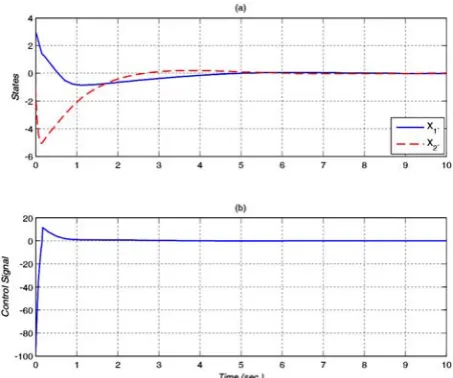
which guarantee that the switching system is passive and asymptotically stable. The behavior of the unperturbed closed-loop system is verified in Fig. 1 in which the switching occurs at t = 0.15 sec. The initial state condition for all simulations of this example is considered as x0 =[3,−1]. The storage functions used in [30] are considered as
( )
(
2)
2 4 1 1 x 0.50.5x x
S = + and
( )
(
2)
2 2 1 2 x 0.5x x
S = + .
Now, consider the uncertainties:
⎟⎟ ⎠ ⎞ ⎜⎜ ⎝ ⎛ − = Δ ⎟⎟ ⎠ ⎞ ⎜⎜ ⎝ ⎛ = Δ ⎟ ⎟ ⎠ ⎞ ⎜ ⎜ ⎝ ⎛ = Δ ⎟⎟ ⎠ ⎞ ⎜⎜ ⎝ ⎛ = Δ ⎟⎟ ⎠ ⎞ ⎜⎜ ⎝ ⎛ = Δ ⎟ ⎟ ⎠ ⎞ ⎜ ⎜ ⎝ ⎛ = Δ 3 2 2 3 1 2 3 2 3 1 2 3 2 1 3 1 1 3 2 3 1 1 2 . 0 0 , 01 . 0 0 , 2 . 0 2 . 0 2 . 0 0 , 01 . 0 0 , 2 . 0 2 . 0 x x g x x f x x g x x f (32)
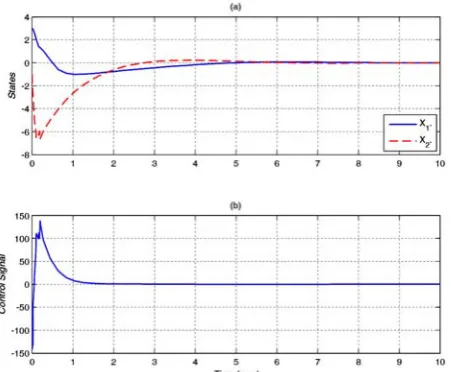
for the switched system (1), the stability of switched system in the presence of nominal control signals (30) is lost as depicted in Fig. 2. Based on the results of Theorem 2, using λi=0 for i=1,2 and H=
[ ]
0 1, the robustifying terms are obtained as:Fig. 1 (a) State trajectories and (b) control signal of the
unperturbed and passive system.
Fig. 2 The unstable closed-loop perturbed switched system:
(a) state trajectories and (b) the control signal.
( )
)
( ), 2 01 . 0 2 . 0 2 . 0 01 . 0 1 1 2 , 2 2 2 4 1 3 1 3 2 6 2 6 1 3 1 2 2 2 4 1 1 s S sign x x x x x x x x x x x t x u + + + + ⎜ ⎝ ⎛ + − − − − − = (33)( )
)
( ), cos 01 . 0 2 . 0 2 . 0 01 . 0 1 1 cos , 2 2 1 1 1 3 1 3 2 6 2 6 1 3 1 2 2 1 1 1 2 s S sign x x x x x x x x x x x x x x x t x u + + + + ⎜ ⎝ ⎛ + − + + + = (34)which stabilize the perturbed switched system. The simulation results are depicted in Fig. 3 which show the stability of the perturbed system. Please note that the rate of convergence of the states to the sliding surface can be arbitrarily improved by increasing λi,i=1,2 at the cost of increasing the amplitude of the control signal.
Fig. 3 The closed-loop switched system with perturbations: (a)
state trajectories and (b) the robustifying sliding mode control signals (33) and (34).
5 Conclusions
In this paper, a redesigned robust integral sliding mode control is developed for a class of nonlinear dissipative switched systems with affine subsystems. The derived variable structure controllers guarantee the stability and convergence of the perturbed switched systems to the origin for norm bounded perturbations. The matched and unmatched perturbations are considered for the switched system, then the stable integral sliding surface is considered and the variable structure control is derived in Theorem 2. The redesigned variable structure controller preserves the stability of the closed-loop perturbed nonlinear switched system much similar to the unperturbed closed-loop switched system. Notice that, the existence of the dissipativity-based nominal control is required for the proposed redesign method. The simulation examples show the effectiveness of the proposed sliding method to dissipative nonlinear switched system in the presence of the matched and unmatched perturbations.
References
[1] A. Balluchi, M. D. Di Benedetto, C. Pinello, C. Rossi and A. Sangiovanni-Vincentelli, “Hybrid control in automotive applications: the cut-off control”, Automatica, Vol. 35, No. 3, pp. 519-535, 1999.
[2] D. Jeon and M. Tomizuka, “Learning hybrid force and position control of robot manipulators”, IEEE Trans. Robot Autom., Vol. 9, No. 4, pp. 423–431, 1993.
[3] F. Khatounian, S. Moreau, J. P. Louis, E. Monmasson, F. Louveau and J. M. Alexandre, “Modeling and simulation of a hybrid dynamic system used in haptic interfaces”, Mathematics and Computers in Simulation, Vol. 71, No. 4-6, pp. 270–281, 2006.
[4] N. H. EI-Farra, P. Mhaskar and P. D. Christofides, “Output feedback control of switched nonlinear systems using multiple Lyapunov functions”, Systems & Control Letters, Vol. 54, No. 12, pp. 1163–1182, 2005.
[5] Q. Su and J. Zhao, “Stabilization of a class of switched systems with state constraints”, Nonlinear Dyn., Vol. 70, No. 2, pp. 1499-1510, 2012.
[6] J. Lian and M. Wang, “Sliding-mode control of switched delay systems with nonlinear perturbations: average dwell time approach”, Nonlinear Dyn., Vol. 62, No. 4, pp. 791–798, 2010.
[7] N. H. Mcclamroch and I. Kolmanovsky, “Performance Benefits of Hybrid Control Design for Linear and Nonlinear Systems”, Proceedings of the IEEE, Vol. 88, pp. 1083-1096, 2000. [8] C. Prieur, R. Goebel and A. R, “Teel. Hybrid
Feedback Control and Robust Stabilization of Nonlinear Systems”, IEEE Transactions on Automatic Control, Vol. 52, No. 11, pp. 2103-2117, 2007.
[9] J. P. Hespanha and A. S. Morse, “Switching between stabilizing controllers”, Automatica, Vol. 38, No. 11, pp. 1905–1917, 2002.
[10] D. Liberzon, Switching in Systems and Control, MA: Birkhäuser, Boston, 2003.
[11] J. Zhao and D. J. Hill, “On stability, L2 -gain and H∞ control for switched systems”, Automatica, Vol. 44, No. 5, pp. 1220–1232, 2008.
[12] J. Zhao and G. M. Dimirovski, “Quadratic stability of a class of switched nonlinear systems”, IEEE Transactions on Automatic Control, Vol. 49, No. 4, pp. 574-578, 2004.
[13] D. Cheng, L. Guo, Y. Lin and Y. Wang, “Stabilization of switched linear systems”, IEEE Transactions on Automatic Control, Vol. 50, No. 5, pp. 661–666, 2005.
[14] T. Ooba and Y. Funahashi, “On a common quadratic Lyapunov function for widely distant systems”, IEEE Transactions on Automatic Control, Vol. 42, No. 12, pp. 1697–1699, 1997. [15] P. Peleties and R. DeCarlo, “Asymptotic stability
of m-switched systems using Lyapunov-like functions”, Proceedings of the 30-th American Control Conference. Boston: MA, USA, pp. 1679–1684, 1991.
[16] M. S., Branicky, “Multiple Lyapunov functions and other analysis tools for switched and hybrid systems”, IEEE Transactions on Automatic Control, Vol. 43, No. 4, pp. 475–482, 1991. [17] A. S. Morse, “Supervisory control of families of
linear set point controllers-part I: exact matching”, IEEE Transactions on Automatic Control, Vol. 41, No. 10, pp. 1413–1431, 1996. [18] C. Briat, “Convex conditions for robust
stabilization of uncertain switched systems with
guaranteed minimum and mode-dependent dwell-time”, Systems & Control Letters, Vol. 78, pp. 63–72, 2015.
[19] J. P. Hespanha and A. S. Morse, “Stability of switched systems with average dwell-time”, in Proceedings of the 38th IEEE Conference on Decision and Control, pp. 2655–2660, 1999. [20] Y. Li, C. Zhang and X. Zhou, “Robust H∞
reliable control for nonlinear delay switched systems based on the average dwell time approach”, Systems Science & Control Engineering, Vol. 3, No. 1, pp. 404-411, 2015. [21] X. Zhao, S. Yin, H. Li and B. Niu, “Switching
Stabilization for a Class of Slowly Switched Systems”, IEEE Transactions on Automatic Control, Vol. 60, No. 1, pp. 221-226, 2015.
[22] J. C. Willems, “Dissipative dynamical systems part I: general theory”, Archive for Rational Mechanics & Analysis, Vol. 45, No. 5, pp. 321-351, 1972.
[23] I. G. Polushin and H. J. Marquez, “On the existence of a continuous storage function for dissipative systems”, Systems & Control Letters, Vol. 46, No. 2, pp. 85–90, 2002.
[24] W. M. Haddad and V. Chellaboina, “Dissipativity theory and stability of feedback interconnections for hybrid dynamical systems”, Math. Probl. Eng., Vol. 7, No. 4, pp. 299–335, 2001.
[25] M. Zefran, F. Bullo and M. Stein, “A notion of passivity for hybrid systems”, Proc. IEEE Conf. Decision Control, Orlando, FL, pp. 768-773, 2001.
[26] J. Zhao and D. J. Hill, “A notion of passivity for switched systems with state-dependent switching”, Control Theory Appl., Vol. 4, No. 1, pp. 70-75, 2006.
[27] W. Chen and M. Saif, “Passivity and passivity based controller design of a class of switched control systems”, Proceeding of the 16-th IFAC World Congress, Prague, CZ, pp. 143-147, 2005. [28] J. Zhao and D. J. Hill, “Dissipativity Theory for
Switched Systems”, IEEE Transactions on Automatic Control, Vol. 53, No. 4, pp. 941–953, 2008.
[29] J. Zhao and D. J. Hill, “Passivity and stability of switched systems: a multiple storage function method”, Systems & Control Letters, Vol. 57, No. 2, pp. 158-164, 2008.
[30] Y. Liu, G. S. Stojanovski, M. J. Stankovski, G. M. Dimirovski and J. Zhao, “Feedback Passivation of Switched Nonlinear Systems Using Storage-like Functions”, International Journal of Control, Automation, and Systems, Vol. 9, No. 5, pp. 980-986, 2011.
[31] Y. Liu and J. Zhao, “Stabilization of switched nonlinear systems with passive and non-passive subsystems”, Nonlinear Dyn., Vol. 67, No. 3, pp. 1709–1716, 2012.
[32] H. Moradi and V. J. Majd, “Stability analysis of disturbed switched systems”, 2nd International Conference on Control, Instrumentation and Automation (ICCIA), Shiraz, Iran, pp. 468-472, 2011.
[33] H. Moradi and V. J. Majd, “Dissipativity-Based Controller Redesign for Uncertain Nonlinear Switched Systems”, International Conference on Electrical and Computer Engineering (ICECE), Istanbul, Turkey, 2013.
[34] H. Moradi and V. J. Majd, “Dissipativity-based stable controller redesign for nonlinear MIMO switched systems in the presence of perturbations”, Nonlinear Dyn., Vol. 75, No. 4, pp. 769–781, 2014.
[35] J. Lian, J. Zhao and G. M. Dimirovski, “Integral Sliding Mode Control for a Class of Uncertain Switched Nonlinear Systems”, European Journal of Control, Vol. 16, No. 1, pp. 16–22, 2010. [36] B. Niua and J. Zhao, “Stabilization and L2-gain
analysis for a class of cascade switched nonlinear systems: An average dwell-time method”, Nonlinear Analysis: Hybrid Systems, Vol. 5, No. 4, pp. 671–680, 2011.
[37] H. H. Choi, “An LMI-based switching surface design method for a class of mismatched uncertain systems”, IEEE Transactions on Automatic Control, Vol. 48, No. 9, pp. 1634– 1638, 2003.
[38] K. S. Kim, Y. Park and S. H. Oh, “Designing robust sliding hyper planes for parametric uncertain systems: a Riccati approach”, Automatica, Vol. 36, No. 7, pp. 1041–1048, 2000. [39] V. Utkin and J. Shi, “Integral sliding mode
control in systems operating under uncertainty conditions”, Proceedings of the 35-th IEEE Conference on Decision and Control, pp. 4591– 4596, 1996.
[40] W. J. Cao and J. X. Xu, “Nonlinear integral-type sliding surface for both matched and unmatched uncertain systems”, IEEE Transactions on Automatic Control, Vol. 49, No. 8, pp. 1355– 1360, 2004.
[41] H. H. Choi, “LMI-based sliding surface design for integral sliding mode control of mismatched uncertain systems”, IEEE Transactions on Automatic Control, Vol. 52, No. 4, pp. 736–741, 2007.
[42] M. Rubagotti, A. Estrada, F. Castanos, A. Ferrara and L. Fridman, “Integral Sliding Mode Control for Nonlinear Systems With Matched and Unmatched perturbations”, IEEE Transactions on Automatic Control, Vol. 56, No. 11, pp. 2699– 2704, 2011.
[43] J. Lian and J. Zhao, “Robust H-infinity integral sliding mode control for a class of uncertain switched nonlinear systems”, J. Control Theory Appl., Vol. 8, No. 4, pp. 521–526, 2010.
Hojjatullah Moradi received his B.Sc.
degree in Communication Engineering from the electrical engineering department of the Shiraz University, Shiraz, Iran in 2006. He then received his M.Sc. and Ph.D. degrees in Control Theory from the electrical and computer engineering department of the Tarbiat Modares University, Tehran, Iran in 2009 and 2013, respectively. His research interests are in the field of nonlinear control, switched systems, robust control and systems biology.
Vahid Johari Majd received his B.Sc.
degree in 1989 from the electrical engineering department of the University of Tehran, Iran. He then received his M.Sc. and Ph.D. degrees in the area of Control Theory from the electrical engineering department of the University of Pittsburgh, PA, U.S.A. in 1991 and 1995, respectively. He is currently an associate professor in the control system department of Tarbiat Modares University, Tehran, Iran, and is the director of intelligent control systems laboratory. His areas of interest include: Intelligent identification and control, multi-agent learning, fuzzy control, cooperative control, formation control, robust nonlinear control, fractional order control, and systems biology.