1. Introduction
1. 1. Objective of the Study
With regard to global warning of greenhouse gases, the microgrids (MGs) can be considered for future electric power systems consisting of small-scale power units, en-ergy storage systems and loads [1]. In other words, MGs provide the appropriate grounds for high-penetration of renewable energies and distributed energy resources (DER) [2]. Noted that the MG is essentially a nonlinear small-scale power system and undergo a wide range of transient conditions will face some stability problems. Therefore, sufficient damping of frequency oscillations is important in MG [3].
1. 2. Literature Review
In the last two decades many studies have been conducted on the MGs [3-6]. In some of them the classical con-trollers were employed to enhance the frequency oscilla-tions in MGs [4-5]. It is clear that a fixed controller based
on the classical theories is not suitable for frequency con-trol of microgrid. Considering the MG frequency concon-trol problem, the conventional control strategies take the in-tegral of the area control error as the control signal. An integral controller can achieve a zero steady state devia-tion; however, it exhibits poor dynamic performance [6]. To cope with this aim, many researchers presented the PID-type fuzzy controller designing and its derivations [7-8]. Compared to the conventional strategies, fuzzy logic controller (FLC) provides much better results; how-ever, it requires fine-tuning and hard efforts to achieve ef-fective performance to damp out the frequency fluctuations. In Ref. [9], a robust fuzzy-PID control sys-tem established by incorporating an optimal fuzzy reason-ing into a well-developed PID-type FLC. Although, this type of controller is more effective than the classical con-trollers, the well optimized fuzzy controller can be re-sulted in more stability. Therefore, optimization algorithm is certainly the first option in this case to reduce fuzzy system effort and find better fuzzy controller [10-12]. In order to control isolated MG, some researchers have used droop control strategies based on active power and frequency (p-f) curve derived from distributed generation (DG) converters. In Ref. [13], a droop control strategy was suggested for DG resources to control the MG fre-quency. Moahmadi et al. [14] presented a novel method
Improvement of Frequency Fluctuations in Microgrids
Using an Optimized Fuzzy P-PID Controller by Modified
Multi Objective Gravitational Search Algorithm
H. Shayeghi*(C.A.)and A. Ghasemi*
Abstract:Microgrids is an new opportunity to reduce the total costs of power generation and supply the energy demands through small-scale power plants such as wind sources, photo voltaic panels, battery banks, fuel cells, etc. Like any power system in micro grid (MG), an unexpected faults or load shifting leads to fre-quency oscillations. Hence, this paper employs an adaptive fuzzy P-PID controller for frefre-quency control of microgrid and a modified multi objective Chaotic Gravitational Search Algorithm (CGSA) in order to find out the optimal setting parameters of the proposed controller. To provide a robust controller design, two non-commensurable objective functions are formulated based on eigenvalues-domain and time-domain and multi objective CGSA algorithm is used to solve them. Moreover, a fuzzy decision method is applied to ex-tract the best and optimal Pareto fronts. The proposed controller is carried out on a MG system under different loading conditions with wind turbine generators, photovoltaic system, flywheel energy, battery storages, diesel generator and electrolyzer. The simulation results revealed that the proposed controller is more stable in comparison with the classical and other types of fuzzy controller.
Keywords: Microgrid, Frequency control, Multi objective CGSA, Adaptive fuzzy P-PID controller.
Iranian Journal of Electrical & Electronic Engineering, 2016. Paper received 8 August 2016 and accepted 23 October 2016. * The Authors are with the Technical Engineering Department, Univer-sity of Mohaghegh Ardabili, Ardabil, Iran.
E-mail: [email protected], [email protected] Corresponding Author: H. Shayeghi.
based on droop control strategy of photovoltaic and bat-tery converters to control the MG frequency. This strategy was evaluated by some virtual MGs and the results re-vealed an acceptable performance with respect to the MG frequency control problems. In Ref. [15], the torque and frequency droop control strategies are used for a doubly-fed induction generator (DFIG). Yuen et al. [16] also stated the practical aspects of providing frequency control reserves (FCRs) and the potential economic profitability of participating in FCR markets based on a setup of mul-tiple MGs. In addition, Ref. [17] was dedicated to a new energy management system (EMS) model to improve the security of a MG in a cost-effective manner. In Refs. s[18, 19], the role of a cascaded H-bridge (CHB) multilevel converter in controlling the frequency was examined. In Ref. [20], investigations were carried out on the coordi-nated vehicle-to-grid (V2G) control and frequency con-troller for robust frequency control in a smart grid with large penetration of renewable energy sources (RES). Here, the battery state-of-charge (SOC) was controlled by the optimized SOC deviation. Li et al. [21] focused on the feasibility of electrolyzer and fuel-cell hybrid system con-trol to secure a real power balance and increase the oper-ational capability of the load frequency control model. In Ref. [22], a virtual synchronous generator control method was reported to use the same control method in stand-alone and grid-connected operations. Authors in Ref. [23] proposed a battery energy storage system to maintain the frequency control process within MGs with large pene-tration of RES. In this study, it was concluded that the final solution improves the system’s stability and security of supply. Shafiee et al. [24] suggested a new method to consider the secondary controls in the droop-controlled MGs.
1. 3. Motivation and contribution
In this paper an adaptive fuzzy P-PID controller is pro-posed for frequency control of MG. As the optimizing of the proposed fuzzy controller is very important to achieve the desired level of system performance, a modified grav-itational search algorithm (GSA) is used to optimize fuzzy P-PID structure. Because, the GSA is a well-known and successful algorithm with flexible structure [25-27]. In order to resolve its shortcomings to obtain the global op-timum solution and ensure the solutions not being trapped in local optima when system has a highly epistatic objec-tive function and number of to be optimized variables is large, a new modified multi objective GSA-based CLS operator, called the CGSA, is investigated to optimize the parameters of the proposed fuzzy controller. The proposed fuzzy P-PID model is a flexible controller with simple configuration that is easy to implementation. As results, the main contributions of this paper can be summarized as follows:
i) Suggestion a fuzzy P-PID controller to improve
fre-quency fluctuation of a MG
ii) Presenting a modified gravitational search
algo-rithm based on the chaos theory to optimize the proposed fuzzy controller parameters.
iii) Considering the nonlinear components and inherent
uncertainties of the MGs in synthesis procedure.
iv) Analyzing the MG system equipped with the
pro-posed fuzzy controller under sever operating con-ditions and power generation uncertainties.
1. 4. Outline of this paper
The rest outline of this paper is structured as follows. Sec-tion 2 illustrates the proposed MG and fuzzy P-PID con-troller structure. Section 3 introduces the multi objective CGSA algorithm and section 4 shows the consistency of two previous sections with respect to the frequency sta-bility. Section 5 describes several loading conditions to demonstrate the performance of the proposed fuzzy P-PID controller in a MG. Finally, the paper is concluded in Sec-tion 6.
2. The proposed power system model 2. 1. Microgrid configuration
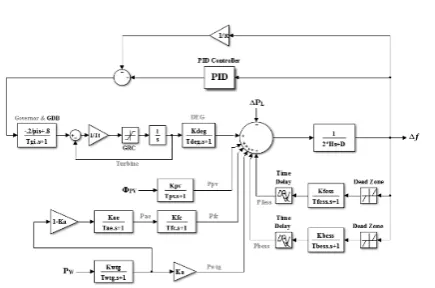
The real configuration of the studied MG is shown in Fig. 1 and the block diagram of this system is shown in Fig. 2 [1]. As shown in Fig. 1, MG is an interconnection of do-mestic distributed loads and low voltage distributed en-ergy sources, such as microturbines, wind turbines, PVs, storage devices, diesel generator, and electrolyzer system. It consists of a group of radial feeders as a part of a dis-tribution system. The domestic load can be divided to sen-sitive/critical and nonsensitive/noncritical loads via separate feeders. The sensitive loads must be always sup-plied by one or more microsources, while the nonsensitive loads may be shut down in case of contingency, or a seri-ous disturbance. Each unit’s feeder has a circuit breaker and a power flow controller commanded by the central controller or energy manager. The circuit breaker is used to disconnect the correspondent feeder (and associated unit) to avoid the impacts of sever disturbances through the MG. The ac MG can be connected to the distribution system by a point of common coupling (PCC) via a static switch (SS). The static switch is capable to island the MG for maintenance purposes or when faults or a contingency is occurred.
For the feeders with sensitive loads, local power supply, such as diesel generators or energy capacitor systems (ECSs) with enough energy saving capacity are needed to avoid interruption of electrical supply. An MG central controller (MGCC) facilitates a high level management of the MG operation by means of technical and econom-ical functions. The microsource controllers (MCs) control the microsources and the energy storage systems. Finally, the controllable loads are controlled by load controllers (LC). The microsources and storage devices use power
electronic circuits to connect to the ac MG. Usually, these interfaces depending to the type of unit are ac/ac, dc/ac, and ac/dc/ac power electronic converters/inverters. As the MG elements are mainly power-electronically interfaced, the MG control depends on the inverter control. For in-creasing reliability in the conventional power systems, the MG systems must be able to have proper performance in both connected and disconnected modes. In connected mode, the main grid is responsible for controlling and maintaining power system in desired conditions and, the MG systems act as real/reactive power injectors. But in disconnected mode, the MG is responsible for maintain-ing the local loads and keepmaintain-ing the frequency and voltage indices at specified nominal values. All needed data for the MG is given Appendix A [28].
In the simulation, the nonlinear model (Fig. 3) with ±0.1 saturation values is replaced with the linear model of tur-bine ΔPVki/ΔPTki represented in Fig, 2 to take the gen-eration rate constraint (GRC), i.e. the practical limit on the rate of change in the generating power, into account.
Fig. 1. The Proposed microgrid containing different types of
power plants
Fig. 2.Block diagram of the microgrid system
Fig. 3. Nonlinear turbine model with GRC
Figure 4 shows the structure of the governor concerning the Governor Dead-Band (GDB).
Fig. 4.A nonlinear model of governor with GDB
Note that these types of power plants have inherent un-certainties or nonlinear pattern; however, to the best knowledge of the researcher, few studies have examined this issue. This paper presents a modified GSA algorithm to design a P-PID fuzzy controller for load frequency con-trol considering GDB, GRC and RES system uncertain-ties. This model can be considered as real-time potential of the studied MG.
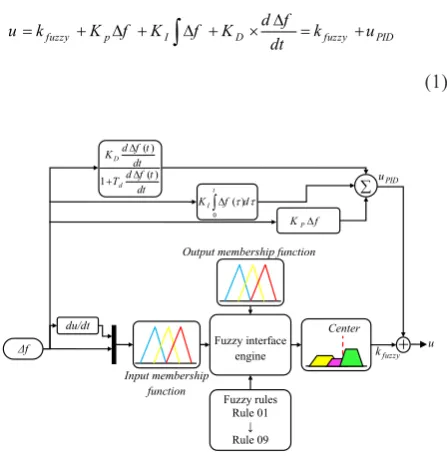
2. 2. Adaptive Fuzzy P-PID controller The graphical view of the proposed adaptive fuzzy P-PID damping controller with a global signal Δf is shown in Fig. 5. The membership functions are used to specify a set of rules, called the rule base which developed based on the optimization procedure. Rules are developed based on two inputs and three linguistic terms. In an inference model, all the rules are compared to the inputs to decide which rules are relevant in the current condition. After the corresponding process, the necessary rules are extracted and the controlled output is specified for the different input conditions. The de-fuzzification mechanism pro-duces the final crisp output of FLC with regard to the fuzzified input. In Fig. 5, the tracking Δf is the input of the fuzzy inference system. The membership functions for Δf and , and the output kfuzzy are of the conventional tri-angular kind. In practice, most of the physical systems have inherent tractable characteristics such as high-order and nonlinearity. Therefore, the PID controllers are added to meet the performance demand and multi objective CGSA method is used to optimize the fuzzy P-PID pa-rameter. In other words, the proposed controller consists of the fuzzy P and the conventional PID with low-pass fil-ter. The component fuzzy P tend to make a system fasfil-ter. The derivative part of PID is used to reduce the rapid
1
1 1/TT 1/S
In1 Out1
Saturation Integrator
i F
'
,
ref i P
' 'PV i
0.2 0.8 ( )
1
g
gi
G s
T s
s
S
changes and overshoots of the control inputs caused by practical constraints. To deal with the steady-state error and to reject disturbances in the control system, the inte-gral part has been used. The parallel fuzzy P +PID control action can be obtained by algebraically simultaneous sum-ming up the fuzzy P control and PID control actions. In the fuzzy P-PID model, the control effort can be deter-mined by:
(1)
Fig. 5.Block diagram of the proposed fuzzy P-PID controller
of the interconnected microgrid
On the other hand, real-world power industry is too con-servative to open the well-known PID control loop and replace by a new control technology. In response to this challenge, in the present paper, the PID controller is re-mained, and the MGSA-based fuzzy logic is used for on-line optimal tuning of its parameters. Therefore, this control configuration provides a smooth performance in start-up and transient circumstances and it could be more acceptable for the real-time MG application.
3. Multi objective chaotic gravitational search algo-rithm
3.1. Standard GSA
In this section, the standard (single-objective) GSA is briefly discussed. In order to get more details, refer to Ref. [25]. To describe the original GSA, consider a vector with s agents ( is ith mass in the dth dimension) and the posi-tion of ith mass is calculated by:
(2)
Then, mass of ith agent is calculated as follows:
(3)
where, Mi(t) and qi(t) are the mass value of the ith agent at time t and the gravitational masse, respectively. The qi (t) can be calculated by:
(4)
where, fiti(t), worst(t) and best(t) are the fitness value of the ith agent at time t, worst and best fitness, one gets:
(5)
To calculate the acceleration of the agent i, aid(t), total forces Fid(t) from a set of heavier masses should be ob-tained based on the gravity law as follows:
(6)
Then, the next velocity of the agent and its position is computed as:
(7)
(8)
where, randi and randj are two uniformly distributed ran-dom numbers in the interval [0, 1], Rij(t) is the Euclidean distance between two agents i and j, Rij(t)=||Xi(t), Xj(t)||2, ε is a small value, kbest is the set of first K agents with the best fitness value and biggest mass as a function of time with the initial value K0 at the beginning which is decreased with time. Here, K0 is set to the total number of agent’s s and is linearly reduced to 1. G denotes the fuzzy p I D fuzzy PID
d f
u k K f K f K k u
dt '
'
³
' u1
( ,..., d,..., n), 1, 2,...,
i i i i
X x x x i s
1 ( ) ( ) ( ) i i s i j q t M t q t
¦
( ) ( ) ( ) ( ) ( ) i ifit t worst t
q t
best t worst t
{1,..., }
{1,..., }
( ) ( ) ( ) ( ) i j s i j s
worst t Max fit t
best t Min fit t
° ® °¯ , , ( ) ( ) ( ) ( ) ( ( ) ( )) ( ) ( ) ( ) ( ) ( ) ( ( ) ( )) ( ) ( ) j i
d d d
i i j i
j kbestji ij
d
j
d i d d
i j j i
jkbestj i
i ij
M t M t
F t rand G t x t x t
R t
M t F t
a t rand G t x t x t
M t R t
H H z z ° ° ® ° ° ¯
¦
¦
( 1) ( ) ( )
d d d
i i i i
V t rand uv t a t
( 1) ( ) ( 1)
d d d
i i i
x t x t v t
Outputmembershipfunction
Inputmembership
function
KP'f
PID
u
u
fuzzy
k
Fuzzy interface engine
Fuzzy rules Rule01
Ļ
Rule09
Center
du/dt
ǻf
0 ( ) t
I
K³'f W Wd
( )
( ) 1
D
d
d f t
K
dt
d f t
T
dt
'
'
¦
gravitational constant by G0, and can be updated by:
(9)
The pseudo code of the standard GSA is shown in Fig. 6.
1. Search space identification, t=0; 2. Randomized initialization Xi(t)
For i=1,2,…,N;
3. Fitness evaluation of agents;
4. Update G(t), best (t), worst(t) and Mi(t) For i=1,2,…,N;
5. calculation of acceleration and velocity; 6. Updating agent’s position to yield Xi(t+1)
For i=1,2,…,N; t=t+1;
7. Repeat steps 3 to 7 until the stopping criterion is reached.
Fig. 6. Pseudo code of the standard GSA
3.2. Chaotic GSA
To enhance the algorithm search ability, the chaos theory is employed. If hasty convergence happens, definitely, there is need to an alternative operator to recover the al-gorithm search. Hereby, the proposed CGSA combines the standard GSA with CLS. Assume that our array of sen-sors controls the current Cji+1 that is formulated based on forcing the pendulum, by rewriting it from cos(t) to a new form as follows:
(10)
where, gkbest refer to the best optimal value in iteration k and controls the local search ability. Thus, the proposed CLS can be stepped as follows:
Step 1: Generate an initial random chaos population as:
(11)
where the chaos variable can be generate as follows:
(12)
Step 2: Determine the chaotic variables
(13)
where Nchaos is the number of individuals for CLS. CxiNg is the ith chaotic variable and the Rand() generate a random value in (0,1).
Step 3: Map the decision variables
Step 4: Convert the chaotic variables into decision vari-ables
Step 5: Assess new solution based on the decision vari-ables
3. 3. Non-dominated Sort (NDS)
The NDS method is employed to build the Pareto ranks dividing the solutions into different fronts with different ranks. Then, the classified individual group is ignored and another layer of non-dominated individuals is considered [29]. In primary sorting, each agent is selected and checked to see whether or not it meets the rules given below with respect to any other agent in the population:
(14)
where, i and j are the agent numbers. After ranking the whole population, a large fitness value is then assigned to the individuals in the first non-dominated front with rank 1. To maintain the goal of diversity, the sharing strategy is applied and the shared fitness of each individual in the front 1 is obtained. Subsequently, a fitness value being smaller than the minimum shared fitness value of the pre-vious front is assigned to the individuals in the next front. Once again, the sharing strategy is used and the individual shared fitness values in the second front are obtained. The procedure continues until the individual shared fitness values are achieved for all fronts. The sharing function values (Share (dij)) for all first front agents can be calcu-lated as:
(15)
(16)
0
( ) ( , )
G t G G t
1 1
1 1
2 (1 +g g ) os(2 g g ), 0.5 1
0.1 (1 cos((1 + g g ))), 0 0.5
j k k k k j
j i best best best best i
i j k k j
i best best i
c c c
c
c c
S
u u d
®
u d
¯
0 1 2
,0 ,0 ,0 1
1 2
0 0 0 0
,0 ,min
0
,max ,min
[ , ,..., ]
[ , ,..., ]
, 1, 2,...,
g
Ng
cls cls cls cls N
Ng
j
cls j
j
j j
X X X X
cx cx cx cx
X P
cx j Ng
P P u 1 2
, , , 1
, 1 ,max ,min ,min
[ , ,..., ] , 1, 2,...,
( ) , 1, 2,...,
g
i Ng
cls cls i cls i cls i N chaos
j j
cls i i j j j g
X X X X i N
x cx P P P j N
u
u
1 2
1
0
[ , ,..., ], 0,1, 2,..., 1, 2,...,
(0)
Ng
i i i i choas
j i
j
cx cx cx cx i N
cx base CLS j Ng
cx rand
.1[] .1[ ] .2[] .2[ ],
Obj i Obj j and Obj i Obj j iz j
2
1 ( ) , Share 0 , ij ij share share ij d if d d otherwise P P ° ® ° ¯ 1 2 max min 1 ( ) i j P s s ij
a s s
x x d x x
¦
where, p1 is the total number of decision variables, xs is the value of sth decision variable; i and j are the agent numbers. The µshare stands for the maximum distance al-lowed between any two agents to become members of a niche. In additions, the niche count for the total population (N) is calculated as follows:
(17)
3. 4. Best compromised solution
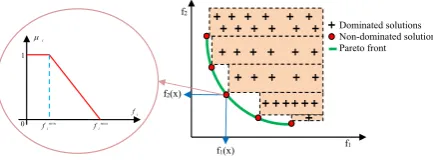
After the Pareto-optimal solutions are calculated then a suitable decision maker is needed to choose one best com-promised solution with respect to a specific preference for different applications. Hence, the fuzzy set mechanism as shown in Fig. 7 is use to resolve this problem. Here, a lin-ear membership function ui is defined for each of the ob-jective functions Fi:
(18)
where, Fimin and Fimax are the minimum and the maxi-mum values of the objective functions, respectively. It is clear that this membership function indicates the achieve-ment degree of the objective functions. The membership function can be normalized for each non-dominated solu-tion k:
(19)
where, O and S are the number of objective functions and non-dominated solutions, respectively. The solution with the maximum value of uk will be selected as the best com-promised solution. The proposed CGSA convergence analysis is given in Appendix B.
Fig. 7. The FCM method used for the selected Pareto set
4. Optimal tuning of the proposed control strategy
The proposed controller design problem is formulated as a multi objective problem with two conflict objective functions based on time-domain and frequency-domain. The frequency-domain objective function allowed some eigenvalues to be shifted to the left-hand side of the ver-tical line in the complex plane. The time-domain objective function dictates power system to control the overshot and undershot responded to output frequency in least values. These objective functions are given by:
(20)
(21)
where, NP, tsim, λ and ζ are the number of operating con-ditions, the time of simulation¸ the ith eigenvalue of the system at an operating point and the desired minimum damping, respectively. Here, α and β are sets with con-stant values 0.56 and 0.085, respectively. The optimal tun-ing parameters problem can be expressed by:
(22)
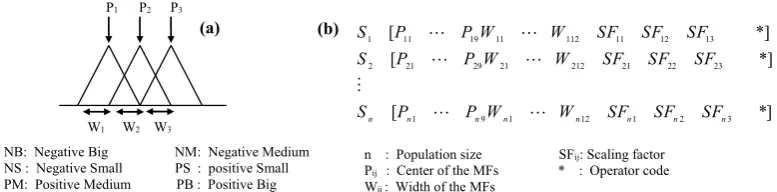
The range [0-20] is typically assumed for KP, KI and KD. Moreover, in the proposed model, each agent is formed to indicate the membership functions (MFs) of the fuzzy logic controller’s inputs and outputs. In other words, the fuzzy P-PID controller is a fuzzy inference model that maps the given inputs in fuzzy variables subjected to fuzzy membership function. Assuming a priori as the most appropriate fuzzy set covering the domains of quantitative attributes the fuzzy association of MFs mining is difficult. It is usually impractical for experts to represent such sets and finding the most appropriate fuzzy MFs sets. Existing clustering-based automated methods are not of interest because they do not consider the optimization of the dis-covered membership functions; therefore, the tuning of multi-scheme MFs with n inputs has received a consider-able attention and is presented by m1, m2,.., mn. In this regard, some assumptions are considered and scheduled as follow:
i) All MFs are defined as triangular partitions with
seven segments from -1 to 1. Zero is the central membership function centered at zero.
ii) Scaling factors of input/output are optimized by
using the CGSA.
The above assumptions are presented in Fig 8.
1
Share
N
i ij
j
Nichecount
¦
dmax max min max min min
max
( ) ( )
1
0
i i i i i i i
i i
i
F F F F F F F
u F F
F F ! ! °° t ® ° d °¯ 1 1 1 o k k i s o k k i u i u u i
¦
¦ ¦
11 0 ( ) sup( )
sim p t
N j
J
¦ ³
t 'f dtE 'f2 , ,
, 1
max[Re( ) min{ |Im( )|, }]
p N
i j i j
i j j
J
¦
O ] O D1 2 max max min min max max min min [ , ] :
p p I I
D D
p I
D
Minimize J J Subject to
K K K K K K
K K K w w w
d d d d
d d d d
f1
f2
f1(x) f2(x)
Dominatedsolutions Non-dominatedsolution Paretofront
m ax
i f m in i f 1 0 i P i f
The combination between optimization of the proposed controller is as follow:
i) The variables are the standard deviation and mean
values of each fuzzy MFs.
ii) These variables act as solutions and search for the
global best fitness.
iii) It initiates with an initial set of variables.
iv) After the variables' being tuned by the CGSA, these
variables will be used to check the performance of the FLC.
v) This process is repeated until the concerned
objec-tive is achieved.
Figure 9 shows the optimization flowchart of the multi objective CGSA method.
5. Simulation Results
The performance of the proposed fuzzy P-PID controller based on the modified gravitational search algorithm is validated for a MG system with different types of re-sources and storages as shown in Fig. 1. Different operat-ing conditions are considered for this test system which listed in Table 1. In order to acquire a better performance, the agent dimension, population size, G0, and α value are set with 40, 60, 20 and 100, respectively. It should be noted that the CGSA algorithm is run for several times
W1 W2 W3
NB: NegativeBig NM: NegativeMedium
NS: NegativeSmall PS : positiveSmall PM: PositiveMedium PB: PositiveBig
P1 P2 P3
(a)
1 11 19 11 112 11 12 13
2 21 29 21 212 21 22 23
1 9 1 12 1 2 3
[ *]
[ *]
[ *]
n n n n n n n n
S P P W W SF SF SF
S P P W W SF SF SF
S P P W W SF SF SF
n : Populationsize SFij:Scalingfactor Pij : CenteroftheMFs * : Operatorcode
Wij: WidthoftheMFs (b)
Fig. 8.(a) Symmetrical membership functions, (b) String architecture in tune of membership functions and scaling factors
No
Yes
Updateforeachparticlelocal bestwithCLSmechanism
START
Defineworkcondition formachineandSet AlgorithmParameters
Generatetheinitial populationbasedon
statevariable
CalculatetheG,best, worst,MiandMgofthe
population
J1
ConstrainsFunction Value Calculatevelocityamounts Basedontheobjective
functionvalues
J2
Stoppingcriteria met?
Agentvelocity Agentposition Iter=Iter+1
Updatethecontrolparameters
Ynd
UsingNon-dominatedsortforall solutionandselectedbestanswervia
fuzzymechanism
Initialpart
Setalgorithmparameters Setsystemdata
Secondpart
Evaluateobjectivefunction Usemultiobjectivetheory
Thirdpart
Usealgorithmoperator EmployCLSsystem
Fig. 9.Flowchart of the proposed algorithm
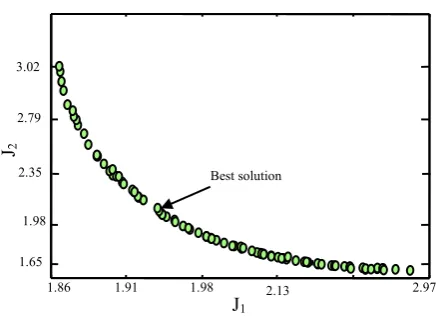
then the optimal set of the proposed controller is selected. The optimal values for the fuzzy P-PID controller are given in Table 2. Also, Fig. 10 shows the MFs form of the fuzzy P-PID controller tuned by CGSA. Figure 11 shows the distribution of the Pareto front belonging to the opti-mization process.
Table 1. Operating Conditions
Table 2. Optimal parameters for fuzzy P-PID controller and
CGSA algorithm
Fig. 10.Optimized MFs for fuzzy logic integrated with the
proposed fuzzy P-PID controller
Fig. 11.Pareto-optimal fronts of the proposed algorithm
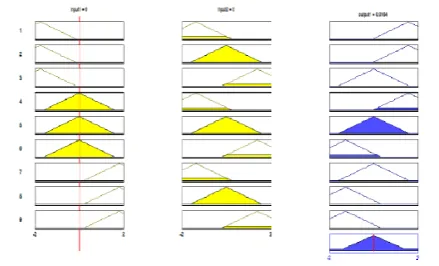
According to Fig. 10, the input signals of the fuzzy con-troller are in the range [-2, +2]. These signals are errors and the changes of errors. Due to the operating conditions as given in Table 1, some parameters is increased and de-creased. At first, we evaluate these parameters effects on the plant's output to select worst operating conditions in designing the proposed fuzzy P-PID controller. The ef-fects of these parameters on the frequency fluctuations are shown in Fig. 12.
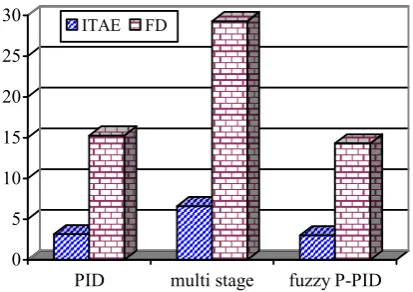
It can be observed that two parameters R and TDEG have a similar performance when the overshoot is enhanced up to +40%; they are increased. On the other hand, two pa-rameters TWTG and (d) TPV have same effects when they are decreased to -40%. In addition, to demonstrate the robustness of the proposed control strategy, two per-formance indices ITAE and FD are defined as follows:
(23)
(24)
where, OverShoot (OS), UnderShoot (US) and settling time of the MG frequency deviation are considered for the FD evaluation.
It is worth noting that the lower values of these indices shows the better response of MG system control in terms of time-domain characteristics. Parameters aos, aus and ats are penalty factors to make equal values for OS, US and Ts, respectively. To the reader easily the fuzzy surface and fuzzy inference diagrams are shown in Figs. 13 and 14, respectively. Synchronizing these factors make better comparison based on FD value.
0
100 .(| |).
sim t
ITAE
³
t 'f dts
os us t s
FD D uOSD uUSD uT
1 Increasingloadstepsfrom -10%to+10%
2 IncreasingparameterRfrom -40%to+40%
3 IncreasingparameterTDEGfrom -40%to+40%
4 DecreasingparameterTWTGfrom+40%to -40%
5 DecreasingparameterTPVfrom+40%to -40%
6 Consideringdelay
KP 1.03
KI 2.087
[LowlimitUplimit] [0,5]
KD 6.023
-2 -1 0 1 2
0 0.5
1
input1
D
egr
e
e
of
me
m
b
ers
hip n z p
-2 -1 0 1 2
0 0.5
1
input2
D
egre
e
of
me
m
b
ersh
ip
n z p
-2 -1 0 1 2
0 0.5
1
output1
D
egr
e
e
of
me
m
b
ers
hip n z p
1.86 1.91 1.98 2.97
J1
1.98 2.79 3.02
2.35
J2
1.65
2.13 Bestsolution
Fig. 13.Graphical view of fuzzy surface
To shows the robustness and effectiveness of the proposed controller, it compared with the following controllers in different operating conditions:
1. Conventional PID controller 2. Multi-stage fuzzy controller [30]
Fig. 14.Fuzzy inference diagram
As the first evaluation, the load step ∆PL = 0.1 as an ex-ternal fault is added to the studied MG as shown in Fig. 2. The responded frequency oscillation is shown in Fig. 15. It can be seen that the overshoot in the equipped sys-tem with fuzzy P-PID controller is significantly better than two other methods. Moreover, undershoot in the pro-posed controller is completely removed and the settling
0 2 4 6 8 10 12 14 16 18 20
-5 0 5 10x10
-3
(a)
0 2 4 6 8 10 12 14 16 18 20
-6 -4 -2 0 2 4 6 8 10 12x10-3
(b)
0 2 4 6 8 10 12 14 16 18 20
-6 -4 -2 0 2 4 6 8 10 12x10
-3
(c)
0 2 4 6 8 10 12 14 16 18 20
-6 -4 -2 0 2 4 6 8 10 12x10-3
(d)
Fig. 12.Effects of different parameters on frequency stability between -40% to +40 %, (a) R (b) TDEG (c) TWTG and (d) TPV,
+40% (Solid), 0% (Dashed) and -40% (Dotted)
time is decreased from 16 s (best solution for two other controllers) to 11 s for the fuzzy P-PID controller.
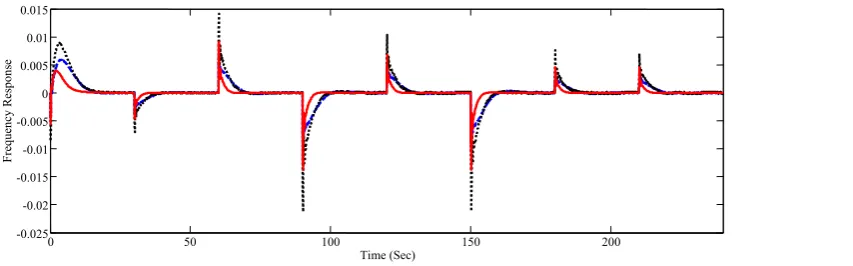
To show the robustness of the proposed controller under different sever operating conditions; Fig. 16 presents the frequency response in MG under the load step 0.1 and delay block. It can be seen that the performance of the proposed controller is better than other methods. It can be concluded from Figs. 14 and 16 that the pro-posed controller in each condition has a robust perform-ance because the compared values of indices OS, US and Ts are close together. In order to show the accepted per-formance of the proposed algorithm, its results of are compared with PI and multi-stage fuzzy controllers under multi-step loadings as shown in Fig. 17 and its frequency response is shown in Fig. 18.
Figure 20 shows the frequency response of the MG under sever loading conditions consisting of random load power changes as shown in Fig. 19 with increasing the parame-ters R and TDEG to +40% of the nominal values and
de-0 5 10 15 20 25 30
-5
0
5
10x10
-3
Time(Sec)
Fre
quenc
y
Re
sp
o
n
se
Fig. 15.Frequency response of the microgrid with the load
step 0.1 without delay, Fuzzy P-PID (Solid), Multi stage (Dashed) and PID (Dotted)
0 50 100 150 200 240
0.005 0.01 0.015 0.02 0.025 0.03 0.035 0.04 0.045 0.05 0.055
Time(Sec)
Loa
d
De
viation
Fig. 17. The load step changes of the interval 240 s.
0 5 10 15 20 25 30
-2
0 2 4 6 8 10x10
-3
Time(sec)
Frequ
ency
Re
sp
o
n
se
Fig. 16. Frequency response of microgrid with the load step
0.1 with delay, Fuzzy P-PID (Solid), Multi-stage (dashed) and PID (Dotted)
0 50 100 150 200
-0.025 -0.02 -0.015 -0.01 -0.005 0 0.005 0.01 0.015
Time(Sec)
Fre
quenc
y
R
es
p
o
ns
e
Fig. 18 .Frequency response of the microgrid to load step changes in the interval 240 s, Fuzzy P-PID (Solid), Multi stage (dashed)
and PID (Dotted)
creasing parameter TWTG and TPV to -40% of the nom-inal values. This case can be considered as the worst op-erating condition observed in the literature. In fact, successful performance under these conditions grantees the good performance of the proposed fuzzy P-PID con-troller in the real-time system.
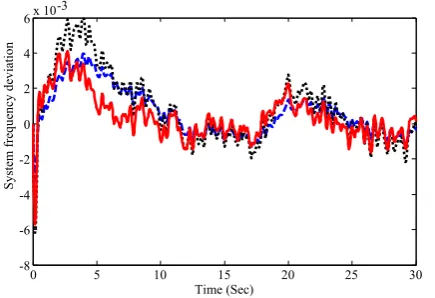
To demonstrate the MG stability by random wind power input, assume that the wind input is varied as shown in Fig. 21. The system frequency response is shown in Fig. 22.
It can be seen from these figures that the frequency devi-ations of the MG are greatly reduced by the proposed fuzzy P-PID controller in terms of overshoot, undershoot and settling time. In other words, the proposed control strategy has a good and rather quick performance in
0 25 50 75 100 125 150 175 200 225 240
-1 -0.8
-0.6
-0.4 -0.2 0 0.2 0.4 0.6
0.8
1
Time(Sec)
L
oa
d
de
v
ia
tion
Fig. 19.Random load power change 0 50 100 150 200
-0.03
-0.02 -0.01 0 0.01 0.02 0.03
Time(s)
R
an
d
o
m
wi
n
d
po
w
er
in
p
u
t
Fig. 21.Random wind power input
0 50 100 150 200
-1.5 -1 -0.5 0 0.5
1 1.5
Time(Sec)
Frequency
re
sp
on
se -0.4 80 85 90
-0.2 0
Fig. 20.System frequency deviation below 40% TWTG and TPV decreasing, 40% R and TDEG increasing and random load power
change, Fuzzy P-PID (Solid), Multi-stage (dashed) and PID (Dotted)
0 5 10 15 20 25 30
-8
-6
-4
-2
0
2 4
6x10⁻³
Time(Sec)
System
fr
eq
ue
ncy
dev
iatio
n
Fig. 22. System frequency deviation for random wind power
input, Fuzzy P-PID (Solid), Multi stage (dashed) and PID (Dotted)
damping the frequency oscillations. Moreover, the numer-ical results for different cases are shown in Figs. 23 and 24. It is worth mentioning that the lower values of these indices shows better system response in terms of time do-main characteristics. Therefore, it is clear that the per-formance of the MG equipped with the fuzzy P-PID controller is better than the conventional PID and multi stage fuzzy controllers.
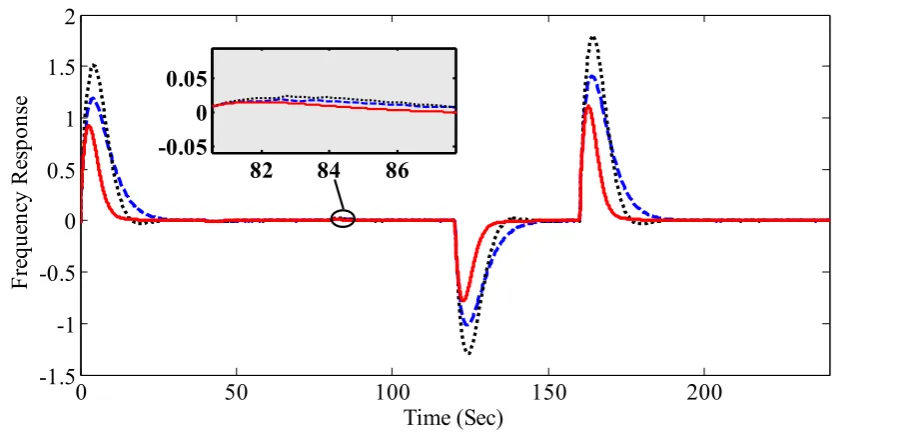
In order to evaluate the robustness of the proposed con-troller, it is assumed that the solar irradiation is changed as shown in Fig. 25. Moreover, like sever operating
con-ditions, the wind speed and load disturbance are also re-garded as shown in Fig 25. In this case, the time-domain simulation result is depicted in Fig. 26. The value of ∆f gradually returns to zero due to linear increases of Φ and PPV. It can be concluded that longer time constant in the studied system can filter out large fluctuations caused by the inherent random solar-irradiation variations. However, longer time delay has a detrimental effect on the control-ling performance on the studied system.
0 5 10 15 20 25 30
PID multi stage fuzzy P-PID
ITAE FD
Fig. 23.Comparison values for microgrid without delay block
0 5 10 15 20 25 30 35
PID multi stage fuzzy P-PID
ITAE FD
Fig. 24. Comparison values for microgrid with delay block
Fig. 25. Variation of solar irradiation, wind speed and load step disturbance
6. Conclusions
This paper presents a robust design of the proposed and adaptive fuzzy P-PID controller for a microgrid system with different types of uncertainties (to convert this model to a practical microgrid) and power units (PV, wind, diesel and etc) in order to enhance the frequency deviation damping caused by MG performance under unexpected conditions. Unlike the conventional controller such as PID, the optimal tuning of fuzzy membership functions and rules is very essential for improving control system performance since a non-optimal set of membership func-tions and rules may lead to sever instability in a microgrid system. Hence, a multi-objective CGSA algorithm has been used to optimally tune the fuzzy set variables in the proposed fuzzy controller. Based on two conflicted objec-tive functions in time and frequency domains, the pro-posed design problem is converted to a multi objective optimization problem over a wide range of loading con-ditions. According to the results obtained from the pro-posed algorithm, it can be said that it is an appropriate approach to improve the frequency deviation. Moreover, extensive simulation studies show that the proposed con-troller provides the desired closed loop performance over a wide range of operating conditions. The findings of this study contribute the researchers to find out the optimal tuning for frequency controller on microgrids. It is also a contribution to the existing knowledge on microgrids ac-cording to four following reasons:
1. An improved fuzzy P-PID controller is investigated for damping the frequency oscillations of microgrid.
2. The efficiency of the CGSA algorithm in comparison with other methods is proved.
3. The CGSA algorithm improved the fuzzy P-PID con-troller design efforts for frequency oscillations in micro-grids.
4. Evaluations of the proposed controller effectiveness under different types of operating conditions such as changes in solar irradiation, wind speed, load step and mi-crogrid uncertainties are indicative of its appropriate per-formance.
Appendix A: The microgrid data All microgrid data are shown in Table 3.
Table 3.Microgrid system Data
0
50
100
150
200
-1.5
-1
-0.5
0
0.5
1
1.5
2
F
re
q
ue
nc
y
Re
sp
o
n
se
Time
(Sec)
82
84
86
-0.05
0
0.05
Fig. 26.System frequency deviations for random solar irradiation, wind speed, step load and +40 uncertainties, Fuzzy P-PID (Solid),
Multi-stage (Dashed) and PID (Dotted)
Value Parameters Value
Parameters
1.5 Kae
3.0
R(Hz/pu)
0.5
Tae(s)
0.012 D(Hz/pu)
1.1
Kfc
0.1667 2H(pus)
4.0
Tfc(s)
1.3 Kdeg
1.8 Kpv
2.0
Tdeg(s)
1.0
Tpv (s)
0.3
Tt(s)
-1.1
Kfess
0.3
Tgi(s)
0.1
Tfess(s)
1.0
Kwtg
-1.3
Kbess
1.5
Twtg (s)
0.1
Tbess(s)
0.6 Ka
Appendix B: Algorithm convergence analysis
In this section, the exploitation and exploration of the pro-posed CGSA algorithm and how it performs better than the classical GSA by testing Langermann's function [31] with two variables of X1 and X2 known as a non-convex problem are presented. Note that this function has many local solutions different from global solutions identified by the smooth plate. To the convenience of the readers, a 3-D view of this function is shown in Fig. 27 and the mathematical equation is presented below:
Figure 28 shows the contour plot of Eq. (25) dealing with the movement of the population in the search process. It can be seen that all population in the proposed algorithm are focused on the global solution in last iteration but the GSA has some violations. According to this analysis, the standard deviations of CGSA and GSA are about 0.002 and 0.035, respectively
Reference
[1] M. R. Khalghani, M. H. Khooban, E.
Mahboubi-Moghaddam, N. Vafamand, and M. Goodarzi, "A
self-tuning load frequency control strategy for
mi-crogrids: Human Brain Emotional Learning",
Electrical Power and Energy Systems, Vol. 75, pp.
311-319, 2016.
[2] M. Goyal, and A. Ghosh,"Microgrids
interconnec-tion to support mutually during any contingency",
Sustainable Energy, Grids and Networks, Vol. 6, pp.
100-108, 2016.
[3] A. Esmaeli, "Stability analysis and control of
mi-crogrids by sliding mode control", Electrical Power & Energy Systems", Vol. 78, pp. 22-28, 2016.
[4] C. Supriyadi, and A. Nandar, " Robust PI control
of smart controllable load for frequency stabiliza-tion of microgrid power system", Renewable En-ergy, Vol. 56, pp. 16-23, 2013.
[5] T. S. Bhatti, A. A. F. Al-Ademi, and N. K. Bansal,
"Load frequency control of isolated wind diesel
hy-brid power systems", Energy Conversion and Man-agement, Vol. 39, pp. 829-837, 1997.
[6] M. H. Moradi, M. Eskandari, and S. M. Hosseinian,
"Cooperative control strategy of energy storage
systems and micro sources for stabilizing micro-grids in different operation modes", Electrical Power & Energy Systems, Vol. 78, pp. 390-400, 2016.
[7] G. Shabib, "Implementation of a discrete fuzzy PID
excitation controller for power system damping", Ain Shams Engineering Journal, Vol. 3, pp. 123-131, 2012.
[8] A. Menadi, S. Abdeddaim, A. Ghamri, and A.
Betka, "Implementation of fuzzy-sliding mode
based control of a grid connected photovoltaic
sys->
@
>
@
>
@
5 2 2
1 2
1 2 2 2
1 2
1
3 5 2 1 7 , 1 2 5 2 3
cos( [( ) ( ) ])
( , ) ,
( ) ( ) 5 2 1 4 9
exp( )
T T
i i i
T
i i
i
a c
c x a x b
f x x
x a x b b
S
S
°
®
°¯
¦
(
25
)
S
Fig. 27.3-D graph of Langermann's function
X1
X
2
A1
0 5 10 15
0 5 10 15
X1
X
2
A
2
0 5 10 15
0 5 10 15
X1
X
2
B1
0 5 10 15
0 5 10 15
X1
X
2
B2
0 5 10 15
0 5 10 15
X1
X
2
C1
0 5 10 15
0 5 10 15
X1
X
2
C2
0 5 10 15
0 5 10 15
Fig. 28.A1-A2: Initial population in first iteration for CGSA
and standard GSA, respectively, B1-B2: Movement of the population after 300th iteration, for CGSA and standard GSA, respectively, C1-C2: Movement of population after 300th
iter-ation, for CGSA and standard GSA, respectively
tem", ISA Transactions, Vol. 58, pp. 586-594, 2015.
[9] I. A. Dounis, P. Kofinas, C. Alafodimos, and D.
Tseles, "Adaptive fuzzy gain scheduling PID
con-troller for maximum power point tracking of pho-tovoltaic system", Renewable Energy, Vol. 60, pp. 202-214, 2013.
[10] H. Shayeghi, A. Ghasemi, and H. Shayanfar, "PID
type stabilizer design for multi machine power sys-tem using IPSO procedure", Computer Science and Engineering, Vol. 1, No. 2, pp. 36-42, 2011.
[11] A. Zakariazadeh, and Sh. Jadid, "Integrated
Sched-uling of Electric Vehicles and Demand Response Programs in a Smart microgrid", Iranian Journal of Electrical and Electronic Engineering", Vol.10, No. 2, pp.114-123, 2014.
[12] A. Hajizadeh, "Robust Power Control of microgrid
based on Hybrid Renewable Power Generation Systems", Iranian Journal of Electrical and Elec-tronic Engineering, Vol. 9, No. 1, pp. 44-57, 2013.
[13] J. Li and P. Li, "Research on microgrid frequency
control with droop characteristic based on la-grange interpolation", Applied Mechanics and Ma-terials, Vol. 556-562, pp. 1814-1817, 2014. [14] F. D. Mohammadi, M. J. Ghorbani, A. Feliachi and
M. A. Choudhry, "Novel load frequency control
ap-proach based on virtual area error in a microgrid including PV and battery", IEEE PES General Meeting, Conference & Exposition , National Har-bor, 2014.
[15] M. F. M. Arani and Y. A. I. Mohamed, "Analysis
and impacts of implementing droop control in DFIG-based wind turbines on microgrid/weak-grid stability", IEEE Transactions on Power Systems, Vol. 30, No. 1, pp. 385-396, 2015.
[16] C. Yuen, A. Oudalov and A. Timbus, "The provision
of frequency control reserves from multiple micro-grids", IEEE Transactions on Industrial Electronics, Vol. 58, No. 1, pp. 173-183, 2011.
[17] N. Rezaei and M. Kalantar, "
Economic-environ-mental hierarchical frequency management of a droop-controlled islanded microgrid", Energy Con-version and Management, Vol. 88, p. 498–515, 2014.
[18] M. F. Kangarlu and M. A. Pahlavani, "Cascaded
multilevel converter based superconducting mag-netic energy storage system for frequency control", Energy, Vol. 70, pp. 504-513, 2014.
[19] K. Singh, C. Singh and N. K. Yadav, "Load
fre-quency control in microgrid", International Journal in Computer and Communication Technology, Vol. 2, No. 9, pp. 680-684, 2013.
[20] S. Vachirasricirikul and I. Ngamroo, "Robust LFC
in a smart grid with wind power penetration by co-ordinated V2G control and frequency controller",
IEEE Transaction on Smart Grid, Vol. 5, No. 1, pp. 371-380, 2014.
[21] X. Li, Y. J. Song and S. B. Han, "Frequency control
in micro-grid power system combined with elec-trolyzer system and fuzzy PI controller", Journal of Power Sources, Vol. 180, No. 1, pp. 468-475, 2008.
[22] C. Lung, T. Shinta, H. Kakigano and Y. Miura,
"Control of uninterrupted switching using a virtual
synchronous generator between stand-alone and grid-connected operation of a distributed genera-tion system for houses", Electrical Engineering in Japan, Vol. 190, No. 4, pp. 26-36, 2015.
[23] I. Serban and C. Marinescu, "Battery energy
stor-age system for frequency support in microgrids and with enhanced control features for uninterruptible supply of local loads", Electrical Power and Energy Systems, Vol. 54, pp. 432-441, 2014.
[24] Q. Shafiee, J. M. Guerrero and J. C. Vasquez, "
Dis-tributed secondary control for islanded microgrids - z novel approach", IEEE Transactions on Power Electronic, Vol. 29, No. 2, pp. 1018-1031, 2014.
[25] A. Ghasemi, H. Shayeghi, and H. Alkhatib, "Robust
design of multimachine power system stabilizers using fuzzy gravitational search algorithm", Elec-tric Power Energy Systems, Vol. 51, pp. 190-200, 2013.
[26] H. Shayeghi, and A. Ghasemi, "A modified
artifi-cial bee colony based on chaos theory for solving non-convex emission/economic dispatch", Energy Conversion and Management, Vol. 79, pp. 344-35, 2014.
[27] H. Shayeghi, and A. Ghasemi, "Optimal tuning of
PID type stabilizer and AVR gain using GSA tech-nique", International Journal on Technical and Physical Problems of Engineering , Vol. 4, No. 2, pp. 98-106, 2012.
[28] H. Bevrani, F. Habibi, P. Babahajyan, M. Watanabe,
and Y. Mitani, "Intelligent frequency control in an
AC microgrid: online PSO-based fuzzy tuning ap-proach", IEEE Transactions on Smart Grid, Vol. 3, pp. 1935-1944, 2012.
[29] A. Ghasemi, "A fuzzified multi objective interactive
honey bee mating optimization for environmental/economic power dispatch with valve point effect", Electrical Power and Energy Systems, Vol. 49, pp. 308-321, 2013.
[30] O. Abedinia, N. Amjady, A. Ghasemi, H. Shayeghi,
"Multi-Stage fuzzy load frequency control based on
multiobjective harmony search algorithm in dereg-ulated environment", Journal of Operation and Au-tomation in Power Engineering, Vol. 1, No. 1, pp. 63-73, 2013.
[31] http://infinity77.net/global_optimization/test_func-tions_nd_L.html
Hossein Shayeghi received the B. S. and M. S. E. de-grees in Electrical and Con-trol Engineering in 1996 and 1998, respectively. He re-ceived his Ph.D. degree in Electrical Engineering from Iran University of Science and Technology, Tehran, Iran in 2006. Currently, he is a full Professor in Technical Engineering Depart-ment of University of Mohaghegh Ardabili, Ard-abil, Iran. His research interests are in the application of robust control, artificial intelligence and heuristic optimization methods to power sys-tem control design, operation and planning, power system restructuring and smart grids. He has au-thored and co-auau-thored of 6 books in Electrical En-gineering area all in Farsi, one book and four book chapters in international publishers and more than 345 papers in international journals and conference proceedings. Also, he collaborates with several in-ternational journals as reviewer boards and works as editorial committee of eight international jour-nals. He has served on several other committees and panels in governmental, industrial, and techni-cal conferences. He was selected as distinguished researcher of the University of Mohaghegh Ardabili several times. In 2007 and 2010 he was also elected as distinguished researcher in engineering field in Ardabil province of Iran. Furthermore, he has been included in the Thomson Reuters’ list of the top one percent of most-cited technical Engineering Scien-tists in 2015 and 2016, respectively. Also, he is a member of Iranian Association of Electrical and Electronic Engineers (IAEEE) and Senior member of IEEE.
Ali Ghasemi received the B.Sc. and M.Sc. (Honors with first class) degree from IUT, UMA, in 2009 and 2011, respectively. and, cur-rently he is pursuing the Ph.D. degree in the electri-cal engineering and com-puter science of UMA. His research interests are application of forecast methods, operation adaptive and robust control of power systems, Planning, Power System Restructuring and applications of heuristic techniques. He has authored of a book in Electrical Engineering area, and more than 90 pa-pers in reputable international journals and confer-ence proceedings. Also, he collaborates as editorial
committee and reviewer of 11 international jour-nals. He is a member of the IAEEE. He has re-ceived some awards, including the Excellence in M.Sc thesis Award from EPGC and UMA, 2012 and 2013, the honors M.Sc. and Ph.D student of UMA, 2014, the best researcher from young re-searcher and Elite club, 2013.