Journal of Computing and Security
http://www.jcomsec.org
Ranking of Common Architectural Styles Based on Availability,
Security and Performance Quality Attributes
Safieh Tahmasebipour
aSeyed Morteza Babamir
a,∗
aDepartment of Computer Engineering, University of Kashan, Kashan, Iran.
A R T I C L E I N F O.
Article history:
Received:27 December 2012 Revised:31 August 2013 Accepted:27 October 2013
Published Online:5 September 2014 Keywords:
Software Architecture, Quality Attributes, Availability, Security, Performance.
A B S T R A C T
An architect designs software using architectural styles and quality attributes. To satisfy quality attributes, architectural tactics are used. An architectural tactic determines how to implement a quality attribute in architectural styles. The interaction between architectural tactics and architectural styles plays an important role in meeting quality attributes. In this article, the interaction between architectural tactics, namely “availability” and “performance”, and architectural styles, namely “pipe & filter”, “layered”, “blackboard”, “client-server” and “broker” is evaluated, and then, a new ranking scheme for the architectural styles is proposed. Through this scheme, the best architectural style maybe obtained for every individual quality attribute or their combinations.
c
2014 JComSec. All rights reserved.
1
Introduction
From different point of view, several definitions has been proposed for the concept of architectural style [1,2]. An architectural style indicates the structure and common properties of a software family rather than single software. Moreover, a style is a set of com-ponents with connecting connectors and constraints that govern the connections. Such a set forms a con-figuration that is governed by some constraints.
Non-functional (quality) requirements play a crit-ical role in software development and are used as a selection criteria for choosing a proper design and ultimate implementation, [3]. In fact, they are soft-ware properties and qualities which should be satisfied along with functional requirements or services [4]. The quality attributes affect software final operation,
sat-∗ Corresponding author.
Email addresses:[email protected](S.
Tahmasebipour),[email protected](S. M. Babamir) ISSN: 2322-4460 c2014 JComSec. All rights reserved.
di-rected at a particular aspect of quality attributes, and (2) we attach simplicity to run time tactics.
Architectural styles Tactics Quality attributes
Figure 1. Relation between architectural styles, quality at-tributes and tactics
An architect uses tactics to an appropriate design using architectural styles. In other words, a set of tactics is implemented in any architectural style. To satisfy the security quality attribute in the Pipe & Filters style, for example, tactic of maintaining data confidentiality is used. This tactic equip a data stream with two filters in its output and input for encryption and decryption respectively.
The Pipe & Filter, Layered, Broker, Blackboard and Client-Server architectural styles and the security, availability and performance tactics are considered in this paper. They are respectively introduced in [2], [9], [10], [11],[12], [13] and [5]. In this study, we deal with the interaction between the tactics and architectural styles mentioned above. Then, we rank the architec-tural styles using our proposed approach considering the priority of the quality attributes suggested by the software designer.
The paper continues as follows: in Section 2, we discuss related work. In Section3, we explain the ar-chitectural tactics and in Section4, we explain the interaction between architectural tactics and style. In Sections5,6and7we determine the interaction be-tween the architectural security, availability and per-formance tactics and Pipe & Filter, Layered, Broker, Blackboard and Client-Server architectural styles. In Section8, we propose ranking the architectural styles using our proposed approach and finally the conclud-ing remarks are given in Section9.
2
Related Work
In this article, the interaction between tactics and common architectural styles for satisfaction of quality attributes is discussed. Tactics were introduced by [5] to meet quality attributes in architectural styles and applied by some researchers, [14]. For the availability quality attribute, for example, the availability tactic was introduced. This tactic is concerned with software failure and its consequences. A failure occurs when software delivers a service that is not consistent with its specification and such a failure is observable by the software users. The recovery or repair tactic is an important type of availability that prevents faults leading to failures or at least bounds effects of faults and makes repair possible. Availability tactics are
divided into three types: a) fault detection, b) fault recovery and c) fault prevention. For fault detection, three tactics were introduced as follows:
• Ping/Echo: One component issues a ping and ex-pects to receive back an echo from the component under scrutiny within a predefined time. If an echo is not returned within the predefined time, the component would be considered as a failed one,
• Heartbeat: In this case, one component emits a heartbeat message periodically and another com-ponent listens to the heartbeat. If the heartbeat fails, it is assumed that the originating compo-nent has failed.
• Exception: One method for recognizing faults is exception, which is raised when a fault occurs. Now we deal with contrast between our approach and the related work. Architectural styles and tactics were discussed in [5] but the interaction between them was not studied. The interaction between architectural styles and tactics was addressed in [8] where a few in-teractions were introduced using six types of changes. To investigate the interaction, they defined concept of
impact magnitudefor each type of change.Magnitude
of an impact shows how much a style should change to implement a tactic. However, the study of the inter-action between the architectural tactics and the set of architectural styles in this paper is different from what studied in [8]; moreover, we address ranking of archi-tectural styles to satisfy quality attributes, which was not presented by [8]. The tactics in embedded systems were proposed by [7]; such systems are not our issue in this paper. Architectural tactics were used for devel-opment quality-driven software architecture by [14]; however, the interaction and ranking of styles were not addressed. The interaction between requirements and tactics and architecture patterns was discussed to implement the reliability quality attribute by [15]. However, in this paper the security, availability and performance tactics are considered; furthermore, some other tactics are considered. The safety tactic was ap-plied to the system safety by [16,17] and some tactics were introduced to improve fault tolerance by [18,19]. Fault Tolerance Tactics were applied to quantify styles of Shared Repository, Layered, Pipe & Filter, Presen-tation Abstraction Control, Model View Controller, Broker, Client-Server, and State Transition by [18].
for the quality attribute was obtained by assigning weights to the architecture elements in different archi-tectural styles.
In [21], making suitable decisions were presented for selection of architecture styles of Pipe & Filter, Layered, Blackboard and Abstract Data Type con-sidering the quality attributes of Performance, Flex-ibility, Reusability and Maintainability. They used the ANP (Analytic Network Process) to support of software architects’ decisions. The ANP is the gen-eral form of AHP (Analytical Hierarchical Process) addressing complex decisions with interdependences between them.
A method for selection of architecture styles in the Decision Support System (DSS) was presented by [22] where fuzzy inference and styles properties are used to support the selection method.
The AHP-based method for the systematic selection of architecture styles based on characteristics of (a) architectural elements and (b) the target system was presented by [23]. To compare two properties, value of 1 is considered if properties have same level of importance and a maximum value of 9 is done if one property is strongly preferred to another one. The approach in [23] considers 5 architecture styles: Pipe & Filter, Client-Server, Blackboard, Layered and Interacting Process for Data-flow, Hierarchical, Data-centered, Call & Return and Event systems respectively.
In this study: (1) the interaction between the Pipe & Filter, Layered, Broker, Blackboard and Client-server architectural styles and the security, availability and performance tactics is discussed and (2), the com-mon architectural styles are ranked based on the qual-ity attributes by adopting a new proposed approach. Eventually, the best architectural style for every indi-vidual quality attribute or a combination of quality attributes is suggested.
3
Architectural tactics
To satisfy each quality attribute, some design and run time tactics have already been presented. The information hiding tactic, for example, is a design time tactic that improves the modifiability quality attribute and the Authenticity tactic is a run time tactic that enhances the security quality attribute. In this study, the run time tactics introduced by [5], are analyzed. Security tactics (Figure2) are divided into three types: a) resisting attacks, b) detecting attacks and c) recovering from attacks. Figure3shows the availability tactics that are divided into three types: a) fault detection, b) fault recovery and c) fault
Security
Recovering-from-Attacks
Identification-of-Attacker, Restoration Detecting-Attacks
Intrusion-Detection Resisting-Attacks
User-Authentication User-Authorization
Limit-Exposure Data-Maintenance
Confidentiality
Figure 2. Architectural tactics of security [5]
Availability
Prevention
Transaction,
Removal-from-Service
Recovery- Preparation-and-Repair
Voting, Active-Redundency,
Passive-Redundency,
Spare
Recovery-Reintroduction
Rollback Shadow
State-Resynchronization
Fault-Detection
Ping/Echo Heartbeat Exception
Figure 3. Architectural tactics of availability [5]
prevention. Performance tactics (Figure4) are divided into three types: a) resource demand, b) resource management and c) resource arbitration, [5,24]. The Resisting tactic features including Authentication, Authorization and Confidentiality were explained in [25,26].
4
Interaction Between the Tactics and
Software Architectural Styles
As mentioned in Section Introduction, architectural tactics are the intersection points of quality attributes and architectural styles. Indeed, tactics determine how to implement quality attributes in architectural styles. To investigate the interaction between tactics and styles, six types of structure and behaviour changes of the architectural styles were introduced by [8]. When a tactic is to be implemented in an architectural style, the style may require more than one change, as follows: “Implemented in”, “Replicates”, “Add in the Style”, “Add out of the Style”, “Modify” and “Delete”, which
are defined as:
• Implemented in: This tactic is implemented within a component of a style by inserting some actions in the component
Performance
Resource-Arbitration
Scheduling-Policy Resource-Management
Introducing-Concurrency, Maintaining-Multiple-Copies, Increasing-Availability-Resources Resource-Demand
Computational-Efficiency-Increase, Computational-Overhead-Reduction,
Event-Rate-Management, Control-Frequency-of-Sampling
Figure 4. Architectural tactics of performance [5]
hardware
• Add in the Style: A new instance of a component is added to the software architecture, which adhere to structure of the original architecture style and the style constraints
• Add out of the Style: A new component is added to the architecture but it does not follow the style structure. The behaviour and actions of the added component are different from those of the style • Modify: The changes of a component structure
implies that there are changes in or additions to action sequence of the component
• Delete: A component is removed
The impact magnitude concept was introduced to evaluate the implementation of tactics of architectural styles, [8]. Magnitude of impact shows the change amount of a style to implement a tactic (Table 1). The impact magnitude is a function of the number of required changes, which is determined through five scales:
Table 1. Magnitude of Impact as a function of the number of required changes[8]
Change Type Change Number Impact Range
Implemented in 1 + + to +
Replicate 3 or less + + to +
Replicate more than 3 + to∼
Add in the Style 3 or less + + to + Add in the Style more than 3 + to∼ Add out of the Style 3 or less ∼to -Add out of the Style more than 3 - to –
Modify 3 or less ++ to
-Modify more than 3 ∼to –
• Good Fit (indicated by “+ +”): The style struc-ture should not change to implement the tactic, i.e., the style structure is highly compatible with the requisite structural of the tactic
• Minor Changes (indicated by “+”): The tactic can be implemented by changing the style structure • Neutral (indicated by “∼”): The style and tactic are basically orthogonal meaning that the tactic is implemented independent of the style and neither receives help from the style nor hinders it • Significant Changes (indicated by “-”): The
needed changes are very significant
• Poor Fit (indicated by “- -”): Compared with previous case, the style structure requires more changes in order to implement the tactic
5
Interaction Between the Security
Tactics and Common Architectural
Styles
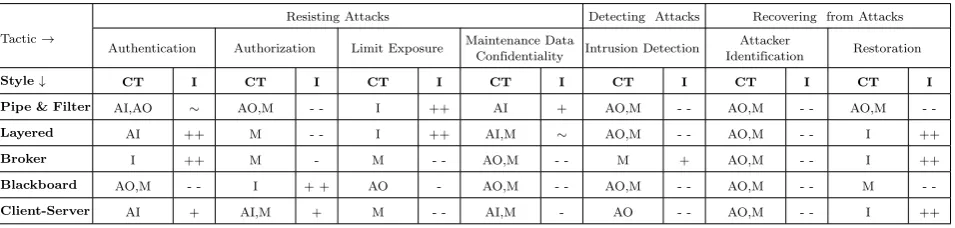
Security tactics are used to meet security quality at-tributes in the architectural styles. Therefore, inter-action between these tactics and architectural styles should be determined. Table2shows our findings for interaction between security tactics (see Figure2) and common architectural styles through magnitudes of –, ++, +, -,∼and types of changes (i.e., Implemented
in (I), Add in the Style (AI), Add out of the Style (AO) and Modify (M)). As stated in the previous sec-tion, in order to determine interaction between the tactics and architectural styles, six types of changes are considered. To implement a tactic in an architec-tural style, it may require more than one change. The impact magnitude of the interactions are determined according to Table1.
Implementation and impact of 5 security tactics in the architectural styles are explained as follows:
Table 2. Interaction between security tactics and common architectural styles Legends:CT: Change Type,I: Impact
Tactic→
Resisting Attacks Detecting Attacks Recovering from Attacks
Authentication Authorization Limit Exposure Maintenance Data
Confidentiality Intrusion Detection
Attacker
Identification Restoration
Style↓ CT I CT I CT I CT I CT I CT I CT I
Pipe & Filter AI,AO ∼ AO,M - - I ++ AI + AO,M - - AO,M - - AO,M
-Layered AI ++ M - - I ++ AI,M ∼ AO,M - - AO,M - - I ++
Broker I ++ M - M - - AO,M - - M + AO,M - - I ++
Blackboard AO,M - - I + + AO - AO,M - - AO,M - - AO,M - - M
-Client-Server AI + AI,M + M - - AI,M - AO - - AO,M - - I ++
the broker component and there is a connection be-tween the client and broker. Consequently, this tactic lies in the “Implemented in” category. In this case, one component changes and its impact magnitude is “++” (see Table1).
User Authorization Tactic in and Blackboard Style: The blackboard style includes a control com-ponent for authorizing users; so, type of this change is “Implemented in”, inasmuch as the control component controls the blackboard routinely. Since only this component changes, the impact magnitude is “++” (see Table1).
Maintaining data confidentiality Tactic and Layer Style: As Figure2shows, “maintaining data confi-dentiality” is a Security tactic. If a layered software should operate within a secure environment and all the software layers belong to a process, a layer would be re-sponsible to encrypt the software output. In this case, the type of change is “Add the in Style”, inasmuch as it follows the style structure. Since a layer is added, regarding the Table1, its impact is “++”. If the lay-ered software operates within an insecure environment and each layer is a separate process, the layers should change so that the output of each layer is encrypted; accordingly, each layer input data should be decrypted before processing (starting from the bottom layer). Such changes are called the “Modify” type because layers should change for the encryption and decryp-tion purposes. Since all layers should be changed and the number of layers is usually more than 3, its im-pact magnitude is “–” (see Table1). Thus, the impact magnitude of this tactic depends on the layers imple-mentation and it is positive or negative. Consequently, the final impact magnitude for this tactic is “∼”.
Intrusion detection Tactic and Client-Server Style:
As Figure2shows, the “Intrusion detection” is a Se-curity tactic. In this tactic, opening software ports should be supervised; this is implemented as an in-dependent process. A monitor component is added to monitor the software opened ports. The type of this change is “Add out of the Style”, inasmuch as the added monitor component (along with its
connec-tions to the style components) does not follow the style structure. Since the number of changes is more than 3, the impact magnitude of this tactic is “–” (see Table1).
Restoration Tactic and Pipe & Filter Style: As Figure 2 shows, “Restoration” is a Security tactic. In this tactic, the compatible state should be saved and the incompatible state should be restored to the compatible state. However, the “Pipe & Filter” style has no state and it acts on a data stream. Consequently, a component should be added for monitoring the style operation in order to save software states. Therefore, types of changes of this tactic are as follows: because of using the monitor component, type of change is the “Add out of the Style”, which it does not follow the style structure. For a filter component, type of change is “Modify”, inasmuch as filters should be modified to send their states to the monitor component. Thus, we can conclude that the number of changes is more than 3 and the impact magnitude is “- -” (see Table1).
6
Interaction
Between
Availability
Tactics and Common Architectural
Styles
Availability tactics are used to meet the availability quality attribute of the architectural styles. There-fore, the interaction between availability tactics and architectural styles should be determined. Tables3
and 4show our findings about the availability tactics. The tables show the interaction between availability tactics and architectural styles of Pipe & Filter, Lay-ered, Blackboard, Client-Server and Broker. As stated in Section 5, the interaction between tactics and ar-chitectural styles leads to six types of changes in the structure and behavior of architectural styles. For the tactic implementation in an architectural style, it may require more than one change.
mag-Table 3. Interaction between availability tactics and common architectural styles Legends:CT: Change Type,I: Impact
Tactic→ Fault Detection Recovering/Reintroduction
Ping/Echo Heartbeat Exception Checkpoint
Rollback Shadow
Stat Resynchro-nization
Style↓ CT I CT I CT I CT I CT I CT I
Pipe & Filter AO,M - - AO,M - - AO,M - - AO,M - - AI + AO,M
-Layered AI,M + AI,M + I ++ I ++ R,AI + M,AI +
Broker I ++ M + M + I ++ I ++ I ++
Blackboard M ∼ M ∼ M - - M - - AO,R - M +
Client Server AI,M + AI,M + M + I ++ AI,R + AI,M +
Table 4. Continued from Table3
Tactic→ Recovery,Preparation and Repair Prevention
Voting Active Redundancy
Passive
Redundancy Spare Transaction
Removal from Service
Style↓ CT I CT I CT I CT I CT I CT I
Pipe & Filter AI + R + R,M - AI + M ∼ AO
-Layered AI,M + R,AI + M,R - M,R ∼ I ++ M,AI ∼
Broker I ++ I ++ M + I ++ I ++ I ++
Blackboard AI,M + R,M + M,R ∼ M,R ∼ M - - AO
-Client Server AI + AI,R + AI,R,M + AI,I + I ++ AO ∼
nitude of impact are: –, ++, +, -, ∼ (see Tables3
and 4). Implementation and impact of 5 availability tactics in the architectural styles are as follows:
Ping/ Echo Tactic and Layer Style: As Figure3
shows, this tactic is an Availability one. In this tactic, an additional component is required to send the ping massage. If all layers belong to one process, the top layer responds to the sender layer by the ping mes-sage, which called the echo message. If each layer is a separate process, each layer sends the ping message to its adjacent lower layer before echoing the response to its upper layer. In fact, ping and echo messages are exchanged hierarchically. Thus, this change lies in the “Add in the Style” type because it follows the style structure. On the other hand, to respond to the ping message via the echo message, layers should change; so, this change lies in the “Modify” category. Regard-ing Table1, the final impact magnitude of this tactic is “+”, inasmuch as the number of changes is more than one. The first change is adding a layer for send-ing the psend-ing message with the impact magnitude “++” and the second one is the change of layers to respond via the echo message with the impact magnitude “-”.
Checkpoint and roll back Tactic and Blackboard Style: As Figure3shows, this tactic is an
Availabil-ity tactic. Since determination of checkpoints: (1) is awkward for rolling back and (2) it contradicts the blackboard idea, an alternative method should be used to log all inputs. Nevertheless, this method is awkward and needs large storage. Therefore, the blackboard component requires significant changes. In this case, the type of change is “Modify” and the number of changes is more than 3. Thus the impact magnitude is “–” (see Table1).
Shadow Tactic and Broker Style: As Figure 3
shows, this tactic is an Availability tactic. In the Broker style, the broker component is a suitable component for monitoring servers. It saves states of servers and marks them as shadow until they return to their normal operations. Since the broker compo-nent typically controls servers operations, the type of change is “Implemented in” and its impact magnitude is “++” (see Table1).
struc-ture remains unchanged and some additional filters are added, this change lies in the “Add in the Style” type. As the number of added components is more than 3 (a couple of voter filters and a voting filter), the impact magnitude is “+” (see Table1).
Active Redundancy Tactic and Client-Server Style: As Figure3shows, this tactic is an Availabil-ity tactic. In this tactic, servers are replicated and a central component is required for sending a request to each server and for concurrent distribution of the request among redundant servers. Response of the main and redundant servers are sent to the client and central component respectively. If a fault occurs, the result is sent to the client via the central component. The central component plays the client role to the server. Since these changes lead to the style structure, types of the changes are: “Add in the Style” due to incorporation of the central component to the style and “Replicates” due to replication of the servers. Since the number of changes is 2 at least, the impact magnitude is “+” (see Table1).
7
Interaction Between Performance
Tactics and Common Architectural
Styles
Since the performance tactics are used to meet the per-formance quality attributes in the architectural styles, the interaction between performance tactics and archi-tectural styles should be determined. Table5shows our findings about the performance tactics where the interaction between performance tactics and archi-tectural styles of Pipe & Filter, Layered, Blackboard, Client-Server and Broker is determined. As stated in Section 5, in order to describe the interaction between tactics and architectural styles, six types of changes in the structure and behaviour of architectural styles were introduced. For the implementation of a tactic in an architectural style, it may require more than one change and the impact magnitude of the inter-action is determined according to Table1. Types of changes include Implemented in (I), Replicates (R), Add in the Style ( AI ), Add out of the Style (AO) , Modify (M). Table5shows the magnitude of impacts (–,++,+,-,∼) for performance tactics (see Figure3).
Implementation and impact of 5 performance tactics in the architectural styles are explained as follows:
Increasing computational efficiency Tactic and Layer Style: As Figure 4 shows, this tactic is a Performance tactic. In the Layer style, each layer performs a separate task; accordingly, the embedded algorithms in layers should be optimized to increase the computational efficiency. To this end, all layers
should change. Thus, the type of this change is “Mod-ify”. Since some layers change, its impact magnitude is minus “-” (see Table1).
Computational overhead reduction Tactic and Blackboard Style: As Figure 4 shows, this tactic is a Performance tactic. To implement this tactic, a monitor component is required to monitor knowledge sources. If a knowledge source has no request for processing, it would be removed from the service. Therefore, the need to processing requests are reduced leading to decrease computational overhead. Because the monitor component does not follow the style structure, the type of change is “Add out of the Style”. The monitor component along with its connections to knowledge sources are added and the knowledge sources should be changed; so, the type of this change is “Modify”. Thus the number of changes is more than 3 and its impact magnitude is “- -” (see Table1).
Introducing Concurrency Tactic and Pipe & Filter Style: As Figure4shows, this tactic is a Performance tactic. In this style, filters should act in parallel when requests arrive. Since filters normally process requests in parallel, the type of change is “Implemented in” and regarding the Table1, the impact magnitude is “+ +”.
Maintaining multiple copies Tactic and Client-Server Style: As Figure 4 shows, this tactic is a Performance tactic. To implement this tactic in this style, the server is copied to the client side so that it becomes a local server for the client. The main server updates are sent to the copied server and so the main server changes; accordingly, the change type is “Mod-ify”. Indeed, during sending updates, the main server plays role of a server and the copied server plays the client role. Therefore, the style structure remains un-changed. This change type is “Replicates” because the server was copied. Since some copies were added to the style, the impact magnitude is “+” (see Table1).
Table 5. Interaction between performance tactics and common architectural styles Legends:CT: Change Type,I: Impact
Tactic→
Resource Demand Resource Management Resource Arbitration
Computational Efficiency
Increase
Computational Overhead
Reduce
Event Rate Management
Sampling Control Frequency
Concurrency Introduction
Multiple Copies Maintenance
Resources Available Increase
Policy Scheduling
Style↓ CT I CT I CT I CT I CT I CT I CT I CT I
Pipe & Filter M - M,AO - - M,AO - - AI + I ++ AO,R - - M ∼ M
-Layered M - AO - M,AI ∼ AI + R,AI + M - M ∼ M
-Broker M + M,AO - - AO,M - M + R,M ∼ AO,R ∼ M ∼ M +
Blackboard M + AO,M - - AO - - M + I ++ AO,M,R - - M ∼ M +
Client Server M + M,AO - - M,AO - AI + R + R,M + M ∼ AO,M
-8
Common Architectural Styles
Rank-ing to Satisfy the Quality Attributes
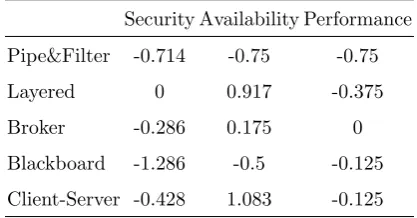
We calculate the average of impact magnitude for each style using Tables2, 3, 4and 5and by assigning a number to each impact magnitude scale (which was introduced in Section 5). In these tables, we use 5 point scale adopted from [23]where the notations of “++”, “+”, “–”, “-” and “∼” are replaced by numbers +2, +1, -2, -1 and zero respectively, [23]. The row average for the mentioned tables is given in Table6.
Table 6. Average of impact magnitude of tactics in common architectural styles
Security Availability Performance Pipe&Filter -0.714 -0.75 -0.75
Layered 0 0.917 -0.375
Broker -0.286 0.175 0
Blackboard -1.286 -0.5 -0.125 Client-Server -0.428 1.083 -0.125 In an architectural style, being more positive signs in a tactic impact magnitude indicates that the style structure has a better consistency to implement the tactic. According to the Table6, the consistency of common architectural styles in implementation of (a) security, (b) availability and (c) performance tactics are:
a) Layer, Broker, Clientserver, Pipe & Filter and Blackboard
b) Broker, ClientServer, Layered, Blackboard and Pipe & Filter
c) Broker, ClientServer, Blackboard, Layered and Pipe & Filter
We explained the interaction of the security, avail-ability and performance tactics with common archi-tectural styles in Sections6to8. Then, we calculated the impact average of all mentioned tactics where the impact average indicates the style consistency in
im-plementation of the tactics. The tactics determine how to implement quality attributes in the architectural styles. To rank an architectural style based on the intended quality attributes, we define Table6as the following Equations.
In the next step, we define priority of security, avail-ability and performance as a matrix, say,q3×1based
on the software developers’ demand. A weight at [0,1] interval is assigned to each quality attribute in range of 0% to 100% by the software developers. The first three entries in matrix q indicates security, availability and performance quality attributes, respectively. In the next step, we suggest Equation1to rank the archi-tectural styles based on the desired quality attributes.
R=ST ×q (1)
Each one of the entry values in matrix R indicate an architectural style compatibility. Indeed, each matrix entry in R determines rank of an architectural style in satisfaction of an intended quality attribute where the more positive entries indicates the higher rank. The evaluation is presented with a case study where requests of mail order companies are collected. 8.1 Case study: Collective Ordering System
a. Given that the software developer has attached important (weight) of 65% and 35% to the system security and performance respectively; Eq. 2is obtained.
qa=
0.65 0 0.35
. (2)
Using Equation 1 and replacing q by Equa-tion 2, the styles rank is determined by Equa-tion3.
Ra=
−0.726 −0.1312 −0.1859 −0.8796 −0.3219
. (3)
Equation3shows that the most positive num-ber is assigned to the layer style. Consequently, to design this software the layer style is the best choice.
b. If weights (important) of security and availability are suggested as 60% and 40% by the software developer respectively, then the following Eq.4
is obtained:
qb=
0.6 0.4 0 . (4)
Using Equation1and replacing q by Equation4, the rank of styles is determined by Equation5.
Rb=
−0.728 +0.376 +0.528 −0.972 +0.176
. (5)
Equation 5 shows that the broker style is the most positive one; therefore, it is suggested to the software developer.
c. If weights, 70% and 30% are suggested for avail-ability and performance respectively by the sys-tem developer, then Eq.6is obtained:
qc= 0 0.7 0.3
. (6)
Using Equation1and replacing q by Equation6, styles rank is determined by Equation7.
Rc=
−0.75 +0.5249
+1.225 −0.3875 +0.7206
. (7)
That the broker style is the most positive one is shown here; therefore, it is suggested to the software developer.
d. If weights of 70%, 10% and 20% are suggested for security, availability and performance by the software developer respectively, then q in Eq.1
is replaced by Eq.8.
qd=
0.7 0.1 0.2
. (8)
Using Equation1and replacing q by Equation8, the styles rank is determined by Equation9.
Rd=
−0.725 +0.017 −0.025 −0.975 −0.216
. (9)
That the Layered style is the most positive one is shown here; therefore, it is suggested to the software developer.
9
Conclusion
Architectural tactics are intersection point of qual-ity attributes and architectural styles. Indeed, archi-tectural tactics determine how to implement quality attributes in architectural styles. In this article, the interactions between “security”, “availability” and “performance” tactics and common architectural styles were determined. According to the average of values that were obtained through the interaction between architectural tactics and architectural styles, the com-patibility of common architectural styles in implemen-tation of, (a) “security”, (b) “availability” and (c) “performance” tactics are as follows, respectively:
a) Styles Layered, Broker, ClientServer, Pipe & Fil-ter and Blackboard
b) Styles Broker, ClientServer, Layered, Blackboard and Pipe & Filter
Moreover, a new approach was proposed to rank com-mon architectural styles based on the intended quality attributes. Using this approach, software developers can determine the best architectural style for every individual quality attribute or their combinations. In this approach, the following steps were taken:
- Determining the interactions between mentioned tactics and common architectural styles, - Calculating and defining the average impact of
tactics as a matrix,
- Defining the quality attributes priority of security, availability and performance as a matrix based on the software developers demands,
- Acquiring the best architectural style via defini-tion of a new equadefini-tion.
Acknowledgements
Authors like to thank University of Kashan for sup-porting this study by Grant No. 92/6188.
References
[1] Paul Clements, Felix Bachmann, Len Bass, David Garlan, James Ivers, Reed Little, Robert Nord, and Judith Stafford. Documenting Software Ar-chitectures: Views and Beyond. SEI series in soft-ware engineering. Addison-Wesley, Boston, MA, 2003. ISBN 9780201703726.
[2] Nick Rozanski and Eoin Woods.Software Systems Architecture: Working With Stakeholders Using Viewpoints and Perspectives. Addison-Wesley, USA, Massachusetts, 2005. ISBN 0321112296. [3] Mohamad Kassab. Non-Functional
Require-ments: Modeling and Assessment. VDM
Verlag, Germany, 2009. ISBN 3639206177, 9783639206173.
[4] K. Saleh and A. Al-Zarouni. Capturing non-functional software requirements using the user requirements notation. InThe International Re-search Conference on Innovation in Information Technology (IIT’04), pages 222–230, 2004. [5] Len Bass, Paul Clements, and Rick Kazman.
Soft-ware Architecture in Practice. Addison-Wesley Professional, USA, Massachusetts, 3rd edition, 2012. ISBN 0321815734, 9780321815736. [6] S.H. Daajeh, R.E. Qutaish, and F.
Al-Qirem. A tactic-based framework to evaluate the relationships between the software product qual-ity attributes. International Journal of Software Engineering, 5(1):5–26, 2012.
[7] S.H. Daajeh, R.E. Qutaish, and F. Al-Qirem. Engineering dependability to embedded systems software via tactics. International
Jour-nal of Software Engineering and Its Applications, 5(4):45–62, 2010.
[8] Neil B. Harrison and Paris Avgeriou. How do ar-chitecture patterns and tactics interact? a model and annotation.Journal of Systems and Software, 83(10):1735–1758, 2010.
[9] Paris Avgeriou and Uwe Zdun. Architectural patterns revisited - a pattern language. In Euro-PLoP, pages 431–470, 2005.
[10] Val´erie Issarny and Jean-Pierre Benˆatre. Architecture-based exception handling. In
HICSS, 2001.
[11] George Fairbanks and D. Garlan. Just Enough Software Architecture: A Risk-Driven Approach. Marshall & Brainerd, USA, 2010. ISBN 9780984618101.
[12] M. V¨olter, M. Kircher, and U. Zdun. Remoting Patterns: Foundations of Enterprise, Internet and Realtime Distributed Object Middleware. Wiley Software Patterns Series. Wiley, England, 2013. ISBN 9781118725856.
[13] R.S. Pressman. Software Engineering: A Prac-titioner’s Approach. McGraw-Hill series in com-puter science. McGraw-Hill Higher Education, USA, 7th edition, 2010. ISBN 9780071267823. [14] Suntae Kim, Dae-Kyoo Kim, Lunjin Lu, and
Sooyong Park. Quality-driven architecture devel-opment using architectural tactics. Journal of Systems and Software, 82(8):1211 – 1231, 2009. ISSN 0164-1212. doi: http://dx.doi.org/10.1016/ j.jss.2009.03.102.
[15] Neil B. Harrison and Paris Avgeriou. Implement-ing reliability: The interaction of requirements, tactics and architecture patterns. In WADS, pages 97–122, 2009.
[16] Weihang Wu and T. Kelly. Safety tactics for soft-ware architecture design. InComputer Software and Applications Conference, 2004. COMPSAC 2004. Proceedings of the 28th Annual Interna-tional, pages 368–375 vol.1, 2004. doi: 10.1109/ CMPSAC.2004.1342860.
[17] Weihang Wu and Tim Kelly. Failure modelling in software architecture design for safety.SIGSOFT Softw. Eng. Notes, 30(4):1–7, May 2005. ISSN 0163-5948. doi: 10.1145/1082983.1083222. [18] Neil B. Harrison and Paris Avgeriou.
Incorporat-ing fault tolerance tactics in software architecture patterns. InSERENE, pages 9–18, 2008. [19] N. Harrison, P. Avgeriou, and Uwe Zdun. On
the impact of fault tolerance tactics on architec-ture patterns. In 2nd International Workshop on Software Engineering for Resilient Systems (SERENE 2010), New York, USA, April 2010. ACM.
soft-ware architecture styles. InThe 4th Malaysian Software Engineering Conference, 2008.
[21] M. K. Delhi Babu, P. Govinda Rajulu, A. Ra-mamohana Reddy, and A. N. Aruna Kumari. Se-lection of architecture styles using analytic net-work process for the optimization of software ar-chitecture. CoRR, abs/1005.4271, 2010.
[22] Shahrouz Moaven, Jafar Habibi, Hamed Ahmadi, and Ali Kamandi. A decision support system for software architecture-style selection. InSERA, pages 213–220, 2008.
[23] Matthias Galster, Armin Eberlein, and Mahmood Moussavi. Systematic selection of software archi-tecture styles. IET Software, 4(5):349–360, 2010. [24] Roger Champagne and Sebastien Gagn´e. Towards
automation of performance architectural tactics application. InWICSA, pages 157–160, 2011. [25] F.S. Babamir and Z. Eslami. Data security in
unattended wireless sensor networks through ag-gregate signcryption. TIIS, 6(11):2940–2955, 2012.
[26] F.S. Babamir and A. Norouzi. Achieving key pri-vacy and invisibility for unattended wireless sen-sor networks in healthcare. The Computer, 2013. Oxford University, doi: 10.1093/comjnl/bxt046, published online (May 8, 2013).
[27] Stephan Bode and Matthias Riebisch. Impact evaluation for quality-oriented architectural de-cisions regarding evolvability. In ECSA, pages 182–197, 2010.
Safieh Tahmasebipour received a Bache-lor of Science degree in software engineering from the University of Qom, Qom, Iran, 2010 with the thesis of “Simulation of nanoscale electrical discharge using MATLAB”. She re-ceived a Master of Science degree in Software Engineering from the University of Kashan, Kashan, Iran, 2012 with the thesis of “Qual-ity evaluation of software architecture styles using architectural tactics”. She has already authored 6 inter-national and internal conference papers.

![Figure 2. Architectural tactics of security [5]](https://thumb-us.123doks.com/thumbv2/123dok_us/41016.2004657/3.595.317.522.80.378/figure-architectural-tactics-of-security.webp)
![Table 1. Magnitude of Impact as a function of the number ofrequired changes[8]](https://thumb-us.123doks.com/thumbv2/123dok_us/41016.2004657/4.595.58.285.507.686/table-magnitude-impact-function-number-ofrequired-changes.webp)