DOI: 10.2478/10004-1254-64-2013-2219 Scientifi c paper
EXPOSURE TO URBAN AIR POLLUTION AND BONE
HEALTH IN CLINICALLY HEALTHY
SIX-YEAR-OLD-CHILDREN
Lilian CALDERÓN-GARCIDUEÑAS1, Antonieta MORA-TISCAREÑO2, Maricela
FRANCO-LIRA3, Ricardo TORRES-JARDÓN4, Bernardo PEÑA-CRUZ2, Carolina PALACIOS-LÓPEZ2,
Hongtu ZHU5, Linglong KONG5, Nicolás MENDOZA-MENDOZA2, Hortencia
MONTESINOS-CORREA2, Lina ROMERO2, Gildardo VALENCIA- SALAZAR2, Michael KAVANAUGH1,
Silvestre FRENK2
The Center for Structural and Functional Neurosciences, The University of Montana, Missoula, MT, USA1, Instituto
Nacional de Pediatría2, Hospital Central Militar3, Centro de Ciencias de la Atmósfera4, Universidad Nacional
Autónoma de México, Mexico City, Mexico, Biostatistics, University of North Carolina Gillings School of Global Public Health, Chapel Hill5, NC, USA
Received in February 2012 CrossChecked in December 2012
Accepted in July 2012
Air pollution induces systemic infl ammation, as well as respiratory, myocardial and brain infl ammation in children. Peak bone mass is infl uenced by environmental factors. We tested the hypothesis that six-year-olds with lifetime exposures to urban air pollution will have alterations in infl ammatory markers and bone mineral density (BMD) as opposed to low-polluted city residents when matched for BMI, breast feeding history, skin phototype, age, sex and socioeconomic status. This pilot study included 20 children from Mexico City (MC) (6.17 years ± 0.63 years) and 15 controls (6.27 years ± 0.76 years). We performed full paediatric examinations, a history of outdoor exposures, seven-day dietary recalls, serum infl ammatory markers and dual-energy X-ray absorptiometry (DXA). Children in MC had signifi cantly higher concentrations of IL-6 (p=0.001), marked reductions in total blood neutrophils (p= 0.0002) and an increase in monocytes (p=0.005). MC children also had an insuffi cient Vitamin D intake and spent less time outdoors than controls (p<0.001) in an environment characterized by decreased UV light, with ozone and fi ne particulates concentrations above standard values. There were no signifi cant differences between the cohorts in DXA Z scores. The impact of systemic infl ammation, vitamin D insuffi ciency, air pollution, urban violence and poverty may have long-term bone detrimental outcomes in exposed paediatric populations as they grow older, increasing the risk of low bone mass and osteoporosis. The selection of reference populations for DXA must take into account air pollution exposures.
KEY WORDS: DXA, particulate matter, systemic infl ammation, UV light, vitamin D insuffi ciency
Environmental pollutants, chemicals and metals have a negative health impact on children (1, 2). There is evidence that exposure to air pollution can result in long-lasting health problems (3-10). Vitamin D defi ciency and rickets are associated with air pollution,
infl ammation, regulates immune responses and has osteoclastic effects with its increased bone-resorption (13). Several studies involving elderly populations have shown that cumulative air pollution concentrations are inversely associated with total body bone mineral density (BMD) (14).
Since childhood and adolescence are crucial periods for skeletal and biochemical bone change, children are a population at risk. Given that nutritional vulnerability is a key aspect in children’s growth, our pilot study focused on the evaluation of the impact of air pollutant exposures in two cohorts of six-year-old children residents of two environments with distinctly different levels of pollution.
The primary purpose of this work was to evaluate the bone mineral density as measured by the dual-energy X-ray absorptiometry (DXA) in six-year-olds with a lifetime residency in a highly polluted city (Mexico City) versus a control group from a city with levels well below the current USA National Ambient Air Quality Standards (NAAQS) (Polotitlán, Mexico State). We aimed to identify possible associations between blood infl ammatory markers, bone mineral density and nutritional intake in the selected cohorts. Due to the fact that Mexico City children spend less time outdoors and live in a UV blocking environment caused by smog, we expected to fi nd alterations in DXA measurements and infl ammatory markers.
Air pollution
The Mexico City metropolitan area is the largest urban centre of North America and an example of extreme urban growth as well as of the accompanying environmental pollution (15). This metropolitan area of over 2000 square kilometres lies in an elevated basin 2240 m above mean sea level, while its urbanized area is surrounded on three sides by mountain ridges with a broad opening to the north and a narrow gap to the south-southwest. In this geographical setting, 20 million inhabitants (including 9 million children), over 40,000 industries and 4 million vehicles consume more than 40 million litres of petroleum fuels per day, producing an estimated annual emission of 2.6 tons of pollutants including coarse and fi ne particulate matter, gaseous pollutants, polycyclic aromatic hydrocarbons, and lipopolysaccharides (15). As a result of high emissions of secondary precursors (nitrogen oxides and volatile organic compounds), ozone concentrations peak in the downwind southwest area in the afternoon, in accordance with the typical diurnal wind transport of air polluted masses. The
higher short-term (i.e., hourly averages) fi ne particulate matter (particles with a diameter less than 2.5 μm,
PM2.5) concentrations coincide with periods when
children are outdoors during school recess and
physical education, whereas maximal O3 levels
coincide with when they play outdoors at home (16).
Due to high traffi c density and increased energy usage, MC suffers from high levels of particulate black carbon (BC) pollution (15). The dominant light-absorbing aerosol species in the region is likely to be BC, commonly known as carbon soot, as well as the associated organic carbon, both of which are produced by diesel engines within the urban area and by the incomplete combustion of fossil fuel biomass burning in the surrounding rural areas. The absorption of solar light by freshly emitted BC aerosols is broadband, although they are more effi cient in the UVB range (280 nm to 315 nm). The presence of highly absorbing fi ne mode aerosols in MC is expected to reduce the UV fl ux at ground level and therefore lessen the photochemical production of oxidants such as ozone (17). However, under certain meteorological circumstances, the presence of fi ne mode scattering aerosols in the boundary layer of the Mexico City air basin that are similar in size as the wavelength of the incoming UV radiation may also increase in the UV-B fl ux at ground level. This is due to their ability to strongly scatter light in the forward direction. In turn, this increase in UV-B fl ux leads to an increase in photochemical pollution (18). Nevertheless, the net reduction effect in UV-B radiation is predominant (18).
The selection of children from Southwest Mexico City (SW MC) was based on three factors: i. the SW location of the paediatric hospital, ii. children living and attending school close to the hospital, and iii. the location of the MC air pollution monitoring stations: Pedregal and Coyoacán. The control city Polotitlán is a small town 2300 m above mean sea level and 73 miles Northwest of Mexico City with an estimated population of 3000 residents. Its main activity is agriculture along with a few small dairy plants. In contrast to Mexico City, in Polotitlán all criteria
pollutants (O3, PM10, SO2, NO2, CO and Pb) are below
PROCEDURES
Study areas and children’s cohorts
This prospective pilot protocol was approved by the review boards and ethics committee at the Hospital Central Militar, and performed according to the Declaration of Helsinki. Written consent was obtained from parents and verbal consent from the children. The geographic areas selected for this study were Southwest Mexico City and Polotitlán. The children belonged to the same socioeconomic status and attended public schools with identical academic and physical education curricula.
Participants
This study includes data from 20 children from
Mexico City (Mean age = 6.17 years, SD = 0.63 years)
and 15 control children (Mean age = 6.27 years, SD =
0.76 years). The criteria for clinical inclusion were: a negative smoking history and environmental tobacco exposure, lifelong residency in MC or in the control city, residency within 5 miles of the city monitoring stations, full term birth, breastfeeding period of ≥ 6 to ≤ 12 months, and unremarkable clinical histories. The exclusion criteria included: i. height or weight below the third percentile or above the 97 percentile ii. premature birth, iii. a history of any type of fracture, iv. any systemic disease, v. intake of any prescribed or other medications including vitamins and dietary supplements vi. a fi rst degree relative with primary osteoporosis. Outdoor daily exposures in hours per day were recorded by the mother during seven days, including the transit time to and from school, the time spent on recess and physical education during school, and outdoor time while playing and engaging in other activities.
Paediatric and dermatological examination
Complete clinical histories were performed and the children underwent physical examinations. The dermatologist examined the children to establish the type of skin according to the Fitzpatrick Classifi cation Scale (19). Fasting blood samples were collected between 7:00 and 9:00 am. Blood samples in the MC cohort were collected the same week as in the control cohort.
Evaluation of nutritional intake
A paediatric nutritionist interviewed the child and asked the mother to keep a detailed written seven-day food intake record, including the weekend.
Peripheral blood analysis
Blood samples were taken for a Comprehensive Metabolic Panel (CMP) and custom made human Multiplexing Laser Bead Technology (Eve Technologies Corporation, Calgary, Alberta, Canada) for the quantification of the following markers: epidermal growth factor EGF, Eotaxin, fi broblast growth factor-2 FGF-2, Fit-3L, Fractalkine, Granulocyte colony stimulating factor G-CSF, Granulocyte/ macrophage colony stimulating factor GM-CSF, Growth-related oncogene GRO, Interferon alpha 2 IFNα2, Interferon gamma IFN γ, Interleukin 1 alpha IL-1α, IL-1β, IL-1ra, IL-2, IL-3, IL-4, IL-5, IL-6, IL-7, IL-8, IL-9, IL-10, IL-12 (p40), IL-12 (p70), IL-13, IL-15, IL-17, Inducible protein 10 IP-10, Monocyte chemotactic protein MCP-1, MCP-3, Macrophage infl ammatory protein 1 alpha MIP-1α, MIP-1β, Platelet-derived growth factor PDGF-AA, PDGF-AB/BB, Regulated upon Activation, Normal T-cell Expressed, and Secreted protein RANTES, Soluble CD40 ligand sCD40K, Membrane bound/ soluble IL-2 receptor alpha sIL-2Rα, Transforming growth factor alpha TGFα, Tumour necrosis factor alpha TNF α, TNF β, and Vascular endothelial growth factor VEGF.
TLR4 Genotyping
DNA was isolated from peripheral blood and genotyped for the presence of the Asp299Gly Toll-like receptor-4 (TLR-4) polymorphism, using an allelic discrimination assay protocol according to Applied Biosystems (Life Technologies Corporation, Carlsbad, CA).
Dual energy X-ray absorptiometry (DXA)
The entire body, spine, bilateral forearm and femur scans were acquired by a Lunar Prodigy Advance Encore 2004, General Electric using the Lunar version 8.80 software. Given that our main focus was exposure to distinct polluted environments, and considering that the selected children were healthy, we used Z scores based on the low-pollution matched population and compared them to the exposed MC children.
Measurement of bone age
Data analysis
The univariate descriptive measurements of the two groups’ characteristic variables were calculated along with 95 % confi dence intervals and p values of two sample t-tests for differences between two group means. The Gaussian distribution was assumed in the inference procedures, i.e. confi dence intervals and two sample t-tests. The laboratory data and nutritional intake data were analysed using the same method as the characteristic variables assuming Gaussian distribution. A paired t-test was used to compare the mean difference between the chronological and bone age of Mexico City children and the controls assuming Gaussian distribution. The Z-score of the BMD DXA was calculated based on the control population with life exposures to air pollutants below the standards. For calculating Z scores, the BMD value was X, while MU and SIGMA were the mean and standard deviation of that variable of the control population, respectively. The Z-score of X was defi ned as (X-MU)/SIGMA. The Z-scores were analysed using inference procedures such as laboratory data and nutritional intake data. Simple linear regression was conducted between total peripheral neutrophils and DXA variables. The r-squares of linear regression and p values for testing linear relationship were calculated. Statistical analyses were performed using R version 2.13 (http://www.r-project.org/). Univariate descriptive measurements were summarized as mean values ±standard deviations. Signifi cance was assumed if either 95 % confi dence
intervals did not cover zero or at p<0.05. The strength
of the simple linear relationship was summarized as r-squares.
RESULTS
Air pollution levels
Mexico City children involved in this study had
been exposed to signifi cant concentrations of O3 and
particulate matter (PM) for their entire life (15). The climatic conditions in MC are relatively stable and thus pollutant concentrations are consistent year after year. In the years from 2007 through 2009, which
includes the study period, PM2.5 annual average
concentrations in SW MC were (16.84±8.04) μg m-3;
(17.96±8.34) μg m-3; and (18.39±8.69) μg m-3,
respectively (the US EPA annual standard calls for an
PM2.5 annual average limit of 15 μg m-3). In addition,
the fourth highest daily maximum 8-hour average ozone concentrations for the same years in that same
part of MC were 240 μg m-3 (0.121 ppm), 250 μg m-3
(0.126 ppm) and 244 μg m-3 (0.123 ppm), respectively
(the ozone US EPA air quality standard stands for an annual fourth-highest daily maximum 8-hour
concentration of 149 μg m-3 (0.075 ppm). In the control
location, pollutant concentrations had been below the current US EPA standards since 2003 (21). UV-B levels at ground level had been lower in MC than in the surrounding rural locations because of the attenuation effect of the polluted urban air in Mexico City (22). Typically, the UV-B reduction increases from Northeast towards Southwest over MC following the same spatial pattern of the oxidant levels. Acosta and Evans (22) reported that by 1996, the reduction in UV-B in the urban area was greater than 40 % compared with surrounding rural areas in highly polluted days, while the yearly average reduction was around 20 %. Even though this effect has been diminished in the last decade due to the decrease in air pollution levels, the UV light reduction persists due to the presence of highly absorbing aerosols (17).
Demographic data and physical exams
Table 1 summarizes the characteristics of the matched samples. There were 15 children from Polotitlán (8 female, 7 male) and 20 children from Mexico City (8 female, 12 male). Controls spent more time outdoors than MC kids [CTL (4.3±0.5) h, MC
(3.5±0.2) h, p<0.001]. The predominant skin type was
type IV with 14 % of children with type III skin.
Laboratory fi ndings
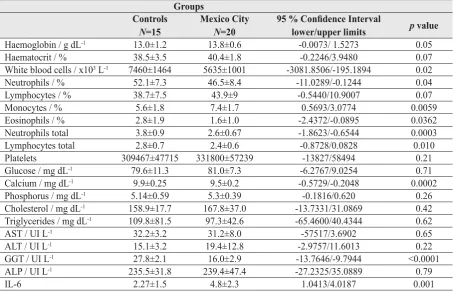
Mexico City children exhibited signifi cantly higher
IL6 concentrations (p=0.001), while they had
signifi cant reductions in WBC (p=0.0002) and total
neutrophils (p=0.0002), and increases in monocytes
(p=0.005) (Table 2). There were no significant
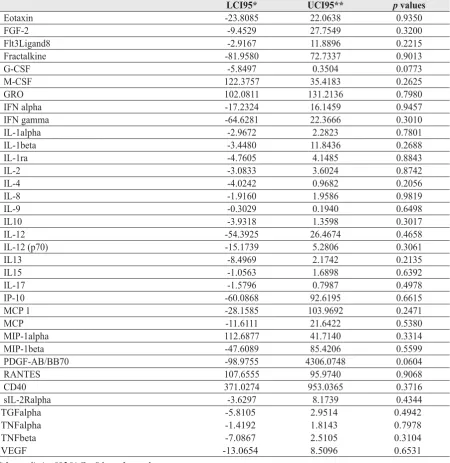
differences in the concentrations of the custom made human Multiplexing Laser Bead Technology infl ammatory panel, except IL-6 (Supplemental Table 1). Total serum alkaline phosphatase was within normal limits in both cohorts. GGT and Ca concentrations were signifi cantly higher in Controls
(p<0.0001 and p<0.0002, respectively) but remained
Table 1 Characteristics of the groups of children studied: Mexico City versus controls
Groups Controls
N=15
Mexico City
N=20
Confi dence Intervals Lower / upper limits
p value
Birth weight / g 2952±655 3144±411 -206.8039/592.5039 0.32 Weight / kg 20.4±3.94 21.2±3.5 -1.9129/3.3795 0.57 Height / m 1.15±0.06 1.14±0.04 -0.0442/0.0375 0.86 BMI / kg m-2 15.14±2.23 15.99±1.84 -0.6066/2.3009 0.24
Outdoor / h 4.3±0.5 3.5±0.2 <0.001
Gender 8F/7M 8F/12 M
Skin type * IV13/III 2 IV 17/III 3
Note: The numerical values shown in the table represent means ± 1 standard deviation as well as 95 % confi dence intervals and p values of two sample t-test for difference between two group means. *The skin classifi cation was based on the Fitzpatrick Classifi cation Scale
Supplemental Table 1 Profi le of infl ammatory mediators and differences between controls and Mexico City children
LCI95* UCI95** p values
Eotaxin -23.8085 22.0638 0.9350
FGF-2 -9.4529 27.7549 0.3200
Flt3Ligand8 -2.9167 11.8896 0.2215
Fractalkine -81.9580 72.7337 0.9013
G-CSF -5.8497 0.3504 0.0773
M-CSF 122.3757 35.4183 0.2625
GRO 102.0811 131.2136 0.7980
IFN alpha -17.2324 16.1459 0.9457
IFN gamma -64.6281 22.3666 0.3010
IL-1alpha -2.9672 2.2823 0.7801
IL-1beta -3.4480 11.8436 0.2688
IL-1ra -4.7605 4.1485 0.8843
IL-2 -3.0833 3.6024 0.8742
IL-4 -4.0242 0.9682 0.2056
IL-8 -1.9160 1.9586 0.9819
IL-9 -0.3029 0.1940 0.6498
IL10 -3.9318 1.3598 0.3017
IL-12 -54.3925 26.4674 0.4658
IL-12 (p70) -15.1739 5.2806 0.3061
IL13 -8.4969 2.1742 0.2135
IL15 -1.0563 1.6898 0.6392
IL-17 -1.5796 0.7987 0.4978
IP-10 -60.0868 92.6195 0.6615
MCP 1 -28.1585 103.9692 0.2471
MCP -11.6111 21.6422 0.5380
MIP-1alpha 112.6877 41.7140 0.3314
MIP-1beta -47.6089 85.4206 0.5599
PDGF-AB/BB70 -98.9755 4306.0748 0.0604
RANTES 107.6555 95.9740 0.9068
CD40 371.0274 953.0365 0.3716
sIL-2Ralpha -3.6297 8.1739 0.4344
TGFalpha -5.8105 2.9514 0.4942
TNFalpha -1.4192 1.8143 0.7978
TNFbeta -7.0867 2.5105 0.3104
VEGF -13.0654 8.5096 0.6531
TLR4 genotyping
All included children lack the Asp299Gly Toll-like receptor-4 (TLR-4) polymorphism, which is associated with a blunted response to lipopolysacharide (23).
Nutritional intake fi ndings
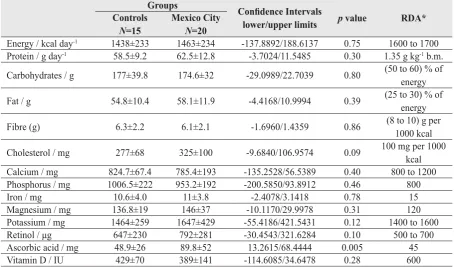
The nutritional intake based on a seven-day recall showed no differences in control and Mexico City children (Table 3), except for the intake of ascorbic acid that was signifi cantly higher in Mexico City
children (p= 0.005). Both cohorts exhibited a Vitamin
D intake below the daily requirement of 600 UI, the deficiency being more severe in MC children [(429±70) IU and (389±141) IU CTL and MC respectively]. For both cohorts, the Ca intake was near the lower acceptable threshold of the requirement for
age (800 to 1200) mg day-1.
Bone age results
There was a significant difference between chronological and bone age in Mexico City children
(p=0.03) based on the evaluation of the left wrist (20),
a difference that was not seen in the controls (p=0.15).
DXA results
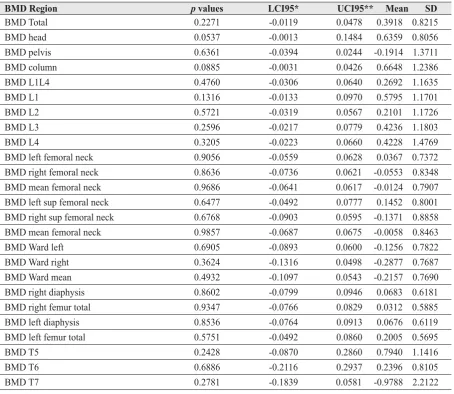
There were no statistical differences between groups in the BMD Z scores in the different anatomical regions (Table 4). Given the importance of infl ammation and air pollution, we performed a linear regression analysis between total peripheral neutrophils and DXA and other CBC variables including WBC, percentages and total numbers of monocytes, lymphocytes, etc. The analysis showed a positive association between
the percentage of body fat and neutrophils (r2=0.12,
p=0.03), while the number of monocytes correlated
with IL6 (r2=0.22, p=0.0116).
DISCUSSION
Mexico City six-year-olds exhibit signifi cantly higher concentrations of IL-6, have a Vitamin D insuffi ciency (24, 25), and spend less time outdoors.
Table 2 Peripheral blood variables and comparisons in control and Mexico City children.
Groups Controls
N=15
Mexico City
N=20
95 % Confi dence Interval
lower/upper limits p value
Haemoglobin / g dL-1 13.0±1.2 13.8±0.6 -0.0073/ 1.5273 0.05
Haematocrit / % 38.5±3.5 40.4±1.8 -0.2246/3.9480 0.07 White blood cells / x103 L-1 7460±1464 5635±1001 -3081.8506/-195.1894 0.02
Neutrophils / % 52.1±7.3 46.5±8.4 -11.0289/-0.1244 0.04 Lymphocytes / % 38.7±7.5 43.9±9 -0.5440/10.9007 0.07 Monocytes / % 5.6±1.8 7.4±1.7 0.5693/3.0774 0.0059 Eosinophils / % 2.8±1.9 1.6±1.0 -2.4372/-0.0895 0.0362 Neutrophils total 3.8±0.9 2.6±0.67 -1.8623/-0.6544 0.0003 Lymphocytes total 2.8±0.7 2.4±0.6 -0.8728/0.0828 0.010 Platelets 309467±47715 331800±57239 -13827/58494 0.21 Glucose / mg dL-1 79.6±11.3 81.0±7.3 -6.2767/9.0254 0.71
Calcium / mg dL-1 9.9±0.25 9.5±0.2 -0.5729/-0.2048 0.0002
Phosphorus / mg dL-1 5.14±0.59 5.3±0.39 -0.1816/0.620 0.26
Cholesterol / mg dL-1 158.9±17.7 167.8±37.0 -13.7331/31.0869 0.42
Triglycerides / mg dL-1 109.8±81.5 97.3±42.6 -65.4600/40.4344 0.62
AST / UI L-1 32.2±3.2 31.2±8.0 -57517/3.6902 0.65
ALT / UI L-1 15.1±3.2 19.4±12.8 -2.9757/11.6013 0.22
GGT / UI L-1 27.8±2.1 16.0±2.9 -13.7646/-9.7944 <0.0001
ALP / UI L-1 235.5±31.8 239.4±47.4 -27.2325/35.0889 0.79
IL-6 2.27±1.5 4.8±2.3 1.0413/4.0187 0.001
Even though changes in the DXA Z scores are not evident in this small cohort, the high concentrations of IL-6 and the vitamin D insuffi ciency are cause for serious concern. Interleukin 6 plays a key role in bone resorption and osteoporosis (26-32). Bones are targets of inflammation, with inflammatory cytokines promoting bone resorption which results in systemic bone loss (30). A clear example of an infl ammatory entity and a bone detrimental effect is infl ammatory bowel disease (IBD) (33). Patients with IBD demonstrate elevated levels of IL-6, TNF α and IL1β, all of which are associated with osteoclastic activity through the activation of p38 mitogen-activated protein kinase (MAPK) pathways (33, 34). Our previous study on older Mexico City children had shown elevated concentrations of TNF α and IL1β (5), thus a osteoclastic synergistic action is likely to be taking place as the children grow up in their polluted environment. TNF α and RANKL interact to potentiate two osteoclastogenic pathways: NFκB and the stress activated protein kinase/c-Jun NH2-terminal kinase activity (36).
TLR4 plays a critical role in the activation of IL-6 producing leukocytes (32) and LPS promotes
osteoclast activity and bone resorption (37). Both associations are also very relevant in Mexico City where children are exposed to signifi cant concentrations of lipopolysaccharides associated with particulate matter (6). Since 85 % of the Mexican population lacks the Asp299Gly Toll-like receptor-4 (TLR-4) polymorphism associated with a blunted response to lipopolysacharide (Calderón-Garcidueñas personal data), most Mexican children will be responsive to LPS and the activation of TLR4.
The characterization of infl ammatory osteoclastic pathways in exposed children, along with the genotyping of TLR4 key polymorphisms, is mandatory to defi ne whether critical mediators of bone loss are up-regulated and how bone responses evolve as the child grows up.
Exposure to sunlight is key for the skin conversion
of 7-dehydrocholesterol to pre-vitamin D3 and vitamin
D3; however, in the setting of air pollution, these
children get less UV light, spend less time outdoors, and their skin phototype is mostly type IV. All of these factors act synergistically to decrease Vitamin D availability. These issues are important for our paediatric populations because air pollution reduces
Table 3 Nutritional intake based on a seven day recall and comparisons in Control and Mexico City children age (6.2±0.69) years
Groups
Confi dence Intervals
lower/upper limits p value RDA* Controls
N=15
Mexico City
N=20
Energy / kcal day-1 1438±233 1463±234 -137.8892/188.6137 0.75 1600 to 1700
Protein / g day-1 58.5±9.2 62.5±12.8 -3.7024/11.5485 0.30 1.35 g kg-1 b.m.
Carbohydrates / g 177±39.8 174.6±32 -29.0989/22.7039 0.80 (50 to 60) % of energy
Fat / g 54.8±10.4 58.1±11.9 -4.4168/10.9994 0.39 (25 to 30) % of energy
Fibre (g) 6.3±2.2 6.1±2.1 -1.6960/1.4359 0.86 (8 to 10) g per 1000 kcal
Cholesterol / mg 277±68 325±100 -9.6840/106.9574 0.09 100 mg per 1000 kcal Calcium / mg 824.7±67.4 785.4±193 -135.2528/56.5389 0.40 800 to 1200 Phosphorus / mg 1006.5±222 953.2±192 -200.5850/93.8912 0.46 800 Iron / mg 10.6±4.0 11±3.8 -2.4078/3.1418 0.78 15 Magnesium / mg 136.8±19 146±37 -10.1170/29.9978 0.31 120 Potassium / mg 1464±259 1647±429 -55.4186/421.5431 0.12 1400 to 1600 Retinol / μg 647±230 792±281 -30.4543/321.6284 0.10 500 to 700 Ascorbic acid / mg 48.9±26 89.8±52 13.2615/68.4444 0.005 45 Vitamin D / IU 429±70 389±141 -114.6085/34.6478 0.28 600
UV light by 20 % on average (22) and the children’s diet becomes a critical source of vitamin D due to the inadequate exposure to sunshine (38). Our cohorts have an adequate caloric, protein, fat and carbohydrate intake but restricted access to fortifi ed Vitamin D foods and a low calcium intake. In a recent study on Mexican children, Elizondo-Montemayor et al. (39) found that 62.1 % of urban children had an insuffi ciency of
25-OHD (21 to 29) ng mL-1 and 20.2 % had a defi ciency
(<20 ng mL-1). The problem of Vitamin D defi ciency
among Mexican children is a serious health issue shared with one billion people worldwide (25, 39).
Given that the majority of bone mass is attained during adolescence and young adulthood, with almost 90 % of skeletal mass accumulated by age 18 (40), factors that influence bone mass accrual during
growth, including mechanical factors and calcium and vitamin D intake, become critical in populations like such as that of Mexico. Thus, we face serious social issues involving the negative impact on our children’s bone health: 1. during the lifetime of our cohorts, there had been a signifi cant rise in crime and violence in neighbourhoods (41) resulting in a marked decrease in the use of public spaces that used to host much of the children’s outdoor activities after school; 2. There are 52 million people in the country with incomes below the poverty line, including 11.7 million in
extreme poverty, 41 %of who are children(42).
Twenty one million children are in households below the poverty level and 77 % of these children live in urban areas. Poverty, food insecurity, and the deteriorating security conditions are affecting the
Table 4 Bone mineral density (BMD / g cm ) Z score, 95 % confi dence intervals, mean and SD, and p values between Controls and Mexico City children
BMD Region p values LCI95* UCI95** Mean SD
BMD Total 0.2271 -0.0119 0.0478 0.3918 0.8215 BMD head 0.0537 -0.0013 0.1484 0.6359 0.8056 BMD pelvis 0.6361 -0.0394 0.0244 -0.1914 1.3711 BMD column 0.0885 -0.0031 0.0426 0.6648 1.2386 BMD L1L4 0.4760 -0.0306 0.0640 0.2692 1.1635 BMD L1 0.1316 -0.0133 0.0970 0.5795 1.1701 BMD L2 0.5721 -0.0319 0.0567 0.2101 1.1726 BMD L3 0.2596 -0.0217 0.0779 0.4236 1.1803 BMD L4 0.3205 -0.0223 0.0660 0.4228 1.4769 BMD left femoral neck 0.9056 -0.0559 0.0628 0.0367 0.7372 BMD right femoral neck 0.8636 -0.0736 0.0621 -0.0553 0.8348 BMD mean femoral neck 0.9686 -0.0641 0.0617 -0.0124 0.7907 BMD left sup femoral neck 0.6477 -0.0492 0.0777 0.1452 0.8001 BMD right sup femoral neck 0.6768 -0.0903 0.0595 -0.1371 0.8858 BMD mean femoral neck 0.9857 -0.0687 0.0675 -0.0058 0.8463 BMD Ward left 0.6905 -0.0893 0.0600 -0.1256 0.7822 BMD Ward right 0.3624 -0.1316 0.0498 -0.2877 0.7687 BMD Ward mean 0.4932 -0.1097 0.0543 -0.2157 0.7690 BMD right diaphysis 0.8602 -0.0799 0.0946 0.0683 0.6181 BMD right femur total 0.9347 -0.0766 0.0829 0.0312 0.5885 BMD left diaphysis 0.8536 -0.0764 0.0913 0.0676 0.6119 BMD left femur total 0.5751 -0.0492 0.0860 0.2005 0.5695 BMD T5 0.2428 -0.0870 0.2860 0.7940 1.1416 BMD T6 0.6886 -0.2116 0.2937 0.2396 0.8105 BMD T7 0.2781 -0.1839 0.0581 -0.9788 2.2122
children’s quality of life and potentially even their bone health.
Bone health is critical in childhood and adolescent years (43). A compromised bone with decreased strength and altered microarchitecture will have detrimental effects during childhood and may leave permanent bone damage (43, 44). Low bone density in children is a serious issue; one that remains diffi cult to evaluate particularly in terms of long-term consequences (44-48). The association of low BMD and a history of at least one fragility fracture are required in order to diagnose osteoporosis in children (44, 47). The evidence of an association between lower than average BMD and a higher fracture rate, along with sustaining repeated fractures, especially at sites specifi c for bone weakness (i.e., the ultradistal radius), are pieces of information we need to include in future studies on older paediatric populations exposed to pollution.
Our studies in Mexico City have shown that lifelong exposures to a polluted environment,
including above standard concentrations of PM2.5, are
associated with signifi cant systemic infl ammation and immunodysregulation (4-6). The marked reduction of peripheral blood neutrophils observed in highly exposed Mexico City children in this work and in previous studies, along with high concentrations of endothelin-1, have been taken as strong evidence for endothelial activation and inflammation (4,6) Moreover, the increase in monocytes has been described upon exposure to particulate matter (49). An interesting association in this work is the positive relationship between body fat and the numbers of peripheral neutrophils, as well as between monocytes and IL-6 concentrations in keeping with the literature pointing to low-grade systemic infl ammation related to higher levels of body fat in children (50, 51).
The impact of the increased production of infl ammatory mediators with osteoclastic activity has to be taken into account when selecting DXA reference urban populations from polluted cities (52). Especially relevant are cities with concentrations of particulate matter (PM) above the current US National Ambient Air Quality Standards, and since people travel to and from larger cities, PM exposures should be taken into consideration through their well-documented systemic effects (9).
This pilot study is limited to the small number of children included; however, since the cohorts represent clinically healthy matched children with unremarkable clinical histories and representative of low and high
polluted urban areas, the results will be useful for planning future longitudinal studies.
In summary, this pilot study on Mexico City six-year-olds is a warning to paediatricians to carefully assess bone health in children residents of polluted megacities and small communities with high PM pollution, taking into consideration the presence of systemic infl ammation and Vitamin D and calcium dietary deficiencies (53, 54). There is a lack of appreciation among paediatricians that vitamin D status and physical activity are critical for skeletal health in young children and that the physician’s role is to provide recommendations to maximize the health of each individual child (25, 55). More paediatric research is needed to characterize the changes in bone metabolism in the setting of urban air pollution; measurements of circulating levels of 25-hydroxyvitamin D [25(OH)D], serum calcidiol (25 OH vitamin D(3), and the parathyroid hormone ought to be included.
There is urgent need to assess protective measures and nutritional supplementation in disadvantaged highly exposed Mexico City children.
The impact of air pollution, nutritional defi ciencies, urban insecurity and poverty may have long-term bone detrimental outcomes in exposed urban paediatric populations, potentially increasing their risk of low bone mass and osteoporosis.
Acknowledgements
This work is supported in part by P20 RR015583.
REFERENCES
1. Stein J, Schettler T, Wallinga D, Valenti M. In harm’s way: toxic threats to child development. J Dev Behav Pediatr 2002;23(Suppl 1):S13-22.
2. Wigle DT, Arbuckle TE, Walker M, Liu S, Krewskin D. Environmental hazards: evidence for effects on child health. J Toxicol Environ Health B Crit Rev 2007;10:3-39. 3. Calderón-Garcidueñas L, Mora-Tiscareño A, Fordham LA,
Valencia-Salazar G, Chung CJ, Rodriguez-Alcaraz A, Paredes R, Variakojis D, Villarreal-Calderón A, Flores-Camacho L, Antunez-Solis A, Henríquez-Roldán C, Hazucha MJ. Respiratory damage in children exposed to urban pollution. Pediatr Pulmonol 2003;36:148-61.
5. Calderón-Garcidueñas L, Villarreal-Calderon R, Valencia-Salazar G, Henríquez-Roldán C, Gutiérrez-Castrellón P, Jardón R, Osnaya-Brizuela N, Romero L, Torres-Jardón R, Solt A, Reed W. Systemic infl ammation, endothelial dysfunction, and activation in clinically healthy children exposed to air pollutants. Inhal Toxicol 2008;20:499-506. 6. Calderón-Garcidueñas L, Macias-Parra M, Hoffman HJ,
Valencia-Salazar G, Henríquez-Roldán C, Osnaya N, Monte OC, Barragán-Mejía G, Villarreal-Calderon R, Romero L, Granada-Macías M, Torres-Jardón R, Medina-Cortina H, Maronpot RR. Immunotoxicity and environment: immunodysregulation and systemic infl ammation in children. Toxicol Pathol 2009;37:161-9.
7. Calderón-Garcidueñas L, Kavanaugh M, Block M, D’Angiulli A, Delgado-Chávez R, Torres-Jardón R, González-Maciel A, Reynoso-Robles R, Osnaya N, Villarreal-Calderon R, Guo R, Hua Z, Zhu H, Perry G, Diaz P. Neuroinfl ammation, Alzheimer’s disease-associated pathology and down regulation of the Prion-related protein in air pollution exposed children and young adults. J Alzheimer Dis 2012;28:93-107.
8. Calderón-Garcidueñas L, Engle R, Mora-Tiscareño A, Styner M, Gómez-Garza G, Zhu H, Jewells V, Torres-Jardón R, Romero L, Monroy-Acosta ME, Bryant C, González-González LO, Medina-Cortina H, D’Angiulli A. Exposure to severe urban air pollution infl uences cognitive outcomes, brain volume and systemic infl ammation in clinically healthy children. Brain Cogn 2011;77:345-55.
9. Brook RD, Rajagopalan S, Pope CA 3rd, Brook JR, Bhatnagar A, Diez-Roux AV, Holguin F, Hong Y, Luepker RV, Mittleman MA, Peters A, Siscovick D, Smith SC Jr, Whitsel L, Kaufman JD, American Heart Association Council on Epidemiology and Prevention, Council on the Kidney in Cardiovascular Disease, and Council on Nutrition, Physical Activity and Metabolism. Particulate matter air pollution and cardiovascular disease: An update to the scientific statement from the American heart Association. Circulation 2010;121:2331-78.
10. Nolan A, Naveed B, Comfort AL, Ferrier N, Hall CB, Kwon S, Kasturiarachchi KJ, Cohen HW, Zeig-Owens R, Glaser MS, Webber MP, Aldrich TK, Rom WN, Kelly K, Prezant DJ, Weiden MD. Infl ammatory biomarkers predict airfl ow obstruction after exposure to World Trade Center dust. Chest 2012;142:412-8.
11. Caloca-Moreno V, Galindo-Estrada I, Frenk S. Aspectos biometereológicos en el raquitismo carencial, in Spanish. Arch Invest Med (Mex) 1973;4:115-24.
12. Balasubramanian S, Ganesh R. Vitamin D defi ciency in exclusively breast-fed infants. Indian J Med Res 2008;127:250-5.
13. Nishimoto N, Kishimoto T. Interleukin-6: from bench to bedside. Nat Clin Pract Rheumatol 2006;2:619-26. 14. Alvaer K, Meyer HE, Falch JA, Nafstad P, Søgaard AJ.
Outdoor air pollution and bone mineral density in elderly men-the Oslo Health Study. Osteoporos Int 2007;18:1669-74.
15. Molina LT, Kolb CE, de Foy B, Lamb BK, Brune WH, Jimenez JL, Ramos-Villegas R, Sarmiento J, Paramo-Figueroa VH, Cárdenas B, Gutierrez-Avedoy V, Molina MJ. Air quality in North America’s most populous city – overview of the MCMA-2003 campaign. Atmos Chem Phys 2007;7:2447-73.
16. Villarreal-Calderón A, Acuña H, Villarreal-Calderón J, Garduño M, Henríquez-Roldán CF, Calderón-Garcidueñas L, Valencia-Salazar G. Assessment of physical education time and alter-school outdoor time in elementary and middle school students in South Mexico City: the dilemma between physical fi tness and the adverse health effects of outdoor pollutant exposure. Arch Environ Health 2002;57:450-60. 17. Li G, Bei N, Tie X, Molina LT. Aerosol effects on the
photochemistry in Mexico City during MCMA-2006/ MILAGRO campaign. Atmos Chem Phys 2011;11:5169-82.
18. Marley NA, Gaffney JS, Castro T, Salcido A, Frederick JE. Measurements of aerosol absorption and scattering in the Mexico City Metropolitan Area during the MILAGRO fi eld campaign: a comparison of results from the T0 and T1 sites. Atmos Chem Phys 2009;9:189-206.
19. Fitzpatrick TB. The validity and practicality of sun-reactive skin type I through VI. Arch Dermatol 1988;124:869-71. 20. Greulich WW, Pyle SI. Radiographic Atlas of Skeletal
Development of the Hand and Wrist. 2nd ed. Stanford (CA): Stanford University Press; 1959.
21. Gobierno del Estado de México. Plan Municipal de Desarrollo Urbano de Polotitlán. H. Ayuntamiento de Polotitlán. Secretaría de Desarrollo Urbano. Gobierno del Estado de México, in Spanish 2008.
22. Acosta LR, Evans WFJ. Design of the Mexico City UV monitoring network: UV-B measurements at ground level in the urban environment. J Geophys Res 2000;116:5017-26. 23. Garantziotis S, Hollingsworth JW, Zaas AK, Schwartz DA.
The effect of Toll-like receptors and Toll-like receptors genetics in human disease. Annu Rev Med 2007;59:343-59.
24. Institute of Medicine. Dietary References Intakes: Calcium, Phosphorus, Magnesium, Vitamin D, and Fluoride. Washington (DC): National Academy Press; 1997. 25. Pekkinen M, Viljakainnen H, Saarnio E, Lamberg-Allardt C,
Mäkitie O. Vitamin D is a major determinant of bone mineral density at school age. PLoS One 2012;7:e40090.
26. Stea S, Visentin M, Granchi D, Clapetti G, Donati ME, Sudanese A, Zanotti C, Toni A. Cytokines and osteolysis around total hip prostheses. Cytokine 2000;12:1575-9. 27. Haynes DR. Infl ammatory cells and bone loss in rheumatoid
arthritis. Arthritis Res 2007;9:104-6.
28. Preston RD, Meinberg TA, Payne JB, Schmid MJ, Lee HM, Golub LM, Marx DB, Reinhardt RA. Infl ammatory mediator release following bone grafting in humans: a pilot study. J Clin Periodontol 2007;34:797-804.
29. Tuszynska A, Krzeski A, Postuba M, Paczek L, Wyczalkowska-Tomasik A, Gornicka B, Pykalo R. Infl ammatory cytokines gene expression in bone tissue from patients with chronic rhinosinusitis - a preliminary study. Rhinology 2010;48:415-9.
30. Geusens P, Lerns WF. Osteoimmunology and osteoporosis. Arthritis Res Ther 2011;13:242-50.
31. Rufo A, Del Fattore A, Capulli M, Carvello F, De Pasquale L, Ferrari S, Pierroz D, Morandi L, De Simone M, Rucci N, Bertini E, Bianchi ML, De Benedetti F, Teti A. Mechanisms inducing low bone density in Duchenne muscular dystrophy in mice and humans. J Bone Miner Res 2011;26:1891-903. 32. Chen J, Hartono JR, John R, Bennett M, Zhou XJ, Wang Y,
6 production by leukocytes during ischemic acute kidney injury is regulated by TLR4. Kidney Int 2011;80:504-15. 33. Agrawal M, Arora S, Li J, Rahmani R, Sun L, Steinlauf AF,
Mechanick JI, Zaidi M. Bone, infl ammation and infl ammatory bowel disease. Curr Osteoporos Rep 2011;9:252-7. 34. Kumar S, Votta BJ, Rieman DJ, Badger AM, Gowen M, Lee
JC. IL1 and TNF-induced bone resorption is mediated by p38 mitogen activated protein kinase. J Cell Physiol 2001;187:294-303.
35. Paganelli M, Albanese C, Borrelli O, Civitelli F, Canitano N, Viola F, Passariello R, Cucchiara S. Infl ammation is the main determinant of low bone mineral density in pediatric infl ammatory bowel disease. Infl amm Bowel Dis 2007;13:416-23.
36. Lam J, Takesshita S, Baker JE, Kanagawa O, Ross JP, Tewitelbaum SL. TNFα induces osteoclastogenesis by direct stimulation of macrophages exposed to permissive levels of RANK ligand. J Clin Invest 2000;106:1481-8.
37. Xing Q, de Vos P, Faas MM, Ye Q, Ren Y. LPS promotes pre-osteoclast activity by up-regulating CXCR4 via TLR-4. J Dental Res 2011;90:157-62.
38. Wharton B, Bishop N. Rickets. Lancet 2003;362:1389-400.
39. Elizondo-Montemayor L, Ugalde-Casas PA, Serrano-Gonzalez M, Cuello-Garcia CA, Borbolla-Escoboza JR. Serum 25-hydroxyvitamin D concentration, life factors and obesity in Mexican children. Obesity 2010;18:1805-11. 40. Bailey DA, McKay HA, Mirwald RL, Crocker PR, Faulkner
RA. A six-year longitudinal study of the relationship of physical activity to bone mineral accrual in growing children: the University of Saskatchewan bone mineral accrual study. J Bone Min Res 1999;14:1672-9.
41. Davis DE. The Giuliani Factor: Crime, Zero Tolerance Policing and the Transformation of the Public Sphere in downtown Mexico City, 2010 [displayed 13 December 2012]. Available at http://www.hks.harvard.edu/inequality/ Seminar/Papers/Davis09.doc
42. Consejo Nacional de Evaluación de la Política de Desarrollo Social [displayed 13 December 2012]. Available at http:// www.coneval.gob.mx/cmsconeval/rw/pages/medicion/index. es.do
43. Caradonna P, Rigante D. Bone health as a primary target in the pediatric age. Eur Rev Med Pharmacol Sci 2009;13:117-28.
44. Bianchi ML. Osteoporosis in children and adolescents. Bone 2007;41:486-95.
45. Borges JLC, Brandão CMA. Low bone mass in children and adolescents. Arq Bras Endocrinol Metab 2006;50:775-82. 46. Manias K, McCabe D, Bishop N. Fractures and recurrent
fractures in children; varying effects of environmental factors as well as bone size and mass. Bone 2006;39:652-7. 47. Ward LM, Glorieux FH. The spectrum of pediatric
osteoporosis. In: Glorieux FH, Pettifor JM, Jüppner H, editors. Pediatric bone: biology and diseases. San Diego (CA): Academic Press; 2003.
48. Boyce AM, Gafni RI. Approach to the child with fractures. J Clin Endocrinol Metab 2011;96:1943-52.
49. Goto Y, Ishii H, Hogg JC, Shih CH, Yatera K, Vincent R, van Eeden SF. Particulate matter air pollution stimulates monocyte release from the bone marrow. Am J Respir Crit Care Med 2004;170:891-7.
50. Roth CL, Kratz M, Ralston MM, Reinehr T. Changes in adipose-derived infl ammatory cytokines and chemokines after successful lifestyle intervention in obese children. Metabolism 2011;60:445-52.
51. Dalmas E, Tordiman J, Guerre-Millo M, Clement K. Le tissu adipeux Un nouveau terrain de jeu pour les cellules immunitaires [Adipose tissue, a new playground for immune cells, in French]. Med Sci (Paris) 2011;11:993-9.
Sažetak
IZLOŽENOST GRADSKOM ONEČIŠĆENJU ZRAKA I ZDRAVLJE KOSTIJU U KLINIČKI ZDRAVOJ ŠESTOGODIŠNJOJ DJECI
Onečišćenje zraka uzrokuje sistemsku upalu, kao i respiratorne, miokardijalne i moždane upale kod djece. Čimbenici iz okoliša utječu na vršnu koštanu masu. Ispitali smo hipotezu da šestogodišnjaci s cjeloživotnom izloženosti gradskom onečišćenju zraka imaju drugačije upalne pokazatelje i mineralnu gustoću kostiju (BMD) od djece iz gradova s niskom razinom onečišćenja kada usporedimo tjelesni indeks mase, povijest dojenja, fototip kože, dob, spol i društveno-ekonomski položaj. Ova pilot-studija uključuje dvadesetero djece iz glavnoga grada Méxica (6,17 ± 0,63) godina i petnaestero kontrolne djece (6,27 ± 0,76) godina. Obavili smo cjelovite pedijatrijske preglede, prikupili povijesti vanjske izloženosti, sedmodnevne analize prehrane, serumske razine upalnih pokazatelja i dvoenergetsku apsorpciometriju X-zraka (DXA). Djeca iz Méxica imala su značajno više koncentracije IL-6 (p=0,001), izrazito smanjen ukupni broj krvnih neutrofi la (p=0,0002) i povećan broj monocita (p=0,005). Djeca iz Méxica također su unosila nedovoljnu količinu vitamina D i provodila manje vremena na otvorenome od kontrolnih ispitanika (p<0,001), i to u okružju obilježenom smanjenom UV svjetlošću te koncentracijama ozona i čestične materije iznad standardnih vrijednosti. Nije bilo značajnih razlika između kohorta u Z-vrijednostima DXA. Učinci sistemske upale, insufi cijencije vitamina D, onečišćenja zraka, gradskog nasilja i siromaštva mogu imati dugoročne štetne posljedice na kosti u izloženim pedijatrijskim populacijama kako one odrastaju, povećavajući tako njihov rizik od smanjenja koštane mase i osteoporoze. Pri odabiru referentne populacije za DXA bi se ubuduće trebala uzimati u obzir i izloženost onečišćenom zraku.
KLJUČNE RIJEČI:čestična materija, DXA, insufi cijencija vitamina D, sistemska upala, UV svjetlo
CORRESPONDING AUTHOR:
Lilian Calderón-Garcidueñas, MD PhD
The Center for Structural and Functional Neurosciences, The University of Montana
32 Campus Drive, 287 Skaggs Building, Missoula, MT 59812