© Author(s) 2017. This work is distributed under the Creative Commons Attribution 3.0 License.
Nitrogen transformations along a shallow subterranean estuary
Mathilde Couturier1,2, Gwendoline Tommi-Morin1,2, Maude Sirois1,3, Alexandra Rao3, Christian Nozais2, and Gwénaëlle Chaillou1,2
1Canada Research Chair on the Geochemistry of Coastal Hydrogeosystems, BOREAS, group on Nordic System,
Département de Biologie, Chimie, Géographie, Université du Québec à Rimouski, Rimouski, G5L3A1, Canada
2Département de Biologie, Chimie, Géographie, Université du Québec à Rimouski, Rimouski, G5L3A1, Canada 3Institut des sciences de la mer de Rimouski, Université du Québec à Rimouski, Rimouski, Quebec, G5L 3A1, Canada
Correspondence to:Mathilde Couturier ([email protected]) Received: 10 December 2016 – Discussion started: 23 December 2016 Revised: 2 June 2017 – Accepted: 7 June 2017 – Published: 11 July 2017
Abstract. The transformations of chemical constituents in subterranean estuaries (STEs) control the delivery of nutri-ent loads from coastal aquifers to the ocean. It is important to determine the processes and sources that alter nutrient con-centrations at a local scale in order to estimate accurate re-gional and global nutrient fluxes via submarine groundwater discharge (SGD), particularly in boreal environments, where data are still very scarce. Here, the biogeochemical trans-formations of nitrogen (N) species were examined within the STE of a boreal microtidal sandy beach located in the Magdalen Islands (Quebec, Canada). This study revealed the vertical and horizontal distribution of nitrate (NO−3), nitrite (NO−2), ammonia (NH+4), dissolved organic nitro-gen (DON) and total dissolved nitronitro-gen (TDN) measured in beach groundwater during four spring seasons (June 2011, 2012, 2013 and 2015) when aquifer recharge was maximal after snowmelt. Inland groundwater supplied high concen-trations of NOxand DON to the STE, whereas inputs from
seawater infiltration were very limited. Non-conservative be-haviour was observed along the groundwater flow path, lead-ing to low NOx and high NH+4 concentrations in the
dis-charge zone. The long transit time of groundwater within the beach (∼166 days), coupled with oxygen-depleted con-ditions and high carbon concentrations, created a favourable environment for N transformations such as heterotrophic and autotrophic denitrification and ammonium production. Bio-geochemical pathways led to a shift in nitrogen species along the flow path from NOx-rich to NOx-poor groundwater. An
estimate of SGD fluxes of N was determined to account for biogeochemical transformations within the STE based on a N-species inventory and Darcy’s flow. Fresh inland
ground-water delivered 37 mol NOxyr−1per metre of shoreline and
63 mol DON m−1yr−1to the STE, and NH+4 input was neg-ligible. Near the discharge zone, the potential export of N species was estimated around 140, 1.5 and 33 mol yr−1per metre of shoreline for NH+4, NOx and DON respectively. In
contrast to the fresh inland groundwater, the N load of beach groundwater near the discharge zone was dominated by NH+4 and DON. Our study shows the importance of tidal sands in the biogeochemical transformation of the terrestrial N pool. This local export of bioavailable N probably supports ben-thic production and higher trophic levels leading to its rapid transformation in surface sediments and coastal waters.
1 Introduction
re-moval (Gonneea and Charette, 2014). The STE supports ex-tensive chemical reactions near the discharge interface and is often assumed to be a non-steady-state system (Kroeger and Charette, 2008). Continental factors (e.g. local hydroge-ology, recharge, precipitation) as well as marine factors (e.g. tidal and wave pumping, hydrography, and density) induce temporal and spatial variability in biogeochemical conditions (see Santos et al., 2012, and references therein). The mixing zone is subject to oscillating conditions, with rapid changes in oxygen saturation, redox potential and organic matter in-put controlled by tidal stage and amplitude, sea level and sea-sonal water table fluctuations (Abarca et al., 2013; Gonneea et al., 2013; Heiss and Michael, 2014; Robinson et al., 2014). These physical processes are likely to impact the distribu-tion and biogeochemical reactivity of many dissolved con-stituents (Beck et al., 2007; Kroeger and Charette, 2008). In this context, the STE either can be a source of nutrients or act as a barrier and limit nutrient discharge to coastal environ-ments. Assessing the role of the STE in nutrient transforma-tions is crucial to better quantifying global chemical fluxes via SGD (Moore, 2010).
Rivers have long been considered the main conveyors of N to the ocean (Seitzinger et al., 2005, and references therein). Beusen et al. (2013) recently provided evidence that SGD also plays a major role in regional and global marine N cy-cles. N loads from SGD to nearshore ecosystems have been estimated to be 4 Tg N yr−1(Voss et al., 2013), and the role of SGD in coastal eutrophication has also been demonstrated (Valiela et al., 1990). These N loads may be an important factor in the development of harmful algal blooms in coastal waters (Anderson et al., 2008; Glibert et al., 2014). Fresh groundwater is often rich in nutrients and other materials from anthropogenic inputs due to coastal development (agri-culture, urbanization) (Howarth and Marino, 2006; Null et al., 2012; Rocha et al., 2015), and models predict a 20 % in-crease in N loads from SGD within the next few decades due to coastal development (Beusen et al., 2013).
Estimates of nutrient loads from the SGD to the coastal ocean have often been based on nutrient concentrations in fresh groundwater, with the assumption that nutrient trans-port through the STE is conservative (Burnett et al., 2006). However, numerous studies have demonstrated that con-centrations of dissolved N change throughout the STE be-cause of biological and chemical reactions (Beck et al., 2007; Loveless and Oldham, 2010; Moore, 2010; Santos et al., 2009). Variations in oxygen and organic matter input along the hydraulic gradient lead to a combination of het-erotrophic processes that can enhance or attenuate the ex-port of N to the coastal ocean (Santoro, 2010). For exam-ple, in the Gulf of Mexico (Turkey Point, Florida), the STE acts as a source of ammonium because remineralization of marine organic matter throughout the STE provides nutri-ents to the SGD exported to the embayment (Santos et al., 2008). In Waquoit Bay (Cape Cod, Massachusetts), Kroeger and Charette (2008) demonstrated that ammonium
accumu-lates in the STE because remineralization of organic matter transported by marine and fresh groundwater outpaces nitri-fication. In contrast, based on the N attenuation observed in a shallow STE due to denitrification (Cockburn Sound, Aus-tralia), Loveless and Oldham (2010) calculated nitrate loads to coastal waters that were 1–2 times lower than previous es-timates based on nutrient concentrations from fresh ground-water. As these studies show, ignoring non-conservative mix-ing can lead to an over- or underestimation of nutrient loads to coastal waters (Beck et al., 2007).
STEs are transient systems where steady state and thus the classical diagenetic sequence of redox reactions are rarely achieved (Sundby, 2006). In transient systems, diagenetic re-actions reflect redox oscillations and environmental condi-tions far from steady state. Redox oscillacondi-tions, with alternat-ing oxic and anoxic conditions in sediments, allow coupled nitrification–denitrification to take place in the same location within the sediment (Aller, 1994). Alternative pathways of nitrate reduction, such as dissimilatory nitrate reduction to ammonium (DNRA) and Anammox, have also been reported in the STE (Erler et al., 2014; Kroeger and Charette, 2008; Rocha et al., 2009; Sáenz et al., 2012). Many of these pro-cesses transform dissolved inorganic nitrogen (DIN) and dis-solved organic nitrogen (DON) along the groundwater flow path. DON is assumed to be from natural rather than anthro-pogenic sources and is often neglected (Hansell and Carl-son, 2014). Nevertheless, DON concentrations can be high in SGD and should be considered (Kroeger et al., 2007; San-tos et al., 2014).
Martinique Beach, located in the Magdalen Islands (Que-bec, Canada) at the southern limit of the boreal climatic zone, is exposed to little or no external contamination. Site-specific studies in boreal and cold environments are still scarce, and climate and hydrology change rapidly in cold climates (Hinz-man et al., 2005). Thus nutrient fluxes by SGD to the coastal ocean in boreal regions and their contribution at local and global scales remain to be elucidated. The objective of this 4-year study was to investigate the spatial and temporal vari-ation of N species (inorganic and organic N) through a shal-low boreal STE, from inland groundwater to coastal ocean. SGD fluxes of the different N species that are discharged to coastal waters by shallow groundwater at this specific-site were also estimated.
2 Materials and methods 2.1 Study area
Figure 1.Position of the study site in the Magdalen Islands (Quebec, Canada)(a, b). Beach profile of Martinique Beach in 2011, 2012, 2013 and 2015; beach profiles were determined using a DGPS; locations of sampling sites (2011–2013, 2015) along the sandy beach transect; depths are relative to mean sea level (i.e. 0 m is mean sea level)(c).
(Gehrels, 1994; Scott et al., 1995a, b). The site experiences semi-diurnal tides with a mean range of 0.8 m and a max-imum range of 1.7 m during spring tide. The archipelago has no rivers; thus the aquifer recharge is only from rain and snow, with the highest recharge during spring snowmelt. The mean yearly recharge is about 230 mm (Madelin’Eau, 2004). Because groundwater constitutes the only source of drinking water in the archipelago, the hydrogeology is well known, and the aquifer constantly monitored (Chaillou et al., 2012; Madelin’Eau, 2007, 2009, 2011). Since anthro-pogenic pressures like urbanization and agriculture are lim-ited in the archipelago, the main sources of N contamination are from residential and recreational areas. Therefore, Mar-tinique Beach is an ideal system in which to study N trans-formations in a boreal microtidal subterranean estuary.
The Martinique Beach STE acts as a shallow unconfined aquifer at the nearshore limit of the Permian aquifer; it re-leases both fresh and recirculated saline groundwater to the coastal embayment (Chaillou et al., 2016). It is a low-energy beach under a microtidal regime (Jackson et al., 2002; Mas-selink and Short, 1993). The upper centimetres (20 cm) of the beach consist of marine sands with a median particle size of 0.30 mm (silt content < 5 %), mainly composed of quartz (95 %). The hydraulic conductivity of this sedimentary unit
is about 11.40±4.40 m d−1 (Chaillou et al., 2016). Lower hydraulic conductivity was measured in the underlying sand-stone aquifer (K∼1.80 m d−1; Madelin’Eau, 2007), which is composed of fine silicate and aluminosilicate sands with Fe-coated silicate grains (Chaillou et al., 2014). These two lay-ers are organic-poor (total organic carbon ([TOC]) < 0.20 % weight percent (wt) and total nitrogen [TN] < 0.10 wt %; Chaillou et al., 2014). In the landward part of the beach, however, an old-age soil horizon dated to∼900 BP (14C dat-ing; Juneau, 2012) occurs a few centimetres below the beach surface. This horizon is carbon-rich ([TOC] > 20 wt %) but has a low nitrogen content ([TN] < 0.50 wt %; Chaillou et al., 2014).
sep-tic tank seepages. They also highlighted the high contribution of fresh groundwater and the limited infiltration of seawater in shallow beach groundwater. The regional seaward fresh groundwater flow (Qinland)of about 0.021 m3s−1was
esti-mated based on mean and multi-annual regional water table levels from municipal wells (Chaillou et al., 2016).Qinlandis
then the theoretical inland groundwater export from the Per-mian sandstone aquifer to Martinique Beach. At Martinique Beach, fresh groundwater flow was also evaluated based on a mean hydraulic gradient through the 50 m length of the beach. This specific flow (Qbeach) was 0.029 m3s−1,
sug-gesting that fresh inland groundwater flux contributes to at least 70 % of the water flow discharging to the coastal wa-ters.
2.2 Groundwater sampling
Sampling was carried out in June 2011, 2012, 2013 and 2015 along a 50 m cross-shore transect. In 2011 and 2012, groundwater samples were collected in the landward part of the STE. In 2013 and 2015, we focused on the inter-tidal and discharge zone, where fresh meteoric groundwa-ter comes in contact with recirculated seawagroundwa-ter. Groundwa-ter extraction was done using multi-level samplers in 2.5 m long PVC pipes (Fig. 1), similar to those described by Mar-tin et al. (2003). Groundwater was collected at 10, 30, 50, 80, 100, 150, 190 and 230 cm below the beach surface. Sam-plers were re-inserted at the same locations each year us-ing differential GPS (DGPS) coordinates. To allow sediments around the samplers to reach equilibrium, sampling started 2 days after their insertion. Groundwater was sampled using a peristaltic pump, and physico-chemical parameters (pH, temperature, oxygen, salinity) were measured directly using an online flow cell with a calibrated multi-parameter probe (600QS, YSI Inc.). Oxygen measurements are not available for 2015, due to sensor malfunction. After stabilization of physico-chemical parameters, all groundwater samples were filtered through a 0.2 µm polypropylene capsule filter. Sam-ples for nutrient analyses (NH+4, NO−3 and NO−2)were stored in acid-washed polyethylene tubes that were rapidly frozen for later analysis; samples for total dissolved iron were stored at 4◦C in 50 mL washed polyethylene tubes and acid-ified with 50 µL of 10 % HNO3; and total dissolved
nitro-gen (TDN) samples were stored in baked 7 mL vials and acidified with 25 µL of high-purity 10 % HCl. TDN measure-ments were only performed in 2012. Groundwater endmem-ber samples were collected in the manner described above from four private and municipal wells (two or three repli-cates per well) located 50 to 2000 m landward of the most inland sampler in the sandstone aquifer. Seawater endmem-ber samples (N=6) were collected about 50 cm above the seabed using a submersible pump at about 900 m offshore in Martinique Bay.
2.3 Chemical analyses
NH+4 samples were measured by flow injection gas exchange–conductivity analysis based on the method de-scribed by Hall and Aller (1992). The precision was±5 % with a detection limit of 0.1 µmol L−1. NO−3 and NO−2, referred to as NOx, were analysed by the colorimetric
method developed by Schnetger and Lehners (2014) and measured with a powerwave XS2 microplate spectropho-tometer. The precision was 2 %, and the limit of detec-tion was 0.4 µmol L−1. DIN was calculated as the sum of NH+4, NO−3 and NO−2. TDN was analysed in 2012 by high-temperature combustion (HTC) using a total organic carbon analyser (TOC-vpn, Shimadzu) with a TNM-1 module, and a precision of 2 %. DON was calculated as the difference be-tween TDN and DIN (i.e. DON=TDN−[NH+4+ NOx]).
DON calculations were only possible in 2012 based on TDN measurements. The DON measurement is still problematic since it combines the analytical errors and uncertainties of the three analyses. Nevertheless, there is currently no single accepted method for the measurement of DON (Hansell and Carlson, 2014). Here we estimated the precision to be around 10 %. Dissolved iron was analysed using a 5100PC flame atomic absorption spectrophotometer (5100ZL Zeeman Fur-nace). Analytical uncertainties were < 5 %.
3 Results
3.1 Distribution of salinity and oxygen saturation Previous studies have already discussed the distribution of physico-chemical parameters along the groundwater flow path at Martinique Beach based on 2012 and 2013 data (Chaillou et al., 2014, 2016; Couturier et al., 2016). Here, we will briefly present an overview of the salinity and redox conditions in the STE (Fig. 2).
!
!
Landward Distance (m) Seaward
[image:5.612.107.493.67.368.2]Landward Distance (m) Seaward
[image:5.612.50.286.523.619.2]Figure 2.Cross-sections of the transect (see Fig. 1c) showing the beach profile and mean distribution of salinity and dissolved oxygen in 2011, 2012, 2013 and 2015 (no dissolved oxygen data are available for 2015). Depths are relative to mean sea level (i.e. 0 m is mean sea level). Contour lines were derived by spatial interpolation (kriging method) of data points; the interpolation model reproduced the empirical data set with a 97 % confidence level. White dots represent the depths at which samples were collected using multi-level samplers. The dashed line represents the water table level.
Table 1.Mean concentrations (µmol L−1)of nitrogen species in the groundwater and seawater endmembers as well as ranges in beach groundwater measured during the study. NOxand NH+4 were mea-sured in 2011, 2012, 2013 and 2015; TDN and DON were meamea-sured in 2012.
Inland wells Seawater Beach groundwater
2011–2015 N=10 N=6 N=245
NOx 65.5±26.7 0.5±0.5 0–26.1
NH+4 0.1±0.3 0.8±0.5 0.1–1056.2
2012 N=2 N=3 N=54
DON 110.9±3.4 7.3±0.8 0–1481.8
TDN 203±4.5 9.1±1.1 7.4–1704.4
3.2 Nutrient distribution from inland groundwater to beach groundwater
The concentrations of NOx (6NO−3+NO−2) measured in
four inland wells ranged from 14 to 94 µmol L−1 with a mean concentration of 65.5±26.7 µmol L−1(Table 1). In the
nearshore well, located 50 m from the shoreline, the con-centration reached 20 µmol L−1. NH+4 concentrations were low, with concentrations varying between 0 and 1 µmol L−1. The fresh inland groundwater endmember was rich in TDN as measured in wells in 2012, with DON making up 53 % of the TDN (i.e. DON=110.9±3.4 µmol L−1). Compared to fresh inland groundwater, the seawater samples were largely depleted in NOx with a mean concentration of
0.5±0.5 µmol L−1(N=6, Table 1). NH+
4 concentrations
were also low with 0.8±0.5 µmol L−1. As in fresh inland groundwater, TDN in seawater was largely dominated by DON that represented∼80 % of the N budget with a mean concentration of 7.3±0.8 µmol L−1. Overall, TDN concen-trations in the seawater endmember were 20 times lower than in the groundwater endmember.
Within the STE, NOx concentrations were low (0–
Landward Distance (m) Seaward Landward Distance (m) Seaward
[image:6.612.108.487.67.372.2](a) (b)
Figure 3.Cross-sections of the transect (see Fig. 1c) showing the beach profile and distributions of(a)nitrate+nitrite (NOx)and(b) am-monium in µmol L−1in 2011, 2012, 2013 and 2015. Black contour lines refer to salinity. Depths are relative to mean sea level (i.e. 0 m is mean sea level). All contour lines were derived by spatial interpolation (kriging method) of data points. White dots represent the depths at which samples were collected using multi-level samplers.
20 µmol L−1 (Fig. 3a). Such hot spots of NO
x
concentra-tions were also recorded in 2011 (up to 15.2 µmol L−1), 2012 (up to 26.1 µmol L−1)and 2015 (up to 19.5 µmol L−1). In contrast to NOx, NH+4 concentrations were high in the
STE, with concentrations ranging from ∼20 µmol L−1 to > 500 µmol L−1 (Fig. 3b), and up to 1056 µmol L−1 (2013, Fig. 3b). Ammonium (NH+4)concentrations measured in the STE were 1 to 1000 times higher than endmember values (Table 1, Fig. 3b). In 2013, an area of high concentrations was observed in the mixing zone, in front of the saline circu-lation cell, where NH+4 concentrations reached values greater than 400 µmol L−1(Fig. 3b). NH+4 concentrations were still high in the saline circulation cell (e.g. 84–92 µmol L−1), and these were also high compared to the overlying seawater end-member (Table 1). NH+4 concentrations decreased sharply with depth in the mixing zone. For example, in June 2013 maximum NH+4 concentrations were around 400 µmol L−1 at 30 cm below the beach surface of the intertidal zone and decreased to 50 µmol L−1at 230 cm (Fig. 3b). NH+4 was the main TDN species in the STE (on average NH+4 concentra-tions accounted for 60 % of TDN in all samples). Thus, in 2012, the TDN distribution was quite similar to the NH+4
distribution (Fig. 4), with high values in the mixing zone. TDN decreased sharply below the saline circulation cell and the mixing zone; values ranged from 50 to 100 µmol L−1and dropped below detection below the saline circulation cell. DON represented 31 % of the TDN in beach groundwater, and the highest concentrations were observed in the mixing zone (> 200 µmol L−1, Fig. 4). DON levels decreased below the saline circulation cell, with concentrations close to 0.
N species showed different distributions relative to groundwater salinity and DO saturation along the STE (Fig. 5). N species were characterized by non-conservative behaviour relative to the theoretical two-endmember mixing between seawater and fresh inland groundwater. NOx
de-clined from 60 µmol L−1in fresh inland groundwater to con-centrations below detection in brackish and saline ground-water (Fig. 5a). The highest concentrations of NOx were
encountered when DO saturation was below 60 %. While dissolved NOx showed removal in the flow path, NH+4
oc-!
Landward Distance (m) Seaward Landward Distance (m) Seaward
[image:7.612.100.496.81.210.2](a) (b)
Figure 4.Cross-sections of the transect (see Fig. 1c) showing the topography and distributions of DON and TDN in µmol L−1in 2012. Black contour lines refer to salinity. Depths are relative to mean sea level (i.e. 0 m is mean sea level). All contour lines were derived by spatial interpolation (kriging method) of data points. White dots represent the depths at which samples were collected using multi-level samplers.
0 5 10 15 20 25 30
0
10
20
30
40
Salinity
NO
x
(a)
0 5 10 15 20 25 30
0
100
300
500
Salinity
DO
N
(c)
0 5 10 15 20 25 30
0
50
100
200
Salinity
NH
4
.
(b)
0 5 10 15 20 25 30
0
100
300
500
Salinity
T
DN
(d)
60 0–20 %
20–60 % 60–100 % na
Figure 5.Distribution of NOxand NH+4 groundwater concentration in µmol L−1collected in 2011, 2012, 2013 and 2015(a, b)and DON and TDN in 2012(c, d)within the STE relative to salinity grouped for different DO saturation from 0 to 20, 20 to 60 and 60 to 100 %. Extra points are not included to allow for better visibility. Black dots were used when no data on DO saturation were available. Red triangles are mean groundwater endmember values, and black squares are mean seawater endmember values. Standard deviations are black lines associated with endmembers. Dashed lines represent the theoretical mixing line between groundwater and seawater endmembers.
curred mainly under suboxic conditions ([DO] < 20 %) and decreased significantly with increased DO (p value < 0.05). Both NH+4 and NOx were observed in 81 of 245 samples
(∼33% of the data set). These samples were mainly lo-cated just below the saline circulation cell and the associ-ated mixing zone, where oxygen-depleted conditions pre-vailed ([DO] < 20 %). In contrast to the behaviour of NOx
and NH+4, TDN and DON exhibited a distinct trend along
the salinity gradient: (i) they fell below the theoretical mix-ing line in fresh and brackish waters (salinity 0–10), and this removal occurred in suboxic–anoxic conditions, and (ii) their concentrations increased above the theoretical mixing line in saline waters (salinity > 10). There was no significant rela-tionship with DO.
[image:7.612.157.440.270.530.2]concen-Landward Distance (m) Seaward
Figure 6.Cross-sections of the transect (see Fig. 1c) showing the topography and distributions of dissolved iron in µmol L−1in 2011, 2012, 2013 and 2015. White contour lines refer to salinity. Depths are relative to mean sea level (i.e. 0 m is mean sea level). All contour lines were derived by spatial interpolation (kriging method) of data points. White dots represent the depths at which samples were collected using multi-level samplers.
tration of 520 µmol L−1 (Fig. 6). Concentrations increased sharply with depth and below the saline circulation cell. Con-centrations of dissolved iron in the upper metre of the STE and in the saline circulation cell were lower, but still high (from 1 to 100 µmol L−1)compared to the overlaying water.
4 Discussion
4.1 Biogeochemical controls of DIN concentrations along the groundwater flow path
The non-conservative behaviour of DIN along the ground-water flow path influences the nutrient concentration in dis-charging groundwater, while at the same time making it dif-ficult to estimate the flux of groundwater-derived DIN to the coastal ocean (Johannes, 1980; Moore, 2010; Valiela et al., 1990). The calculation of chemical fluxes using samples from inland wells may result in significant errors in esti-mated chemical fluxes. Processes occurring in the STE must
be elucidated to improve our understanding of the role of the STE in altering groundwater-derived N. The DIN pool changed from NOx-rich groundwater in the aquifer to NH+4
-rich groundwater in the STE. In our study, NOxrepresented
99 % of the DIN pool in the fresh inland groundwater end-member but only 37 % in the seawater endend-member. In the next section, the potential biogeochemical mechanisms con-trolling the N pool along the flow path are explored.
4.1.1 Nitrate loss along the STE
NOx concentrations were low within the STE in contrast to
the high concentrations measured in fresh inland ground-water. There was strong attenuation in NOx, with mean
2008), and denitrification is generally recognized as the most significant mass removal process along the flow path (Ko-rom, 1992). Denitrification is central to the nitrogen cycle in the subsurface groundwater environment. It involves the re-duction of NOxto N2gas via a chain of microbial reduction
reactions.
As oxygen-depleted conditions and high dissolved organic carbon (DOC) concentrations are encountered along the STE (Couturier et al., 2016), denitrification may be one of the pro-cesses driving rapid groundwater-borne NOxloss. The
stoi-chiometry of nitrate reduction and the oxidation of organic matter by denitrification, given by Jørgensen et al. (2014), are as follows:
5CH2O+4NO−3 +4H+=2N2+5CO2+7H2O. (R1)
According to this stoichiometry, the mean concentration of DOC observed in the STE (i.e. 1940 µmol C L−1; Couturier et al., 2016) could be used to reduce 1550 µmol L−1of nitrate to dinitrogen by denitrification. With concentrations of NOx
around 20 µmol L−1 in the nearshore well, this means that all groundwater-borne NO−3 may conceivably be reduced by DOC. However, even if the concentration of DOC in ground-water is high, Couturier et al. (2016) showed that dissolved organic matter (DOM) had a strong terrestrial signature along the STE at Martinique Beach. This OC was characterized by a high-molecular-weight and was enriched in lignin-derived compounds. In an alluvial aquifer, Baker and Vervier (2004) confirmed that the rate of denitrification was best predicted by the concentration of low-molecular-weight organic acids compared to high-molecular-weight compounds. In an un-confined sandy aquifer, Postma et al. (1991) reported that ni-trate reduction was minimal when OC was present as lignin and lignite fragments (i.e. as high-molecular-weight com-pounds). Thus, the terrestrial DOC present in the Martinique Beach STE may not promote high rates of heterotrophic den-itrification at the study site.
Nitrate reduction can be supported, however, by electron donors other than organic matter such as Fe2+(Aller, 1994; Postma, 1990). There is evidence that groundwater contain-ing Fe2+ contains little or no nitrate (Korom, 1992). The presence of reduced iron is assumed to facilitate the occur-rence of denitrification according to Reactions 2 and 3:
5Fe2++NO−3 +12H2O=Fe(OH)3+ 1 2N2+9H
+, (R2)
10Fe2++2NO−3 +14H2O=10FeOOH+N2+18H+ (R3)
High DOC concentrations (Couturier et al., 2016) support the reductive dissolution of Fe oxyhydroxides and lead to total dissolved iron concentrations as high as 1000– 1600 µmol L−1, with concentrations reaching 2700 µmol L−1 in deep groundwater below the saline circulation cell (Fig. 6). Thus Fe2+can act as an electron donor and may have induced a loss of nitrates along the flow path. This autotrophic deni-trification is most efficient in aquifers with low nitrate input
(Postma et al., 1991) and in margin sediments (Anschutz et al., 2002; Chaillou et al., 2007; Hulth et al., 1999; Hyacinthe et al., 2001). The stoichiometry of Reactions 2 and 3 shows that 1 mol Fe2+can reduce 0.2 mol NO−3. Based on the range of Fe2+concentrations measured along the transect, this pro-cess is capable of completely reducing groundwater-borne NOx.
With a maximum groundwater flow rate of 0.029 m3s−1 in beach groundwater (Chaillou et al., 2016), the groundwa-ter transit time through the STE (∼50 m) is about 166 days, which is long enough to support denitrification reactions and subsequent N transformations. Hot spots of NOx
concentra-tions (e.g. 7.5 µmol L−1at 50 cm depth with [DO] < 10 % in
2013, 15.2 µmol L−1 at 80 cm depth with [DO] < 30 % in
2012 and 2015; Fig. 3a) were likely the result of local and sporadic production rather than traces of groundwater-borne NOx. The downward infiltration of oxygenated seawater by
tides could be large enough to oxidize NH+4 and produce NO−3 along the saline circulation cell. These concentrations of NO−3 remained low (< 6 µmol L−1)in the STE probably because of the multiple electron donors that can be used to reduce NO−3 to N2under anoxic conditions (i.e. DOC, Fe2+,
NH+4, H2S and FeS).
4.1.2 Ammonium production along the STE
Mineralization of organic matter is likely the most impor-tant source of NH+4 in the Martinique Beach STE. DON measurements in 2012 were high (0–1481 µmol L−1), with a mean value of 80 µmol L−1. DON is a complex mixture of primarily uncharacterized compounds, of which 10 to 70 % are estimated to be bioavailable (Seitzinger et al., 2002). DON bioavailability is often reported to be dependent on the nature of compounds (Sipler and Bronk, 2014). In the beach groundwater, DON represented 39 % of the TDN, so its mineralization by heterotrophic microorganisms could be responsible for part of the NH+4 production in the STE (Kroeger et al., 2006). Ammonium production is mainly lo-cated upstream of the saline circulation cell (Fig. 3b) and is linked to the presence of high DON concentrations as observed in June 2012 (Fig. 4). Because ammonification is highly dependent on the bioavailability of DON, it is dif-ficult to estimate what fraction of NH+4 could be derived from DON mineralization. Based on the estimate that 10 to 70 % of DON is bioavailable as proposed by Seitzinger et al. (2002), mineralization of DON could lead to the produc-tion of 8 to 56 µmol L−1of NH+4, which represents between 2 and 10 % of the NH+4 concentration observed in beach groundwater.
In coastal sediments, where sulfate is not limiting, sulfate reduction produces NH+4 according to the following reaction: 53SO24−+(CH2O)106(NH3)16(H3PO4)=39CO2
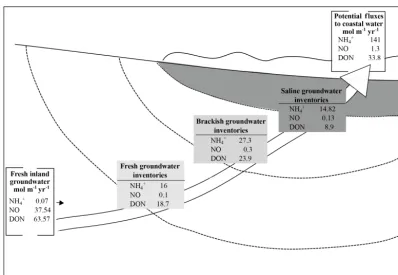
Figure 7.Schematic representation of (1) N inventories in fresh, brackish and saline beach groundwater (boxes from light grey to dark grey; dashed lines represent the schematic salinity separation) and of (2) fresh inland groundwater fluxes and potential exported fluxes to coastal water (white boxes). White arrow schematizes the groundwater flow path from the inland groundwater to the seepage face. The increase in TDN along the groundwater flow path is attributed to release of N from particulate organic matter of terrestrial origin.
NH+4 was observed in samples with salinity > 4, with the highest concentrations (∼1.25 mmol L−1)at salinity around 15. At salinity 15, we estimate a SO24− concentration of 12 mmol L−1 in beach surface groundwater, which is suf-ficient to produce 3.6 mmol L−1 NH+4 by sulfate reduction. This reaction could therefore explain the remainder of NH+4 production in beach groundwater.
The breakdown of macro-algal deposits derived from wave and tidal action in sediments can also increase N input to beach groundwater (Kelaher and Levinton, 2003; Rossi et al., 2011) and can potentially add NH+4. At Martinique Beach, algal deposits were not specifically measured but were often observed after storm events. In addition, external contami-nation from wastewater or sceptic tank seepages cannot be completely excluded. Nevertheless, the absence of traces of NH+4 contamination in the landward part of the beach and the stable isotopes of water reported by Chaillou et al. (2017) do not support an anthropogenic NH+4 input.
4.2 Nutrient transport along the flow path
The non-conservative behaviour of nutrients within the STE makes it difficult to estimate the export of nutrients to the coastal ocean. As pointed out in the review by Moore (2010), robust measurements of nutrient fluxes are needed on a
site-specific scale to obtain accurate regional and global esti-mates. In non-conservative systems, however, the determi-nation of appropriate nutrient endmember concentrations for flux calculations is not straightforward. Beck et al. (2007) previously highlighted the need to closely scrutinize the bio-geochemical processes in the STE to refine nutrient export fluxes to coastal areas. Here, inorganic and organic N in-ventories were estimated along the groundwater flow path based on salinity. Then the potential nitrogen fluxes out of the STE were estimated and compared to the fresh inland groundwater-borne nutrient fluxes. Fluxes and inventories of the different N species along the groundwater flow path are summarized in Fig. 7.
4.2.1 Nitrogen inventories
groundwa-Table 2.Nutrient inventories estimated along the STE. Inventories were calculated in fresh, brackish and saline beach groundwater; the 2013 data set was used. For dissolved organic nitrogen, concentrations measured in 2012 were used.
N Inventories [µmol m−2]
Beach groundwater NH+4 NO−3 DIN DONa TDNa
Freshwater (S< 5) 57 16 0.1 16.1 18.7 34.8
Brackish water (5 <S< 15) 19 27.3 0.3 27.6 23.9 51.5
Saline water (S> 15) 15 14.8 0.1 15 8.9 24
aCalculated on 2012 sampling.
ter (S> 15; N=15). Inorganic and organic nitrogen invento-ries are presented in Table 2.
In the inland groundwater wells, fresh groundwater was rich in DON (Table 1). DIN represented only 33 % of the TDN, with NOxmaking up 95 % of the inorganic pool
(Ta-ble 1). In the fresh beach groundwater (S< 5), nutrient inven-tories showed that DON was still the main N species with an inventory of 18.7 µmol m−2(Table 2), which represented
more than 50 % of the TDN pool. In DIN, a shift from NOx
to NH+4 occurred from the inland groundwater to deep fresh beach groundwater: NOxbecame a negligible fraction (NOx
inventory < 0.5 µmol m−2), whereas NH+4 was the main in-organic fraction, representing 46, 53 and 61% of the TDN in fresh, brackish and saline beach groundwater respectively.
NH+4 was clearly produced along the groundwater flow path through the STE. In brackish groundwater, a strong production of TDN was observed: DIN, NH+4 and DON in-creased by 169, 168 and 127 % respectively (Fig. 7). Based on the previous work of Couturier et al. (2016), the source of nitrogen released in the STE is thought to be mineralization of terrestrial rather than marine organic matter. This strong in situ TDN production in the brackish beach groundwater altered the groundwater-borne N pool. Indeed, TDN concen-trations in the saline circulation cell are much higher than the input from inland groundwater, even if this TDN is sub-sequently attenuated in surface sediment in the saline circu-lation cell due to biogeochemical processes and dilution (Ta-ble 2). Our findings showed that, even if groundwater-borne TDN in the form of NO−3 and DON was mostly attenuated along the groundwater flow path, a “new” N pool was pro-duced within the STE as it was already observed for DOM (Couturier et al., 2016).
4.2.2 Nitrogen fluxes
The fresh groundwater-borne N fluxes to the STE have been calculated as the product of the mean DON, NOx and NH+4
concentrations of the fresh inland groundwater endmember and the flow of fresh groundwater on shore (Chaillou et al., 2016). The fresh inland groundwater-derived N input estimated in this way was < 0.07 and 37 mol m−1yr−1 for
NH+4 and NOxrespectively. Estimated DIN and DON fluxes
are 37 mol m−1yr−1 and 63 mol m−1y−1 respectively
(Ta-Table 3.N fluxes delivered to STE and exported to coastal ocean in mol m−1yr1. Fresh inland groundwater-borne fluxes were com-puted as the product of average concentrations of N in groundwa-ter endmembers and the volume of fresh groundwagroundwa-ter discharge (Qinland). The exported N fluxes were the product of N inventory at the high-tide mark and the flow measured in the beach (Qbeach). In-organic N fluxes were estimated based on 2013 sampling, and DON fluxes were based on 2012 sampling.
Fluxes mol m−1yr−1 NH+4 NOx DIN DONa
Fresh inland groundwater 0.07 37 37 63
Exported N 141 1.3 142.3 33.8
aCalculated based on 2012 sampling with hydrologic flow determined in 2013.
ble 3). The estimated groundwater-borne TDN flux was ap-proximately 102 mol m−1yr−1, corresponding to an annual N input of∼1700 kg along the 1200 m Martinique Beach shoreline. This flux is dominated by DON and NOx. Inland
groundwater clearly acts as a source of nitrogen to the beach groundwater, as has been observed in other STEs, such as in Dor Bay (Mediterranean coast; Weinstein et al., 2011), Cockburn Sound (western Australia; Loveless and Oldham, 2010) and Waquoit Bay (Cape Cod, MA; Talbot et al., 2003; Gonneea and Charette, 2014). However, the groundwater-borne N load at Martinique Beach was very low in compar-ison to the above-mentioned sites, where fresh groundwater NOxconcentrations as high as 300 µmol L−1were reported.
[image:11.612.153.441.95.172.2]seep-age face (Rao and Charette, 2012). Integrating the role of in situ N transformations is also critical to accurately estimat-ing the impact that coastal boreal systems have on regional and global nutrient budgets. Here, the potential nutrient ex-port from the STE at Martinique Beach to the seepage face has been calculated based on Darcy’s flow through the 50 m length of the STE reported by Chaillou et al. (2016). To esti-mate the potential nitrogen export to the seepage face, we as-sumed that the TDN produced in the Martinique Beach STE is flushed out of the system by the continental hydraulic gra-dient.
This potential N export corresponds to 141, 1.3 and 33.8 mol m−1yr−1 for NH+4, NOx and DON respectively
(Table 3), corresponding to an annual N input of∼3100 kg along the 1200 m Martinique Beach shoreline, which is twice the groundwater-borne fluxes. DIN exported to the seep-age face (∼142 mol m−1yr−1) was in the range of
previ-ous measurements at other sites, such as the Mediterranean coast (France; 530 mol m−1yr−1; Weinstein et al., 2011), the Gulf of Mexico (FL, USA; 414 mol m−1yr−1; Santos et al., 2009) and the Atlantic coast (Aquitania coast, France; 150 mol m−1yr−1; Anschutz et al., 2016). However, in most of these studies, the DIN pool was mainly dominated by NOx,
while at Martinique Beach NH+4 represented more than 90 % of the potential DIN supply to the seepage face. It is note-worthy that fewer studies report NH+4 as the main N species exported to the coastal ocean compared to NOx. Kroeger et
al. (2007) showed high proportions of NH+4 and DON in SGD fluxes to Tampa Bay (FL, USA), which may be ex-plained in part by historical eutrophication, local hypoxia and anoxia in this area (Janicki et al., 2001). Measurements of DON flux to the coastal ocean are scarce. Kim et al. (2013) reported conservative mixing of DON, with export fluxes of 1.31×10⁵mol d−1in Hwasun Bay (Jeju Island, Korea) and in the Gulf of Mexico; Santos et al. (2009) estimated that land-derived DON makes up∼52 % of the total N exported to the coastal ocean.
It is difficult to estimate N fluxes by SGD to Martinique Bay, as coupled nitrification–denitrification in the upper 5– 10 cm of sediments at the seepage face may remove much of the TDN flux exported from the STE (Gao et al., 2009; Gihring et al., 2010; Rao et al., 2008). Since NH+4 and DON are N species highly bioavailable to microorganisms, this N export can further be directly transformed by the micro-phytobenthos and higher trophic levels (Miller and Ullman, 2004). While fresh inland groundwater provides little input of N to Martinique Beach, biogeochemical processes in the beach groundwater lead to the transformation of organic N to inorganic N. These biogeochemical processes affect the N species potentially discharged to the coastal ocean. This N supply from the beach groundwater could therefore change the local benthic biogeochemical cycles and associated com-munities (Sawyer, 2015; Welti et al., 2015).
5 Conclusion
This study highlights the role of the STE in processing groundwater-derived N in a shallow boreal STE, far from anthropogenic pressures. N was mobilized within the STE since in situ production of NH+4 and DON were observed in beach groundwater. Fresh inland groundwaters delivered to the STE are rich in NOx and DON and depleted in NH+4.
DON represented the main N species along the flow path. However, a shift from NOxto NH+4 occurred due to the
re-moval of NOxand the addition of NH+4 within the STE.
Ni-trate loss along the flow path could be attributed to alternative reduction pathways such as Fe oxidation and to the mineral-ization of OC, since DOC concentrations were high in the STE. A part of NH+4 production could be attributed to min-eralization of DON. The increase of TDN (i.e. the sum of DON and NH+4)in beach groundwater is likely the result of release of N from particulate organic matter of terrestrial origin. As a consequence, TDN in beach groundwater was higher than the inland fresh groundwater, revealing the reac-tivity of the system. While the input of NOxrepresents 32 %
(37 mmol m−1yr−1)of the fresh groundwater input of TDN to the STE, NOx fluxes potentially exported from the STE
to the seepage face only represent 1 % of the total exported TDN. Thus, near the discharge zone, NH+4 and DON domi-nated the TDN load exported to surface sediments and Mar-tinique Bay. This local export of bioavailable N is probably removed in surface sediments, or it supports benthic produc-tion and higher trophic levels. This study highlights the im-pact of biogeochemical transformations on N species in a bo-real STE. Our study showed that biogeochemical transforma-tions, along a continuum between fresh inland groundwater and the ocean, modify the distribution of N species, provid-ing new N species from terrestrial origin to the coastal ocean. These biogeochemically active and dynamic systems reflect the challenge of accurately estimating groundwater nutrient fluxes to the coastal ocean.
Data availability. All the data resulting from this study are avail-able from the authors upon request ([email protected]).
Competing interests. The authors declare that they have no conflict of interest.
Research Council of Canada to Gwénaëlle Chaillou and the Université du Québec à Rimouski. Partial funding was provided by Québec-Océan to Mathilde Couturier.
Edited by: Caroline P. Slomp
Reviewed by: two anonymous referees
References
Abarca, E., Karam, H., Hemond, H. F., and Harvey, C. F.: Transient groundwater dynamics in a coastal aquifer: the effects of tides, the lunar cycle and the beach profile, Water Resour. Res., 49, 2473–2488, https://doi.org/10.1002/wrcr.20075, 2013.
Aller, R. C.: Bioturbation and remineralization of sedimentary or-ganic matter: effects of redox oscillation, Chem. Geol., 114, 331– 345, https://doi.org/10.1016/0009-2541(94)90062-0, 1994. Anderson, D. M., Burkholder, J. M., Cochlan, W. P., Gobler, C.
J., Heil, C. A., Kudela, R. M., Parsons, M. L., Rensel, J. E. J., Townsend, D. W., Trainer, V. L., and Vargo, G. A.: Harmful al-gal blooms and eutrophication: examining linkages from selected coastal regions of the United States, Harmful Algae, 8, 39–53, https://doi.org/10.1016/j.hal.2008.08.017, 2008.
Anschutz, P., Jorissen, F. J., Chaillou, G., Abu-Zied, R., and Fontanier, C.: Recent turbidite deposition in the eastern Atlantic: early diagenesis and biotic recovery, J. Mar. Res., 60, 835–854, https://doi.org/10.1357/002224002321505156, 2002.
Anschutz, P., Charbonnier, C., Deborde, J., Deirmendjian, L., Poirier, D., Mouret, A., Buquet, D., and Lecroart, P.: Terrestrial groundwater and nutrient discharge along the 240-km-long Aquitanian coast, Mar. Chem., 185, 38–47, https://doi.org/10.1016/j.marchem.2016.04.002, 2016.
Baker, M. A. and Vervier, P.: Hydrological variability, organic mat-ter supply and denitrification in the Garonne River ecosystem, Freshwater Biol., 49, 181–190, https://doi.org/10.1046/j.1365-2426.2003.01175.x, 2004.
Beck, A. J., Tsukamoto, Y., Tovar-Sanchez, A., Huerta-Diaz, M., Bokuniewicz, H. J., and Sanudo-Wilhelmy, S. A.: Importance of geochemical transformations in deter-mining submarine groundwater discharge-derived trace metal and nutrient fluxes, Appl. Geochem., 22, 477–490, https://doi.org/10.1016/j.apgeochem.2006.10.005, 2007. Beck, M., Riedel, T., Graue, J., Köster, J., Kowalski, N., Wu, C. S.,
Wegener, G., Lipsewers, Y., Freund, H., Böttcher, M. E., Brum-sack, H.-J., Cypionka, H., Rullkötter, J., and Engelen, B.: Imprint of past and present environmental conditions on microbiology and biogeochemistry of coastal Quaternary sediments, Biogeo-sciences, 8, 55–68, https://doi.org/10.5194/bg-8-55-2011, 2011. Beusen, A. H. W., Slomp, C. P., and Bouwman, A. F.: Global land–
ocean linkage: direct inputs of nitrogen to coastal waters via submarine groundwater discharge, Environ. Res. Lett., 8, 34035, doi:1748-9326/8/3/034035, 2013.
Blanco, A. C., Nadakoa, K., and Yamamoto, T.: Planktonic and benthic microalgal community composition as indica-tors of terrestrial influence on a fringing reef in Ishigaki Island, Southwest Japan, Mar. Environ. Res., 66, 520–535, https://doi.org/10.1016/j.marenvres.2008.08.005, 2008. Burnett, W., Aggarwal, P., Aureli, A., Bokuniewicz, H.,
Ca-ble, J., Charette, M. A., Kontar, E., Krupa, S., Kulkarni,
K., Loveless, A., Moore, W., Oberdorfer, J., Oliveira, J., Ozyurt, N., Povinec, P., Privitera, A., Rajar, R., Ramessur, R., Scholten, J., Stieglitz, T., Taniguchi, M., and Turner, J.: Quantifying submarine groundwater discharge in the coastal zone via multiple methods, Sci. Total Environ., 367, 498–543, https://doi.org/10.1016/j.scitotenv.2006.05.009, 2006.
Chaillou, G., Anschutz, P., Dubrulle, C. and Lecroart, P.: Transient states in diagenesis following the deposition of a gravity layer: dynamics of O2, Mn, Fe and N-species in experimental units, Aquat. Geochem., 13, 157–172, https://doi.org/10.1007/s10498-007-9013-0, 2007.
Chaillou, G., Touchette, M., Rémillard, A., Buffin-Bélanger, T., St-Louis, R., Hétu, B., and Tita, G.: Synthèse de l’état des con-naissances sur les eaux souterraines aux Îles-de-la-Madeleine – Impacts de l’exploration et de l’exploitation des ressources na-turelles sur celles-ci, Université du Québec à Rimouski, 2012. Chaillou, G., Couturier, M., Tommi-Morin, G., and Rao,
A. M.: Total alkalinity and dissolved inorganic car-bon production in groundwaters discharging through a sandy beach, Procedia Earth Planet. Sci., 10, 88–99, https://doi.org/10.1016/j.proeps.2014.08.017, 2014.
Chaillou, G., Lemay-Borduas, F., and Couturier, M.: Transport and transformations of groundwater-borne carbon discharging through a sandy beach to coastal ocean, Can. Water Resour. J., 38, 809–828, https://doi.org/10.1080/07011784.2015.1111775, 2016.
Chaillou, G., Lemay-Borduas, F., Larocque, M., Couturier, M., Biehler, A., and Tommi-Morin, G.: Flow and discharge of groundwater from a snowmelt-affected sandy beach, J. Hydrol., in revision, 2017.
Couturier, M., Nozais, C., and Chaillou, G.: Microtidal sub-terranean estuaries as a source of fresh terrestrial dissolved organic matter to coastal ocean, Mar. Chem., 186, 46–57, https://doi.org/10.1016/j.marchem.2016.08.001, 2016.
Erler, D. V, Santos, I. R., Zhang, Y., Tait, D. R., Befus, K. M., Hidden, A., Li, L., and Eyre, B. D.: Nitrogen transformations within a tropical subterranean estuary, Mar. Chem., 164, 38–47, https://doi.org/10.1016/j.marchem.2014.05.008, 2014.
Gao, H., Schreiber, F., Collins, G., Jensen, M. M., Kostka, J. E., Lavik, G., de Beer, D., Zhou, H., and Kuypers, M. M.: Aerobic denitrification in permeable Wadden Sea sediments, ISME J., 4, 417–426, https://doi.org/10.1038/ismej.2009.127, 2009. Gehrels, W. R.: Determining relative sea-level change from
salt-marsh foraminifera and plant zones on the coast of Maine, USA, J. Coastal Res., 10, 990–1009, 1994.
Gihring, T. M., Canion, A., Riggs, A., Huettel, M., and Kostka, J. E.: Denitrification in shallow, sublittoral Gulf of Mex-ico permeable sediments, Limnol. Oceanogr., 55, 43–54, https://doi.org/10.4319/lo.2010.55.1.0043, 2010.
Glibert, P. M., Icarus Allen, J., Artioli, Y., Beusen, A., Bouw-man, L., Harle, J., Holmes, R., and Holt, J.: Vulnerabil-ity of coastal ecosystems to changes in harmful algal bloom distribution in response to climate change: projections based on model analysis, Glob. Change Biol., 20, 3845–3858, https://doi.org/10.1111/gcb.12662, 2014.
Gonneea, M. E., Mulligan, A. E., and Charette, M. A.: Climate-driven sea level anomalies modulate coastal groundwater dy-namics and discharge, Geophys. Res. Lett., 40, 2701–2706, https://doi.org/10.1002/grl.50192, 2013.
Hall, P. J. and Aller, R. C.: Rapid, small-Volume, flow injection analysis for CO2and NH4+in marine and freshwaters, Limnol. Oceanogr., 37, 1113–1119, 1992.
Hansell, D. A. and Carlson, C. A.: Biogeochemistry of marine dis-solved organic matter, Academic Press, Elsevier, San Diego, Ca, USA, 2014.
Heiss, J. W. and Michael, H. A.: Saltwater-freshwater mix-ing dynamics in a sandy beach aquifer over tidal, srpmix-ing- srping-neap and seasonal cycles, Water Resour. Res., 50, 6747–6766, https://doi.org/10.1002/2014WR015574, 2014.
Hinzman, L. D., Bettez, N. D., Bolton, W. R., Chapin, F. S., Dyurg-erov, M. B., Fastie, C. L., Griffith, B., Hollister, R. D., Hope, A., Huntington, H. P., Jensen, A. M., Jia, G. J., Jorgenson, T., Kane, D. L., Klein, D. R., Kofinas, G., Lynch, A. H., Lloyd, A. H., Mcguire, A. D., Nelson, F. E., Oechel, W. C., Osterkamp, T. E., Racine, C. H., Romanovsky, V. E., Stone, R. S., Stow, D. A., Sturm, M., Tweedie, C. E., Vourlitis, G. L., Walker, M. D., Walker, D. A., Webber, P. J., Welker, J. M., Winker, K. S., and Yoshikawa, K.: Evidence and implications of recent cli-mate change in northern Alaska and other Arctic regions, Clim. Change, 72, 251–298, https://doi.org/10.1007/s10584-005-5352-2, 2005.
Howarth, R. W. and Marino, R.: Nitrogen as the limiting nu-trient for eutrophication in coastal marine ecosystems: evolv-ing views over three decades, Limnol. Oceanogr., 51, 364–376, https://doi.org/10.4319/lo.2006.51.1_part_2.0364, 2006. Hulth, S., Aller, R. C., and Gilbert, F.: Coupled anoxic
nitri-fication/manganese reduction in marine sediments, Geochim. Cosmochim. Ac., 63, 49–66, https://doi.org/10.1016/S0016-7037(98)00285-3, 1999.
Hyacinthe, C., Anschutz, P., Carbonel, P., Jouanneau, J. M., and Jorissen, F. J.: Early diagenetic processes in the muddy sediments of the bay of biscay, Mar. Geol., 177, 111–128, https://doi.org/10.1016/S0025-3227(01)00127-X, 2001. Jackson, N., Nordstrom, K., Smith, D., and Virginia, W.:
Geomor-phic – biotic interactions on beach foreshores in estuaries, J. Coastal Res., 424, 414–424, doi:0749-0208, 2002.
Janicki, A., Pribble, R., Janicki, S., and Winowitch, M.: An analy-sis of long-term trends in Tampa Bay water quality, Tampa Bay Estuary Program, St Petersburg, FL, USA, 2001.
Johannes, R. E.: The ecological significance of the submarine dis-charge of groundwater, Mar. Ecol.-Prog. Ser., 3, 365–373, 1980. Jørgensen, L., Lechtenfeld, O. J., Benner, R., Middelboe, M., and Stedmon, C. A.: Production and transformation of dis-solved neutral sugars and amino acids by bacteria in seawater, Biogeosciences, 11, 5349–5363, https://doi.org/10.5194/bg-11-5349-2014, 2014.
Juneau, M.-N.: Hausse récente du niveau marin relatif aux Îles de la Madeleine, Master’s thesis, Université du Québec à Rimouski, Rimouski, Canada, 2012.
Kelaher, B. and Levinton, J.: Variation in detrital en-richment causes spatio-temporal variation in soft-sediment assemblages, Mar. Ecol.-Prog. Ser., 261, 85–97, https://doi.org/10.3354/meps261085, 2003.
Kim, T., Kwon, E., Kim, I., Lee, S., and Kim, G.: Dissolved organic matter in the subterranean estuary of a volcanic island, Jeju: im-portance of dissolved organic nitrogen fluxes to the ocean, J. Sea Res., 78, 18–24, https://doi.org/10.1016/j.seares.2012.12.009, 2013.
Knee, K. L. and Jordan, T. E.: Spatial distribution of dissolved radon in the Choptank river and its tributaries: implications for ground-water discharge and nitrate inputs, Estuar. Coast., 36, 1237– 1252, 2013.
Korom, S. F.: Natural denitrification in the saturated zone: a review, Water Resour. Res., 28, 1657–1668, https://doi.org/10.1029/92WR00252, 1992.
Kroeger, K. D. and Charette, M.: Nitrogen biogeochemistry of sub-marine groundwater discharge, Limnol. Oceanogr., 53, 1025– 1039, 2008.
Kroeger, K. D., Cole, M. L., and Valiela, I.: Groundwater-transported dissolved organic nitrogen exports from coastal watersheds, Limnol. Oceanogr., 51, 2248–2261, https://doi.org/10.4319/lo.2006.51.5.2248, 2006.
Kroeger, K. D., Swarzenski, P. W., Greenwood, W. J., and Reich, C.: Submarine groundwater discharge to Tampa Bay: nutrient fluxes and biogeochemistry of the coastal aquifer, Mar. Chem., 104, 85– 97, https://doi.org/10.1016/j.marchem.2006.10.012, 2007. Loveless, A. M. and Oldham, C. E.: Natural attenuation of
nitro-gen in groundwater discharging through a sandy beach, Biogeo-chemistry, 98, 75–87, https://doi.org/10.1007/s10533-009-9377-x, 2010.
Madelin’Eau: Gestion des eaux souterraines aux Îles-de-la-Madeleine Un défi de développement durable Rapport final, 2004.
Madelin’Eau: Secteur sud-est de l’île de grande entrée – Rapport hydrologique, 2007.
Madelin’Eau: Secteur de grande-entrée – flanc nord alimentation en eau potable, 2009.
Madelin’Eau: Projet de réalisation d’un forage gazier vertical et conventionel d’une profondeur de 2500 m, municipalité des îles de la Madeleine – Rapport d’étape 1, expertise hydrogéologique, 2011.
Martin, J. B., Hartl, K. M., Corbett, D. R., Swarzenski, P. W., and Cable, J. E.: A multi-level pore-water sampler for permeable sediments, J. Sediment. Res., 73, 128–132, https://doi.org/10.1306/070802730128, 2003.
Masselink, G. and Short, A.: The effect on tide range on beach morphodynamics and morphology: a conceptual beach model, J. Coastal Res., 9, 785–800, 1993.
McCoy, C. and Corbett, D. R.: Review of submarine ground-water discharge (SGD) in coastal zones of the Southeast and Gulf Coast regions of the United States with man-agement implications, J. Environ. Manage., 90, 644–51, https://doi.org/10.1016/j.jenvman.2008.03.002, 2009.
Miller, D. C. and Ullman, W. J.: Ecological consequences of ground water discharge to Delaware Bay, United States, Groundwater, 42(, 959–970, https://doi.org/10.1111/j.1745-6584.2004.tb02635.x, 2004.
Moore, W. S.: The effect of submarine groundwater dis-charge on the ocean., Ann. Rev. Mar. Sci., 2, 59–88, https://doi.org/10.1146/annurev-marine-120308-081019, 2010. Null, K. A., Dimova, N. T., Knee, K. L., Esser, B. K.,
Swarzen-ski, P. W., Singleton, M. J., Stacey, M., and Paytan, A.: Sub-marine groundwater discharge-derived nutrient loads to San Francisco bay: implications to future ecosystem changes, Es-tuar. Coast., 35, 1299–1315, https://doi.org/10.1007/s12237-012-9526-7, 2012.
Postma, D.: Kinetics of nitrate reduction by detrital Fe (II)-silicates, Geochim. Cosmochim. Ac., 54, 903–908, 1990.
Postma, D., Boesen, C., Kristiansen, H., and Larsen, F.: Nitrate re-duction in an unconfined sandy aquifer: water chemistry, reduc-tion processes and geochemical modeling, Water Resour. Res., 27, 2027–2045, https://doi.org/10.1029/91WR00989, 1991. Rao, A. M. F. and Charette, M. A.: Benthic nitrogen fixation in an
eutrophic estuary affected by groundwater discharge, J. Coastal Res., 280, 477–485, https://doi.org/10.2112/JCOASTRES-D-11-00057.1, 2012.
Rao, A. M. F., McCarthy, M. J., Gardner, W. S., and Jahnke, R. A.: Respiration and denitrification in permeable continental shelf deposits on the South Atlantic Bight: N2: Ar and isotope pair-ing measurements in sediment column experiments, Cont. Shelf Res., 28, 602–613, 2008.
Rivett, M. O., Buss, S. R., Morgan, P., Smith, J. W. N., and Bem-ment, C. D.: Nitrate attenuation in groundwater: A review of bio-geochemical controlling processes, Water Res., 42, 4215–4232, https://doi.org/10.1016/j.watres.2008.07.020, 2008.
Robinson, C., Li, L., and Barry, D. A.: Effect of tidal forcing on a subterranean estuary, Adv. Water Resour., 30, 851–865, https://doi.org/10.1016/j.advwatres.2006.07.006, 2007a. Robinson, C., Xin, P., Li, L., and Barry, D. A.: Groundwater
flow and salt transport in a subterranean estuary driven by in-tensified wave conditions, Water Resour. Res., 50, 165–181, https://doi.org/10.1002/2013WR013813, 2014.
Rocha, C., Ibanhez, J., and Leote, C.: Benthic nitrate bio-geochemistry affected by tidal modulation of Submarine Groundwater Discharge (SGD) through a sandy beach face, Ria Formosa, Southwestern Iberia, Mar. Chem., 115, 43–58, https://doi.org/10.1016/j.marchem.2009.06.003, 2009.
Rocha, C., Wilson, J., Scholten, J., and Schubert, M.: Retention and fate of groundwater-borne nitrogen in a coastal bay (Kinvara Bay, Western Ireland) during summer, Biogeochemistry, 125, 275– 299, https://doi.org/10.1007/s10533-015-0116-1, 2015. Rossi, F., Incera, M., Callier, M., and Olabarria, C.: Effects of
de-trital non-native and native macroalgae on the nitrogen and car-bon cycling in intertidal sediments, Mar. Biol., 158, 2705–2715, https://doi.org/10.1007/s00227-011-1768-6, 2011.
Sáenz, J. P., Hopmans, E. C., Rogers, D., Henderson, P. B., Charette, M. A., Schouten, S., Casciotti, K. L., Sinninghe Damsté, J. S., and Eglinton, T. I.: Distribution of anaerobic ammonia-oxidizing bacteria in a subterranean estuary, Mar. Chem., 136, 7–13, https://doi.org/10.1016/j.marchem.2012.04.004, 2012.
Santoro, A. E.: Microbial nitrogen cycling at the saltwater-freshwater interface, Hydrogeol. J., 18, 187–202, https://doi.org/10.1007/s10040-009-0526-z, 2010.
Santos, I., Burnett, W. C., Dittmar, T., Suryaputra, I. G. N., and Chanton, J.: Tidal pumping drives nutrient and dis-solved organic matter dynamics in a Gulf of Mexico
subter-ranean estuary, Geochim. Cosmochim. Ac., 73, 1325–1339, https://doi.org/10.1016/j.gca.2008.11.029, 2009.
Santos, I., Eyre, B. D., and Huettel, M.: The driving forces of porewater and groundwater flow in permeable coastal sediments: A review, Estuar. Coast. Shelf S., 98, 1–15, https://doi.org/10.1016/j.ecss.2011.10.024, 2012.
Santos, I. R., Burnett, W. C., Chanton, J., Mwashote, B., Suryapu-tra, I. G. N. A., and Dittmar, T.: Nutrient biogeochemistry in a Gulf of Mexico subterranean estuary and groundwater-derived fluxes to the coastal ocean, Limnol. Oceanogr., 53, 705–718, https://doi.org/10.4319/lo.2008.53.2.0705, 2008.
Santos, I. R., Bryan, K. R., Pilditch, C. A., and Tait, D. R.: In-fluence of porewater exchange on nutrient dynamics in two New Zealand estuarine intertidal flats, Mar. Chem., 167, 57–70, https://doi.org/10.1016/j.marchem.2014.04.006, 2014.
Sawyer, A. H.: Enhanced removal of groundwater-borne nitrate in heterogeneous aquatic sediments, Geophys. Res. Lett., 42, 403– 410, https://doi.org/10.1002/2014GL062234, 2015.
Schlacher, T. A. and Connolly, R. M.: Land–ocean coupling of car-bon and nitrogen fluxes on sandy beaches, Ecosystems, 12, 311– 321, https://doi.org/10.1007/s10021-008-9224-2, 2009. Schnetger, B. and Lehners, C.: Determination of nitrate plus
nitrite in small volume marine water samples using vana-dium(III)chloride as a reduction agent, Mar. Chem., 160, 91–98, https://doi.org/10.1016/j.marchem.2014.01.010, 2014.
Scott, D. B., Brown, K., Collins, E. S., and Medioli, F. S.: A new sea-level curve from Nova Scotia: evidence for a rapid accelera-tion of sea-level rise in the late mid-Holocene, Can. J. Earth Sci., 32, 2071–2080, https://doi.org/10.1139/e95-160, 1995a. Scott, D. B., Gayes, P. T., and Collins, E. S.: Mid-holocene
prece-dent for a future rise in sea-level along the Atlantic coast of North America, J. Coastal Res., 11, 615–622, 1995b.
Seitzinger, S. P., Sanders, R. W., and Styles, R.: Bioavail-ability of DON from natural and anthropogenic sources to estuarine plankton, Limnol. Oceanogr., 47, 353–366, https://doi.org/10.4319/lo.2002.47.2.0353, 2002.
Seitzinger, S. P., Harrison, J. A., Dumont, E., Beusen, A. H. W., and Bouwman, A. F.: Sources and delivery of carbon, nitrogen and phosphorus to the coastal zone: an overview of global Nutrient Export from Watersheds (NEWS) models and their application, Global Biogeochem. Cy., 19, GB4S01, https://doi.org/10.1029/2005GB002606, 2005.
Sipler, R. E. and Bronk, D. A.: Dynamics of dissolved organic ni-trogen, in: Biogeochemistry of marine dissolved organic matter, edited by: Hansell, D. A. and Carlson, C. A., 127–184, Academic Press, San Diego, Ca, USA, 2014.
Slomp, C. P. and Van Cappellen, P.: Nutrient inputs to the coastal ocean through submarine groundwater discharge: controls and potential impact, J. Hydrol., 295, 64–86, 2004.
Sundby, B.: Transient state diagenesis in
conti-nental margin muds, Mar. Chem., 102, 2–12,
https://doi.org/10.1016/j.marchem.2005.09.016, 2006.
Talbot, J. M., Kroeger, K. D., Rago, A., Allen, M. C., and Charette, M. A.: Nitrogen flux and speciation through the subterranean es-tuary of Waquoit Bay, Massachusetts, Biol. Bull., 205, 244–245, https://doi.org/10.2307/1543276, 2003.
wa-tersheds and their effects on coastal waters, Biogeochemistry, 10, 177–197, 1990.
Voss, M., Bange, H. W., Dippner, J. W., Middelburg, J. J., Montoya, J. P., and Ward, B.: The marine nitrogen cycle: recent discover-ies, uncertainties and the potential relevance of climate change, Philos. T. R. Soc., 368, https://doi.org/10.1098/rstb.2013.0121, 2013.
Weinstein, Y., Yechieli, Y., Shalem, Y., Burnett, W., Swarzen-ski, P. W., and Herut, B.: What is the role of fresh ground-water and recirculated seaground-water in conveying nutrients to the coastal ocean?, Environ. Sci. Technol., 45, 5195–5200, https://doi.org/10.1021/es104394r, 2011.