Received: 21 February 2017 – Revised: 17 May 2017 – Accepted: 31 May 2017 – Published: 13 July 2017
Abstract.Solar flare effects (Sfe’s) are rapid magnetic vari-ations related to the enhancement of the amount of radiation produced during solar flare events. For several minutes, the ionosphere is activated and electron densities, electrical con-ductivities and electric currents are enhanced. The magnetic signature of a flare is visible in the illuminated hemisphere, and sometimes it shows up as small crochet-like movements in the magnetograms. However, regarding their detection us-ing an automatized procedure, they have been very elusive because their small amplitude, which is close to the level of noise produced by other natural phenomena, and their highly variable irregular shapes make it extremely difficult to apply predesigned patterns. In this paper, we summarize the diffi-culties that Sfe detection presents and explain a line of work we initiated to overcome these difficulties with the goal of achieving a system capable of performing automatic detec-tion. Some properties of Sfe’s, including spherical symmetry around the vortex and different time durations between Sfe’s and other natural variations, were used to construct an index allowing us to detect Sfe’s.
Keywords. Geomagnetism and paleomagnetism (rapid time variations)
1 Introduction
Several rapid magnetic variations attracted the attention of scientists from an early moment. At the IAGA General As-sembly (Rome, 1954) a new committee was created on rapid variations and Earth currents with A. Romañá from the Ebre Observatory elected as chairman. The task of the committee was to create lists of events, including sudden storm com-mencements (SSC), pulsations during sudden commence-ments (PSC), sudden impulses (SI) and solar flare effects (SFE), which were to be published in the IAGA annual bul-letins (Curto et al., 2007). Since then, the working
proce-dure to detect SSC and Sfe events has been more or less the same and it is still based on manual methods. Recently, many attempts to automatize the detection of sudden commence-ments (SC) have succeeded using different approaches, e.g., neural networks (Segarra and Curto, 2013), wavelet filters (Takano et al., 1999) and time–frequency clusters (Hafez and Ghamry, 2011). The key factor in the successful automatic detection of SSC was probably the fact that they mostly have a common morphological pattern: the main signal, a sudden increase in theH component, is similar around the world. However, this is not true for Sfe’s. They are elusive, so previ-ous attempts at Sfe automatic detection failed and until now there have been no references in the scientific literature re-garding their possible automatic detection.
2 Difficulties in Sfe detection
800 J. J. Curto et al.: Automatic detection of Sfe: a proposal
Figure 1.Two examples of Sfe’s on theDcomponent at EBR mag-netic observatory:(a)one at 14:34 UT on 9 March 2015 with a “V valley” shape and(b)the other at 09:42 UT on 21 June 2015 with a “crochet” shape.
look like a “V valley”. Sometimes they are steep, but at other times they are smooth (Fig. 1). According to Curto et al. (2016b), this is due to the temporal variations in the ra-diation, which have irregular shapes in their origin: the so-lar disturbances. Moreover, Sfe events are the result of the action of several radiation bands (X and UV) that occur at different heights of the Sun, so they could be synchronic or not. They also have different relaxation times (Richmond and Venkateswaran, 1971). Thus, to achieve a certain degree of certainty in the Service of Rapid Magnetic Variations (Curto et al., 2007), other contemporary ionospheric effects are usu-ally sought out (Tsurutani et al., 2009).
3 A proposal for Sfe automatic detection 3.1 Spherical symmetry of the radiation
[image:2.612.48.287.66.266.2]Despite the abovementioned difficulties, there are some char-acteristics of Sfe phenomena that can be used as key elements to elucidate whether a movement in the magnetograms is or is not an effect of a solar disturbance. The symmetric distri-bution of the radiation around the subsolar point is one char-acteristic. Symmetric radiation means symmetric ionization and, to a certain extent, symmetric currents. These electric currents appear as a result of two systems that are not coinci-dent in space: the first due to tidal winds moved by thermal cells because of the day–night temperature gradients and the second due to ionization induced by solar radiation, which is distributed as a spherical cap around the subsolar point. In any case, the resultant electric circuit has a circle-like shape flowing around a central point known as the current vortex.
Figure 2.Simplified scheme of a circular system of electric cur-rents like that of Sfe’s in the Northern Hemisphere. Magnetic vec-tors point towards the vortex of the system.
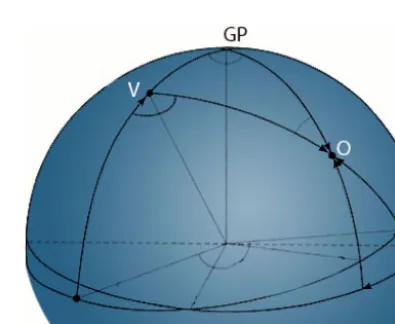
Figure 3.After the coordinate transformation, new coordinates can be computed for each magnetic observatory (O). The new pole (V) is the vortex of the current system instead of the geographic pole (GP).
[image:2.612.327.525.310.472.2]Figure 4.Derivate of theH component for 9 August 2011 at Ebre Observatory acting as a high-pass filter. Increasing the width (n) of the filter results in a reduction in the high-frequency noise, but the signal-to-noise ratio decreases more quickly. Thus, we chosen=1.
up the contributions of the whole group of observatories in the illuminated area, we can increase the signal-to-noise ra-tio. However, the perfect circular current model is a simpli-fication of the reality. As shown by Curto et al. (1994a), the current vortex (loop) is usually elliptical with moderate ec-centricities in solstices but achieving important ecec-centricities in equinox. The overall performance will necessarily be re-duced due to the slight misalignment of the observatory sig-nals outside the main axes of the ellipse.
However, manual operation is still necessary in this pro-cess to extract the Sq contribution as a prior action before
computing the Sfe vector. The diurnal magnetic variation,Sq,
is always superposed on Sfe’s and has a similar, although not identical, circular current system shape (Curto et al., 1994a). Sq and Sfe current systems are not exactly coincident in
space; generally in the Northern Hemisphere, the Sfe vor-tex is delayed from theSqvortex (Curto et al., 1994b). Thus,
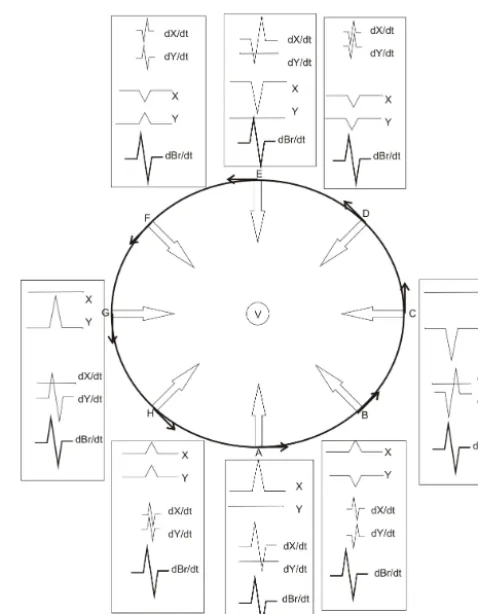
Figure 5.Sfe signatures from observatories under the electric cur-rent loop are very diffecur-rent depending on their location with re-spect to the vortex. However, after the coordinate transformation, the derivatives of the radial component of the Sfe vectors,Br, at
different points of the circle (A–H) become coherent.
in each case, it has to be estimated manually. Observers es-timate the diurnal variation trend by eye. However, a care-less assessment of theSq level could mask the Sfe decay,
which would translate directly into Sfe vector computation errors (Curto et al., 2016a). With the ideas proposed above we can improve the detection method but we will still not have achieved our goal, which is the complete automatiza-tion of the detecautomatiza-tion process.
3.2 Different time durations
From the above, we can conclude that theSq signal should
be removed to produce an automatic process. To this end, we can take advantage of the different time durations of the signals. While Sq variations last 1 day (TSq=24 h), Sfe’s usually last for several minutes (TSfe=0.2 h) (Curto et al.,
1994a), so the frequency rate of Sq is one hundredth that
[image:3.612.52.285.69.435.2]usu-802 J. J. Curto et al.: Automatic detection of Sfe: a proposal
Figure 6.Signals from magnetic disturbances, like SC, cancel be-cause the signal at one observatory is counterbalanced by the signal at its counterpart.
ally essentially a composition of step and ramp signals. After derivation, they become peaks and steps, respectively. We use a simple formulation:
˙
B=δB(t )/δt=B(t+n1t )−B(t−n1t )/2n1t, (1) whereB(t )˙ is the time derivative of a magnetic field com-ponent,1t=1 min andncontrols the temporal width of the filter. In our case n=1 gives the best results (Fig. 4). This filter allows the Sfe signal to pass, but other natural signals with longer periods, like theSqsignals, are attenuated.
3.3 Sfe index
With an appropriate coordinate transformation, which would mean transforming from a coordinate reference system based on the geographic pole to a coordinate reference system based on the current vortex pole, the problem becomes quite simple. Sfe variations occur mostly in the radial component, Br. The Sfe signals (and their derivatives) from the different
observatories with plenty of different shapes are transformed into a unique and simple shape, thus becoming coherent sig-nals (Fig. 5). In this way, multiplicity and complexity are transformed into singleness and simplicity.
At that point, a new index,δSFET, can be defined as the
mean of the derivatives of the radial components of the Sfe variations,1B˙r, of the considered observatories in the
coor-dinate system with the vortex as a center:
δSFET ≡(1B˙r1+1B˙r2+. . .+1B˙rn)/n, (2)
[image:4.612.310.546.65.302.2]wherenis the number of observatories considered. Regard-ing the signal-to-noise ratio, this index behaves in such a way that the Sfe signals are reinforced but other natural magnetic
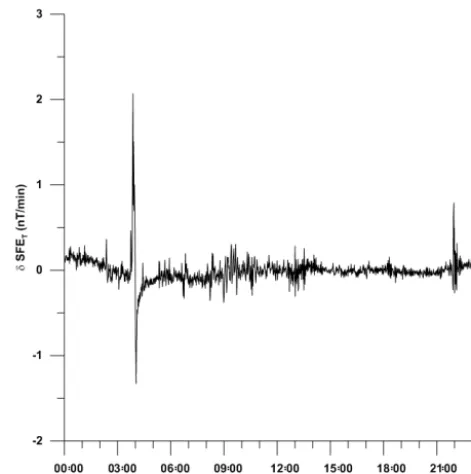
Figure 7.δSFET for 4 August 2011. On this day, Sfe’s occurred
at 03:44 UT and SSC occurred at 21:53. As shown, the algorithm shrinks the SC signal but cannot reject it completely.
disturbances (SC, pulsations or substorms), which could be considered as noise, become incoherent; in the mean, they almost cancel themselves out. Thus, the effect of SC, which are common rapid magnetic variations produced by the en-hancement of the solar wind pressure, tend to vanish. When summing up the radial contributions of the observatories at a given longitude, the signals from observatories at a higher latitude with respect to the vortex are counterbalanced by the signals from observatories at a lower latitude (Fig. 6). To summarize, with this strategy we obtain a high common-mode rejection ratio, but the cancellation is not perfect. For example, SC disturbances have a latitude dependence, so low-latitude observatories have stronger signals than high-latitude observatories for the main phase (the step function), while the opposite is true for the preliminary impulses (PI; Araki, 1994; narrow sawtooth function). This produces an unavoidable certain level of noise. On the other hand, each observatory does not always have a counterpart observatory in the opposite part of the vortex. The lack of a counter-part observatory means that the SC signal is not counterbal-anced. However, this undesirable effect is mostly shrunk by the mean when there is a large population of observatories available (Fig. 7).
Figure 8.Percentage of false negatives as a function of the selected threshold value.
event, a given threshold is not considered a false negative if it succeeds in detecting the event at least at one point. We took 1 nT min−1as a threshold value to keep the clearest and biggest events.
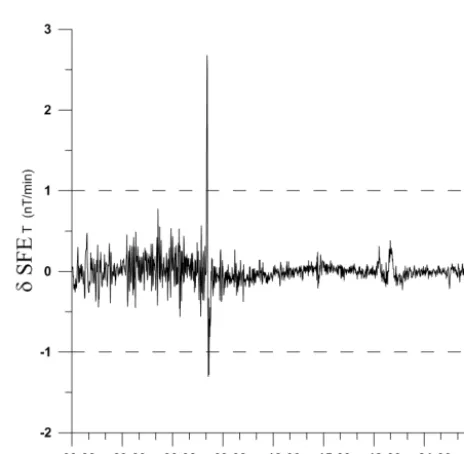
An Sfe detector has been developed, and it is now working in a test mode with promising results. We work only on the lit hemisphere. In the first stage, we focus on the northern current loop because of the higher availability of magnetic observatories there; however, in a second stage, the southern current loop will also be analyzed for a comprehensive pa-trol. We analyze observatories at low and mid latitudes and exclude equatorial observatories because they are influenced by the equatorial electrojet. We also exclude high-latitude ob-servatories because they are very influenced by auroral cur-rents. The magnetic observatories used in each case vary ac-cording to the time of the event. Only those observatories in the lit area are taken. As an example of Sfe detection, we present an Sfe event that happened on 9 August 2011 (Fig. 9). This Sfe event was clearly identified through the Sfe index, δSFET. A clear peak stands out above the noise level,
pro-viding easy detection after a thresholding process (Fig. 10).
4 Conclusions
Sfe detection is a difficult task because this kind of distur-bance has a changing and unpredictable nature rather than regular patterns. This explains the absence of automatic de-tection methods so far. However, by taking advantage of some special characteristics of Sfe’s according to their na-ture, including spherical symmetry around the vortex and
dif-Figure 9.The Sfe as seen on the Ebre Observatory magnetogram in theH andDcomponents at 08:00 UT on 9 August 2011.
Figure 10.δSFET for 9 August 2011. A clear peak at 08:00 UT
stands out from the noise, allowing for clear Sfe detection.
ferent time durations between Sfe’s and other natural varia-tions with similar spatial distribuvaria-tions likeSq, we were able
to separate the Sfe signal from other natural disturbances. We defined an Sfe index by taking into account the derivative of the radial contribution of the Sfe disturbances with respect to the vortex of the current system responsible for the Sfe varia-tion. This detector, now in a test phase, has proven successful in detecting Sfe events.
[image:5.612.46.286.65.304.2] [image:5.612.312.544.284.511.2]804 J. J. Curto et al.: Automatic detection of Sfe: a proposal
Competing interests. The authors declare that they have no conflict of interest.
Acknowledgements. This research has been supported by the Span-ish government project CTM2014-52182-C3-1-P of MINECO. The authors also wish to thank INTERMAGNET and all the collaborat-ing observatories providcollaborat-ing high-quality magnetic data. Finally, we thank the International Service of Rapid Magnetic Variations and their collaborating observatories for providing lists of Sfe events.
The topical editor, Jean Rasson, thanks Christine Amory-Mazaudier and one anonymous referee for help in evaluating this paper.
References
Araki, T.: A physical model of geomagnetic sudden commence-ment, AGU Geophys. Monogr., 81, 183–200, 1994.
Curto, J. J. and Gaya-Piqué, L. R.: Geoeffectiveness of So-lar FSo-lares in magnetic crochet (sfe) Production: I – De-pendence on their spectral nature and position on the solar disk, J. Atmos. Sol.-Terr. Phy., 71, 1695–1704. https://doi.org/10.1016/j.jastp.2008.06.018, 2009a.
Curto, J. J. and Gaya-Piqué, L. R.: Geoeffectiveness of Solar Flares in magnetic crochet (sfe) Production: II – Dependence on the detection method, J. Atmos. Sol.-Terr. Phy., 71, 1705–1710, https://doi.org/10.1016/j.jastp.2007.12.003, 2009b.
Curto, J. J., Amory-Mazaudier, C., Cardús, J. O., Torta, J. M., and Menvielle, M.: Solar flare effects at Ebre: Regular and reversed solar flare effects, statistical analysis (1953 to 1985), a global case study and a model of elliptical ionospheric currents, J. Geo-phys. Res., 99, 3945–3954, 1994a.
Curto, J. J., Amory-Mazaudier, C., Cardús, J. O., Torta, J. M., and Menvielle, M.: Solar flare effects at Ebre: Unidimentional physical, integrated model, J. Geophys. Res., 99, 23289–23296, 1994b.
Curto, J. J., Cardús, J. O., Alberca, L. F., and Blanch, E.: Milestones of the IAGA International Service of Rapid Magnetic Variations, Earth Planets Space, 59, 463–471, 2007.
Curto, J. J., Castell, J., and Del Moral, F.: Sfe: waiting for the big one, Journal of Space Weather and Space Climate, 6, A23, https://doi.org/10.1051/swsc/2016018, 2016a.
Curto, J. J., Alberca, L. F., and Castell, J.: Dynamic aspects of the Solar Flare Effects and their impact in the detection procedure, J. Ind. Geophys. Union, 2, 99–104, 2016b.
Hafez, A. G. and Ghamry, E.: Automatic detection of geomagnetic sudden commencements via time-frequency clusters, Adv. Space Res., 48, 1537–1544, 2011.
Richmond, A. D. and Venkateswaran, S. V.: Geomagneticcrochets and associated ionospheric current systems, Radio Sci., 6, 139– 164, 1971.
Romañá, A.: Provisional atlas of rapid variations, Annals of the In-ternational Geophysical Year, II B, 668–709, 1959.
Segarra, A. and Curto, J. J.: Automatic Detection of Sudden Com-mencements using Neural Networks, Earth Planets Space, 65, 791–797, https://doi.org/10.5047/eps.2012.12.011, 2013. Takano, S., Minamoto, T., Arimura, H., Niijima, K., Iyemori, T.,
and Araki, T.: Automatic detection of geomagnetic sudden com-mencementsusing lifting wavelet filters, Lecture Notes in Com-puter Science, 1721, Springer, Berlin, Heidelberg, 1999. Tsurutani, B. T., Verkhoglyadova, O. P., Mannucci, A. J., Lakhina,