Volume 2, Issue 4, 2015
65 Available online at www.ijiere.com
International Journal of Innovative and Emerging
Research in Engineering
e-ISSN: 2394 - 3343 p-ISSN: 2394 - 5494
Automated Attendance System
Sandeep Sonsane
a, Siddhesh Thakur
a, Priyank Suthar
aand Jignesh Sisodia
ba Student, Information Technology Department, Sardar Patel Institute of Technology, Mumbai, India.
bAssistant Professor, Information Technology Department, Sardar Patel Institute of Technology, Mumbai, India.
ABSTRACT:
This paper conveys our proposed automated attendance system using image processing. The hand written signature is regarded as the primary means of identifying the signer of a written document based on the implicit assumption that a person’s normal signature changes slowly and is very difficult to erase, alter or forge without detection. It is easier for people to migrate from using the popular pen-and-paper signature to one where the handwritten signature is captured and verified. A person’s signature is an important biometric attribute of a human being and is used for authorization purpose. Signature recognition is the process of verifying the writer’s identity by checking the signature against samples kept in the database. The result is usually between 0 and 1 which represents a fit ratio (1 for match and 0 for mismatch). Signature recognition is most often used to describe the ability of a computer to translate human writing into text. As signature is the primary mechanism both for authentication and authorization in legal transactions, hence efficient auto-mated solutions for signature verification has raised.
Keywords: Image Processing, Signature Verification, OpenCV, Euclidean distance, Attendance.
I. INTRODUCTION
Attendance records are very important in academics. However maintaining the attendance database of hundreds of students has become a tedious task. Many attempts were made to automate this process with success to a certain extent. Many of these systems make use of sophisticated biometric equipment while some others use Barcodes and Radio Frequency Identity Cards. Whereas even today the majorly used system is to take the signature of present candidates and then manually enter these records in a computer. We are automating this process by developing a system which uses image processing to automatically update the attendance records in the computer.
II. LITERATURESURVEY
A. Origin Of Concept
The hand written signature is regarded as the primary means of identifying the signer of a written document based on the implicit assumption that a person’s normal signature changes slowly and is very hard to erase, change or forge without detection. Handwritten signature is one of the ways to authorize transactions and authenticate the human identity compared with other electronic identification methods such as fingerprints scanning, face recognition and retinal vascular pattern screening. People find it easier to migrate from using the popular pen-and-paper signature to one where the handwritten signature is captured and verified electronically.[8] A person’s signature is an important biometric attribute of a human being and is used for authorization purpose. Several other approaches are possible for signature recognition with a lot of scope of research. Here, we use an off-line signature recognition technique. Signature can have special characters and flourishes and hence most of the time they can be unreadable. [8] Also intrapersonal variations and interpersonal differences make it necessary to analyze them as complete images and not as letters and words put together.[9] Signature recognition process is used for verifying the writer’s identity by checking the signature against samples kept in the database. The result of this process is between 0 and 1 which represents a fit ratio. Signature being a primary mechanism both for authentication and authorization in legal transactions, the need for dynamic auto-mated solutions for signature verification has increased. [8]
B. Existing Sample Systems FingerCheck:
FingerCheck makes use of fingerprint detection as a method for attendance marking. FingerCheck is an online
Volume 2, Issue 4, 2015
66 ADP Small Business Time and Attendance
ADP's Small Business Time and Attendance system is Web-based and offers multiple ways of collecting employee time-and-attendance information, including electronic time sheets, biometric time clocks and wireless devices, or via an interactive voice response system. The software automatically adds up employee hours and feeds them directly to the business's payroll and tax solutions. The system allows managers to create work schedules and then track absences, long lunches and early departures. ADP's solution also allows employees to request and track their time off. The software integrates with a variety of payroll, tax services and human resources solutions.
III.PROPOSEDSYSTEM
OUR PROPOSED SYSTEM WORKS AS FOLLOWING:
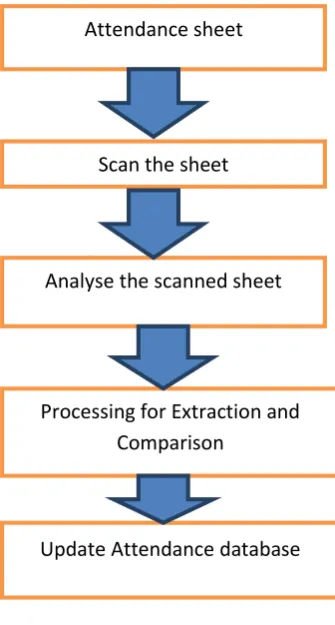
Figure 1.Work Flow
Step 1:Firstly an attendance sheet will be passed on in the classroom as usual. The students will sign on this sheet. Step 2:Post that the lecturer is supposed to scan this sheet at the end of the week or whatever the regular cycle is of updating the attendance.
Step 3:The system will take this scanned copy and analyze it to detect the names of the students and the signatures in front of their names.
Step 4:Then these signatures will be processed for extraction of features and then compared with the pre-existent signatures of the students in the database.
Step 5:The attendance database will be updated with count of every students attendance.
IV.ALGORITHM
Statistical approach
Using statistical knowledge, the relation, deviation, etc between two or more data items can easily be found out. To find out the relation between some set of data items we generally follow the concept of Correlation Coefficients. In general statistical usage refers to the departure of two variables from independence. To verify an entered signature with the help of an average signature, which is obtained from the set of, previously collected signatures, this approach follows the concept of correlation to find out the amount of divergence in between them. A unique method is introduced in [7]. In this approach various features are extracted which include global features like image gradient, statistical features derived from distribution of pixels of a signature and geometric and topographical descriptors like local correspondence to trace of the signature.[8] The classification involves obtaining variations between the signatures of the same writer and obtaining a distribution in distance space. For any questioned signature the method obtains a distribution which is compared with the available known and a probability of similarity is obtained using a statistical Kolmorogorv-Smirnov test.[8] Using only 4 genuine samples for learning, the method achieves 84% accuracy which can be improved to 89% when the genuine signature sample size is increased. This method does not use the set of forgery signatures in the training/learning[8].
Attendance sheet
Scan the sheet
Analyse the scanned sheet
Processing for Extraction and
Comparison
Volume 2, Issue 4, 2015
67
Steps of Implementation
We perform signature verification in four major steps as follows:
Signature Registration
Image Pre-Processing
Feature Extraction
Signature Verification
a. Signature Registration
In the registration process we collect five sample signatures from each student. These signatures are processed and then feature extraction is performed on them. The values of the various extracted features are then averaged and their variance is also saved in the database. The average will be used for comparison with the attendance sheet signatures and the variance is used for the threshold.
Figure 2. Original Signature
b. Image pre-processing
Preprocessing is the phase in which we put the signature image through a number of processes so that it can be used for signature verification. The signature sheet contains of spurious noise that interferes with the natural course of verification. Additionally the image also needs to be brought to a standard form.
We performed the following steps in our preprocessing phase: 1.) Convert to Grayscale
2.) Perform a Gaussian Blur 3.) Dilation
4.) Threshold
Figure 3. Grey Scale Image of the signature
c. Feature extraction
Volume 2, Issue 4, 2015
68 1.) Aspect Ratio
Aspect ratio is the ratio of the height to the width of the signature. A signature might vary in size but its aspect ratio is always similar. For this we need to first find the bounding box of the signature. This is done by traversing the image from all four sides until a signature pixel is encountered. [5]
Figure 4. Aspect Ratio of Signature
2.) Mass
This is the ratio of the signature pixels to the bounding box of the signature
3.) Closed area of signature
It is the area that a signature closes off from the external region. For this also we traverse the image from left to right until a signature pixel is encountered, but this time we change the pixel value to 1 i.e the opposite colour. Finally we count the no. of signature pixels that are remaining. This step is performed from all four sides i.e Top, bottom, left and right.[4]
Figure 5. Closed area of the signature
4.) Ratio of the distance between centroids
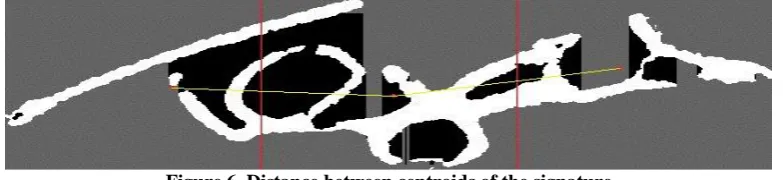
The signature was divided into three vertical parts. The centre of mass of the three parts was calculated individually. Then we calculate the distance between the left side centroid and the middle centroid followed by the distance between the middle and right centroid. We calculate the ratio between these distances. For a genuine signer these ratios stay almost constant.[3]
Figure 6. Distance between centroids of the signature
5.) Baseline Slant Angle
The signature image is divided into two parts. Then the centre of mass is calculated for each individual parts. We then draw an imaginary line between these two points and calculate its slant with respect to the horizontal. This slant will also be constant for a genuine signature.
Figure 7. Base line slant angle of the signature
V. CONCLUSIONS
This paper presents an approach to automation of the attendance management system. We make use of signature verification using OpenCV library for Java. The signature verification was done by using feature extraction approach. Features of genuine signatures were extracted and stored in database and post that all the signatures were matched to these features. We have used the statistical approach of signature verification. Findings reveal that simple forgeries had very low False Acceptance rate whereas skilled forgeries had a higher False Acceptance rate.
REFERENCES
[1] Ozgunduz, E., Karsligil, E., and Senturk, T. 2005.Off-line Signature Verification and Recognition by Support Vector Machine. Paper presented at the European Signal processing Conference.
Volume 2, Issue 4, 2015
69 [3] S. Uchida and M. Liwicki(2010) “Analysis of Local Features for Handwritten Character Recognition.” In Proc.
ICPR 2010, pp. 1945-1948.
[4] Raghuwanshi K. , Dubey N. , Nema R. and Sharma R. (2013) “Signature Verification through MATLAB Using Image Processing” International Journal on Emerging Trends in Electronics and Computer Science, VOL. 2, Issue 4,April 2013.
[5] Anu Rathi, Divya Rathi, Parmanand Astya(2012) “Offline handwritten Signature Verification by using Pixel based Method”, International Journal of Engineering Research & Technology (IJERT) ISSN: 2278-0181 Vol. 1 Issue 7, September-2012.
[6] Nilesh Y. Choudhary, Mrs. Rupal Patil & Dr. Umesh. Bhadade(2013) " Signature Recognition & Verification System Using Back Propagation Neural Network" In International Journal of IT, Engineering and Applied Sciences Research (IJIEASR) ISSN: 2319-4413 Volume 2, No. 1, January 2013
[7] Ramachandra A. C ,Jyoti shrinivas Rao(2009) ”Robust Offline signature verification based on global features” IEEE International Advance Computing Conference ,2009.
[8] Pradeep Kumar, Shekhar Singh, Ashwini Garg and Nishant Prabhat (2013) "Hand Written Signature Recognition & Verification using Neural Network " International Journal of Advanced Research in Computer Science and Software Engineering Volume 3, Issue 3, March 2013 ISSN: 2277 128X