Iranian Journal of Fisheries Sciences 16(2) 567-577 2017
Growth performance, feed utilization and body composition
of Nile tilapia, Oreochromis niloticus (Linnaeus, 1758) fed
with different levels of black soldier fly, Hermetia illucens
(Linnaeus, 1758) maggot meal diet
Muin H.
1; Taufek N.M.
1; Kamarudin M.S.
2; Razak S.A.
1*Received: November 2015 Accepted: July 2016
Abstract
In this study, fish meal (FM) was replaced by the black soldier fly maggot meal (BSFM) with replacement levels at 0%, 25%, 50%, 75% and 100%. The feeding trial was conducted for 56 days and the effect of each replacement level on the growth performance, feed utilization, body composition and survival of the experimental fish was assessed. All the experimental diets were well accepted by the fish. No mortality was observed during the experimental period. Diet 3 resulted in the highest weight gain and SGR values of 8.74±0.18 and 2.43±0.04% respectively. FCR and PER values obtained for Diet 3 were also better compared to that with other diets. Although there were no significant differences in crude protein content among fishes fed different diets
(Diet 1 to Diet 5), fish fed Diet 3 showed significant (p<0.05) increase in crude protein
content at the end of the experiment. Based on these results, it may be concluded that BSFM can be used to replace FM with up to 50% replacement without causing adverse effects on growth and feed utilization parameters.
Keywords: Hermetia illucens, Black soldier fly maggot meal, Oreochromis niloticus,
Growth performance, Feed utilization
1-AquaNutriBiotech Research Laboratory, Institute of Biological Sciences, Faculty of Science, University of Malaya, 50603 Kuala Lumpur, Malaysia.
2-Department of Aquaculture, Faculty of Agriculture, Universiti Putra Malaysia, Serdang, Selangor, Malaysia.
*Corresponding author's Email: [email protected].
Introduction
Extensive research has been done to seek alternative protein sources to replace fish meal in the fish feed industry. Aquaculture can no longer depend on fish meal as a sole protein source because of its fluctuating supply and increasing price trend. The increase in price of fish meal in the market will indirectly increase the production cost of the fish farmed (Hardy, 2010). Several types of feed have been investigated in an attempt to seek a replacement for fish meal in fish feed
(Lunger et al., 2007; Silva et al., 2010;
Cabral et al.,2011; Richard et al., 2011;
Muin et al., 2013; Muin et al., 2014;
Muin et al., 2015). These feed include
animal protein, plant, and also aquatic plant-based diet. One of the criteria in order to be a good alternative protein source is the ability to supply adequate protein with appropriate balance in amino acid content required by fish to
support growth and health (Khan et al.,
2012; Naz and Javed, 2013).
Furthermore, these feeds should be cheaper than fish meal, easy to access, and found in abundance locally.
Recently, researchers tend to use insect-based meal as an alternative to replace fish meal protein. A few species of insects have been studied. For
example, Jabir et al., (2012a, 2012b)
and Jabir et al., (2014) evaluated the
potential of super worm meal, Awoniyi
et al., (2003); Fasakin et al.,( 2003);
Ajani et al., (2004); Ogunji et al.,
(2007) and Atteh and Ologbenla (2015) worked on housefly maggot meal,
Taufek et al., (2016) evaluated the
potential of black cricket meal in
African catfish diet, and Sing et al.,
(2014) evaluated and analyzed the
protein of blow fly maggot meal in tilapia diet.
The black soldier fly (BSF) is a
non-pest tropical and warm-temperate
region insect and can colonize a wide variety of decomposing vegetables and animal matter. It is a member of the Stratiomyidae family and is not considered as a pest as the adult flies are not attracted to human habitation or food and therefore do not transmit
diseases (Furman et al., 1959). These
pre pupae contain 42% crude protein and 35% fat which makes it a suitable source for fishmeal replacement in commercial fish feed production and also as a promising source for biodiesel due to its high fatty acid content
(Newton et al., 1977). However,
information about Black soldier fly maggot meal (BSFM) in fish feed is still limited.
The purpose of this study is to evaluate the use of the black soldier fly (Hermetia illucens) maggot meal (BSFM) protein source as a fish meal substitute in the practical commercial tilapia diets and its relation to growth performance, feed utilization, and body composition.
Materials and methods
BSF was cultured at the
AquaNutriBiotech Research
Laboratory, University of Malaya, Malaysia. After 2 weeks of feeding,
Iranian Journal of Fisheries Sciences 16(2) 2017 569
matured larvae were collected and sacrificed humanely by putting them into a freezer before being dried at 50°C for 24 hours. Dried larvae was then ground into a powder and kept in a cold room at 4°C. BSFM and all the raw materials were analyzed for their
chemical content using standard
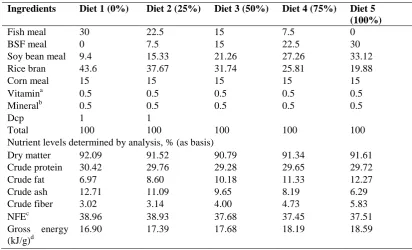
methods according to AOAC (2002) (Table 1). Five different feed levels of FM replacement were formulated using WinFeed (version 2.8) software based on isonitrogenous crude protein (30%) content. The protein replacement was at 0% (Diet 1), 25% (Diet 2), 50% (Diet 3), 75% (Diet 4) and 100% (Diet 5). All experimental diets were prepared using the ‘Mini Pelleting Machine’ to produce standard sized pellet of 1.5 mm in diameter. Every diet was then dried in an oven at 60 C for 24 hours to prevent fungus infestation. Samples from each diet were then chemically tested for its moisture, protein, lipid, fiber and ash. The results are shown in Table 2.
Feeding trials were conducted for eight weeks. The fish were obtained
from a commercial supplier in
Balakong, Selangor, Malaysia. Prior to the feeding trials, the fish were acclimatized for a week and were fed with commercial pellet. The fish were then randomly chosen and weighed, before being randomly distributed into fifteen plastic tanks. Each tank was stocked with ten fish. Each diet was assigned to triplicate tanks. Several fish were frozen in the freezer for proximate analysis. The feeding level was at 5% of the fish body weight. Fish were fed two times daily. The fish were weighed
once in two weeks and the appropriate feeding ration was adjusted for the following week. At the start of the experiment, ten fish were sacrificed and kept frozen till the end of the experiment for proximate analysis. At the end of the experiment, all the fish were sacrificed, pooled, and analyzed for their nutrient composition.
Proximate composition of BSFM, fish meal, diet samples, fish carcasses before and after experiment were determined using standard laboratory methods according to AOAC (2002). Crude protein content was determined using automatic Kjeldahl technique and multiplying N by 6.25 factors. Crude lipid was evaluated by Soxtec Tecator System and dry matter was calculated from weight loss after 24 hours drying at 100 C. For ash, the sample was burnt in an oven at 600 C until constant weight was achieved. Fiber analysis was done using the fiber cap procedure which includes digestion by alkali and acid. Amino acid analysis was done using the HPLC (Jasco, CO-2056 Plus, Intelligent Column Oven) by comparing the peak retention time to a known standard.
Growth performance was measured in order to analyze the feed utilization efficiency of the fish.
Body weight gain (BWG) = Wt – Wi
Feed conversion ratio (FCR) = total feed intake (g) / total wet weight gain (g)
Specific growth rate (SGR) = [(lnWt –
ln Wi)/T] × 100
Protein efficiency ratio (PER) = wet weight gain (g) / total protein intake (g)
Survival rate (%) = (final number of remaining fish / initial number of fish)× 100
Where Wt – mean final weight,
Wi– mean initial weight,
T – feeding trial period in days,
Analyses were performed using the statistical package SPSS 14.0. All the data were subjected to one-way analysis of variance (ANOVA) followed by a comparison of means using the Duncan Test. All differences were regarded as
significantly different at p<0.05 among
treatment groups.
Results
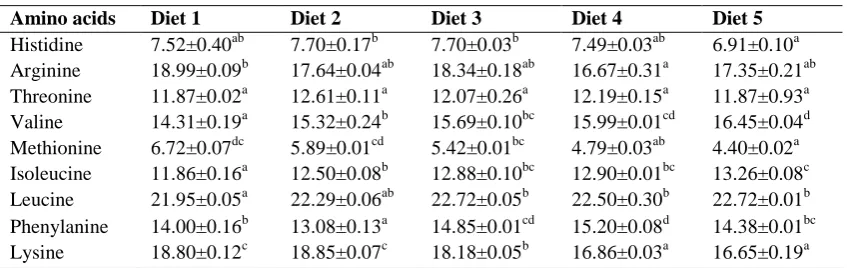
From Table 1, BSFM used in this study contain 41.74±1.09% crude protein and 28.74±1.44% lipid. Besides that, the proximate analysis and amino acid content of experimental diets are shown in Table 2 and Table 3.
Table 4 shows the growth
performance of tilapia fingerlings fed experimental diets. Initial stocking density of fish was ten fish per aquarium tank. At the end of the experiment, there were no significant
differences (p>0.05) in terms of
survival rate of the fish fed five different diets. All experimental diets show 100% survival rate where all the fish survived and no mortality was recorded. The growth of fish was obtained by measuring the weight gain every two weeks. The initial mean weight of fish fed diets 1, 2, 3, 4 and 5 were 3.07± 0.09 g, 3.09 ± 0.04 g, 3.03 ± 0.05 g, 3.02 ± 0.07 g and 2.99 ± 0.02 g, respectively as shown in Table 4. At the
end of the experiment, the final weight of fish fed diet 2 was the highest (11.83 ± 0.44), followed by diet 3 (11.77 ± 0.16 g), diet 4 (11.43± 0.33g), diet 1 (10.86 ± 0.55 g) and diet 5 (10.43 ±
0.28 g).
No significant differences (p>0.05)
were observed for specific growth rate (SGR) and feed conversion ratio (FCR) among all diets. However, the fish fed diet 3 showed the highest SGR (2.43±0.04%) and the best FCR (2.91±0.10) compared to that in other diets. On the other hand, weight gain and protein conversion ratio (PER)
showed significant differences (p<0.05)
among all diets. For weight gain (WG) and the protein efficiency ratio (PER), the fish fed with diet 3 produced the
best results at 8.74±0.18g and
1.17±0.04 respectively.
There were significant differences
(p<0.05) for crude protein content in
muscle tissue among fish in all treatments as shown in Table 5. The initial body composition for crude protein content of the fish was 51.03 ± 0.22%. Diet 2 (25% replacement of fish meal) resulted in the highest increment in crude protein level (60.88±2.75), followed by fish fed diet 5 (58.75 ± 0.84), diet 3 (58.73 ± 0.28), diet 4 (58.44 ± 1.09) and diet 1 (58.16 ± 0.29).
Iranian Journal of Fisheries Sciences 16(2) 2017 571
Table 1: Proximate composition of BSFM
Chemical composition (%) Composition (mean ± SE) Dry matter (%) 89.37 ± 0.12 Crude Protein (%) 41.74 ± 1.09 Crude lipid (%) 28.74 ± 1.44
Ash (%) 10.64 ± 0.04
Fiber (%) 12.50 ± 0.23
Table 2: Formulation and chemical composition of the experimental diets.
Ingredients Diet 1 (0%) Diet 2 (25%) Diet 3 (50%) Diet 4 (75%) Diet 5 (100%)
Fish meal 30 22.5 15 7.5 0
BSF meal 0 7.5 15 22.5 30
Soy bean meal 9.4 15.33 21.26 27.26 33.12
Rice bran 43.6 37.67 31.74 25.81 19.88
Corn meal 15 15 15 15 15
Vitamina 0.5 0.5 0.5 0.5 0.5
Mineralb 0.5 0.5 0.5 0.5 0.5
Dcp 1 1
Total 100 100 100 100 100
Nutrient levels determined by analysis, % (as basis)
Dry matter 92.09 91.52 90.79 91.34 91.61
Crude protein 30.42 29.76 29.28 29.65 29.72
Crude fat 6.97 8.60 10.18 11.33 12.27
Crude ash 12.71 11.09 9.65 8.19 6.29
Crude fiber 3.02 3.14 4.00 4.73 5.83
NFEc 38.96 38.93 37.68 37.45 37.51
Gross energy (kJ/g)d
16.90 17.39 17.68 18.19 18.59
avitamin A 50.000MTV; Vitamin D3 10.000MTV; Vitamin E 75.000gm; Vitamin K3 20.000gm; vitamin B1 10.000gm; vitamin B2 30.000gm; vitamin B6 20.000GM; Vitamin 12 0.100gm; calcium D- Pantathenate 60.000gm; nicotinic acid 200.000gm; folic acid 5.000gm; biotin 235.000gm.
bselenium 0.200gm; iron 80.000gm; manganese 100.000gm; zinc 80.000gm; copper 15.000gm; potassium chloride 4.000gm; magnesium oxide 0.6000gm; sodium bicarbonate 1.500gm; iodine 1.000gm; cobait 0.250 gm.
c
NFE = 100 – (% protein + % lipid + % ash + % fiber+ % moisture)
dGross energy (GE) was calculated using the following factors: crude protein= 23.9kJ/g, crude lipid= 39.8 kJ/g and NFE = 17.6 kJ/g (Schulz et al., 2005).
Table 3: Essential amino acid composition of diets used in this study (mg/crude protein).
Amino acids Diet 1 Diet 2 Diet 3 Diet 4 Diet 5
Histidine 7.52±0.40ab 7.70±0.17b 7.70±0.03b 7.49±0.03ab 6.91±0.10a Arginine 18.99±0.09b 17.64±0.04ab 18.34±0.18ab 16.67±0.31a 17.35±0.21ab Threonine 11.87±0.02a 12.61±0.11a 12.07±0.26a 12.19±0.15a 11.87±0.93a Valine 14.31±0.19a 15.32±0.24b 15.69±0.10bc 15.99±0.01cd 16.45±0.04d Methionine 6.72±0.07dc 5.89±0.01cd 5.42±0.01bc 4.79±0.03ab 4.40±0.02a Isoleucine 11.86±0.16a 12.50±0.08b 12.88±0.10bc 12.90±0.01bc 13.26±0.08c Leucine 21.95±0.05a 22.29±0.06ab 22.72±0.05b 22.50±0.30b 22.72±0.01b Phenylanine 14.00±0.16b 13.08±0.13a 14.85±0.01cd 15.20±0.08d 14.38±0.01bc Lysine 18.80±0.12c 18.85±0.07c 18.18±0.05b 16.86±0.03a 16.65±0.19a All values are means ± SE for triplicate feeding groups and values in same row with different letters are significantly different (p<0.05).
Essential amino acid requirements of Nile tilapia according to National Research Council (1993) are: tryptophan 1.00, lysine 5.12, histidine 1.72, arginine 4.20, threonine 3.75, valine 2.80, methionine 2.68, isoleucine 3.11, leucine 3.39, phenylalanine + tyrosine 3.75.
Table 4: Growth performance of tilapia fingerling fed with experimental diets.
Diet 1 Diet 2 Diet 3 Diet 4 Diet 5
Weight, g 3.07 ± 0.09a 3.09 ± 0.04a 3.03 ± 0.05a 3.02 ± 0.07a 2.99 ± 0.02a Final weight, g 10.86 ± 0.55ab 11.83 ± 0.44b 11.77 ± 0.16b 11.43 ± 0.33ab 10.43 ± 0.28a Weight gain, g 7.79±0.52ab 8.74±0.43b 8.74±0.18b 8.41±0.26ab 7.44±0.29a SGR, % 2.25±0.09a 2.39±0.06a 2.43±0.04a 2.38±0.02a 2.23±0.06a FCR 3.18±0.13a 3.08±0.21a 2.91±0.10a 3.09±0.04a 3.31±0.08a PER 1.04± 0.04ab 1.10± 0.07bc 1.17 ± 0.04c 1.09± 0.01abc 1.02± 0.02a
Survival, % 100a 100a 100a 100a 100a
SGR = (lnW2 – ln W1/T) X 100, FCR = food fed/ live weight gain, PER = live weight gain (g)/ protein fed (g)
All the values are means ± SE for triplicate feeding groups. Means on the same row with different letters are significantly different (p<0.05).
Table 5: Initial and final body composition of tilapia fingerlings fed on experimental diets (%). Component Initial Diet 1 Diet 2 Diet 3 Diet 4 Diet 5 Dry matter 99.20±0.24a 96.24±0.05a 96.03±0.09a 95.76±0.36a 96.15±0.25a 95.86±0.25a Protein 51.03±0.22a 58.16±0.29b 60.88±2.75b 58.73±0.28b 58.44±1.09b 58.75±0.84b Fat 10.82±0.16a 21.02±0.43c 17.95±1.42b 21.07±0.45c 21.02±0.43c 19.96±0.48bc Ash 7.50±0.11a 15.92±0.43bc 16.51±0.49c 15.81±0.64bc 14.80±0.11b 15.58±0.41bc All the values are means ± SE for triplicate feeding groups. Means on the same row with different letters are significantly different (p<0.05).
Discussion
From this study, it can be shown that BSFM contain 41.74±1.09% crude protein and 28.74±1.44% lipid. The value for crude protein is higher than the values reported by other researchers
previously. Studies done by Sheppard et
al., (1994) and Newton et al., (2005)
reported that the prepupae of black soldier fly contained approximately
40% protein and 30% fat. Ojewola et
al., (2005) reported that factors such as
Iranian Journal of Fisheries Sciences 16(2) 2017 573
source, stage of harvesting, methods of processing and drying may affect the
nutrient content of samples.
Furthermore, Jabir et al., (2012b)
working on Super worm meal reported that feed consumed by the super worm during its growth affect the crude lipid content.
At the end of this experiment, all fishes in all treatments showed good survival. This indicates that the pelleted diet was highly palatable and well
accepted by the fish. Rodríguez‐Serna
et al., (1996) said that unacceptability due to the unpalatability of the diets fed to fish is one of the most common problems when an alternative protein source was used to replace FM. Besides that, good handling practices and water
quality management during the
experimental period may affect the survival rate of fish (Bichi and Ahmad, 2010).
In the present study, there are slightly significant differences in terms of weight gain among all diets. Weight gain of fish fed Diet 2 and Diet 3 was significantly higher compared to that in other treatments. However, weight gain of experimental fishes decreased as the replacement of FM increased further. This indicates that tilapia fish could accept the alternative protein (BSFM) optimally only up to the 50% inclusion level. SGR, There were no significant differences recorded for SGR among all treatments. These results indicate that replacement of fish meal with BSFM up to 100% did not affect the specific growth rate of fish. The best SGR
values recorded was fish fed Diet 3 with
a value of 2.43±0.04%.
There was no significant difference among all diets in terms of FCR value. However, Diet 3 (2.91±0.01) produced the best value compared to others. A low value of FCR is a good indicator of a high quality feed. This result suggests that 50% replacement of fish meal by BSFM could be used to feed Nile Tilapia fingerlings in order to obtain
good feed utilization. However,
St‐Hilaire et al., (2007) reported that
good FCR was obtained in fish fed rainbow trout diets replaced with 25% black soldier fly meal without causing adverse effects on the FCR of the fish. In this study, as the percentage of the replacement of fishmeal increases, the FCR values also increases. It is unknown why this happens and needs
further investigation. However,
St‐Hilaire et al., (2007) assumed that
diets containing more BSFM contained chitin and this may affect their digestibility. Similar findings were reported by Köprücü and Özdemir (2005) who found that lower ADCs dry matter, protein, average amino acid, lipid and energy were observed in tilapia fed feeds with high content of ash and chitin. However, they did not provide the digestibility data to support their hypothesis as it was not collected. PER is an indicator of quality of protein content in feedstuff and usually high PER values are required for better feed utilization of fish. In the present
study PER values ranged from
1.02±0.02 to 1.17±0.04 which were lower than those reported by other
researchers working with tilapia. In contrast to the present study, higher
PER values were reported Maina et al.,
(2002) and Ogunji et al., (2008) for
tilapia fed a diet with FM replaced by maggot meal. The differences between PER reported by the different studies could be due to quality of dietary
protein used.
For the whole body protein
composition, there are slightly
significant differences between initial carcass and final carcass in fish fed with different level inclusion of FM. However the body protein in all experimental groups did not differ much during the experimental period. These findings showed that the whole body protein content of fish was not clearly affected by the diet composition used. This could be due to the duration of the trial which was limited to only 8 weeks; therefore limiting the ability of the study to detect small differences in these parameters. However for fat content, it shows large variations. Similar results were obtained by Atack
et al., (1979) and Hasan and Macintosh (1993). They reported that lipid content tends to show greater fluctuations than other carcass components.
In conclusion, the present study indicates that BSFM can replace up to 50% (Diet 3) of the protein in FM without adverse effects in growth performance, feed utilization and body
composition of tilapia. However,
further studies on palatability and digestibility should be conducted to
strengthen the findings of the present study.
Acknowledgements
The authors would like to thank staff of Fish Nutrition Department, Freshwater Fish Research Centre, Glami Lemi for their technical assistance. Thanks are also due to University of Malaya for providing financial support through grant PV 115-2012 A to HM, and grant, Project no: FP049-2014A to SAR.
References
Ajani, E., Nwanna, L. and Musa, B.,
2004. Replacement of fishmeal with
maggot meal in the diets of Nile
tilapia, Oreochromis niloticus.
World Aquaculture, 35, 52-54.
AOAC, 2002. Official methods of
analysis, 13th Ed, Association of
Official Analytical Chemists,
Washington DC, USA.
Atack, T., Jauncey, K. and Matty, A.,
1979. The utilization of some single
cell proteins by fingerling mirror
carp (Cyprinus carpio).
Aquaculture,18, 337-348.
Atteh, J. and Ologbenla, F., 2015.
Replacement of fish meal with maggots in broiler diets: effects on performance and nutrient retention.
Nigerian Journal of Animal Production, 20, 44-49.
Awoniyi, T., Aletor, V. and Aina, J.,
2003. Performance of
broiler-chickens fed on maggot meal in
place of fishmeal. International
Journal of Poultry Science, 2, 271-274.
Iranian Journal of Fisheries Sciences 16(2) 2017 575
Bichi, A. and Ahmad, M., 2010.
Growth performance and nutrient
utilization of African catfish (Clarias
gariepinus) fed varying dietary levels of processed cassava leaves.
Bayero Journal of Pure and Applied Sciences,3(1).
Cabral, E., Bacelar, M., Batista, S., Castro-Cunha, M., Ozório, R. and
Valente, L., 2011. Replacement of
fishmeal by increasing levels of plant protein blends in diets for
Senegalese sole (Solea senegalensis)
juveniles. Aquaculture, 322, 74-81.
Fasakin, E., Balogun, A. and Ajayi,
O., 2003. Evaluation of full‐fat and
defatted maggot meals in the feeding
of clariid catfish Clarias gariepinus
fingerlings. Aquaculture Research,
34, 733-738.
Furman, D.P., Young, R.D. and
Catts, P.E., 1959. Hermetia illucens
(Linnaeus) as a factor in the natural
control of Musca domestica
Linnaeus. Journal of Economic
Entomology, 52, 917-921.
Hardy, R.W., 2010. Utilization of plant
proteins in fish diets: effects of global demand and supplies of
fishmeal. Aquaculture Research, 41,
770-776.
Hasan, M. and Macintosh, D., 1993.
Effect of environmental temperature and feeding rate on the growth, food utilization and body composition of
common carp (Cyprinus carpio L.)
fry. Colloques de l'INRA (France).
Jabir, M.D.A.R., Razak, S.A. and
Vikineswary, S., 2012a. Effect of
mushroom supplementation as a prebiotic compound in super worn
based diet on growth performance of
red tilapia fingerlings. Sains
Malaysiana, 41, 1197-1203.
Jabir, M.D.A.R, Razak, S.A. and
Vikineswary, S., 2012b. Chemical
composition and nutrient
digestibility of super worm meal in
red tilapia juvenile. Pakistan
Veterinary Journal, 32.
Jabir, M.D.A.R., Razak, S.A. and
Vikineswary, S., 2014. Nutritive
potential and utilization of super
worm (Zophobas morio) meal in the
diet of Nile tilapia (Oreochromis
niloticus) juvenile. African Journal of Biotechnology,11, 6592-6598.
Khan, N., Qureshi, N., Nasir, M., Vandenberg, G., Mughal, M., Maqbool, A., Jabbar, M. and
Zikria, N., 2012. Effect of artificial
feed on sensory attributes of flesh of
Indian major carps (Labeo rohita,
Catla catla and Cirrhinus mrigala) fed in monoculture and polyculture
systems. Pakistan Veterinary
Journal, 32, 349-353.
Köprücü, K. and Özdemir, Y., 2005.
Apparent digestibility of selected feed ingredients for Nile tilapia (Oreochromis niloticus).
Aquaculture, 250, 308-316.
Lunger, A.N., McLean, E. and Craig,
S., 2007. The effects of organic
protein supplementation upon
growth, feed conversion and texture quality parameters of juvenile cobia (Rachycentron canadum).
Aquaculture, 264, 342-352.
Maina, J.G., Beames, R.M., Higgs, D., Mbugua, P.N., Iwama, G. and
Kisia, S.M., 2002. Digestibility and
feeding value of some feed
ingredients fed to tilapia
Oreochromis niloticus (L.).
Aquaculture Research, 33, 853-862.
Muin, H., Fatah, N.N.A., Nor,
M.H.M. and Razak, S.A., 2013.
Rice bran replacement in Clarias
gariepinus fingerlings diets with
Pleurotus florida stalk. Sains Malaysiana, 42, 1109-1114.
Muin, H., Fatah, N.N.A., Bahari, I.H.
and Razak, S.A., 2014.
Replacement of rice bran with
Pleurotus florida stalks on growth
performance of Oreochromis
niloticus fingerlings. Sains Malaysiana, 43(5), 675-681.
Muin, H., Taufek, N.M., Abiodun, R.A., Yusuf, H.M. and Razak,
S.A., 2015. Effect of partial and
complete replacement of fishmeal with mushroom stalk meal soy bean meal on growth performance of Nile
tilapia, Oreochromis niloticus. Sains
Malaysiana, 44, 511-516.
National Research Council. 1993. In
situ Bioremediation: When does it work?. National Academies Press.
Naz, S. and Javed, M., 2013. Growth
responses of fish during chronic exposure of metal mixture under
laboratory conditions. Pakistan
Veterinary Journal, 33, 354-357.
Newton, G., Booram, C., Barker, R.
and Hale, O., 1977. Dried larvae
meal as a supplement for swine.
Journal of Animal Science, 44, 395-400.
Newton, L., Sheppard, C., Watson,
D., Burtle, G. and Dove, R., 2005.
Using the black soldier fly, Hermetia
illucens, as a value-added tool for the management of swine manure.
Animal and Poultry Waste
Management Center, North Carolina State University, Raleigh, NC17.
Ogunji, J.O., Nimptsch, J., Wiegand,
C. and Schulz, C., 2007. Evaluation
of the influence of housefly maggot meal (magmeal) diets on catalase,
glutathione S-transferase and
glycogen concentration in the liver of Oreochromis niloticus fingerling.
Comparative Biochemistry and Physiology Part A: Molecular and Integrative Physiology, 147, 942-947.
Ogunji, J., Toor, R., Schulz, C. and
Kloas, W., 2008. Growth
performance, nutrient utilization of
Nile tilapia Oreochromis niloticus
fed housefly maggot meal
(magmeal) diets. Turkish Journal of
Fisheries and Aquatic Sciences, 8, 141-147.
Ojewola, G., Okoye, F. and Ukoha,
O., 2005. Comparative utilization of
three animal protein sources by
broiler chickens. International
Jounal of Poultry Sciences, 4, 462-467.
Richard, L., Surget, A., Rigolet, V., Kaushik, S.J. and Geurden, I.,
2011. Availability of essential amino
acids, nutrient utilisation and growth in juvenile black tiger shrimp,
Penaeus monodon, following
fishmeal replacement by plant
protein. Aquaculture, 322, 109-116.
Iranian Journal of Fisheries Sciences 16(2) 2017 577
Rodríguez‐Serna, M., Olvera‐Novoa,
M. and Carmona‐Osalde, C., 1996.
Nutritional value of animal
by‐product meal in practical diets for
Nile tilapia Oreochromis niloticus
(L.) fry. Aquaculture Research, 27,
67-73.
Schulz, C., Knaus, U., Wirth, M. and
Rennert, B., 2005. Effect of varying
dietary fatty acid profile on growth performance, fatty acid, body and tissue composition of juvenile pike
perch (Sander lucioperca).
Aquaculture Nutrition, 11, 403-413.
Sheppard, D.C., Newton, G.L.,
Thompson, S.A. and Savage, S.,
1994. A value added manure
management system using the black
soldier fly. Bioresource Technology,
50, 275-279.
Silva, J.M., Espe, M., Conceição, L.E., Dias, J., Costas, B. and
Valente, L.M., 2010. Feed intake
and growth performance of
Senegalese sole (Solea senegalensis
Kaup, 1858) fed diets with partial replacement of fish meal with plant
proteins. Aquaculture Research, 41,
e20-e30.
Sing, K.-W., Kamarudin, M.S.,
Wilson, J.-J. and Sofian-Azirun,
M., 2014. Evaluation of blowfly
(Chrysomya megacephala) maggot meal as an effective, sustainable replacement for fishmeal in the diet of farmed juvenile red tilapia (Oreochromis sp.) Pakistan Veterinary Journal, 34, 288-292.
St‐Hilaire, S., Sheppard, C.,
Tomberlin, J.K., Irving, S.,
Newton, L., McGuire, M.A.,
Mosley, E.E., Hardy, R.W. and
Sealey, W., 2007. Fly prepupae as a
feedstuff for rainbow trout,
Oncorhynchus mykiss. Journal of the World Aquaculture Society, 38, 59-67.
Taufek, N.M., Aspani, F., Muin, H., Raji, A.A., Razak, S.A. and Alias,
Z., 2016. The effect of dietary
cricket meal (Gryllus bimaculatus)
on growth performance, antioxidant
enzyme activities, and
haematological response of African
catfish (Clarias gariepinus). Fish
Physiology and Biochemistry, 1-13.