Weak Algebraic Hyperstructures as a Model for
Interpretation of Chemical Reactions
B.DAVVAZ
Department of Mathematics, Yazd University, Yazd, Iran
Correspondence should be addressed to B. Davvaz (Email: [email protected]) Received 22 November 2014; Accepted 7 January 2016
ACADEMIC EDITOR:ALI REZA ASHRAFI
ABSTRACT The concept of weak algebraic hyperstructures or Hv-structures constitute a generalization of the well-known algebraic hyperstructures (semihypergroup, hypergroup and so on). The overall aim of this paper is to present an introduction to some of the results, methods and ideas about chemical examples of weak algebraic hyperstructures. In this paper after an introduction of basic definitions and results about weak algebraic hyperstructures, we review:
(1) Weak algebraic hyperstructures associated with chain reactions. (2) Weak algebraic hyperstructures associated with dismutation reactions. (3)Weak algebraic hyperstructures associated with redox reactions.
KEYWORDSWeak algebraic hyperstructure • hypergroup • Hv-group • chain reaction • dismutation reaction • redox reaction.
1.
I
NTRODUCTIONGenotopies. In [15], Davvaz, Santilli and Vougiouklis studied multi-valued hyperstructures following the apparent existence in nature of a realization of two-valued hyperstructures with hyperunits characterized by matter-antimatter systems and their extensions, where matter is
represented with conventional mathematics and antimatter is represented with isodual mathematics, also see [16]. In [17], the authors presented Ying’s twin universes, Santilli’s isodual theory of antimatter, and DavvazSantilliVougiouklis two-valued hyperstructures representing matter and antimatter in two distinct but co-existing space times. They identified a seemingly new map for both matter and antimatter providing a mathematical prediction of Ying’s twin universes, and introduced a four-fold hyperstructure representing matter-antimatter as well as Ying’s twin universes, all co-existing in distinct space times. Another motivation for the study of hyperstructures comes from physical phenomenon as the nuclear fission. This motivation and the results were presented by Hošková, Chvalina and Račková (see [20, 21]). In [11], the authors provided, for the first time, a physical example of hyperstructures associated with the elementary particle physics, Leptons. They have considered this important group of the elementary particles and shown that this set along with the interactions between its members can be described by the algebraic hyperstructures.
Mendel, the father of genetics took the first steps in defining “contrasting characters, genotypes in F1 and F2 . . . and setting different laws”. The genotypes of F2 is dependent on the type of its parents genotype and it follows certain roles. In [18], Ghadiri et al. analyzed the second generation genotypes of monohybrid and a dihybrid with a mathematical structure. They used the concept of Hv-semigroup structure in the F 2-genotypes with cross operation and proved that this is an Hv-semigroup. They determined the kinds of number of the Hv-subsemigroups of F2-genotypes. In [10], inheritance issue based on genetic information is looked at carefully via a new hyperalgebraic approach. Several examples are provided from different biology points of view, and it is shown that the theory of hyperstructures exactly fits the inheritance issue.
Another motivation for the study of hyperstructures comes from chemical reactions. In [6], Davvaz and Dehghan-Nezhad provided examples of hyperstructures associated with chain reactions. In [7], Davvaz et al. introduced examples of weak hyperstructures associated with dismutation reactions. In [12], Davvaz et al. investigated the examples of hyperstructures and weak hyperstructures associated with redox reactions, see [1, 8, 9, 13].
2.
W
EAKA
LGEBRAICH
YPERSTRUCTURESthe distributive law and so on are replaced by their corresponding weak axioms. Since then the study of Hv-structure theory has been pursued in many directions by Vougiouklis, Davvaz, Spartalis, Dramalidis, Hošková, and others. In this section, we present some definitions and basic facts about weak hyperstructures [5, 29, 31].
Let H be a non-empty set and :H H (H)
be a hyperoperation. The “·” in H is called weak associative if
x· (y · z) ∩ (x · y) · z ≠∅, for all x, y, z ∈H. The “ ·” is called weak commutative if
. , , forallx y H x
y y
x
The “ ·” is called strongly commutative if
. , , forallx y H x
y y
x
The hyperstructure (H, ·) is called an Hv-semigroup if “· ” is weak associative. An Hv -semigroup is called an Hv-group if
. , foralla H H
a H H
a
In an obvious way, the Hv-subgroup of an Hv-group is defined.
Consider H = {e, a, b, c}and define ∗ on H with the help of the following table:
* e a b C e e a b c a a e,a c b b b c e,b a c c b a e,c
Then (H, ∗) is an Hv-group which is not a hypergroup. Indeed, we have (a ∗ b) ∗ c = c∗ c= {e,c}, a ∗ (b∗ c) = a∗ a= {e, a}. Therefore, ∗is not associative.
A first motivation to study the weak hyperstructures is the following example. Let (G, ·) be a group and R be an equivalence relation on G. In G/R consider the hyperoperation ⊙ defined by x ⊙y = {z| z ∈x · y}, where x denotes theequivalence class of the element x. Then, (G,⊙) is an Hv-group which is not always a hypergroup.
All the weak properties for hyperstructures can be applied for subsets. Forexample, if (H, ·) is a weak commutative Hv-group, then for all non-empty subsets A, B, C of H, we have (AB)(BA)and A(BC)(AB)C. To prove this, one has simply to take one element of each set.
Let (H1,),(H2,) be two Hv-groups. A map f :H1 H2 is called an Hv
-homomorphism or a weak homomorphism if
. , , ) ( ) ( )
(x y f x f y forallx y H1
f is called an inclusion homomorphism if
. ,
), ( ) ( )
(x y f x f y forallx y H1
f
Finally, f is called a strong homomorphism or a good homomorphism if . , ),
( ) ( )
(x y f x f y forallx y H1
f
If f is onto, one to one and strong homomorphism, then it is called an isomorphism. Moreover, if the domain and the range of f are the same Hv-group, then the isomorphism is called an automorphism. We can easily verify that the set of all automorphisms of H, defined by Aut H, is a group.
Several Hv-structures can be defined on a set H. A partial order on these hyperstructures can be introduced, as follows.
Let (H, ·) and (H, ∗) be two Hv-groups defined on the same set H. We say that “ ·” less than or equal to “∗” and we write · ≤ ∗, if there is f ∈ Aut(H,∗) such that x · y ⊆ f(x∗y), for all x, y ∈ H. If a hyperoperation is weak associative, then every greater hyperoperation, defined on the same set is also weak associative. In [30], the set of all Hv-groups with a scalar unit defined on a set with three elements is determined using this property.
Greater hyperoperation from the one of a given Hv-group defines an Hv-group. The weak commutativity is also valid for every greater hyperoperation. We remarkthat this statement is not true for hypergroups.
Let (H, ·) be an Hv-group. The relation β∗ is the smallest equivalence relation on H such that the quotient H/β∗ is a group. β∗ is called the fundamental equivalence relation on
H. If U denotes the set of all finite products of elements of H, then a relation β can be defined on H whose transitive closure is the fundamental relationβ∗. The relation β is
defined as follows: for x and y in H we write xβy if and only if {x, y}⊆u for some u ∈ U. We can rewrite the definition of β∗on H as follows: aβ∗bif and only if there exist z
1, . . . ,
zn+1 ∈H with z1 = a, zn+1 = b and u1, . . . , un ∈ U such that {zi, zi+1} ⊆ ui (i = 1, . . . , n). Suppose that β∗(a) is the equivalence classcontaining a ∈H. Then, the product ⊙ on H/β∗ is
defined as follows:
β∗(a) ⊙β∗(b) = {β∗(c)| c ∈ β∗(a) · β∗(b)} for all a, b ∈ H.
It is not difficult to see that β∗(a) ⊙ β∗(b) is the singleton {β∗(c)} for all c ∈ β∗(a) · β∗(b). In
this way H/β∗ becomes a group.
Let (H, ·) be an Hv-group. An element x ∈ H is called single if its fundamental class is singleton, i.e., β∗(x) = {x}. Denote by SH the set of all single elements of H. Let (H, ·)
be an Hv-group and x ∈ SH. Let a ∈ H and take any element v ∈ H such that x ∈ a · v. Then, β∗(a) = {h ∈H | h · v = x}.
hyperoperation ◦ <· can have the same set SH if only in the products of non-single elements the ◦ is less than · . Finally, if ρ and σ areequivalence relations with ρ < σ such that H/ρ and H/σ are non-equal groups, then they can not have both single elements.
Let (H,·) be an Hv-group with (left, right) identity elements. Then, H is called (left, right) reversible in itself when any relation c∈a· b implies the existence of a left inverse a′ of a and a right inverse b′ of b such that b ∈a′ · c and a ∈ c · b′. The Hv-group (H, ·) is called feebly quasi-canonical if it is regular, reversible and satisfies the following conditions:
For each a ∈H, if a′, a′′ are inverses of a, then for each x ∈H, we have: a′ · x = a′′ · x and x · a′ = x · a′′.
A feebly quasi-canonical Hv-group H is called feebly canonical if it is strongly commutative.
3.
C
HEMICALR
EACTIONSChemistry is the study of matter and of the changes matter undergoes. A chemicalequation describes the products of a reaction that from the starting molecules oratoms. Chemistry seeks to predict the products that result from the reaction of specificquantities of atoms or molecules. Chemists accomplish this task by writing andbalancing chemical equations. Symmetry is very important in chemistry researchesand group theory is the tool that is used to determine symmetry. Classical algebraicstructures (group theory) is a mathematical method by which aspects of a moleculessymmetry can be determined. Algebraic hyperstructures are generalizations of classical algebraic structures. In a classical algebraic structure, the composition of twoelements is a set. A motivation for the study of hyperstructures comes from chemical reactions. In [6], Davvaz and Dehghan-Nezhad provided examples of hyperstructures associated with chain reactions. In [7], Davvaz et al. introduced examples of weak hyperstructures associated with dismutation reactions. In [12], Davvaz et al. investigated the examples of hyperstructures and weak hyperstructures associated withredox reactions. In this section we review these examples. For more details we referto [6, 7, 12].
3.1 CHAIN REACTIONS
conditions,probably because the substances that sustain the reaction are easily affectedby substances other than the reactants themselves. An atom or group of atomspossessing an odd (unpaired) electron is called radical. Radical species can be electricallyneutral, in which case they are sometimes referred to as free radicals. Pairsof electrically neutral “free” radicals are formed via homolytic bond breakage. Thiscan be achieved by heating in non-polar solvents or the vapor phase. At elevatedtemperature or under the influence ultraviolet light at room temperature, all molecularspecies will dissociate into radicals. Homolsis or homolytic bond fragmentationoccurs when ( in the language of Lewis theory ) a two electron covalent bond breaks and one electron goes to each of the partner species.
For example, chlorine, Cl2, forms chlorine radicals (Cl•) and peroxides form
oxygenradicals.
XX2X ClCl2 Cl R OORR O
Radical bond forming reactions (radical couplings) are rather rare processes. The reason is because radicals are normally present at low concentrations in a reactionmedium, and it is statistically more likely they will abstract a hydrogen, or undergoanother type of a substitution process, rather than reacting with each other by coupling.And as radicals are uncharged, there is little long range columbic attraction between two radical centers. Radical substitution reactions tend to proceed as chainreaction processes, often with many thousands of identical propagation steps. Thepropensity for chain reactivity gives radical chemistry a distinct feel compared withpolar Lewis acid/base chemistry where chain reactions are less common. Methanecan be chlorinated with chlorine to give chloromethane and hydrogen chloride. Thereaction proceeds as a chain, radical, substitution mechanism. The process is a littlemore involved, and three steps are involved: initiation, propagation and termination:
(1) Cl22Cl•
(1) is called chain-initiating step. (2) Cl•+ CH4HCl+ CH•3
(3) CH•3 + Cl2 CH3Cl + Cl•
then (2), (3), (2), (3), etc, until finally:
(2) and (3) are called chain-propagating steps. (4) Cl•+ Cl•Cl2 or
(5) CH•3 + CH•3CH3CH3 or
(6) CH•3 + Cl•CH3Cl.
First in the chain of reactions is a chain-initiating step, in which energy is absorbedand a reactive particle generated; in the present reaction it is the cleavage of chlorineinto atoms (Step 1).There are one or more chain-propagating steps, each of which consumes a reactive particle and generates another; there they are the reaction ofchlorine atoms with methane (Step 2), and of methyl radicals with chlorine (Step3).
A chlorine radical abstracts a hydrogen from methane to give hydrogen chloride and a methyl radical. The methyl radical then abstracts a chlorine atom (a chlorineradical) from Cl2 to give methyl chloride and a chlorine radical... which abstractsa hydrogen from methane... and the cycle continues... Finally there are chainterminatingsteps, in which reactive particles are consumed but not generated; inthe chlorination of methane these would involve the union of two of the reactiveparticles, or the capture of one of them by the walls of the reaction vessel.
The halogens are all typical non-metals. Although their physical forms differfluorine and chlorine are gases, bromine is a liquid and iodine is a solid at room temperature,each consists of diatomic molecules; F2,Cl2,Br2 and I2. The halogens all react
with hydrogen to form gaseous compounds, with the formulas HF, HCl, HBr and HI all of which are very soluble in water. The halogens all react with metals to give halides.
.. .. .. .. .. .. .. .. :F - F: , : Cl - Cl: , :Br - Br: , :I - I: .. .. .. .. .. .. .. ..
The reader will find in [22] a deep discussion of chain reactions and halogens. During chain reaction
AB B
A
light or heat
2
2
2
there exist all molecules A2, B2, AB and whose fragment parts A•, B• in experiment. The
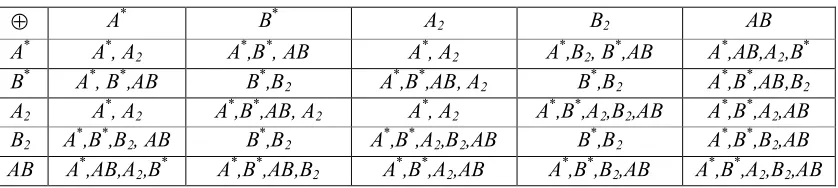
elements of this collection can by combine with each other. All combinational probabilityfor the set H = {A•, B•, A2, B2, AB} to do without energy can be displayed as in
Table 1.
Table 1. Chain Reactions.
A* B* A2 B2 AB
A* A*, A2 A*,B*, AB A*, A2 A*,B2, B*,AB A*,AB,A2,B*
B* A*, B*,AB B*,B2 A*,B*,AB, A2 B*,B2 A*,B*,AB,B2
A2 A*, A2 A*,B*,AB, A2 A*, A2 A*,B*,A2,B2,AB A*,B*,A2,AB
B2 A*,B*,B2, AB B*,B2 A*,B*,A2,B2,AB B*,B2 A*,B*,B2,AB
Then, (H,⊕) is an Hv-group [6]. Moreover, X = {A•,A2} and Y = {B•,B2} are only
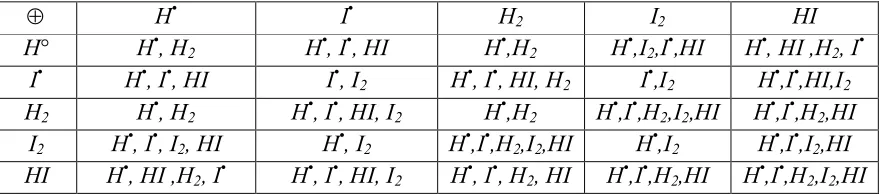
Hv-subgroups of (H,⊕) [6]. If we consider A = H and B ∈{F, CL, Br, I} (for example B = I), the complete reactions table becomes Table 2.
Table 2. For H and I.
H• I• H2 I2 HI
H° H•, H2 H•, I•, HI H•,H2 H•,I2,I•,HI H•, HI ,H2, I• I• H•, I•, HI I•, I2 H•, I•, HI, H2 I•,I2 H•,I•,HI,I2 H2 H•, H2 H•, I•, HI, I2 H•,H2 H•,I•,H2,I2,HI H•,I•,H2,HI
I2 H•, I•, I2, HI H•, I2 H•,I•,H2,I2,HI H•,I2 H•,I•,I2,HI HI H•, HI ,H2, I• H•, I•, HI, I2 H•, I•, H2, HI H•,I•,H2,HI H•,I•,H2,I2,HI
3.2 DISMUTATION REACTIONS
In a redox reactions or oxidation-reduction reaction, electrons are transferred fromone reactant to another. Oxidation refers to the loss of electrons, while reductionrefers to the gain of electrons. A substance that has strong affinity for electronsand tends to extract them from other species is called an oxidizing agent or an oxidant. A reducing agent, or reductant, is a reagent that readily donates electronsto another species [26]. A half reaction is a reduction or an oxidation reaction. Twohalf-reactions are needed to form a whole reaction. Redox reactions have a numberof similarities to base reactions. Like acid-base reactions, redox reactions area matched set; you don’t have an oxidation reaction without a reduction reactionhappening at the same time. When the change in free energy (ΔG) is negative, aprocess or chemical reaction proceeds spontaneously in the forward direction. WhenΔG is positive, the process proceeds spontaneously in reverse. In electrochemical reactions ΔG = −nFE, where n, F and E are number of electrons transferred inthe reaction, Faraday constant and cell potential, respectively [26].
The change in the oxidation state of a species lets you know if it has undergone oxidation or reduction. Oxidation is the process in which an atom undergoes an algebraic increase in oxidation number, and reduction is the process in which anatom undergoes an algebraic decrease in oxidation number. On this basis, oxidationreduction is involved in the reaction;
O2 + C CO2
Disproportion at ion or dismutation is used to describe two particular types of chemical reaction:
(1) A chemical reaction of the type 2AA+A, where A,AandAare different chemical pieces [27]. Most but not all are redox reactions. For example 2H2OH3O+ + OH−
is a disproportionation, but is not a redox reaction.
(2) A chemical reaction in which two or more atoms of the same element originallyhaving the same oxidation state react with other chemical(s) or themselves to give different oxidation numbers. In another word, disproportionation is a reaction in which a species is simultaneously reduced and oxidized to form two differentoxidation numbers. The reverse of disproportionation is called comproportionation. Comproportionation is a chemical reaction where two reactants, each containing thesame element but with a different oxidation number, will form a product with anoxidation number intermediate of the two reactants. For example, an element tin in the oxidation states 0 and +4 can comproportionate to the state +2. The standardreduction potentials of all half reactions are:
V E
V E
V
ESn4/Sn2 0.154 , Sn2/Sn 0.136 , Sn4/Sn 0.009
Therefore, the comproportionation reaction is spontaneous.
Sn4 2Sn2 Sn
All combinational probability for the set S = {Sn, Sn2+, Sn4+} to do withoutenergy can be displayed as follows. The major products are written in Table 3.
Table 3.Dismutation Reactions Sn.
Sn Sn2+ Sn4+
Sn Sn Sn,Sn2+ Sn2+ Sn2+ Sn,Sn2+ Sn2+ Sn2+,Sn4+ Sn4+ Sn2+ Sn2+,Sn4+ Sn4+
Then, (S,⊕) is weak associative. Also, we can conclude that ({Sn, Sn2+},⊕) is a hypergroup and ({Sn2+, Sn4+},⊕) is an Hv-semigroup [7]. Chlorine gas reacts with dilute hydroxide to form chloride, chlorate and water.The ionic equation for this reaction is as follows [19]:
O H ClO Cl
OH
Cl2 6 5 3 3 2
3
Indium has three oxidation states 0,+1 and +3. The standard reduction potentialsof
all half reactions are:
E
In3/In
0
.
434
V
,
E
In/In
0
.
147
V
,
E
In3/In
0
.
338
V
.
According to the standard reduction potentials, disproportionationreaction of In+ is spontaneous. All combinational probability for the set S ={In, In+, In3+} to do without energy can be displayed as Table 4.
Table 4. Dismutation Reactions In.
In In+ In3+
In In In, In+ In, In3+
In+ In, In+ In, In3+ In+, In3+ In3+ In, In3+ In+, In3+ In3+
Then, (S,⊕) is weak associative. Clearly, ⊕is commutative. Also, the reproduction axiom holds. Therefore, (S,⊕) is a commutative Hv-group [7]. Vanadium forms a number of different ions including V, V 2+, V 3+, V O2+ and V O2+. The oxidation states of these species are 0, +2, +3, +4 and +5, respectively. The standard reduction potentials of all corresponding half reactions are:
All combinational probability for the set S = {V, V 2+, V 3+, V O2+, V O2+}to dowithout energy in acidic media can be displayed as following table. When thereactants are added in appropriate stoichiometric ratios. For example vanadium(V ) reacts with V O2+ as follows:
O H V
H O
V
V 2
3
2 12 5 6
3
2
Then, (S,⊕) is a hyperstructure. The hyperstructures
({V, V 2+},⊕), ({V 2+, V 3+},⊕),({V 3+, V O2+},⊕) and ({V O2+, V O+2},⊕) are hypergroups [7]. Moreover, we have:
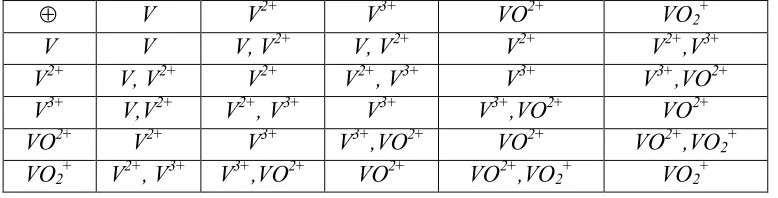
The major products between all forms of vanadium are showed in Table 6. It is assumed the reactants are added together in 1 : 1 mole ratios.
Table 5. Vanadium.
V V2+ V3+ VO2+ VO2+
V V V, V2+ V2+ V2+, V3+ V3+
V2+ V,V2+ V2+ V2+, V3+ V3+ V3+, VO2+
V3+ V2+ V2+, V3+ V3+ V3+,V2+ VO2+
VO2+ V2+, V3+ V3+ V3+, VO2+ VO2+ VO2+, VO2+ VO2+ V3+ V3+, VO2+ VO2+ VO2+, VO2+ VO2+
Table 6.The Major Products between all Forms of Vanadium.
V V2+ V3+ VO2+ VO2+
V V V, V2+ V, V2+ V2+ V2+,V3+
V2+ V, V2+ V2+ V2+, V3+ V3+ V3+,VO2+ V3+ V,V2+ V2+, V3+ V3+ V3+,VO2+ VO2+ VO2+ V2+ V3+ V3+,VO2+ VO2+ VO2+,VO2+ VO2+ V2+, V3+ V3+,VO2+ VO2+ VO2+,VO2+ VO2+
Therefore, (S,⊕) is a hyperstructure. The hyperstructures
({V, V 2+},⊕), ({V 2+, V 3+},⊕),({V 3+, V O2+},⊕) and ({V O2+, V O+2},⊕) are hypergroups. Moreover, we have:
({V, V 2+},⊕) ({V 2+, V 3+},⊕)({V3+, V O2+},⊕)({V O2+, V O2+},⊕).
3.3 REDOX REACTIONS
Redox (reduction-oxidation) reactions include all chemical reactions in which atomshave their oxidation state changed. This can be either a simple redox process, such as the oxidation of carbon to yield carbon dioxide (CO2) or the reduction of carbon by hydrogen
to yield methane (CH4), or a complex process such as the oxidation of glucose (C6H12O6) in
Each half-reaction has a standard reduction potential (E0), which is equal to thepotential difference at equilibrium under standard conditions of an electrochemicalcell in which the cathode reaction is the half-reaction considered, and the anode isa standard hydrogen electrode (SHE). For a redox reaction, the potential of the cellis defined by: E0cell= E0cathode− E0anode. If the potential of a redox reaction (E0cell)is positive, this reaction will spontaneous [23]. For example, consider the redox reaction of Ag2+ with Ag:
Ag2+ + Ag Ag+. We can write two half-reactions for this reaction: (1) Ag2++ e Ag+,
(2) AgAg+ + e.
The E0 of the first reaction (E0cathode) is 1.98 V (vs. SHE) and the E0of the second reaction (E0anode) is 0.799 V (vs. SHE) [26]. Therefore, in this case, the E0cell(E0cathode− E0anode= 1.181) is positive and the above redox reaction between Ag2+and Ag is spontaneous. Silver (Ag) is a transition metal and has a large number of applications in jewelry, electrical contacts and conductors, catalysis of chemical reactions, disinfectants and microbiocides. Silver plays no known natural biological role in humans and itself is not toxic, but most silver salts are toxic, and some may be carcinogenic. Ag can be in three oxidation state: Ag (0), Ag (I) and Ag (II). Among Ag (I) andAg (II), Ag (I) is very well characterized and many simple ionic compounds areknown containing Ag+. However, AgF2
is known which Ag has oxidation state ofII in it. AgF2 is strongly oxidizing and a good
fluorimating agent. But Ag (II) ismore stable in complex forms. A number of Ag (II) complexes have been obtainedby oxidation of Ag (I) salts is aqueous solution in the presences of the ligand. Forexample, [Ag (pyridine)4]2+ and [Ag (bi pyridine)2]2+ are quite
stable. The +1oxidation state is the best known oxidation state of silver. Ag+ salts are generallyinsoluble in water with the exception of nitrate, fluoride and perchlorate. Moststable Ag (I) complexes have a linear structure [25].
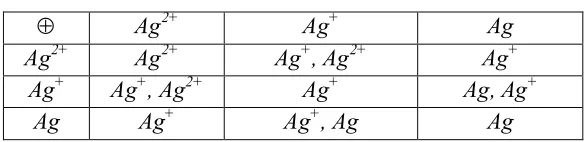
As described above, Ag species with different oxidation state can react with themselves. All possible products for spontaneous reactions are presented in Table7.
Table 7.Redox Reactions Ag.
Ag2+ Ag+ Ag
Ag2+ Ag2+ Ag+, Ag2+ Ag+ Ag+ Ag+, Ag2+ Ag+ Ag, Ag+
Ag Ag+ Ag+, Ag Ag
Copper (Cu) is a ductile metal with very high thermal and electrical conductivity. It is used as a conductor of heat and electricity, a building material, anda constituent of various metal alloys. Cu can be in four oxidation state: Cu (0),Cu(I), Cu (II) and Cu (III). In nature, copper mainly is as CuFeS2, with oxidationstate of II for Cu. Also, Cu can be as Cu2S or
Cu2O with the oxidation stateof I. Pure copper is obtained by electrolytic refining using
sheets of pure copper as cathode and impure copper as anode. In this process different ions of Cu, Cu(II)or Cu(I), reduced to Cu(0) at cathode. Cu(III) is generally uncommon, howeversome its complexes are known [25].
The standard reduction potential (E0) for conversion of each oxidation state to another are: E0 (Cu3+/Cu2+) = 2.4 V ,E0 (Cu2+/Cu+)= 0.153 V , E0 (Cu2+/Cu)=0.342 V and E0 (Cu+/Cu)= 0.521 V , where potentials are versus SHE [26]. Accordingto these standard potentials, and similar to example of Ag, the following reactions are spontaneous:
(1) Cu3+ + Cu+Cu2+, (2) Cu3+ + Cu Cu2+ + Cu+.
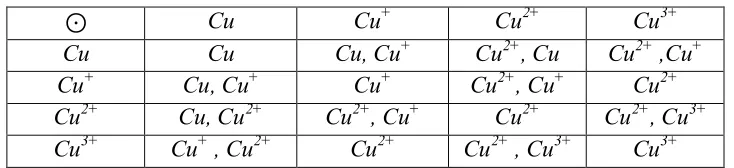
Therefore, all possible products in reactions between oxidation states of Cu which can be produced spontaneously are listed in Table 8.
Table 8.Redox Reactions Cu.
⊙ Cu Cu+ Cu2+ Cu3+
Cu Cu Cu, Cu+ Cu2+, Cu Cu2+ ,Cu+ Cu+ Cu, Cu+ Cu+ Cu2+, Cu+ Cu2+ Cu2+ Cu, Cu2+ Cu2+, Cu+ Cu2+ Cu2+, Cu3+ Cu3+ Cu+ , Cu2+ Cu2+ Cu2+ , Cu3+ Cu3+
In Table 8, the hyperoperation ⊙ is weak associative. Hence, we have an Hv -semigroup. The hyperstructures
({Cu, Cu+},⊙), ({Cu, Cu2+},⊙), ({Cu+, Cu2+},⊙) and ({Cu2+, Cu3+},⊙)
are hypergroups. Let H be a set with three elements. OnH, we define the following hyperoperation: x ⋆ y = {x, y}, for all x, y ∈ H.
It is easy to see that ⋆is associative and so (H, ⋆) is a hypergroup. Now, we have ({Cu, Cu+, Cu2+},⊙)(H, ⋆).
Note that ({Cu+, Cu2+, Cu3+},⊙) is not semihypergroup. Americium (Am) is a transuranic radioactive chemical element in actinide series. It has four oxidation states of 0, 2, 3 and 4. The standard reduction potential (E0) for conversion of each oxidation state to another are: E0 (Am4+/Am3+)= 2.6 V, E0 (Am3+/Am2+) = −2.3 V, E0 (Am3+/Am) = −2.048 V and E0 (Am2+/Am)=−1.9 V , where potentials are versus SHE [26]. Therefore, the following reaction is spontaneous:
Therefore, all possible combinations for different oxidation states of Am which can be produced without energy are presented in Table 9.
Table 9. Redox Reactions Am.
Am Am2+ Am3+ Am4+
Am Am Am, Am2+ Am, Am3+ Am, Am4+
Am2+ Am, Am2+ Am2+ Am2+, Am3+ Am3+ Am3+ Am, Am3+ Am2+,Am3+ Am3+ Am3+,Am4+ Am4+ Am, Am4+ Am3+ Am3+, Am4+ Am4+
Regarding to Table 9, similar to Table 8, we have ({Am, Am2+, Am3+},⊗)(H, ⋆). Note that ({Am2+, Am3+, Am4+},⊗) is not semihypergroup.
Gold (Au) is a dense, soft, shiny, malleable and ductile metal and can be in fouroxidation states of Au (0), Au (I), Au (II) and Au (III). Au (III) is common forgold compounds and exist as: Au2O3, AuF3, AuCl3, AuBr3 and Au (OH)3. Au (I)is much less
stable in solution and is stabilized in complexes [25].
The standard reduction potential (E0) for conversion of each oxidation state toanother are: E0 (Au3+/Au+)= 1.401 V , E0 (Au3+/Au)= 1.498 V , E0 (Au2+/Au+)=1.8 V and E0 (Au+/Au)= 1.692 V , where potentials are versus SHE [26]. Accordingto these standard potentials, the following reaction is spontaneous:
Au2+ + Au Au+.
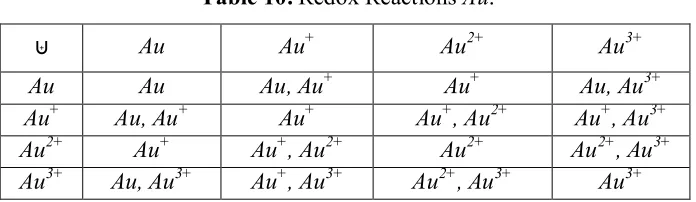
Therefore, the major products in reactions between oxidation states of Au whichcan be produced spontaneously are listed in Table 10.
Table 10. Redox Reactions Au.
⊎ Au Au+ Au2+ Au3+
Au Au Au, Au+ Au+ Au, Au3+
Au+ Au, Au+ Au+ Au+, Au2+ Au+, Au3+ Au2+ Au+ Au+, Au2+ Au2+ Au2+, Au3+ Au3+ Au, Au3+ Au+, Au3+ Au2+, Au3+ Au3+
R
EFERENCES1. S. C. Chung, K. M. Chun, N. J. Kim, S. Y. Jeong, H. Sim, J. Lee and H. Maeng, Chemical hyperalgebras for three consecutive oxidation states of elements, MATCH Communications in Mathematical and in Computer Chemistry 72 (2014) 389–402.
2. P. Corsini, Prolegomena of Hypergroup Theory, Second edition, Aviani Editore, 1993.
3. P. Corsini and V. Leoreanu, Applications of Hyperstructures Theory, Advances in Mathematics, Kluwer Academic Publisher, 2003.
4. B. Davvaz, Polygroup Theory and Related Systems, World Scientific Publishing Co. Pte. Ltd., Hackensack, NJ, 2013.
5. B. Davvaz, A brief survey of the theory of Hv-structures, Proc. 8th International
Congress on Algebraic Hyperstructures and Applications, 19 September, 2002, Samothraki, Greece, Spanidis Press, 2003, 39–70.
6. B. Davvaz and A. Dehgan-Nezad, Chemical examples in hypergroups, Ratio Matematica 14 (2003) 71–74.
7. B. Davvaz, A. Dehghan-Nezhad and A. Benvidi, Chemical hyperalgebra: dismutation reactions, MATCH Communications in Mathematical and in Computer Chemistry 67 (2012) 55–63.
8. B. Davvaz, A. Dehghan-Nezad and A. Benvidi, Chain reactions as experimental examples of ternary algebraic hyperstructures, MATCH Communications in Mathematical and in Computer Chemistry 65 (2) (2011) 491–499.
9. B. Davvaz and A. Dehghan-Nezhad, Dismutation reactions as experimental verifications of ternary algebraic hyperstructures, MATCH Communications in Mathematical and in Computer Chemistry 68 (2012) 551–559.
10.B. Davvaz, A. Dehghan-Nezad and M. M. Heidari, Inheritance examples of algebraic hyperstructures, Information Sciences224 (2013) 180–187.
11. A. Dehghan-Nezhad, S. M. Moosavi-Nejad, M. Nadjafikhah and B. Davvaz, A physical example of algebraic hyperstructures: Leptons, Indian Journal of Physics86 (11) (2012) 1027–1032.
12.B. Davvaz, A. Dehghan-Nezad and M. Mazloum-Ardakani, Chemical hyperalgebra: Redox reactions, MATCH Communications in Mathematical and in Computer Chemistry 71 (2014) 323–331.
14.B. Davvaz and V. Leoreanu-Fotea, Hyperring Theory and Applications, International Academic Press,115, Palm Harber, USA, 2007.
15.B. Davvaz, R. M. Santilli and T. Vougiouklis, Studies of multivalued hyperstructures for the characterization of matter-antimatter systems and their extension, Algebras Groups and Geometries, 28 (3) (2011) 105–116.
16.B. Davvaz, R. M. Santilli and T. Vougiouklis, Multi-Valued Hypermathematics for Characterization of Matter and Antimatter Systems, Journal of Computational Methods in Sciences and Engineering (JCMSE), 13 (2013) 37– 50.
17.B. Davvaz, R. M. Santilli and T. Vougiouklis, Mathematical prediction of Ying’s twin universes, American Journal of Modern Physics 4 (3) (2015)5–9. 18.M. Ghadiri, B. Davvaz and R. Nekouian, Hv-Semigroup structure on F2
-offspring of a gene pool, International Journal of Biomathematics 5 (4) (2012) 1250011 (13 pages).
19.C. Harding, D.A. Johnson, R. Janes, Elements of the P Block, Published by Royal Society of Chemistry, 2002.
20.Š. Hošková, J. Chvalina and P. Račková, Transposition hypergroups of Fredholm integral operators and related hyperstructures. Part I, Journal of Basic Science,4 (2008) 43–54.
21.Š. Hošková, J. Chvalina and P. Račková, Transposition hypergroups of Fredholm integral operators and related hyperstructures. Part II, G. Journal of Basic Science 4 (2008) 55–60.
22.R.T. Morrison and R. N. Boyd, Organic Chemistry, Sixth Eddition, Prentice-Hall Inc., 1992.
23.Mortimer, C. E., Chemistry: A Conceptual Approach, 4th ed., D. Van Nostrad Co., New York, 1979.
24.R.M. Santilli and T. Vougiouklis, Isotopies, genotopies, hyperstructures and their applications, New frontiers in hyperstructures, New frontiers in hyperstructures (Molise, 1995), 1–48, Ser. New Front. Adv. Math. Ist. Ric. Base, Hadronic Press, Palm Harbor, FL, 1996.
25.M.S. Sethi and M. Satake, Chemistry of Transition Elements, South Asian Publishers, New Delhi, 1988.
26.D.A. Skoog D.M. West and F.J. Holler, Saunders College Publishing, New York, 1992.
28.T. Vougiouklis, The fundamental relation in hyperrings. The general hyperfield, Algebraic Hyperstructures and Applications (Xanthi, 1990), 203–211, World Sci. Publishing, Teaneck, NJ, 1991.
29.T. Vougiouklis, A new class of hyperstructures, Journal of Combinatorics, Information & System Sciences 20 (1995) 229–235.
30.T. Vougiouklis, Hv-groups defined on the same set, Discrete Mathematics 155
(1996) 259–265.
31.T. Vougiouklis, Convolutions on WASS hyperstructures, Combinatorics (Romeand Montesilvano, 1994). Discrete Mathematics174 (1997) 347–355. 32.T. Vougiouklis, Hyperstructures and their Representations, Hadronic Press Inc.,