Patient Experience Journal
Volume 4 | Issue 3
Article 18
2017
Using appreciative inquiry as a framework to
enhance the patient experience
Kerry Moorer MBA
Schawan Kunupakaphun
Elilzabeth Delgado
Matthew Moody
Christina Wolf MSN, RN, CNL
See next page for additional authors
Follow this and additional works at:
https://pxjournal.org/journal
Part of the
Finance and Financial Management Commons
,
Health and Medical Administration
Commons
,
Health Policy Commons
,
Health Services Administration Commons
, and the
Health
Services Research Commons
This Case Study is brought to you for free and open access by Patient Experience Journal. It has been accepted for inclusion in Patient Experience Journal by an authorized editor of Patient Experience Journal.
Recommended Citation
Moorer, Kerry MBA; Kunupakaphun, Schawan; Delgado, Elilzabeth; Moody, Matthew; Wolf, Christina MSN, RN, CNL; Moore, Karen RN, MS, FACHE; and Eamranond, Pracha MD, MPH (2017) "Using appreciative inquiry as a framework to enhance the patient experience,"Patient Experience Journal: Vol. 4 : Iss. 3 , Article 18.
Using appreciative inquiry as a framework to enhance the patient
experience
Authors
Kerry Moorer MBA; Schawan Kunupakaphun; Elilzabeth Delgado; Matthew Moody; Christina Wolf MSN,
RN, CNL; Karen Moore RN, MS, FACHE; and Pracha Eamranond MD, MPH
Patient Experience Journal
Volume 4, Issue 3 – 2017, pp. 128-135
Patient Experience Journal, Volume 4, Issue 3 – 2017
© The Author(s), 2017. Published in association with The Beryl Institute and Patient Experience Institute
Downloaded from www.pxjournal.org 128
Case Study
Using appreciative inquiry as a framework to enhance the patient
experience
Kerry Moorer, MBA,
Babson College, [email protected]
Schawan Kunupakaphun,
Lawrence General Hospital, [email protected]
Elilzabeth Delgado,
Lawrence General Hospital, [email protected]
Matthew Moody,
Lawrence General Hospital (Intern), [email protected]
Christina Wolf, MSN, RN, CNL,
Lawrence General Hospital, [email protected]
Karen Moore, RN, MS, FACHE
Lawrence General Hospital, [email protected]
Pracha Eamranond, MD, MPH,
Harvard Medical School, [email protected]
Abstract
The following case depicts the journey of a non-profit hospital in an under-served community and its attempts to turn around suffering patient experience. The Hospital turned to the theories of Appreciative Inquiry and the power of a strengths-based approach to create a framework to support the patient experience initiatives. Hospital leadership led the formation of a Patient Experience Team to implement ten initiatives in order increase the top box score in the domain of willingness to recommend the hospital, as that was selected as a global measure of success for the overall
improvement project.
Keywords
Appreciative inquiry, patient experience, patient satisfaction, value based purchasing, safety net hospital, patient-centered care, recommend the hospital, hourly rounding, purposeful rounding
Background
Lawrence General Hospital is a private, non-profit community hospital located about 30 miles north of Boston. Lawrence is home to one of the largest Hispanic populations (76%)1 in Massachusetts. Lawrence is also characterized by a large percent of its residents living below the poverty line (28%), higher unemployment rates than the state average (9% vs 6%), and low levels of education (31.5% of the community does not have a high school diploma). In addition to poor economic conditions, Lawrence has a serious housing shortage leading to a high rate of homelessness in the community. Not only is Lawrence an impoverished city but it is significantly medically and socially underserved. Lawrence General Hospital is categorized as a safety net hospital defined by
providing “a significant level of care to low-income,
uninsured, and vulnerable populations.”2 The Hospital payor mix is primarily governmental, approximately 70% with 36% of that being Medicaid.
The Hospital has historically been negatively associated with the poor, indigent community that it has served,
rather than a leader in the region “providing high quality, high value medical care for the whole family.”1 To worsen the situation the Hospital also was receiving some of the lowest patient satisfaction scores among its peer groups.3
At the start of 2016, the domain of communication with doctors ranked in the 5th percentile, communication with nurses ranked in the 13th percentile and responsiveness of hospital staff ranked 12th among peers in the Press Ganey database.3
Forward thinking hospital leadership saw an opportunity to transform the hospital and the way care was delivered to better access surrounding communities to ensure financial stability with the increase mix of commercial payor sources. Historically, patients from the surrounding more economically stable communities would travel into Boston for their care. Lawrence General Hospital was determined to make significant investments that were needed to improve the look, the image, and most of all the care provided to all communities across the region. Hundreds of millions of dollars were invested to construct a brand new emergency center, a state-of-the-art surgical center and complete overhaul of existing hospital units including a brand new ICU.
Using appreciative inquiry as a framework to enhance the patient experience, Moorer et al.
129 Patient Experience Journal, Volume 4, Issue 3 – 2017
“patients have a choice, and they are using publicly
reported data to exercise their options regarding where to
go for care.”4 After the significant investments in leading technologies and first-in-class facilities, the Hospital needed patients in the region to choose Lawrence General Hospital as the place they wanted to receive their care. Thirdly, with the regulatory changes including Value Based Purchasing, the Hospital was leaving close to $1 million per year on the table for its inability to achieve the required patient experience scores. Financial pressures from the government, decreased volume, and the outflow of cash for renovations left the hospital in a position where every available dollar needed to be captured rather than allowing it to go into Boston.
Developing a Framework
The Patient Experience Team reconvened in late 2015 to redefine the strategies to improve the patient experience. There had been failed attempts in the past to ignite this movement but it was clear that the misaligned culture of the organization was a barrier to achieving success. Several factors lead to the misalignment of the culture within the organization. One of those factors pointed to caregiver burnout caring for these very medically- and socially-complex patients day after day. In addition, there was a lack of clear goals and a shared vision around the strategies to improve the patient experience. Many managers and clinicians did not even understand the instrument, or HCAHPS survey (Hospital Consumer Assessment of Healthcare Providers and Systems) by which the Hospital’s
performance was measured.
Being resource-constrained, the Hospital looked to a framework that would allow the team to approach this undertaking with the resources and the strengths that were currently in place. The team decided to utilize Appreciative
Inquiry after seeing “the power of positive questions.”4
“Appreciative Inquiry is exactly what its name suggests: an
approach to change that utilizes positive inquiry, or questions, to determine what individuals and teams appreciate, or value, to discover the best of the organization. Those insights are used to create a compelling vision to design a plan for the future that builds on those strengths. An organization then moves toward fulfilling that vision by designing processes, systems, and structures in alignmentwith its strengths,
best practices, and patterns of high performance.”4 (Figure 1)
Individuals who work in healthcare are inherently built to find problems and fix them but focusing on problems will orient the team consistently toward what is wrong and
what is negative. “When the focus is on only deficits, the
people in the organization can become disempowered,
discouraged, and demoralized.”5 By flipping the focus away from a problem- oriented approach to look at what is
right with the organization allows the organization to discover how it can achieve more of what is right. This process energizes people, inspires positivity, and encourages creative and innovative ways to reach those dreams. Given the level of caregiver burnout and the need for culture change within the hospital, the Patient
Experience team embraced Appreciative Inquiry as a tool to engage leaders and staff to identify,celebrate, and spread best practices to improve the patient experience and ultimately improve HCAHPS scores.
Implementation
In order for Appreciative Inquiry to take root throughout the entire organization, the Hospital had to train as many front line staff members as possible. Creating a grassroots movement had to start from the top and the bottom consecutively. Initially five of the hospital's top executives were immersed in Appreciative Inquiry through a week-long training. The trained hospital executives aweek-long with a consulting expert in Appreciative Inquiry hosted two all-day offsite retreats. The purpose of the all-all-day offsite retreats was to disseminate the framework of Appreciative Inquiry to front line staff (nurses, aides, environmental services, security, valet, nurse managers, etc). The first retreat was held in April of 2016 and the second retreat was held six months later in October. Every department was invited and anyone interested was afforded the ability to attend. Approximately 350 employees, involved in direct patient care, were immersed in Appreciative Inquiry.
With the framework of Appreciative Inquiry beginning to distill its way through the organization, the Patient Experience Team selected ten initiatives on which to focus its efforts to improve the patient experience. The ten initiatives were selected with the input of the entire team. Each initiative was assigned to an owner who was responsible for driving the success of that initiative.
Examples of Applied Appreciative Inquiry
The owners were encouraged to apply Appreciative Inquiry to the development of each initiative as
appropriate to generate a sense of optimism, creativity, and motivation for change. For example, the Hospitalist group participated in a separate Appreciative Inquiry retreat focused on exploring what makes an exceptional patient experience? Providers emerged from the retreat having agreed to implement a set of best practices when communicating with patients (sitting at the bedside, providing a business card, explaining the plan of care, etc.). To re-invigorate purposeful hourly rounding, the
Med/Surg Clinical Nurse Leader (CNL) asked a group of
nurses and nursing assistants “When hourly rounding was working well on your unit, what was happening?” The
Using appreciative inquiry as a framework to enhance the patient experience, Moorer et al.
Patient Experience Journal, Volume 4, Issue 3 – 2017 130
about the care they provided. Afterwards, the group readily agreed to re-design and pilot the process on their unit.
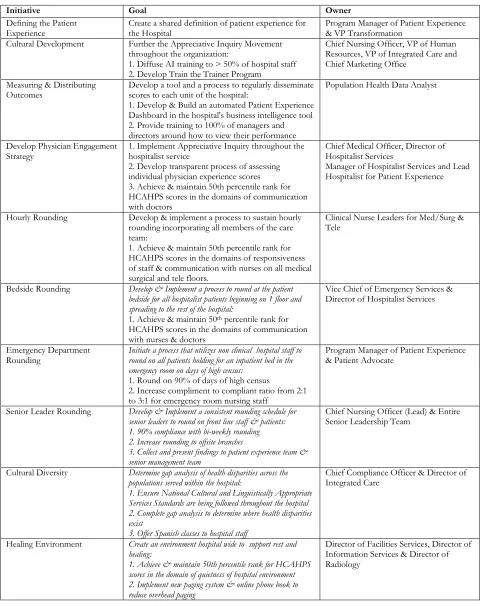
Initiative owners were also required to set clear, realistic and achievable goals. The following table was created and disseminated throughout the organization. Initiative owners were required to regularly report on the progress of their initiatives at the bi-weekly patient experience team meetings. At the start of each new fiscal year an annual operating plan was compiled with the process as to how the goals would be achieved.
The Patient Experience Team selected only 10 initiatives that they believed would best reach the core of the hospital staff providing direct patient care. The discussion below further expands on several of the initiatives identified as critical to improving the overall patient experience. (Table 1)
Defining the Patient Experience
Prior to embarking on any improvement efforts, the Hospital needed to develop a shared understanding of what patient experience meant to Lawrence General Hospital. The Patient Experience Team solicited input from the entire hospital and received responses from 130
hospital staff. After several hours of brainstorming the Patient Experience Team crafted a definition that was unique to the Hospital and created through the voices of the hospital staff. A common definition helped to unite all of the staff to ensure movement toward the same vision.
Measuring & Distributing Outcomes
The lack of access to performance analytics had been a factor in previous failed attempts to get improvement efforts off the ground. In order for this attempt to be successful the team needs consistent reliable access to the patient experience scores. The data analysts on the Patient Experience Team were tasked with utilizing a business intelligence tool to create dashboards for each individual unit that would be updated monthly to reflect the most up-to-date scores, comparison to past performance, and peer rankings. Once the dashboard was completed a training program would be established to train every
manager and director on accessing their unit’s
performance data as well as minimum expectations around sharing the data with their staff.
Physician Engagement Strategy
Using appreciative inquiry as a framework to enhance the patient experience, Moorer et al.
131 Patient Experience Journal, Volume 4, Issue 3 – 2017
Table 1. Initiatives of the patient experience team
Initiative Goal Owner
Defining the Patient
Experience Create a shared definition of patient experience for the Hospital Program Manager of Patient Experience & VP Transformation Cultural Development Further the Appreciative Inquiry Movement
throughout the organization:
1. Diffuse AI training to > 50% of hospital staff 2. Develop Train the Trainer Program
Chief Nursing Officer, VP of Human Resources, VP of Integrated Care and Chief Marketing Office
Measuring & Distributing
Outcomes Develop a tool and a process to regularly disseminate scores to each unit of the hospital: 1. Develop & Build an automated Patient Experience Dashboard in the hospital's business intelligence tool 2. Provide training to 100% of managers and directors around how to view their performance
Population Health Data Analyst
Develop Physician Engagement Strategy
1. Implement Appreciative Inquiry throughout the hospitalist service
2. Develop transparent process of assessing individual physician experience scores 3. Achieve & maintain 50th percentile rank for HCAHPS scores in the domains of communication with doctors
Chief Medical Officer, Director of Hospitalist Services
Manager of Hospitalist Services and Lead Hospitalist for Patient Experience
Hourly Rounding Develop & implement a process to sustain hourly rounding incorporating all members of the care team:
1. Achieve & maintain 50th percentile rank for HCAHPS scores in the domains of responsiveness of staff & communication with nurses on all medical surgical and tele floors.
Clinical Nurse Leaders for Med/Surg & Tele
Bedside Rounding Develop & Implement a process to round at the patient bedside for all hospitalist patients beginning on 1 floor and spreading to the rest of the hospital:
1. Achieve & maintain 50th percentile rank for
HCAHPS scores in the domains of communication with nurses & doctors
Vice Chief of Emergency Services & Director of Hospitalist Services
Emergency Department Rounding
Initiate a process that utilizes non clinical hospital staff to round on all patients holding for an inpatient bed in the emergency room on days of high census:
1. Round on 90% of days of high census
2. Increase compliment to compliant ratio from 2:1 to 3:1 for emergency room nursing staff
Program Manager of Patient Experience & Patient Advocate
Senior Leader Rounding Develop & Implement a consistent rounding schedule for senior leaders to round on front line staff & patients: 1. 90% compliance with bi-weekly rounding 2. Increase rounding to offsite branches
3. Collect and present findings to patient experience team & senior management team
Chief Nursing Officer (Lead) & Entire Senior Leadership Team
Cultural Diversity Determine gap analysis of health disparities across the populations served within the hospital:
1. Ensure National Cultural and Linguistically Appropriate Services Standards are being followed throughout the hospital 2. Complete gap analysis to determine where health disparities exist
3. Offer Spanish classes to hospital staff
Chief Compliance Officer & Director of Integrated Care
Healing Environment Create an environment hospital wide to support rest and healing:
1. Achieve & maintain 50th percentile rank for HCAHPS scores in the domain of quietness of hospital environment 2. Implement new paging system & online phone book to reduce overhead paging
Using appreciative inquiry as a framework to enhance the patient experience, Moorer et al.
Patient Experience Journal, Volume 4, Issue 3 – 2017 132
residents or other specialists. After an initial analysis of the patient responses in the domains of communication with doctors, the residents and specialists were found to have the highest scores from their patients. To support hospitalist providers in their efforts to improve patient experience, their incentive structure was changed to reflect patient experience scores rather than productivity. This provided the physicians with the flexibility to spend as much time with a family as they needed.
Hourly Rounding
The Hospital scores in the domain of responsiveness of hospital staff were also suffering. Patients felt that their call bells were not being answered as quickly as they wanted. The Patient Experience Team decided to draft a plan to conduct purposeful hourly rounding that was successfully piloted on one Med/Surg floor, then spread to other Med/Surg and Telemetry units. Nurses and nursing assistants share the responsibility of rounding on each patient every 1-2 hours and focusing on the “4 Ps” and
patient safety (pain, potty or toileting, positioning, and keeping patient possessions within reach). Unit leaders support rounding by developing unit champions to model best rounding practice, identifying purposeful rounding as an annual competency, following up with patients to verify rounding behaviors, and tying rounding efforts to
improvements in HCAHPS scores on unit Quality Boards.
Multidisciplinary Bedside Rounding
In prior years, the Hospital launched a small pilot of multidisciplinary bedside rounds on a small Med/Surg unit. The pilot resulted in skyrocketing patient experience scores in the domains of communication with nurses and doctors.It was perfect timing to reinvigorate bedside rounding as the Patient Experience Team was evaluating which initiatives should be added to the top 10. Proven successful as an initiative to improve patient-centered care, bedside rounding needed a dedicated facilitator to
orchestrate. The multidisciplinary team soon exceeded its goal of rounding at the bedside with 50% of the unit’s
hospitalist patients, but continued to face challenges around consistent participation of key members, shared understanding of roles and purpose, time constraints, and maintaining patient privacy. Despite these challenges, the team maintained its focus on an ideal state for rounds, shared that vision with the multidisciplinary team, and
demonstrated a “successful” bedside round for the
Hospitalist group, leading to improved participation by providers and improved rounds efficiency.
Senior Leader Rounding
Like many other initiatives, senior leader rounding had been attempted previously but had failed to come to fruition. The Patient Experience team understood that
“senior leadership visibility is critical to improving the
patient experience.”6 Senior leader rounding not only allows senior leaders to see what is going on where care is
being delivered but it allows them to see how the initiative is affecting the Hospital. Even more importantly, senior leader rounding demonstrates to staff that leaders are engaged in this initiative. The Patient Experience team decided to resurrect this initiative as engaging senior leaders would be the momentum needed to continue to push the Patient Experience movement forward.
Emergency Department Rounding
The Hospital is home to the 3rd busiest emergency center in the state. Over 75,000 patients are seen each year in the emergency department. The Hospital typically staffs about 140 beds creating a bottleneck, especially during the highest-volume months of the year, November - February, as patients wait in the emergency department for an inpatient bed. About 70% of inpatient discharges came in through the emergency room. After reviewing hundreds of patient complaints it became clear that regardless of what was done on the inpatient side if these patients were waiting 20+ hours for an inpatient bed, the Hospital was not receiving high patient experience scores. The Patient Experience Team elected to staff a small group of volunteers that would visit the emergency center every day that a high census was reported. Upon each trip to the emergency department the volunteer team would bring down a fresh coffee cart with snacks that was offered to those patients that had been waiting for their inpatient bed. The coffee and snacks were also offered to the staff as they were at high risk of burnout with the high number of patients for which they were caring.
Each of the project owners were required to define a process in order to achieve success. Those strategies were compiled into an annual operating plan for the Patient Experience Team. Every few months, each of the owners was required to report out on progress of their initiative, successes and best practices.
Results
HCAHPS scores were used to measure the results of the
Hospital’s patient experience initiatives. HCAHPS are recognized as the “national standard for collecting and
public reporting information that enables valid comparisons to be made across all hospitals to support
consumer choice.”6 The domain of willingness to recommend the hospital was tracked to measure overall
success of the Patient Experience Team’s initiatives. Over
the course of the last year of work the top box score, or
percent of patients that reported they would “Definitely”
Using appreciative inquiry as a framework to enhance the patient experience, Moorer et al.
133 Patient Experience Journal, Volume 4, Issue 3 – 2017
Figure 2. 2015-2016 Top Box Score for Recommend the Hospital
Using appreciative inquiry as a framework to enhance the patient experience, Moorer et al.
Patient Experience Journal, Volume 4, Issue 3 – 2017 134
Discussion
The Patient Experience Team selected the domain of Recommend the Hospital as a global measure to determine overall success of the Patient Experience Team and the initiatives that were selected for implementation. The ultimate overarching goal of the Patient Experience Team was to increase the scores in the domain of willingness to
“Definitely” Recommend the Hospital. Having one true
north for the direction of the team ensured that everyone was on the same page and moving in the same direction. Using Appreciative Inquiry as a way to reframe problems into opportunities for change helped energize and propel improvement efforts forward. As previously mentioned in the background, the Hospital has made significant investments in its infrastructure and the key to achieve growth is the willingness of customers to recommend the Hospital. In order for the Hospital to become a regional medical facility allowing members of the community to receive first in class care in a regional medical center rather than at the high cost of Boston hospital it is a win-win for both the patients of the community and the Hospital.
The initial results are promising as there have been upticks in the key domain of recommend the Hospital over the first year of work. Quarter over quarter, the Hospital continues to see improvements in top box score as well as percentile rankings. In Quarter One of 2016, the first quarter after the kick off of the Patient Experience team,
68.9% of patients reported that they would “Definitely”
recommend the hospital. In the last quarter of 2016, through November, that top box score increased to 74.4%
of patients “Definitely” recommend the hospital. At initial
glance only an 8% increase may only be a slight
improvement, but looking back over historic performance 74.4% was the highest score achieved in almost two years. An even more important measure of success was
demonstrated in the percentile rank of the Hospital in the domain of willingness to recommend the Hospital. In Quarter 4 2016, the Hospital achieved the 51st percentile rank among the Hospital's peer group nationally. As demonstrated by the graphs in the results section, the percentile rank has been steadily increasing as the work of the Patient Experience Team continues to spread
throughout the hospital. Scoring above the 50th percentile for the first time in years in the domain of willingness to recommend the hospital was the greatest success for Patient Experience Team and will continue the momentum to push the initiatives forward. This global measure can be seen as one of the most difficult measures to move but movement in this specific domain is viewed
as a “dial” on the overall HCAHPS rankings.7
Limitations
There have been limitations with the initiative as major construction projects designed to improve the look and
care provided at the Hospital have had negative impacts on the patient experience. As a result of the construction there was a reduction in the number of beds available causing significant wait times for patients in the emergency room awaiting transfer to an inpatient bed as well as very high levels of noise heard throughout the hospital. The Patient Experience Team also unearthed major issues with hospital flow that cause significant wait times and delays for patients as they move throughout their hospital stay. The Patient Experience Team is dedicated to removing the barriers currently caused by these limitations. The team is working with all departments of the hospital to understand bottlenecks and barriers. The Hospital and Patient Experience Team understands the limitations have negative impacts in the current state but once resolved will allow for significant long-term success.
Improving the Hospital’s patient experience, image, brand
and reputation are keys achieving budgeted growth, ensuring return on investments into infrastructure and state of the art facilities, as well as capturing dollars currently at risk under Value Based Purchasing. For a stand-alone community hospital to survive in a time of uncertainty it is critical that the Patient Experience Team succeeds in its dedicated efforts to change culture and create a patient centered environment. If the Hospital continues on its upward trajectory in the domain of willingness to recommend the hospital then patients from all over the region will continue to choose this Hospital for their care.
References
1. Lawrence General Hospital, Greater Lawrence Family Health Center, and Health Resources in Action. Community Health Needs Assessment 2016. Rep. Lawrence, MA: Lawrence General Hospital, 2016. Print.
2. Gage, Larry S., and Christine Capito Burch. "What Is a Safety Net Hospital?" What Is a Safety Net
Hospital?National Association of Public Hospitals and Health Systems, n.d. Web. 8 Dec. 2016.
3. Section 2. Why Improve Patient Experience?. Content last reviewed April 2016. Agency for Healthcare Research and Quality, Rockville, MD.
http://www.ahrq.gov/cahps/quality- improvement/improvement-guide/2-why-improve/index.html
4. May, Natalie, Daniel M. Becker, and Richard M. Frankel. Appreciative Inquiry in Healthcare: Positive Questions to Bring out the Best. Brunswick, OH: Crown Custom, 2011. Print.
5. Merlino, James. Service Fanatics: How to Build Superior Patient Experience the Cleveland Clinic Way. New York: McGraw-Hill Education, 2015. Print.
Using appreciative inquiry as a framework to enhance the patient experience, Moorer et al.
135 Patient Experience Journal, Volume 4, Issue 3 – 2017
Survey - Frequently Asked Questions. Centers for Medicare and Medicaid. Web.