Iranian Rehabilitation Journal, Vol. 11, Special issue, 2013
Original Article
Right Hand Preference in implicit motor learning in children with
high-functioning Autism and Asperger syndrome
Sara Izadi-Najafabadi*
Isfahan University of Medical Sciences, Isfahan, Iran
Navid Mirzakhani-Araghi
Shahid Beheshti University of Medical Sciences, Tehran, Iran
Vahid Nejati, PhD.
Shahid Beheshti University, Tehran, Iran
Zahra Pashazadeh-Azari; Akbar Zahedi-Barough
Shahid Beheshti University of Medical Sciences, Tehran, Iran
Objectives: Cerebral hemispheres functioning have been found to be abnormal in children with ASD. The role of lateralization in implicit and explicit motor learning has received little attention in ASD researches. The main goal of this study is investigating the differences between two hands implicit and explicit motor learning in children with ASD and typical matched group.
Method: In the present random clinical trial study, 30 boys with ASD aged 7-11 were compared with 32 typical matched boys. Typical group and the ASDs, which were screened with ASSQ, were selected from elementary schools in Najafabad (Isfahan, Iran). Participants performed a serial reaction time task (10 blocks) with each hand in implicit and explicit group with random allocation.
Results: Learning comparison between two groups showed significant difference which means explicit learning deficit in the ASDs with right (p=0.009) and left hand (p=0.004). Results also indicated no significant difference in implicit learning between ASDs and typical matched group in right (p=0.385) and left hand (p=0.18). Hands differences also showed speeded right hand in implicit learning in children with ASD (p=0.028) while no differences was seen in explicit learning and typical children.
Discussion: Explicit learning of right and left hand was impaired in children with ASD while implicit learning of both hands maintained intact and a right hand preference in implicit motor learning was observed in children with ASD due to left striatal system abnormality.
KeyWords: Motor Learning, Explicit and Implicit Learning, Hand Preference, High-Functioning Autism, Asperger
Submitted: 23 Sep 2013 Accepted: 17 Dec 2013
Introduction
Autism spectrum disorder is a neurodevelopmental disorder characterized by impairments in social interaction, communication (both verbal and non-verbal) and repetitive motor behavior. Autism and Asperger disorders are the most prevalent subtypes of ASD which are distinguished by delays in language (1). Cerebral hemispheres differences in executive function (2), rate and speed of tactile processing(3), electroencephalography (EEG) activation (4), cerebral blood flow pattern(5), size of
and procedural learning (18). Implicit motor learning is resulted when the participant is unaware of movement components. Although a highly complicate brain network is thought to be involved in implicit motor learning, frontal lobe (5,19-22) cerebellum (23), and basal ganglia (23,24) are the most important brain areas found to be activated during this type of learning. It has been suggested that internal chronometric systems are required to learn a motor sequence precisely and implicitly (25) Cerebellum and striatum, in order, are responsible for execution and timing of rapid and slow motor sequence(26). Several studies suggested that implicit learning is mainly processed by right hemisphere (22,27). However, Grafton suggested left hemisphere specialization in implicit learning without regards to which hand is used (20). Explicit learning is defined as learning of facts and personal experiences which are consciously accessed (18). Informing the participant about the gaol and execution of a motor task in a way that participant can explain it verbally is believed to be explicit motor learning (28). Brain imaging and brain damage studies have indicated that explicit motor learning involves temporal gyri (29), frontal lobe (30,31) especially left prefrontal area (30), hippocampus, thalamus, left cerebellum (32) and basal ganglia (23). Lateralized left hemisphere for explicit learning could be implied from brain imaging and brain damage studies (30).
Several studies have been implemented in the last decade investigating implicit and explicit learning in the ASDs with different results. Some studies indicated impaired implicit learning in ASDs (33,34) as the result of two hypothesises: motor skill deficit (34) and learning compensation (33).The first hypothesis, motor learning deficit, mentioned by (34) was refused by a number of studies. Some researchers suggested abnormal implicit learning in autism when it contains motor components (35-38). Learning compensation hypothesis, based on evidences of category learning task (CLT) and artificial grammar learning (AGL), was provided by Klinger et al (33) implying compensation of impaired implicit learning in ASD using explicit strategies. Brown et al (36) rejected this claim using different tasks evaluating implicit learning such as serial reaction time (SRT), artificial grammar learning (AGL), contextual cueing (CC), and probabilistic classification learning (PCL) tasks. In addition, several other researches using some different tasks confirm intact implicit learning in ASD (25,39-41). Although most recent studies have demonstrate intact implicit learning in ASD, Romero-Munguia (42) relied on
evidences of implicit learning impairment and presented Mnesic imbalance theory to explain diagnostic symptoms of ASD. He described the imbalance between impaired implicit memories and relatively preserved explicit memory. His theory was similar to learning compensation hypothesis by Klinger et al (33) to some extent. Brown et al (36) indicated no relation between implicit learning and diagnostic features of ASD. Each task used in their study covered one features relative to ASD, SRTT: motor coordination, CC: perceptual processing of context, AGL: language, and PCL: social elements. Recently, less sensitivity to implicit cues during language acquisition in ASD has been thought to be due to impairment in implicit language learning(43).Although evidences of implicit learning in ASD seem to have inconsistent results, most of them indicated intact implicit learning. Among all these studies, we found just one study investigating left and right hemisphere differences in implicit learning processing using an oculomotor serial reaction time task and a sensorimotor control task (25). Tasks require eye tracking between two locations. In this study, 52 individuals with autism were compared with 54 age-, IQ-, and gender-matched typical individuals. D’Cruze et al (25) concluded intact procedural learning in autism and speeded rightward responses in autism as a result of atypical functioning of left hemisphere striatal chronometric system. To our knowledge, there is no other evidences evaluating ASDs hemispheres differences in implicit learning and this study is the first one using hands in order to investigate these differences.
Explicit strategies are used in many rehabilitation settings for ASD (36,40). Researches on explicit learning in people with ASD consistently suggested no impairment in this group (36; Kourkoulou, 2010; Watanabe, Ikeda, Miyao, 2010). Paired associates learning (36), CC (40), and 2*10 tasks (44) have been used to assess explicit learning in ASDs. No study was found using SRTT to investigate explicit learning in ASD and none of the found studies in this regards demonstrated hemisphere differences during explicit learning in autism and whether brain asymmetry for implicit and explicit learning in children with ASD follows a normal pattern as typical individuals or not. That is why this study has been motivated.
speeds up responses to stimuli by decreasing time needed to make proper response. This decrement is seen in both patterned and random sequences. Duration changes in patterned sequences imply learning speed and in random sequences refer to motor performance. Error making decrement in responding to stimuli (learning accuracy) is another criterion of leaning. Changing response-to-stimulus intervals (45), sequence length and structure (46), attentional demands of tasks (47), and effector hand (48,20) can influence motor learning rate in SRTT. Effectors of hands differences in implicit and explicit learning can also indicate how right and left hemispheres function in this regard. Studying hand differences have been wildly used to investigate functional brain asymmetry in healthy individuals (48-54) and in individuals with ASD (3,9).
In the present study, we aimed to evaluate hands differences in implicit and explicit motor learning in children with ASD using a serial reaction time task, in order to uncover ASD brain asymmetry and use it in rehabilitation setting. Which motor learning type and which hand to use in children with ASD in order to benefit more from rehabilitation intervention can be implied from this study.
Methods
Participants - Thirty boys with ASD divided into
two equal groups (15) of implicit learning and explicit learning, and thirty two typical boys also divided into two equal groups (16) of implicit learning and explicit learning ages from 7 to 11 participated in this study. Children with ASD and their typical matched peers were recruited from 17 public elementary schools for boys in Najafabad (Isfahan, Iran). Teachers screened fifty seven children using High-Function Autism Spectrum
Screening Questionnaire (ASSQ). Ehlers, Gillberg, Wing (1999) provided 27 questions to screen children with Asperger and high-functioning autism (teachers cut off=22, parents cut off= 19) (55). Persian version of ASSQ used in this study has been validated by Kasechi (2012) (56). Both Psychologist and examiner checked the screened children for DSM-IV criteria (1). Twenty seven children with high-functioning autism and 9 children with Asperger syndrome were diagnosed. Parents of diagnosed children signed informed consent prior to participation in the study (One children with High-functioning autism was excluded in this regard).Inclusion criteria contained right-handedness using hand Edinburg inventory(57), lack of visual and auditory impairment, motor dysfunction in upper limb, neurological disease, and seizure. 3 children with high-functioning autism were excluded for left-handedness, and one for seizure. Participant inability to perform the task was considered as exclusion criteria which excluded one child with high-functioning autism from study. Then participants IQ performance were evaluated by a psychologist using Wechsler intelligence scale for children-III to match four groups. Studies have suggested role of IQ in explicit learning. However, there is no relation between IQ and implicit learning (36,58). Probability of using explicit strategies during implicit learning and effect of IQ on explicit learning force studies to use IQ matched groups in order to control IQ effects on learning rate and results. Four selected groups of this study (ASD/implicit, ASD/explicit, typical/implicit, and typical/explicit) were gender-, dominant hand-, IQ performance- (F(3,58)=0.0.960, p=0.418), and age-matched (F(3,58)=0.477, p=0/699). Table (1) contains demographics of the four studied groups.
Table1. Demographics of participants
ASSQ Age IQ performance Hand Edinburg score N
M(SD) range M(SD) range M(SD) range M(SD) range HFA 11
ASD/implicit
ASP 4 34.4
(7.22) 23-48
8.6
(1.40) 7-11
82.93
(18.03) 62-135
66.33
(34.92) 0-100 HFA 10
ASD/explicit
ASP 5 34.27
(7.87) 22-48
8.73
(1.44) 7-11
79.47
(17.05) 49-110
49
(33.5) 0-100
Typical/implicit 16 (1.62) 8.69 7-11 (17.06) 87.44 63-131 (15.97) 86.25 50-100
Typical/explicit 16 9.19
(1.6) 7-11 78.69
(12.087) 55-101 77.19
Apparatus -
A 14-inch LCD notebook computer was used for computational serial reaction time task produced by Brain and Cognitive Research Center, Shahid Beheshti University in Iran. Responses were produced using a keyboard apart from the notebook keyboard. Computer software of SRTT recorded all results, time and error, for each participant.
Serial Reaction Time Task -
In the used version of SRTT colored squares (yellow, green, blue, and red) appeared on monitor as stimulus and participants were asked to press the corresponding button on the keyboard with their index finger of both right hand (dominant) and left hand (non-dominant) as quickly and as accurately as possible. Corresponding button refer to “P” for blue, “Q” for yellow, “Z” for green, and “M” for red color.
In this experiment, each block was made of 10 sequences, and each sequence contained 7 stimuli. Each participant faced two sets of blocks (each set contained 10 blocks). The first 10 blocks followed a sequence called S1 and was performed by right hand of each participant. Colored squares order presented in S1 was yellow, green, yellow, blue, red, green, blue. The second set contained another sequence of stimuli called S2 (red, yellow, green, blue, yellow, red, blue) and was performed by left hand of each participant. In each set of blocks, two blocks, 2nd and 8th blocks, did not follow the patterned sequence and stimuli were randomly appeared. To minimize the use of explicit strategies during implicit learning, the response-to-stimulus interval was set at 0 ms.
General procedure -
Testing was conducted at participants’ schools and participants were tested individually seated comfortably on a chair in front of notebook monitor. The session lasted approximately 60 min and participants were allowed to have rests between blocks from 1 min to 15 min based on their opinion and they were motivated by having chocolates. SRTT used for all four groups was the same and all participants were instructed orally and similarly to perform the task. Typical and ASD children in explicit learning group were aware of stimuli order in sequences. Prior to starting each set, stimuli order drawn in a piece of paper was presented to children in explicit learning group and they were told to follow the order and that the drawing would be with them throughout the task to check the order if needed. They were also told to press the corresponding button as quickly and as accurately as
they can. Typical and ASD children in implicit learning group were not aware of the sequences and were only told to press the corresponding button as quickly and as accurately as they can. In addition, prior to each set, they were told to perform the task with the appropriate hand (right or left). Half of participants in each group started the task with sequence S1, and the other half started with sequence S2 in order to eliminate order effect.
Statistical analyses -
For all analyses, the alpha level was set at 0.05. Repeated Measure Analyses of Variance was used to examine the effect of block (8 patterned blocks), hand (left and right), and group (ASD and typical) on speed and accuracy of SRTT in each learning group (implicit and explicit). In this test, block and hand were considered as within subject factors and group was considered as between subject factor. Paired t-test was used to compare the effect of random blocks on speed and accuracy in each group. Comparison of random blocks between ASD and typical children in each learning group was conducted using repeated measure ANOVA in which random block was considered as within subject factor and group (ASD and typical) as between subject factor. In all repeated measure ANOVAs taken, Mauchly’s test of sphericity was significant except three of them. If the Mauchly test statistic was not significant then we used the sphericity assumed F value in. If it was significant then we used the Greenhouse-Geisser corrected F value.
Results
Right and left hand implicit motor learning in children with ASD and typical matched peers
difference in learning accuracy of dominant hand (F(3.046, 88.337)=0.413, p=0.747).
Left hand (non-dominant) speed (F(1.889, 26.440)=1.132, p=0.335) and accuracy (F(1.603, 22.442)=0.995, p=0.381) did not change across 8 patterned blocks in children with ASD. Typical children just showed significant differences in 8 patterned blocks in speed (F(3.273, 49.101)=5.206, p=0.003), but not accuracy (F(2.84, 42.592)=1.081, p=0.365). ASD and typical children comparison did not show significant differences in 8-block-accuracy (main effect of group: F(1,29)=3.083, p=0.090 and group *block interaction effect: F(2.001, 58.035) =0.752, p=0.476) and –speed (main effect of group: F(1, 29)=1.888, p=0.180 and group*block interaction effect: F(3.122, 90.551)=0.750, p=0.530) suggesting intact implicit motor learning with non-dominant left hand in children with ASD.
Right hand motor performance did not improve significantly across random blocks in children with ASD (speed: t(14)=0.988, p=0.34 and accuracy: t(14)=0.326, p=0.206) and typical peers (speed: t(15)=1.243, p=0.233 and accuracy: t(15)=1.480, p=0.159) during performing implicit motor learning task. ASD and typical children did not differ significantly in right hand implicit motor speed (group main effect: F(1, 29)=1.520, p=0.228 and group*block interaction: F(1, 29)=0.075, p=0.786) and accuracy (group main effect: F(1, 29)=1.680, p=0.205 and group*block interaction: F(1, 29)=0.262, p=0.613). Left hand motor speed increased in typical children performing implicit motor learning task (t(15)=3.728, p=0.002), but not in children with ASD (t(14)=1.593, p=0.133). However, no significant difference was found between ASD and typical children in this regard (main effect of group: F(1, 29)=1.875, p=0.181, and group *block interaction: F(1, 29)=0.273, p=0.605). Left hand implicit motor accuracy did not make significant effect in ASD (t(14)=-1.547, p=0.144) and typical children (t(15)=0.764, p=0456). Group comparison in this regards showed significant difference in main effect of group (F(1,29)=6.433, p=0.017), but not the interaction effect of block*group (F(1, 29)=1.137, p=0.295).
Right and left hand explicit motor learning in children with ASD and typical matched peers
Results showed no explicit learning effect in speed (F(2.638, 36.938)=0.986, p=0.402) and accuracy (F(1.661, 23.256)=0.808, p=0.437) across the 8 patterned blocks with dominant right hand. However, typical children speeded up during explicit motor learning task with right hand (F(7, 105)=2.998, p=0.007), but no difference was found
in their accuracy (F(3.45, 51.747)=1.085, p=0.369). ASD children differed significantly with typical children in the main effect of group in right hand explicit learning speed (F(1, 29)=7.962, p=0.009). Main effect of group in accuracy of right hand explicit learning (F(1, 29)=0.159, p=0.693) and interaction effect of group with both speed (F(3.689, 106.972)=1.525, p=0.204) and accuracy (F(3.236, 94.636)=1.01, p=0.396) across 8 patterned blocks showed no significant difference.
Explicit motor learning did not occur in left hand of ASD children as no progress is seen in speed (F(2.462, 34.463)=2.427, p=0.093) and accuracy (F(3.913, 54.784)=1.364, p=0.259) across 8 patterned blocks. Speed (F(5.141, 77.119)=7.936, P=0.000), but not accuracy (F(1.946, 29.190)=0.627, P=0.537), of left hand increased in typical children implementing explicit motor learning task. Groups significantly differ in the main effect of group in left hand explicit motor learning speed (F(1, 29)=9.597, p=0.004), but not in accuracy (F(1, 29)= 0.224, p=0.639) and interaction effect of group with speed (F(3.158, 91.583)=0.722, p=0.548) and accuracy (F(3.403, 98.687)=0.197, p=0.918). These results suggested explicit motor learning deficit in both right and left hand of children with ASD.
Right hand explicit motor accuracy regressed significantly in children with ASD across the random blocks (t(14)=2.505, p=0.025). No significant difference was found in speed of right hand across random blocks of explicit motor task in ASD (t(14)= -1.496, p=0.157) and typical children (t(15)=1.209, p=0.245). Group comparison in speed showed significant differences in main effect of group (F(1, 29)=9.085, p=0.005) but not in interaction effect (F(1, 29)= 3.441, p=0.074). Accuracy did not differ significantly across random blocks between two groups performing explicit motor task with their dominant hand (main effect of group: F(1,29)=1.073, p=0.309 and interaction effect: F(1, 29)=0.13, p=0.721).
29)=2.188, p=0.15 and group*block interaction: F(1, 29)=0.056, p=0.815).
Right and left hand difference in implicit motor learning in ASD and typical children
Comparison of implicit learning accuracy between left and right hand did not reach significance in both ASD (interaction effect of hand*patterned block: F(2.001, 28.011)=0.739, p=0.487) and typical (interaction effect of hand*patterned block: F(3.440, 51.605)=0.906, p=0.456) children. No significant difference was found between two groups in left and right hand accuracy differences (interaction effect of block*hand*group: F(2.398, 69.541)=0.462, P=0.667). Right and left hand speed in implicit
motor task did not differ significantly in typical children (interaction effect of hand*patterned block: F(4.337, 65/056)=0.844, p=0.51). Right and left hand of ASD children did not differ significantly in speed across blocks (interaction effect of hand*patterned block: f(2.296, 32.142)=0.381, P=0.715), but right hand showed a faster speed than the left hand (Hand main effect: F(1, 14)=5.971, p=0.028). Right and left hand speed across patterned blocks showed no significant difference between two groups (interaction effect of block*hand*group: F(3.856, 111.837)=0.668, p=0.610). Table (2) show the preceded results.
Table2. Right and left hand differences in implicit motor task in ASD and typical children
ASD Typical Right Left Right Left
Accuracy Speed Accuracy Speed Accuracy Speed Accuracy Speed 67.15
(0.59)
1.286 (0.073)
67.23 (0.78)
1.357 (0.07)
68.6 (0.23)
1.211 (0.046)
68.53 (0.26)
1.237 (0.054)
ASD & Typical comparison
F-ratio P-value F-ratio P-value F-ratio P-value
Accuracy 0.948 0.417 1.266 0.294 1.247 0.297
Block
Speed 3.326 0.028 7.936 0.000 9.35 0.000
Accuracy 0.014 0.908 0.006 0.938 0.021 0.887
Hand
Speed 5.971 0.028 0.603 0.45 4.739 0.038
Accuracy 0.739 0.487 0.906 0.456 1.134 0.335
Block*hand Speed 0.381 0.715 0.844 0.51 0.471 0.75
Accuracy 4.954 0.034
Group
Speed 1.370 0.251
Accuracy 0.845 0.484
Block*group Speed 0.866 0.499
Accuracy 0.005 0.946
Hand*group
Speed 1.024 0.32
Accuracy 0.462 0.667
Block*hand*group
Speed 0.668 0.61
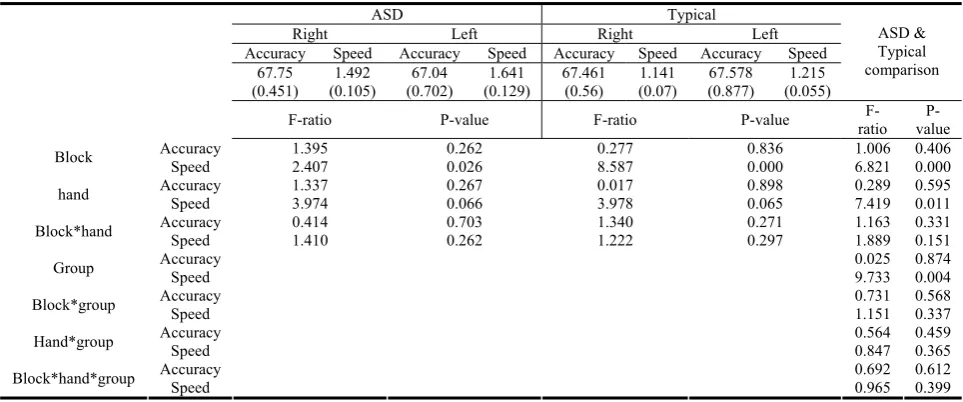
Right and left hand difference in explicit motor learning in ASD and typical children
No difference was found between right and left hand accuracy in both children with ASD (block*hand interaction: F(2.432, 34.054)=0.414, p=0.703) and their typical matched group (block*hand interaction:
F(3.289, 49.337)=1.340, p=0.271) while performing explicit motor task. Group comparison did not reach significance at interaction effect of block*hand*group (F(4.394, 127.414)=0.629, p=0.612).
Fig. 1. Right and left hand difference in explicit motor learning in ASD Table (3) contains F-ratio and p-value related to report comparison.
Table 3. Right and left hand differences in explicit motor task in ASD and typical children
ASD Typical Right Left Right Left
Accuracy Speed Accuracy Speed Accuracy Speed Accuracy Speed 67.75
(0.451)
1.492 (0.105)
67.04 (0.702)
1.641 (0.129)
67.461 (0.56)
1.141 (0.07)
67.578 (0.877)
1.215 (0.055)
ASD & Typical comparison
F-ratio P-value F-ratio P-value ratio F- value
P-Accuracy 1.395 0.262 0.277 0.836 1.006 0.406
Block
Speed 2.407 0.026 8.587 0.000 6.821 0.000
Accuracy 1.337 0.267 0.017 0.898 0.289 0.595
hand Speed 3.974 0.066 3.978 0.065 7.419 0.011
Accuracy 0.414 0.703 1.340 0.271 1.163 0.331
Block*hand Speed 1.410 0.262 1.222 0.297 1.889 0.151
Accuracy 0.025 0.874
Group Speed 9.733 0.004
Accuracy 0.731 0.568
Block*group Speed 1.151 0.337
Accuracy 0.564 0.459
Hand*group Speed 0.847 0.365
Accuracy 0.692 0.612
Block*hand*group Speed 0.965 0.399
Discussion
Results indicated no explicit motor learning with dominant hand in children with ASD which differed significantly with that of control group. Motor
dominant hand explicit knowledge processing and explicit motor learning in children with ASD. Non dominant left hand explicit learning deficit in children with ASD could also be derived from the results as no progress in speed and accuracy were seen throughout practicing explicit motor task with left hand in these children and they were significantly different in speed and accuracy from typical children.
It seems that this study is the first one suggesting explicit motor learning deficit with both dominant and non-dominant hands in children with ASD. Found studies investigating explicit learning in ASD have used Paired associates learning (PAL) (36), CC (40) and 2*10 (44) tasks indicating intact explicit learning in children with ASD that are not in line with the current study findings. Watanabe et al (2010)examined children with Asperger syndrome only and Brown et al (36) mentioned children with Autism spectrum conditions in their study and no specific diagnose was made. However, few participants in this study were diagnosed as Asperger syndrome and most of them were high-functioning autism instead. Studying children with different type of disorders from the extreme spectrum of autism may result in different findings in this regard. In addition, different tasks and so different mnemonic demands of tasks used in these studies may cause different results. The more a task has mnemonic demands, the more it is impervious to dysfunction (44).2*10 task which evaluates visiomotor explicit sequence learning through trial and error (44), PAL containing construction of a word seen before (36), and CC which involves recognition memory to investigate spatial explicit learning (40) require mnemonic processes to some extent leading to differences in results between these studies and ours. Although explicit learning is IQ-dependant (36,58), Watanabe et al (2010) did not match their studied groups for IQ. Age differences in different studies can also explain discrepancy between results. Kourkoulou evaluated adults with high-functioning autism and Asperger aged approximately 19 although our participants were children with high-functioning autism and Asperger aged from 7 to 11. Geriatric studies have shown the role of age in explicit learning causing decrement in the rate of learning due to different brain areas atrophy (59,60). However, no studies have been found to compare explicit motor learning with SRTT between children and youth. It’s probable that explicit learning changes as children grow up.
It has been suggested that explicit learning initially activates prefrontal area of the brain especially in left hemisphere (30,31). Overlap between abnormal brain areas in ASD and areas involved in explicit learning(25,38,62)along with left hemisphere dysfunction in ASD (3,6,63,64)confirm explicit learning deficit probability with dominant right hand which is controlled with contra lateral hemisphere in children with ASD. Studies have shown left hemisphere specialization in motor functions and that both hands are controlled by left hemisphere in some extent (65), on the other hand primary and supplementary motor areas of ipsilateral hemisphere are found to be involved in explicit learning of right-handed individuals (66). Therefore, it is probable that left hemisphere affects left hand explicit learning as well and as a result disturbs explicit learning in children with ASD.
Mier et al (1998) showed activation of left primary motor area and right anterior cerebellum in right hand motor learning task and activation of right primary motor area and left anterior cerebellum in left hand motor learning task. These left hemisphere areas are involved in explicit learning (30,32). Therefore left hemisphere abnormality in children with ASD (3,6,63,64) can explain their deficit in explicit learning with both right and left hands. In addition, left and right hands deficit in explicit motor learning in ASD was expectable as left hemisphere laterality in motor functions has diminished in ASD and normal leftward asymmetry of caudate nucleus participated in motor behaviour have not been found in autistic children (4,20).
Right hand implicit motor learning results also showed linear progress in speed throughout the 8 patterned blocks in both children with ASD and their typical matched peers. Group comparison also indicated no difference in implicit learning speed. Accuracy of implicit learning did not improve in two studied groups and they showed less accuracy in children with ASD. As no learning effect has been seen in accuracy, group differences did not refer to lower learning and just implied less accurate children. Left hand implicit learning is considered normal in children with ASD as no difference was found between them and typical children. However, no learning effect has been seen throughout 8 patterned blocks.
long sequences and RSI used in their study. Klinger et al (33) results are not in line with ours because of following reasons: studied groups were not IQ-matched, and the tasks used in their study mainly evaluate IQ not learning (36).
Romero-Munguía (42) in his Mnesic imbalance theory mentioned that autism diagnostic symptoms are the results of impaired implicit learning although this study and those suggesting intact implicit learning in ASD reject this claim. Brown et al (36) used four different tasks assessing implicit learning as each task was related to one aspect of ASD. They showed intact implicit learning in ASD and no relation between implicit learning and core symptoms of ASD.
Right hemisphere dominance in implicit learning relative to left hemisphere (22,27) and its role in controlling contra lateral left hand explain intact left hand implicit learning. It has been suggested that ipsilateral hemisphere activates in unimanual implicit motor learning, thus right hemisphere, dominant in implicit learning, activates during right hand implicit motor learning task(21) leading to intact implicit learning with right hand. Results of the current study also indicated no difference between two hands in explicit motor learning speed and accuracy in both ASD and typical groups. Although explicit motor learning is impaired in ASD, it seems that explicit learning asymmetry in children with ASD may be normal and the same as typical group or at least follows a normal pattern.
Hands similarity in explicit motor learning may be the cause of brain areas controlling hand movements. As mentioned before, bilateral motor areas are more activated while using left hand than right hand (67).TMS studies have also confirmed left hemisphere specialization for motor functions and hands similarity (68). Left hemisphere specialization along with its role in explicit learning may cause hands similarity in explicit learning (30,31). However, it seems that left hemisphere functions in motor goals in children with ASD do not follow a normal pattern [4,10). Therefore different reasons corresponding to hands similarity in children with ASD and typical children may also be probable. In addition, asymmetry in right and left hand explicit learning in children with ASD may confirm abnormal lateralization in children with ASD. Impaired right and left hand explicit learning in children with ASD can also cause no difference between two hands in this type of learning. Currently it was believed that explicit learning is intact in children with ASD and as a result studies focus on implicit learning and hand differences in this type of learning rather than explicit
learning. Therefore it’s difficult to discuss these results based on similar evidences. Escalante-mead (2003) has confirmed no lateralization in autistic children and our results are also in line with Wittling et al (2010) study suggesting similarity in motor speed rate in left and right hand of children with ASD.
The other important finding of the present study is speeded right hand implicit learning relative to left hand in children with ASD and left and right hand similarity in typical children. No difference has been found between two groups in this regard. These results are comparable with those of D’Cruz et al (25) who found speeded rightward responses in aoculo motor-serial reaction time task in children with autism relative to typical children while our study did not demonstrate this result relative to typical children. They indicated that their findings refer to lateralization of striatal-temporal coding system in contra lateral hemisphere (left hemisphere) which is involved in internal motor response sequence timing. They also explained their results on the basis of evidences of striatal structural and functional deficit in autism. D’Cruz et al (25) explanation for their findings can discuss the present study findings too. In our study participants were diagnosed as both high functioning autism and Asperger aged from 7 to 11 while D’Cruz et al (25) assessed children with autism aged from 8 to 53 only and their sample size was 3 times more than ours. These differences in study methods may results in difference between these two studies.
Our results are also in line with Rinehart et al (2002) findings using a serial choice reaction-time task as a tool to assess executive function. They suggested right hemi-space function (left hemisphere) impairment in children with Autism but not Asperger. In summary, explicit learning (controlled by left hemisphere) of right and left hand was impaired in children with ASD while implicit learning (controlled by right hemisphere) of both hands maintained intact and a right hand preference in implicit motor learning was observed in children with ASD due to left striatal system abnormality.
beneficial when accurate timing is desired in rehabilitation as left timing systems deficit interfere less with the function and learning. In addition we can aim to affect left striatal timing system through teaching timing to right hands of children with ASD. However, interventional studies are needed to confirm these claims.
Acknowledgement
The authors would like to thank all of the participating families, and also the children from Primary Schools who participated in this study. We would like to gratefully acknowledge the research assistance of the psychologists, Leila Shokoohandeh and Masoomeh Pirooz.
References
1. American Psychiatric Association. Diagnostic and statistical
manual of mental disorders. 4th ed. Washington, DC: American Psychiatric Association; 1994.
2. Rinehart NJ, Bradshaw JL, Brereton AV, Tonge BJ.
Lateralization in individuals with high-functioning autism and Asperger's disorder: a frontostriatal model. Journal of Autism and Developmental Disorders. 2002; 32(4):321-32.
3. Wittling R, Schweiger E, Rizhova L, Vershinina E, Starup
L. A simple method for measuring brain asymmetry in children: Application to autism. Behavior research methods. 2009; 41(3):812-9.
4. Stroganova TA, Nygren G, Tsetlin MM, Posikera IN,
Gillberg C, Elam M, et al. Abnormal EEG lateralization in boys with autism. Clinical Neurophysiology. 2007; 118(8):1842-54.
5. Ito H, Mori K, Hashimoto T, Miyazaki M, Hori A, Kagami
S, et al. Findings of brain 99mTc-ECD SPECT inhigh-functioningautism-3-dimensional stereotactic ROI template analysisofbrain SPECT. The Journal of Medical Investigation. 2005; 52:49-56
6. Hauser SL, DeLong GR, Rosman NP. Pneumographic
findings in the infantile autism syndrome.A correlation with temporal lobe disease. Brain: a journal of neurology. 1975; 98(4):667-88.
7. Hazlett HC, Poe MD, Gerig G, Smith RG, Piven J. Cortical
gray and white brain tissue volume in adolescents and adults with autism. Biological psychiatry. 2006; 59(1):1-6.
8. Cornish KM, McManus I. Hand preference and hand skill in
children with autism. Journal of Autism and Developmental Disorders. 1996; 26(6):597-609.
9. Dane S, Balci N. Handedness, eyedness and nasal cycle in
children with autism. International Journal of Developmental Neuroscience. 2007; 25(4):223-6.
10.Escalante-Mead PR, Minshew NJ, Sweeney JA. Abnormal
brain lateralization in high-functioning autism.Journal of autism and developmental disorders. 2003; 33(5):539-43.
11.McManus I, Murray B, Doyle K, Baron-Cohen S.
Handedness in childhood autism shows a dissociation of skill and preference. Cortex. 1992; 28(3):373-81.
12.Oxman J. KttMM. On the nature and variability of linguistic
impairment in autism.clinical psychology review. 1981; 1: 337-51.
13.Arnold G, Schwartz S. Hemispheric lateralization of
language in autistic and aphasic children. Journal of Autism and Developmental Disorders. 1983; 13(2):129-39.
14.Blackstock E. Cerebral asymmetry and the development of
early infantile autism.Journal of autism and childhood schizophrenia. 1978 1978/09/01; 8(3):339-53.
15.Dawson G, Warrenburg S, Fuller P. Cerebral lateralization
in individuals diagnosed as autistic in early childhood. Brain and Language. 1982; 15(2):353-68.
16.Flagg EJ, Cardy JEO, Roberts W, Roberts TP. Language
lateralization development in children with autism: insights from the late field magnetoencephalogram. Neuroscience letters. 2005; 386(2):82-7.
17.Prior MR, Bradshaw JL. Hemisphere functioning in autistic
children.Cortex. 1979; 15(1):73-81.
18.Hirsch S. ERP correlates of procedural learning: Designing a
task for children with autism: Honors Theses. Wesleyan
University; 2010.
19.van der Graaf F, Maguire R, Leenders K, de Jong B.
Cerebral activation related to implicit sequence learning in a Double Serial Reaction Time task. Brain Research. 2006; 1081(1):179-90.
20.Grafton ST, Hazeltine E, Ivry RB. Motor sequence learning
with the nondominant left hand.Experimental Brain Research. 2002; 146(3):369-78.
21.Honda M, Deiber M-P, Ibáñez V, Pascual-Leone A, Zhuang
P, Hallett M. Dynamic cortical involvement in implicit and explicit motor sequence learning. A PET study.Brain. 1998; 121(11):2159-73.
22.Rauch SL, Savage CR, Brown HD, Curran T, Alpert NM,
Kendrick A, et al. A PET investigation of implicit and explicit sequence learning.Human Brain Mapping. 1995; 3(4):271-86.
23.Wilkinson L. KZ, Jahanshahi M. The role of the basal
ganglia and its cortical connections in sequence learning: Evidence from implicit and explicit sequence learning in Parkinson’s disease. Neuropsychologia. 2009; 47:2546-73.
24.Vakil E, Kahan S, Huberman M, Osimani A. Motor and
non-motor sequence learning in patients with basal ganglia lesions: the case of serial reaction time (SRT). Neuropsychologia. 2000; 38(1):1-10.
25.D'Cruz A-M, Mosconi MW, Steele S, Rubin LH, Luna B,
Minshew N, et al. Lateralized response timing deficits in autism. Biological psychiatry. 2009; 66(4):393-7.
26.Ivry R. The representation of temporal information in
perception and motor control.Current Opinion in Neurobiology. 1996; 6(6):851-7.
27.Halsband U, Lange RK. Motor learning in man: a review of
functional and clinical studies. Journal of Physiology-Paris. 2006; 99(4):414-24.
28.Nejati V, Ashayeri H, GarusiFarshi M, Aghdasi M. The
interfernce effect of dual task on implicit and explicit motor sequence learning in elderly and youth.Review of Cognitive Sciences. 2008; 9(1): 33-9.
29.Schendan HE, Searl MM, Melrose RJ, Stern CE. An FMRI
study of the role of the medial temporal lobe in implicit and explicit sequence learning.Neuron. 2003; 37(6):1013-25.
30.Ashe J, Lungu OV, Basford AT, Lu X. Cortical control of
motor sequences. Current opinion in neurobiology. 2006; 16(2):213-21.
31.Destrebecqz A, Peigneux P, Laureys S, Degueldre C, Del
Fiore G, Aerts J, et al. Cerebral correlates of explicit sequence learning. Cognitive Brain Research. 2003; 16(3):391-8.
32.Ghilardia M, Gheza C, Dhawanc V, Moellerd J, Mentis M,
Nakamura T, et al. Patterns of regional brain activation associated with different forms of motor learning. Brain Research. 2000; 871(1):127-45.
33.Klinger L.G KMR, Pohlig R. Impliat learning impairments
in autism spectrum disorders: Implications for treatment. London: Jessica Kingsley Publishers; 2007.
34.Mostotesky SH. GM, LandaRJ.,Denckla MB. Evidence for a
35.Barnes KA, Howard Jr JH, Howard DV, Gilotty L, Kenworthy L, Gaillard WD, et al. Intact implicit learning of spatial context and temporal sequences in childhood autism spectrum disorder. Neuropsychology. 2008; 22(5):563.
36.Brown J, Aczel B, Jiménez L, Kaufman SB, Grant KP.
Intact implicit learning in autism spectrum conditions.The quarterly journal of experimental psychology. 2010; 63(9):1789-812.
37.Nemeth D, Janacsek K, Balogh V, Londe Z, Mingesz R,
Fazekas M, et al. Learning in Autism: Implicitly Superb. PLoS ONE. 2010; 5(7):e11731.
38.Gidley Larson JC, Mostofsky SH. Evidence that the pattern
of visuomotor sequence learning is altered in children with autism. Autism Research. 2008; 1(6):341-53.
39.Gordon B, Stark S. Procedural learning of a visual sequence
in individuals with autism. Focus on autism and other developmental disabilities. 2007; 22(1):14-22.
40.Kourkoulou A. Implicit learning of spatial context in
adolescents and adults with autism spectrum disorder: Durham University; 2010.
41.Travers BG, Klinger MR, Mussey JL, Klinger LG.
Motor linked implicit learning in persons with autism spectrum disorders. Autism Research. 2010; 3(2):68-77.
42.Romero-Munguía M. Mnesic imbalance: a cognitive theory
about autism spectrum disorders. Annals of general psychiatry. 2008; 7(1):20.
43.Scott-Van Zeeland AA, McNealy K, Wang AT, Sigman M,
Bookheimer SY, Dapretto M. No neural evidence of statistical learning during exposure to artificial languages in children with autism spectrum disorders. Biological psychiatry. 2010; 68(4):345-51.
44.Watanabe K, Ikeda H, Miyao M. Learning efficacy of
explicit visuomotor sequences in children with attention-deficit/hyperactivity disorder and Asperger syndrome. Experimental brain research. 2010; 203(1):233-9.
45.Stadler MA. Implicit serial learning: Questions inspired by
Hebb (1961). Memory & Cognition. 1993; 21(6):819-27.
46.Stadler M, Neely C. Effects of sequence length and structure
on implicit serial-learning. Psychological Research. 1997; 60(1-2):14-23.
47.47. Nejati V Garusi FM, Ashayeri H,Aghdasi MT. The Role
of Explicit Knowledge of Sequence in Motor Sequence Learning. Research in sport science [Persian].2008; 11:161-71.
48.Berner MP, Hoffmann J. Effector-related sequence learning
in a bimanual-bisequential serial reaction time task. Psychological Research. 2008; 72(2):138-54.
49.Amunts K, Jäncke L, Mohlberg H, Steinmetz H, Zilles K.
Interhemispheric asymmetry of the human motor cortex related to handedness and gender. Neuropsychologia. 2000; 38(3):304-12.
50.Armstrong C, Oldham J. A comparison of dominant and
non-dominant hand strengths.Journal of Hand Surgery (British and European Volume). 1999; 24(4):421-5.
51.Cho J. PK-S, Kim M, Park S-H. . Handedness and
Asymmetry of Motor Skill Learning in Right-handers. J Clin Neurol. 2006; 2(2):113–7.
52.Gonzalez CL, Goodale MA. Hand preference for precision
grasping predicts language lateralization. Neuropsychologia. 2009; 47(14):3182-9.
53.Van Mier H, Tempel L, Perlmutter J, Raichle M, Petersen S.
Changes in brain activity during motor learning measured with PET: effects of hand of performance and practice. Journal of Neurophysiology. 1998; 80:2177-99.
54.Sainburg R, Kalakanis D. Differences in control of limb
dynamics during dominant and nondominant arm reaching. Journal of Neurophysiology. 2000; 83(5):2661-75.
55.Ehlers S, Gillberg C, Wing L. A screening questionnaire for
Asperger syndrome and other high-functioning autism spectrum disorders in school age children.Journal of autism and developmental disorders. 1999; 29(2):129-41.
56.Kasechi M. Validity and reliability of Persian version of
Autism spectrum screening questionnaire. Tehran: University of Welfare and Rehabilitation Sciences; 2012.
57.Oldfield R. The assessment and analysis of handedness: The
Edinburgh inventory. Neuropsychologia. 1971; 9(1): 97-113.
58.Reber AS WF, Hernstadt R. Implicit and explicit learning:
individual differences and IQ. Journal of Experimental Psycholy, Learning, Memory, Cognition. 1991; 17(5):888-96.
59.Dennis NA, Cabeza R. Age-related dedifferentiation of
learning systems: an fMRI study of implicit and explicit learning. Neurobiology of aging. 2011; 32(12):2318. E 17-. e30.
60.Nejati V, GarusiFarshi M, Ashayeri H, Aghdasi M.
Comparing explicit motor sequence learning in youth and elderly. Motaleate tarbiati va ravanshenasie daneshgahe ferdosi. 2008:113-25.
61.Belmonte MK, Allen G, Beckel-Mitchener A, Boulanger
LM, Carper RA, Webb SJ. Autism and abnormal development of brain connectivity.The Journal of Neuroscience. 2004; 24(42):9228-31.
62.Müller R-A, Cauich C, Rubio MA, Mizuno A, Courchesne
E. Abnormal activity patterns in premotor cortex during sequence learning in autistic patients. Biological Psychiatry. 56(5):323-32.
63.Dawson G, Warrenburg S, Fuller P. Hemisphere functioning
and motor imitation in autistic persons. Brain and Cognition. 1983; 2(4):346-54.
64.Herbert MR, Ziegler D, Deutsch C, O'Brien L, Kennedy D,
Filipek P, et al. Brain asymmetries in autism and developmental language disorder: a nested whole-brain analysis. Brain. 2005; 128(1):213-26.
65.Serrien DJ, Ivry RB, Swinnen SP. Dynamics of hemispheric
specialization and integration in the context of motor control. Nature Reviews Neuroscience. 2006; 7(2):160-6.
66.Avanzino L, Pelosin E, Tacchino A, Giannini A, Bove M.
The role of ipsilateral hemisphere in explicit motor sequence learning.A TMS study.Clinical Neurophysiology. 2011; 122:S159-S60.
67.Kawashima R, Yamada K, Kinomura S, Yamaguchi T,
Matsui H, Yoshioka S, et al. Regional cerebral blood flow changes of cortical motor areas and prefrontal areas in humans related to ipsilateral and contralateral hand movement. Brain Research. 1993; 623(1):33-40.
68.Schambra HM, Abe M, Luckenbaugh DA, Reis J, Krakauer