Vol.19, No.2, 2019, 207-217
ISSN: 2279-087X (P), 2279-0888(online) Published on 24 May 2019
www.researchmathsci.org
DOI: http://dx.doi.org/10.22457/apam.613v19n2a10
207
Annals of
Seventh and Eighth Order Triangular Sum Labeling of
Graphs
C. Jayasekaran1 and C. Sunitha2 1
Department of Mathematics, Pioneer Kumaraswamy College Nagercoil-629003 Tamilnadu, India.
2
Department of Mathematics, Women’s Christian College, Nagercoil-629001 Tamilnadu, India. Email: [email protected]
1
Corresponding author. Email: [email protected]
Received 19 March 2019; accepted 14 May 2019
Abstract. A (p, q) graph G is said to admit a seventh (or eighth) order triangular sum
labeling if its vertices can be labeled by non negative integers such that induced edge labels obtained by the sum of the labels of end vertices are the seventh (or eighth) order triangular numbers. A graph G which admits a seventh (or eighth) order triangular sum labeling is called a seventh (or eighth) order triangular sum graph. In this paper we prove that double star K1,n,n, Tgn and Coconut tree admit seventh and eighth order triangular
sum labelings.
Keywords: Star graph, coconut tree, seventh and eighth order triangular sum graph AMS Mathematics Subject Classification (2010): 05C78
1. Introduction
The graphs considered here are finite, connected, undirected and simple. The vertex set and the edge set of graph are denoted by V(G) and E(G) respectively. For various graph theoretic notations and terminology we follow Harary [3] and for number theory we follow Burton [1]. We will give the brief summary of definitions which are useful for the present investigations. In [8] they have proved star and bistar related graphs are divisor cordial graphs. Some authors in [10] have discussed Star in Coloring of some star
familes.For a dynamic survey of various graph labeling problem along with an extensive
bibliography we refer to Gallioan [4].
Definition 1.1. [2,7 ] A triangular number is a number obtained by adding all positive
integers less than or equal to a given positive integer n. If the nth triangular number is denoted by An, then An = 1 + 2 + . . . + n = 1
2
n (n+1).
The triangular numbers are 1, 3, 6, 10, 15, 21, 28, 36, . . .
Definition 1.2. [6, 9] A triangular sum labeling of a graph G is a one to one function f:
C. Jayasekaranand C. Sunitha
208
E(G) → {A1, A2, . . ., Aq} of the edges of G defined by f (uv)+ =f (u) f (v)+
e uv E(G)
∀ = ∈ . The graph which admits such labeling is called a triangular sum graph.
Definition 1.3. [5] A second order triangular number is a number obtained by adding all the squares of positive integer less than or equal to a given positive integer n. If the nth second order triangular number is denoted by Bn , then
Bn = 1 2
+ 22 + 32 + . . . + n2
( 1)(2 1) 6
1 + +
= n n n
The second order triangular numbers are 1, 5,14, 30,55,. …
Definition 1.4. A second order triangular sum labeling of a graph G is a one to one function f: V(G) → W that induces a bijection f+: E(G) → {B1, B2, . . ., Bn} of the edges
of G defined by f+(uv) = f(u) + f(v), ∀ e = uv∈ E(G). The graph which admits such labeling is called a second order triangular sum graph.
Definition 1.5. A seventh order triangular number is a number obtained by adding all the seventh powers of positive integers less than or equal to a given positive integer n. If the nth seventh order triangular number is denoted by Gn, then
Gn = 1 7
+ 27 + 37 + . . . + n7
[
3 6 4 2]
) 1 ( 24
1 2 + 2 4+ 3− 2− +
= n n n n n n
The seventh order triangular numbers are 1, 129, 2316, 18700, 96825, 376761, 1200304, 3297456, 8080425, 18080425, 37567596, . . .
Definition 1.6. A seventh order triangular sum labeling of a graph G is a one to one function f: V(G) → W that induces a bijection f+: E(G) → {G1, G2, . . ., Gq} of the edges
of G defined by f+(uv) = f(u) + f(v), ∀ e = uv∈ E(G). The graph which admits such labeling is called a seventh order triangular sum graph.
Definition 1.7. An Eighth order triangular number is a number obtained by adding all the eighth powers of positive integers less than or equal to a given positive integer n. If the nth eighth order triangular number is denoted by Hn, then
Hn = 18 + 28 + … + n8
] 3 9 15
5 15 5 [ 90
) 1 2 ( ) 1
( + + 6+ 5+ 4− 3− 2+ −
= n n n n n n n n n
The eighth order triangular numbers are 1, 257, 6818, 72354, 462979, 2142595, ….
Definition 1.6. An Eighth order triangular sum labeling of a graph G is a one-to-one function f: V(G) → W that induces a bijection f+: E(G) → {H1, H2, …, Hq} of the edges
209
2. Main result
Theorem 2.1. The star graph K1, n admits seventh order triangular sum labeling.
Proof: Let u be the central vertex and let u1, u2, . . ., un be the pendant vertices of the star
K1, n. Then the vertex set V(K1, n) = {u, ui/ 1≤ i ≤ n} and the edge set E(K1,n) = {uui / 1 ≤ i ≤ n}. Clearly K1,n has n + 1 vertices and n edges. Define f : V(K1,n) → W by
f(u) = 0
f(ui) = Gi = i i i i i n
i i ≤ ≤ + − − + + 1 , ] 2 4 6 3 [ 24 ) 1
( 4 3 2
2 2
.
Then f induces a bijection f + : E(G) → {G1, G2, . . ., Gn} given by
f + (uui) = f(u) + f(ui) = 0 + Gi = Gi= [3 6 4 2], 1 i n
24 ) 1
( 4 3 2
2 2 ≤ ≤ + − − + + i i i i i i .
Clearly, the induced edge labels are the first n seventh order triangular numbers. Hence K1,n admits a seventh order triangular sum labeling.
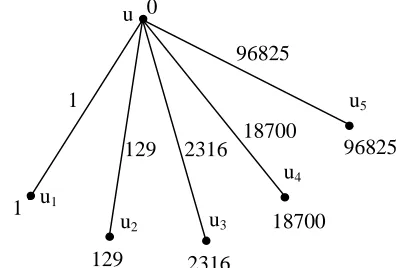
Example 2.2. A seventh order triangular sum labeling of K 1, 5 is shown in figure 2.1.
Figure 2.1: K 1, 5 with a seventh order triangular sum labeling
Theorem 2.3. The double star K1, n, n admits seventh order triangular sum labeling.
Proof: Let G be the double star K1,n,n. Let V(G) = {u, ui, vi / 1 ≤ i ≤ n} be the vertex set
and E(G) = {uui, uivi/1 ≤ i ≤ n} be the edge set of K1,n,n. Then G has 2n + 1 vertices and
2n edges. Define f : V(G) → W by f(u) = 0
f(ui) = Gi, 1 ≤ i ≤ n
f(vi) = Gn+i− f(ui), 1 ≤ i ≤ n
Then f induces a bijection f + : E(G) → {G1, G2, . . ., G2n} given by
f+ (uui) = f(u) + f(ui) = 0 + Gi = Gi, 1 ≤ i ≤ n
f+(uivi) = f(ui) + f(vi) = f(ui) + Gn+I - f(ui) = Gn+i, 1 ≤ i ≤ n.
Thus, the induced edge labels are the first 2n seventh order triangular numbers. Hence G admits a seventh order triangular sum labeling.
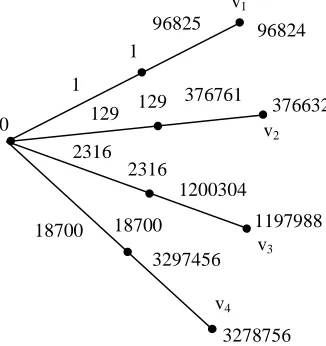
Example 2.4. A seventh order triangular sum labeling of K 1,4,4 is shown in figure 2.2. 0 u u5 u4 u3 u2 u1 1 1 129 129 2316
2316 18700 96825
C. Jayasekaranand C. Sunitha
210
Figure 2.2: K 1, 4, 4 with a seventh order triangular sum labeling
Theorem 2.5. The bistarBm,n admits seventh order triangular sum labeling.
Proof: Let u and v be the vertices of K2. Join m pendent vertices u1, u2, . . ., um at u and
join n pendent vertices v1, v2, . . ., vn at v. The resultant graph is the bistar G = Bm,n with
vertex set V(G) = {u, v, ui, vj / 1 ≤ i ≤ m, 1 ≤ j ≤ n} and edge set E(G) {uui, vvj, uv / 1
≤ i ≤ m, 1 ≤ j ≤ n}. Clearly G has m + n + 2 vertices and m + n + 1 edges. Define f: V(G)
→ W by
f(u) = 0 f(v) = 1
f(ui) = Gi+1, 1 ≤ i ≤ m
f(vj) = Gm+1+j - f(v), 1 ≤ j ≤ n
Then f induces a bijection f+ : E(G) → {G1, G2, …, Gm + n + 1) given by
f+(uui) = f(u) + f(ui) = 0 + Gi+1 = Gi+1, 1≤i ≤m
f+(uv) = f(u) + f(v) = 1 = G1
f+(vvj) = f(v) + f(vj) = f(v) + Gm+1+j - f(v) = Gm+1+j, 1 ≤ j ≤ n.
Thus, the induced edge labels are the first m + n + 1 seventh order triangular numbers. Hence Bm, n admits a seventh order triangular sum labeling.
Example 2.6. A seventh order triangular sum labeling of B4,3 is shown in figure 2.3. 0
1
1 129
2316
18700
129
2316
18700 96825
376761
1200304
3297456 v1
v2
v3
v4
96824
376632
1197988
3278756
37676 1 129
2316
2316 129
18700
96825
96825
u 1 v
1 v1
v2
v3
37676 0 1200304
1200303
3297456
3297455 0
u1
u2
u3
211
Figure 2.3: B4,3 with a seventh order triangular sum labeling
Theorem 2.7. Yn + 1 admits a seventh order triangular sum labeling if n ≥ 3.
Proof: Let Pn be the path u1u2 . . . un. Let v be the vertex adjacent to u2. The resultant
graph G is Yn + 1 with vertex set V(G) = {ui, v / 1 ≤ i ≤ n} and the edge set E(G) = {uiui+1,
vu2/ 1 ≤ i ≤ n – 1}. Clearly the graph G has n + 1 vertices and n edges. Define f : V(G) →
W by
f(u1) = 1 = G1
f(v) = 129 = G2
f(u2) = 0
f(ui) = Gi+1 - f(ui-1), 3 ≤ i ≤ n
Then f induces a bijection f+: E(G) → {G1, G2, . . ., Gn} given by
f +(u1u2) = f(u1) + f(u2) = 1 = G1
f +(u2v) = f(u2) + f(v) = 0 + 129 = G2
f +(u2u3) = f(u2) + f(u3) = 0 + 23161 = G3
f +(uiui+1) = f(ui) + f(ui+1) = f(ui) + Gi+1 - f(ui) = Gi+1, 3 ≤ i ≤ n
Thus, the induced edge labels are the first n seventh order triangular numbers. Hence G admits seventh order triangular sum labeling.
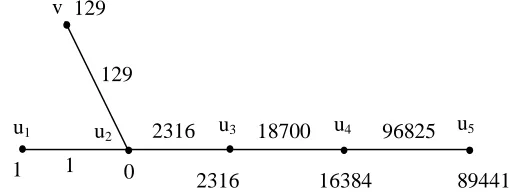
Example 2.8. A seventh order triangular sum labeling of Y5+1 is shown in figure 2.4.
Figure 2.4: Y5+1 with a seventh order triangular sum labeling
Theorem 2.9. Tgn admits seventh order triangular sum labeling.
Proof: Let u1u2 . . . un be the path of length n. For 1 ≤ j ≤ n – 2, let vj and wj be the
vertices adjacent to uj+1. The resultant graph is called a Twig graph Tgn, with vertex set
V(Tgn) = {ui, vj, wj / 1 ≤ i ≤ n, 1 ≤ j ≤ n - 2} and the edge set E(Tgn) = {uiui+1, vjuj+1, wjuj+1
/ 1 ≤ i ≤ n – 1, 1 ≤ j ≤ n – 2}. Clearly the graph Tgn has 3n - 4 vertices and 3n - 5 edges.
Define f: V(G) → W by
f(u2) = 0
f(u3) = G1
f(ui) = Gi – 2 – f(ui - 1), 4 ≤ i ≤ n
f(u1) = G3n-5
f(vi) = Gn-2+i – f(ui+1), 1 ≤ i ≤ n – 2
f(wi) = G3n - 5 - i – f(ui+1), 1 ≤ i ≤ n – 2.
Then f induces a bijection f+ : E(G) → {G1, G2, . . ., G3n - 5 } given by
f+(u1u2) = f(u1) + f(u2) = G3n-5
f+(uiui+1) = f(ui) + f(ui+1) = Gi-1, 2 ≤ i ≤ n – 1
f+(viui+1) = f(vi) + f(ui+1) = Gn-2+i – f(ui+1) + f(ui+1) = Gn-2+i, 1 ≤ i ≤ n – 2.
2316
18700 96825
129
129
u1 u2 u3 u4 u5
1 1 0
2316
16384 89441
C. Jayasekaranand C. Sunitha
212
f+(wiui+1) = f(wi) + f(ui+1) = G3n-5-i+ f(wi) – f(wi) = G3n - 5 - i, 1 ≤ i ≤ n – 2.
Thus, the induced edge labels are the first 3n−5 seventh order triangular numbers. Hence Tgn admits a seventh order triangular sum labeling.
Example 2.10. A seventh order triangular sum labeling of Tg5 is shown in figure 2.5
Figure 2.5: Tg5 with a seventh order triangular sum labeling
Theorem 2.11. The Coconut tree T(m, n) admits a seventh order triangular sum labeling. Proof: Let u1, u2, …, un be the end vertices of star K1, n with central vertex u. Let v1, v2,
…,vm be the path Pm. Identifying v1 with u. The resultant graph G is a coconut tree T(m,n)
with vertex set V(G) = {vi, uj/1 ≤ i ≤ m, 1 ≤ j ≤ n} and edge set E(G) = {vivi+1, v1uj, /1 ≤ j
≤ n, 1 ≤ i ≤ m −1}. Clearly G has n + m vertices and n + m − 1 edges. Define f: V(G) → W by
f(v1) = 0
f(vi) = Gi−1− f(vi - 1), 2 ≤ i ≤ m
f(uj) = Gm+j-1, 1 ≤ j ≤ n.
Then f induces a bijection f+ : E(G) → {G1, G2, . . ., Gm + n - 1 }given by
f+ (vivi+1) = f(vi ) + f(vi+1) = f(vi) + Gi - f(vi) = Gi, 1 ≤ i ≤ m- 1
f∗(v1uj) = f(v1 ) +f(uj) = 0 + Gm+j-1 = Gm + j - 1, 1 ≤ j ≤ n.
Thus, the induced edge labels are the first n + m − 1 seventh order triangular numbers. Hence G admits a seventh order triangular sum labeling.
8080425
8080425
3297455 3297456
1200304
1200176 18080425
18700 18700
96825 96824
376761 376633
2188 128
u1
1 0 v1
v2
v3
w1
2316 u2
u3
u4
u5
w2
w3
18080425
1
213
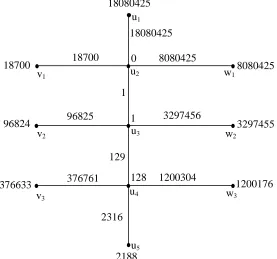
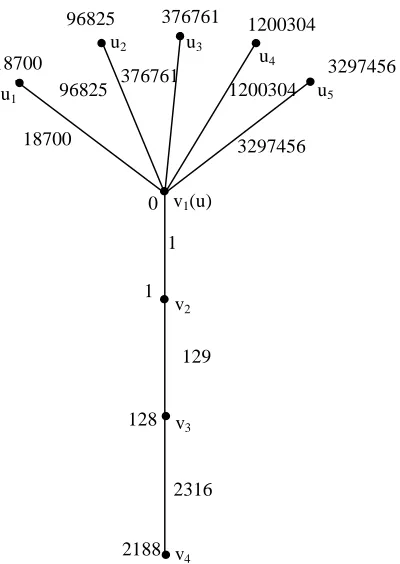
Example 2.12. A seventh order triangular sum labeling of T (4, 5) is shown in figure 2.6.
Figure 2.6: T (4, 5) with a seventh order triangular sum labeling
Theorem 2.13. The star graph K1,n admits an eighth order triangular sum labeling.
Proof: Let u be the central vertex and let u1, u2, . . ., un be the pendant vertices of the star
K1,n. Then the vertex set V(K1, n) = {u, ui / 1 ≤ i ≤ n} and the edge set E(K1,n) = {uui / 1 ≤
i ≤ n}. Clearly K1,n has n + 1 vertices and n edges. Define f : V(K1,n) → W by
f(u) = 0
f(ui) = Hi, 1≤ i≤ n.
Then f induces a bijection f + : E(G) → {H1, H2, . . ., Hn} given by
f + (uui) = f(u) + f(ui) = 0 + Hi = Hi, 1 ≤ i ≤ n.
Cleary, the induced edge labels are the first n eighth order triangular numbers. Hence K1, n
admits an eighth order triangular sum labeling.
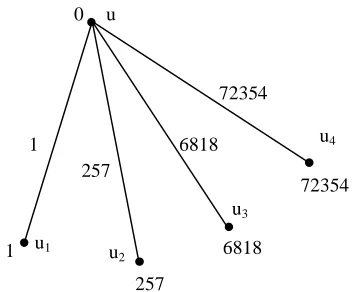
Example 2.14. An eighth order triangular sum labeling of K 1, 5 is shown in Figure 2.7. 1
v2
129
128
2188 0 v1(u) u1
u2 u3
u4
u5
2316 1 96825
96825
376761
1200304 1200304 376761
18700
18700 3297456
3297456
v3
C. Jayasekaranand C. Sunitha
214
Figure 2.7: K 1, 4 with an eighth order triangular sum labeling
Theorem 2.15. The double star K1, n, n admits an eighth order triangular sum labeling.
Proof: Let G be the double star K1, n, n. Let V(G) = {u, ui, vi / 1 ≤ i ≤ n} be the vertex set
and E(G) = {uui, uivi / 1 ≤ i ≤ n} be the edge set of K1,n,n. Then G has 2n + 1 vertices and
2n edges. Define f : V(G) → W by f(u) = 0
f(ui) = Hi , 1 ≤ i ≤ n
f(vi) = Hn+i - f(ui), 1 ≤ i ≤ n
Then f induces a bijection f + : E(G) → {H1, H2, . . ., H2n} given by
f+ (uui) = f(u) + f(ui) = 0 + Hi = Hi, 1 ≤ i ≤ n
f+(uivi) = f(ui) + f(vi) = f(ui) + Hn+I - f(ui) = Hn+i, 1 ≤ i ≤ n.
Thus, the induced edge labels are the first 2n eighth order triangular numbers. Hence G admits an eighth order triangular sum labeling.
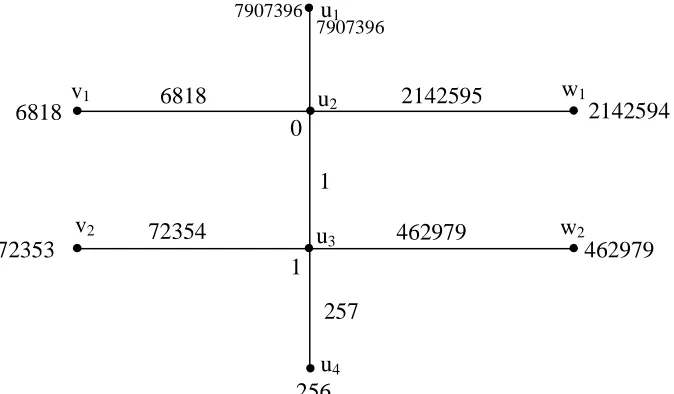
Example 2.16. An eighth order triangular sum labeling of double star K1,3,3is shown in figure 2.8.
Figure 2.8: Double star K1, 3, 3 with an eighth order triangular sum labeling 72354
u 0
1
257
6818
1 u1 u
2
u3
u4
72354
6818
257
2142595 1
1
6818
u2
u3 u1
v1
72353
v2
v3
462722
2135777 6818
0
257 u
215
Theorem 2.17. Yn+1 admits an eighth order triangular sum labeling.
Proof: Let Pn be the path u1u2 . . . un. Let v be the vertex adjacent to u2. The resultant
graph G is Yn+1 with vertex set V(G) = {ui, v / 1 ≤ i ≤ n} and the edge set E(G) = {uiui+1,
vu2 /1 ≤ i ≤ n – 1}. Clearly the graph G has n + 1 vertices and n edges. Define f: V(G) →
W by f(u1) = 1
f(u2) = 0
f(v) = 257
f(ui) = Hi - f(ui-1), 3 ≤ i ≤ n.
Then f induces a bijection f+ : E(G) → {H1, H2, . . ., Hn} given by
f+(u1u2) = f(u1 ) + f (u2) = 1 = H1
f+(u2v) = f(u2) +f(v) = 257 = H2
f+(u2u3) = f(u2 ) + f(u3) = 0 + 6818 = H3
f+(uiui+1) = f(ui) + f(ui+1) = f(ui) + Hi+1 – f(ui) = Hi+1, 3 ≤ i ≤ n.
Cleary, the induced edge labels are the first n eighth order triangular numbers. Hence G admits an eighth order triangular sum labeling.
Example 2.18. An eighth order triangular sum labeling of Y5+1is shown in figure 2.9.
Figure 2.9: Y5+1 with an eighth order triangular sum labeling
Theorem 2.19. Tgn admits an eighth order triangular sum labeling.
Proof: Let u1u2 . . . un be the path of length n. For 1 ≤ j ≤ n – 2, let vj and wj be the
vertices adjacent to uj+1. The resultant graph is called a Twig graph Tgn, with vertex set
V(Tgn) = {ui, vj, wj / 1 ≤ i ≤ n, 1 ≤ j ≤ n - 2} and the edge set E(Tgn) = {uiui+1, vjuj+1, wjuj+1
/ 1 ≤ i ≤ n – 1, 1 ≤ j ≤ n – 2}. Clearly the graph Tgn has 3n − 4 vertices and 3n − 5 edges.
Define f: V(G) → W by
f(u2) = 0
f(u3) = H1
f(ui) = Hi – 2 - f(ui - 1), 4 ≤ i ≤ n
f(u1) = H3n-5
f(vi) = Hn-2+i – f(ui+1), 1 ≤ i ≤ n – 2
f(wi) = H3n - 5 - i – f(ui+1), 1 ≤ i ≤ n – 2.
Then f induces a bijection f+ : E(G) → {H1, H2, . . ., H3n - 5} given by
f+(u1u2) = f(u1) + f(u2) = H3n-5
f+(uiui+1) = f(ui) + f(ui+1) = Hi-1, 2 ≤ i ≤ n – 1
f+(viui+1) = f(vi) + f(ui+1) = Hn-2+i, 1 ≤ i ≤ n – 2.
f+(wiui+1) = f(wi) + f(ui+1) = H3n - 5 - i, 1 ≤ i ≤ n – 2.
6818
72354 462979
257
1 1 0
6818
66536 396443
u1
u2 u3
C. Jayasekaranand C. Sunitha
216
Cleary, the induced edge labels are the first 3n−5 eighth order triangular numbers. Hence Tgn admits an eighth order triangular sum labeling.
Example 2.20. An eighth order triangular sum labeling of Tg4 is shown in figure 2.10.
Figure 2.10: Tg4 with an eighth order triangular sum labeling
Theorem 2.21. The coconut tree T(m, n) is an eighth order triangular sum labeling. Proof: Let u1, u2, …, un be the end vertices of star K1, n with central vertex u. Let
v1, v2, …,vm be the path Pm. Identifying v1 with u. The resultant graph G is a coconut tree
T(m,n) with vertex set V(G) = {vi , uj/1 ≤ i ≤ m, 1 ≤ j ≤ n} and edge set E(G) = { vivi+1,
v1uj, / 1 ≤ j ≤ n, 1 ≤ i ≤ m - 1}. Clearly G has n + m vertices and n + m - 1 edges. Define f:
V(G) → W by
f(v1) = 0
f(vi) = Hi-1 - f(vi-1), 2 ≤ i ≤ m
f(uj) = Hn+j-1 , 1 ≤ i ≤ n.
Then f induces a bijection f+ : E(G) → {H1, H2, . . ., Hm+n-1 } given by
f+ (v ivi+1) = f(v i ) + f(vi+1) = Hi, 1 ≤ i ≤ m - 1
f∗(v1uj) = f(v1 ) +f(uj) = Hm+j-1, 1 ≤ j ≤ n.
Cleary, the induced edge labels are the first n + m − 1 eighth order triangular numbers. Hence G admits an eighth order triangular sum labeling.
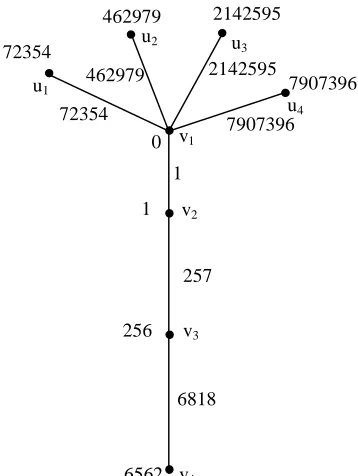
Example 2.22. An eighth order triangular sum labeling of T(4, 4) is shown in Figure
2.11.
u1
462979
462979 2142595
2142594
72354 72353
6818 6818
0
1
1
u4
257
256 u2
u3
v1
v2
w1
w2 7907396
217
Figure 2.11: Coconut tree T(4, 4) with an eighth order triangular sum labeling
3. Conclusion
In this paper, we prove the seventh and eighth order triangular sum labeling of star graph K1, n, double star K1, n, n, bistar Bm,n, Yn + 1, Tgn and Coconut tree T(m, n).
REFERENCES
1. D.M. Burton, Elementary number theory, Brown Publishers, Second edition (1990).
2. J. Devaraj, S.P.Reshma and C.Sunitha, On triangular sum graphs of some graphs,
International Journal of Advanced and Innovative Research, 6 (2017) 8.
3. F.Harrary, Graph theory, Narosa publishing House (2001).
4. J.A.Gallioan, A dynamic survey of graph labeling, The Electronics Journal of
Combinatorics, 17 (2010) # DS6.
5. S.Murugesan, D.Jayaraman and J.Shiama, Second and third order triangular sum
labeling of graphs, Intern. Journal of Mathematical Archive, 4(2) (2013) 55-62. 6. M.A.Seoud and M.A Salim, Further results on triangular sum graphs, International
Mathematical Form, 7(48) (2012) 2393-2405.
7. P.Shankaran, On triangular sum labelings of graphs, Global Research and
Development Journal for Engineering, 3 (2018) 29-33.
8. S.K.Vaidya and N.H.Shah, Some star and bistar related divisor cordial graphs,
Annals of Pure and Applied Mathematics, 3(1) (2013) 67-77.
9. S.K.Vaidya, U.M.Prajapatti and P.L.Vihol, Some important results on triangular sum
graphs, Applied Mathematical Sciences, 3(36) (2009) 1763-1772.
10. D.Vijayalakshmi and S.Priyanka, Star-in-coloring of some star graph families,
Annals of Pure and Applied Mathematics, 14(3) (2017) 461-464.
72354
462979 2142595
v1
1 0
1 v2
257
256 v3
v4 6818 u1
u2 u3
u4 7907396
72354
462979 2142595
7907396