Original Article
COMPARATIVE EVALUATION OF THE FIT OF THE PARTIAL
DENTURE FRAMEWORK FABRICATED FROM CONVENTIONAL
CASTING WAX AND LIGHT CURED PATTERN WAX – AN IN VITRO
STUDY
Tahsin Mansur Veljee, * Shruthi C S, ** Poojya R ***
* Post Graduate Student, Department of Prosthodontics, M R Ambedkar Dental College and Hospital, Bangalore, Karnataka, India **Professor, Department of Prosthodontics, M R Ambedkar Dental College and Hospital, Bangalore, Karnataka, India
***Reader, Department of Prosthodontics, M R Ambedkar Dental College and Hospital, Bangalore, Karnataka, India
________________________________________________________________________
ABSTRACT
Aim: Evaluate and compare the accuracy of fit of the partial denture framework fabricated from conventional casting wax and light cured pattern wax by measuring gaps or spaces present between the framework and supporting structures which will enable the dentist and dental technician to evaluate the accuracy of fit of the prosthesis before it’s delivered to the patient. Materials And Method: A total number of 10 castings were prepared for the evaluation of the clasp assembly. A stone cast with the 1st molar and 2nd premolar missing on the left side of the arch was chosen. Mesial and distal rest seats were prepared on the 1st molar and 2nd premolar respectively. It was then duplicated for the fabrication of a nickel-chromium die. Light cured pattern wax was adapted onto the refractory cast. Refractory casts were duplicated to adapt the conventional casting wax. Accuracy of the fit was evaluated by measuring the thickness of polyvinyl siloxane material between rest and rest seat area. The results were statistically analysed using student t-test (Open Epi Info). Results: Light cured pattern shows better occlusal rest fit than control group in all the four zones. Marginal zone of the occlusal rest shows better fit as compared to the buccal, lingual and central zones. Conclusion: There was a statistically significant difference between the marginal zone and buccal zone, central zone and buccal zone in the control group and light cured patterns.
KEYWORDS: Casting wax; light cured pattern wax; metal framework
INTRODUCTION
Tooth loss from disease and trauma has always been a feature of mankind’s existence. Partially edentulous condition is a universally observed phenomenon having various treatment options such as removable and fixed partial dentures. Even though the removable partial denture is indicated in many cases, patients are not satisfied because they often complain of ill-fitting prosthesis. In addition, the practitioners avoid the laborious procedures involved in the fabrication of the partial denture metal framework with the design of various component parts. The operators also feel the unpredictability in the fit of the framework, especially with the clasp assembly. Casting an extensive cast partial framework can be a challenge, given distortions and defects attributable to laboratory conditions. It’s an accepted fact that more extensive the framework, greater the chance for distortion, despite
improvement in laboratory procedures.[1] Wax
patterns develop a degree of internal strain during preparation which gets relieved over time and the wax distorts. These adverse properties of wax have been recognized and research on alternative materials have been carried out. Initially, chemically cured resins were formulated followed by light cured resin pattern materials with benefits like:
no duplication required,
faster and more complete curing,
reduced porosity,
almost instant finishing,
adequate working time for complex
procedures
Table 1: Evaluation of the premolar rest area
ZONES GROUP 1 GROUP 2 P VALUE
Buccal 0.312 ± 0.026 0.342 ± 0.026 0.1055
Lingual 0.242 ± 0.028 0.282 ± 0.029 < 0.05*
Central 0.128 ± 0.019 0.128 ± 0.048 < 0.05*
Marginal 0.044 ± 0.011 0.1 ± 0.024 < 0.001**
*p < 0.05 = significant
**p < 0.001 = highly significant
Table 2: Table 2: Evaluation of the molar rest area
ZONES GROUP 1 GROUP 2 P VALUE
Buccal 0.3 ± 0.022 0.334 ± 0.019 < 0.05*
Lingual 0.266 ± 0.026 0.296 ± 0.026 0.105
Central 0.118 ± 0.024 0.176 ± 0.028 < 0.05*
Marginal 0.05 ± 0.015 0.09 ± 0.018 < 0.05*
*p < 0.05 = significant
material economy.[2]
The success of prosthesis depends on how well it fits without causing injury to the remaining teeth and soft tissues. A study was hence undertaken to evaluate and compare the accuracy of fit of the partial denture framework fabricated from conventional casting wax and light cured pattern wax by measuring space present between the framework and supporting structures which will enable the dentist and dental technician to evaluate the accuracy of fit of the prosthesis before it’s delivered to the patient.
MATERIALS AND METHODS
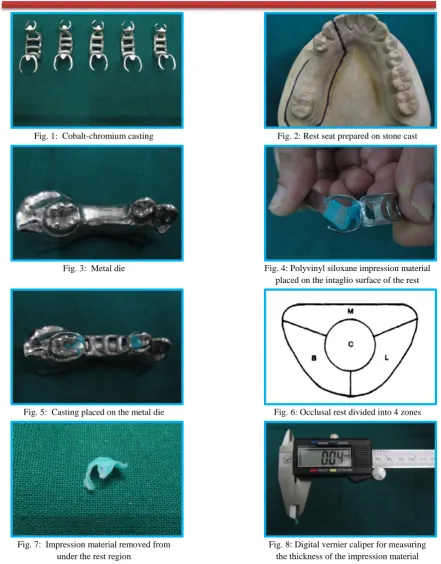
A total number of 10 castings (Fig. 1) were prepared for the evaluation of the clasp assembly. A stone cast with the 1st molar and 2nd premolar missing on the left side of the arch was chosen. Mesial and distal rest seats were prepared on the 1st molar and 2nd premolar respectively (Fig. 2). It was then duplicated for the fabrication of a nickel-chromium die (Fig. 3). This metal die was then duplicated using polyvinyl siloxane material and the refractory casts were obtained. Light cured pattern wax was adapted onto the refractory cast. Refractory casts were duplicated to adapt the
conventional casting wax. Castings were made by using phosphate bonded investment. Polyvinyl siloxane material was placed on the intaglio surface of the rests and the casting was held in place on the metal die with finger pressure (Fig. 4). Accuracy of the fit was evaluated by measuring the thickness of polyvinyl siloxane material between rest and rest seat area (Fig. 5). The occlusal rest was divided into 4 zones to facilitate statistical analysis - marginal ridge zone, buccal zone, lingual zone and central zone (Fig. 6). The thickness of the material was measured by a digital vernier caliper in the 4 zones for all castings (Fig. 7 and Fig. 8).
RESULT
The results were statistically analysed using student t-test (Open Epi Info). Mean and standard deviation values for the result obtained were calculated and statistically analysed. Group 1 castings were those that were casted using light cured pattern wax. Group 2 castings were those that were casted using conventional casting wax. It was found that the zone of marginal ridge was more closely adapted to the premolar rest seat (0.05 ± 0.015, 0.09 ± 0.018) than other zones for
(0.05 ± 0.015, 0.09 ± 0.018) than other zones for the castings made by both, the conventional casting wax and light cured pattern wax respectively (Table 1 and Table 2). The average fit of the marginal ridge zone was more superior than the central zone followed by the lingual zone and the buccal zone (Graph 1 and Graph 2). For both the castings, the buccal zone showed least adaptability. The castings obtained from light
cured pattern wax were more superior than those obtained from conventional casting wax (Graph 1 and Graph 2).
DISCUSSION
Precision fit of partial denture castings is quite difficult to achieve. A removable partial denture framework is a fabricated using high fusing base metal alloy that results in higher shrinkage than gold alloys, and therefore there is difficulty in
Fig. 1: Cobalt-chromium casting Fig. 2: Rest seat prepared on stone cast
Fig. 3: Metal die Fig. 4: Polyvinyl siloxane impression material placed on the intaglio surface of the rest
Fig. 5: Casting placed on the metal die Fig. 6: Occlusal rest divided into 4 zones
Fig. 7: Impression material removed from under the rest region
achieving the desired fit. Ito et al3 put forth the following conclusions:
(i) Casting shrinkage decreased when the flow
of the wax pattern increased.
(ii) Flow of the wax pattern increased as the
exothermic reaction increased.
(iii) A larger casting ring was suggested for
castings when a relatively thick wax pattern or an inlay wax that has a higher strength,
softening temperature and low flow
percentage is used.
In the present invitro study rest seat adaptation was evaluated for the castings done using light cured pattern material and conventional lost wax technique as control group. The technique described by Parker et al.,[4] was used to evaluate the occlusal contacts of the rest seat by dividing the rest seat area into 4 zones.[5] Evaluation of the fit of the castings using polyvinyl siloxane material showed that the castings made by light cured patterns were statistically better fitting than the castings made by conventional wax patterns. It was also seen that occlusal rest seat fit was comparatively better in the castings which were made with light cured pattern than the conventional lost wax pattern. The marginal ridge zone appeared to fit significantly better than all the other zones. This may occur because of less shrinkage in the zone of the bulky marginal ridge compared with the thinner parts of the remainder. There may be less chance of post casting alteration in the marginal ridge zone because it is likely that there is less distortion during the recovery process, and the amount of mechanical polishing may be reduced. In addition, consistent with the concept of a better fit with beveled margins than with butt joint relationships, the marginal ridge zone may be viewed as a beveled relationship to the rest whereas the remainder of the rest seat is in a butt or horizontal relationship.[5] The reason for more space in the conventional lost wax pattern castings than light cured pattern is because of lesser capability of the molten metal in the refractory technique to reproduce margins in the investment material mold cavity, which could increase marginal discrepancies. This assumption may be supported by the fact that the casting is made over a
duplicated cast, which is obtained with
investment material having a more porous surface compared to dental stone. An impression material
is also necessary for the duplication process which increases the risk of distortions and inadequate detail reproduction. The present study is in agreement with the studies made by Parker et al.[4] and Dunham et al7 that polyvinyl siloxane impression material can be used as a material to evaluate the thickness of the space between the clasp assembly and the abutment. Marginal ridge zone shows better adaptability than the other zones, and buccal and lingual zones show the least adaptability.[5] No castings have ideal fit that is absolute zero space as mentioned by Christensen.[6]
CONCLUSION
Within the limitations of the study, the following conclusions were drawn:
Light cured pattern shows better occlusal rest fit than control group in all the four zones.
Marginal zone of the occlusal rest shows
better fit as compared to the buccal, lingual and central zones. There was a statistically significant difference between the marginal zone and buccal zone, central zone and buccal zone in the control group and light cured patterns.
CONFLICT OF INTEREST & SOURCE OF FUNDING
The author declares that there is no source of funding and there is no conflict of interest among all authors.
BIBLIOGRAPHY
1. Shetty MS, Shenoy KK. Techniques for
Evaluating the Fit of Removable and Fixed Prosthesis. ISRN Dentistry 2011.
2. Rajagopal P, Chitre V, Aras MA. A
comparison of the accuracy of patterns processed from an inlay casting wax, an auto-polymerised resin and a light-cured resin pattern material. Indian J Dent Res 2012;23:152-6.
3. Ito M. Effect of selected physical properties
of waxes on investments and casting shrinkage. J Prosthet Dent 1996;75:211.
4. Parker MH. Comparison of occlusal contacts
in maximum intercuspation for two
impression techniques. J Prosthet Dent 1997;78:255-59.
5. Stern MA, Brudvik JS, and Frank RP.
1985;53:658-62.
6. Christensen GJ. Marginal fit of gold inlay
castings. J Prosthet Dent 1966;16:297-305.
7. Dunham D. A clinical investigation of