June 2017, Vol. 4, No. 1, pp. 25-33 ISSN 2373-2156 (Print) 2373-2164 (Online) Copyright © The Author(s). All Rights Reserved. Published by American Research Institute for Policy Development DOI: 10.15640/jpesm.v4n1a2 URL: https://doi.org/10.15640/jpesm.v4n1a2
The Effects of Gymnastics and Whole Body Vibration Exercises on
Body Composition
Nurcan Demirel1 , Gül Tiryaki Sönmez2, Hüseyin Eroğlu3, & Şerife Vatansever4
Abstract
The purpose of this study was to comparatively analyze the effects of 6 weeks of gymnastics and whole body vibration exercises on body composition. Twenty twomale subjects participated in this research (Age average 21.4 ± 2.4 and height average1.75 ± 5.6 cm).Participants were randomlyassigned to three groups;Gymnastics and Whole-body Vibration Exercise Group (GWBVEG, n=7), Gymnastics ExerciseGroup (GEG, n=8) and Control Group (CG, n=7).Body composition were measured before and after 6 week-exercise period.For data analyses Wilcoxon Signed Ranks Test was used in order to look at the differences among the dependant groups and Mann Whitney Utest was used in order to to look at the differences among the independant groups.When the groups’ post-tests forbody composition values were compared, it was observed that the improvement of body composition (Impedance (IMP) values of the GWBVEG group was significantly higher than the one for GEG and CG groups(p>0.05). As a result, it is suggested that the whole-body vibration in gymnastics can be considered as an important criteria for the improvement of body composition.
Keywords: Whole Body Vibration, Gymnastics, Body Composition
Introduction
Vibration exercises are used as a performance improvement method in sports and exercise sciences, especially after the year of 2000. It attracted the attention of researchers as a special exercise and workout method (Show, C. C. 2005; Power Plate
1Atatürk Üniversity, Faculty of Sport Sciences, Department of Sport and Health Sciences,
Erzurum/Turkey 2
Department of Health Sciences, Lehman College, The City University of New York, NEW ,York/USA
3Kahramanmaraş Sütçüİmam Üniversitesi, Department of Phy. Education and Sports,
Kahramanmaraş/Turkey
Next Generation 2016). Therefore, vibration exercises are currently part of many sports centers’ programsas a popular exercise type.
The effect of vibration exercise or of itstraining depends on the characteristics of the vibration (Kin İşler, A. 2007).Vibration is used in two different methods as an exercise anda training method.The first method is called “local vibration” practice.In this method, the vibration can be applied directly on the widest surface of the muscle needed for workout or on the tendon.Moreover, it can be applied by a hand-held vibration source. In the second method, which is called “whole-body vibration (WBV)”, the vibration is applied by a vibration source, which is away from the target muscle (Demirel, N.et al., 2009; Demirel, N. 2009; Hannah, R. et al., 2013). The importance of vibration exercises is the fact that they causeinvoluntary consecutive muscle contractions.These movements taking place in muscles cause tension in the tendons as well.This tension also helps beneath-abdominal muscleswhich are called “deep muscles“, spinal muscles and facial muscles work. Therefore, vibration exercises strengthen the muscles by working them deeplyin short periods of time (Bosco, C. et al., 1999).
Therefore, the purpose of this research is to comparatively analyze whether gymnastics exercises combined with whole body vibration exercises have an effect on body composition.
Material And Method
Participants
Twenty twountrained male college students who enrolled in Physical Education and Sports programparticipated in this research. Average age of the subjects was 21.4 ± 2.4 years and average height was 1.75 ± 5.6 cm.Participants were randomly assigned to three groups; gymnastics and whole-body vibration exercise group (GWBVEG, n=7), gymnastics exercise group (GEG, n=8), control group (CG, n=7).There were no significantdifferencesamong the groups’baseline values of body compositions(p>0.05).
To be eligible to participate in the study, subjects were required to meet the following criteria:
Helsinki Declaration of 1975, and was approved by the Ethical Committee of the University.
Procedures
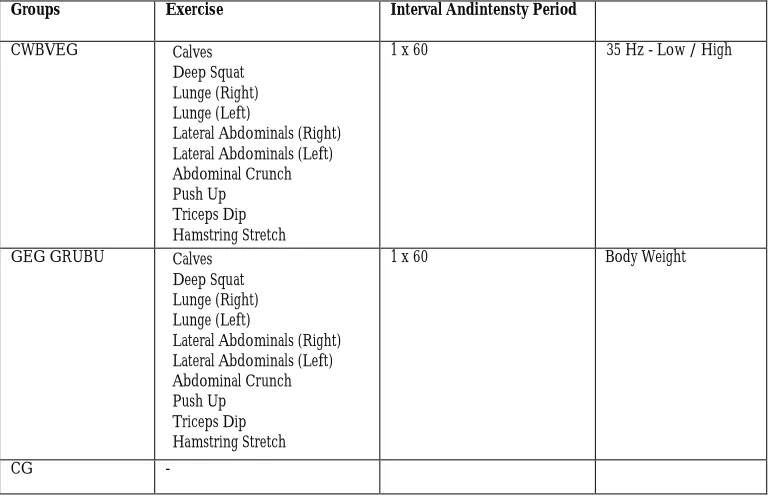
Study design: In this study, “pre-test, post-test controlled group ”model was used. After the pre-test, the subjects in the GWBVEG and GEG groups performed six-weeks of exercise training (Table 1), while the CG did not participate in any exercise training. During the training, all subjects were under direct supervision and were instructed on how to perform each exercise.A Power-Plate vibration platform (Pro 5, USA) was used to superimpose WBV on voluntary exercise.)
Table 1 : Exercise Protocol
Groups Exercise Interval Andintensty Period
CWBVEG Calves
Deep Squat Lunge (Right) Lunge (Left)
Lateral Abdominals (Right) Lateral Abdominals (Left) Abdominal Crunch Push Up Triceps Dip Hamstring Stretch
1 x 60 35 Hz - Low / High
GEG GRUBU Calves
Deep Squat Lunge (Right) Lunge (Left)
Lateral Abdominals (Right) Lateral Abdominals (Left) Abdominal Crunch Push Up Triceps Dip Hamstring Stretch
1 x 60 Body Weight
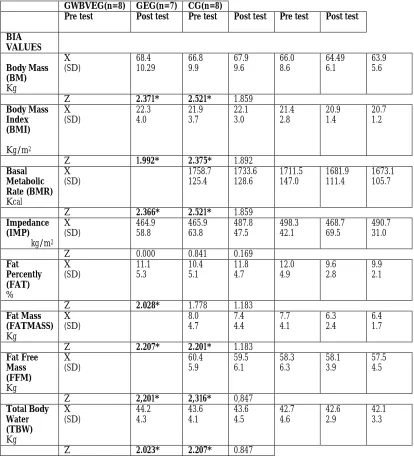
Table 2: Comparison of the pre and post tests for BIA values of the groups
GWBVEG(n=8) GEG(n=7) CG(n=8)
Pre test Post test Pre test Post test Pre test Post test
BIA VALUES Body Mass (BM) Kg X (SD) 68.4 10.29 66.8 9.9 67.9 9.6 66.0 8.6 64.49 6.1 63.9 5.6
Z 2.371* 2.521* 1.859
Body Mass Index (BMI) Kg/m2 X (SD) 22.3 4.0 21.9 3.7 22.1 3.0 21.4 2.8 20.9 1.4 20.7 1.2
Z 1.992* 2.375* 1.892
Basal Metabolic Rate (BMR) Kcal X (SD) 1758.7 125.4 1733.6 128.6 1711.5 147.0 1681.9 111.4 1673.1 105.7
Z 2.366* 2.521* 1.859
Impedance (IMP) kg/m2 X (SD) 464.9 58.8 465.9 63.8 487.8 47.5 498.3 42.1 468.7 69.5 490.7 31.0
Z 0.000 0.841 0.169
Fat Percently (FAT) % X (SD) 11.1 5.3 10.4 5.1 11.8 4.7 12.0 4.9 9.6 2.8 9.9 2.1
Z 2.028* 1.778 1.183
Fat Mass (FATMASS) Kg X (SD) 8.0 4.7 7.4 4.4 7.7 4.1 6.3 2.4 6.4 1.7
Z 2.207* 2.201* 1.183
Fat Free Mass (FFM) Kg X (SD) 60.4 5.9 59.5 6.1 58.3 6.3 58.1 3.9 57.5 4.5
Z 2,201* 2,316* 0,847
Total Body Water (TBW) Kg X (SD) 44.2 4.3 43.6 4.1 43.6 4.5 42.7 4.6 42.6 2.9 42.1 3.3
Body Composition Measurements
Measuraments of the participants' body composition evaluations were made between 08:00-10:00 in the morning, without any liquid and food intake during 12-hours prior to the measurements.
Measurements were taken while the participants had standard workout clothes (short and t-shirt) and no shoes on them.Leg-to-Leg Bio-Electric Impedence Analysis (BIA) method (Tanita Body Fat Analyser, Model TBF 300-Japan) was used to evaluate the participants' body weight and composition.
Analysis
Non-parametric tests were used to analyze the data, which does not indicate normal distribution and homogenity.Wilcoxon Signed Ranks Test was used to see the difference between the dependent groups and Mann Whitney U test was used to see the difference between the independant groups. Statistical analysis was carried out using SPSS version 18.0 (SPSS, Inc., Chicago, IL, USA).Data are presented as means ±SD and significance level was set at p<0.05.
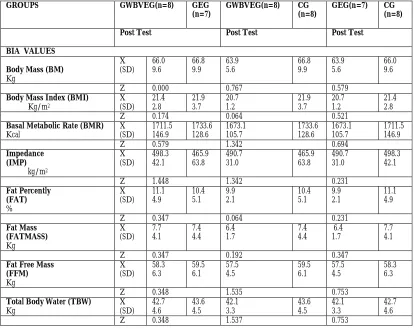
Table 3: Comparison of post tests for BIA values of the groups
When the GWBVEG group’s pre and post tests of BIA values were compared (Table 2); while there was no significant difference in Impedance (IMP) value, there was a significant difference in all other values (464.9±58.8 kg/m2, 465.9±63.8 kg/m2 ) (p<0.05).
When the pre and post tests for GEG Group’s BIA values were compared; while there was significant difference in Body Mass (BM) (67.9±9.6 kg, 66.0±8.6 kg), Body Mass Index (BMI) (22.1±3.0 kg/m2, 21.4±2.8 kg/m2),Basal Metabolic Rate (BMR) (1733.6±128.6 kcal, 1711.5±147.0 kcal),Fat Mass (FATMASS) (7.4±4.4 Kg, 7.7±4.1 kg),Fat Free Mass (FFM) (59.5±6.1 kg, 58.3±6.3 kg), Total Body Water (TBW) (43.6±4.5 kg, 42.7±4.6) values, no significant difference was observed in other values (p<0.05).
No significant difference was found for the control group (p<0.05).
GROUPS GWBVEG(n=8) GEG
(n=7)
GWBVEG(n=8) CG (n=8)
GEG(n=7) CG (n=8)
Post Test Post Test Post Test
BIA VALUES Body Mass (BM)
Kg X (SD) 66.0 9.6 66.8 9.9 63.9 5.6 66.8 9.9 63.9 5.6 66.0 9.6
Z 0.000 0.767 0.579
Body Mass Index (BMI)
Kg/m2 X (SD) 21.4 2.8 21.9 3.7 20.7 1.2 21.9 3.7 20.7 1.2 21.4 2.8
Z 0.174 0.064 0.521
Basal Metabolic Rate (BMR)
Kcal X (SD) 1711.5 146.9 1733.6 128.6 1673.1 105.7 1733.6 128.6 1673.1 105.7 1711.5 146.9
Z 0.579 1.342 0.694
Impedance (IMP) kg/m2 X (SD) 498.3 42.1 465.9 63.8 490.7 31.0 465.9 63.8 490.7 31.0 498.3 42.1
Z 1.448 1.342 0.231
Fat Percently (FAT) % X (SD) 11.1 4.9 10.4 5.1 9.9 2.1 10.4 5.1 9.9 2.1 11.1 4.9
Z 0.347 0.064 0.231
Fat Mass (FATMASS) Kg X (SD) 7.7 4.1 7.4 4.4 6.4 1.7 7.4 4.4 6.4 1.7 7.7 4.1
Z 0.347 0.192 0.347
Fat Free Mass (FFM) Kg X (SD) 58.3 6.3 59.5 6.1 57.5 4.5 59.5 6.1 57.5 4.5 58.3 6.3
Z 0.348 1.535 0.753
Total Body Water (TBW)
Kg X (SD) 42.7 4.6 43.6 4.5 42.1 3.3 43.6 4.5 42.1 3.3 42.7 4.6
Discussion
It can be stated that in the literature (Bosco, C. et al., 1999; Demirel, N. et al., 2009;Fjeldstad, C. et al. 2009; Kinser, A. M. et al. 2008; Verscheuren, S. et al. 2004), vibration workouts’ various durations and training protocols affected body compositions in general positively and therefore, demonstrated similarity with our study. In the study that we conducted, we can consider that the negative significant difference (p<0.05) that happened in the control group’s BIA values happened as a result of the loss of motivation due to weight gain.
In a metabolic study that investigated the effects on body composition, Bonner (1999) observed that 10-minutes vibration training performed during 6 months, 3 days per week can increase the resting metabolism by 18%, and that similar workouts without the use of vibration exercise would reduce the resting metabolism by 2% rate (Bosco, C. et al. 1999).
The purpose of Frank and Moss' (2003) research was to examine the effect of vibration training on cellulite.Participants were divided into three groups as Vibration (Power Plate), Traditional Endurance (Cardio) and Control.An average of 25.68% reduction occured in Power Plate group's total body weight and in most important parameters, including the cellulite, following the Power Plate workout of 10 minutes each session during a period of 6 months with a total of 11 hours.An avarage of 32.30% decrease occurred in the training group that participated in the Cardio exercise, following a total of 40 hours workout, 45 minutes each, 2 to 3 times a week during 6 months.In both groups (Vibration and Cardio), anthropometric measures slightly decreased and this reduction was not significant.As a result, it was concluded that vibration training is an effective method with no side effects on reducing the severity of cellulite (Frank, H., Moos, B. 2003).
Moody (2007) et al., in the research that they conducted on females in the years of 1969 and 1972, examined the effect of training on body composition. In their study, they found that training provides a significant reduction in body fat, a slight increase in lean body weight and a slight decrease in total body weight (Paradisis, G., Zacharogiannis, E., 2007).
BMI values of the first and last test, while a statistically significant difference of 0.01 was observed between these measured values. A decrease of 6.61 was achieved between the body fat rate values of the first and last test, while a statistically significant difference of 0.01 was observed between these values (Kolukisa, S., 2015). It can be deducted that the resulting changes signify that the gymnastics training performed with the selected protocol and for the selected period of time impacted body composition positively in general terms and that our research findings were similar to findings from the literature (Delecluse, C. et al., 2003; Yılmaz, C., 1997; Torvinen, S., 2003).
Acknowledgments
We are grateful to our study participants for their willing cooperation and the considerable time that they spent in participating in this study.
References
Bosco, C., Cardinale, M., Tsarpela, O., &Locatelli E. (1999). “New Trands in Training Science: The Use of Vibrations for Enhancing Performance. New Studies in Athletics, Vol.14, No.4, pg.55-62.
Delecluse, C., Roelants, A., &Erschueren, S. (2003). Strength Increase after Whole-Body Vibration Compared with Resistance Training. Medicine & Science in Sports & Exercise: June - Volume 35 - Issue 6 - pp 1033-1041.
Demirel, N., Kaya, F., Biçer, B., Erzeybek, M., Özen, Ş., &Pınar, S. (2009). The Effects of The Whole Body Vibration Exercises on Body Composition Markers in Female. 11th ICHPER●SD Europe Regional Congress & expositons., April 22-24, Lara, Antalya-Turkey.
Demirel, N. (2009). Menopoz Öncesi Bayanlarda Tüm Vücut Titreşim Antrenmanının Yaşlanmanın Geciktirilmesi Üzerine Etkisinin İncelenmesi., Marmara Üniversitesi Sağlık Bilimleri Enstitüsü-Beden Eğitimi ve Spor Anabilim Dalı, Yayınlanmamış Doktora Tezi. Danışman: Salih Pınar.
Fjeldstad, C., Palmer, I., Bemben, M., &Bemben D. (2009). Whole-Body Vibration Augments Resistance Training Effects on Body Composition in Postmenopausal Women, Maturitas.Volume 63, Issue 1, Pages 79-83.
Hannah, R., Minshull, C., &Folland J. P. (2013). Whole-Body Vibration Does Not İnfluence Knee Joint Neuromuscular Function or Proprioception., Scandinavian Journal of Medicine &Science in Sports., Volume 23, Issue 1, Pages 96-104.
Kin İşler, A. (2007). Titreşimin Performansa Etkisi. Spor Bilimleri Dergisi Hacettepe J. of Sport Sciences, 18 (1), 42-56.
Kinser, A. M., Ramsey, M. W., O'Bryant, H. S., Ayres, C. A., Sands, W. A., Stone, M. H. (2008). Vibration and Stretching Effects on Flexibility and Explosive Strength in Young Gymnasts. Medicine & Science in Sports & Exercise., Volume 40 - Issue 1 - pp 133-140.
Kolukisa, S. (2015). Examination of Changes Occurring in the Anatomic and Physiologic Structures of Women Participating in Power Plate Trainings. Anthropologist, 19(2): 525-531.
Paradisis, G., &Zacharogiannis, E. (2007).Journal of Sports Science and Medicine. 6, 44-49. Power Plate Next Generation (2016).User Manual.www.POWER-PLATE.COM
Roelants, M., Delecluse, C., &Whole-Body-Vibration Training Increases Knee-Extension Strength and Speed of Movement in Older Women.Verschueren S. (2004). M.Journal of The American Geriatrics Society; Jun, Vol. 52 Issue 6, p901-908, 8p.
Show, C.C. (2005). Biomechanical Study on A New Training Machine and Method for Power and Strength. Journal of Mechanics in Medicine and Biology, Vol. 5, No. 2., 243–25. Torvinen, S. (2003). Effect of Whole Body Vibration on Muscular Performance, Balance, and
Bone.Academic dissertation, University of Tampere, Finland.
Verscheuren, S., Roelants, M., Delecluse, C., Swinnen, S., Vanderscheuren, D., &Boonen S. (2004). Effect of 6-Month Whole Body Vibration Training on Hip Density, Muscle Strength and Postural Control in Postmenopausal Women: A Randomized Controlled Pilot Study.Journal of Bone and Mineral Research (Vol. 19 (3).