www.ijpar.com
IJPAR |Vol.8 | Issue 4 | Oct - Dec - 2019 Journal Home page: www.ijpar.com
Research article Open Access
Simultaneous method development and validation for estimation of
fosnetupitant and palonosetron using HPLC
G Karuna*, R.V. Valli Kumari, M. Sathish Kumar, S Markatham**
Depertment of pharmaceutical analysis Mallareddy Institute of pharmaceutical Sciences,
Maisammaguda Dhulapally, Secunderabad-500014 Telangana State
*Corresponding Author:G Karuna
E-mail: [email protected]
ABSTRACT
Akynzeo injection dosage form containing 0.25 mg and 235 mg of palonosetron and fosnetupitant, respectively is recently approved in US, used in adults for the avoidance of delayed and acute nausea and vomiting during chemotherapy in emetogenic cancer. In this investigation, a reverse phase high pressure liquid chromatography method for quantification of palonosetron and fosnetupitant simultaneously is developed and validated. The separation of palonosetron and fosnetupitant was accomplished using 0.1M NaH2PO4 - methanol (60:40, v/v) as mobile phase and Kromosil, C18 (25 cm × 4.6 mm, 5µm) as analytical column. Quantitation of palonosetron and fosnetupitant was by photodiode array detector at 225 nm in the amount range of 235-705 µg/ml (fosnetupitant) and 0.25-0.75 µg/ml (palonosetron). Using described conditions of chromatography, the method shown good resolution and separation of fosnetupitant and palonosetron with retention time of 3.034 min and 4.779 min, respectively. Detection & quantification limits for palonosetron and fosnetupitant were calculated as 0.0245 µg/ml & 0.0817 µg/ml and 1.219 µg/ml & 4.06 2 µg/ml, respectively. For accuracy and precision that are expressed as relative standard deviation and percent respectively, the found values are satisfactory and acceptable as given by ICH.Recovery assay carried out for samples gave recoveries of 99.65% and 99.29% 102.5% and 95.2% for fosnetupitant and palonosetron, respectively. In conclusion, a reliable and suitable and reliable procedure for simultaneous estimation of fosnetupitant and palonosetron using RP-HPLC technique was developed & validated successfully.
Keywords:
Fosnetupitant, Palonosetron, RP- HPLC.INTRODUCTION
HIGH PERFORMANCE LIQUID
CHROMATOGRAPHY
High performance liquid chromatography, alias high pressure liquid chromatography, a latest technique of analysis is used to separate, detect and estimate every ingredient from the mixture. The liquid solvent of sample mixture is pressurized and infiltrated and passed into a column of solid adsorbant using HPLC pumps. This technique enables the column to flow under high pressure by which the different constituents of the sample are isolated by the difference of their affinities.A mass exchange process incorporating adsorption is seen in chromatography technique. In HPLC, the partition of specimen segments is prompted by sending a pressurized fluid and an example that gets brewed in a section containing adsorbent with the help of a pump. As usual, the adsorbent comprises of a granular material made of solid particles (e.g. silica, polymers, etc.) 2 μm to 50 μm in size forms that is the dynamic segment [1-4].
As usual, the adsorbent comprises of solid particles of granular nature such as silica, polymers, etc 2 μm to 50 μm in size forms that is the dynamic segment. The connection with retentive particles having distinctive degrees forms the segments of example mixture/blend that has to be freed from each other. The pressurized fluid possessing a combination of solvents (e.g. acetonitrile, water and/or methanol) is ‘mobile phase’. A vital role is played by the organization and temperature affecting
connections among sample segments and adsorbent of the partition procedure plays a vital role.As basically pressure at which the method performed (50 to 350 bar) are more, the traditional ("low weight") liquid chromatography perceived is HPLC, where as orderly liquid chromatography confide in gravity potential to forward the portable stage through its segment. Only tiny sample amount has to be isolated in scientific HPLC, measurements of column section across are 2.1 mm to 4.6 mm distance and 30 mm to 250 mm along its length. Further, segments of HPLC posses much tinier adsorbent particles (2 to 50 μm in normal molecule size) which increase resolving power of HPLC (the capacity to identify and separatecomponents) through mixture’s isolation,to make it an outstanding chromatography method.The HPLC instrumentation has pump, injector, column, detector and display system. The parts are inclusive of the following [5-10].
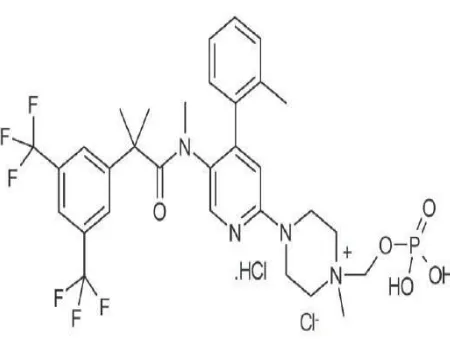
FOSNETUPITANT
2018 April by Food and Drug Administration. Fosnetupitant is a netupitant’s prodrug form. Substance P or neurokinin 1 receptor antagonist. Option for treating patients who have chemotherapy induced vomiting and nausea. 4-(5-{2-[3,5-
bis(trifluoromethyl)phenyl]-N,2-dimethylpropanamido}-4- (2- methylphenyl) pyridin- 2-yl)-1- [(hydrogenphosphonooxy) methyl]-1- methylpiperazin-1-iumC31H35F6N4O5P 688.608g/mol
www.ijpar.com
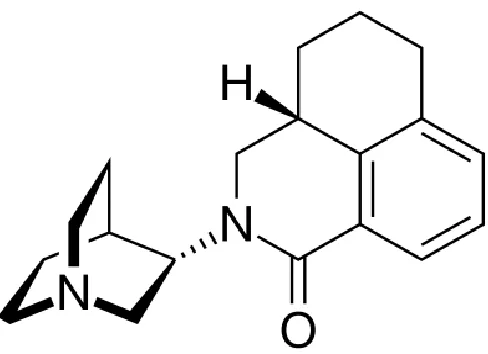
PALONOSETRON
2003 July by Food and Drug Administration. Antiemetic, serotonergic antagonist and 5
hydroxytryptamine Type 3 receptor
antagonist.Option for treating patients who have chemotherapy induced vomiting and nausea. (3aS)-2-[(3S)-1-Azabicyclo [2.2.2] oct-3-yl]-2,3,3a,4,5,6-hexahydro-1H-benz [de] isoquinolin-1- one. C19H24N2O. 332.87 g/mol
CHEMICAL STRUCTURE
Figure 2: Palonosetron structure
MATERIALS AND METHODS
Materials
Material Obtained from
Fosnetupitant reference drug Lara Drugs Private Limited, Telangana, India
Palonosetron reference drug -do-
Milli-Q water Milli-Q water system, USA
NaH2PO4 (AR) Sd. Fine Chemicals Ltd, Mumbai, India
Methanol (HPLC grade) Merck specialities Ltd, Hyderabad, India
Instrumentation
Name Specification
Chromatography system Waters Alliance system (2695 Module)
Detector Photodiode array detector (2998 Module)
Injector Rheodyne ten microliter
Data processorsoftware Empower 2 version
Column Kromosil, C18, 25 cm × 4.6 mm, 5 µm
pH meter Digisun pH meter 7007 model
PREPARATION OF MOBILE PHASE
M NaH2PO4 and methanol are mixed in ratio 60:40 volume/volume
Chromatography conditions
Parameter Optimized condition
Flow rate 1.0 ml/min
Injector volume 10 microlitres
Temperature 25˚C
Wavelength for detection 225 nm
Run time ofanalysis 7 min
PREPARATION OF STOCK
SOLUTION OF FOSNETUPITANT
AND PALONOSETRON
The mixed stock solution was prepared freshly by dissolving 235 mg of fosnetupitant and 0.25 mg of palonosetron in 100 ml of mobile phase. Concentration of stock solution is 235.0 µg/ml of fosnetupitant and 2.5 µg/ml of palonosetron.
RESULTS AND DISCUSSION
Method development
Optimization is initiated after a reasonable chromatogram is obtained. A reasonable chromatogram is one that has less or more symmetrical peaks of the selected drugs,
fosnetupitant and palonosetron, in the chromatogram. The detection of all selected compounds has to be achieved. The mobile phase components, analytical column, detection wavelength, flow rate were chosen on the basis of better separation, peak symmetry, peak area, theoretical plates and retention time. To optimize the conditions in the current investigation, the following trails were done.
Mobile Phase :0.1% orthophosphoric acid and methanol (60:40, vol/vol) Analytical column: Lichrocart, C18, 25 cm × 4.6 mm, 5 µm
Flow Rate : 1ml/min
Temperature of column : 25˚C Volume of sample : 10 µl Run
Time for analysis :10min Wavelength for
detection : 225 nm
Figure 3: Chromatogram obtained in trail one
Data obtained for trail 1
Name Retention Time Area Resolution Tailing Plate Count
Fosnetupita nt 3.189 4963541 - 0.71 1166
www.ijpar.com
METHOD VALIDATION
The developed method for fosnetupitant and palonosetron simultaneous quantification by RP-HPLC technique with photodiode array detector was validated for system suitability, linearity, selectivity, precision, accuracy, limit of detection and limit of quantification and robustness.
SYSTEM SUITABILITY
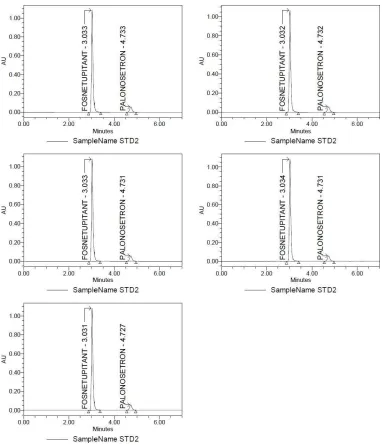
Working solution with concentration 470 µg/ml fosnetupitant and 0.50µg/ml palonosetron is prepared and assayed by applying the proposed method five times. Relative standard deviation of
peak area response and retention time of fosnetupitant and palonosetron were determined. Also the values of theoretical plates, tailing factor and resolution are determined. Recommended limits are given below:
%RSD of peak area - ≤ 2% % RSD of retention time - ≤ 2%; Tailing factor - ≤2
Plate count - >2000 Resolution - > 1.5.
As values are inside the acceptance limits (Table 1 and 2), the method passes the system suitability test.
LINEARITY
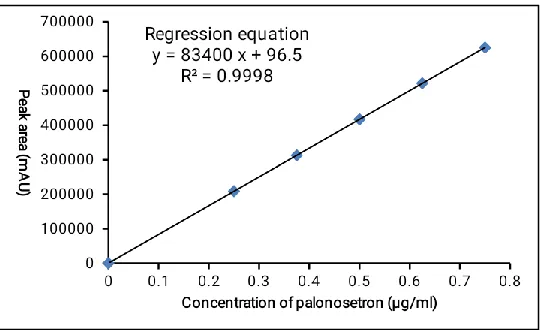
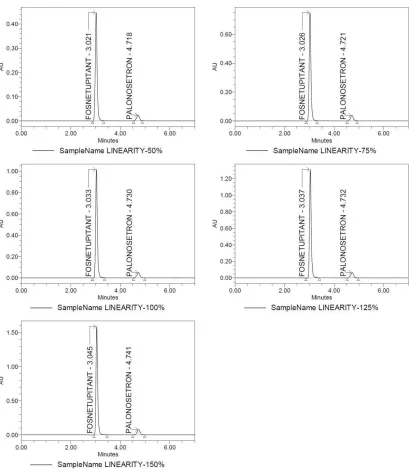
Linearity study was performed with five calibration solutions (fosnetupitant from 235 µg/ml to 705 µg/ml and palonosetron from 0.25 µg/ml to 0.75 µg/ml). The peak area of fosnetupitant and palonosetron in all calibration solutions were determined using proposed method. The study
showed linear relationship with concentration range of 235 µg/ml – 705 µg/ml for fosnetupitant and 0.25 µg/ml - 0.75 µg/ml for palonosetron. The linearity of a fosnetupitant and palonosetron calibration curves are confirmed by good regression coefficient
(R2 is ˃ 0.999) and small y-intercept value in the regression equation.
Table 3: Fosnetupitant and palonosetron linearity results Fosnetupitant
concentration (µg/ml)
Fosnetupitant peak area (mAU)
Palonosetron concentration (µg/ml)
Palonosetron peak area (mAU)
235 2521917 0.25 208806
352 3787886 0.375 312577
470 5045499 0.5 417202
587 6309105 0.625 521712
705 7568990 0.75 625300
Figure 9: Fosnetupitant linearity graph
www.ijpar.com
Figure 11: Chromatograms obtained in linearity test
SELECTIVITY
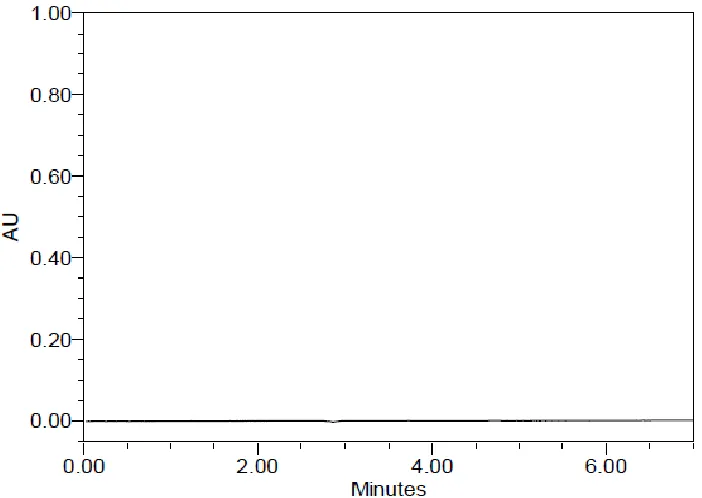
Selectivity was weighed up through comparison of standard solution (470 µg/ml fosnetupitant and 0.50 µg/ml palonosetron), mobile phase, placebo blank and spiked placebo (470 µg/ml
Figure 12: Chromatogram obtained in selectivity test (mobile phase)
www.ijpar.com
Figure 14: Chromatogram obtained in selectivity test (placebo spiked with drugs)
Figure 15: Chromatogram obtained in selectivity test (standard solution)
SENSITIVITY
Limit of detection (LOD) and Limit of quantification (LOQ) are used to represent the method sensitivity. Signal to noise ratio of 3.1 and 10.1 is determined to calculate the values of LOD and LOQ. For this, low concentration solutions of fosnetupitant and palonosetron were
Figure 16: Chromatogram obtained in sensitivity test
PRECISION
Precision was examined through analyzing 6 replicates of working standard sample (470 µg/ml fosnetupitant and 0.50 µg/ml palonosetron) on the
similar day. The peak areas and relative standard deviation of fosnetupitant and palonosetron are determined. The relative standard deviation less than 2%, showed method preciseness.
Table 4: Fosnetupitant and palonosetron precision results
S.No
Fosnetupitant peak area (mAU)
Statistical values for fosnetupitant
Palonosetron peak area (mAU)
Statistical values for palonosetron
A 5044401 Average: 417184 Average:
B 5044099 5044990 417520 417578
C 5042900 SD: 417692 SD:
D 5042095 2999.167 417742 125.225
E 5049118 RSD: 417532 RSD:
F 5047328 0.059 417798 0.030
www.ijpar.com
Figure 17: Chromatograms obtained in precision test
RECOVERY TEST
Three replicates of three samples (50%, 100% and 150%) were prepared by spiking pure fosnetupitant palonosetron in placebo for determination of accuracy by recovery experiment. The recovery percent of fosnetupitant
and palonosetron was determined using the proposed method. The recovery achieved for fosnetupitant and palonosetron was inside the range 80% to 120 as recommended by ICH. There is no hindrance from the excipients used in the placebo. Hence the accuracy of method is proved.
Table 5: Fosnetupitant accuracy and recovery results Percentage
spiked (%)
Peak area (mAU)
Amount added (µg/ml)
Amount found (µg/ml)
Recovery (%)
Statistical values
50% 2524312 235 234.34 99.72 Mean: 99.79%
SD: 0.0808% RSD: 0.0810%
2528442 235 234.72 99.88
100% 5042907 470 468.15 99.61 Mean: 99.61% SD: 0.0451% RSD: 0.0453%
5045615 470 468.40 99.66
5041045 470 467.98 99.57
150% 7568672 705 702.62 99.66 Mean: 99.60%
7563011 705 702.10 99.59 SD: 0.0513%
RSD: 0.0515%
Table 6: Palonosetron accuracy and recovery results Percentage spiked (%)
Peak area (mA U)
Amount added (µg/ml)
Amount found (µg/ml)
Recovery (%)
Statistical values
50%
208560 0.248 0.248 100.19 Mean: 100.29%
SD: 0.0889% RSD: 0.0886%
208841 0.248 0.248 100.32
208932 0.248 0.248 100.36
100%
417444 0.495 0.496 100.26
Mean: 100.26% SD: 0.0900% RSD: 0.0898%
417036 0.495 0.496 100.17
417795 0.495 0.497 100.35
150% 625066 0.743 0.743 100.09 Mean: 100.14%
SD: 0.0757%
625230 0.743 0.743 100.11
625927 0.743 0.744 100.23 RSD: 0.0756%
www.ijpar.com
Figure19: Chromatogram obtained in accuracy and recovery testat100% level
Figure20: Chromatogram obtained in accuracy and recovery testat150% level
ROBUSTNESS
Robustness is done with working standard sample (470 µg/ml fosnetupitant and 0.50 µg/ml palonosetron). Influence of slight or small modifications in HPLC conditions on system suitability parameters in the proposed method is evaluated to assess method robustness. The robustness results tested showed a slight or small
change in method conditions, such as ratio of components in mobile phase (± 5%), temperature
Table 7: Fosnetupitant Robustness Data
Condition tested Tested value Theoretica l
plate Peak tailing Resolution Temperature in column (oC)
23 9050 1.17 -
27 11071 1.23 -
Flow rate (ml/min) 0.9 6227 1.13 -
1.1 6726 1.12 -
Mobile phase pH (units)
10581 1.29 -
10423 1.27 -
Ratio of methanol in mobile phase (%) 35 6227 1.13 -
45 9050 1.17 -
Analytical wavelength (nm)
223 10481 1.30 -
227 10588 1.29 -
Table 8: Palonosetron robustness data
Condition tested Tested
value Theoretical plate Peak tailing Resolution
Temperature in column (oC) 23 7554 0.94 9.02
27 9839 0.98 10.50
Flow rate (ml/min) 0.9 4884 0.92 7.38
1.1 4893 0.92 7.60
Mobile phase pH 10070 1.03 10.65
(units) 10019 1.05 10.57
Ratio of methanol in mobile phase (%)
35 4884 0.92 7.38
45 7554 0.94 9.02
Analytical wavelength (nm)
223 10275 1.06 10.63
227 10375 1.05 10.73
CONCLUSION
A novel robust and simple reverse phase high performance liquid chromatography method was developed for assay of fosnetupitant and palonosetron, simultaneously. Proposed method shown good resolution and separation of fosnetupitant and palonosetron with retention
time of 3.034 min and 4.779 min, respectively. The method proposed was validated for selectivity, system suitability, accuracy, robustness and precision. The developed & validated method provides reward of being economic, simple andconsumes less time for more number of analyzing samples.
REFERENCE
[1]. Drug Combinations to Overcome Treatment Resistance. National Cancer Institute. Retrieved 2017, 10-03.
[2]. Goodwin G, Fleischhacker W, Arango C, Baumann P, Davidson M, de Hert M, Falkai P, Kapur S, Leucht S, Licht R, Naber D, O'Keane V, Papakostas G, Vieta E, Zohar J. Advantages and disadvantages of combination treatment with antipsychotics ECNP Consensus Meeting, March 2008, Nice. European Neuropsychopharmacology, 19(7), 2009, 520-532.
[3]. Rogatsky E. Modern high performance liquid chromatography and HPLC 2016 International Symposium. Journal of Chromatography and Separation Techniques, 7(2), 2016, 135.
www.ijpar.com
performance liquid chromatography and its application to pharmacokinetics studies. Pharmaceutica Analytica Acta, 6(6), 2015, 383.
[6]. AL-Jammal MKH, Al Ayoub Y, Assi KH. Development and validation of micro emulsion high performance liquid chromatography (MELC) method for the determination of nifedipine in pharmaceutical preparation. Pharmaceutica Analytica Acta, 6(3), 2015, 347.
[7]. Myron P, Siddiquee S, Azad SA, Yong YS. Tributylamine facilitated separations of fucosylated chondroitin sulfate (fucs) by high performance liquid chromatography (HPLC) into its component using 1-phenyl- 3-methyl-5-pyrazolone (pmp) derivatization. Journal of Chromatography and Separation Techniques, 6 (3), 2015, 256.
[8]. Caglar S, Alp AR. A validated high performance liquid chromatography method for the determination of saxagliptin and metformin in bulk, a stability indicating study. Journal of Analytical and Bioanalytical Techniques, S12, 2014, 010
[9]. deFigueiredo NB, Érica NO, Matheus MTM, José FA, Maria CBS, Marcelo FO. Determination of 3,4 -methylenedioxymethamphetamine (mdma) in confiscated tablets by high -performance liquid chromatography (HPLC) with diode array detector. J Forensic Res. 1(2), 2010, 106.