Vol. 7, No. 2, 2015, 177-184
ISSN: 2320 –3242 (P), 2320 –3250 (online) Published on 22 January 2015
www.researchmathsci.org
177
International Journal of
Ordering Policy for Deteriorating Items with Time
Dependent Demand
M. Maragatham1 and G. Gnanavel2 1
Department of mathematics, Periyar E.V.R. College, Trichy-23, India E-mail: [email protected]
Corresponding Author
2
Department of mathematics, SRG Engineering College, Namakkal-17, India E-mail: [email protected]
Received 30 October 2014; accepted 15 December 2014
Abstract. This paper deals with an inventory model to determine the optimal ordering quantity and optimal cycle time. It is assumed that the annual demand is a decreasing function of time and deteriorating units are replaced during the cycle time. Numerical examples are given to illustrate our results.
Keywords: Inventory model, deteriorating units, demand AMS Mathematics Subject Classification (2010): 90B05
1. Introduction
178
partial Backlogging. In this proposed study, an inventory model has been developed for deteriorating items. In this model deteriorating items are replaced under some conditions. The deteriorating items are constant and shortages are allowed in this model.
2. Notations and assumptions Notations
D(t) - The demand rate per unit time. θ - The deteriorating items per unit time. H - The holding cost per unit.
C - The purchasing cost per unit time. Q - The ordering quantity.
A - The ordering cost per unit. T - The length of the cycle time.
C1 - The inventory shortage cost per unit time.
Tr - The replacement time for deteriorating items.
TC - The total present value of the cost over the cycle time.
Assumptions
1. The replenishment is uniform.
2. The shortage cost is a linear function of time D(t)=a(1-bt) If a>0 and 0<b>1.. 3. The holding cost is constant.
4. Shortages are allowed.
5.The deteriorating items are replaced when an inventory level reaches Q/2. 6. The purchasing cost of items used for replacement is C/2.
3. Mathematical formulation
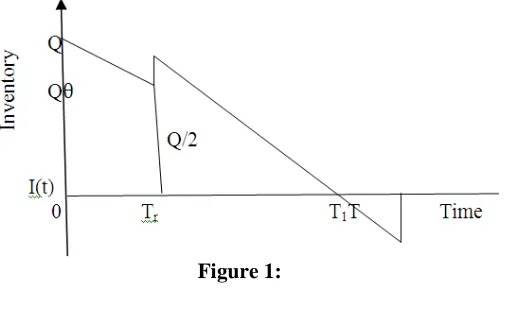
If the inventory model with above described assumption and notation is depicted in fig 1, we consider I(t) as total amount of inventory at the beginning of the each period. The variation of inventory level I(t) with respect to time t due to combined effect of demand and deterioration. But we have to replace the deteriorating items at Tr. Then inventory
level goes to zero at T1and shortages occur during time period(T1, T).The differential
equation in which on hand inventory I(t) satisfying in three different part of cycle time T are given by
179 ୢ୍ሺ୲ሻ
ୢ୲ + θIሺtሻ = −aሺ1 − btሻ 0 ≤ t ≤ T୰ (1) ୢ୍ሺ୲ሻ
ୢ୲ + θIሺtሻ = −aሺ1 − btሻT୰≤ t ≤ Tଵ (2) ୢ୍ሺ୲ሻ
ୢ୲ = −aሺ1 − btሻTଵ≤ t ≤ T (3)
dIሺtሻ
dt + θIሺtሻ = −aሺ1 − btሻ 0 ≤ t ≤ T୰ Iሺtሻe୲= −a නሺ1 − btሻe୲dt
Iሺtሻe୲= −a ቈሺ1 − btሻe୲
θ +be
୲
θଶ + c
Iሺtሻe୲=ିୟ
మሾθሺ1 − btሻ + bሿe୲+ c, where c is the constant of integration. The solution of equation (1), with boundary condition I(0)=Q, t=0
Q =−aθଶሾθ + bሿ + c Q +θaଶሾθ + bሿ = c Iሺtሻe୲=−a
θଶሾθሺ1 − btሻ + bሿe୲+ Q +θaଶሾθ + bሿ
Iሺtሻ =−aθଶሾθሺ1 − btሻ + bሿ + Q + ቂθaଶሺθ + bሻቃ eି୲
Iሺtሻ = Q − θQt − at. (4) Thus the replacement time is obtained by putting the boundary condition t=Tr , I(Tr)=୕ଶin
equation (1),
Q
2 = Q − θQT୰− aT୰ −Q2 = −θQT୰− aT୰
ଶሺθ୕ାୟሻ୕ = T୰ (5)
During the period (Tr,T1) the inventory depletes due to the detoured or demand. Hence
the inventory level at any time during (Tr,T1) is described by differential equation. dIሺtሻ
dt + θIሺtሻ = −aሺ1 − btሻT୰≤ t ≤ Tଵ
Iሺtሻe୲= −a ቈሺ1 − btሻe୲
θ +be
୲
θଶ + c
Iሺtሻ = −a ቈሺ1 − btሻθ +θbଶ + ceି୲
With the boundary condition when t=Tr , I(Tr)=୕ଶ+ θQ, we have Qሺ1 + 2θሻ
2 = −a ቈሺ1 − bT୰
ሻ
θ +θbଶ + ceି౨
ceି౨= a ቈሺ1 − bT୰ሻ
θ +θbଶ +Qሺ1 + 2θሻ2
c = e౨ቈa ቆሺ1 − bT୰ሻ
180
Iሺtሻ = −a ቈሺ1 − btሻθ +θbଶ + ቈa ቆሺ1 − bTθ ୰ሻ+θbଶቇ +Qሺ1 + 2θሻ2 eሺ౨ି୲ሻ
Iሺtሻ =୕ሺଵାଶሻଶ + ቂa − abT୰+୕ሺଵାଶሻଶ ቃ ሺT୰− tሻ (6) With the boundary condition t=T1 ,I(T1)=0
ܶଵ=
ொሺଵାଶఏሻ ଶ
ቂܽ − ܾܽܶ+ఏொሺଵାଶఏሻଶ ቃ+ ܶ
ܶଵ=ሾଶሺଵି்ொሺଵାଶఏሻೝሻାఏொሺଵାଶఏሻሿ+ ܶ (7) Thus the initial order quantity is obtained using the boundary conditions t=0 I(t)=Q
ܳ = −ܽߠ −ܾܽߠଶ+ܳሺ1 + 2ߠሻ2 +ܽߠ −ܾܽߠ ܶ+ܾܽߠଶ+ܳሺ1 + 2ߠሻߠܶ2 + ܽܶ− ܾܽܶଶ+ܾܽߠ ܶ
ܳ −ܳሺ1 + 2ߠሻ2 −ܳሺ1 + 2ߠሻߠܶ2 = ܽܶ− ܾܽܶଶ
ܳ 1 −ሺ1 + 2ߠሻ2 −ሺ1 + 2ߠሻߠܶ2 ൨ = ܽܶሺ1 − ܾܶሻ
ܳ = ்ೝሺଵି்ೝሻ
ቂଵିሺభశమഇሻమ ିሺభశమഇሻഇೝమ ቃ (8) The state of inventory during (T1,T) can be represented by the differential equation.
݀ܫሺݐሻ
݀ݐ = −ܽሺ1 − ܾݐሻܶଵ≤ ݐ ≤ ܶ
ܫሺݐሻ = −ܽ නሺ1 − ܾݐሻ݀ݐ
ܫሺݐሻ = −ܽ ቆݐ −ܾݐ2 ቇ + ܿଶ
With the boundary condition t=T1I(T1)=0
0 = −ܽ ቆܶଵ−ܾܶଵ ଶ
2 ቇ + ܿ ܿ = ܽ ቆܶଵ−ܾܶଵ
ଶ
2 ቇ
The solution of the equation is
ܫሺݐሻ = −ܽ ቆݐ −ܾݐ2 ቇ + ܽ ቆܶଶ ଵ−ܾܶଵ ଶ
2 ቇ ܫሺݐሻ = ܽ ቈቆܶଵ−ܾܶଵ
ଶ
2 ቇ − ቆݐ −ܾݐ
ଶ
2 ቇ
ܫሺݐሻ = ܽ ቂሺܶଵ− ݐሻ −ଶ൫ܶଵଶ− ݐଶ൯ቃ (9) The ordering cost is A. The total inventory holding cost during [0,T] is
ܪܥ = ℎ ቈන ܫሺݐሻ݀ݐ +்ೝ
න ܫሺݐሻ݀ݐ
்భ
்ೝ
181
ܪܥ = ℎ ቈන ሺܳ − ߠܳݐ − ܽݐሻ݀ݐ்ೝ
+ න ܳሺ1 + 2ߠሻ2 + ܽ − ܾܽܶ+ߠܳሺ1 + 2ߠሻ2 ൨ ሺܶ− ݐሻ൨ ݀ݐ ்భ
்ೝ
ܪܥ = ℎ ቐቈܳܶ− ሺߠܳ − ܽሻܶ
ଶ
2 +ܳሺ1 + 2ߠሻ2 ሺܶଵ− ܶሻ
+ ൬ܽ − ܾܽܶ+ߠܳሺ1 + 2ߠሻ2 ൰ ቌܶሺܶଵ− ܶሻ − ቆܶଵ ଶ
2 −ܶ
ଶ
2 ቇቍቑ ܪܥ = ℎ ቄቂܳܶ− ሺߠܳ − ܽሻ்ೝ
మ
ଶ ቃ +ொሺଵାଶఏሻଶ ሺܶଵ− ܶሻ + ቀܽ − ܾܽܶ+ఏொሺଵାଶఏሻଶ ቁ ቀܶଵܶ− ்భమ
ଶ −்ೝ మ
ଶቁቅ (10) The shortage cost during [ T1,T]
ܵܥ = ܥଵቈන ܫሺݐሻ݀ݐ
்
்భ
ܵܥ = ܥଵܽ ቈන ሺܶଵ− ݐሻ −ܾ2 ൫ܶଵଶ− ݐଶ൯൨ ݀ݐ ்
்భ
ܵܥ = ܥଵܽ ቌܶଵሺܶ − ܶଵሻ − ቆܶ ଶ− ܶ
ଵଶ
2 ቇቍ −ܾ2 ቌܶଵଶሺܶ − ܶଵሻ − ቆܶ
ଷ− ܶ ଵଷ
3 ቇቍ
ܵܥ = ܥଵܽ ቈܶଵܶ −ܶଵ ଶ
2 −ܶ
ଶ
2 −ܾ2 ቆܶଵଶܶ −2ܶ
ଷ
3 −ܶଵ
ଷ
3 ቇ ܵܥ = ܥଵܽ ܶଵܶ −ሺ்భ
మା்మሻ
ଶ −
ଶቀܶଵଶܶ −
ሺଶ்యି்భయሻ
ଷ ቁ൨ (11) The purchasing cost during [0, T1]
ܲܥ = ܥܳ + ߠܳܥ2
ܲܥ =ொଶ ሺ2 + ߠሻ (12) The total cost per unit time TC (T) is
ܶܥሺܶሻ =ܶ ሾܱܥ + ܵܥ + ܲܥ + ܪܥሿ1
Now TC (T) will be minimum whenడ்ሺ்ሻడ் = 0 andడమడ்்ሺ்ሻమ > 0 , ܶhe optimum values of T for the minimum average total cost TC(T) is the solution of equation
182
߲ܶܥሺܶሻ
߲ܶ = −ܶܣଶ
−ܶℎଶቊቈܳܶ− ሺߠܳ − ܽሻܶ ଶ
2 +ܳሺ1 + 2ߠሻ2 ሺܶଵ− ܶሻ + ൬ܽ − ܾܽܶ+ߠܳሺ1 + 2ߠሻ2 ൰ ቆܶଵܶ−ܶଵ
ଶ
2 −ܶ
ଶ
2 ቇቋ −ܳܥܶଶሺ2 + ߠሻ2
+ ܥଵܽ ቌܶଵ ଶ
2ܶଶ−12 −ܾ2 ቆ2ܶଵ ଷ
3 −2ܶ3 ቇቍ = 0
−ܶܣଶ−ܶℎଶቊቈܳܶ− ሺߠܳ − ܽሻܶ ଶ
2 +ܳሺ1 + 2ߠሻ2 ሺܶଵ− ܶሻ + ൬ܽ − ܾܽܶ+ߠܳሺ1 + 2ߠሻ2 ൰ ቆܶଵܶ−ܶଵ
ଶ
2 −ܶ
ଶ
2 ቇቋ −ܳܥܶଶሺ2 + ߠሻ2
+ܥܶଵଶܽቆܶ2 −ଵଶ 2ܶ3 ቇ + ܥଵଷ ଵܽ ൬ܾܶ3 −12൰ = 0
ܶଶܥ
ଵܽ ൬ܾܶ3 −12൰
= ܣ
+ ℎ ቊቈܳܶ− ሺߠܳ − ܽሻܶ ଶ
2 +ܳሺ1 + 2ߠሻ2 ሺܶଵ− ܶሻ + ൬ܽ − ܾܽܶ+ߠܳሺ1 + 2ߠሻ2 ൰ ቆܶଵܶ−ܶଵ
ଶ
2 −ܶ
ଶ
2 ቇቋ + ܳܥሺ2 + ߠሻ2 − ܥଵܽ ቆܶଵ
ଶ
2 −2ܶଵ
ଷ
3 ቇ
ሺ2ܾܶଷ− 3ܶଶሻ = 6
ܥଵܽ ቊܣ
+ ℎ ቊቈܳܶ− ሺߠܳ − ܽሻܶ ଶ
2 +ܳሺ1 + 2θሻ2 ሺTଵ− T୰ሻ + ቆa − abT୰+θQሺ1 + 2θሻ2 ቇ ቆTଵT୰−Tଵ
ଶ
2 −T୰
ଶ
2 ቇቋ + QCሺ2 +
θሻ
2 − Cଵa ቆTଵ
ଶ
2 −2Tଵ
ଷ
3 ቇቋ
Provided that it satisfies the following conditions
∂ଶTCሺTሻ
∂Tଶ =2ATଷ+2hTଷቊቈQT୰+ θQሺa − 1ሻT୰ ଶ
2 +Qሺ1 + 2θሻ2 ሺTଵ− T୰ሻ + ቆaሺ1 − bT୰ሻ +θQሺ1 + 2θሻ2 ቇ ቆሺTଵ−T୰ሻ
ଶ
2 ቇቋ +2QCTଷ ሺ2 + θሻ2
183 பమେሺሻ
பమ > 0, [Tଵ> T୰, 3 > 2ܾTଵ, a > 1,(Therefore its terms are positive)]
3.1. Numerical examples
Example 3.1.1. Let a=100 units/year b=0.2, A=100 per order, C=8 per unit, C1=100 per
unit, h=60 unit/annum, θ=0.2 by the help of mathematical calculations, we obtain the optimum solutions are Q*= 150 and T*= 1.5 putting Q* and T* we get the optimum average cost TC (T)*=3297.
Example 3.1.2. Let a=400 units/year=0.2, A=100 per order, C=8 per unit, C1=100 per
unit, h=60 unit/annum, θ=0.2 by the help of mathematical calculations, we obtain the optimum solutions are Q*=603 and T*=1.9 putting Q* and T* we get the optimum average cost TC (T)*=10226.
5. Conclusion
In this paper, an inventory model is developed in which annual demand is decreasing function of time and deteriorating items are replaced during the cycle time. This model is solved analytically by minimizing the total cost finally; the proposed model is verified by the numerical example.
REFERENCES
1. H.Bahari Kashani, Replenishment schedule for deteriorating items with time proportional demand, Journal of Operation Research Society, 40 (1989) 95-81. 2. H.J.Chang and C.Y.Dye, An Inventory model for deteriorating items with linear
demand under condition of permissible delay in payments, Production Planning and Control, 12 (2001) 274-282.
3. K.J.Chung and Y.F.Hway, The optimal cycle time for EOQ inventory model under permissible delay in payments, International Journal of Production Economics, 84 (2003) 307-318.
4. U.Deva and L.K.Patel, (T, Si) Policy inventory model for deteriorating item with time proportional demand, J. Opl. Res. Soc., 32 (1981) 137-142.
5. P.M.Ghare and G.F.Schrader, A model for an exponentially decaying inventory, Journal of Industrial Engineering, 14 (1963) 238-243.
6. S.K.Goyal and B.C.Giri, Recent trends in modeling of deteriorating inventory, Euoropean J. Operational Research, 134 (2001) 1-16.
7. F.W.Harish, Operations and cost, A.W.Company, Chicago,1951.
8. M.Maragatham and P.K.Lakshmidevi, An inventory model for non-instantaneous deterioratingitems under conditions of permissible delay in paymentsfor n-cycles, Intern. J. Fuzzy Mathematical Archive, 2(2013) 49-57. 9. M.Kumar, A.Chauhan and R.Kumar, A deterministic inventory model for
deteriorating items with price dependent demand and time varying holding cost under trade credit, International Journals of Soft Computing and Engineering, 2 (2012).
184
11. S.Singh, An Economic order quantity model for item having linear demand under inflation and permissible delay, International Journals of Computer Applications, 33 (9) (2011) 520-527.
12. Y.K.Shah and M.C.Jaiswal, A lot size model for exponentially deteriorating inventory with finite production rate, European J. Operational Research, 29 (1976) 70-72.
13. T.Singh and H.Pattnayk, An EOQ model for deteriorating items with linear demand, variable deterioration and partial backlogging, Journals of Service Science and Management, 6 (2) (2013) 186-190.
14. R.P.Tripathy and A.K.Uniyal., A quantiy dependent EOQ model with cash flow under permissible delay in payments, IJSTM, 2 (2011) 20-26.