Factors Affecting the Business Performance of Small Businesses in Sekhukhune Ajay K Garg1, Phillip NT, Phaahla2
1Nana Sita Street, TUT Business School Pretoria, South Africa 2Amur Falcon Street, Elandspoort, Pretoria, South Africa
[email protected], [email protected]
Abstract: This study identifies the factors that affect the business performance of Small, Micro and Medium Enterprises (SMMEs) in the Sekhukhune District of the Limpopo Province in South Africa. The study collected data from a randomly selected sample of 200 SMMEs and used WARP PLS software to analyse data. The results indicated that five factors, namely “finance”, “characteristics of entrepreneurs”, “location of business”, “government support”, as well as “products and services” were positively related to business performance. In contrast to other studies, this study found that owners’ personal funds and their proper management played a key role in the performance of businesses. This has a major implication for government support agencies that provide funding opportunities.
Keywords: SMMEs, Owner’s Funds, Location of Business, Finance, Business Performance 1. Introduction
Small and Medium Enterprise (SME) employment is attributable to about 35% of the total employment generated by SMEs globally, while this number is 52% for developing economies compared to 34% for emerging and 41% in developed economies. However, in recent years (2015-2016), this contribution remained stagnant with a marginal increase of 34.6 % to 34.8%, (International Labour Organisation News, 2017). In China, SMEs contribute60% to the country’s Gross Domestic Product (GDP) 50% to tax revenue; 70% to import and export trade; and 80% of employment in urban areas (Zhu, Wittman and Peng, 2012). In the United States (US), SMEs represent 99.7% of firms and contribute more than 50% to the non-farm GDP and are responsible for 60% to 80% of new jobs in the economy (Longley, 2006). In Pakistan, SMEs represent about 90% of all enterprises; 80% of the non-agricultural labour force; and 40% to its GDP (Harvie and Lee, 2002; Neumark, Wall and Zhang, 2008). In South Africa, SMEs account for around 40% of the GDP and SMEs are expected to provide 90% of the new jobs created by 2030 (Jones, 2016). Notably, it is important to implement the right policies to create a conducive environment for SMEs in South Africa. It is therefore imperative to study the current challenges that these SMEs face. Although several studies have touched on the topic, this study attempts to explore these factors in the Sekhukhune District of the Limpopo Province, which is not as developed as the Gauteng or North West Provinces of South Africa. The study identifies factors that affect the success of small businesses and to assess the relationship between these factors and business performance.
2. Literature Review
SMEs and SMMEs are used interchangeably worldwide due to the absence of a universally accepted definition. The geographic location and legislation influence the various definitions of these types of enterprises. As such, definitions differ across countries and industries (Orobia and Byabashaija, 2013; Islam, Keawchana and Yusuf, 2011; Leopoulos, Kirytopoulos, and Malandrakis, 2006). The European, Indian and US definitions of SME includes both qualitative and quantitative characteristics as criteria for defining small businesses. However, the most common measures used to define small businesses include the number of employees, annual turnover, ownership, value of fixed assets, production methods and legal status (Agyei-Mensah, 2011; Abor and Quartey, 2006). The South African definition, as per the National Small Businesses Act, 1996(Act No 102 of 1996), considers the number of employees plus the annual turnover. With the above definitions as a reference point, the next section details the factors that affect the success of small businesses.
1Corresponding author
Factors Affecting the Success of Small Businesses: Numerous studies have identified the factors that affect business success, such as finance; characteristics of an entrepreneur; location of business; government support; and product and services (Daskalakis, Jarvis and Schizas, 2013; Fatoki and Asah, 2011; Fatoki and Garwe, 2010; Chittithaworn, Islam, Keawchana & Yususf, 2011; Garg and Makukule, 2015). Each factor will be discussed in detail in the following section.
Financial Resources: Access to finance plays an essential role in the success of small businesses. Without sufficient capital, small businesses are unable to grow and introduce new products and services. Numerous studies have highlighted finance as the major reason why small businesses fail, especially during the start-up phase (Coleman, 2000; Islam, Khan, Obaidullah and Alam, 2011; Rogerson, 2008; Okpara and Wynn, 2007). Furthermore, research has revealed that small businesses rely heavily on their own funds and prefer not to raise capital from sources outside the family. Simultaneously, many small business owners are unaware of existing funding agencies, while others consider applying for grants to be a waste of time. It was found that small businesses who obtain outside financial assistance experience a smooth transition from a start-up to a well-established business (Daskalakis, Jarvis and Schisas, 2013; Yusuf, 2014). Researchers have highlighted that external credit is not readily available to small businesses. This is attributed to the fact that commercial banks are reluctant to provide credit facilities to small businesses. One of the reasons for this is that commercial banks believe that lending to SMEs is less profitable than lending to large businesses. Notably, lending to small businesses involves high credit administration costs and high risks (Okpara and Wynn, 2007; Van Scheers, 2010; Abor and Biekpe, 2006; Pansiri and Temtime, 2010; Ladzani 2010; Mambula, 2002; Gill and Biger, 2012). Collateral was found to be an essential determinant for accessing finance.
Small business owners struggle to obtain loans; as financial institutions do not deem them trustworthy. In addition, small business owners do not have a reliable track record and often fail to understand the importance of proper budgeting (Mbonyane and Ladzani, 2011; Bosma and Levie, 2009; Ahmad and Seet, 2009). Numerous studies have found that small businesses should prioritise financial management training to overcome growth barriers. Furthermore, research has revealed that small business owners spend their capital on items that are unrelated to the business, as they are unable to distinguish between capital and profit. This has resulted in cash-flow problems, as too much of the business’ cash is used for personal expenses (Neneh and Van Zyl, 2012; Bezuidenhout and Nenugwi, 2012; Rogerson, 2000; Acts, Arendius, Hay and Minniti, 2004; Okpara and Wynn, 2007). The above literature suggests that financial resources like owners’ funds and borrowing from external sources play a key role in business success. External credit is not readily available to small businesses due to their inability to provide collateral. Furthermore, financial institutions do not find small businesses trustworthy and prefer to lend money to large businesses with higher profitability.
Characteristics of an Entrepreneur: Entrepreneurship involves a special type of decision-making process. Therefore, an entrepreneur’s characteristics are the key determinants of business success. Research has proven that the success of a business depends on the entrepreneur’s personality structure, which includes experience and expertise. A business owner’s entrepreneurial spirit and motivation largely determine the growth and survival potential of his/her business (Islam et al., 2011; Ligthelm, 2010; Kritikos, 2007). Numerous studies have highlighted a positive relationship between business management, entrepreneurial conduct and business success. Therefore, an entrepreneur’s competence, characteristics, attitudes, motives and risk-taking capabilities have a significant impact on the success of the business. Entrepreneurs with human, social and financial knowledge were found to be in a better position to identify potential opportunities accurately (Hill, 2001; McCartan-Quinn and Carson, 2003; Dockel and Ligthelm, 2005; Omri, Frikha and Bouraoui, 2015).
Therefore, it is essential that entrepreneurs acquire basic business managerial skills to manage their business ventures successfully (Baughnand Neupert, 2003; Sriramand Mersha, 2010). Research has highlighted a lack of both technical and managerial skills as constraints to business development. Furthermore, 90% of entrepreneurs believe that one of the reasons for high business failure is inadequate managerial skills in the business sector (Perks and Austin, 2013; Brink, Cant and Ligthelm, 2003; Rogerson, 2008; Young, Schaffers and Bruwer, 2012). The above literature concludes that entrepreneurial, technical and managerial skills and the ability to conduct thorough market research are essential skills for small businesses to succeed and grow.
Location of Business: Studies by Eckert and West (2008), Fatoki and Garwe (2010), Fatima and Muneer (2016) and Rantso, (2016) established that the survival and growth of a firm are associated with the geographic location. Notably, location was found to influence the performance of rural businesses, as it is related to the availability of markets and access to infrastructure. As a result, the choice of a business location should be considered carefully to minimise distribution costs, meet demand and beat competition. Therefore, potential business owners should check the suitability of their target location prior to making any decision pertaining to where to embark on their business.
Government Support: Lack of government support is cited as a major barrier to the growth of small businesses. This is associated with inadequate, inefficient support systems regarding the availability of public services. Furthermore, it can be attributed to the fact that institutions and associations that provide business support to SMEs are fragmented and uncoordinated. This is partly due to a lack of clear guidance and policy pertaining to the sector’s development (Bilal and Mqbali, 2015; Peng and Luo, 2000; Ladzani and Netswera, 2009). Literature also reveals that most SMEs believe that they do not receive adequate support from the government. This is despite government initiatives that are in place. Furthermore, business owners found it challenging and discouraging to obtain government support, as it is perceived to be based on bribery and business connections. To this end, a study conducted in China indicated that the country’s government has rolled out several business support systems for SMEs based on research and development (R&D). However, most small business owners in the country admitted that they find it difficult to access and benefit from these support services (Okpara, 2011; Zhu, Wittman and Peng, 2012; Fatoki and Garwe, 2010).
Products and Services: Innovative products, as well as quality, affordability and reliability of services are key strategic determinants of business success (Chittithaworn et al., 2011). SMEs that focus on introducing new products have a higher growth rate than SMEs that fail to introduce new products. To achieve growth, small business owners should find new products, markets and exploit new business opportunities (Tuan and Yoshi, 2009; Unger, Keith, Hilling, Geilnik and Frese, 2009; Coyne and Leeyson, 2004). Access to markets was revealed as one of the barriers to small business growth. This challenge is brought about by the fact that established firms are associated with advanced production processes, know trade secrets and have superior technology. Other advantages of large businesses include customer loyalty, extensive product advertising and marketing, as well as access to distribution channels (Moy and Luk, 2003; Briggs, 2009; Karakaya, 2002; Krasniqi, 2007; Ladzani and Van Vuuren, 2002). It was revealed that small businesses’ outdated technology is a hindrance to SME-based development. Subsequently, SMEs require assistance with capacity building and access to technology.
3. Objectives of the Study and Research Methodology
Limpopo Province is the most rural province in South Africa. Sekhukhune is one of five districts in Limpopo Province. Unlike other district municipalities in Limpopo, it is situated some distance from major towns. The level of skills in Sekhukhune is the lowest of any district in Limpopo. This severely hampers the district’s ability to be innovative in implementing economically productive ventures. Consequently, there is an increased reliance on Government for trade purposes. Furthermore, this district is classified as the poorest of the poor districts in the country. Currently, 35% of the economically active population is employed within the district. On the other hand, 60% of workers are employed outside the district. This is attributable to the low level of job opportunities. For this reason, Sekhukhune in Limpopo Province was selected for this study. While other factors like the location of business and Government support plays a critical role in SMEs success. Lastly product and services, technology, efficiency etc. can be supportive to the success of small businesses.
Studies conducted by various researchers (Fatoki and Garwe, 2010; Van Scheers, 2010; Thornhill and Amit, 2003) confirm that 75% of the small businesses in South Africa remain unsustainable until they graduate into established firms. The estimated failure rate of SMMEs in South Africa is between 70% and 80%, while less than half of newly established businesses survive beyond five years, resulting in millions of rand being lost on business ventures. This is a common phenomenon throughout the world. To reduce the risk of failure and increase the chances of success, it is essential to understand the factors that affect business performance. As such, this study addresses the question: What are the factors that contribute to the business performance in SMEs operating in Sekhukhune? Accordingly, the two objectives are: to identify factors that affect the success of small businesses in Sekhukhune; and to assess the relationship between these success factors and business performance.
Population and Sample Size: The population consisted of small businesses in Sekhukhune that have been operating for more than three years. The size of the small businesses, number of years in business and the number of employees were used to identify businesses that fall within the parameters of the definition of a “small business”. Included were retail shops, general dealers, building material hardware shops, restaurants, greengrocers, brick makers, public phone operators, welders, motor mechanics, car washes, as well as panel beaters and spray painters. Liquor shops and restaurants were excluded from the study. Out of the population of 549 registered small businesses in Sekhukhune (Limpopo Business Support Agency, 2011), a structured questionnaire was distributed to a randomly selected sample of 200 businesses. The sample calculator formula for a population of 549, with a 95% confidence level and a 5% margin, yields a sample size of 220. A sample size of 200 (37% of the population) was found suitable to obtain a final response of at least 100, which provides stable statistical results.
The respondents included small business owners or managers operating in the said district municipality. The data collection process took approximately three weeks. To obtain a high response rate, the respondents were requested to complete the questionnaires on the spot. The returned questionnaires were checked for completeness. Questionnaires with more than two missing responses were rejected. A total of 160 responses were returned of which 124 were fully completed. Some of the reasons for non-response included the fact that there was no financial benefit or respondents did not have time. The participants were fully informed of the purpose and objectives of the study before they participated in the study. Furthermore, participants were guaranteed privacy, confidentiality and anonymity with regard to the information provided. In cases where both the owner and the manager were actively involved in the day-to-day running of the business, the person who oversaw the overall management was requested to complete the questionnaire.
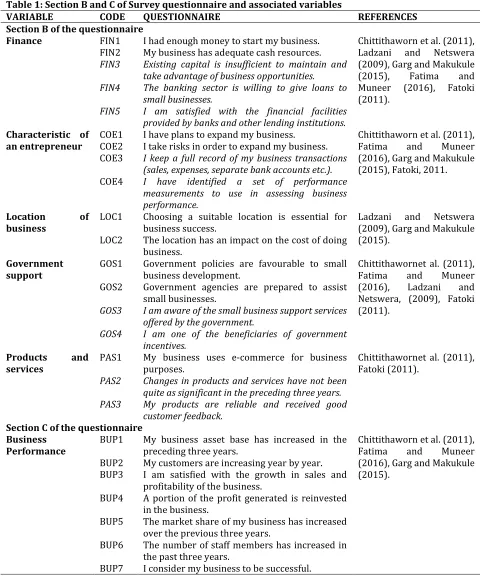
affect business success. It comprised of 25 questions. The variables (dependant)included “finance”, “characteristics of an entrepreneur”, “location of business”, “government support”, as well as product and services”. Section C was used to measure the perceived business performance (dependent variable). Table 1 below shows the development of sections B and C of the questionnaire. The questions shown in italics (FIN3, FIN 4, etc.) could not be validated for this study.
Table 1: Section B and C of Survey questionnaire and associated variables
VARIABLE CODE QUESTIONNAIRE REFERENCES
Section B of the questionnaire
Finance FIN1 I had enough money to start my business. Chittithaworn et al. (2011), Ladzani and Netswera (2009), Garg and Makukule (2015), Fatima and Muneer (2016), Fatoki (2011).
FIN2 My business has adequate cash resources.
FIN3 Existing capital is insufficient to maintain and take advantage of business opportunities. FIN4 The banking sector is willing to give loans to
small businesses.
FIN5 I am satisfied with the financial facilities provided by banks and other lending institutions.
Characteristic of
an entrepreneur COE1 I have plans to expand my business. Chittithaworn et al. (2011), Fatima and Muneer (2016), Garg and Makukule (2015), Fatoki, 2011. COE2 I take risks in order to expand my business.
COE3 I keep a full record of my business transactions (sales, expenses, separate bank accounts etc.).
COE4 I have identified a set of performance measurements to use in assessing business performance.
Location of
business LOC1 Choosing a suitable location is essential for business success. Ladzani and Netswera (2009), Garg and Makukule (2015).
LOC2 The location has an impact on the cost of doing business.
Government
support GOS1 Government policies are favourable to small business development. Chittithawornet al. (2011), Fatima and Muneer (2016), Ladzani and Netswera, (2009), Fatoki (2011).
GOS2 Government agencies are prepared to assist small businesses.
GOS3 I am aware of the small business support services offered by the government.
GOS4 I am one of the beneficiaries of government incentives.
Products and
services PAS1 My business uses e-commerce for business purposes. Chittithawornet al. (2011), Fatoki (2011).
PAS2 Changes in products and services have not been quite as significant in the preceding three years. PAS3 My products are reliable and received good
customer feedback.
Section C of the questionnaire Business
Performance BUP1 My business asset base has increased in the preceding three years. Chittithaworn et al. (2011), Fatima and Muneer (2016), Garg and Makukule (2015).
BUP2 My customers are increasing year by year. BUP3 I am satisfied with the growth in sales and
profitability of the business.
BUP4 A portion of the profit generated is reinvested in the business.
BUP5 The market share of my business has increased over the previous three years.
BUP6 The number of staff members has increased in the past three years.
The questionnaire was pre-tested before starting the data collection process. The purpose of pre-testing was to assess whether the questions were clear and whether respondents were given enough time to complete the questionnaire. Furthermore, the pre-testing phase helped refine the questionnaire, so that respondents could answer the questions easily and eliminate problems relating to data recording. The pre-test took place through prearranged sessions with 10 business owners and managers residing in the survey area that have the knowledge and experience of running a small business. Subsequently, minor adjustments were made to the questionnaire, which related to sentence construction or phrasing and language used. Three types of analysis were conducted. Descriptive statistics were applied to the demographic profile. A chi-square test was applied to find the relationship between the demographic profile and the study’s variables.
4. Data Analysis
The demographic results reflected that small businesses that were operating in Sekhukhune, Limpopo, were sole traders that were owned or run by males (71%). Small business owners with more than 20 years’ business experience represented 43% of the respondents. A total of 62% of respondent had a high school qualification. The majority (57%) of the respondents were married. A total of 43% of respondents were over 50 years of age. Most small business owners who participated in this study indicated that their business establishments (72%) employed between one and five people. Table 2 below shows the average, standard deviation, Skegness and kurtosis scores, as well as Cronbach’s alpha for all the variables used in this study. The Cronbach’s alpha scores for all variables were in the range of 0.7 or above, while other parameters were in the expected limits. The average values above 2 on a scale of 4 suggest that all the factors had a positive correlation.
Table 2: Average Values, Standard Deviation, Cronbach’s Alpha, Skewness and Kurtosis of the Final Distribution of the Indicators (N=124)
Construct Mean Std.
Dev Kurtosis Skewness Cronbach’s alpha Composite reliability coefficient
Finance 2.03 0.71 -0.33 0.42 0.696 0.866
Characteristics of the enterprise 3.12 0.51 1.48 -0.69 0.759 0.891
Location of business 3.32 0.43 -1.15 0.59 0.696 0.866
Government support 2.34 0.64 -0.08 0.33 0.782 0.901
Products and services 3.21 0.67 1.93 -0.92 1.00 1.00
Business performance 2.89 0.45 0.85 -0.40 0.739 0.819
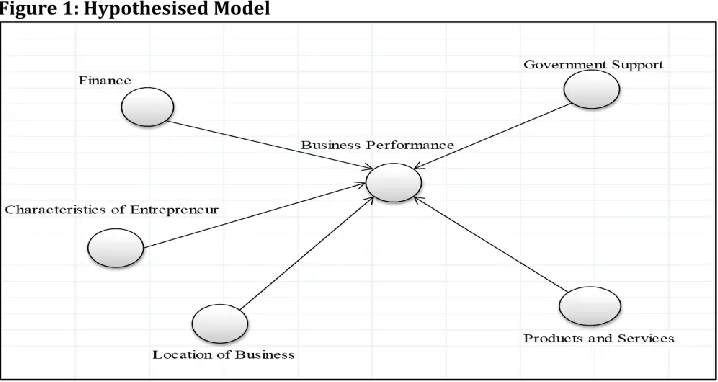
Figure 1 below depicts the model that was hypothesised to test the relationship between dependent and independent variables. “Business performance” was the dependent variable, while “finance”, “characteristics of an entrepreneur”, “location of business” and “government support” were the independent variables. It was hypothesised that all independent variables had a positive relationship with dependent variables.
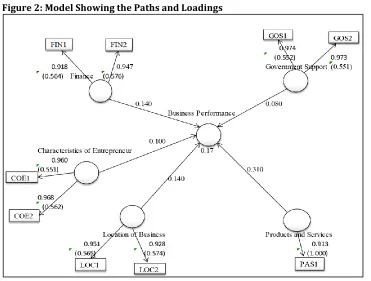
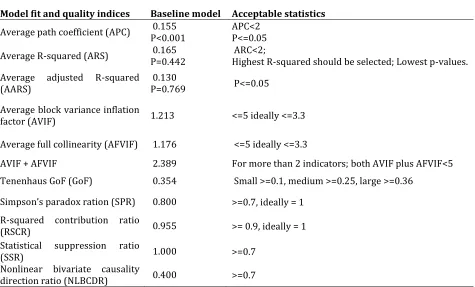
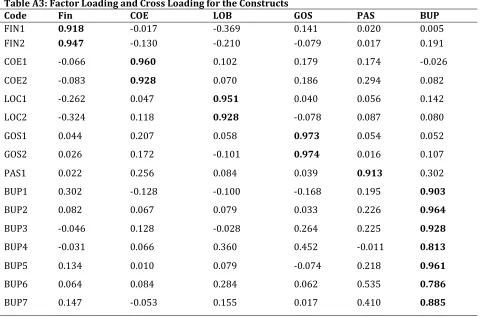
A three months’ trial version of Warp Partial Least Square (5.0) statistical software was utilised for data analysis. The elements of the model, decision criteria, factor-loading, cross-loading, internal consistency and construct validity are depicted in Annexure 1. All model characteristics were within decision criteria (seeTablesA1 and A2 in Annexure 1). The factor loadings suggest that there was no major multicollinearity between the indicators, given the fact that the indicator loadings in relation to its constructs are greater than the other constructs (see Table A3 in Annexure). To determine internal consistency and discriminates validity, the constructs were merged in the form of a model. The results suggest good internal consistency, as well as convergent and discriminates validity for all constructs. Furthermore, all constructs had an AVE greater than 0.5, or 50%. The decision rule is that AVE should be greater than 0.5. This implies that at least 50% or more of the variance of indicators should be accounted for (see Table A4 in Annexure 1). Bootstrap re-sampling was performed to examine the statistical significance of path loading, weights and T-values. Table 3 below shows the results of the analysis.
Table 3: The Path Loading and T-Values
Path Loading T-Values
Finance business performance 0.140 1.397*
Characteristics of an entrepreneur business performance 0.100 1.598*
Location of business business performance 0.140 1.398*
Government support business performance 0.080 1.172*
Products and services business performance 0.310 1.978*
*statistically significant at 95% confidence level
Table 4: Chi-Square and Crosstabs between Demographic Data and Variables
Variable Age Gender Marital
status Educational qualifications Business type Number staff of members
Years in business
Finance 0.524 0.069 0.001* 0.008* 0.013* 0.000* 0.076
Characteristics of
an entrepreneur 0.010* 0.027* 0.699 0.016* 0.347 0.001* 0.000*
Location of
business 0.550 0.291 0.069 0.004* 0.000* 0.961 0.032*
Government
support 0.494 0.565 0.000* 0.005* 0.001* 0.015* 0.000*
Product and
services 0.601 0.227 0.040* 0.381 0.354 0.181 0.002*
Business
performance 0.352 0.007 0.004* 0.003* 0.014* 0.002* 0.053
*p-value of less than 0.05 shows the association between the demographic information and the variables.
Table 4 shows various statistically valid relationships between variables. However, there was no specific trend or specific conclusions that could be drawn. In general, it can be said that that there was an association between “business performance” and the demographic variables, marital status, business type and educational qualifications, number of staff members or staff complement.
Analysis of the Model Path Coefficients Per Factor: The path coefficient values suggest that all factors, namely “finance”, “characteristics of an entrepreneur”, “business location”, “government support”, as well as “products and services” had a weak positive relationship with” business performance”. The chi-square test was performed to determine whether there was an association between the variables and the demographic data (age, gender, marital status, educational qualifications, business type and years in business). The decision rule is that the p-value must be less than 5% or 0.05 for an association to exist between demographic information and variables.
Discussion: The objective of this study was to identify factors that affect the success of small businesses and to assess the relationship between these factors and business performance. This section discusses the factors that were validated in this study.
Finance: Literature suggests that finance plays a significant role in the success of SMMEs. Accordingly, this study considered five indicators under the variable “finance”. These factors are indicated in Table 1 as FIN 1 to FIN 5. The factor analysis showed that the indicators FIN3, 4 and 5 were not valid indicators while, FIN 1 and 2 were validated. These validated factors indicate that business owners had enough money to start businesses and adequate cash resources to perform business. There was a weak but positive relationship between the indicators representing “finance” and “business performance. This finding suggests that “finance” is a factor that impacts “business performance”. However, the key factors in finance are the owners’ financial resources and the adequacy of SMME operations. The factors did not validate indicate that external finance is not a key factor in business performance. This explains the fact that small businesses fail despite external finance. Owner’s financial resources and the proper management thereof plays a key role in the performance of small businesses. These findings are contrary to previous research findings on external financial support for SMMEs, which argued that external finance was the key to business success (Okpara and Wynn, 2007; Gill and Biger, 2012; Fatoki and Garwe, 2010). Rather, the current research findings are in line with that of Daskalakis et al. (2013) and Yusuf (2014). Notably, these authors found that small business owners rely heavily on their own funds, were unaware of existing funding agencies and some considered applying for grants as a waste of time.
risk-taking to expand business showed a positive but weak relationship with “business performance”. These findings suggest that small businesses did not practice record keeping and did not have any performance measures. However, it was revealed that risk-taking and plans to expand business enterprises were inherent characteristics of SMMEs studied. This is in line with the findings of authors like Hill (2001), McCartan-Quinn (2003), Dockel and Lighthelm (2005), Omri et al. (2015), Garg and Makukule, (2015) and Garg and Letsolo, (2016).
Location of Business: Choosing a suitable location and impact of location on cost were the two indicators that were tested and validated in this study. It was established that “location of business” had a positive but weak positive relationship with “business performance”. These findings are consistent with the studies conducted by Eckert and West (2008), Fatoki and Garwe (2010), Fatima and Muneer (2016) and Rantso (2016).
Government Support: Government policies and other types of support are considered a key aspect in the success of SMMEs and were positively related to “business performance”. The factor analysis showed that government policies were favourable, and agencies were prepared to assist small businesses. However, other factors such as awareness of government support to SMMEs and beneficiary of government support were not validated in this study. These findings suggest that government agencies should do more to render support to SMMEs. Notably, the aforementioned findings are in line with that of Okpara (2011), Zhu et al. (2012), Fatoki and Garwe (2010), Bongomin, Munene, Ntayi and Malinga (2018) and Gupta and Mirchandani (2018).
Products and Services: The right product mix and knowledge of customers are necessary for businesses to succeed. The study found a positive relationship between “products and services” and “business performance”. Factor analysis results found that changes in SMMEs’ products and services and customer feedback on their products were not valid indicators, suggesting that SMMEs did not focus on product and service mix. However, they were using e-commerce for business purposes. Researchers such as Garg and Choeu (2015) and Chittitwhaworn, et al. (2011) support this finding.
5. Conclusion and Recommendations
This study confirms that finance, characteristics of entrepreneurs, the location of the business, government support etc. played a role in the business performance of SMMEs in the selected sample. The study concluded that small businesses rely heavily on their own funds. Furthermore, results revealed that some businesses were unaware of funding opportunities and considered applying for government funding a waste of time. As such, it is recommended that government funding should be marketed more broadly to reach target markets. They should also make funding procedures hassle free. Risk-taking remains one of the key determining factors in small businesses. To this end, training programmes to identify and quantify risks can help small businesses safeguarding against business risks. Training in record keeping is also recommended. The study also found that the location of a business, as well as products and services were important determinants of business success. Hence, local agencies should provide advisory services to help small businesses succeed. The authors propose to revert these recommendations to the Sekhukhune Local Municipality for implementation. However, the findings in the study cannot be generalised, especially the findings on financial aspects which are contrary to other studies. Furthermore, findings from this study can provide feedback to Government with regard to various schemes they have launched to support SMMEs in South Africa.
References
Abor, J. & Biekpe, N. (2006). Small business financing initiatives in Ghana. Problems and Perspectives in
Management, 4(3), 69-77.
Acts, Z. J., Arenius, P., Hay, M. & Minniti. (2004). Global Entrepreneurship Monitor. Babson College and London.
Ageyei-Mensah, B. K. (2011). Financial management practices of small firms in Ghana: An empirical study.
African Journal of Business Management, 5(10), 3781-3793.
Ahmad, N. H. & Seet, P. (2009). Dissecting behaviours associated with business failure: A qualitative study of SME owners in Malaysia and Australia. Asian Social Science, 5(9), 98-104.
Baughn, C. C. & Neupert, K. E. (2003). Culture and national conditions facilitating entrepreneurial start-ups.
Journal of International Entrepreneurship, 1(3), 313-324.
Bezuidenhout, A. & Nenugwi, A. L. (2012). A competency framework for the small business sector in Johannes burg South Africa. African Journal of Business Management, 6(47), 11658-11669.
Beaver, G. & Jennings, P. (2005). Competitive advantage and entrepreneurial power: The dark side of entrepreneurship. Journal of Small Business and Enterprise Development, 12(1), 9-23.
Bilal, Z. O. & Mqbali, N. S. (2015). Challenges and constraints faced by small and medium enterprises (SMEs) in Al Batinah governorate of Oman. World Journal of Entrepreneurship, Management and Sustainable
Development, 11(2), 120-130.
Bongomin, G., Munene, J. C., Ntayi, J. M. & Malinga, C. A. (2018). Determinants of SMMEs’ growth in post-war communities in developing countries: Testing the interaction effect of government support. World
Journal of Entrepreneurship, Management and Sustainable Development, 14(1), 50-73.
Bosma, N. & Levie, J. (2009). Global Entrepreneurship Monitor. Babson College, Universidad del Desarrollo and Reykjavik University; available from http://www.gemconsortium.org/.
Brink, A., Cant, M. & Ligthelm, A. (2003). Problems experienced by Small Businesses in South Africa: 16th Annual Conference of Small Enterprise Association of Australia and New Zealand, held in Australia on 28 September-1 October, 2003. Ballarat.
Briggs, B. R. (2009). Issues affecting Ugandan indigenous entrepreneurship in trade. African Journal of
Business Management, 12(3), 786-797.
Chittithaworn, C., Islam, M. D. A., Keawchana, T. & Yusuf, H. M. (2011). Factors affecting the business success of small and medium enterprises in Thailand. Asian Social Science, 7(5), 180-190.
Coleman, S. (2000). Access to capital and terms of credit: A comparison of men-and women-owned small businesses. Journal of Small Business Management, 38(3), 25-37.
Coyne, C. J. & Leeyson, P. T. (2004). The Plight of underdeveloped countries. Cato Journal, 24(3), 235-249. Daskalakis, N., Jarvis, R. & Schizas, E. (2013). Financing practices and preferences for micro and small firms.
Journal of Small Business and Enterprise Development, 20(1), 80-101.
Dockel, J. A. & Lighthelm, A. A. (2005). Factors responsible for the growth of small business. Bureau of Market
Research, University of South Africa, 8(1), 54-62.
Eckert, A. & West, D. S. (2008). Firm survival and chain growth in a privatised retail liquor store industry.
Review of Industrial Organisation, 32(1), 1-18.
Fatima, S. M. A. & Muneer, M. S. A. (2016). Factors influencing women entrepreneur’s performance in SMEs.
World Journal of Entrepreneurship, Management and Sustainable Development, 12(2), 82-101.
Fatoki, O. & Asah, F. (2011). The impact of firm and entrepreneurial characteristics on access to debt finance by SMEs in King Williams Town, South Africa. International Journal of Business Management, 6(8), 170-179.
Fatoki, O. & Garwe, D. (2010). Obstacles to the growth of new SMEs in South Africa: A principal component analysis approach. African Journal of Business Management, 4(5), 729-738.
Fatoki, O. O. 2011. The impact of human, social and financial capital on the performance of small and medium-sized enterprises (SMEs) in South Africa. Journal of Business Management, 29(3), 193-204. Fielden, S. L., Davidson, M. J. & Makin, P. J. (2000). Barriers encountered during micro and small business
start-up in North-West England. Journal of Small Business and Enterprise Development, 7(4), 295-304. Garg, A. K. & Makakule, P. (2015). Business risk management–the key success factor: evidence from shebeens
and taverns in Soshanguve Township. Problems and Perspectives in Management, 13(2), 71-81. Garg, A. K. & Letsolo, P. (2016). Gender, Risk-Taking Propensity and Culture of Entrepreneurs at Small and
Garg, A. K. & Thobeng, C. (2015). The Adoption of Electronic Commerce by Small and Medium Enterprises in Pretoria East. The Electronic Journal of Information Systems in Developing Countries, 68(7), 1-23. Ghouri, A. M., Khan, N. V. R., Malik, M. A. & Razza, Q. A. (2011). Marketing practices and their effects on a firm’s
performance: Findings from small and medium-sized catering and restaurants in Karachi.
International Journal of Business and Management, 6(5), 251-259.
Gupta, N. & Mirchandani, A. (2018). Investigating entrepreneurial success factors of women-owned SMEs in UAE. Management Decision, 56(1), 219-232.
Gill, A. & Biger, N. (2012). Barriers to small business growth in Canada. Journal of Small Business and
Enterprise Development, 19(4), 656-668.
Harvie, C. & Lee, B. (2002). The Role of SMEs in National Economies in East Asia. Edward Elgar Publishing. USA.
Hill, J. (2001). A multidimensional study of the key determinants of effective SME marketing activity.
International Journal of Entrepreneurial Behaviour and Research, 7(5), 171-204.
Islam, M. A., Keawchana, T. & Yusuf, D. H. M. (2011). Factors affecting business success of Small & Medium Enterprises (SMEs) in Thailand. Asian Social Science, 7(5), 180-190.
Islam, M. D. A, Khan, M. A, Obaidullah, A. B. Z. & Alam, M. S. (2011). Effects of entrepreneur and firm characteristics on the business success of Small and Medium Enterprises (SMEs) in Bangladesh.
International Journal of Business and Management, 6(3), 289-299.
Jones, E. (2016). SMEs struggle for survival in South Africa CNBS AFRICA (ONLINE). Jones, N., Borgman, R. & Ulusoy, E. (2015). Impact of social media on small businesses. Journal of Small Businesses and
Enterprise Development, 22(4), 611-622.
Kadam, A. & Ayarekar, S. (2014). Impact of social media on entrepreneurship and entrepreneurial performance: Special reference to Small and Medium-scale enterprises. Journal of Management, 10(1), 1-11.
Karakaya, F. (2002). Barriers to entry in industrial markets. Journal of Business and Marketing, 17(5), 379-388.
Kritikos, A. S. (2007). Is Entrepreneurship Success Predictable? An Ex-Ante Analysis of the Character-Based Approach. [Discussion Paper: 2687]; available from [email protected].
Kiggundu, M. N. (2002). Entrepreneurs and entrepreneurship in Africa: what is known and what needs to be done. Journal of Development Entrepreneurship, 7(3), 239-258.
International Labour Organisation (ILO) News. (2017). Sluggish SME development hurts jobs and the economy; available from http://www.ilo.org/global/about-the-ilo/newsroom/ news/WCMS_579872/lang--en/index.htm.
Ladzani, L. & Netswera, G. (2009). Support for rural small businesses in Limpopo Province, South Africa.
Development Southern Africa, 26(2), 225-239.
Ladzani, W. (2010). Historical perspective of small business development initiatives in South Africa with special reference to Limpopo Province. Problems and Perspective in Management, 8(3), 68-79.
Ladzani, M. W. & Van Vuuren, J. J. (2002). Entrepreneurship training for emerging SMEs in South Africa.
Journal of Small Business Management, 40(2), 153-160.
Leopoulos, V. N., Kirytopoulos, K. A. & Malandrakis, C. (2006). Risk Management for SMEs: Tools to use and how. Journal of Production Planning and Control, 17(3), 322-332.
Ligthelm, A. A. (2010). Entrepreneurship and Small Business Sustainability. Southern African Business Review, 14(3), 131-153.
Limpopo Business Support Agency (LIBSA). (2011). Annual Report. Polokwane: LIBSA.
Longley, R. (2006). Small business drives US economy, provide jobs for over half of nation’s private workforce; available fromhttp://usgovinfo.about.com/od/smallbusiness/a/ sbadrives.htm. [Accessed on 25th April 2018].
Mambula, C. (2002). Perceptions of SMEs growth constraints in Nigeria. Journal of Small Business
Management, 40(1), 58-65.
Mbonyane, B. & Ladzani, W. (2011). Factors that hinder the growth of small businesses in South African townships. European Business Review, 23(6), 550-560.
McCartan-Quinn, D. & Carson, D. (2003). Issues which impact upon marketing in the small firm. Small Business
Economics, 21(2), 201-213.
Neneh, N. B. & Van Zyl, J. (2012). Towards establishing long-term surviving Small and Medium Enterprises (SMEs) in South Africa: An Entrepreneurial Approach. African Journal of Business Management, 6(28), 8327-8343.
Neumark, D. Wall, B. & Zhang, J. (2008). Just the fact. Small business and job creation: Do Small businesses create jobs? Public Policy Institute of California; available fromhttp://www.ppic.org.
Omri, A., Frikha, M. A. & Bouraoui, M. A. (2015). An empirical investigation of factors affecting small business success. Journal of Management Development, 34(9), 1073-1093.
Okpara, J. O. (2011). Factors constraining the growth and survival of SMEs in Nigeria. Management Research
Review, 34(2), 156-171.
Okpara, J. O. & Wynn, P. (2007). Determinants of small business growth constraints in a sub-Saharan African economy. SAM Advanced Management Journal, 72(2), 24.
Orobia, L. A. & Byabasha, W. (2013). How do small business owners manage working capital in an emerging economy? Qualitative Research in Accounting and Management, 10(2), 127-143.
Pansiri, J. & Temtime, Z. T. (2010). Linking firm and manager’s characteristics to perceived critical success factors for innovative entrepreneurial support. Journal of Small Business and Enterprise Development, 17(1), 45-59.
Peng, M. W. & Luo, Y. (2000). Managerial ties and firm performance in a transition economy: The nature of a micro-macro link. Journal of Academy of Management, 43(3), 486-501.
Perks, S. & Austin, G. D. (2013). Exploring business growth aspirations and strategic planning of hairdressing salons in South Africa. Integrative Business & Economics, 2(1), 319-332.
Rantso, T. A. (2016). Factors affecting performance/success of small scale-rural non-farm enterprises in Lesotho: Journal of Enterprising Communities: People and Places in the Global Economy, 10(3), 226-248.
Rogerson, C. M. (2000). Successful SMEs in South Africa: the case of clothing producers in the Witwatersrand.
Development Southern Africa, 17(5), 687-716.
Rogerson, C. M. (2008). Tracking SMME development in South Africa: Issues of finance, training and the regulatory environment. Urban Forum, 19, 61-81.
Shane, S. & Cable, D. (2002). Network ties, reputation, and the financing of new ventures: Journal of
Management Science, 48(3), 364-381.
South Africa. (1996). National small business Act, 102.Sriram, V. & Mersha, T. (2010). Stimulating entrepreneurship in Africa. World Journal of Entrepreneurship, Management and Sustainable
Development, 6(4), 257-272.
Stokes, D. & Blackburn, R. (2002). Learning the hard way: the lessons of owner-manager who have closed their businesses. Journal of Small Business and Enterprise Development, 9(1), 17-27.
Swierczek, F. W. & HA, T. T. (2003). Entrepreneurial orientation, uncertainty avoidance and firm performance: An analysis of Thai and Vietnamese SMEs. Entrepreneurship and Innovation, 4(1), 46-58.
Thornhill, S. & Amit, R. (2003). Learning About Failure: Bankruptcy, Firm Age, and the Resource-Based View.
Organisation Science, 14(5), 497-509.
Tuan, N. P. & Yoshi, T. (2009). Factors contributing to the growth of Small and Medium Enterprises: An empirical analysis of Vietnam’s manufacturing firms. Management Review, 31(2), 35-51.
Unger, J. M., Keith, N., Hilling, C., Gielnik, M. M. & Frese, M. (2009). Deliberate practice among South African small business owners: Relationships with education, cognitive ability, knowledge, and success.
Journal of Occupational and Organisational Psychology, 82, 21-44.
Van Scheers, L. (2010). Challenges of small groceries shops in South Africa. World Journal of Entrepreneurship,
Management and Sustainable Development, 6(3), 221-231.
Young, L., Schaffers, L. & Bruwer, J. P. (2012). South African informal businesses sustainability in the Cape Town Central Business District: The power of internal financial controls. African Journal of Business
Management, 6(45), 11321-11326.
Yusuf, J. E. (2014). Impact of start-up support through guided preparation. Journal of Entrepreneurship and
Public Policy, 3(1), 72-95.
Zhu, Y., Wittman, X. & Peng, M. W. (2012). Institution-based barriers to innovation in SMEs in China. Asia
ANNEXURE 1
Table A1: Elements of the Model Number of
latent
variables Latent variables Number indicators of Number of paths
6 Finance 2 1
Characteristics entrepreneur of an 2 1
Location of business 2 1
Government support 2 1
Product and services 1 1
Business performance 7 1
Total number of indicators
16 Total number of paths 5
Sample size 124
Measurement (Outer) Model Analysis
Factor-Based PLS Type PTH1
Re-sampling method used Bootstrapping
Structural (Inner) model analysis
Warp3 Basic
Number of resample used 100 Number of
iterations 8 Table A2: Model Characteristics and Decision Criteria
Model fit and quality indices Baseline model Acceptable statistics Average path coefficient (APC) 0.155 P<0.001 APC<2 P<=0.05
Average R-squared (ARS) 0.165 P=0.442 ARC<2; Highest R-squared should be selected; Lowest p-values.
Average adjusted R-squared
(AARS) 0.130 P=0.769 P<=0.05
Average block variance inflation
factor (AVIF) 1.213 <=5 ideally <=3.3
Average full collinearity (AFVIF) 1.176 <=5 ideally <=3.3
AVIF + AFVIF 2.389 For more than 2 indicators; both AVIF plus AFVIF<5 Tenenhaus GoF (GoF) 0.354 Small >=0.1, medium >=0.25, large >=0.36
Simpson’s paradox ration (SPR) 0.800 >=0.7, ideally = 1 R-squared contribution ratio
(RSCR) 0.955 >= 0.9, ideally = 1
Statistical suppression ratio
(SSR) 1.000 >=0.7
Nonlinear bivariate causality
Table A3: Factor Loading and Cross Loading for the Constructs
Code Fin COE LOB GOS PAS BUP
FIN1 0.918 -0.017 -0.369 0.141 0.020 0.005
FIN2 0.947 -0.130 -0.210 -0.079 0.017 0.191
COE1 -0.066 0.960 0.102 0.179 0.174 -0.026
COE2 -0.083 0.928 0.070 0.186 0.294 0.082
LOC1 -0.262 0.047 0.951 0.040 0.056 0.142
LOC2 -0.324 0.118 0.928 -0.078 0.087 0.080
GOS1 0.044 0.207 0.058 0.973 0.054 0.052
GOS2 0.026 0.172 -0.101 0.974 0.016 0.107
PAS1 0.022 0.256 0.084 0.039 0.913 0.302
BUP1 0.302 -0.128 -0.100 -0.168 0.195 0.903
BUP2 0.082 0.067 0.079 0.033 0.226 0.964
BUP3 -0.046 0.128 -0.028 0.264 0.225 0.928
BUP4 -0.031 0.066 0.360 0.452 -0.011 0.813
BUP5 0.134 0.010 0.079 -0.074 0.218 0.961
BUP6 0.064 0.084 0.284 0.062 0.535 0.786
BUP7 0.147 -0.053 0.155 0.017 0.410 0.885
Table A4: Internal Consistency and Discriminant Validity Constructs
Code FIN COE LOC GOS PAS BUP AVE SAVE
FIN 0.874 0.763 0.873
COE -0.090 0.897 0.804 0.897
LOC -0.366 0.104 0.874 0.763 0.873
GOS 0.041 0.219 -0.025 0.906 0.820 0.906
PAS 0.024 0.280 0.092 0.043 1.000 1.000 1.000