Acquiring Math: Connecting Math Learning and Second Language
Acquisition
Michael J. Bossé
Appalachian State University
Anass Bayaga
University of Zululand
Marjorie Campo Ringler
East Carolina University
Catherine Fountain
Appalachian State University
Erica Slate Young
Appalachian State University
Research in second language acquisition and the learning of mathematics has matured through long, albeit disconnected, histories. This study examines how theories and models of second language acquisition can be applied to the learning of mathematics and, through this, develops a novel framework defining stages in the learning of mathematics. This framework considers dimensions of language (social and academic), cognitive level (undemanding and demanding), locus of activity (student and teacher), and primary mode of communication (listening, reading, speaking, and writing) and leads to the mathematical learning stages: receiving mathematics, reading and replicating mathematics, negotiating meaning; communicating mathematics; and producing mathematics. This framework has numerous implications for the learning and assessment of mathematics.
Keywords: Mathematics Learning; Mathematics Education; Language Acquisition
Preamble: Personal Motivation
After years involved in research regarding cognitive issues associated with mathematics learning, one of the researchers in this study had an opportunity to travel to an African nation where s/he witnessed the native people in the act of casual, social conversation fluently and fluidly switch between two languages with some ideas and words from one language and other words from the other language in the same sentence. S/he became captivated by this curiosity and decided that it warranted further investigation. S/he wondered what the theories of language learning spoke to this phenomenon and wondered if these theories could inform the research regarding cognitive issues associated with mathematics learning. In order to further investigate connections between language and mathematics learning, s/he associated with researchers in mathematics education and linguistics. As an unanticipated result, almost all of the researchers in this study grew up at least bilingual. The ethnic and research diversity of this group led to investigating the intersection of language and mathematics learning in a novel manner. The results of this collaboration are provided in the following pages.
Introduction
seeks to identify similarities between concepts and models in SLA and theories and models of mathematical learning, and determine how theories of SLA can inform our understanding of how mathematical learning develops.
A key insight underlying the current study is that seemingly disconnected fields of study often have salient conceptual commonalities which, if discovered, may significantly affect one or more fields by propelling theoretical frameworks into novel dimensions (Simon, 2009). Although many theories of SLA assume that language acquisition operates separately from other learning processes, we believe that for language acquisition in a school context there are several parallels with other types of learning.
The goal of this investigation is to analyze and synthesize the literature in the fields of SLA and mathematics learning, observe intersections of these realms, see how SLA theories can speak to mathematics learning, notice if new dimensions evolve from the synthesis, and consider implications of these new dimensions.
It is important to recognize how the integration of the fields of SLA and mathematical learning theories speak to one another and how this synthesis leads to a novel framework of mathematics learning. In so doing, an integrated theory of mathematical learning has significant implications for instructional practice and assessment of students’ mathematical understanding.
Literature Review
The following literature review is segregated into three primary components: preliminary considerations of primary language acquisition; an investigation of a selection of theories regarding SLA; and a brief discussion of choice theories regarding mathematical learning. Later in this investigation, a number of these theories will be synthesized.
As Simon (2009) values synthesizing multiple mathematics learning theories into more robust holistic theories, we advance this notion to synthesize theories across the domains of language acquisition and mathematics leaning. In order to do so, this literature review is lengthier than in most research papers. In order to later synthesize ideas between SLA and mathematics learning as delineated in the research methodology, more rather than less information is needed. A simple cursory investigation of these dimensions would prove insufficient.
It is also important to recognize that this literature review begins with considering various theories regarding language acquisition. This is purposive in a number of ways. First, the question at hand is how SLA theories speak to mathematics leaning and not the converse. Thus, initial emphasis must be on language acquisition. Second, in following discussions, theories regarding mathematics learning are selected for consideration based, at least in part, on some characteristics of similarity with language acquisition theories. While the latter point may imply the expected evolution of self-fulfilling prophecies regarding commonalities between SLA and mathematics learning, it is the nature of these connecting fibers and implications from such which are most informative to this study.
Primary Language Acquisition Preliminaries
Since the work of Noam Chomsky and others in the 1950’s and 60’s (Chomsky, 1957, 1959, 1964; Krashen & Terrell, 1983; Vygotsky, 1978), language acquisition, as indicated by use of the term acquisition rather than learning, is understood as innate processes occurring naturally and predictably in normally developing children. This research focused exclusively on the development of children’s first spoken language, outside of the school context.
According to primary language acquisition (PLA) theorists, native language is learned through social interaction – with adults, siblings, television, radio, signs, and etc. – without explicit instruction. Innatists generally state that language acquisition of grammatical rules is guided by principals of an innate Universal Grammar that apply to any language (Brown, 1973; Chomsky, 1957; Lightbrown & Spada, 1999). Interactionists are inclined to see language acquisition similar to, and influenced by, cognitive development (Lightbrown & Spada, 1999; Vygotsky, 1978). Vygotsky (1978) proposes an interactionist theory by concluding that language develops entirely from social interaction. Interestingly, while Vygotsky argues that speech, communication, and social interaction lead to personal and internal development of ideas, Piaget (1972) conversely hypothesizes that the development of ideas leads to the development of language through which to communicate these ideas.
The process of language acquisition shares many conceptual commonalities with Piaget’s (1972) processes of assimilation and accommodation. Through a circular, simultaneous, and subconscious process, the learner encounters language within his environment, strives to receive that language, is then affected by the new language which becomes integrated with his prior knowledge, and then allows for the assimilation and accommodation of more sophisticated linguistic structures useful in additional social context and content.
Bruner (1966) provides three modes of representation that define the child’s innate cognitive development. These modes, the Enactive, Iconic, and Symbolic, are sequential representations which denote a developmental transition of conceptual understanding from the concrete and physical to mental imagery, and finally to the abstract. Through the process of language acquisition, the learner begins understanding simple words with limited meaning; most energy is associated with the physical reproduction of the language. As language acquisition matures, language becomes a tool through which to understand and interact with the environment; linguistic structures form “pictures” or concepts. Linguistic maturity develops as the learner employs language to symbolize or represent his ideas and understanding.
Many of the notions proposed by Piaget and Bruner can be recognized in the stages of language acquisition previously mentioned. Additionally, Piaget’s process of assimilation and accommodation can be recognized as a learner transitions from using language in social contexts to academic contexts.
to mathematics learning, the nature of PLA as sequential stages is significant in respect to mathematics learning.
Models and Theories of Second Language Acquisition
Previewing the literature discussed in this section, some salient notions from this section regarding SLA are later considered in respect to mathematics learning. Some of these notions include that:
SLA is sequentially developed from a social language to an academic language and transitions from less cognitively demanding to more cognitively demanding communication of ideas (notably, the literature typically employs the terms cognitively undemanding and cognitively demanding to denote this range); various stages in SLA place greater or lesser emphasis on listening, reading,
speaking, and writing;
there is a critical period in physiological and cognitive development (i.e., prepubescent) in which SLA can be maximized;
in the process of SLA, students encounter ideas in the second language which are beyond their grasp, ideas which are beyond their ability to communicate about, and ideas for which they modify language in order to functionally communicate; and
SLA follows the path of teacher-initiated communication to student production of communication.
A separate body of work subsequently developed regarding second language acquisition (SLA) – the learning of a language other than one’s native language or languages. SLA typically occurs in a structured learning environment of some sort and may include acquisition of both written and spoken language. The latter dimension is the focus of this present work.
In this section, we discuss some of the most influential models and frameworks for SLA. The theories of SLA outlined below were chosen for their cognitive rather than sociocultural focus, as this aspect of acquisition and learning is more relevant to the study at hand. Omission of other theories of SLA (e.g. Vygotsky, 1978) is not intended to minimize their importance in the broader field. Likewise, while a full discussion of the distinction between first and second language acquisition is beyond the scope of this paper, it is worth noting certain theories that treat language acquisition more broadly, including Lenneberg’s Critical Period hypothesis (Lenneberg 1975), may also have relevance for mathematical learning. We will later return to this point.
Previously, in respect to PLA, the learner was denoted as a child, indicating the young age at which PLA typically occurs. In respect to SLA, the learner is in an academic environment (typically a school) and is denoted as a student.
environment that does not inhibit students’ acquisition, and the idea that there is a natural order in which elements of a second language are acquired. This final idea is more fully developed in Krashen and Terrell’s natural model (Krashen & Terrell, 1983) and is based in part on studies that showed a natural order of acquisition in first language development (Brown 1973).
Krashen (1977, 1982) recognizes the significance of comprehensible input regarding the language which is being acquired. Comprehensible input is language that students simultaneously are able to understand and that is slightly beyond their current level of production. Thus, students can receive and mostly understand the communication from another but cannot reciprocate by replicating the ideas or reconstructing and communicating the ideas in their own words in the language being acquired. Krashen defined a silent period through which students are more focused on understanding and processing language rather than producing it.
Output and Interlanguage. While Krashen’s theories continue to be widely influential
in the study of SLA, two other key SLA concepts merit mentioning because of their potential applications to mathematics learning: the role of production (or output) alongside comprehension (or input) and the notion that students develop a distinctive linguistic code as they learn a second language, called an interlanguage. The proposal that comprehensible output or production of language by students is necessary for acquisition and that the awareness gained when students notice gaps in their language production is essential to progress in acquisition was first proffered by Merrill Swain (Swain 1985, Swain & Lapkin, 1995). Though often viewed as a rival theory to Krashen’s theory of comprehensible input, the two are not irreconcilable and the consensus in current SLA research is that for most students to successfully acquire a second language, they must both understand and produce messages in that language.
Also complementary to both Krashen’s and Swain’s models, Selinker’s concept of interlanguage (Selinker, 1972, 1992) posits that students develop a series of unique codes as they acquire a second language. While these codes vary by individual, they are typically characterized by patterns of language transfer from students’ native language(s), by overgeneralization and overapplication of rules in the second language, and often by the fossilization of errors, particularly in adult learners. Another key characteristic of interlanguage is that it is constantly changing and developing throughout the language learning process. Study of this interlanguage can therefore elucidate the cognitive processes that students undergo as they learn a second language.
communicative language skills that are the main focus of other models of SLA and the latter being the more specific linguistic skills that are needed for academic success in a second-language school environment.
Another essential concept in Cummins’ framework that informs the present study is the Linguistic Interdependence Theory, better known as Common Underlying Proficiency (CUP). Common Underlying Proficiency proposes that, when learning a second language, experience and learning in either language will lead to increased competence underlying both languages. This is particularly relevant to the acquisition of CALP, as the skills needed to be successful in an academic environment are generally thought to have a greater cognitive load than the basic interpersonal communication skills Cummins (1979, 1984, 1991). According to CUP, since the competencies associated with literacy are transferable, skills, learning, and knowledge transfer into any language and facilitate the learning of the second language. Consequently, there is no need to re-teach academic concepts in a second language because knowledge is transferable between languages. This is bolstered by a large body of research on third language acquisition that shows that bilingual individuals are aided in their acquisition of subsequent languages by the skills they acquired when learning a second language (Cabrelli Amaro, Flynn, & Rothman, 2012).
Although the Cummins model for SLA is framed around pedagogical practice, its richness allows for it to be reinterpreted as a theory of learning regarding SLA. According to the Cummins (1979, 1986) model, the student follows a continuum from a social language to an academic language. Social language develops as a process of the person being the recipient of a language, beginning to communicate with others, and possibly becoming fluently conversant in social settings. Central to the conversation within social language are topics associated with daily personal experiences. While valuable in many ways, social language is far from being fluent in an academic language, wherein the learner can read, write, and independently communicate information regarding an academic subject. Academic language differs from social language in several aspects. These differences are evident in content (academic content versus personal experiences), in communicative style (precise and proper linguistic use versus slang and cultural shibboleths), and as a replication and demonstration of subject matter maturity (communication which replicates that of content experts versus informal communication used by the novice) (Cummins, 1979, 1984, 1991).
Student fluency in an academic language is the goal of nearly every educational setting; mathematics teachers wish students to eventually communicate as mathematicians, history teachers wish students to eventually communicate as historians etc. Thus, social versus academic language is not singularly a concern for those teaching new languages; it is a concern for the teaching and learning of any academic field of study.
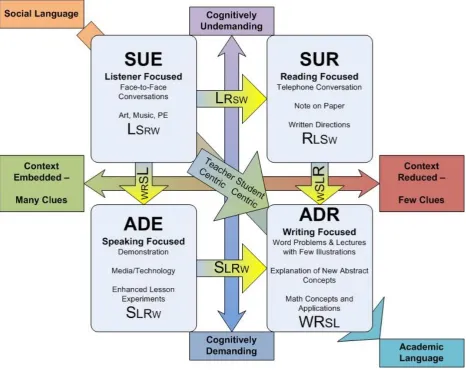
the paths of conversational fluency and academic fluency that students experience when learning a second language. Many of the precise characteristics and descriptors within Figure 1 are defined later in this investigation.
Figure 1. Progression from social to academic language acquisition.
Connecting the Cummins Model to Listening, Speaking, Reading, and Writing.
Linguists such as Cummins, emphasize the importance of using all modes of communication to facilitate SLA and the learning of academic content in the second language. Krashen and Terrell (1983) stress the need for ELLs to be allowed to move into verbal production of the new language at a comfortable rate. Students must hear and understand messages in the partner language and build a listening vocabulary before being expected to produce spoken language (Herrell & Jordan, 2004); and spoken language precedes written language.
emphasis on both reading and writing. Similarly, within the SUR stage,
R
LSW denotes greatest emphasis on reading, least emphasis on writing, and an equal emphasis on listening and speaking. Transitioning from the SUE stage to the SUR stage, we note the arrow labeledL
RSW, which denotes that moving fromL
SRW toR
LSW necessitates greatest emphasis on listening, lessened emphasis on reading, and least emphasis on speaking and writing.Altogether, the model in Figure 1 can be seen as transitioning from listening and speaking to reading and writing as central modes of communication associated with greater fluency in second language acquisition. Additionally, this process from the passive roles of listening and reading to the active roles of speaking and writing connotes that fluency is associated with the production and dissemination of information rather than the reception of information from others.
BICS continuum. In Figure 1, the upper left quadrant (SUE) and upper right quadrant (SUR) refer to BICS and the acquisition of Social language associated to cognitively Undemanding content with Embedded or Reduced context clues, respectively. Students first listen to, then follow, and then participate in simple face-to-face conversations in the second language. The language is informal and topics discussed are familiar and personal. “Understanding” primarily conveys comprehension of the central idea of a conversation.
Social language with clues embedded in cognitively undemanding content (SUE) activities involve listening (L: Listener Focused) to teachers and interacting with peers. The context embedded clues which occur within the expression of the language include using gestures, facial expressions, and body motions to communicate simple messages. These are the initial stages of SLA. At this stage, academic subjects such as art, music, and physical education are easier for students because of the many context clues (gestures, modeling, visuals, demonstrations) embedded within the communication and practice of the subjects and the expected products are usually evaluated visually as opposed to in written form. For instance, for young mathematics learners, a teacher may open their arms in one direction or another to provide the context clues regarding greater than or less than. Instruction and information dissemination are teacher-centered. Instructional methodologies and learning activities are explicitly developed to include many contextual clues to scaffold learning of SLA and promote understanding of the social language and practice in speaking (S) the second language.
The next phase of the BICS continuum is characterized by social language with reduced context clues in cognitively undemanding content (SUR). As students become more proficient with social language, they are able to understand simple communications with fewer context clues. Students are able to speak (S) and read (R) simple directions or notes. In this stage students may hold a telephone conversation or understand a note on a paper. Students become adequately proficient at SLA to listen (L), speak (S), and read (R), and write (W) in the second language at cognitive undemanding levels with few context clues. Instruction and information dissemination remain teacher-centered and instructional methodologies and learning activities are explicitly developed to provide fewer context clues for social language. However, teachers continue to embed context clues to teach new social language in increasingly cognitively demanding content.
Herein, in order to satisfactorily perform academically, merely understanding the gist of a lesson’s content objective is inadequate.
In the stage characterized by academic language with clues embedded in academically demanding content (ADE), students are expected to learn cognitively demanding content and be able to speak (S) with academic soundness in the content of study. Simultaneously, the social language expectations remain undiminished as teachers use collaborative learning strategies to encourage social interactions centered on academic topics that encourage academic speaking (S), academic listening (L), and academic reading (R) more so than academic writing. Context embedded clues provide support in the use of academic modes of language. Examples of such clues include demonstrations, use of media and technology to enhance learning, experiments, visuals, graphic organizers, etc. Learning and information transmission begin to transition from teacher-centered to student-centered.
In the final phase, defined by academic language with reduced context clues in cognitively demanding content (ADR), the student is proficient in the second language and is able to understand academics mostly devoid of context clues. Focus shifts from language acquisition to content acquisition. While students at this stage are considered advanced in SLA and are able to function in the second language at all four modes (listening, speaking, reading, and writing), writing (W) and reading (R) are the primary means of linguistic communication. Learning becomes student-centered and independent. Students are expected to be able to write fluently within the context of the academic topic and become the creators and disseminators of information. Students at ADR are able to learn from textbooks through reading and from teachers by listening to lectures. Teachers of students at ADR are able to initiate instruction at abstract levels of cognition. Notably, learning activities that fall in the ADE quadrant combine BICS and CALP by using the social interplay associated with cooperative learning groups with the academic rigor necessary for a student to learn and communicate about subjects and collaboratively develop understanding of cognitively demanding tasks.
Figure 2. Associations of the Cummins Stages to Bloom’s Taxonomy.
The SUE stage utilizes language as a medium to understand the surrounding world (Cummins, 1986; Tomasello, 1999); therefore, language helps students acquire knowledge and comprehension of a complex, mostly social world within the academic setting of the classroom (Nelson et al., 2003). Language at this stage helps communicate concepts at the lowest levels of Bloom’s Taxonomy. Herein, due to the lack of second language proficiency, students are merely the recipients of information and are yet unable to discern the value of the information they encounter.
The SUR stage deals with information through comprehension and low-level applications of Bloom’s Taxonomy. Students test their understanding by applying language to simple written communication with fewer context clues.
In the ADE stage, applications become more abundant and analysis of information evolves. Students’ purposes for learning language evolve from learning language in order to communicate socially to the learning academic content through the second language (Cummins, 1986; Tomasello, 1999). It becomes necessary for students to simultaneously dissect both the language and the subject areas being considered. Learning experiences become more dependent on prior academic experiences and interconnected with prior knowledge.
In the ADR stage, analysis gives way to synthesis and evaluation, as the responsibility for the communication of knowledge moves from the teacher to the student. Language becomes fully developed as a communication tool. Students analyze ideas, synthesize previously disconnected notions, and become increasingly more proficient in using language to express academic learning (Herrell & Jordan, 2004; Nelson et al., 2003).
Connecting SLA to both Stage Learning Theories and Sociocultural Psychology.
Initially, in respect to the Cummins model of SLA and its dimension of progression through various stages, some similarities may be assumed between this model and Piaget’s stage theory of learning. However, as previously cited, much of the theoretical bases of PLA and SLA are constructed upon Vygotsky’s sociocultural learning theories. Since these two connections may initially seem antithetical, this dichotomy is herein examined more completely.
each of these stages in his maturation through young adulthood. These stages include: Sensorimotor (infancy), Pre-operational (toddler and early childhood), Concrete Operational (elementary and early adolescence), and Formal Operational (adolescence and adulthood). Within each of these stages, Piaget defines a cyclic developmental process through which the child progresses in order to transition from one stage to another. These four phases include: observation of characteristics of actions and effects; reflecting abstraction; empirical abstraction; and generalization to new level of knowledge and insights. Summarily, within Piaget’s framework, thinking becomes increasingly abstract and logical with development and maturation.
While Piaget theorizes that children independently invent many ideas to learn, in contrast, Vygotsky argues that teachers and peers mediate learning to move students among the levels. According to Vygotsky, intellectual skills (the development and integration of five main cognitive functions: language, thinking, perception, attention, and memory) are progressively mastered by children (Byrnes, 2008). When children first learn a skill, they make errors and rely heavily on teachers for corrective advice. After extensive practice via problem-solving and feedback from teachers and capable peers, children master skills independently (Gallimore & Tharpe, 1990). Teachers often use scaffolding techniques (consistent with the ADR quadrant of the Cummins model) to help students progress along their zone of proximal development.
Contrasting the Piagetian view of children as the object of, or receivers amidst, the educational process, Vygotsky acknowledges that children are active agents in the educational process (Blanck, 1990). Contradicting Piaget’s emphasis on biological maturity as an inevitable condition for learning, Vygotsky contends that the developmental process is towed by the learning process and that learning is primarily socially interactive and, especially in the preschool years, is deeply situated in play. While both Vygotsky and Piaget believe that there is a progressive development from lower forms to higher forms of thought, Vygotsky does so without the stage-oriented framework propounded by Piaget.
Many parallels can be recognized between the Cummins model of SLA, Vygotsky’s writings, and the work of Sylvia Scribner, another sociocultural learning theorist. As Cummins notes the distinction between social and academic language, Scribner (1968) examines the differences between the spoken language of schooled and unschooled people (Wertsch, Hagstrom, & Kikas, 1995) and extensively defines and characterizes writing as both a product and a process of language, while simultaneously differentiating writing from language. In respect to writing, Scribner (1968) states: (1) Writing produces a material product. Language separates the producer from the product. (2) Writing externalizes thought. The use of inner speech for thinking precedes the final product. (3) Written language is more abstract than spoken language. In written language, the situation is not concretely given but must be constructed through text. Written language is stripped of all the expressive features of direct communication – inflection and tempo of speech, facial expression, gesture, and the like, which enrich language meaning. Comprehension of written text is divorced from such aids and, to a much greater extent than in oral speech, is a more purely cognitive activity. Summarily, many of Scribner’s notions regarding language and writing correlate well within the Cummins model. Particularly, writing, which is a culminating, abstract, linguistic enterprise stripped of expressive features, well defines SLA in the ADR quadrant of the Cummins model.
work through their understanding of linguistic structures in conjunction with other students. Pica (1996) describes it as “a type of communication highly suited to L2 learners' needs and requirements in the learning process” (p. 247), noting that negotiation of meaning often occurs in situations of classroom communication in which “the even flow of communication is broken, or is on the verge of breaking down due to the lack of comprehensibility in a message,” (p. 246), forcing students to rely on a number of communicative strategies to facilitate understanding and learning.
In SLA, negotiation of meaning is an essentially social process as it involves communication between two or more interlocutors, and it has come to be understood as a rather particular process centered about three strategies: confirmation and comprehension
checks, which involve using repetition and other communicative strategies to confirm understanding, and requests for clarification, which seek greater understanding of the given utterance or message (Pica, 1987). However, the concept of negotiation of meaning has been applied more broadly, as in Garfinkel (1967) where it refers to the construction and exchange of meaning in communication, or in Christiansen (1997), where the term is used to describe student-teacher and student-student interactions during an activity involving mathematical modeling. Christiansen also notes that these interactions involve both a negotiation of the understanding of the mathematical concepts behind the activity and a negotiation of the parameters of the activity itself.
Connecting Discordant Theories. Since components of the Cummins model of SLA can be correlated to both stage-oriented theories, such as that of Piaget, and sociocultural theories such as those of Vygotsky and Scribner, it must be questioned if a false dichotomy and Balkanization is too quickly formed between stage theories and non-stage theories of learning and development. Indeed, Wertsch (1990) does not completely divorce one from another as he recognizes three general themes which run throughout Vygotsky’s writings: (a) reliance on genetic (i.e. developmental) analysis (similar in some ways to Piaget’s work); (b) the claim that higher mental functions in the individual have their origins in social life (with correlates to Bruner’s (1966, 1979) work which includes its own theory of learning founded upon sequential modes of representations); and (c) the claim that an essential key to understanding human social and psychological processes is the tools and signs used to mediate them.
Throughout a volume edited by Martin, Nelson, and Tobach (1995), in analysis of the theories of language and learning promoted by Sylvia Scribner, various authors propound opposing thoughts on cognition. Altogether, however, the book advocates for understanding cognition by integrating complementary processes instead of having competing radical views. More recently, rather than discarding some mathematical learning theories for other competing theories, Simon (2009) opines the value of synthesizing multiple theories into more encompassing and explanatory wholes. Thus, herein, we do not place stage-based learning theories in opposition to those without this characteristic. Rather we join the two and use the most valuable complementary aspects of each.
Models and Theories of Mathematical Learning
stage-based (sequential or iterative); recognizing varying levels of interacting with or communicating about mathematics; and noting varying cognitive levels of the learner associated with mathematics learning.
The selected mathematics learning theories are seminal works upon which further research and theoretic development was grounded. In many cases, the theories selected are used herein as originally developed and not as more recently modified by others. As with the selection of theories of SLA, the intention is not to dismiss more recent thought and development emanating from these theories; rather, these more recent considerations of these theories are seen to confirm the importance and foundational nature of the theories selected. Since an entire monograph could be dedicated to cataloging and defining mathematical learning theories (Lerman, 2006; Lerman & Tsatsaroni, 2004; Simon, 2009) – making this study impossible, this investigation delimited itself to three well recognized mathematical learning theories: the van Hiele model of geometric understanding (Burger & Shaughnessy, 1986; Fuys, Geddes, & Tischler, 1988; Van Hiele, 1986) considers the realm of geometric understanding; Dienes’ Learning Cycle (1960, 1971) considers earlier and more general mathematical learning; and the Structure of Observed Learning Outcomes (SOLO) Taxonomy (Biggs & Collis, 1982) considers problem-solving in the context of the learning of subjects in general and has been applied to the learning of algebra. Together, these frameworks delineate processes within mathematical learning through which students progress.
Van Hiele Model. Van Hiele (1986) theorizes five sequential levels of geometric understanding through which students learn. In the level denoted Visualization, students recognize figures, but do not recognize properties of these figures. In the second level,
Analysis, students analyze components of figures, but cannot explain interrelationships between, and properties among, figures. In Informal Deduction, students understand and utilize properties within and among figures and can follow informal proofs. However, students are unable to develop or understand less conventional proofs in unfamiliar logical order. In Deduction, students understand and can use axiom systems in proofs and can prove theorems in numerous ways. In Rigor, students can abstractly and with rigor examine, compare, and contrast different axiom systems.
The van Hiele model additionally proffers a five-phase sequence through which students transition from any level to the following level. In the first phase,
Inquiry/Information, students passively and actively participate in communication regarding the concepts in the respective level through observation, questioning, investigation, and nomenclature. In Directed Orientation, through teacher-sequenced activities, students investigate concepts and come to understand seminal conceptual characteristics respective to the level. In the third phase, Explication, students actively and interactively communicate what they know about the level and, thereby, concretize the system of relations respective to the level being examined. In Free Orientation, students experience more complex, multi-step, and open-ended tasks that have multiple solution paths, gain independence in problem-solving, and fully apply and integrate numerous conceptual relations within the respective level. In the last phase, Integration, students internalize concepts by synthesizing relations and constructing a new body of thought.
Play, students are introduced to mostly unstructured activities that will become the experiential foundation to which future experiences can be connected. Fundamental concepts are informally and tacitly developed. In Games, more structured and formalized activities and experiences connect the learner more tightly to future concepts that will be learned. Rules are employed in the activities, but the learner has gained neither the experience nor insight to generalize these rules. In Searching for Communalities, mathematical concepts develop and are independently applied appropriately to relevant situations. The learner begins to recognize generalizations of rules from different experiences and activities and recognizes conceptual commonalities within these experiences. Herein, the Dynamic Principle becomes cyclical and Searching for Communalities in one concept becomes play for a following concept.
Beyond the three-stage Dynamic Principle, Dienes’ Learning Cycle includes the stages Representation, Symbolization, and Formalization (Dienes, 1960, 1971; Dienes, & Golding, 1971). While in Searching for Communalities the learner recognizes commonalities from experiences and entertains generalizations, these commonalities are provided to him through teacher directed activities. The stage of Representations transcends such by the learner himself discovering commonalities among mathematical experiences and generalizing such to novel activities and investigations. In Symbolization, the learner need no longer experience mathematics through activities. The conceptual understandings developed through Representations can now be further investigated, applied, and extended symbolically. In Formalization, mathematical concepts can be interconnected into structures leading to mathematical proofs.
SOLO Taxonomy. According to Biggs and Collis’ (1982) Structure of Observed
Learning Outcomes (SOLO Taxonomy), students transition through a sequence of levels in the learning of mathematics. In the first phase, Prestructural, as students engage in a task/investigation, they are distracted or misled by irrelevant or disjointed concepts previously encountered. In the Unistructural phase, in a task/investigation ripe with conceptual pieces and alternate heuristics, students focus on one concept/heuristic of which they are most familiar/comfortable to the exclusion of others which may be more efficient, effective, or explanatory. During the Multistructural phase, experiencing a task/investigation, students can use more than one conceptual piece or heuristic, but cannot integrate them into a single, powerful, workable whole. In the Relational phase, students integrate conceptual pieces of a task into a coherent whole with structure and meaning. In the final phase, Extended Abstract, students can generalize the coherent structure, adopt novel features into the structure, modify the structure, and apply the structure in novel scenarios. Unlike the van Hiele Model, which has disjointed levels which become connected through the five-phase sequence, the SOLO Taxonomy recognizes intermediate stages: Prestructional to Unistructural; Unistructural to Multistructural; Multistructional to Relational; and Relational to Extended Abstract.
Research Methodology
Simultaneously considering learning theories from seemingly disparate fields of research holds inherent difficulties. Two or more fields of study may employ similar vocabulary with far different meaning attached to such. Conversely, two or more fields of study may use different vocabularies that hold the same meaning. Thus, it is often necessary to go beyond the prose within each field to ascertain more salient and foundational characteristics and then compare/contrast those characteristics. This later process often requires either the recasting of concepts and vernacular in one field to those in another or the invention of entirely new verbal descriptors. These are all dynamics within discourse analysis (Gee, 2005; Johnstone, 2002; Schiffrin, Tannen, & Hamilton, 2001), and thus techniques associated with discourse analysis were used to find conceptual similarities between models of SLA and mathematical learning theories.
Recalling the literature, this study sought to recognize how SLA theories inform mathematics learning theories by seeking conceptual commonalities among the following:
PLA through the works of: Bailey, Madden, and Krashen (1974); Brown (1973); Bruner (1966); Chomsky (1957, 1959, 1964); Dulay and Burt (1973, 1974); Krashen and Terrell (1983); Lightbrown and Spada (1999); Piaget (1972); Vygotsky (1978); and others.
SLA through the works of: Brown (1973); Byrnes (2008); Christiansen (1997); Cummins (1979, 1984, 1991); Gallimore and Tharpe (1990); Garfinkel (1967); Herrell and Jordan (2004); Krashen (1977, 1982); Krashen and Terrell (1983); Nelson et al. (2003); Piaget (1972); Pica (1987); Scribner (1968); Selinker (1972, 1992); Swain (1985); Swain and Lapkin (1995); Tomasello (1999); and others. Mathematics Learning Theories through the works of: Biggs and Collis (1982); Burger
and Shaughnessy (1986); Dienes (1960, 1971); Fuys, Geddes, and Tischler (1988); van Hiele (1986); and others.
This involved careful analysis of the documentary prose defining each theory, with the goal of breaking each one down into seminal conceptual bites. These bites were then compared among fields of study and their intersections were discovered. Some of these conceptual bites included:
Learning is the personal and interpersonal negotiating and constructing of meaning.
Learning begins socially and informally and transitions to academic and formal. Learning transitions from cognitively undemanding to cognitively demanding
ideas.
Learning proceeds through various stages (sequential or iterative).
o Some of these stages place greater or lesser emphasis on listening, reading, speaking, and writing.
o These stages evolve from teacher-initiated communication to student production of communication.
o Some of these stages varying cognitive levels at which the learner interacts with the topic.
In the process of learning, students encounter ideas which are beyond their grasp, ideas which are beyond their ability about which to communicate, and ideas which they modify in order to functionally communicate;
addressing (Gee, 2005; Johnstone, 2002; Schiffrin et al., 2001). This novel framework is provided later in this paper.
Analysis of Similarities between Models of SLA and Mathematical Learning
Conceptual commonalities exist between the van Hiele (1986) model and both Krashen’s (1977, 1982) theories and the Cummins (1979, 1984, 1991) model of SLA. For instance, Visualization, and its informal understanding of geometry, relates to the informal linguistic understanding found in the SUE stage and to Krashen’s theory that comprehension must precede production. Analysis shares conceptual commonalities with SUR, as simple concepts are investigated, but formal communication and explanation is yet beyond the student. In Informal Deduction, students begin to use the structures of geometry and orally reason through informal proofs and justifications, similar to ADE and comprehensible output in theories of SLA. In Deduction, both orally and in writing, students employ more formal geometric reasoning and justification and consider more complex notions. This corresponds to ADE with increased focus on writing over oral communication. Last, with Scribner’s argument that written language is more abstract than spoken language and that writing is most highly emphasized in ADR, Rigor shares similarities with ADR as students investigate and communicate fluently about abstract geometric concepts.
Little analysis is needed to reveal that the five-phase transitional sequence (Inquiry/Information, Directed Orientation, Explication, Free Orientation, and Integration) between van Hiele model stages also demonstrates connections to the Cummins (1986) model. Through these phases, the student has cognitive experiences similar to the SLA transition from BICS to CALP, with focus increasing from listening and speaking to reading and writing.
Aspects of the Dynamic Principle also associate closely with models of SLA. The unstructured, cognitively undemanding activities involved in Free Play parallel student social experiences in SUE and also find a parallel in Krashen’s notion of the affective filter, or the idea that learning occurs best in a low-stress environment. As SUR student experiences transition from emphasizing listening to reading, more structured activities in Games begin to develop informal conceptual understanding. Searching for Communalities shares commonalities with, and becomes a connecting agent among, SUR and ADE, as concepts develop, are independently applied, and become generalized. The Learning Cycle similarly has conceptual correspondence with the Cummins model. The progress among Representation, Symbolization, and Formalization clearly aligns with the SLA progression from cognitively undemanding social language to cognitively demanding academic language, and likely also with the progression from comprehension to production.
The SOLO Taxonomy also possesses numerous connections to the Cummins model of SLA. Avoiding the pedantic comparisons as previously provided, little examination is necessary to see the conceptual connections between: the Prestructural phase and SUE; the Unistructural phase and SUR; the Multistructural and Relational phases and ADE; and the Extended Abstract and ADR.
Communicating Through Other Models
following statements, select words or ideas associated with language learning previously stated in this paper are replaced with words associated with mathematics or mathematics learning and vice versa. The fact that these statements with interchanged verbiage for language and mathematics remain sensible further confirms that learning theories from both camps share conceptual commonalities.
Through a circular, simultaneous, and subconscious process, the learner encounters language [mathematics] within his environment, strives to receive that language [mathematics], is then affected by the new language [mathematics] which becomes integrated with his prior knowledge, and then allows for the assimilation and accommodation of more sophisticated linguistic [mathematical] structures useful in additional social context and content.
Through the process of language [mathematics] acquisition, the learner begins understanding simple words [mathematical concepts] with limited meaning; most energy is associated with the physical reproduction of the language [mathematics]. As language [mathematics] acquisition matures, language [mathematics] becomes a tool through which to understand and interact with the environment; linguistic [mathematical] structures form “pictures” or concepts. Linguistic [Mathematical] maturity develops as the leaner employs language [mathematics] to symbolize or represent his ideas and understanding.
Comprehensible input is language [mathematics] that students simultaneously are able to understand and that is slightly beyond their current level of production. Thus, students can receive and mostly understand the communication from another, but cannot reciprocate by replicating the ideas or reconstructing and communicating the ideas in their own words in the language [mathematics] being acquired.
According to CUP, since the skills associated with [mathematical] literacy are transferable, skills, learning, and knowledge transfer into any language [mathematical study] and facilitate the learning of a second language [additional mathematics]. Consequently, there is no need to re-teach academic [fundamental mathematical] concepts in a second language [each mathematical domain] because knowledge is transferable between languages [domains].
In Informal Deduction, students understand and utilize properties within and among figures [the language] and can follow informal proofs [conversations]. However, students are unable to develop or understand less conventional proofs [conversations] in unfamiliar logical order.
In Free Play, students are introduced to mostly unstructured [linguistic] activities that will become the experiential foundation to which future experiences can be connected. Fundamental [linguistic] concepts are informally and tacitly developed. In Games, more structured and formalized [linguistic] activities and experiences connect the learner more tightly to future concepts that will be learned. [Linguistic] Rules are employed in the activities, but the learner has gained neither the experience nor insight to generalize these rules. In Searching for Communalities, mathematical [linguistic] concepts develop and are independently applied appropriately to relevant situations. The learner begins to recognize generalizations of rules from different experiences and activities and recognizes conceptual commonalities within these experiences.
In the first phase, Prestructural, as students engage in a task/investigation, they are distracted or misled by irrelevant or disjointed [linguistic] concepts previously encountered. In the Unistructural phase, in a task/investigation ripe with [linguistic] conceptual pieces and alternate heuristics, students focus on one concept/heuristic [language] of which they are most familiar/comfortable to the exclusion of others which may be more efficient, effective, or explanatory.
The Consequences of SLA for Theories of Mathematical Learning
Tightening the Spiral
In some of the frameworks of learning previously investigated, a sequence of stages can be recognized. While some frameworks represent primarily a once-in-a-lifetime sequence of stages (e.g., Piaget (1972), van Hiele (1986), and Krashen’s (1977, 1982; Krashen & Terrell, 1983) model of SLA), others represent a more circular path that repeats at the learning of each new concept (e.g, Bloom’s Taxonomy (Bloom, Englehart, Furst, Hill, & Krathwohl, 1956; Bloom & Krathwohl, 1956), SOLO (Biggs & Collis, 1982), and, it could be argued, Selinker’s (1972, 1992) concept of interlanguage). Some linguists have likewise proposed that while initial language acquisition occurs invariably in childhood, our knowledge of language is continually being refined as we use it (Bybee, 1999, Bybee & Beckner, 2009). The authors of this paper argue that the sequential and circular paradigms of learning should be melded and that no sequence of learning is singularly once-in-a-lifetime and no circular sequence is completely repeated at the learning of every new topic.
…
Figure 3. Tightening the Spiral in the Cummins Model
Joining the notions of CUP with sequencing of stages, the Cummins (1979, 1984, 1991) Model for SLA can be extended into, and envisioned as, a tightening spiral. As students progress through the model for a specific subject matter in one phase and transition to another subject area in another phase, conceptual connections between the two subject matters often diminish the need for fully returning to the SUE phase of the model in the study of each new subject investigation.
Geometry to Algebra II, concepts should connect from Algebra I and Geometry to Algebra II and few students should need to revert significantly in the Cummins Model. More so, when students begin precalculus, concepts from Algebra I, Geometry, and Algebra II should scaffold their learning.
A Novel Stage Theory of Mathematical Learning
Altogether, the previous discussions have demonstrated connections between SLA and mathematics learning. However, within this discourse, we take no stance regarding whether or not mathematics itself is a language. For the purpose of this investigation, this debate is both unnecessary and fractious. Regarding this debate, we encourage readers to consider the works of others (e.g., Adler, 1991; Allen, 1988; Atkinson, 1992; Barwell, 2009; Brennan & Dunlap, 1985; Changeux & Connes, 1995; Culyer, 1988; Davis & Hersh, 1981; Ernest, 1991; Esty, 1992; Esty & Teppo, 1994; Freudenthal, 1991; Pimm, 1987; Schwarzenberger, 2000; Schweiger, 1994; Thomas, 1988; Usiskin, 1996). Rather, we argue, herein, that the learning of mathematics shares many commonalities with the learning of a second language. Altogether, then, mathematics is learned similarly to that of a second language. This position, however, carries with it a number of implications. The first of which, a novel sequencing of mathematical learning, we discuss immediately below. Additional implications are left for latter discussions.
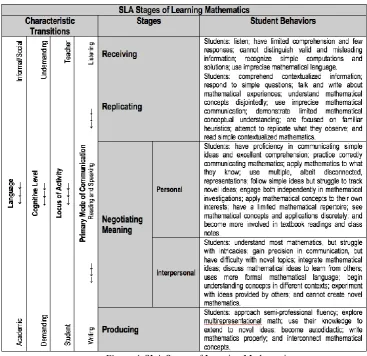
Upon analyzing various learning theories both inside and outside of mathematics and synthesizing these frameworks into a coherent whole, a novel framework evolved which propounds that mathematical learning follows a path denoted by the constructs: Receiving Mathematics; Reading and Replicating Mathematics; Negotiating Meaning; Communicating Mathematics; and Producing Mathematics. While it is proposed that these constructs are primarily sequential, we do not hold dogmatically to such and see the possibility that there are both some overlaps among some of these constructs, that some learners may on occasion jump forward or back through the constructs, and that students progress through these learning constructs more so in the form of the tightening spiral.
Figure 4. SLA Stages of Learning Mathematics.
Receiving Mathematics. The Pre-production stage of SLA lasts 0 to 6 months from a person’s initial encounter with a new language; this stage is also known as the silent period (Krashen & Terrell, 1983). For school-age learners of mathematics, this implies that students are listening to teacher-generated mathematics and trying to understand the flow of the conversation. The ability to interactively communicate mathematically is not possible.
In the second stage of SLA, the Early Production Stage, learners have limited comprehension but can give one or two responses in the new language, benefit from predictable patterns of speech and conversation, and through very simple verbal expressions they can label and manipulate representations. In this stage of language acquisition, children use familiar phrases and key words, but often use grammar incorrectly. Bruner’s Enactive stage (1966, 1979) shares common notions with both the first and second stage of language acquisition and effectively bridges the gap between the two.
correct. They are able to recognize simple predictable computations and solution strategies and attempt to replicate some. In the earliest stages of language acquisition, the child begins by simply hearing communication and imitating what they can, but he has an inability to create language independently; he soon becomes involved in more formal linguistic instruction. Similarly, in Dienes’ Learning Cycle, students experience mostly unstructured activities (Free Play), tacitly develop concepts through their experiences, and then more firmly connect concepts to experiences through more formal activities (Games). While their use of mathematical language is imprecise and often incorrect, students can recognize mathematical expressions and manipulate simple representations. Notably, the majority of these descriptors are quite similar to those found in the Visualization (van Hiele, 1986) and Prestructural (Biggs & Collis, 1982) stages of mathematical learning.
The notions of comprehensible input and output (Krashen, 1977, 1982; Krashen & Terrell 1983) and interlanguage (Selinker 1972, 1992) are readily noticed in the stage Receiving Mathematics. In this stage, students often understand some but not all that a teacher is saying (comprehensible input) and often cannot effectively express their mathematical ideas (comprehensible output). For instance, a student may see the numeral 15, marginally understand that to mean 1 ten and 5 ones (comprehensible input), and say “one five” (comprehensible output). Absent of teacher questioning techniques, many students fall silent, awaiting more information from the teacher (i.e., the silent period (Krashen, 1977, 1982; Krashen & Terrell 1983)). Students often communicate mathematical ideas using and nomenclature and the concatenation of ideas that are mathematically and linguistically unsound; in essence, they construct their own mathematical interlanguage.
In the construct Receiving Mathematics, the teacher initiates and guides mathematical discussions and investigations. Communication is primarily verbal. Excellent teachers use inquiry techniques, investigations, questioning skills, and discussion to assist the student to construct the knowledge surrounding the mathematical topic being investigated. Students are actively attempting to integrate the mathematics, mathematical vocabulary, and techniques they see demonstrated into their own fabric of knowledge. Consistent with the SUE stage of the Cummins model for language acquisition, mathematics is understood only informally and in very restricted contexts. Certain terms have only a singular meaning at one time. Imprecise mathematical language and ideas are tolerated as they are recognized as a necessary phase in the process of learning. Mathematical language and understanding are informally socially mediated.
In this stage, listening is the primary role of the student, with speaking taking a secondary and limited role. While this does not imply that teachers do not use questioning techniques through which to understand student thinking and assist the student in clarifying ideas, it simply means that students have insufficient mathematical mastery to provide significant responses in return.
exists is rarely understood. For instance, while “and” and “or” in the context of the union and intersection of sets versus in determining the probability of events may be understood to some point, connections between the two contexts may not be recognized. Mathematical expressions increase in number and sophistication, but yet lack both linguistic precision and conceptual understanding. Students are focused more on heuristics with which they feel most familiar/comfortable rather than unfamiliar heuristics that may prove more valuable. The comfort level a student has with an experience is predicated upon his experience with prior similar experiences. This is consistent with Dienes’ (1960, 1971), Searching for Communalities in which multiple experiences lead to commonalities among experiences and this recognized common structure being applied to additional relevant situations. Thus, as with language acquisition, mathematical learning is strongly correlated to a student’s comfort with the topic.
In the construct Replicating Mathematics, students read mathematical examples and attempt to replicate in both speech and writing what they observe from the teacher. The understanding of the mathematics may be minimal, and students find success if they can mimic examples from the text or chalkboard. Communication need not be singularly verbal; students can read simple mathematics within the context of what they have been discussing in class. Students independently create or apply little novel information. This stage holds many similarities with the SUR stage of the Cummins model where communication transitions from speaking to reading and applying simple contextually comprehensible written language. Sense-making remains somewhat informally social. Students learn as they communicate with one another. However, they do not yet understand that the purpose for sharing ideas is in learning and mediating understanding; rather, they communicate with one another as a natural social practice.
In this learning construct, speaking and listening as student roles slowly gives way to reading mathematical texts and notes from the board. Replication takes place even within the language of mathematics, as students attempt to say things using phrases similar to those of the teacher – whether or not they understand the verbiage. Teachers probe student understanding through questioning and are often satisfied when students can tell the teacher what the teacher previously told the student.
Again, some notions from SLA are readily recognized by the mathematics teacher. While students are improving in their comprehension, many novel ideas are occasionally just beyond their reach (comprehensible input) and, although their communication is improving, some mathematical discourse lacks precision (comprehensible output). To a greater extent, they produce an interlanguage through which they construct understanding and communicate ideas. For instance, when students see the expression x2 they may call this “x two” with the expectation that the teacher and the other students understand that “x
two” connotes x2 (interlanguage). However, conversely, when students articulate “x two” only observation of how they use and work with this expression will reveal whether he considers it to mean x2 and x∙2. This interlanguage is often a derivative of the language and
notions they observe from their teachers.
Negotiating Meaning. Throughout the stage Negotiating Meaning, speaking becomes a more primary role in student learning. Listening to instruction and other students and reading instructional notes and the textbook take on additional roles. The roles of reading and listening are recognized as supporting a student’s ability to properly discuss mathematics.
(comprehensible input). Students employ better mathematical language and ideas are communicated more effectively with fewer miscommunications of ideas (comprehensible output). Their interlanguage develops to denote understood mathematical connections. For instance, they might refer to a ratio as a fraction, the x-intercepts of an equation, or the roots of a graph. Communication between students and the teacher and between students is ripe with confirmation and comprehension checks and requests for clarification, (Christiansen, 1997; Garfinkel, 1967; Pica, 1987).
In the learning construct Negotiating Meaning, students discuss mathematical ideas for the purpose of learning from, and with, one another. However, unlike Negotiation of Meaning as strictly understood in SLA, in the context of mathematics, students engage both independently and corporately in mathematical investigations while negotiating meaning. For instance, they may engage in conversations and correct other students’ work and thinking. Students create meaningful contexts by applying mathematical concepts to their own interests and real-world scenarios but still have a limited repertoire of types of problems to which they can apply mathematical concepts. While they generally see mathematical concepts and applications discretely, understanding of the interconnectedness of mathematical concepts is emerging. Focus is principally on accomplishing something and not on communicating ideas in a precise academic manner. For instance, they might “cancel” expressions or “cross out” similar terms in the numerator and denominator with little concern for the informality of the description of what they are doing. As with the ADE stage of the Cummins model, spoken communication is emphasized in the learning process. Students experiment with ideas provided to them by others. Although they may consider novel intersections of ideas, few ideas significantly extend beyond the context of the discussions.
As is seen in the following descriptors, Negotiating Meaning spans a number of stages in SLA. These can be distinguished as early and later development. Additionally, Negotiating Meaning caries both a personal and an interpersonal dimension. These are addressed herein.
In earlier phases in Negotiating Meaning, commensurate to students moving from the Emergence of Speech to Intermediate Fluency in Krashen’s model (Krashen, 1977, 1982; Krashen & Terrell 1983), they gain proficiency in communicating ideas and improve comprehension. Precision in communication gains greater importance and language is seen more holistically as a structure. However, students have difficulty engaging in communication outside their realm of previous experience and knowledge. Similarly, moving from Bruner’s Iconic to Symbolic stage (1966, 1979) means that language takes on a symbolic form and becomes a medium through which ideas are conveyed.
proofs, the learner, as in Dienes’ (1960, 1971), can both independently discover common notions among various experiences and make applications of such to novel activities and investigations.
Students at the Intermediate Stage of language acquisition can achieve in the primary language and participate in academic activities with some processing needed to understand the intricacies of the second language such as idioms and slang. This is commensurate with latter phases in Negotiating Meaning. Precision in communication gains greater importance and language is seen more holistically as a structure. However, students have difficulty engaging in communication outside their realm of previous experience and knowledge. In Bruner’s (1966) Symbolic stage, language takes on a symbolic form and becomes a medium through which ideas are conveyed.
In Deduction (van Hiele, 1986) and Relational (Biggs & Collis, 1982) stages, mathematics becomes integrated into coherent structure and students are able to work within this structure. Unfortunately, students have difficulty working outside of the framework of which they are familiar and struggle to extend it beyond to new concepts. The mathematical language gains in precision and becomes more efficient and more symbolic. As with Dienes’ (1960, 1971) Symbolization, mathematical learning needs to remain experiential; students can learn by considering and extending ideas symbolically.
Personal Negotiation of Meaning. In the learning construct Personal Negotiation of Meaning, guided by teacher direction, students engage both independently and corporately in mathematical investigations. They apply mathematical concepts to their own interests and real-world scenarios. However, students often have a limited repertoire of types of problems to which they can apply mathematical concepts and they see mathematical concepts and applications discretely. The interconnectedness of mathematical concepts has not yet developed. Focus is explicitly on accomplishing something and not on communicating ideas in a precise academic manner.
In this construct, reading and speaking share roles in the classroom. Students become more involved in textbook readings and class notes. They carefully read examples in order to apply the mathematical concepts to assigned exercises. They read mathematics in order to personally negotiate the information in the text with their existing frame of knowledge. The goal of communication is in solving the problems at hand.
Arguably, this stage of mathematical learning may be the goal at which most classroom teachers aim their instruction and the level of student learning with which most educators are satisfied. Once students can replicate and apply mathematics, many educational environments promote little beyond this. Thus, it may be only natural that few students attain levels of mathematical learning higher than the stage to which the educational system is aiming.
Interpersonal Negotiating of Meaning. In the learning construct Interpersonal Negotiating of Meaning, students discuss mathematical ideas for the precise purpose of learning from, and with, one another. Mathematics and its language become more formal. Terms and concepts become understood in different contexts. Mathematical concepts become interconnected. As with the ADE stage of the Cummins model, spoken communication is emphasized in the learning process. Students experiment with ideas provided to them by others. Although they may consider novel intersections of ideas, few ideas significantly extend beyond the context of the discussions.