1
Mathematics Teachers' Professional Development
Program - Needs and Expectations
Michal Levi-Keren
The Kibbutzim College of Education, Technology and Arts, Israel
, Israel, School of Education
, Aviv University
-Tel
Dorit Patkin
The Kibbutzim College of Education, Technology and Arts, Israel,
Abstract
This paper presents the major findings and recommendations from a formative
evaluation of the first of a 2-year in-service training program. This program was
designed for the professional development of math teachers. It was developed
following an educational reform, which was meant to enhance the teachers' ability to
generate changes in their teaching methods and implement them in class. The
teachers' attitudes towards the program were examined using close-ended
questionnaires and open-ended questions which were administered to 19 teachers at
the end of their first year of inclusion in the program. The research findings attested to
the contribution of the program to the teachers' development - mainly to those with
longer experience in math teaching – in the area of the taught discipline itself, as well
as in the didactic-educational area and the personal-emotional area. These findings
were anchored in a conceptual framework of a model of the development of the
teachers' nature of concern and interest regarding the change. The article discusses the
potential instrumental and conceptual application of the findings in a focused
decision-making process pertaining to running the program, and to a research-based
accompaniment of the implementation process of professional development programs.
Key words: Professional development, in-service mathematics teachers, educational
2
1. Introduction
A layout of teachers’ professional development was conceived within a framework of
an educational reform in Israel (Ministry of Education, 2014). It was based on the
understanding that constant development of knowledge and skills throughout the
professional life of educational practitioners is vital for maintaining high-quality and
relevant teaching in the education system. As part of this reform, it was stated that the
professional development procedure should train teachers in knowledge and skill
development, as well as include theoretical, personal-emotional and practical
components (Ibid).
Pursuant to this layout, as of 2012 programs enabling teachers to grow and
develop have been implemented. One of these programs is the 2-year long in-service
training program entitled "Teachers initiating and implementing educational
programs" [hereunder "the program"] designed to develop educational initiatives as a
means of developing innovative, relevant and applied thinking.
According to the policy layout designed by the Ministry of Education (2014), an
educational initiative can include any field of educational activity, which suits the
teachers and can be applied through the academic year. For instance: development
and implementation of instructional unit; development and implementation of social
intervention in class and fostering academic skills among pupils (in certain subjects or
in general). The uniqueness of the program, which is the focus of this study, is the fact
that it integrates mathematics as a discipline rather than providing generic purposeful
knowledge for all educational practitioners (Ministry of Education, 2014).
2. Theoretical Background
For more than two decades, starting from the last decade of the 20th century, results in
mathematics exams on national and international levels have demonstrated a decline
in learners' attainments (Gonzales et al., 2009; OECD, 2009). Following these
findings, and within the framework of the general educational reform in Israel and the
change of mathematics curricula at elementary and high schools, a decision was made
to organize professional in-service training courses for mathematics teachers on the
3
The rationale underpinning these courses was to enhance professional
development of mathematics teachers (Courtney, 2007; Day, Sammos, Stobart,
Kington & Gu, 2007) so that they acquire subject matter knowledge (SMK) and
pedagogical content knowledge (PCK) (Guskey, 1995; Shulman, 1986). All these will
promote the quality of teaching (Day & Leitch, 2007), and will bring about a
meaningful process of change among those teachers (Stigler & Hiebert, 1999). This
professional development might lead to improvement in learners' attainments
(ACME, 2006; AFT, 2002; CSMTP, 2000).
Wayne and Youngs (2003) conducted a literature review which indicated that
the higher the mathematics teachers' knowledge was, the higher the learners'
attainments in mathematics were. These findings are supported by Thames (2006). He
argued that the scope of mathematics education courses (regarding SMK and PCK)
might predict learners' extent of success in this subject. Moreover, the final report of
the National Mathematics Advisory Panel (2008) engages in it.
A study conducted by Shriki and Patkin (in press) showed that teachers need
reinforcement of their ability to cope with emotional aspects relating to the learners –
making them like mathematics, enhancing their self-confidence regarding their ability
to succeed in mathematics and promoting their motivation to study it. Moreover, the
teachers relating to the above mentioned research, indicated the need to become
acquainted with varied learning materials and acquire proper competences which will
help them in adapting these materials and competences to the variety of learner types.
Teachers' professional development and education throughout their years of
practice results in pressures exerted on the education system today to commit to
change, innovation and rationalization. According to Guskey (1986), "...staff
[professional] development programs are a systematic attempt to bring about change -
change in the classroom practices of teachers, change in their beliefs and attitudes,
and change in the learning outcomes of students" (p.5). The introduction of
pedagogical changes and the implementation thereof involve many difficulties,
mainly in cases whereby the body deciding about the change is external to school
(i.e., the Ministry of Education). Changes in the field of education have unique
characteristics (Maskit, 2012). The main ones are: change is accompanied by mixed
feelings, both positive and negative; and it depends on the individuals' ability to
4
Hall and Hord (2011) conceived a model for measuring, describing and
explaining change processes which teachers who adopt educational innovation are
undergoing. The model is named CBAM (Concerns-Based Adoption Model) and
consists of three distinct dimensions, one of which, the most relevant to this study, is
the Stages of Concerns. This dimension engages in the development stages of
teachers' nature of concern and interest with regard to the change transpiring in their
school. The key concept of the model is 'concerns' and it comprises feelings, needs,
interest, preoccupations and concerns associated with the change. The main element
of the model then is the teachers who are mostly affected by it. The model serves
many studies conducted in recent years in the context of professional development
programs for mathematics teachers (Oleson, 2010); implementing a new mathematics
curriculum (Cetinkaya, 2012); and using interactive whiteboards in class (Hall,
Chamblee & Slough, 2013). Detailed information about the theoretical,
methodological and applied aspects of the model are included in a paper recently
published by Hall (2013).
The concerns model identifies and provides ways to assess seven possible
concerns related to an innovation (Hall & Hord, 2011):
1. Awareness –awareness of the need for change as well as the interest in it are
limited. Teachers at this stage usually have other important concerns, which
require their attention.
2. Informational – there is awareness of the change and interest in information
about it, its characteristics and everything required for its implementation.
Teachers begin looking for information about the change.
3. Personal – teachers express doubts about requirements of the change and are
preoccupied with features of the roles they will have to fulfill, the incentives and
their 'personal' benefits from the future change.
4. Management – teachers focus on processes, behaviors and competences
associated with introduction of the change. Their main concerns relate to effective
functioning, educational practice organisation, time and lessons timetable
organisation and proper use of the resources at their disposal.
5. Consequence – teachers focus on examining the effect of the change on the
5
6. Collaboration – the need for collaboration, teamwork and coordination with
others in connection with the change processes. Teachers wonder how their
colleagues implement the change and begin looking for information.
7. Refocusing – teachers' needs are focused on studying the change effectiveness
and effects as well as on assessing the need for changes and adjustments in order
to achieve better results.
These concerns vary from the self-oriented level (stages 1-3) to the
task-oriented level (stage 4) and finally to the impact based level (stages 5-7). Although
the stages describe a developmental sequence, this does not mean that every person
passes through the entire sequence in the same way. People pass through the stages at
different time ranges and their focus at each stage is different.
Thus, this model advocates taking into consideration the features of teachers'
professional background, including the knowledge, beliefs, needs and expectations
which they bring with them to in-service training courses. It was found that
mathematics teachers came to professional development activities with various levels
of content understanding. That impacted their experience with the professional
development program and what they had learned from it (Santagata, Kersting, Givvin,
& Stigler, 2011). Professional development needs of teachers may vary, as the
teachers' "demographic profiles" (like their level of teaching experience) change
(Mukundan, Nimehchisalem & Hajimohammadi, 2011). Thus, disregarding the
teachers' present needs might make them feel that in-service training courses do not
meet their requirements or do not greatly contribute to their professional development
(O'Sullivan, 2004; Shriki & Lavy, 2012; Shriki & Patkin, in press). Hence, this might
actually undermine course effectiveness (Loucks-Horsley, Love, Stiles, Mundry &
Hewson, 2003). With this in mind, it was claimed that in order to ensure successful
professional development that improvesmathematics and scienceteaching practice, it
is essential to understand and address teacher professional development expectations,
experiences, needs, and constraints (Chval, Abell, Pareja, Musikul & Ritzka, 2008).
The present evaluation research was conducted for the purpose of maintaining a
control and evaluation process, aimed at creating maximum efficiency, drawing
conclusions and upgrading the program. In the context of this evaluation, we use the
CBAM as a conceptual lens through which teacher change can be defined, and not as
6
Therefore, we will deal with the model in the discussion chapter, rather than the
findings one.
2.1 Description of the program
The "Teachers initiating and implementing educational programs" is grounded in
three longitudinal axes, which constitute a conceptual and substantive infrastructure
for developing various initiatives in the field of mathematics teaching:
1. Acquaintance with new learning materials and experiencing with them, while
focusing on various principles and aspects of leading initiatives in the education
system, and building frameworks for implementing initiatives in the field of
mathematics teaching.
2. Development of a school-based mathematics team functioning as a learning,
working and initiating community in mathematics, while coordinating and
establishing links for the school activity in other areas.
3. Observation of a longitudinal view of a mathematical field: developing over a
sustained period of time, spatial capability for enhancing geometry content
knowledge, while integrating measurements and analysis of arithmetic and
algebraic connections. Moreover, expanding PCK associated with the learning
and teaching of these aspects, cognitive and emotional aspects and
misconceptions.
The program consisted of a total of 150 hours spread over two years. During
each year, the program included 45 hours of theoretical studies as well as 30 hours of
support and tutoring: fifteen hours of them were devoted to small group work (10
hours of personal consulting and 5 hours of group consulting), and 15 hours were
devoted to writing the initiatives.
The program comprised 11 encounters (lessons) of four hours each. Three of
them (12 hours) were devoted to the topic "Art of teaching and promotion of learning
from theory to the class and back". This is the generic part of the program. Other four
encounters (16 hours) engaged in the inculcation of PCK in solid geometry as an
infrastructure for the development of complex mathematics thinking (developing
malleability of spatial skills through training in generating mental images of solids of
revolution). The activities in these encounters comprised measurement of solids,
7
Theorem in three dimensions). At the end of the first year of the program (during the
last four encounters, 17 hours) the instructions of the program dealt with developing
the teachers' initiatives. The main teaching methods were: lectures, discussion in the
class plenary and working in small groups (2-3 teachers). The assessment of the
teachers' work included presenting the proposals of the initiatives (40%), their
reflection on the planning phase (40%) and peer group assessment (20%).
Similarly, the second year of the program (also consisting of 75 hours) included
encounters devoted to the inculcation of varied tools for documenting initiatives and
teaching/learning processes, while focusing on theoretical and applied aspects
stemming from the development of mathematics teaching units and their
implementation, as well as tutoring of the applied project. The ways of instruction
were similar in this year, and the teachers' assessment was based on implementing the
initiatives at schools (60%), report of, and reflection upon, the initiatives (30%) and
peer group assessment (10%).
Two areas come to the fore in the programs of the teachers' professional
development courses (Ministry of Education, 2014): discipline and
didactic-educational. In addition, as part of the programs, the pedagogical change processes
are inextricably tied with feelings, concerns and worries, as explained in relation to
the Hall and Hord model (Hall & Hord, 2011). Consequently, we deemed it
appropriate to include the personal-emotional area in the program's evaluation.
2.2 The research goals
This formative evaluation research was done during the running of the program. Its
purpose was to inform stakeholders about the program by providing them with the
empirical evidence needed to make mid-course corrections to improve the quality of
the program.
Following this rationale and Patton's distinction regarding the uses of
evaluation findings (Patton, 2001), we set two goals for our study:
1. To assist in making concrete decisions regarding the running of the program. This
goal is oriented towards an instrumental use of the findings. In this type of use,
there must be a clear, discernible link between the results and a programmatic
8
2. To provide insights associated with the empirical follow-up of the internalization
of mathematics teachers' professional development. This goal is oriented towards
a conceptual use of the findings.
3. Methods
3.1 Participants
The sample consisted of 19 participants (18 females and one male) for whom 2013
was their first year of studies in the program. All the teachers teaching in primary
schools (students from ages six to eleven) or secondary schools (students from ages
12 to 15). The arithmetic mean of their ages was 50.32 and the standard deviation was
6.90. Examination of the teachers' professional background indicated that they were
well-educated and experienced in teaching. Most of them hold a master's degree
(83.3%) and the rest (16.7%) have a bachelor's degree. Moreover, it showed that in
the past they had attended various in-service training courses of mathematics
teaching. Arithmetic mean of their teaching seniority in mathematics and in general
was 19.95 (SD=9.39) and 24.26 (SD=6.65), respectively.
3.2 Research tools
1. A close-ended questionnaire administered in the beginning of the program (pre).
The questionnaire was based on existing questionnaires (specified later) and adapted
to the purpose of this study. The questionnaire consisted of 26 statements which
related to the participants' attitudes regarding expectations from the program,
self-perception of capabilities (while distinguishing between SMK and PCK), and
satisfaction from the program. For each statement the instruction was: "please write
your opinion". The alternative responses ranged between 1 (very low extent) and 5
(very great extent). Additionally, the questionnaire examined the background details
of the teachers: gender, year of birth, teaching experience, and specific math teaching
experience.
2. A questionnaire administered at the end of the year (post), which checked the same
aspects included in the pre questionnaire, and therefore comprised the same 30
statements. Moreover, seven open-ended questions were added designed to examine
9
expectations for the future. Table 1 presents the close-ended parts of the administered
questionnaires and the reliability of the various dimensions at the two test dates.
Table 1: Structure of the questionnaires and reliability of the dimensions
The source from which the questions were taken
The dimension Examples of items No. of items
Reliability according to
Cronbach's alpha Pre Post
Mishal & Patkin (in press)
Expectations SMK • I will explore the
understanding of key mathematical ideas
3 .87 .90
PCK • The program will enhance my PCK • My capabilities in
teaching solid geometry will improve
9 .90 .92
Self-perception of capabilities
SMK • My level of mastery in arithmetic and algebra
2 .83 .95
PCK • My ability to adapt the teaching methods to the area of content
5 .74 .92
Shabtai (2009) General satisfaction
• The program enriched my knowledge
7 .93 .82
Total: 26
3.3 Research procedure
The research design was in the 'pre-post' format without a control group. Despite its
inherent weaknesses, this simple design is frequently used in program evaluations
(Treasury Board of Canada, 1998).
The questionnaires were administered, by the first author, in the middle of the
year (January 2013), at the beginning of the fifth encounter, after the inculcation of
the general generic knowledge and before inculcation of the SMK. Consequently, in
this questionnaire the teachers were required to relate to the preceding encounters.
The second questionnaire was administered at the end of the year (May 2013) during
the last encounter which engaged in the inculcation of the SMK. While ministering
the two questionnaires, teachers were identified according to the list of the program
attendants and thus their anonymity was maintained.
10
The data was quantitatively and qualitatively analyzed, and will be reported
numerically and in narrative quotes (mixed methods design). In the analysis of the
quantitative part no statistical significance tests were performed, due to the small size
of the groups. Nevertheless, in order to assess the change that occurred in the teachers'
group throughout the year, a calculation was made of the differences between the
means that were found at the two test dates. These differences were divided by the
mean standard deviation of the compared groups (and were expressed by standard
deviation units), thus enabling a comparison between the various variables. The
answers to the open-ended questions were analyzed using statement-level content
analysis.
The teachers' answers in the quantitative part of the questionnaire were
segmented according to two central background variables in which a variance was
found among the teachers: teaching experience in general and math teaching
experience. Since the correlation between age and teaching experience in math was
positive, very high and significant (r=.85; p<.001), we decided not to include the age
variable in the analyses.
The teachers' answers in the qualitative part were analyzed according to the
math teaching experience variable, as it was found to be the most discerning between
the teacher groups in the quantitative part of the findings. The comparison between
the teacher groups according to this variable was performed in those cases where
different types of answers were recorded in the open-ended questions. In the analyses,
the teachers were divided according to the median value: teaching experience in
general – relatively short (13-22 years); long (23-36); math teaching experience –
relatively short (4-20 years); long (21-36).
4. Findings
The findings are presented according to the three developmental areas examined: the
discipline, the didactical-educational and the personal-emotional.
4.1 The discipline
The way by which the teachers grasp their command of arithmetic, algebra and
geometry as well as their pedagogical abilities to teach this subject matter was
11
the program, regarding its contribution to the empowerment of these two components
of professional efficacy were fulfilled. The measurement of the rate of the teachers'
satisfaction from the program with regard to the knowledge acquired; the relevance of
the subjects covered and the materials administered, enabled us to complete the
picture of their general benefit.
The issues relevant to the discipline were addressed by means of a close-ended
questionnaire, which was administered at the beginning and at the end of the program.
The qualitative data gathered at the end of the year facilitated a complete and richer
picture of the quantitative findings.
4.1.1 Capabilities assessment
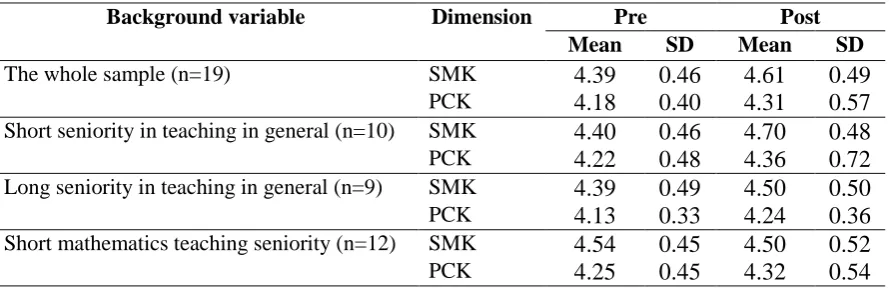
Already at the beginning of the program, the teachers assessed their capabilities with
reference to SMK and PCK as high to very high (4.39 and 4.18 respectively, on a
scale ranging between 1-5). At the end of the program, the findings showed a slight
increase (of less than half the standard deviation) in the teachers' perceptions of these
two dimensions (4.61 and 4.31 respectively). The comparison of the PCK perception
and the SMK perception in each of the test dates separately indicated that the teachers
perceived their capabilities of SMK as higher than their capabilities of PCK.
A further examination was done regarding each of the values of the following
background variables: seniority in teaching and seniority in mathematics teaching. A
minor improvement was found between the two test dates regarding the teachers'
perceptions of all the investigated variables. An exception was the relatively
prominent improvement (1.7 SD) in SMK among teachers with vast experience in
mathematics teaching (seniority of 21-36 years). Table 2 presents the statistical
information obtained from this test.
Table 2: Means and SD in teachers' self-perception of their capabilities of understanding mathematics and its teaching
Background variable Dimension Pre Post
Mean SD Mean SD
The whole sample (n=19) SMK 4.39 0.46 4.61 0.49
PCK 4.18 0.40 4.31 0.57
Short seniority in teaching in general (n=10) SMK 4.40 0.46 4.70 0.48
PCK 4.22 0.48 4.36 0.72
Long seniority in teaching in general (n=9) SMK 4.39 0.49 4.50 0.50
PCK 4.13 0.33 4.24 0.36
Short mathematics teaching seniority (n=12) SMK 4.54 0.45 4.50 0.52
12
Long mathematics teaching seniority (n=7) SMK 4.14 0.38 4.79 0.39
PCK 4.06 0.30 4.29 0.66
The improvement trend manifested during the year by the teachers regarding
the assessment of their capabilities found its expression also in the answers to the
open-ended questions. In one of the questions they were asked what are the most
meaningful topics which they acquired while engaging in knowledge relating to
mathematics and the teaching thereof, including solid geometry? Most of the
teachers pointed out that they had acquired extensive new knowledge: three of them
indicated that in general and gave no details. At a similar frequency (4) teachers'
answers related to specific contents studied in the program: mathematical riddles,
rotational solids and intersection of solids. At a somewhat lower frequency (3)
teachers indicated they had acquired knowledge connected to teaching methods in
class. About one quarter of the respondents (4) said they had not acquired new
knowledge or acquired only limited knowledge. Some of these teachers have
extensive experience in mathematics teaching while others have a short seniority.
Another teacher with many years of experience in mathematics teaching indicated: "I
was familiar with the material because I taught it in high school".
Moreover, being engaged throughout the year in writing the initiative proposal,
as another meaningful topic, improved their capabilities. More specified answers were
received at a high frequency (7). These teachers pointed out that they mainly
benefited by acquiring research writing competences (writing literature review and
references) and writing for pedagogical needs (critical reflection). Additional answers
given at a lower frequency related to the fact that the teachers benefited by
comprehending the requirements for writing an initiative (2); teamwork (2);
understanding new ideas and ways of thinking (3). Several teachers (4) gave a general
answer, namely that they benefited from writing the initiative proposal. Only one
teacher told: "I have not learnt, this is knowledge which I had acquired earlier during
my studies towards a bachelor and a master's degrees".
4.1.2 Actualization of expectations
The gap between the initial expectations level and their materialisation at the end of
the year was examined. The results illustrated a decrease in the way teachers felt
13
dimensions of the expectations (a 0.7 SD gap regarding SMK and 0.9 SD related to
PCK). For example, at the beginning of the program the teachers expected to great
extent that following the program they would become acquainted with various
thinking ways of learners (means of the item was 4.06, S.D=0.94). However, at the
end of the year, the mean value for this item was 3.33, and the standard deviation was
0.97.
It seems therefore that at the beginning of the program teachers had high
expectations of acquiring PCK, namely learning didactic tools which would allow
them to enhance their knowledge with a variety of updated teaching and learning
methods; adapt the learning materials to the teaching objectives and the different
capabilities of the learners and so on. These expectations were materialized to an
intermediate extent at the end of the year. This finding complied with the
above-mentioned findings regarding teachers' need to enrich their PCK. These results are
presented in Table 3 below.
Table 3: Means and SD of dimensions of expectations from the program (N=19)
Dimension Pre Post
Mean SD Mean SD
SMK 3.56 0.86 2.92 1.05
PCK 3.80 0.59 3.18 0.86
Another finding associated with the data presented in Table 3 indicates that
teachers' expectations of SMK are somewhat lower than their expectations of CPK at
both the test dates. Table 4 presents the results obtained for the two administrations
after classifying the participants according to their background variables.
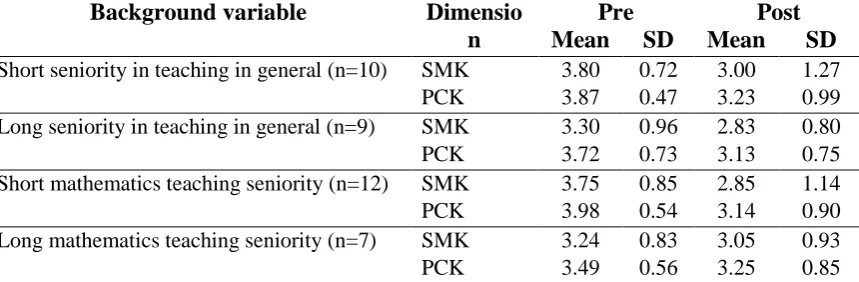
Table 4: Means and SD in teachers' expectations from the program according to their background variables
Background variable Dimensio n
Pre Post Mean SD Mean SD
14
The data presented in Table 4 illustrate a decrease in the level of expectations
from the program among all the comparison groups. The relatively high gaps
(between 0.9 SD and 1.2 SD) in PCK were manifested among teachers having the
least teaching experience in general (13-22 years) and mathematics teaching in
particular (4-20 years). Furthermore, a decrease in the teachers' expectations in
mathematics SMK was prominent among teachers with a short seniority in
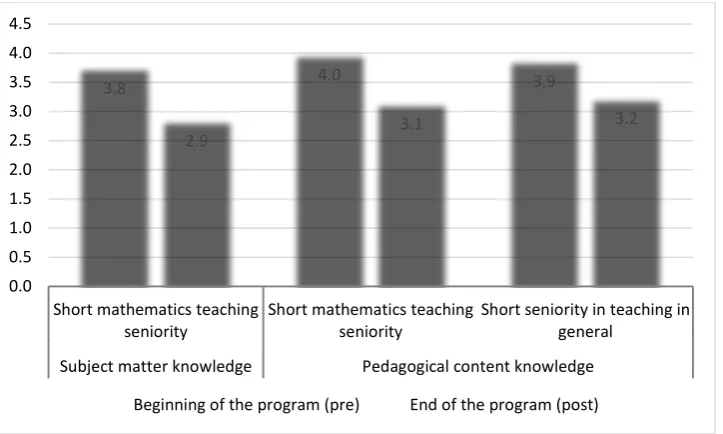
mathematics teaching. These findings relating to the teacher groups, which
demonstrated a considerable change in expectations, are visually presented in Fig. 1
below.
Fig. 1: Teachers' attitudes towards their expectations from the program at its beginning and its end, divided by background variables
Fig.1 clearly shows that the teachers with the relatively shortest seniority in
mathematics teaching displayed a decrease in the level of expectations associated with
the acquisition of both CPK and SMK.
4.1.3. Satisfaction
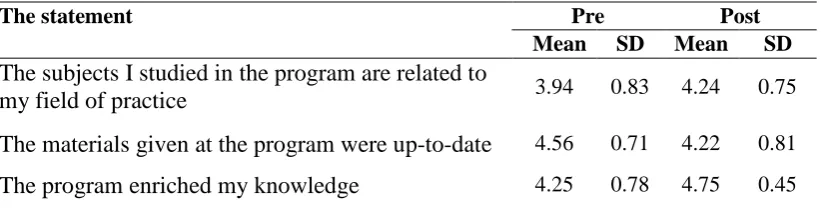
The satisfaction questionnaire explored various aspects associated with the program.
Table 5 presents the means and standard deviations for the statements relevant to the
discipline.
Table 5: Means and SD of statements associated with the disciplinesatisfaction (N=18)
3.8 4.0 3.9
2.9 3.1 3.2
0.0 0.5 1.0 1.5 2.0 2.5 3.0 3.5 4.0 4.5
Short mathematics teaching
seniority Short mathematics teachingseniority Short seniority in teaching ingeneral Subject matter knowledge Pedagogical content knowledge
15
Table 5 illustrates an improvement in teachers' satisfaction related to the
relevancy of the learnt subjects (a gap of 0.4 SD), and mainly to the extent of their
knowledge enrichment (a gap of 0.8 SD). A minor decrease in the teachers'
satisfaction was manifested at the end of the program as to how updated were the
materials presented (a gap of 0.45 SD).
An examination performed according to the teachers' background variables,
while relating to the mean of the three relevant statements, demonstrated that out of
all the comparisons, the greatest improvement in mean satisfaction was expressed by
teachers with an extensive experience in mathematics teaching (21-36 years). The
difference between the mean displayed at the beginning of the program (4.10) and at
its end (4.43) was close to an entire standard deviation (0.8 SD).
The high level of satisfaction of all the teachers at the end of the year was
validated by the answers to the open-ended questions. In one of them, the teachers
were asked whether there were subjects which should not have been addressed
during the program. Only two teachers pointed out that the theoretical part could
have been shortened as well as the subjects studied during the first three encounters
(the generic part of the program). The other teachers (7) indicated that all the subjects
should have been handled, or did not answer that question (10), because they had
nothing to write. For example, one of the answers was: "No, everything was relevant
and important".
When answering another question, few teachers (5) said they had not benefited
from the inculcation of SMK ("new" and "proper" in their words), nor from the
subjects studied during the first three encounters. Four teachers among them have a
short seniority in mathematics teaching. The rest replied that they benefited from all
the areas and gave answers such as: "I benefited throughout the entire course", or did
not respond.
4.2 The didactic-educational area
Post Pre
The statement
SD Mean SD
Mean
0.75 4.24
0.83 3.94
The subjects I studied in the program are related to my field of practice
0.81 4.22
0.71 4.56
The materials given at the program were up-to-date
0.45 4.75
0.78 4.25
16
In order to explore the didactic-educational area, the teachers were asked what were
the changes, which transpired in their teaching and/or assessment processes?
Most of the teachers' answers to this question (10) related to changes generated in
their teaching methods. Some of them indicated that they had undergone these
changes following the lessons of the lecturer in charge of the generic part of the
program. These changes are connected to the way of teaching both from the
pedagogical aspect (more revisions of the material in varied ways, providing simple
explanations, encouraging learners who encounter difficulties); from the
content-oriented aspect (the initiative focus); and from the organizational aspect (effective use
of the lesson time). Additional answers related to the changes in teachers' approach
and ways of thinking regarding their work in class: doubting things which seemed
obvious, way of asking questions in class and more focused and pupil-oriented
observation of learners in class and their learning methods; and observation of
learning processes of the teachers themselves. As one of the teachers formulated it: "I
have learnt to think differently, approach learners in another way and pay more
attention to my learning method as well as to that of my pupils".
The changes mentioned in relation to the assessment processes were few. Thus
for example, one of the teachers said: "I don't give very low scores to my pupils. I ask
them to do the test again after having indicating their mistakes and working with them
on the subject which they find difficult". Only two teachers mentioned that no
changes had been generated in their teaching and/or assessment method.
In addition, the teachers were asked whether they had implemented in their
class an activity which integrated certain aspects acquired during the program.
Among the teachers who gave examples of activities in class following the program,
the most salient answer related to maximum involvement of all the pupils in class (6).
Moreover, the teachers indicated activities of mathematical language (4), enrichment
activities, thinking assignments and use of riddles (3), as well as using ideas learnt in
the field of solid geometry (2). One teacher said "yes" without giving any further
details; another wrote "no" while two others mentioned "not yet". These last three
teachers have a very limited experience in mathematics teaching. Below are example
answers of teachers who implemented in their class what they had learnt in the
program:
17
Yes, I am trying to give more thinking-challenge assignments. I started integrating also the study of mathematical concepts in English.
Certainly, the ideas of solid geometry as well as diversity and discourse in class based on what we had learnt here. Paying attention to the discourse and to my words.
Following this question the teachers were asked what more they required in
order to promote implementation of the content they had learnt in the program.
The most prevalent answer (6) to this question related to the need to learn more and
get counselling and support either in the algebra content knowledge or in the PCK.
Thus for example the following answers were given:
I would have liked to listen some more to X (one of the program lecturers). I believe I can learn additional things from him, I liked his approach to the pupils' assessment.
I would have liked to learn algebra so that I could improve my illustrations in class.
The second most frequent answer (3) related to the need for training the school
staff and collaborating with them. Answers such as self-criticism and attention to
teaching as well as experience and time were indicated at a lower frequency (2).
These answers illustrate that the teachers have not yet implemented the
educational initiative they had planned during the first year of the program since this
stage should be applied, according to the program designers, in the second year of the
program. However, the teachers adopted practical measures in order to materialize the
knowledge and competences acquired during the program.
Another feature of the didactic-educational area relates to the learning method
during the program and the teachers' teamwork. In this context, the teachers were
asked what were the most meaningful things they acquired while engaging in
teamwork for the purpose of implementing the initiative. About one quarter of the
obtained answers (5) were positive but general. For example: "Teamwork is important
and contributes to work". Four additional answers manifested the importance of
dividing and sharing the work. At a lower frequency, the teachers indicated the
collaborative thinking and brainstorming (3) and the opportunity of enriching their
18
outcome: "Writing the initiative made our teamwork more effective and facilitated
achievement of better outcomes". Two others related to the outcome of the teamwork:
Making new friends and integration of school's staff. One teacher pointed out that he
had learnt to be flexible within the framework of the teamwork.
4.3 The personal-emotional area
The contribution of the program to the personal-emotional area was investigated
through the teachers' satisfaction with reference to the program's compliance with
their professional needs and their expectations (personal aspect) as well as with
reference to the lecturers' attitude and the atmosphere in the group (emotional aspect).
Table 6 presents the means and standard deviations for the statements, which are
relevant to the personal-emotional area.
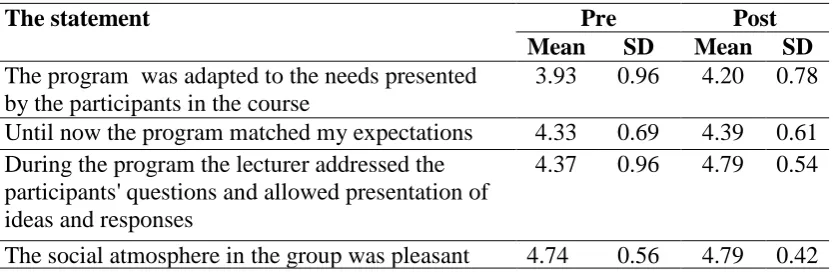
Table 6: Means and standard deviations for statements which are relevant to satisfaction in the personal-emotional Area (N=19)
Post Pre The statement SD Mean SD Mean 0.78 4.20 0.96 3.93
The program was adapted to the needs presented by the participants in the course
0.61 4.39
0.69 4.33
Until now the program matched my expectations
0.54 4.79
0.96 4.37
During the program the lecturer addressed the participants' questions and allowed presentation of ideas and responses
0.42 4.79
0.56 4.74
The social atmosphere in the group was pleasant
Table 6 illustrates that teachers' satisfaction in the personal-emotional area at
the end of the program was higher than reported at the beginning. The gap between
the two test dates was particularly prominent regarding the teachers' satisfaction with
the lecturers' attitude (4.79 vs 4.37 respectively). This gap is more than half the
standard deviation (0.6 SD).
Data analysis according to teachers' background variables, while relating to
the mean of the four relevant statements, showed that in the emotional aspect too,
teachers with many years of experience in mathematics teaching expressed greater
satisfaction at the end of the first year of the program than at its beginning (4.61 vs
4.31, respectively). This gap (0.8 SD) was the highest in comparison to the other
background variable.
Moreover, teachers' future expectations regarding the second year of the
19
Analysis of the teachers' answers to the open-ended question ("what are your
expectations from the next year of the program?") displayed expectations for
assistance in applying the initiative at school, with all that it involves (5 teachers).
Most of these teachers (4) have limited experience in mathematics teaching. Below
are some examples of their answers:
Assistance, support in implementing the initiative, criticism and feedback about the process introduced at school so that I can improve and learn.
Focus myself more on the implementation of the initiative at school.
In addition, other teachers, who also have a shorter experience in mathematics teaching, related also to the possible effects of the initiative:
That the initiatives be fruitful and successful.
Implement the initiative and see results in the pupils' learning.
Further answers (4) related to the expectation that the tutors would support the
practice and that the peer learning would continue. Half of these answers were given
by teachers with a limited experience in mathematics teaching and the other half by
teachers who are highly experienced in mathematics teaching. Below are some
examples: "Closer support and tutoring. What I missed was conducting with the tutor
a discourse, which would enable presentation of ideas and growth"; "Continue peer
learning, be enriched by learning materials and participants' ideas".
Thus, teachers' expectations associated with the continued program related to
their wish that the actual practice of internalizing the educational initiatives developed
during this year would be accompanied by feedback and tutoring. Moreover, some
teachers were aware of the anticipated difficulties following the implementation of the
initiatives. One of the teachers wrote: "… the tutors will support the practice and help
in things which make me stuck or unsuccessful". Three more teachers, two of them
having long seniority in mathematics teaching asked that "the level of studies will
remain the same as in the previous year". Two teachers with a short experience
replied they expected more workshops and greater emphasis on the practical part.
20
The research assessed a 2-year in-service training course at the end of its first year,
aiming to assist in making concrete decisions associated with additional similar
programs. Moreover, the study presented insights that can be used for the Ministry of
Education's decision-making regarding the issue of internalizing mathematics
teachers’ professional development programs. The contribution of the program was
explored with reference to three areas defined as essential for the professional
development of education practitioners. The first area was discipline, which related to
three aspects: assessing teachers' capabilities in mathematical and pedagogical content
knowledge, actualization of expectations as well as satisfaction with the professional
knowledge acquired in the program.
The findings show that at the beginning of the program and at its end the
teachers assessed themselves as having a high to very high capability both in the SMK
and the PCK. In each of the two test dates, their self-perception regarding PCK of
geometry teaching was low as compared to the way they assessed their SMK. This
was supported by Shriki and Patkin (in press) who found that 'teachers indicated
difficulties in coping with pupil heterogeneous classes and the need to know varied
learning materials, while developing their capability of adapting these materials to the
types of learners… teachers' need to enhance their mathematical knowledge was
found less meaningful…' (Ibid, p. 187).
A comparison of the two test dates illustrates that at the end of the first year of
the program a slight improvement transpired in the way the teachers perceived their
capabilities of comprehending mathematics (SMK) and of teaching it (PCK).
However, teachers with the longest mathematics teaching seniority demonstrated a
noticeable change in the way they perceived their capability of comprehending
mathematics.
Explanation for the finding relating to experienced teachers might be
embodied in the professional stage at which they are. According to the model of
teachers' career circles developed by Huberman (1989), teachers with a 19-30 years
seniority in teaching are at a stage whereby some of them are satisfied with their
choice to teach and they find renewed energy to continue developing. Perhaps then,
teachers in this study organized the content knowledge they had acquired during the
program in a different way than the teachers who were less experienced, and
21
more in this respect. Moreover, there is empirical evidence that teachers who, from
the professional development viewpoint, are at the growth and enthusiasm stage
display more positive attitudes towards the introduction of changes and the
implementation of educational initiatives (Masskit, 2011). The experienced teachers'
sense of greatly benefiting from the program probably affected their satisfaction with
it both from the professional and personal-emotional aspects as shown further on.
Regarding the extent of actualization of teachers' expectations with reference
to SMK and CPK which the program inculcated to them, findings attested that
teachers' expectations from the program tended to be higher with regard to the PCK
than to the SMK, both at the beginning and end of the program. These findings might
be explained by the teachers' relatively low self-assessment of their capability in the
field of PCK.
Teachers' great need at this stage for the inculcation of PCK is in line with
findings of other studies (Shriki & Lavy, 2012; Shriki & Patkin, in press). These
studies explored mathematics teachers' perceptions of their professional development
needs. Their findings showed that teachers were interested in improving their
professional knowledge so that it affects the pupils' learning in class.
A comparison performed at the beginning and end of the program indicated a
decrease among all the teachers in their level of expectations with regard to the
inculcation of SMK and PCK. Analyses made according to teachers' background
variables illustrated a decreased expectations level mainly with regard to PCK.
Teachers with a high number of years of teaching experience in general and
mathematics teaching in particular did not manifest a considerable decrease in the
level of their expectations.
Perhaps the teachers' feeling that their expectations have not been fully
materialized is connected to the fact that they have not yet managed to implement, in
the educational practice at school, the initiative, which they had planned and
developed during their first year of studies. One can assume that if detailed
information about the program and its objectives had been given to the teachers at the
beginning of the program, it would have allowed us to diagnose the meaning and
essence of the change processes (expected following the program) from the teachers'
22
Findings relating to these two aspects of the discipline, namely teachers'
capabilities assessment and their expectations from the program, show that teachers
whose professional and experiential background are different benefit differently from
the mathematics program, with regard to the change in the perception of their
capabilities and in their expectations level throughout the program. Also other studies
reported that mathematics and science teachers had different expectations from
professional development programs. This difference was related to the number of
their years of seniority (Chval et al., 2008).
Findings related to the third aspect of the discipline, which engaged in teachers'
satisfaction, indicate an improvement in teachers' attitudes towards their benefit from
the relevancy of the learnt subjects and mainly from the knowledge they have
acquired. However, there was a slight decrease in their attitudes towards the benefit
from the materials used during the program.
Teachers with a relatively vast experience in mathematics teaching
demonstrated throughout the year a prominent improvement in the mean value of the
satisfaction variable. This improvement might be connected to the fact that the
program empowered their sense of mathematics comprehension capability (see
findings related to the first aspect).
The fact that all the teachers were generally satisfied with the program was also
manifested by their indication that the mathematics program did not include any
subjects which failed to benefit them. Only a few teachers, mostly having a short
mathematics teaching seniority, mentioned that they did not benefit from the
inculcation of new mathematical knowledge as well as of subjects learnt in the
generic part of the program.
The second investigated area, which is related to teachers' professional
development, was the didactic-educational area. The teachers attested that changes
had been generated in their professional practice, mainly in the field of teaching
processes and less in the field of assessment processes. Most of them, mainly those
most experienced in mathematics teaching, managed to apply in their class the
knowledge, ideas and competences they had acquired mainly during the generic part
of the program, (e.g., the need to involve all the pupils in the class activities). In order
23
teachers underscored the need for assistance in acquiring knowledge and being
supported by the program tutorial team.
In addition, it was evident that the teachers greatly benefited from the
teamwork they experienced when implementing the initiative. The learning method
during the program can account for this finding. The participant teachers were divided
into work teams. In some initiatives, participants from different schools worked for
the same initiative together in the same team. This entailed an enhanced peer learning
in implementing common initiatives simultaneously at several schools. Towards the
end of the year, initiatives in mathematical context were consolidated and proposed.
The titles of two of them were for example: " the interplay of mathematics and
English"; and "school speaks 'measures'". Teamwork like the one teachers
experienced during the program can constitute a modeling for their teaching style in
class. They as teachers could lead the development of pupils' initiatives and inquiry
works in the spirit of the teamwork they applied as learners during the program.
The third investigated developmental area was the personal-emotional area.
The teachers' answers attested to an improvement in their satisfaction with the extent
to which the program complied with their professional need and their expectations,
and mainly with the lecturers' attitudes towards the participants' questions during the
program. In this context too, the improved satisfaction was manifested by teachers
with the highest number of years engagement in mathematics teaching.
Regarding the second year of the program, the teachers expressed their wish to
be assisted in the internalization of the initiative at school as well as their hope that
the initiative will yield results. These expectations seem essential to the success of the
program. The research literature dealing with teachers' continued learning indicates
that one of the conditions for attributing an added value to teachers' professional
development is that implementation of the contents, ideas and experience learnt
during the various development processes, are accompanied by inquiry processes,
additional learning and internalization of the material with the assistance of experts
and peers (Avdor, 2008).
The findings associated with the change process, which the teachers have
undergone during the first year of the program with reference to the discipline as well
as with the personal-emotional area, can be analyzed through the terms of the model
24
program the teachers were focused on themselves, their behaviors and competences
related to the introduction of the change.
The high expectations for enriching their SMK and PCK illustrated that the
teachers were interested in the informational stage, which falls in the self-concern
level. Analyzing the way the teachers expressed their future expectations from the
second year of the program, shows that at the end of the year some of teachers’
attention focused on the impact of the change since they were concerned about the
consequence (the effect of the change on pupils' attainments) and about
collaboration (the need for teamwork and coordination with others about the change
processes). Nevertheless, other teachers, mostly having a short seniority in
mathematics teaching, are still preoccupied with the organisation of the initiative and
its implementation at school (task-oriented) and hence are at the management stage.
That is, they focus on the patterns of action, which they have started setting for
themselves around the new ideas they have studied. Thus, at the end of the first year
of the program, the teachers gradually begin adjusting themselves to the anticipated
change. According to their professional background and personal preferences they
implement in their own way the competences and strategies they have acquired in the
program.
In the second year of the program, after assimilating the initiative developed at
school, all teachers are expected to be at the refocusing stage. At this stage, they will
explore the change effectiveness and impact and the question whether changes and
adaptations are required (Guskey, 2002). This assumption is based on
research, showing that teachers' concerns about implementing innovative pedagogical
practices were altered as a result of a professional development: concerns shifted from
focusing on the need for information (personal concerns) and management of the
innovative pedagogical practice, to concerns about collaborating with colleagues and
about refocusing: adjusting the innovation to achieve greater impact on students
(Oleson, 2010).
6. Conclusions
6.1 Conclusions regarding the instrumental use of the findings
This study focused on presenting a small group of teachers' attitudes towards the
25
limitation, the research findings should be considered as initial insights about the way
the program was implemented and the extent of its success rather than
generalizations. It seems that the research findings can also at this stage serve the
developers of this program and of similar programs in a direct and immediate manner
with regard to the instrumental use of the research findings.
In light of the teachers' satisfaction with this program, it is recommended to
conduct the course also in the future. Nevertheless, one should remember that this
study found a difference between the teachers regarding their professional background
and their experience. Hence, they might have benefited differently from the program
in regard to their capability perception, extent to which their expectations were
materialized during the program, as well as their satisfaction from it. Moreover, the
varied foci of interest, preoccupations and concerns manifested by the teachers'
answers attest to the differential impact of the change processes on each of its partners
(Fullan, 2007). Their responses, which manifested experiences in both the cognitive,
emotional and behavioral areas, illustrate the complexity of the change process.
There is empirical evidence that teachers who attended in-service training
courses did not believe that the courses in which they participated satisfied their needs
or contributed to their professional development (Shriki & Patkin, in press).
Therefore, professional development programs should start with needs assessment
(O'Sullivan, 2004), in order to create realistic expectations from the program among
the teachers and to increase their satisfaction. Consequently, the program's designers
should identify, at the stage of planning the course, the knowledge, beliefs, needs and
expectations which teachers bring with them to the course. Moreover, they should
take all of them into consideration in order to create an optimal compliance between
the teachers and their various professional characteristics and the studied contents and
learning materials applied in the course (Shriki & Lavy, 2012). Putting particular
emphasis on activities that make professional development goals explicit, enhancing
teachers' motivation (Santagata et al., 2011).
Since our findings are aligned with Mukundan and his Colleagues (2011), who
found that the teachers with lower teaching experience expressed a higher need for
professional development activities than those who were more experienced, a strictly
planned program may provide a good solution also to this issue. From an operational
26
• Based on the present findings we should keep emphasizing the inculcation of PCK, particularly in the case of teachers with a small number of mathematics teaching
seniority years. Some of these teachers may be at the stage of developing and
consolidating their professional identity as well as their professional confidence and
maturity. As mentioned in the theoretical background of this study, numerous studies
pointed out the relation between teachers' knowledge and that of their pupils (Wayne
& Youngs, 2003; Thames, 2006; National Mathematics Advisory Panel, 2008).
Hence, they stipulated the need to enhance teachers' PCK by attending programs
designed to support their professional development (Shriki & Patkin, in press). This
component of knowledge is perceived by mathematics teachers themselves as a
component, which they need in order to fulfill their role in the best way
(Guberman-Glebov & Gorev, 2012).
• Due to the importance and contribution of the teamwork as mentioned by the
teachers themselves, we should keep considering it as a means of meaningful
learning. Collaborative learning groups involve teachers in a reflective discussion
with colleagues about learning and teaching processes. Hence, they facilitate exposure
of group members' expertise as well as the formation of collective knowledge
throughout the joint work (Stanley, 2011). Moreover, some researchers argue that
learning which transpires within the framework of professional learner communities,
constitutes one of the prerequisites for professional learning having an impact on
teachers' knowledge and competences and on pupils' learning (Darling-Hammond,
Wei, Andree, Richardson, & Orphanos, 2009).
• Most teachers' future expectations, which are focused on implementation of
the initiative and its introduction at school, are the focus of activities of the second
year of the program. Consequently, it is recommended adopting several actions,
which according to the research literature could facilitate introduction of the changes
(Maskit, 2010). For example, granting autonomy to teachers involved in the change
process; evoking a sense of confidence and acknowledging the problematics
stemming from the change; being considerate of teachers' preoccupations and
concerns which emerge following introduction of the change; setting up systems of
collaboration between colleagues within school and between schools; and
implementing the change through flexible work patterns with reference to knowledge
27
implementing an educational initiative) is external, being determined and consolidated
by the Ministry of Education. Nevertheless, these activities might enhance teachers'
sense of responsibility for their work and the outcomes thereof as well as promote the
importance of their place in the change process
6.2 Conclusions regarding the conceptual use of the findings
Regarding the second research goal, we relate to the possible conceptual use of the
research findings. Therefore, we suggest insights which we believe are associated
with the research-based accompaniment that the Ministry of Education should adopt
in order to assimilate programs for mathematics teachers' professional development.
These insights are aimed in practice to internalize the empirical practice as an
organizational way of life rather than a means of making focused decisions only.
Ministry of Education employees, who consolidated the professional
development layout, emphasize the need for bridging the gaps between them and the
field (Ministry of Education, 2014). Based on this statement, here are some
recommendations for further research efforts:
• Getting the whole picture regarding the accomplishment level of the program
objective, as set by its designers, requires a data-based follow-up over a long period of
time. Using empirically an evidence-based conceptual framework associated with the
assimilation of changes, similar to that of Hall and Hord (2011) demonstrated in this
study, could help the program leaders to comprehend the change process; understand
how individuals react to the change; and know what are the proper activities
necessary to guarantee its success. In this context, for example, it would be
appropriate to check whether implementation of the initiative is supported at school in
a direct and overt way, have the required resources been allocated?, is the attending
teachers' impact on the educational institution manifested by the atmosphere and ways
of conducts and so on (Guskey, 2002).
• Furthermore, in order to obtain a full and more appropriate perspective of the
current contribution of the program, it is recommended comparing its outcomes with
outcomes of other similar programs in Israel whose learning layout is different. This
refers to essentially generic programs in several disciplines, which inculcate
28
position holders and different target populations and others (Ministry of Education
2014).
To conclude, it seems fitting to cite Shulman: "If teacher education research is
to make a significant difference, we must make new scholarly commitments.
Long-term programs of scholarship, regularly embedded in ongoing teacher preparation,
must become a norm, with ties to student learning established wherever and whenever
possible" (Shulman, 2002, p.253).
It seems that this study and future ones, which will accompany the second year
of the program might constitute an infrastructure for additional research. The results
of these studies could hopefully improve the education system on its way to promote
teaching and learning processes.
References
Avdor, S. (2008). The layout for teacher's professional development following "Ofek Hadash" reform. The Ministry of Education, Israel. (Academic counseling and final; editing) [Hebrew].
ACME – Advisory Committee on Mathematics Education (2006). Ensuring effective continuing professional development for teachers of mathematics in primary
schools. London: The Royal Society. Retrieved from: www.acme-uk.org
AFT (2002). Principles for professional development, AFT's guidelines for creating
professional development programs that make a difference. Washington, DC:
American Federation of Teachers.
Cetinkaya, B. (2012). Understanding teachers in the midst of reform: Teachers' concerns about reformed sixth grade mathematics curriculum in turkey.
Eurasia Journal of Mathematics, Science & Technology Education, 8(3), 155-166. Retrieved from
http://search.proquest.com/docview/1312422483?accountid=14765
Chval, K., Abell, S., Pareja, E., Musikul, K., & Ritzka, G. (2008). Science and mathematics teachers’ experiences, needs, and expectations regarding professional development. Eurasia Journal of Mathematics, Science & Technology Education, 4(1), 31-43.
29
CSMTP (Committee on Science and Mathematics Teacher Preparation) (2000).
Educating teachers of science, mathematics, and technology: New practices
for the new millennium. Washington, DC: National Academies Press.
Retrieved from: http://fermat.nap.edu/catalog/9832.html
Darling-Hammond, L., Wei, R. C., Andree, A., Richardson, N., & Orphanos, S. (2009). Professional learning in the learning profession: A status report on
teacher development in the United States and abroad. Washington, DC:
National Staff Development Council.
Day, C., & Leicth, R. (2007). The continuing professional development of teachers: Issues of coherence, cohesion and effectiveness. In T. Townsend (Ed.),
International handbook of school effectiveness and improvement (pp.
707-726). Dordrecht: Springer.
Day, C., Sammos, P., Stobart, G., Kington, A., & Gu, Q. (2007). Teachers matter:
Connecting work, lives and effectiveness. Maidenhead: McGraw-Hill/Open
University Press.
Fullan, M. (2007). The New Meaning of Educational Change. (4th ed.), New York: Teachers College.
Gonzales, P., Williams, T., Jocelyn, L., Roey, S., Kastberg, D., & Brenwald, S. (2009). Highlights from TIMSS 2007: Mathematics and Science Achievement
of U.S. Fourth and Eighth-Grade Students in an International Context. IES,
National Center for Education Statistics, U.S. Department of Education. Washington, DC. Retrieved from http://nces.ed.gov/pubs2009/2009001.pdf
Guberman-Glebov, R., & Gorev, D. (2012). What elementary school mathematics teachers should know and be able to do – From the point of view of the
teachers of mathematics in elementary schools. Achva Academic college of
Education, Israel. [Hebrew].
Guskey, T. R. (1986). Staff development and the process of teacher change.
Educational Researcher, 15(5), 5-12.
Guskey, T. R. (1995). Professional development in education: In search of the optimal mix. In T. R. Guskey & M. Huberman (Eds.), Professional development
education: New paradigms and practices (pp. 114-131). New York: Teachers
College Press.
Guskey, T. R. (2002). Does it make a Difference? – Evaluating Professional Development. Educational Leadership, 59(6), 45-51.