Study on Combining Ability and Heterosis in Maize (Zea
mays l.) Using Partial Diallel Analysis
Ali Abdikadir Hassan
1*, Abubakar Ali Jama
2, Omar Hassan Mohamed
3, Bhabendra Kumar Biswas
41,4Department of Genetics and Plant Breeding, Faculty of Agriculture, Hajee Mohammad Danesh Science and Technology
University, Dinajpur, Bangladesh
2Faculty of Agriculture, Zamzam University, Mogadishu, Somalia
3Department of Fisheries Management, Hajee Mohammad Danesh Science and Technology University, Dinajpur,
Bangladesh
In the present study, six diverse maize inbred lines were crossed in all possible combinations without reciprocals by using a half diallel mating design to obtain 15 single crosses. Inbred parents and their F1 single crosses with a check were evaluated to assess the role of general and specific combining ability and heterosis for some quantitative traits. Significant general combining ability variances was observed only for cob height and number of kernels per row and specific combining ability variances were observed for plant height, cob length, Number of kernel rows per cob, number of kernels per row, number of kernels per cob, cob weight, thousand grain weight and grain yield per plant. The GCA/SCA ratio was less than unity for all studied traits. Based on GCA estimates, it could be concluded that the best combiners were ML10, ML14 and ML15 inbred lines for most of the studied traits. This result indicated that these inbred lines could be considered as good combiners for improving these traits. Significant positive SCA effects were found for all studied traits. Based on SCA effects, it could be concluded that the crosses, ML06×ML10, ML10×ML15, and ML15×ML17 could be exploited by the maize breeders to increase maize yield. Three F1 hybrids such as ML06×ML10, ML10×ML15, and ML15×ML17 proved to be the outstanding hybrids to immediate further steps for commercial cultivation. Conclusively, the F1 hybrid, ML15×ML17 was the best combination as evaluated through combining ability and standard heterosis.
Keywords: Zea mays; Inbreed lines; heterosis; general combining ability; specific combining ability
INTRODUCTION
Maize (Zea mays L.) is one of the important cereal crops and occupies a prominent position in global agriculture after wheat and rice. According to World Data Atlas, global
maize production was 1134million tons in the year 2017.
Subtly and silently maize, also known as corn, has emerged as the most important cereal crop after rice in
Bangladesh, relegating wheat to third. Country’s annual
maize output reached the new high of 2.75 million tons in 2016-17 and 90 percent of the home-grown maize is
feeding a burgeoning poultry and fish feed industry (BBS,
2018). Maize being a C4 type plant, is physiologically more efficient, has higher grain yield. It provides food, feed, fodder, fuel and serves as a source of basic raw material for a number of industrial products viz., starch, oil, protein, alcoholic beverages, food sweeteners, cosmetics and bio-fuel etc. It is a versatile crop with wider genetic variability
and able to grow successfully throughout the world covering tropical, subtropical and temperate agro-climatic conditions. Maize acreage and production have an increasing tendency with the introduction of hybrids due to its high yield potential (Izhar and Chakraborty, 2013). Knowledge of genetic architecture of the characters is essential for adopting appropriate breeding procedure. Such knowledge leads the plant breeder to develop new commercial varieties of the crop. A sound breeding
*Corresponding Author: Ali Abdikadir Hassan, Department of Genetics and Plant Breeding, Faculty of Agriculture, Hajee Mohammad Danesh Science and Technology University, Dinajpur, Bangladesh.
E-mail: [email protected]
Research Article
programme provides the opportunity to produce high yielding varieties of a crop. However, the development of meaningful breeding programme needs information on the nature of gene actions controlling the yield and yield contributing characters (Tewachew et al., 2018). Stressed that information on variation attributable to genetic differences and also on the relationship among various quantitative traits is fundamentally significant in a crop improvement programme. Inbred lines are prerequisite for hybrid development in maize. Combining ability is an important aspect of hybrid breeding programme and its analysis is of special importance in cross-pollinated crops like maize as it helps in identifying potential parents that can be used for producing hybrids and synthetics (Uddin
et al., 2008;Talukder et al., 2016). Over the years, the combining ability concept has become increasingly important not only in maize but in other crops as well. Combining ability studies are more reliable as they provide useful information for the selection of parents in terms of performance of hybrid (Amiruzzaman et al., 2010). It helps to get idea about the nature of gene action for a particular character (Uddin et al., 2008; Astereki et al., 2017). This information is also useful to breeder for selection of diverse parents and hybrid combinations. Diallel cross analysis provides the estimates of genetic parameters regarding combining ability and a picture of the dominance relationship of the parents studied using the first filial generation (F1) with or without reciprocals. The potential of heterosis is just beginning to be exploited in developing countries through expansion of hybrid seeds. A number of populations e.g., single crosses, three-way crosses, double crosses, varietal hybrids, multiple hybrids, composites, synthetics, pools etc. are feasible for commercial cultivation by virtue of the crop being a highly cross-pollinated species. Yield in maize crop has increased substantially over the years as the breeders are successful in harnessing the heterosis than in other crop species. The discovery of heterosis phenomenon, the development of hybrid breeding technology and successful commercial exploitation of heterosis in maize are considered to be significant achievements and land marks in the history of biological sciences during the present century. This indicates the importance of maize in the ever-increasing demand for food and warrants the continuous development of new high yielding hybrids. In heterosis breeding programme, the selection of parents/inbreeds based on their morphological diversity with good combining ability is very important in producing superior hybrids. The analysis of general combining ability (GCA) and specific combining ability (SCA) helps in identifying potential parents/inbreeds for the production of superior hybrids (Aisyah et al., 2016). The concept of combining ability was introduced by Sprague and Tatum (1942) and its mathematical model was set by Griffing (1956) in his classical paper in conjunction with the diallel crosses, where partitioned the total variation of diallel data into GCA of the parents and SCA of the crosses. The value of any inbred/parent depends on its per se performance and its combining ability in crosses (Vacaro et al., 2002).
Diallel crosses have been widely used in genetic research to investigate the inheritance of important traits among a set of genotypes. The nature and magnitude of gene action is an important factor in developing an effective breeding programme, which can be understood through combining ability analysis. Beside combining ability, value of heterosis can also be used as one important consideration for selecting parent genotype and novel hybrid. The information of heterosis value on certain selected genotypes can be very useful for development hybrid novel variety (Amanullah et al. 2011) and is helpful to plant breeders for formulating hybrid breeding programs. Therefore, the present study aimed to investigate the general combining ability of parents for yield and its components with identifying the best performing hybrids on the basis of specific combining ability.
MATERIALS AND METHODS
Location and soil condition
The experimental field was located at 24.00N latitude and
90.250E longitudes at an altitude of 34m above the sea
level. The land belonged to the Agro Ecological Zone (AEZ) of the Old Himalayan Piedmont Plain of Bangladesh. The soil was sandy loam with pH value of 6.2 during the growing period to the crop.
Experimental Design and Layout
Six promising maize pure line cultivars (ML06, ML10, ML14, ML15, ML17, and ML25) were crossed in half diallel fashion excluding the reciprocals. The lines were come out for the development of 15 experimental hybrids (Table 1). These six inbred were considered as the parental lines for the development of experimental hybrids. The experiment was set up in a Randomized Complete Block Design (RCBD) with three replications. The plot size was 18.4m x 4.5m. The distance maintained between two lines was 0.75m and between block was 1.0m.
Land Preparation
The experimental plot was prepared by ploughing with power tiller followed by exposed to the sun for a week and after one week the land was harrowed, ploughed and cross-ploughed several times followed by laddering to obtain a good tilth. After laddering the weeds and the stubbles of previous crops were removed from the land and finally a desired tilth of soil for planting of maize seed was obtained.
Application of Manures and Fertilizers
rate of 50, 195, 100, 10 and 10 kg/ha respectively as basal doses. The rest of 120 kg urea was applied in three equal splits (i.e.40 kg/ splits) at 25, 45, and 60 days after planting as side dressing, 3-5 cm away from the plant and the furrow of the fertilizer of the fertilizer of the hilled up immediately, at the same time third dressing of urea, rest 35 kg of MOP was used. The maize seed were planted in lines, each having a line to line distance of 0.75 m and soaked seed (soaking time was 24 h) were planted in the well-prepared plot.
Caring of plants
When the seedling stated to emerge in the beds it was always kept under careful observation. Irrigation was provided at stage, pre-flowering stage and milking stage at 45, 65, and 80 days after planting (DAP) for proper growth and development of plants. The seedling was first thinned from all of the lines 10 days after germination and second thinning was carried out after 7 days for maintaining proper spacing in the experimental plots. Weeding and mulching were done to keep the plots free form weeds, easy aeration of soil and to conserve soil moisture, which ultimately ensured better growth and development. Breaking of crust of the soil was done when needed through mulching. After 50 days of planting, first spray of chlorpyriphos was done against sucking pest such as jassids and aphids. The crops were harvested when the husk cover was completely dried and yellowish color was formed in the grain. The cob of five randomly selected plants of each genotype was separately harvested.
Data collection
Data were collected on maturity (days), plant height (cm), cob length (cm), kernel rows per cob, kernels per rows, kernels per cob, cob weight (g), 1000 grain weight (g) and grain yield per plant (g).
Data analysis
Analysis of variance: The mean values of the entries in each replication were used for analysis of variance (ANOVA). The significant difference among genotypes was tested by `F` test at 1% and 5% levels of probability.
Estimation of heterosis: Heterosis expressed as percent of increase of Fl hybrid over mid parent (average or relative heterosis), better parent (heterobeltiosis) and commercial check (standard heterosis) were computed for each character using the formula of Griffing (1956) and Mirshamsi et al. (2006).
RESULTS AND DISCUSSION
Results indicated that mean squares of genotypes were highly significant for all studied traits i.e., maturity, plant
height, number of kernel rows per cob, number of kernels per cob, cob weight, and 1000 grain weight (Table 2). General combining ability mean squares (GCA) were significant for all traits except cob length, number of kernels per row and rain yield per plant. On the other hand, Specific Combining Ability (SCA) mean squares were highly significant for maturity, plant height, number of kernel rows per cob, number of kernels per cob, cob weight, and 1000 grain weight. The GCA/SCA ratio was less than unity for all studied traits.
General combining ability effects
Significant GCA effects were found for all studied traits except the cob length, number of kernels per row and grain yield per plant (Table 2). Based on GCA estimates (Table 3), it could be concluded that the best combiners for plant height were ML10 and, ML14; for cob length ML06 and ML14; for number of kernel row per cob ML06; for number of kernel per row ML17; for number of kernel per cob ML14 and ML15; for cob weight ML14; for hundred grain weight ML06 and ML10 and for grain yield per plant inbred lines were ML06 and ML14. These results indicated that these inbreed could be considered as good combiners for improving these traits. Amiruzzaman et al. (2010) also identified the correlation of good general combining ability of grain yield and other yield attributing traits with per se
performance of parental genotypes. Therefore, per se
performance of parents could be used as useful index for general combining ability.
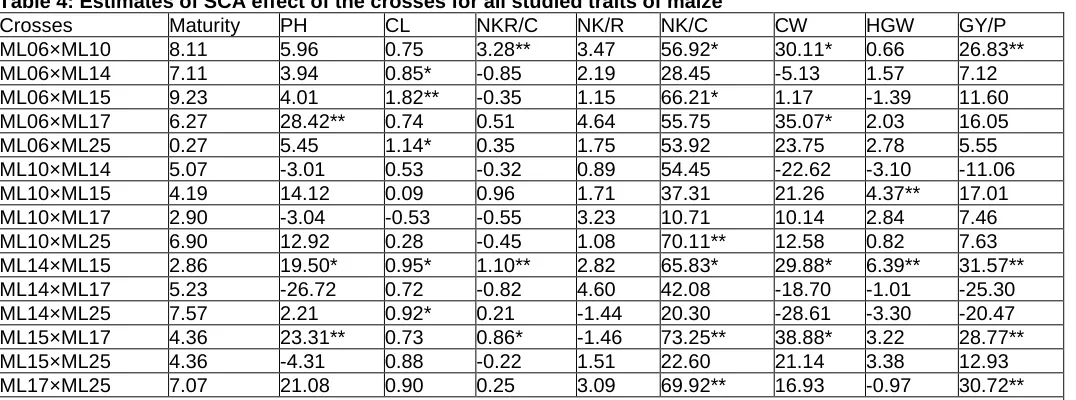
Specific combining ability effects
Heterosis over mid-parent
Results showed positive and negative significant heterosis values for all studied traits. For the trait of plant height ML06×ML17, ML15×ML17 and ML17×ML25; for cob length ML06×ML25 and ML06×ML15 for number of kernel rows per cob ML06×ML10 and ML10×ML15; for number of kernel per row ML06×ML17, ML10×ML25, ML15×ML17 and ML17×ML25; for number of kernel per cob; ML06×ML10, ML06×ML15, ML06×ML17, ML10×ML25, ML15×ML17, ML15×ML25 and ML17×ML25; for cob weight all crosses except ML06×ML14, ML15×ML17, ML06×ML17 and ML06×ML10; for hundred grain weight ML14×ML15, ML10×ML15 and ML15×ML17, and for grain yield per plant ML10×ML15, ML10×ML25 and ML15×ML17 showed positive significant heterosis over mid-parent (Table 5).
Heterosis over better-parent
Results showed significant heterosis values over better-parents in all studied traits except maturity and hundred grain weights for most crosses. For plant height ML06×ML17, ML15×ML17 and L17×ML25; for cob length ML06×ML25 and ML10×ML15; for number of kernel rows per cob ML06×ML10, ML10×ML15 and ML15×ML17;
number of kernel per row ML06×ML15, ML06×ML17, ML10×ML17, ML10×ML25, ML15×ML17 and ML17×ML25; for number of kernel per cob ML06×ML10, ML06×ML15, ML06×ML17, ML10×ML17, ML15×ML17 and ML17×ML25; for cob weight ML06×ML10, ML06×ML17, ML10×ML15 and ML15×ML17, and for grain yield per plant ML06×ML10, ML06×ML15, ML06×ML17, ML10×ML15, ML10×ML17, ML15×ML17 and ML17×ML25 were showed significant and positive heterosis over better-parent (Table 6).
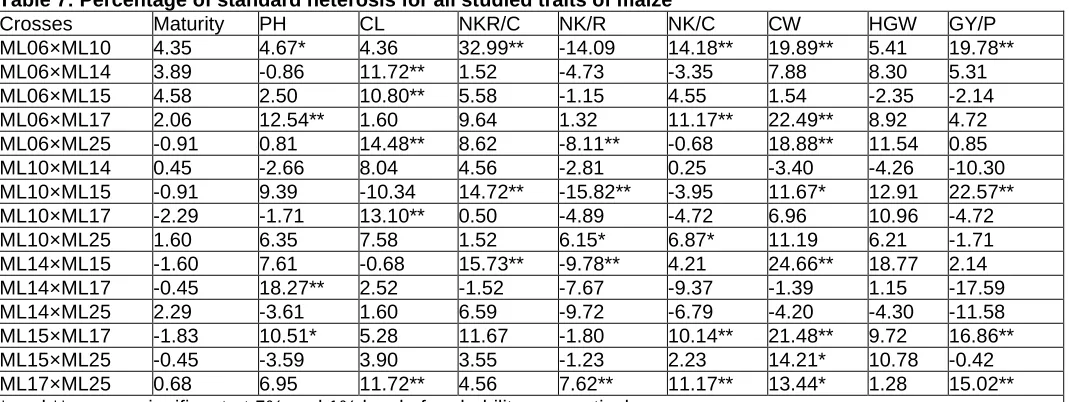
Heterosis over check variety
Two hybrids showed significant standard heterosis for plant height i.e. ML06×ML17 and ML14×ML17. For cob length ML06×ML14, ML06×ML15, ML06×ML25, ML10×ML17 and ML17×ML25; for number of kernel rows per cob ML06×ML10, ML10×ML15 and ML14×ML15; for number of kernel per row ML17×ML25; for number of kernel per cob ML06×ML10, ML06×ML17, ML10×ML25, ML15×ML17 and ML17×ML25; for cob weight ML06×ML10, ML06×ML17, ML06×ML25, ML10×ML15, ML14×ML15, ML15×ML17, ML15×ML25 and ML17×ML25, and for grain yield per plant ML06×ML10, ML10×ML15, ML15×ML17, and ML17×ML25 showed the positive significant heterosis over check variety (Table 7).
Table 1: Representation of half diallel crossing program with six parents
ML06 ML10 ML14 ML15 ML17 ML25
ML06 ML06×ML10 ML06×ML14 ML06×ML15 ML06×ML17 ML06×ML25 ML10 ML10×ML14 ML10×ML15 ML10×ML17 ML10×ML25
ML14 ML14×ML15 ML14×ML17 ML14×ML25
ML15 ML15×ML17 ML15×ML25
ML17 ML17×ML25
ML25
Table 2: Mean squares from analysis of variance for Genotypes, General Combining Ability (GCA) and Specific Combining Ability (SCA) of all studied traits of maize
SOV Maturity PH CL NKR/C NK/R NK/C CW TGW GY/P Genotypes 261.04*** 934.44*** 2.475 3.5168* 57.88 33102.88** 2717.55* 34.05* 1659.34 GCA 18.46** 92.50 1.86** 0.2483 9.71** 10451.25 300.13 1.1 260.60 SCA 109.86*** 384.47*** 2.93** 1.4802** 18.88** 41841.12** 1107.75** 14.73** 650.61* Error 1.30 56.72 1.48 0.5084 22.29 3765.02 421.17 4.97 288.92 GCA/SCA 0.168 0.240 0.635 0.167 0.514 0.25 0.270 0.080 0.400 σ2A 0.00 0.00 -3.26 0.00 -2.30 -1439.46 0.00 0.00 0.00
σ2D 434.23 1311.00 12.58 3.88 -3.41 3266.97 2746.34 39.04 1446.77
* and ** means significant at 5% and 1% level of probability, respectively; σ2A = Additive genetic variance, σ2D = Dominant
Table 3: Estimates of general combining ability effects for inbred parents for all studied traits of maize
Parents Maturity PH CL NKR/C NK/R NK/C CW HGW GY/P ML06 2.76 1.35 2.65** 0.19** 0.85** 83.16** -0.57 0.12** 1.76* ML10 -0.19 4.78** 0.55* 0.06* -5.18** -182.17** -2.90** 0.08 -4.31** ML14 0.13 4.09** 1.98** 0.06* -4.54** 130.56** 11.27** 0.25** 8.46** ML15 -0.98 2.46* -2.23** 0.10** 1.94* 157.65** -6.16** -0.76** -7.61** ML17 -1.69 -2.20* 1.29** -0.23** 7.05** -170.86** -3.30** 0.03 -1.40* ML25 -0.02 -2.30* 0.54** -0.20** 0.88* 118.44** 1.68 0.26** -1.40* * and ** means significant at 5% and 1% level of probability, respectively
PH= Plant height (cm), CL= Cob length (cm)NKR/C= Number of kernel rows per cob, NK/R= Number of kernels per row, NK/C= Number of kernels per cob, CW= Cob weight (g), TGW= 1000 grain weight (g) and GY/P= Grain yield per plant (g)
Table 4: Estimates of SCA effect of the crosses for all studied traits of maize
Crosses Maturity PH CL NKR/C NK/R NK/C CW HGW GY/P ML06×ML10 8.11 5.96 0.75 3.28** 3.47 56.92* 30.11* 0.66 26.83** ML06×ML14 7.11 3.94 0.85* -0.85 2.19 28.45 -5.13 1.57 7.12 ML06×ML15 9.23 4.01 1.82** -0.35 1.15 66.21* 1.17 -1.39 11.60 ML06×ML17 6.27 28.42** 0.74 0.51 4.64 55.75 35.07* 2.03 16.05 ML06×ML25 0.27 5.45 1.14* 0.35 1.75 53.92 23.75 2.78 5.55 ML10×ML14 5.07 -3.01 0.53 -0.32 0.89 54.45 -22.62 -3.10 -11.06 ML10×ML15 4.19 14.12 0.09 0.96 1.71 37.31 21.26 4.37** 17.01 ML10×ML17 2.90 -3.04 -0.53 -0.55 3.23 10.71 10.14 2.84 7.46 ML10×ML25 6.90 12.92 0.28 -0.45 1.08 70.11** 12.58 0.82 7.63 ML14×ML15 2.86 19.50* 0.95* 1.10** 2.82 65.83* 29.88* 6.39** 31.57** ML14×ML17 5.23 -26.72 0.72 -0.82 4.60 42.08 -18.70 -1.01 -25.30 ML14×ML25 7.57 2.21 0.92* 0.21 -1.44 20.30 -28.61 -3.30 -20.47 ML15×ML17 4.36 23.31** 0.73 0.86* -1.46 73.25** 38.88* 3.22 28.77** ML15×ML25 4.36 -4.31 0.88 -0.22 1.51 22.60 21.14 3.38 12.93 ML17×ML25 7.07 21.08 0.90 0.25 3.09 69.92** 16.93 -0.97 30.72** * and ** means significant at 5% and 1% level of probability, respectively
PH= Plant height (cm), CL= Cob length (cm)NKR/C= Number of kernel rows per cob, NK/R= Number of kernels per row, NK/C= Number of kernels per cob, CW= Cob weight (g), TGW= 1000 grain weight (g) and GY/P= Grain yield per plant (g)
Table 5: Percentage of heterosis over mid-parents for all studied traits of maize
Crosses Maturity PH CL NKR/C NK/R NK/C CW HGW GY/P ML06×ML10 17.57 13.60** -3.50 37.35** 0.82 39.34** 43.95** 9.66** 48.37** ML06×ML14 16.90 8.26 9.33 -2.08 0.11 -2.26 2.60 8.35 9.63 ML06×ML15 18.13 17.58** 8.68** 7.49 17.56* 29.21** 39.56** 12.30** 47.39** ML06×ML17 16.03 30.05** -2.32 10.06* 22.40** 34.76** 55.71** 13.87** 40.97** ML06×ML25 11.34 15.60* 12.23** 8.62 5.11 14.38 37.10** 13.18** 45.11** ML10×ML14 14.80 1.43 -3.09 1.72 2.50 2.01 -11.04 -4.15 -5.83 ML10×ML15 13.68 19.44** -19.42** 17.86** 0.52 19.58* 46.53** 29.94** 48.55** ML10×ML17 12.84 8.08 -0.35 1.80 15.36* 16.33* 30.26* 16.07 29.67** ML10×ML25 15.96 16.10* -3.34 2.43 21.92** 23.95** 23.33 7.84 49.15** ML14×ML15 13.49 18.24** -5.67 11.08* -3.70 7.15 27.12* 30.93 16.53 ML14×ML17 14.81 -9.56 -4.64 -6.73 -0.06 -8.30 -5.16 1.75 -13.75 ML14×ML25 16.60 5.88 -3.53 0.59 -6.95 -9.64 -14.48 -6.46 -13.21 ML15×ML17 13.67 28.53** -1.87 11.53* 20.76** 36.20** 69.71* 26.96** 62.23** ML15×ML25 13.91 11.26 -1.13 3.03 14.92* 20.00* 43.43** 13.03** 37.90** ML17×ML25 15.98 24.35** 4.07 2.61 27.15** 28.12** 32.62* 3.34 43.60** * and ** means significant at 5% and 1% level of probability, respectively
Table 6: Percentage of heterosis over better-parents for all studied traits of maize
Crosses Maturity PH CL NKR/C NK/R NK/C CW HGW GY/P ML06×ML10 19.42 8.42 -11.15* 36.10** 0.42 38.33** 38.23** 9.59 46.77** ML06×ML14 18.58 3.92 5.88 -7.40 -9.06 -16.11 -17.29 4.42 -10.23 ML06×ML15 20.31 16.83** 5.47 6.94 15.54* 26.66* 27.17 1.52 30.82** ML06×ML17 18.98 28.27** -7.24 8 18.44** 34.68** 53.41** 13.24 40.00** ML06×ML25 12.79 14.89* 8.87* 6.20 2.92 9.01 27.03 10.53 16.69 ML10×ML14 14.96 0.82 -8.02 -4.62 -7.22 -12.98 -25.94 -7.68 -23.54 ML10×ML15 13.98 13.31* -23.67** 16.19** -0.81 18.07 28.74* 17.53 33.12** ML10×ML17 13.90 1.80 -3.71 -1 12.06* 15.54* 23.32 15.50 29.16** ML10×ML25 16.27 10.16 -8.41 -0.74 18.91** 17.31 18.82 5.26 13.71 ML14×ML15 13.19 12.81* -5.88 5.55 -13.88 -9.55 -4.43 14.52 -12.93 ML14×ML17 16.04 -14.32 -6.40 -10.18 -11.86 -21.34 -24.40 -2.46 -29.76 ML14×ML25 16.75 1.04 -3.70 -2.77 -13.82 -19.10 -26.56 -7.72 -24.64 ML15×ML17 14.43 27.57** -3.88 10* 18.86** 33.59** 56.76** 15.35 44.87** ML15×ML25 14.51 11.29 -1.18 1.24 10.63 12.22 22.04 9.79 15.20 ML17×ML25 17.37 23.39** 1.99 2.23 20.55** 22.03* 21.22 0.37 33.08** * and ** means significant at 5% and 1% level of probability, respectively
PH= Plant height (cm), CL= Cob length (cm)NKR/C= Number of kernel rows per cob, NK/R= Number of kernels per row, NK/C= Number of kernels per cob, CW= Cob weight (g), TGW= 1000 grain weight (g) and GY/P= Grain yield per plant (g)
Table 7: Percentage of standard heterosis for all studied traits of maize
Crosses Maturity PH CL NKR/C NK/R NK/C CW HGW GY/P ML06×ML10 4.35 4.67* 4.36 32.99** -14.09 14.18** 19.89** 5.41 19.78** ML06×ML14 3.89 -0.86 11.72** 1.52 -4.73 -3.35 7.88 8.30 5.31 ML06×ML15 4.58 2.50 10.80** 5.58 -1.15 4.55 1.54 -2.35 -2.14 ML06×ML17 2.06 12.54** 1.60 9.64 1.32 11.17** 22.49** 8.92 4.72 ML06×ML25 -0.91 0.81 14.48** 8.62 -8.11** -0.68 18.88** 11.54 0.85 ML10×ML14 0.45 -2.66 8.04 4.56 -2.81 0.25 -3.40 -4.26 -10.30 ML10×ML15 -0.91 9.39 -10.34 14.72** -15.82** -3.95 11.67* 12.91 22.57** ML10×ML17 -2.29 -1.71 13.10** 0.50 -4.89 -4.72 6.96 10.96 -4.72 ML10×ML25 1.60 6.35 7.58 1.52 6.15* 6.87* 11.19 6.21 -1.71 ML14×ML15 -1.60 7.61 -0.68 15.73** -9.78** 4.21 24.66** 18.77 2.14 ML14×ML17 -0.45 18.27** 2.52 -1.52 -7.67 -9.37 -1.39 1.15 -17.59 ML14×ML25 2.29 -3.61 1.60 6.59 -9.72 -6.79 -4.20 -4.30 -11.58 ML15×ML17 -1.83 10.51* 5.28 11.67 -1.80 10.14** 21.48** 9.72 16.86** ML15×ML25 -0.45 -3.59 3.90 3.55 -1.23 2.23 14.21* 10.78 -0.42 ML17×ML25 0.68 6.95 11.72** 4.56 7.62** 11.17** 13.44* 1.28 15.02** * and ** means significant at 5% and 1% level of probability, respectively
PH= Plant height (cm), CL= Cob length (cm)NKR/C= Number of kernel rows per cob, NK/R= Number of kernels per row, NK/C= Number of kernels per cob, CW= Cob weight (g), TGW= 1000 grain weight (g) and GY/P= Grain yield per plant (g)
CONCLUSION
In the present study, six parental lines along with their 15 F1 hybrids were evaluated for their general combining
ability (GCA) and specific combining ability (SCA) effect on the yield and yield contributing traits of maize, which were found to be significant. Among the six inbred lines, ML10, ML14 and ML15 appeared as the best general combiners in hybridization series for gaining heterotic effect in hybrid combinations regarding grain yield per plant. ML06×ML10, ML10×ML15, and ML15×ML17 were found to be the outstanding F1 hybrids among which ML15×ML17 was the
best combination as evaluated through combining ability and standard heterosis.
REFERENCES
Aisyah SI, Wahyuni S, Syukur M, Witono JR (2016). The Estimation of Combining Ability and Heterosis Effect for Yield and Yield Components in Tomato (Solanum lycopersicum Mill.) at Lowland. Ekin J. Crop Breed. Gen. 2(1):23-29
Amanullah JS, Mansoor M, Khan MA (2011). Heterosis studies in diallel crosses of maize. Sarhad J. Agric. 27(2):207-211.
Amiruzzaman M, Islam MA, Hassan L, Rohtnan MM (2010). Combining Ability and Heterosis for Yield and Yield Component Characters in Maize. Acad. J. Plant Sci. 3 (2): 79-84.
Astereki H, Sharifi P, Pouresmael M (2017). Correlation and path analysis for grain yield and yield components in chickpea (Cicer arietinum L.). Genetika, 49(1): 273 –
284.
BBS (2018). Statistical Year Book of Bangladesh,
Bangladesh Bureau of Statistics, Ministry of planning, Government of the People’s Republic of Bangladesh. Bitzer ML, Patterson FL, Nyquist WE (1967). Diallel
Analysis and Gene Action in Crosses of Tritficum aestivum. L. Agronomy Abstract Medison p. 4.
Griffing B. (1956). Concept of general combining ability and specific combining ability in relation to diallel crossing system. Australian J. Biol. Sci. 9: 463-493. Guerrero, C.G., Miguel, A.G.R., Jose, G.L.O., Ignacio,
O.C., Cirilo, V.V., Mario, G.C., Alejandro, M.R. and Anselmo, G.T. (2014). Combining ability and heterosis in corn breeding lines to forage and grain. American J. Pl. Sci. 5:845-856.
Haddadi, M.H., Eesmaeilof, M., Choukan, R and Rameeh, V. (2012). Combining ability analysis of days to silking, plant height, yield components and kernel yield in maize breeding lines. Afr. J. Agric. Res. 7(33): 4685-4691.
Izhar T, Chakraborty M (2013). Combining Ability and Heterosis for Grain Yield and Its Components in Maize Inbreds over Environments (Zea mays L.). African J. Agric. Res. 8 (25): 3276-3280.
Mirshamsi KA, Shahriari FM, Nemati H (2006). Estimation of Heterosis and Combining of Ability for yield Components and Earliness in Seven Tomato Lines using Diallel Crossing Method. Agric. Sci. Technol. J. 20(3): 1-12.
Sprague GF, Tatum LA (1942). General vs. specific combining ability in single crosses of corn. Agron. J. 34: 923-932.
Talukder MZA, Karim ANMS, Ahmed S, Amiruzzaman M (2016). Combining Ability and Heterosis On Yield and Its Component Traits in Maize (Zea mays L.) Bangladesh J. Agric. Res. 41(3): 565-577
Tewachew A, Mohammed W, Assefa A (2018). Genetic Variability, Heritability and Genetic Advance Analysis in Upland Rice (Oryza sativa L.) Genotypes for Yield and Yield Related Traits in Benishangul Gumuz, Ethiopia. Int. J. Plant Breed. Crop Sci. 5(3):437-443.
Uddin MS, Amiruzzaman M, Bagum SA, Hakim MA, Ali MR (2008). Combining Ability and Heterosis in Maize (Zea mays L.). Bangladesh J. Gene. Plant Breed. 21 (1): 21-28.
Vacaro E, Fernandex J, Neto B, Pegoraro DG, Nuss CN, Conceicao LH (2002). Combining ability of twelve maize populations. Pesuisa GropecuriaBrasilerira. 37: 67-72.
Wynne JC, Emery DA, Rice PW (1970). Combining Ability Estimates in Arachishypogea L. II. Field performance of F1Hybrids. Crop Sci. 10: 713-15.
Accepted 20 May 2019
Citation: Hassan AA, Jama AA, Mohamed OH, Biswas BK (2019). Study on Combining Ability and Heterosis in Maize (Zea mays l.) Using Partial Diallel Analysis. International Journal of Plant Breeding and Crop Science, 6(2): 520-526.