is mainly dependent upon aerobic metabolism (Stolen et al., 2005) that is why specific aerobic conditioning is needed (Stone & Kilding, 2009).
Success in soccer is dependent on multitude factors (Little & Williams, 2006) such as physiological, techni-cal, and tactical skills (Hoff, Wisloff, Engen, Kemi, & Helgerud, 2002). Small-sided games (SSGs) became popular method of developing soccer specific aerobic fitness (Impellizzeri et al., 2006). SSGs are modern means of specific training where exercise intensity can be manipulated mainly by modifying external factors (Hill-Haas, Dawson, Impellizzeri, & Coutts, 2011). Little and Williams (2006), and Reilly (2005) indicated that high specificity of loading, decision making under pressure of opponents, and keeping players motivated were the most important advantages of using small-sided games in soccer training. Thus, researchers have examined variables that may affect the intensity of SSGs such as dimensions of the pitch (Casamichana & Cas-tellano, 2010), number of players (Aslan, 2013; Castel-lano, Casamichana, & Dellal, 2013), rule modifications
Introduction
Match analyses of player’s match performance (Alexan-dre et al., 2012) showed that soccer is sport of acyclic nature and intensity (Mallo & Navarro, 2007), it is clas-sified as a high intensity intermittent sport (Bangsbo, Mohr, & Krustrup, 2006; McMillan, Helgerud, Macdon-ald, & Hoff, 2005). Distances covered at the top level are 10–12 km for the field players, average work intensity moves around anaerobic threshold (Stolen, Chamari, Castagna, & Wisloff, 2005), and the players perform 1000–1400 short activities such as acceleration, changes of direction with changes of activity patterns (Sjokvist et al., 2011). Mean heart rate moves from 160 to 170 beats per minute during a soccer game (Mohr, Krustrup, & Bangsbo, 2005). Because of the game duration, soccer
* Address for correspondence: Karel Hůlka, Department of Sport, Faculty of Physical Culture, Palacký University Olo-mouc, třída Míru 117, 771 11 OloOlo-mouc, Czech Republic. E-mail: [email protected]
The influence of different level of opponents on internal responses
and external loads during small-sided games in soccer
Karel Hůlka*, Radim Weisser, Jan Bělka, and Pavel Háp
Faculty of Physical Culture, Palacký University Olomouc, Olomouc, Czech Republic
Copyright: © 2015 K. Hůlka et al. This is an open access article licensed under the Creative Commons Attribution License (http://creativecommons.org/licenses/by/4.0/).
Background: Small-sided games belong to specific training where exercise intensity can be manipulated mainly by modifying external factors. To ensure suitable usage of small-sided games in practice, we have to know the vari-ables, which could influence internal responses and external loads. Objective: The purpose of this work is to deter-mine the influence of opponents of different levels on internal response and external load during a 4-a-side soccer game. Methods: Twenty physical education and soccer coaching students (age 22.53 ± 1.02 years; body mass index 20.83 ± 2.13 kg ⋅ m–2; peak heart rate 195.26 ± 6.05 beats ⋅ min–1) participated in the study. Heart rate, distance
cov-ered, global rate of perceived exertion, and technical demands (passes, shots, steals, turnovers) were monitored. The participants were divided into two higher level teams and two lower level teams according to experts’ perfomance ranking. Results: The results showed significantly lower average heart rate achieved by higher level teams in the 4-a-side game against lower level opponents compared to against higher level teams. Then lower level teams reached significantly higher average heart rate in the 4-a-side game against higher level teams than in mutual lower level team 4-a-side game. We found out significantly higher distance covered by lower level teams in 4-a-side game against higher level teams than in lower level teams mutual 4-a-side game. Conclusions: The results of this study demonstrated that the performance level of opponents influence internal and external load of the players. The higher level of opponents increases the work load of lower level teams.
(Mallo & Navarro, 2007), continuous and intermittent modality (Impellizzeri et al., 2006), goalkeepers’ partici-pation (da Silva et al., 2011; Hill-Haas, Coutts, Rowsell, & Dawson, 2008), and coach encouragement (Rampi-nini et al., 2007).
Koklu, Ersoz, Alemdaroglu, Asc, and Ozkan (2012) showed that method of team formation could influence the exercise intensity and in their work they compared work intensity of players in teams formatted by different methods based on level of technical, tactical, or physi-cal performance. Dellal, Hill-Haas, Lago-Penas, and Chamari (2011) found differences between the work intensity of amateur and professional players in small-sided games but only in their mutual game. In this study we want to support these research gaps and determine the influence of different level of opponents to internal response and external load during 4-a-side soccer games.
Methods
Participants
Twenty physical education and soccer coaching students of Palacký University Olomouc, Czech Republic par-ticipated in the study. All students were active players in the fourth and fifth Czech division. The participants were divided (for description of division see Proce-dures section) into higher level performance group (age 22.37 ± 1.23 years; body mass index 20.25 ± 1.26 kg ⋅ m–2;
peak heart rate 196.60 ± 4.99 beats ⋅ min–1) and lower
level performance group (age 22.70 ± 0.67 years; body mass index 21.30 ± 1.55 kg ⋅ m–2; peak heart rate
194.31 ± 4.08 beats ⋅ min–1). The group of students was
deliberately chosen to highlight the performance differ-ences between higher and lower level teams. All proce-dures were conducted after the competitive part of the season (June and July 2014). Participation was volun-tary and players could withdraw from the study at any time. The aims and objectives of the present study have been clarified to all participants and all of them gave a voluntary written informed consent.
Procedures
The peak heart rate (HRpeak) values were measured by means of the Yo-Yo intermittent level recovery test (Bangsbo, Iaia, & Krustrup, 2008) and were established for each player individually (Krustrup et al., 2006). The lower level group covered the 1285.46 ± 485.88 m and higher level teams 1318.17 ± 418.87 m. All the players were familiar with this test because they had performed it as a regular part of a conditioning test before and dur-ing the season. Heart rate measures were performed using the TEAM Polar2Pro system (Polar Electro,
Kem-pele, Finland).
During the first measured practice the participants were evaluated by three experts during a 4-a-side game based on their participation in the team performance and a ranking was made. The participants were divided into two higher level teams (HLT; ten best players) and two lower level teams (LLT) according to the ranking. Each team consisted of five players. Subsequently the tournament was created and during the following three weeks every team played one 4-a-side game per week. Each team played three 4-a-side games.
The videos of the 4-a-side games were recorded with two Canon HF10 video cameras (each with a resolu-tion of 1280 × 720 pixels). Each camera was used to record a separate half of the court. One camera was placed perpendicular to the side line (620 cm above the surface, 840 cm from the side line) in the middle of the first recorded half of the court. The second camera was placed in an analogous manner to record the second half of the court. To obtain distance covered (an indi-cator of external load) the video records of small-sided games were analysed by a standardised procedure using a software package Video Manual Motion Tracker 1.0 (Hulka, Cuberek, & Svoboda, 2014). Recorded 4-a-side games were observed by one expert to determine the technical scores for each team performed during each 4-a-side game. Technical demands were divided into five categories (passes, pass accuracy, shots on goal, steals, and turnovers).
The heart rate was monitored during all measure-ments by TEAM Polar2Pro system (Polar Electro,
Kempele, Finland) and the results were expressed by a percentage of HRpeak of each participant. Global rate of perceived exertion was recorded just after the 4-a-side games using the Borg scale (RPE, category rate scale 1–10) to evaluate the subjective psycho-physiological strain of the players (Castagna, Impellizzeri, Chaouachi, Ben Abdelkrim, & Manzi, 2011). The participants were instructed and familiarized with the scale at the end of the two sessions before starting the measurement sessions.
4-a-side soccer game (4v4SSG)
The observed participants used blue T-shirts with large orange numbers (corresponding with official soccer rules) to permit clear identification. The 4-a-side soccer games were played on the 40 × 20 m (100 m2 per player)
149.88 ± 10.82 beats ⋅ min–1 (77.92 ± 4.05% of HR peak)
and 161.73 ± 7.05 beats ⋅ min–1 (84.86 ± 2.05% of
HRpeak) against higher level teams (HLTs). The aver-age heart rate of LLT in the 4v4SSG against HLT was 169.14 ± 7.71 beats ⋅ min–1 (88.17 ± 2.76% of HR
peak) and
160.80 ± 12.09 beats ⋅ min–1 (83.05 ± 3.84% of HR peak)
against LLTs.
The statistical analysis showed significant differ-ences between the average heart rate of teams in the 4v4SSG against different level teams (F = 4.15; p = .014;
ω2= 0.32). Detailed analysis showed significantly lower average heart rate achieved by the HLTs in the 4v4SSG against LLTs than against HLTs (Table 1; p = .013). Further, lower level teams reached significantly higher average heart rates in the 4v4SSG against HLTs than in LLTs mutual 4v4SSG (Table 2; p = .034). In addition, significantly higher average heart rate achieved the LLTs than HLTs in their mutual 4v4SSG (p = .006).
When we examined separated heart rate zones we found out that the performance level of opponents brought about significant differences in time spent in the heart rate zone < 75% HRpeak (F = 7.27; p = .001;
ω2= 0.48) and 85–90% of HR
peak (F = 3.19; p = .038;
Statistical analyses
Software SPSS (Version 17; SPSS, Chicago, IL, USA) was used to process the data. Descriptive statistics mean and standard deviation (s) were used to describe partici-pant’s performance during the SSGs. The average heart rate values measured during the SSGs were compared. To compare gained data a one-way ANOVA and Bon-ferroni post-hoc test were used. ANOVA preconditions were checked by the Lilliefors test of normality and Leven test of homogeneity. The results were completed by effect size calculation:
ω2 = [F ⋅ (k – 1)] – k + 1/[F ⋅ (k – 1)] + n – k + 1,
where F is ANOVA value, k is number of groups, and n is a sample size. The statistical significances of all parts of the analysis were determined at α < .05.
Results
The average heart rate of higher level teams in the 4v4SSG against lower level teams (LLTs) was
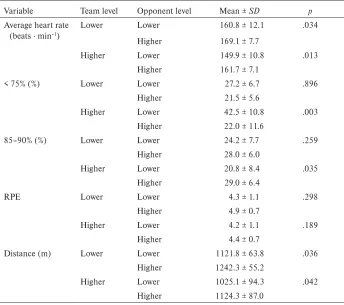
Table 1
The effect of opponents’ level in teams with higher or lower level of performance
Variable Team level Opponent level Mean ± SD p
Average heart rate (beats ⋅ min–1)
Lower Lower 160.8 ± 12.1 .034
Higher 169.1 ± 7.7
Higher Lower 149.9 ± 10.8 .013
Higher 161.7 ± 7.1
< 75% (%) Lower Lower 27.2 ± 6.7 .896
Higher 21.5 ± 5.6
Higher Lower 42.5 ± 10.8 .003
Higher 22.0 ± 11.6
85–90% (%) Lower Lower 24.2 ± 7.7 .259
Higher 28.0 ± 6.0
Higher Lower 20.8 ± 8.4 .035
Higher 29.0 ± 6.4
RPE Lower Lower 4.3 ± 1.1 .298
Higher 4.9 ± 0.7
Higher Lower 4.2 ± 1.1 .189
Higher 4.4 ± 0.7
Distance (m) Lower Lower 1121.8 ± 63.8 .036
Higher 1242.3 ± 55.2
Higher Lower 1025.1 ± 94.3 .042
Higher 1124.3 ± 87.0
ω2= 0.25), but not in 75–85% (F = 1.25; p = .311;
ω2= 0.04) and > 90% heart rate zone (F = 1.09; p = .367; ω2= 0.01). The deeper analysis of heart rate zone 85–90% of HRpeak revealed that significantly higher time spent in this zone of HLTs in their mutual 4v4SSG than against lower level teams (p = .035). Similarly to average heart rate results significantly lower time spent in this zone of HLTs than LLTs when played mutual 4v4SSG (p = .013). HLTs in their mutual 4v4SSG spent significantly higher time in the < 75% of HRpeak heart rate zone than against LLTs (Table 1; p = .003). This time was also higher compared to the time spent in this zone in mutual LLTs 4v4SSG (p = .006). Other differences were not significant.
The values of RPE on the end of SSGs are showed in Table 1. We did not find any significant differences (F = 1.25; p = .298; ω2= 0.04) among RPE at the end of 4v4SSG.
The average distance covered by the teams during 4v4SSG was around 1100 m (Table 1). The statistical analysis showed significant differences among the aver-age distance covered by different teams during 4v4SSG (F = 9.75; p = .001; ω2= 0.57). Detailed analysis of mea-sured differences showed significantly higher distance covered by the LLTs in 4v4SSG against HLTs than in LLTs mutual 4v4SSG (Table 1; p = .036). And HLTs reached shorter distance covered against LLTs than in HLTs mutual 4v4SSG (Table 1; p = .042). Other differ-ences were not significant.
Table 3 shows the technical analysis of the teams during 4v4SSG. We only used the descriptive statistics, because of the small number of involved teams.
Discussion
Small-sided games are suitable means to develop soc-cer specific aerobic conditioning despite any disadvan-tages, as for example, exact control of work intensity (Krustrup, Dvorak, Junge, & Bangsbo, 2010; Little, 2009). For facilitating of the usage of small-sided games the search for variables affecting the work intensity is needed. Hill-Haas et al. (2011) showed variables (pitch size, rules modifications, number of players, goal-keeper, coach encouragement), which influence work intensity. Dellal et al. (2011) showed that performance level can influence the work load. According to Koklu et al. (2012) the team formation method (including low and high performance differentiation) could be another variable influencing work intensity. The purpose of this study was to determinate the influence of the different level of opponents to internal responses and external loads of players during 4-a-side soccer game. We sup-posed that the variable of different level of opponents was able to influence the work load and lead to inad-equate training impulse for individual players. These Table 2
The effect of opponents’ level in teams with similar level of performance
Variable 4v4SSG p
Average heart rate (beats ⋅ min–1)
lower vs lower level .195 higher vs higher level
< 75% (%) lower vs lower level .318 higher vs higher level
85–90% (%) lower vs lower level .936 higher vs higher level
RPE lower vs lower level .298
higher vs higher level
Distance (m) lower vs lower level .37 higher vs higher level
Note. ˂ 75% = time spent in the heart rate zone ˂ 75% of HRpeak, 85–90% = time spent in the heart rate zone 85–90 of % HRpeak, RPE = rate of perceived exertion, Distance = distance covered. p = statistical significance of Bonferroni test.
Table 3
Technical actions of the teams during 4v4SSG
Technical action LLTvLLT LLTvHLT HLTvLLT HLTvHLT
Passes 122 91 145 126
% passes 79 67 81 79
Shots 14 11 20 15
Steals 18 17 20 16
Turnovers 10 11 9 12
findings could facilitate the training evaluation and the individualization of work load during soccer practices.
The measured average heart rates were lower com-pared to work of Rampinini et al. (2007) who published percentage of average heart rate 88.7 ± 2.0% of HRpeak, or Manolopoulos et al. (2012) who found out even 93.5 ± 1.7% of HRpeak. On the contrary Dellal, Varliette, Owen, Chirico, and Pialoux (2012) measured 84.7 ± 2.7% of HRpeak in amateur players, which is very similar to our results. We think that our data were lower than the first two studies and similar with the third study because of the amateur level of measured players. Indeed, according to Dellal et al. (2011) technical and tactical awareness can limit the performance of the players during 4v4SSG. When higher level teams played their mutual 4v4SSG and in the 4v4SSG of lower level teams against higher level teams the players achieved similar average heart rate around 85% of HRpeak. These values are considered to be a significant stimulus to the cardiovascular system (Hoff et al., 2002).
The comparison of internal responses and exter-nal loads during mutual 4v4vSSG of HLTs and LLTs showed differences in distance covered only (Table 2). Our results are similar to Dellal et al. (2011) who found differences in distance covered and RPE between ama-teur and professional players during small-sided games. Both results showed that only heart rate measurement can hide the right responses of players to a training ses-sion and make individualized planning of training pro-cess impossible. The HLTs are able to produce more work load with similar internal response thanks of bet-ter metabolic and physical adaptation. The influence of performance level to work load corresponds with results of soccer match analysis (Stolen et al., 2005) which could point good validity of small-sided games as means of specific aerobic conditioning development.
Other results of this study demonstrated that the work intensity was lower in HLTs when played against LLTs and similarly LLTs had significantly higher aver-age heart rate against HLTs than LLTs. Both averaver-age heart rate and distance covered showed the same ten-dencies. HLTs achieve with lower average heart rate and concurrently shorter distance covered than LLTs. A higher number of turnovers and lower number of passes of LLTs showed that they did not control the ball for a longer time. This fact was probably trans-ferred to longer time spent in the 85–90% of HRpeak, shorter in the < 75% of HRpeak, and longer distance covered, which resulted in shorter time for recovery after the high intensity bursts. The work/rest ratio is considered to be an origin of rate of fatigue because of insufficient PCr resynthesis and disposing of metabolic by products including the accumulation of potassium in muscle interstitium (Gaitanos, Williams, Boobis, &
Brooks, 1993; Glaister, 2005; Hill-Haas, Rowsell, Daw-son, & Coutts, 2009). Conversely, HLTs made many more passes with higher accuracy and shots than LLTs in their mutual game. Thanks to better positioning game of HLTs, they expended less effort on ball pos-session than LLTs and to develop good shooting situ-ation. According to Gamble (2007) specific training format of conditioning players should aim to impose proportionate stresses on metabolic and physiological systems corresponding to those typically experienced during game. The differences in the work/rest ratio could lead to different responses to intermittent work of players to the same practice and could create the discrepancies in metabolic adaptations. These applied SSGs could lead to the overloading or undertraining of the players without their coaches’ knowledge. It could contradict all positives of small-sided games usage in the practice. The practices could not lead to provision of a progressive training load over time. Our results indicated that the variable of the performance level of opponent team could compromise the progressive individualized development of the teams with larger performance differences.
According to Coutts, Rampinini, Marcora, Cast-agna, and Impellizzeri (2009) and Hill-Haas et al. (2011) RPE is a valid and objective method of work intensity evaluation. On the contrary internal and external load indicators of RPE did not show signifi-cant differences among 4v4SSG. The RPE of lower level teams is slightly higher in the 4v4SSG against higher level teams but negligibly. The perceived work intensity moved from four to five, which corresponds to work intensity around 80% of HRpeak. The value of RPE could be influenced by the duration of work intervals (Fanchini et al., 2011) or size of the pitch (Casamichana & Castellano, 2010) but it seems that the performance level of the opponent teams forma-tion do not influence, although the internal and exter-nal load indicators are different. The differences in the work intensity caused by the performance level of the opponent teams could be hidden to the coach, when only rate of perceived exertion is used. According to our results the players in our study underestimated the work intensity in comparison with the results heart rate measurement. This underestimation was independent of the level of players participated on the 4v4SSG.
Due to the group of subjects used with heteroge-neous levels of soccer performance, further research in this direction is very important in amateur and profes-sional soccer teams, where the differences may not be so large.
Conclusions
The results of this study demonstrated that the per-formance level of opponents influences internal and external load of the players. It could compromise pro-gressive individualized development of the teams with larger performance differences. Every coach should be aware of this variable to reach equal relative intensity of the game. Appropriate use of small-sided games is the way to work in the team with individualized training load, where the endurance training, technical, and tac-tical training are connected. Therefore, the coach can create individualized and specific soccer practices. The results showed that these differences in work intensity can be hidden, when only rate of perceived exertion is used.
References
Alexandre, D., da Silva, C. D., Hill-Haas, S., Wong, D. P., Natali, A. J., de Lima, J. R. P., & Karim, C. (2012). Heart rate monitoring in soccer: Interest and limits dur-ing competitive match play and traindur-ing, practical appli-cation. Journal of Strength and Conditioning Research, 26, 2890–2906.
Aslan, A. (2013). Cardiovascular responses, perceived exer-tion and technical acexer-tions during small-sided recreaexer-tional soccer: Effects of pitch size and number of players. Journal of Human Kinetics, 38, 95–105.
Bangsbo, J., Iaia, F. M., & Krustrup, P. (2008). The Yo-Yo intermittent recovery test: A useful tool for evaluation of physical performance in intermittent sports. Sports Medi-cine, 38, 37–51.
Bangsbo, J., Mohr, M., & Krustrup, P. (2006). Physical and metabolic demands of training and match-play in the elite soccer player. Journal of Sports Sciences, 24, 665–674. Casamichana, D., & Castellano, J. (2010). Time-motion,
heart rate, perceptual and motor behaviour demands in small-sides soccer games: Effects of pitch size. Journal of Sports Sciences, 28, 1615–1623.
Castagna, C., Impellizzeri, F. M., Chaouachi, A., Ben Abdelkrim, N., & Manzi, V. (2011). Physiological responses to ball-drills in regional level male basketball players. Journal of Sports Sciences, 29, 1329–1336. Castellano, J., Casamichana, D., & Dellal, A. (2013).
Influ-ence of game format and number of players on heart rate responses and physical demands in small-sided soccer games. Journal of Strength and Conditioning Research, 27, 1295–1303.
Coutts, A. J., Rampinini, E., Marcora, S. M., Castagna, C., & Impellizzeri, F. M. (2009). Heart rate and blood lactate correlates of perceived exertion during small-sided soccer games. Journal of Science and Medicine in Sport, 12, 79–84. da Silva, C. D., Impellizzeri, F. M., Natali, A. J., de Lima, J. R. P., Bara, M. G., Silami-Garcia, E., & Marins, J. C. B. (2011). Exercise intensity and technical demands of small-sided games in young Brazilian soccer players: Effect of number of players, maturation, and reliability. Journal of Strength and Conditioning Research, 25, 2746–2751. Dellal, A., Hill-Haas, S., Lago-Penas, C., & Chamari, K.
(2011). Small-sided games in soccer: Amateur vs. pro-fessional players’ physiological responses, physical, and technical activities. Journal of Strength and Conditioning Research, 25, 2371–2381.
Dellal, A., Varliette, C., Owen, A., Chirico, E. N., & Pialoux, V. (2012). Small-sided games versus interval training in amateur soccer players: Effects on the aerobic capac-ity and the abilcapac-ity to perform intermittent exercises with changes of direction. Journal of Strength and Conditioning Research, 26, 2712–2720.
Fanchini, M., Azzalin, A., Castagna, C., Schena, F., Mccall, A., & Impellizzeri, F. M. (2011). Effect of bout duration on exercise intensity and technical performance of small-sided games in soccer. Journal of Strength and Conditioning Research, 25, 453–458.
Gaitanos, G. C., Williams, C., Boobis, L. H., & Brooks, S. (1993). Human muscle metabolism during intermit-tent maximal exercise. Journal of Applied Physiology, 75, 712–719.
Glaister, M. (2005). Multiple sprint work: Physiological responses, mechanisms of fatigue and the influence of aerobic fitness. Sports Medicine, 35, 757–777.
Hill-Haas, S., Coutts, A., Rowsell, G., & Dawson, B. (2008). Variability of acute physiological responses and perfor-mance profiles of youth soccer players in small-sided
games. Journal of Science and Medicine in Sport, 11,
487–490.
Hill-Haas, S. V., Dawson, B., Impellizzeri, F. M., & Coutts, A. J. (2011). Physiology of small-sided games training in football: A systematic review. Sports Medicine, 41, 199–220. Hill-Haas, S. V., Rowsell, G. J., Dawson, B. T., & Coutts, A. J. (2009). Acute physiological responses and time-motion characteristics of two small-sided training regimes in youth soccer players. Journal of Strength and Conditioning Research, 23, 111–115.
Hoff, J., Wisloff, U., Engen, L. C., Kemi, O. J., & Helgerud, J. (2002). Soccer specific aerobic endurance training. British Journal of Sports Medicine, 36, 218–221.
Hulka, K., Cuberek, R., & Svoboda, Z. (2014). Time-motion analysis of basketball players: A reliability assessment of Video Manual Motion Tracker 1.0 software. Journal of Sports Sciences, 32, 53–59.
Impellizzeri, F. M., Marcora, S. M., Castagna, C., Reilly, T., Sassi, A., Iaia, F. M., & Rampinini, E. (2006). Physi-ological and performance effects of generic versus specific aerobic training in soccer players. International Journal of Sports Medicine, 27, 483–492.
players: The influence of different team formation meth-ods. Journal of Strength and Conditioning Research, 26, 3118–3123.
Krustrup, P., Dvorak, J., Junge, A., & Bangsbo, J. (2010). Executive summary: The health and fitness benefits of regular participation in small-sided football games. Scan-dinavian Journal of Medicine and Science in Sports, 20, 132–135.
Krustrup, P., Mohr, M., Nybo, L., Jensen, J. M., Nielsen, J. J., & Bangsbo, J. (2006). The Yo-Yo IR2 test: Physiological response, reliability and application to elite soccer. Medi-cine & Science in Sports & Exercise, 38, 1666–1673. Little, T. (2009). Optimizing the use of soccer drills for
phys-iological development. Strength and Conditioning Journal, 31(3), 67–74.
Little, T., & Williams, A. G. (2006). Suitability of soccer training drills for endurance training. Journal of Strength and Conditioning Research, 20, 316–319.
Mallo, J., & Navarro, E. (2007). Physical load imposed on soccer players during small-sided training games. Journal of Sports Medicine and Physical Fitness, 48, 166–171. Manolopoulos, E., Kalapotharakos, V. I., Ziogas, G.,
Mitro-tasios, M., Spaneas, K. S., & Tokmakidis, S. P. (2012).
Heart rate responses during small-sided soccer games. Journal of Sports Medicine & Doping Studies, 2(2), 36–39. McMillan, K., Helgerud, J., Macdonald, R., & Hoff, J.
(2005). Physiological adaptations to soccer specific endur-ance training in professional youth soccer players. British Journal of Sports Medicine, 39, 273–277.
Mohr, M., Krustrup, P., & Bangsbo, J. (2005). Fatigue in soc-cer: A brief review. Journal of Sports Sciences, 23, 593–599. Rampinini, E., Impellizzeri, F. M., Castagna, C., Abt, G.,
Chamari, K., Sassi, A., & Marcora, S. M. (2007). Factors influencing physiological responses to small-sided soccer games. Journal of Sports Sciences, 25, 659–666.
Reilly, T. (2005). An ergonomics model of the soccer train-ing process. Journal of Sports Sciences, 23, 561–572. Sjokvist, J., Laurent, M. C., Richardson, M., Curtner-Smith,
M., Holmberg, H. C., & Bishop, P. A. (2011). Recovery from high-intensity training sessions in female soccer players. Journal of Strength and Conditioning Research, 25, 1726–1735.
Stolen, T., Chamari, K., Castagna, C., & Wisloff, U. (2005). Physiology of soccer: An update. Sports Medicine, 35, 501–536.