ISSN 0975-928X
Research Article
Combining ability analysis for yield contributing characters in chickpea
Jairam Amadabade1, Anju Arora1, Hemant Sahu2
1
Department of Genetics and Plant Breeding, GBPUAT, Pantnagar-263145, Uttarakhand, India. 2
Department of Genetics and Plant Breeding, IGKV, Raipur-492012, Chattisgarh, India. Email: [email protected]
(Received: 10 June 2014; Accepted: 10 Oct 2014)
Abstract
In the present investigation, six genotypes of chickpea viz., PG0127, PG0126, CSG8962, ICCL87322, HC-1 and BG362 were used as parents for 6 × 6 diallel analysisexcluding reciprocals to estimate general and specific combining ability variances and effects. Genetic analysis revealed that both additive and non-additive genetic components of variation are important for inheritance of all the characters. However, the magnitude of non-additive (sca) variance was considerably higher than additive (gca) variance for all the characters except 100 seed weight representing the predominance of non additive gene action. The parents HC-1 and BG362 were found to be good general combiners for grain yield and most of its component characters and were one of the parents in most of the best specific cross combinations. The crosses HC-1 × BG362 and CSG8962 × HC-1 were the best cross combinations for yield and most of its components. In view of parallel role of both additive and non-additive genetic effects determining the inheritance of different characters, their simultaneous exploitation through adoption of biparental approach is suggested.
Keyword:
Chickpea, diallel, gene action, combining ability Introduction
The chickpea (Cicer arietinum L., 2n=2x=16) also known as garbanzo bean, Indian pea, Bengal gram is an edible self fertilizing annual diploid grain legume of the family Fabaceae and sub family Faboideae. It is the third most important pulse crop of the world after dry bean and dry pea. It is cultivated on large areas in the world, yet with relatively low productivity. India ranks first in chickpea production and area with 7.70 million tonnes production from 8.32 million hectare area but with a low productivity of 841 kg/ha (FAO Statistics, 2012). Since the productivity is quite low and to augment the production, concerted efforts are needed to improve the productivity. Before embarking on the breeding programme, it is necessary to choose the parents carefully for hybridization programme. Combining ability analysis enables the breeder in his task of selecting the parents. It also provides the vital and necessary information on the nature of gene action governing the expression of the character in question and thus helps in deciding upon the future breeding strategy. Hence it is necessary to evaluate the combining ability, which is useful to assess the nicking ability of parents, at the same time elucidates the nature and magnitude of different types of gene action involved. This can be of immense help to plant breeders in choosing desirable genotypes for a breeding programme to provide valuable information regarding cross combinations to be exploited commercially (Salimath and Bahl, 1985). Therefore, the present investigation was undertaken to study the nature and magnitude of additive and
non-additive components of genetic variance in chickpea through analysis of general and specific combining abilities for seed yield and its components in a 6 x 6 diallel cross set.
Material and Methods
The material for the present study comprised of 15 F1s (excluding reciprocals) generated by involving
6 diverse parents in a 6 x 6 diallel cross set. The genotypes involved in study include three lines viz., PG0127, PG0126 and ICCL87322 and three varieties viz., CSG8962, BG362 and HC-1. All the six parents were sown in the crop season 2011-12 at Crop Research Centre, G. B. Pant University of Agriculture and Technology, Pantnagar and crossed in a diallel fashion. The resulting 15 F1
hybrids and parents were evaluated in a Randomized Block Design (RBD) with three replications in the crop season 2012-13. The observations were recorded from five plants visually showing good health selected randomly from each plot in all the replications on days to 50% flowering, days to maturity, plant height, number of primary branches per plant, pods per plant, seeds per pod, seeds per plant, 100 seed weight and grain yield per plant.
ISSN 0975-928X
http://sites.google.com/site/ejplantbreeding 665
and non-significant gca effects were designated as poor combiners.
Results and discussion
A general analysis of variance was carried out for all the nine characters viz., days to 50% flowering, days to maturity, plant height, number of primary branches per plant, number of pods per plant, number of seeds per pod, number of seeds per plant, 100 seed weight and grain yield. The differences were significant to highly significant between genotypes for all the characters except for number of seeds per pod for which non significant differences were observed thus, justifying the use of material in present investigation (Table 1). The ANOVA for combining ability of nine characters given in Table 2 indicated that mean sum of squares due to general combining ability were significant for all the characters except for number of seeds per pod. The variances for specific combining ability were significant for all the characters except for number of primary branches per plant and number of seeds per pod.
Thus, the results revealed that non additive genetic variances accomplished an important role in the expression of different characters. Similar were the findings of Dahiya et al. (1980) for pods per plant and plant height; Rawat et al. (1981) for days to first flowering, plant height, pods per plant, seeds per plant, seed size and yield per plant; Jeena and Arora (2001) for pods per plant, biological yield per plant, plant height, 100 seed weight, seed yield per plant and days to maturity; Gupta et al. (2007) for number of branches per plant, pods per plant, biological yield per plant and harvest index; Sarode
et al. (2000) for all the yield contributing characters studied except 100 seed weight; Singh et al. (2008) for seed weight per plant and Bhardwaj et al.
(2010) for number of branches per plant.
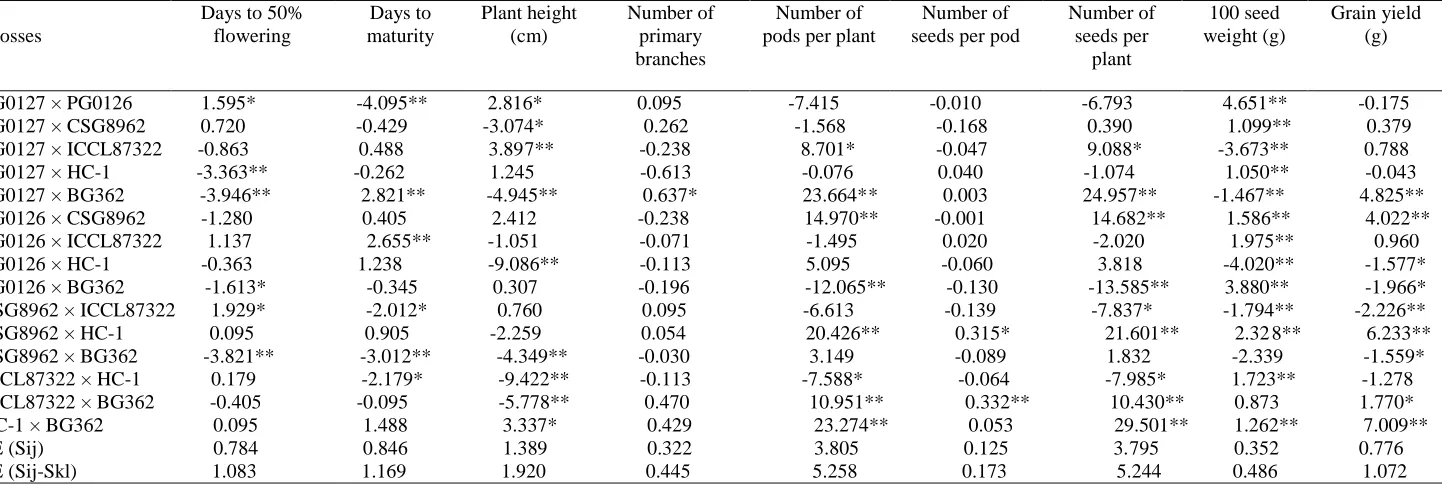
The estimate of general combining ability effects for all the six parents and specific combining ability effects for half diallel crosses for nine characters with their corresponding standard error are presented in Table 3 and 4, respectively. The estimate of gca effects shown that none of the parental line excelled as good general combiner for all the characters, so it was difficult to pick good combiners for all the characters together because the combining ability effects were not consistent for all the yield components, possibly because of negative association among some of the characters (Gowda and Bahl, 1978). This shows that genes for different desirable characters would have to be combined from different sources (Kumari, 1999). However, the gca effects indicated that HC-1 and BG362 were found to be good general combiners for most of the characters. For days to 50% flowering, HC-1 was found to be good negative
combiner, while PG0127 was found to be good negative combiner for earliness. For number of primary branches and number of seeds per pod, none of the parents was good combiner. The parents HC-1 and BG362 were good general combiners for number of pods per plant and number of seeds per plant. For 100 seed weight, PG0126 was good general combiner, while HC-1 and BG362 along with PG0126 were good combiners for grain yield per plant. For taller plant type ICCL87322 was good general combiner, while CSG8962 and BG362 were good combiners for dwarf plant type.
Overall results of parents showed that HC-1 showed good general combining ability for early flowering. Additionally, this parent was good combiner for grain yield per plant which was contributed by two component characters viz. number of pods per plant and number of seeds per plant. The parent BG362 also showed good general combining ability for grain yield per plant in addition to yield contributing characters like plant height, number of pods per plant and number of seeds per plant. Hence it is suggested that these parents can be used in hybridization programme for developing high yielding hybrids/varieties in chickpea.
The sca effects of hybrids indicated that nine crosses were found to have significant sca effects for grain yield per plant. Five out of nine crosses
ISSN 0975-928X
hybridization barriers. In view of such problems, the possibility of exploitation of transgressive segregants in chickpea has been reported (Singh, 1974). This suggests that a large proportion of non additive effects in self pollinated crops seems to be due to additive x additive effects and that selection be delayed to later generations (Singh et al. 1992).
Thus, the sca effect of a cross was reflected through the gca of its parents which demands inclusion of at least one good combining parent in producing superior hybrids. However, a few of the superior crosses involved both of the parents with poor combining abilities viz., PG0127 × BG362 and PG0127 × HC-1 for early maturity, PG0126 × HC-1 and ICCL87322 × HC-1 for dwarf plant type, PG0126 × CSG8962 for number of pods per plant and CSG8962 × HC-1 for 100 seed weight, while some superior crosses involved one of the parent with poor combining ability viz., PG0127 × BG362 and PG0126 × CSG8962 for grain yield per plant, PG0127 × PG0126 and PG0126 × BG362 for 100 seed weight, CSG8962 × HC-1 and ICCL87322 × BG362 for number of seeds per plant and a very few superior crosses had both the parents with better combining abilities viz., CSG8962 × BG362 for dwarf plant type and HC-1 × BG362 for number of pods per plant, number of seeds per plant and grain yield per plant. This suggests that high sca effect of any cross combination does not necessarily depend on the gca effects of the parental lines involved. This superiority of sca effects may be due to complementary type of gene action or involvement of non allelic interaction of fixable and non fixable genetic variance (Sharma and Mani, 2001).
Thus the present investigation revealed the importance of both additive and non additive genetic effects for different characters. Under such a situation where both additive and non additive genetic variances are important factors of inheritance, maximum grain production may be attainable with a system that can exploit both additive and non additive genetic effects simultaneously. Therefore, in such cases, it is advisable to practice biparental mating in F2 among selected crosses by way of intermating the most desirable segregants alternately with selection to isolate superior genotypes or use of recurrent selection scheme (diallel selective mating system) to enhance the frequency of desirable recombinants with high yield potential ( Nagaraj et al. 2002). This will help in building the population from which desirable purelines could be developed simultaneously. Linkage is another factor that complicates the problem in selection. If linkages are predominantly of the repulsion type, a generation of intercrossing to increase the opportunity of recombination may become
important (Singh et al. 1992). It can also be concluded from the data that genetically diverse and high combining parents should be used in formulating cross combinations. Selection by progeny testing as well as recurrent selection can then be used to evolve lines which may transgress both the combining parents.
Acknowledgement
The first author gratefully acknowledges Indian Council of Agricultural Research (ICAR) for providing him financial assistance in terms of Junior Research Fellowship during the period of the study.
References
Bhardwaj, R., Sandhu, J.S. and Singh I. 2010. Heterosis in relation to combining ability in chickpea (Cicerarietinum L.). Crop Improv., 37 (2): 126-132.
Dahiya, B.B., Walida, R.B. and Tomar, Y.B. 1980. Basis of selection in chickpea. Int. Chickpea Newslr., 3:6.
Gowda, C.L. and Bahl, P. N. 1978. Combining ability in chickpea. Indian J. Genet.,38: 245-251. Griffing, B. 1956. Concept of general and specific
combining ability in relation to diallel crossing system. Aust. J. Biol. Sci., 9:463-493.
Gupta, S. K., Sandhu, J. S. and Garg, T. 2007. Combining ability in desi chickpea. J. Food Leg., 20: 22-24.
Jeena, A.S. and Arora, P.P. 2001. Combining ability in chickpea (Cicer arietinum L.). Leg. Res., 24(1): 16-19.
Kumari, V. 1999. Genetics of yield and its component characters in grasspea (Lathyrus sativus L.). Annals of Agric. Res.,20: 73-76.
Nagaraj, K., Salimath, P.M. and Kajjidoni, S.T. 2002. Genetic variability created through biparental mating in chickpea (Cicer arietinum L.,). Indian J. Genet. ,62 (2): 259-260.
Rawat, M.C., Tiwari, A.S. and Pandey, R.L. 1981. Combining ability analysis in Bengal gram (Cicerarietinum L.). J. Res. Assam Agric. Univ., 2: 151-155.
Salimath, P.M. and Bahl, P.N. 1985. Heterosis and Combining ability for earliness in
chickpea (Cicer arietinum
L.). Indian J.Genet., 45(1): 97-100.
Sarode, N.D., Deshmukh, R.B., Patil, J.V., Manjare, M.R. and Mhase, L.B. 2000. Heterosis and combining ability in chickpea (Cicer arietinum L.). Leg. Res., 23(3): 206-209. Singh, R., Sharma, R., Varshney, R.K., Sharma, S.K and
Singh, N.K. 2008. Chickpea improvement: role of wild species and genetic markers. Biotechnol. and Genetic Enginneering Rev.,
25: 267-314.
Singh, K. B. 1974. Exploitation of heterosis in pulse crops. Indian J. Genet.,34A: 731-808. Singh, O., Gowda, C.L.L., Sethi, S.C., Dasgupta, T. and
ISSN 0975-928X
http://sites.google.com/site/ejplantbreeding 667
ISSN 0975-928X
669
Table 1. Analysis of variance of different characters studied for parents and F1’s
Mean sum of squares of different characters
Source of
variation d.f.
Days to 50% flowering Days to maturity Plant height (cm) Number of primary branches Number of pods per plant Number of seeds per pod
Number of seeds per plant
100 seed weight (g)
Grain yield (g)
Replication Treatment Error SE CD(1%) CD(5%) CV(%) 2 20 40 40.08184 28.38437** 2.345908 0.8842903 3.382306 2.527542 1.656533 7.351191 17.1875** 2.732440 0.9543655 3.650336 2.727836 1.195084 21.82961 77.11667** 7.370692 1.567449 5.995309 4.480196 6.164560 0.4285649 0 .738094* 0.3952384 0.3629685 1.388312 1.037463 24.44866 4.438058 698.7059** 55.29294 4.293131 16.42072 12.27094 16.96132 0.2139700 0.069159 0.0596344 0.1409899 0.5392698 0.4029875 19.47431 2.924851 836.4927** 54.99883 4.281699 16.37699 12.23826 14.93895 2.782087 5.1223** .4721902 .3967326 1.517455 1.133970 2.876565 2.886789 40.7748 ** 2.296562 0.8749403 3.346544 2.500817 12.72716 *, ** significant at 5% and 1% probability level.
Table 2. Analysis of variance for GCA and SCA for different characters
Mean sum of squares of different characters Source of
variation
d.f. Days to 50% flowering Days to maturity Plant height (cm) Number of primary branches Number of pods per plant Number of seeds per pod Number of seeds per plant 100 seed weight (g) Grain yield (g)
GCA 5 58.211** 32.311** 36.274** 1.750** 590.419** 0.070 709.778** 230.529** 30.938** SCA 15 18.440** 12.140** 90.732** 0.401 734.801** 0.069 878.731** 23.320** 44.054** Error 40 2.347 2.733 7.370 0.395 55.293 0.060 54.999 0.472 2.297
ISSN 0975-928X
Table 3. Estimate of general combining ability (gca) effects of parents for various characters in Chickpea Parents Days to 50%
flowering
Days to maturity
Plant height (cm)
Number of primary branches
Number of pods per plant
Number of seeds per pod
Number of seeds per plant
100 seed weight (g)
Grain yield (g)
PG0127 -0.028 -2.028** -0.085 -0.250 -2.194 -0.039 -2.129 -0.629** -0.983** PG0126 1.972** -0.194 0.329 -0.083 -5.498** -0.072 -5.721** 6.024** 1.418** CSG8962 -1.153** 0.139 -1.381** -0.250 -2.079 0.086 -2.404 0.142 -0.216 ICCL87322 -1.236** 0.222 2.015** -0.083 -2.615 -0.001 -3.402* -2.186** -1.578**
HC-1 -1.403** 0.306 0.300 0.292 5.963** 0.011 6.894** -2.358** 0.626* BG362 1.847** 1.556** -1.177* 0.375 6.423** 0.015 6.763** -0.992** 0.735** SE (gi) 0.285 0.308 0.506 0.117 1.386 0.046 1.382 0.128 0.282 *, ** significant at 5% and 1% probability level.
Table 4. Estimate of specific combining ability (sca) effects of crosses for various characters in chickpea
Crosses
Days to 50% flowering
Days to maturity
Plant height (cm)
Number of primary branches
Number of pods per plant
Number of seeds per pod
Number of seeds per
plant
100 seed weight (g)
Grain yield (g)
PG0127 × PG0126 1.595* -4.095** 2.816* 0.095 -7.415 -0.010 -6.793 4.651** -0.175 PG0127 × CSG8962 0.720 -0.429 -3.074* 0.262 -1.568 -0.168 0.390 1.099** 0.379 PG0127 × ICCL87322 -0.863 0.488 3.897** -0.238 8.701* -0.047 9.088* -3.673** 0.788 PG0127 × HC-1 -3.363** -0.262 1.245 -0.613 -0.076 0.040 -1.074 1.050** -0.043 PG0127 × BG362 -3.946** 2.821** -4.945** 0.637* 23.664** 0.003 24.957** -1.467** 4.825** PG0126 × CSG8962 -1.280 0.405 2.412 -0.238 14.970** -0.001 14.682** 1.586** 4.022** PG0126 × ICCL87322 1.137 2.655** -1.051 -0.071 -1.495 0.020 -2.020 1.975** 0.960 PG0126 × HC-1 -0.363 1.238 -9.086** -0.113 5.095 -0.060 3.818 -4.020** -1.577* PG0126 × BG362 -1.613* -0.345 0.307 -0.196 -12.065** -0.130 -13.585** 3.880** -1.966* CSG8962 × ICCL87322 1.929* -2.012* 0.760 0.095 -6.613 -0.139 -7.837* -1.794** -2.226** CSG8962 × HC-1 0.095 0.905 -2.259 0.054 20.426** 0.315* 21.601** 2.32 8** 6.233** CSG8962 × BG362 -3.821** -3.012** -4.349** -0.030 3.149 -0.089 1.832 -2.339 -1.559* ICCL87322 × HC-1 0.179 -2.179* -9.422** -0.113 -7.588* -0.064 -7.985* 1.723** -1.278 ICCL87322 × BG362 -0.405 -0.095 -5.778** 0.470 10.951** 0.332** 10.430** 0.873 1.770* HC-1 × BG362 0.095 1.488 3.337* 0.429 23.274** 0.053 29.501** 1.262** 7.009** SE (Sij) 0.784 0.846 1.389 0.322 3.805 0.125 3.795 0.352 0.776 SE (Sij-Skl) 1.083 1.169 1.920 0.445 5.258 0.173 5.244 0.486 1.072