Prophylactic Oral Calcium Reduces Symptomatic Hypocalcemia in Patients
undergoing Total or Subtotal Thyroidectomy: a Randomized Controlled Trial
Ali Ghafouri1, Saeed Shirangi2, Shahrzad Mohseni2, Abolfazl Shojaiefard1, Zhamak Khorgami1, Anoushirvan Hedayat2
1 Research Center for Improvement of Surgical Outcomes and Procedures, Department of Surgery, Shariati Hospital, Tehran
University of Medical Sciences, Tehran, Iran
2 Department of Surgery, Shariati Hospital, Tehran University of Medical Sciences, Tehran, Iran
Received: 19 Oct. 2013; Received in revised form: 2 Dec. 2013; Accepted: 4 Jan. 2014
________________________________________________________________________________________________________
Abstract
Objectives:Prophylactic oral calcium supplement has been proposed in patients undergoing thyroidectomy in order to decrease incidence of postoperative hypocalcemia, and the duration of hospital stay. This study aimed to assess the effects of prophylactic oral calcium in patients undergoing total or subtotal thyroidectomy.
Methods: Forty three patients who were scheduled for total and subtotal thyroidectomy, were randomly allocated to the
case (n=23) and control (n=20) groups. Oral calcium carbonate (1 gram q 8 hours) was given to the patients in the case group starting 12 hours before surgery till 7 days post thyroidectomy. Clinical symptoms of hypocalcemia and postoperative calcium levels were compared between the two groups.
Results:The mean postoperative calcium level 12 hours after surgery was not statistically different between the two groups (8.9±0.5 vs. 8.5±0.7, p=0.092); while after 24 hours, calcium level was significantly lower in the control group (8.9±0.5 vs. 8.4±0.8, p=0.037). The number of patients who had paresthesia was significantly higher in the control group than case group, at both 12 hours (p=0.02) and 24 hours postoperatively (p=0.04). Duration of hospitalization was significantly lower in the case group compared to the control group (p=0.006).
Conclusions: Prophylactic oral calcium supplementation decreases the hypocalcemia related paresthesia after
thyroidectomy and shortens duration of hospital stay.
Citation: Ghafouri A, Shirangi S, Mohseni Sh, Shojaiefard A, Khorgami Zh, Hedayat A. Prophylactic Oral Calcium Reduces Symptomatic Hypocalcemia in Patients undergoing Total or Subtotal Thyroidectomy: a
Randomized Controlled Trial. Acad J Surg, 2014; 1(3-4): 40-44.
Keywords: Thyroidectomy, Calcium, Hypocalcemia, Hyperparathyroidism
Introduction
The rate of hypocalcemia after bilateral thyroidectomy ranges from 0.5 to 50% (1), and permanent hypocalcemia occurs in 0.4-13.8% cases after thyroid surgery (2,3).
Several studies have attempted to recognize the factors that would predict the development of post thyroidectomy hypocalcemia (2,4-12), however its prediction is still impractical.
Some studies have proposed routine administration of oral calcium and/ or vitamin D in patients undergoing total thyroidectomy in order to reduce the likelihood of transient symptomatic hypocalcemia, and shorten the hospitalization period.
Bellantone et al. (13) assessed the effect of calcium and also calcium plus vitamin D administration in this group of patients. They showed that both of these protocols effectively decrease the rate of symptomatic hypocalcaemia. Tartaglia et al. (14) studied the effect of calcitriol and oral calcium in more than 200 patients with total thyroidectomy. They also showed that
prophylactic administration of calcitriol (1 microgram twice a day) and oral calcium (500 milligram 3 times per day) significantly reduces the risk of severe postoperative hypocalcaemia. Uruno (15) from Japan reported similar results with intravenous calcium administration.
In this study, we evaluated the effect of prophylactic administration of oral calcium in patients undergoing total or subtotal thyroidectomy to determine the efficacy of prophylactic administration of oral calcium for reduction of post-thyroidectomy hypocalcemia.
Materials and Methods
Initially, a randomization list was prepared by the randomization software. Patients were randomly assigned to case (A) and control (B) groups through opening the sealed envelope by the research coordinator at the end of surgery. Patients requiring total or subtotal thyroidectomy due to multinodular goiter or thyroid cancer were consecutively enrolled into the study and were randomly assigned to either receive prophylactic oral calcium or not receive any prophylactic calcium. Serum albumin, calcium, phosphorous, creatinine and BUN levels were measured before surgery. Serum calcium was measured serially after surgery. Hypocalcemia symptoms were monitored, and need to intravenous calcium and hospital stay were recorded.
We performed subtotal thyroidectomy for multinodular goiter if there was normal thyroid tissue at the base otherwise we performed total thyroidectomy. Total thyroidectomy was also performed in Grave’s disease and thyroid cancer. In cancer patients, we performed central lymph node dissection in all cases and lateral lymph node dissection if indicated. We routinely localized parathyroid glands during the surgery and preserved them. There was no accidental parathyroid removal or autotransplantation in our patients.
Patients in the case group (A) received calcium carbonate orally (1 g at 10 PM and 6 AM before the surgery in the morning), and 1 g every 8 hours after the surgery for one week. Control group (B) did not receive calcium supplements. Calcium levels were checked at 1 and 12 hours after surgery and also calcium and phosphorus were measured in the morning of first postoperative day. All Patients were evaluated for the signs and symptoms of hypocalcemia by a trained nurse every 4 hours after surgery, and the data registered in data collection forms.
If hypocalcemic symptoms such as perioral or acral paresthesia, tingling or Chvostek sign appeared in case group, they were infused 10 ml intravenous calcium gluconate 10% slowly over 30 minutes. In control group with mild symptoms calcium carbonate were
administered with the dose of 500-1000 mg every 8 hours and if more severe symptoms such as carpopedal spasm developed or calcium level was less than 7.5 mg/dl then 10 ml of intravenous calcium gluconate 10% was infused slowly and was repeated if necessary. Frequency of clinical and laboratory hypocalcemia and intravenous calcium administration were recorded.
All patients were discharged 48 hours after surgery when calcium level was more than 7.5 mg and they did not have hypocalcemic symptoms and surgical complications.
For both groups calcium levels were checked one week postoperatively and they were followed at surgery clinic. Patients were advised to immediately call the physician or come back to the hospital emergency room whenever symptoms of hypocalcemia developed after discharge. Hypocalcemic symptoms, extra calcium administration, i and readmissions were recorded.
Statistical analyses were performed using SPSS for windows (version 17; SPSS Inc., Chicago, IL, USA). The normality of variables was analyzed according to Kolmogorov–Smirnov test. Variables in normal distribution were analyzed with Student’s t-test and the other variables were analyzed by nonparametric tests (Mann–Whitney U test). Sequential change of quantitative variables between two groups was analyzed using repeated measures ANOVA test. P-values less than 0.005 were considered as significant.
Results
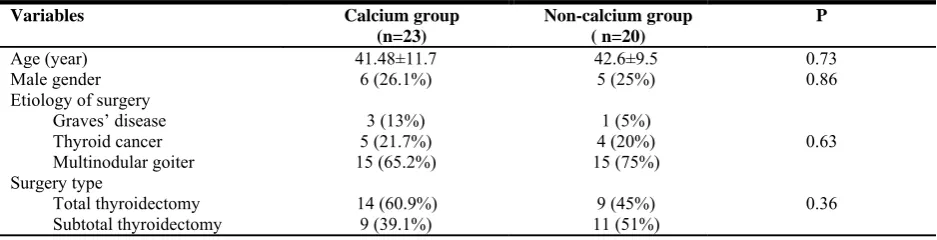
Among 43 consecutive patients, 23 (53.5%) received oral calcium before thyroidectomy (case group), and 20 (46.5%) did not receive calcium (non-calcium group). Mean age of the patients was 40.9±11 (17 - 61 years). There was no difference in age, gender, and indication of surgery between the two groups (p>0.05), which indicate to the random validity of the study (Table 1).
In calcium group, 14 (60.9%) patients underwent total thyroidectomy and for 9 (39.1%) patients subtotal thyroidectomy was performed. In non-calcium group
Table 1. Comparison of mean age and patients’ distribution according to the etiology and surgery type between case and groups.
Variables Calcium group
(n=23)
Non-calcium group ( n=20)
P
Age (year) 41.48±11.7 42.6±9.5 0.73
Male gender 6 (26.1%) 5 (25%) 0.86
Etiology of surgery
0.63
Graves’ disease 3 (13%) 1 (5%)
Thyroid cancer 5 (21.7%) 4 (20%)
Multinodular goiter 15 (65.2%) 15 (75%)
Surgery type
0.36
Total thyroidectomy 14 (60.9%) 9 (45%)
the operative procedures were total thyroidectomy for 9 (45%) patients and subtotal thyroidectomy for 11 (51%) patients; no statistical differences was found between the two groups (p=0.36) with regard to surgical procedure type (Table1). The mean calcium level 12 hours after surgery was higher in calcium group than in non-calcium group but not statistically significant (8.9±0.5 vs. 8.5±0.7 mg/dl, p=0.092). The mean calcium level in the morning of postoperative day was significantly higher in calcium group than in non-calcium group (8.9±0.5 vs. 8.4±0.8, p=0.037).
Paresthesia was also experienced significantly less frequent by calcium group than non-calcium group at 12 hours (2 (8.7%) vs. 8 (40%), p=0.02) and 24 hours after surgery (1 (4.3%) vs. 6 (30%), p=0.04) (Table-2). No difference was detected between the two groups in relation to paresthesia at 6h after surgery, Chvostek sign and carpopedal spasm 6, 12, and 24 hours after surgery. Serum calcium level at 1 week after surgery was also comparable. The need for intravenous calcium infusion during hospitalization was lower in calcium group than non-calcium group (2 (8.6%) vs. 10 (50%) which was statistically significant p=0.003).
Twenty patients (87%) in calcium group were discharged 1 day after surgery, whereas 11 (55%) patients of non-calcium group discharged 1 day after surgery which was significantly different between the two groups (p=0.02). Calcium measured one week after surgery was 9.1±0.6 mg/dl in the calcium group and 8.7±0.5 mg/dl in non-calcium group (p=0.007). Comparison of changes in serial serum calcium levels between the two groups was performed using Repeated Measures ANOVA which indicated that there was statistically significant differences between the two groups (p=0.024).
Discussion
Hypocalcemia is a major concern following thyroid surgery and occurs in up to one-third of patients following thyroidectomy. Although 97% of cases are self-limiting, if parathyroid glands removed inadvertently or damaged irreversibly, hypocalcemia remains permanently and can cause significant and serious clinical symptoms and raises the medical costs (16,17). Patients undergoing thyroidectomy should be monitored carefully for hypocalcemia and should be treated by oral or intravenous infusion of calcium to relieve symptoms and prevent related complications. Typically, symptoms of transient hypocalcaemia occur 24 to 48 hours after surgery (13). Perioral paresthesia, and other mild symptoms of hypocalcaemia, can be treated with oral calcium intake. More severe signs such as carpopedal spasm require prompt intravenous infusion of calcium followed by oral calcium and activated form of vitamin D (calcitriol) (18).
Various factors may account for an increased risk of hypocalcemia, including Graves’ disease, older age, poor surgical technique, hemodilution, and increased urinary calcium excretion secondary to surgical stress. On the contrary, increasing surgeon’s experience can decrease the risk (1,19-21). Recently it has been shown that preoperative serum vitamin D deficiency is an independent risk factor for hypocalcemia following total thyroidectomy although it only increases the risk of transient hypocalcemia (19,20,22).
Several strategies have been anticipated for conserving calcium level after thyroidectomy. To decrease the symptoms of hypocalcemia, some surgeons prefer to prescribe oral calcium prophylactically, whereas others prefer to treat patients with postoperative hypocalcemia. They routinely check hypocalcemia symptoms in postoperative period and measure serum calcium. Also, they educate patients on
Table 2. Comparison of hospitalization period, mean calcium level 12 and 24 hour post-surgery and intravenous calcium
requirement in calcium and non-calcium groups. The data is described in the form of amount and “mean±standard deviation”.
Variable calcium group
(n=23)
non-calcium group (n=20)
* P
Hospitalization Period (day)
2.1±0.3 2.9±1.4 0.006
Mean calcium level one hour post-surgery
8.9±0.6 8.8±0.4 0.971
Mean calcium level
12 h post-surgery 8.9±0.5 8.5±0.7 0.092
Mean calcium level
24 h after surgery 8.9±0.5 8.4±0.8 0.037
Calcium level one
week after surgery 9.1±0.6 8.7±0.5 0.007
Paresthesia 12 h
After surgery(patient) 2(8.7%) 8(40%) 0.02
Paresthesia 24h
After surgery(patient) 1(4.3%) 6(30%) 0.04
Calcium intravenous
the symptoms of hypocalcemia while discharging them. Park et al. (16) demonstrated that administration of oral calcium and vitamin D reduces the incidence and severity of hypocalcaemia after total thyroidectomy. Moore (23) showed that oral calcium administration may lead to sooner discharge on the second postoperative day (36 hours after Surgery) without hypocalcaemia attack. Sanabria (24) evaluated four randomized clinical trials in a meta-analysis. They found that administration of calcium and vitamin D supplements decreases the incidence of hypocalcaemia symptoms after thyroidectomy.
The main preventive measure is preserving parathyroid glands by careful dissection during the surgery; also parathyroid autotransplantation has been campaigner as another resolution to prevent permanent hyperparathyroidism after total, subtotal, or completion thyroidectomy for benign or malignant diseases of the thyroid. It has been reported that patients who received parathyroid autotransplantation had a significantly lower risk of permanent hyperparathyroidism once postoperative hypocalcemia occurred (25,26). Abboud et al. (27) performed a retrospective study on 252 patients who underwent total thyroidectomy. They found that routine autotransplantation of at least 1 parathyroid gland along with routine calcium and vitamin D supplementation during total thyroidectomy efficiently reduced symptomatic hypocalcemia and permanent hyperparathyroidism.
In the present study it was shown that administration of oral calcium supplements, starting the night before surgery and continuing postoperatively every 8 hours, would significantly decrease symptomatic hypocalcaemia after total or subtotal thyroidectomy.
In spite of normal ranges of serum calcium level in two groups 24 hours after surgery, the difference was statistically significant between two groups. Although calcium values were between 8.5-10.5 in two groups but it was lower in non-calcium group and the rate of hypocalcemia symptoms was significantly higher in non-calcium group with more perioral and/or limb paresthesia 12-24 hours after surgery.
Another finding in this study was that the number of patients requiring intravenous calcium was significantly lower in calcium group (8.6% vs. 50%). It can be suggested that prophylactic oral calcium reduces the need for calcium injections after total or subtotal thyroidectomy.
Considering the administration of prophylactic oral calcium supplementation reduces the symptoms of hypocalcemia 24 hours after surgery; thus, patients can be discharged within 24 hours. It should be borne in mind that the prophylactic dose of calcium (1 g of calcium carbonate every 8 hours) with or without calcitriol could prevent the development of symptoms of hypocalcaemia after thyroidectomy.
This study had some limitations. Low number of patients and possible low power of findings are of the limitations mandating further studies and later meta-analysis. Also, we did not study serum intact parathyroid hormone and other related markers to calcium homeostasis.
In conclusion, prophylactic oral calcium supplementation therapy reduces the incidence of symptomatic hypocalcemia and the need for calcium infusion 24 hours after total or subtotal thyroidectomy. It may also allow the patient discharge from the hospital earlier.
Conflict of interest
None declared.
References
1. Sciumè C, Geraci G, Pisello F, Facella T, Li VF, Licata A, et al. [Complications in thyroid surgery: symptomatic post-operative hypoparathyroidism incidence, surgical technique, and treatment]. Ann. Ital. di Chir. 2005;77(2):115-22.
2. Pattou F, Combemale F, Fabre S, Carnaille B, Decoulx M, Wemeau J-L, et al. Hypocalcemia following thyroid surgery: incidence and prediction of outcome. World J. of Surg. 1998;22(7):718-24.
3. Sharma PK, Barr LJ. Complications of thyroid surgery. Aug 27, 2012: Available from: http://emedicine.medscape.com/article/852184-overview. 4. Bourrel C, Uzzan B, Tison P, Despreaux G, Frachet B,
Modigliani E, et al. Transient hypocalcemia after thyroidectomy. The Ann. of Otol., Rhinol. & Laryngol. Suppl. 1993;102(7):496-501.
5. Demeester-Mirkine N, Hooghe L, Van Geertruyden J, De Maertelaer V. Hypocalcemia after thyroidectomy. Arch. of Surg. 1992;127(7):854-8.
6. McHenry CR, Speroff T, Wentworth D, Murphy T. Risk factors for postthyroidectomy hypocalcemia. Surgery. 1994;116(4):641-7; discussion 7-8.
7. Adams J, Andersen P, Everts E, Cohen J. Early postoperative calcium levels as predictors of hypocalcemia. The Laryngoscope. 1998;108(12):1829-31.
8. Wilson RB, Erskine C, Crowe PJ. Hypomagnesemia and hypocalcemia after thyroidectomy: prospective study. World J. of Surg. 2000;24(6):722-6.
9. Moore C, Lampe H, Agrawal S. Predictability of hypocalcemia using early postoperative serum calcium levels. The J. of Otolaryngol. 2001;30(5):266-70.
10. Yamashita H, Noguchi S, Murakami T, Uchino S, Watanabe S, Ohshima A, et al. Predictive risk factors for postoperative tetany in female patients with Graves’ disease. J. of the Am. Coll. of Surg.. 2001;192(4):465-8. 11. Bentrem DJ, Rademaker A, Angelos P. Evaluation of
serum calcium levels in predicting hypoparathyroidism after total/near-total thyroidectomy or parathyroidectomy. The Am. Surg. 2001;67(3):249-51; discussion 51-2. 12. Luu Q, Andersen PE, Adams J, Wax MK, Cohen JI. The
2002;24(1):63-7.
13. Bellantone R, Lombardi CP, Raffaelli M, Boscherini M, Alesina PF, De Crea C, et al. Is routine supplementation therapy (calcium and vitamin D) useful after total thyroidectomy? Surgery. 2002;132(6):1109-13.
14. Tartaglia F, Giuliani A, Sgueglia M, Biancari F, Juvonen T, Campana FP. Randomized study on oral administration of calcitriol to prevent symptomatic hypocalcemia after total thyroidectomy. The Am. J. of Surg. 2005;190(3):424-9.
15. Uruno T, Miyauchi A, Shimizu K, Tomoda C, Takamura Y, Ito Y, et al. A prophylactic infusion of calcium solution reduces the risk of symptomatic hypocalcemia in patients after total thyroidectomy. World J. of Surg. 2006;30(3):304-8.
16. Roh J-L, Park CI. Routine oral calcium and vitamin D supplements for prevention of hypocalcemia after total thyroidectomy. The Am. J. of Surg. 2006;192(5):675-8. 17. Safioleas M, Stamatakos M, Rompoti N, Mouzopoulos G,
Iannescu R, Salichou V, et al. Complications of thyroid surgery. Chirurgia (Bucharest, Romania: 1990). 2005;101(6):571-81.
18. Pallotti F, Seregni E, Ferrari L, Martinetti A, Biancolini D, Bombardieri E. Diagnostic and therapeutic aspects of iatrogenic hypoparathyroidism. Tumori. 2002;89(5):547-9.
19. Thomusch O, Machens A, Sekulla C, Ukkat J, Lippert H, Gastinger I, et al. Multivariate analysis of risk factors for postoperative complications in benign goiter surgery: prospective multicenter study in Germany. World J. of Surg. 2000;24(11):1335-41.
20. Erbil Y, Barbaros U, Temel B, Turkoglu U, İşsever H, Bozbora A, et al. The impact of age, vitamin D3 level, and
incidental parathyroidectomy on postoperative hypocalcemia after total or near total thyroidectomy. The Am. J. of Surg. 2009;197(4):439-46.
21. Thomusch O, Machens A, Sekulla C, Ukkat J, Brauckhoff M, Dralle H. The impact of surgical technique on postoperative hypoparathyroidism in bilateral thyroid surgery: a multivariate analysis of 5846 consecutive patients. Surgery. 2003;133(2):180-5.
22. Kirkby-Bott J, Markogiannakis H, Skandarajah A, Cowan M, Fleming B, Palazzo F. Preoperative vitamin D deficiency predicts postoperative hypocalcemia after total thyroidectomy. World J. of Surg. 2011;35(2):324-30. 23. Moore Jr FD. Oral calcium supplements to enhance early
hospital discharge after bilateral surgical treatment of the thyroid gland or exploration of the parathyroid glands. J. of Am. Coll. Surg. 1994;178(1):11-6.
24. Sanabria A, Dominguez LC, Vega V, Osorio C, Duarte D. Routine postoperative administration of vitamin D and calcium after total thyroidectomy: a meta-analysis. Int. J. of Surg. 2011;9(1):46-51.
25. Lo CY, Lam KY. Routine parathyroid autotransplantation during thyroidectomy. Surgery. 2001;129(3):318-23. 26. Olson Jr JA, DeBenedetti MK, Baumann DS, Wells Jr SA.
Parathyroid autotransplantation during thyroidectomy. Results of long-term follow-up. Ann. of Surg. 1996;223(5):472.