Bulletin of Mathematical Analysis and Applications ISSN: 1821-1291, URL: http://www.bmathaa.org Volume 3 Issue 2(2011), Pages 269-277.
STRASSEN’S MATRIX MULTIPLICATION ALGORITHM FOR MATRICES OF ARBITRARY ORDER
(COMMUNICATED BY MARTIN HERMANN)
IVO HEDTKE
Abstract. The well known algorithm ofVolker Strassenfor matrix mul-tiplication can only be used for (𝑚2𝑘×𝑚2𝑘) matrices. For arbitrary (𝑛×𝑛) matrices one has to add zero rows and columns to the given matrices to use
Strassen’s algorithm. Strassengave a strategy of how to set𝑚 and𝑘for arbitrary𝑛to ensure𝑛≤𝑚2𝑘. In this paper we study the number𝑑of ad-ditional zero rows and columns and the influence on the number of flops used by the algorithm in the worst case (𝑑=𝑛/16), best case (𝑑= 1) and in the average case (𝑑≈𝑛/48). The aim of this work is to give a detailed analysis of the number of additional zero rows and columns and the additional work caused byStrassen’s bad parameters. Strassenused the parameters𝑚and 𝑘to show that his matrix multiplication algorithm needs less than 4.7𝑛log27 flops. We can show in this paper, that these parameters cause an additional work of approximately 20 % in the worst case in comparison to the optimal strategy for the worst case. This is the main reason for the search for better parameters.
1. Introduction
In his paper “Gaussian Elimination is not Optimal” ([14]) Volker Strassen developed a recursive algorithm (we will call it 𝒮) for multiplication of square matrices of order𝑚2𝑘. The algorithm itself is described below. Further details can be found in [8, p. 31].
Before we start with our analysis of the parameters of Strassen’s algorithm we will have a short look on the history of fast matrix multiplication. The naive algorithm for matrix multiplication is an 𝒪(𝑛3) algorithm. In 1969
Strassen showed that there is an𝒪(𝑛2.81) algorithm for this problem.
Shmuel Winograd optimizedStrassen’s algorithm. While theStrassen-Winogradalgorithm is a variant that is always implemented (for example in the famous GEMMW package), there are faster ones (in theory) that are impractical to implement. The fastest known algorithm, devised in 1987 byDon CoppersmithandWinograd, runs in
1991Mathematics Subject Classification. Primary 65F30; Secondary 68Q17.
Key words and phrases. Fast Matrix Multiplication, Strassen Algorithm. c
⃝2011 Universiteti i Prishtin¨es, Prishtin¨e, Kosov¨e.
The author was supported by the Studienstiftung des Deutschen Volkes. Submitted February 2, 2011. Published March 2, 2011.
𝒪(𝑛2.38) time. There is also an interesting group-theoretic approach to fast matrix multiplication fromHenry CohnandChristopher Umans, see [4], [5] and [13]. Most researchers believe that an optimal algorithm with𝒪(𝑛2) runtime exists, since then no further progress was made in finding one.
Because modern architectures have complex memory hierarchies and increasing parallelism, performance has become a complex tradeoff, not just a simple matter of counting flops (in this article one flop means one floating-point operation, that means one addition is a flop and one multiplication is one flop, too). Algorithms which make use of this technology were described by Paolo D’Alberto and Alexandru Nicolau in [1]. An also well known method isTiling: The normal algorithm can be speeded up by a factor of two by using a six loop implementation that blocks submatrices so that the data passes through the L1 Cache only once.
1.1. The algorithm. Let𝐴and𝐵be (𝑚2𝑘×𝑚2𝑘) matrices. To compute𝐶:=𝐴𝐵 let
𝐴= [
𝐴11 𝐴12
𝐴21 𝐴22
]
and 𝐵 = [
𝐵11 𝐵12
𝐵21 𝐵22
] ,
where 𝐴𝑖𝑗 and 𝐵𝑖𝑗 are matrices of order 𝑚2𝑘−1. With the following auxiliary matrices
𝐻1:= (𝐴11+𝐴22)(𝐵11+𝐵22) 𝐻2:= (𝐴21+𝐴22)𝐵11
𝐻3:=𝐴11(𝐵12−𝐵22) 𝐻4:=𝐴22(𝐵21−𝐵11)
𝐻5:= (𝐴11+𝐴12)𝐵22 𝐻6:= (𝐴21−𝐴11)(𝐵11+𝐵12)
𝐻7:= (𝐴12−𝐴22)(𝐵21+𝐵22)
we get
𝐶= [
𝐻1+𝐻4−𝐻5+𝐻7 𝐻3+𝐻5
𝐻2+𝐻4 𝐻1+𝐻3−𝐻2+𝐻6
] .
This leads to recursive computation. In the last step of the recursion the products of the (𝑚×𝑚) matrices are computed with the naive algorithm (straight forward implementation with threefor-loops, we will call it 𝒩).
1.2. Properties of the algorithm. The algorithm𝒮 needs (see [14])
𝐹𝒮(𝑚, 𝑘) := 7𝑘𝑚2(2𝑚+ 5)−4𝑘6𝑚2
flops to compute the product of two square matrices of order 𝑚2𝑘. The naive algorithm𝒩 needs𝑛3multiplications and𝑛3−𝑛2additions to compute the product of two (𝑛×𝑛) matrices. Therefore 𝐹𝒩(𝑛) = 2𝑛3−𝑛2. In the case 𝑛 = 2𝑝 the algorithm 𝒮 is better than 𝒩 if 𝐹𝒮(1, 𝑝) < 𝐹𝒩(2𝑝), which is the case iff 𝑝 ⩾10. But if we use algorithm 𝒮 only for matrices of order at least 210 = 1024, we get a new problem:
Lemma 1.1. The algorithm𝒮 needs 173(7𝑝−4𝑝)units of memory (we write “uom”
in short) (number of floats or doubles) to compute the product of two (2𝑝×2𝑝)
matrices.
as input arguments for the recursive calls of𝒮. Therefore we get𝑀(𝑛) = 7𝑀(𝑛/2)+ (17/4)𝑛2. Together with𝑀(1) = 0 this yields to𝑀(2𝑝) = 173(7𝑝−4𝑝). □
As an example, if we compute the product of two (210×210) matrices (represented as double arrays) with 𝒮 we need 8⋅ 17
3(7
10−410) bytes, i.e. 12.76 gigabytes of
memory. That is an enormous amount of RAM for such a problem instance. Brice Boyeret al. ([3]) solved this problem with fully in-place schedules of Strassen-Winograd’s algorithm (see the following paragraph), if the input matrices can be overwritten.
Shmuel WinogradoptimizedStrassen’s algorithm. The Strassen-Wino-gradalgorithm (described in [11]) needs only 15 additions and subtractions, whereas
𝒮 needs 18. Winograd had also shown (see [15]), that the minimum number of multiplications required to multiply 2×2 matrices is 7. Furthermore, Robert Probert([12]) showed that 15 additive operations are necessary and sufficient to multiply two 2×2 matrices with 7 multiplications.
Because of the bad properties of 𝒮 with full recursion and large matrices, one can study the idea to use only one step of recursion. If𝑛is even and we use one step of recursion of𝒮 (for the remaining products we use𝒩) the ratio of this operation count to that required by𝒩 is (see [9])
7𝑛3+ 11𝑛2 8𝑛3−4𝑛2
𝑛→∞
−−−−→ 7
8.
Therefore the multiplication of two sufficiently large matrices using𝒮costs approx-imately 12.5 % less than using𝒩.
Using the technique of stopping the recursion in theStrassen-Winograd al-gorithm early, there are well known implementations, as for example
∙ on the Cray-2 fromDavid Bailey([2]),
∙ GEMMW fromDouglaset al. ([7]) and
∙ a routine in the IBM ESSL library routine ([10]).
1.3. The aim of this work. Strassen’s algorithm can only be used for (𝑚2𝑘× 𝑚2𝑘) matrices. For arbitrary (𝑛×𝑛) matrices one has to add zero rows and columns to the given matrices (see the next section) to useStrassen’s algorithm. Strassen gave a strategy of how to set𝑚 and𝑘 for arbitrary𝑛to ensure 𝑛≤𝑚2𝑘. In this paper we study the number𝑑of additional zero rows and columns and the influence on the number of flops used by the algorithm in the worst case, best case and in the average case.
It is known ([11]), that these parameters are not optimal. We only study the number 𝑑 and the additional work caused by the bad parameters of Strassen. We give no better strategy of how to set 𝑚 and 𝑘, and we do not analyze other strategies than the one fromStrassen.
2. Strassen’s parameter for matrices of arbitrary order
Algorithm 𝒮 uses recursions to multiply matrices of order 𝑚2𝑘. If 𝑘 = 0 then 𝒮
coincides with the naive algorithm 𝒩. So we will only consider the case where 𝑘 >0. To use 𝒮 for arbitrary (𝑛×𝑛) matrices𝐴and𝐵 (that means for arbitrary 𝑛) we have to embed them into matrices ˜𝐴and ˜𝐵which are both (˜𝑛ט𝑛) matrices with ˜𝑛:=𝑚2𝑘
and𝐵. This results in
˜ 𝐴𝐵˜ =
[
𝐴 0𝑛×ℓ 0ℓ×𝑛 0ℓ×ℓ
] [
𝐵 0𝑛×ℓ 0ℓ×𝑛 0ℓ×ℓ ]
=: ˜𝐶,
where 0𝑘×𝑗 denotes the (𝑘×𝑗) zero matrix. If we delete the last ℓ columns and rows of ˜𝐶we get the result 𝐶=𝐴𝐵.
We now focus on how to find𝑚and𝑘for arbitrary𝑛with𝑛⩽𝑚2𝑘. An optimal but purely theoretical choice is
(𝑚∗, 𝑘∗) = arg min{𝐹𝒮(𝑚, 𝑘) : (𝑚, 𝑘)∈ℕ×ℕ0, 𝑛⩽𝑚2𝑘}.
Further methods of finding𝑚and𝑘can be found in [11]. We choose another way. According toStrassen’s proof of the main result of [14], we define
𝑘:=⌊log2𝑛⌋ −4 and 𝑚:=⌊𝑛2−𝑘⌋+ 1, (2.1)
where⌊𝑥⌋denotes the largest integer not greater than𝑥. We define ˜𝑛:=𝑚2𝑘 and study the relationship between𝑛and ˜𝑛. The results are:
∙ worst case: ˜𝑛⩽(17/16)𝑛,
∙ best case: ˜𝑛⩾𝑛+ 1 and
∙ average case: ˜𝑛≈(49/48)𝑛.
2.1. Worst case analysis.
Theorem 2.1. Let 𝑛∈ℕwith 𝑛⩾16. For the parameters (2.1)and𝑚2𝑘= ˜𝑛we
have
˜ 𝑛≤17
16𝑛.
If 𝑛is a power of two, we have ˜𝑛=1716𝑛.
Proof. For fixed 𝑛 there is exactly one 𝛼 ∈ ℕ with 2𝛼 ≤ 𝑛 < 2𝛼+1. We define
𝐼𝛼:={2𝛼, . . . ,2𝛼+1−1}. Because of (2.1) for each 𝑛∈𝐼𝛼the value of 𝑘is
𝑘=⌊log2𝑛⌋ −4 = log22𝛼−4 =𝛼−4.
Possible values for𝑚are
𝑚= ⌊
𝑛 1 2𝛼−4
⌋ + 1 =
⌊ 𝑛16
2𝛼 ⌋
+ 1 =:𝑚(𝑛).
𝑚(𝑛) is increasing in 𝑛 and 𝑚(2𝛼) = 17 and 𝑚(2𝛼+1) = 33. Therefore we have
𝑚∈ {17, . . . ,32}. For each 𝑛∈𝐼𝛼one of the following inequalities holds:
(𝐼1𝛼) 2𝛼= 16⋅2𝛼−4 ≤ 𝑛 < 17⋅2𝛼−4 (𝐼2𝛼) 17⋅2𝛼−4 ≤ 𝑛 < 18⋅2𝛼−4
.. .
(𝐼16𝛼) 31⋅2𝛼−4 ≤ 𝑛 < 32⋅2𝛼−4= 2𝛼+1.
Note that 𝐼𝛼 =⊎16 𝑗=1𝐼
𝛼
𝑗. It follows, that for all𝑛∈ℕ there exists exactly one𝛼 with𝑛∈𝐼𝛼 and for all𝑛∈𝐼𝛼 there is exactly one𝑗 with𝑛∈𝐼𝛼
𝑗.
Note that for all𝑛∈𝐼𝑗𝛼we have𝑘=𝛼−4 and𝑚(𝑛) =𝑗+ 16. If we only focus on𝐼𝛼
𝐹𝒮(2𝑗,10−𝑗)
𝑗
0 1 2 3 4 5 6 7 8 9 10
1×10⁹ 2×10⁹
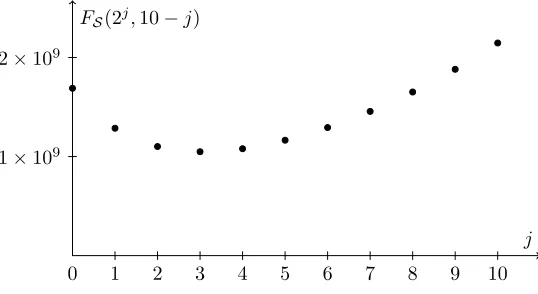
Figure 1. Different parameters (𝑚= 2𝑗, 𝑘= 10−𝑗, 𝑛 =𝑚2𝑘) to apply in theStrassen algorithm for matrices of order 210.
and 𝑛 has its minimum at the lower end of 𝐼𝛼
𝑗). On 𝐼𝑗𝛼 the value of ˜𝑛 and the minimum of𝑛are
˜
𝑛𝛼𝑗 := (16 +𝑗)⋅2𝛼−4 and 𝑛𝛼𝑗 := (15 +𝑗)⋅2𝛼−4.
Therefore the difference𝑑𝛼𝑗 := ˜𝑛𝛼𝑗 −𝑛𝛼𝑗 is constant:
𝑑𝛼𝑗 = (16 +𝑗)⋅2𝛼−4−(15 +𝑗)⋅2𝛼−4= 2𝛼−4 for all𝑗.
To set this in relation with𝑛we study
𝑟𝛼𝑗 := ˜𝑛 𝛼 𝑗 𝑛𝛼
𝑗 = 𝑛
𝛼 𝑗 +𝑑𝛼𝑗
𝑛𝛼 𝑗
= 1 + 𝑑 𝛼 𝑗 𝑛𝛼
𝑗
= 1 + 2 𝛼−4
𝑛𝛼 𝑗
.
Finally𝑟𝛼
𝑗 is maximal, iff𝑛𝛼𝑗 is minimal, which is the case for𝑛1𝛼= 16⋅2𝛼−4= 2𝛼. With𝑟𝛼
1 = 17/16 we get ˜𝑛≤ 17
16𝑛, which completes the proof. □
Now we want to use the result above to take a look at the number of flops we need for 𝒮 in the worst case. The worst case is 𝑛 = 2𝑝 for any 4 ≤ 𝑝 ∈
ℕ. An
optimal decomposition (in the sense of minimizing the number (˜𝑛−𝑛) of zero rows and columns we add to the given matrices) is 𝑚 = 2𝑗 and 𝑘 = 𝑝−𝑗, because 𝑚2𝑘= 2𝑗2𝑝−𝑗 = 2𝑝=𝑛. Note that these parameters 𝑚and 𝑘have nothing to do with equation (2.1). Lets have a look on the influence of𝑗:
Lemma 2.2. Let 𝑛 = 2𝑝. In the decomposition 𝑛 = 𝑚2𝑘 we use 𝑚 = 2𝑗 and 𝑘=𝑝−𝑗. Then𝑓(𝑗) :=𝐹𝒮(2𝑗, 𝑝−𝑗) has its minimum at𝑗= 3.
Proof. We have𝑓(𝑗) = 2⋅7𝑝(8/7)𝑗+ 5⋅7𝑝(4/7)𝑗−4𝑝6. Thus
𝑓(𝑗+ 1)−𝑓(𝑗)
= [2⋅7𝑝(8/7)𝑗+1+ 5⋅7𝑝(4/7)𝑗+1−4𝑝6]−[2⋅7𝑝(8/7)𝑗+ 5⋅7𝑝(4/7)𝑗−4𝑝6]
= 2⋅7𝑝(8/7)𝑗(8/7−1) + 5⋅7𝑝(4/7)𝑗(4/7−1)
= 2⋅7𝑝(8/7)𝑗⋅1/7−15⋅7𝑝(4/7)𝑗⋅1/7 = 2(4/7)𝑗7𝑝−1(2𝑗−7.5).
Therefore,𝑓(𝑗) is a minimum if𝑗 = min{𝑖: 2𝑖−7.5>0}= 3.
𝑓1(𝑝)
𝑝
4 6 8 10 12 14 16 18 20 1.19
1.20 1.21
𝑓2(𝑝)
𝑝
4 6 8 10 12 14 16 18 20 1.006
1.007 1.008
Figure 2. Comparison of Strassen’s parameters (𝑓1, 𝑚 = 17,
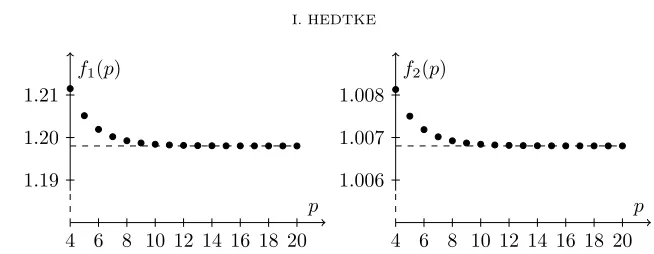
𝑘=𝑝−4), obviously better parameters (𝑓2, 𝑚= 16, 𝑘=𝑝−4) and the optimal parameters (lemma, 𝑚 = 8, 𝑘 = 𝑝−3) for the worst case𝑛= 2𝑝. Limits of𝑓𝑗 are dashed.
Figure 1 shows that it is not optimal to use𝒮 with full recursion in the example 𝑝= 10. Now we study the worst case 𝑛= 2𝑝 and different sets of parameters 𝑚 and𝑘for𝐹𝒮(𝑚, 𝑘):
(1) If we use equation (2.1), we get the original parameters of Strassen: 𝑘= 𝑝−4 and𝑚= 17. Therefore we define
𝐹1(𝑝) :=𝐹𝒮(17, 𝑝−4) = 7𝑝 39⋅172
74 −4
𝑝6⋅17
2
44 .
(2) Obviously 𝑚 = 16 would be a better choice, because with this we get 𝑚2𝑘=𝑛(we avoid the additional zero rows and columns). Now we define
𝐹2(𝑝) :=𝐹𝒮(16, 𝑝−4) = 7𝑝 37⋅162
74 −4
𝑝6.
(3) Finally we use the lemma above. With𝑚= 8 = 23 and𝑘=𝑝−3 we get
𝐹3(𝑝) :=𝐹𝒮(8, 𝑝−3) = 7𝑝 3⋅64
49 −4 𝑝6.
Now we analyze 𝐹𝑖 relative to each other. Therefore we define 𝑓𝑗 := 𝐹𝑗/𝐹3 (𝑗 = 1,2). So we have𝑓𝑗:{4,5, . . .} →ℝ, which is monotonously decreasing in𝑝.
With
𝑓1(𝑝) =
289(4𝑝⋅2401−7𝑝⋅1664)
12544(4𝑝⋅49−7𝑝⋅32) and 𝑓2(𝑝) =
4𝑝⋅7203−7𝑝⋅4736 147(4𝑝⋅49−7𝑝⋅32)
we get
𝑓1(4) = 3179/2624≈1.2115 lim
𝑝→∞𝑓1(𝑝) = 3757/3136≈1.1980 𝑓2(4) = 124/123≈1.00813 lim
𝑝→∞𝑓2(𝑝) = 148/147≈1.00680.
2.2. Best case analysis.
Theorem 2.3. Let 𝑛∈ℕwith 𝑛⩾16. For the parameters (2.1)and𝑚2𝑘= ˜𝑛we have
𝑛+ 1≤𝑛.˜
If 𝑛= 2𝑝ℓ−1,ℓ∈ {16, . . . ,31}, we have 𝑛˜=𝑛+ 1.
Proof. Like in Theorem 2.1 we have for each 𝐼𝛼
𝑗 a constant value for ˜𝑛𝛼𝑗 namely 2𝛼−4(16 +𝑗). Therefore𝑛 <𝑛˜ holds. The difference ˜𝑛−𝑛has its minimum at the upper end of 𝐼𝑗𝛼. There we have ˜𝑛−𝑛= 2𝛼−4(16 +𝑗)−(2𝛼−4(16 +𝑗)−1) = 1.
This shows𝑛+ 1≤˜𝑛. □
Let us focus on the flops we need for𝒮, again. Lets have a look at the example 𝑛= 2𝑝−1. The original parameters (see equation (2.1)) for𝒮 are𝑘=𝑝−5 and 𝑚= 32. Accordingly we define𝐹(𝑝) :=𝐹𝒮(32, 𝑝−5). Because 2𝑝−1≤2𝑝 we can add 1 zero row and column and use the lemma from the worst case. Now we get the parameters 𝑚= 8 and𝑘=𝑝−3 and define ˜𝐹(𝑝) :=𝐹𝒮(8, 𝑝−3). To analyze 𝐹 and ˜𝐹 relative to each other we have
𝑟(𝑝) :=𝐹(𝑝) ˜ 𝐹(𝑝) =
4𝑝⋅16807−7𝑝⋅11776 4𝑝⋅16807−7𝑝⋅10976.
Note that𝑟:{5,6, . . .} →ℝis monotonously decreasing in𝑝and has its maximum
at𝑝= 5. We get
𝑟(5) = 336/311≈1.08039 lim
𝑝→∞𝑟(𝑝) = 11776/10976≈1.07289.
Therefore we can say: In the best case the parameters ofStrassenare approx. 8 % worse than the optimal parameters from the lemma in the worst case.
2.3. Average case analysis. With 𝔼𝑛˜ we denote the expected value of ˜𝑛. We search for a relationship like ˜𝑛≈𝛾𝑛for𝛾∈ℝ. That means𝔼[˜𝑛/𝑛] =𝛾.
Theorem 2.4. For the parameters (2.1)of Strassen 𝑚2𝑘= ˜𝑛we have
𝔼˜𝑛=49
48𝑛.
Proof. First we focus only on 𝐼𝛼. We write 𝔼𝛼 := 𝔼∣𝐼𝛼 and 𝔼𝛼𝑗 := 𝔼∣𝐼𝛼
𝑗 for the
expected value on𝐼𝛼 and𝐼𝑗𝛼, resp. We have
𝔼𝛼𝑛˜= 1 16 16 ∑ 𝑗=1 𝔼𝛼𝑗𝑛˜= 1 16 16 ∑ 𝑗=1 ˜ 𝑛𝛼𝑗 = 1
16 16
∑
𝑗=1
(𝑗+ 16)2𝛼−4= 2𝛼−5⋅49.
Together with𝔼𝛼𝑛= 1 2[(2
𝛼+1−1) + 2𝛼] = 2𝛼+ 2𝛼−1−1/2, we get
𝜌(𝛼) :=𝔼𝛼 [𝑛˜ 𝑛 ] =𝔼 𝛼𝑛˜ 𝔼𝛼𝑛 =
2𝛼−5⋅49 2𝛼+ 2𝛼−1−1/2.
Now we want to calculate𝔼𝑘 :=𝔼∣𝑈(𝑘)[˜𝑛/𝑛], where𝑈(𝑘) :=
⊎𝑘 𝑗=0𝐼
4+𝑗by using the
values𝜌(𝑗). Because of∣𝐼5∣= 2∣𝐼4∣and∣𝐼4∪𝐼5∣= 3∣𝐼4∣we have
𝔼1= 13𝜌(4)+23𝜌(5). With the same argument we get
𝔼𝑘=
4+𝑘 ∑
𝑗=4
Finally we have
𝔼
[˜𝑛
𝑛 ]
= lim
𝑘→∞𝔼𝑘= lim𝑘→∞ (4+𝑘
∑
𝑗=4
𝛽𝑗𝜌(𝑗) )
= lim 𝑘→∞
( 49 2𝑘+1−1
4+𝑘 ∑
𝑗=4
22𝑗−9 2𝑗+ 2𝑗−1−1/2
) = 49
48,
what we intended to show. □
Compared to the worst case (˜𝑛 ≤ 17
16𝑛, 17/16 = 1 + 1/16), note that 49/48 = 1 + 1/48 = 1 +13⋅ 1
16.
3. Conclusion
Strassenused the parameters𝑚and𝑘 in the form (2.1) to show that his matrix multiplication algorithm needs less than 4.7𝑛log27 flops. We could show in this paper, that these parameters cause an additional work of approx. 20 % in the worst case in comparison to the optimal strategy for the worst case. This is the main reason for the search for better parameters, like in [11].
References
[1] P. D’Alberto and A. Nicolau, Adaptive Winograd’s Matrix Multiplications, ACM Trans. Math. Softw. 36, 1, Article 3 (March 2009).
[2] D. H. Bailey, Extra High Speed Matrix Multiplication on the Cray-2, SIAM J. Sci. Stat. Comput., Vol. 9, Co. 3, 603–607, 1988.
[3] B. Boyer, J.-G. Dumas, C. Pernet, and W. Zhou,Memory efficient scheduling of Strassen-Winograd’s matrix multiplication algorithm, International Symposium on Symbolic and Al-gebraic Computation 2009, S´eoul.
[4] H. Cohn and C. Umans, A Group-theoretic Approach to Fast Matrix Multiplication, Pro-ceedings of the 44thAnnual Symposium on Foundations of Computer Science, 11-14 October 2003, Cambridge, MA, IEEE Computer Society, pp. 438-449.
[5] H. Cohn, R. Kleinberg, B. Szegedy and C. Umans, Group-theoretic Algorithms for Matrix Multiplication, Proceedings of the 46th Annual Symposium on Foundations of Computer Science, 23-25 October 2005, Pittsburgh, PA, IEEE Computer Society, pp. 379-388. [6] D. Coppersmith and S. Winograd,Matrix Multiplication via Arithmetic Progressions, STOC
’87: Proceedings of the nineteenth annual ACM symposium on Theory of Computing, 1987. [7] C. C. Douglas, M. Heroux, G. Slishman and R. M. Smith, GEMMW: A Portable Level
3 BLAS Winograd Variant of Strassen’s Matrix–Matrix Multiply Algorithm, J. of Comp. Physics, 110:1–10, 1994.
[8] G. H. Golub and C. F. Van Loan, Matrix Computations, Third ed., The Johns Hopkins University Press, Baltimore, MD, 1996.
[9] S. Huss-Lederman, E. M. Jacobson, J. R. Johnson, A. Tsao, and T. Turnbull,Implementation of Strassen’s Algorithm for Matrix Multiplication, 0-89791-854-1, 1996 IEEE
[10] IBM Engineering and Scientific Subroutine Library Guide and Reference, 1992. Order No. SC23-0526.
[11] P. C. Fischer and R. L. Probert,Efficient Procedures for using Matrix Algorithms, Automata, Languages and Programming – 2nd Colloquium, University of Saarbr¨ucken, Lecture Notes in Computer Science, 1974.
[12] R. L. Probert,On the additive complexity of matrix multiplication, SIAM J. Compu, 5:187– 203, 1976.
[13] S. Robinson,Toward an Optimal Algorithm for Matrix Multiplication, SIAM News, Volume 38, Number 9, November 2005.
[14] V. Strassen,Gaussian Elimination is not Optimal, Numer. Math., 13:354–356, 1969. [15] S. Winograd, On Multiplication of 2×2 Matrices, Linear Algebra and its Applications,