Available Online at www.ijpret.com 194
INTERNATIONAL JOURNAL OF PURE AND
APPLIED RESEARCH IN ENGINEERING AND
TECHNOLOGY
A PATH FOR HORIZING YOUR INNOVATIVE WORK
ANALYSIS OF BLOCK MOTION ESTIMATION TECHNIQUES IN VIDEO
COMPRESSION
LATHA G.
Assistant Professor, Dept of ECE, Apollo Engineering College, Chennai, Tamilnadu, India.
Accepted Date: 22/11/2014; Published Date: 01/12/2014
\
Abstract:Block matching motion estimation is akey Component in video compression because of its high computational complexity. The process of motion estimation has become a bottleneck problem in many video applications. In recent years, several video compression standards had been proposed for different applications such as CCITT H.261, MPEG-1, MPEG-2, MPEG-4, H.264, VC-1. One common feature of these standards is that they use DCT transform coding to reduce spatial redundancy and block motion estimation/compensation to reduce the temporal redundancy. In addition, the encoders complexity of these video standards are dominated by the motion estimation, if Full Search(FS) is used as the block matching algorithm(BMA). FS matches all possible displaced candidate blocks within the search area in the reference frame, in order to find the block with the minimum distortion. Massive computation is, therefore, required in the implementation of FS. Many fast BMAs had been developed to alleviate the heavy computation of FS. Typical applications include HDTV, multimedia communications, video conferencing, etc. Motion estimation is a useful in estimating the motion of any object. Motion estimation has been conventionally used in the application of video encoding but nowadays researchers from various fields other than video encoding are turning towards motion estimation to solve various real life problems in their respective fields.
Keywords: Block Motion, Video Compression
Corresponding Author: MS. G. LATHA
Access Online On:
www.ijpret.com
How to Cite This Article:
Available Online at www.ijpret.com 195 INTRODUCTION
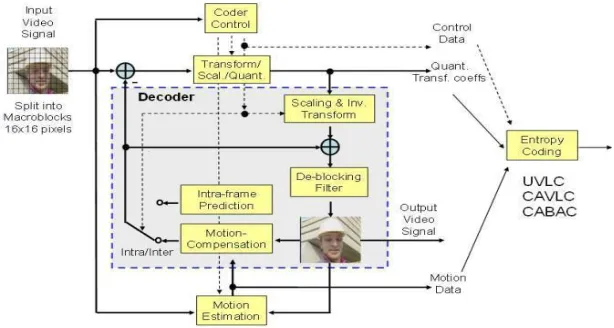
Motion compensated transform coding forms the basis of the existing video compression Standards H.26 1/H.262 and MPEG- 1 /MPEG-2, where the compression algorithm tries to exploit the temporal and spatial redundancies by using some form of motion compensation followed by a transform coding, respectively. The key step in removing temporal redundancy is the motion estimation where a motion Vector is predicted between the current frame and a reference frame. Following the motion estimation, a Motion compensation stage is applied to obtain the residual image, i.e. the pixel differences between the current frame and a reference frame. Later this residual is compressed using transform coding or a combination of transform and entropy coding. The above Video compression standards employs block motion estimation techniques. The main advantages of FSBME (fixed size block motion estimation) are simplicity of the algorithm and the fact that no segmentation information needs to be transmitted [1]-[2]-[3].
Fig. 1 Video compression process
Available Online at www.ijpret.com 196 motion estimation for video compression so far. All the methods are proposed keeping any one or more of the three directions aimed that 1.reducing computational complexity 2.representing true motion (proving good quality) 3.reducing bit rate(high compression ratio).
The key to high performance of video compression lies in an efficient reduction of the temporal redundancy. For this purpose, the block-based motion estimation (BBME) technique has been successfully applied in the video compression standards from H.261 to H.264. The most straightforward BBME method must be full search algorithm (FSA) that searches every candidate position within the search range.
The various block matching algorithms are Three Step Search (TSS), Diamond Search (DS) and Two Dimensional Logarithmic Search. In this paper, review of the various block matching based motion estimation algorithms are presented.
SECTION-II
A. Block Matching Algorithms:
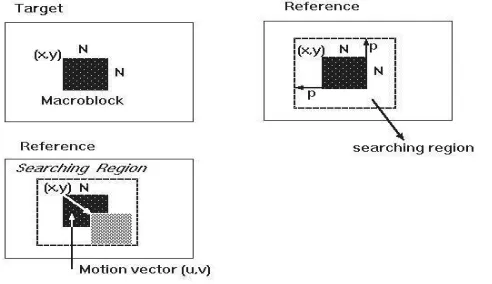
Available Online at www.ijpret.com 197 Fig. 2: Block based Motion Estimation process
The idea is represented in Fig 2. The matching of one macro block with another is based on the output of a cost function. The macro block that results in the least cost is the one that matches the closest to current block. The most intuitive approach for block matching is to use the full search algorithm (FSA).
SECTION-III
2.1. Full Search Method:
This algorithm, also known as Full Search, is the most computationally expensive block
matching algorithm of all. This algorithm calculates the cost function at each possible location in the search window. As a result of which it finds the best possible match and gives the highest PSNR amongst any block matching algorithm. Fast block matching algorithms try to achieve the same PSNR doing as little computation as possible. The obvious disadvantage to ES is that the larger the search window gets the more computations it requires 169 iteration if p=6 and it requires 289 iteration if p=8.
2.2. Three Step Search-Full search:
It searches for the best motion vectors in a coarse to fine search pattern. The algorithm may be described as:
Step 1: An initial step size is picked. Eight blocks at a distance of step size from the centre (around the centre block) are picked for comparison.
Available Online at www.ijpret.com 198 Steps 1 and 2 are repeated till the step size becomes smaller than 1. A particular path for the convergence of this algorithm is shown below:
2.3. Two Dimensional Logarithmic Search:
Although this algorithm requires more steps than the Three Step Search, it can be more accurate, especially when the search window is large. The algorithm may be described as:
Step 1: Pick an initial step size. Look at the block at the Centro the search are and the four blocks at a distance of s from this on the X and Y axes. (The five positions form a + sign)
Step 2: If the position of best match is at the centre, halve the step size. If however, one of the other four points is the best match, then it becomes the centre and step 1 is repeated.
Step 3: When the step size becomes 1, all the nine blocks around the centre are chosen for the search and the best among them is picked as the required block.
A particular path for the convergence of the algorithm is shown in the following figure:
SECTION-IV
Available Online at www.ijpret.com 199 SECTION-V
CONCLUSION:
A review of the various block matching based motion estimation algorithms has been presented. These algorithms are classified into three categories, namely, fast algorithms, true motion or good quality oriented methods and low computation complexity VSBME techniques algorithms. Algorithms are reviewed, in terms of both coding efficiency and computational complexity. Additionally, in order to design a low complexity ME algorithm, the researchers should jointly use the powerful techniques to reduce the computational cost in different aspects. When used well together, the new design will significantly reduce the computational cost, as compared with the traditional fast ME algorithms.
REFERENCES
1. K.-P. Lim, G. Sullivan, and T. Wiegand, Text Description of Joint Model Reference Encoding Methods and Decoding Concealment Methods, Joint Video Team (JVT) of ISO/IEC MPEG & ITU-T VCEG Doc. JVT-X101, Jul. 2007.
2. H.264/AVC Reference Software ver. 11.1, Joint Video Team (JVT) of ISO/IEC MPEG & ITU-T VCEG [Online]. Available: http://iphomehhi.de/suehring/tml/,Aug.2006
3. Y.-W. Huang, C.-Y. Chen, C.-H. Tsai, C.-F. Shen, and L.-G. Chen, “Survey on block matching motion estimation algorithms and architectures with new results,” J. VLSI Signal Process., vol. 42, no. 3, pp.297–320, Mar. 2006.
4. J. R. Jain and A. K. Jain, “Displacement Measurement and Its Application in Interframe Image Coding,” IEEE Trans. Commun., vol. 29, no.12, pp. 1799–1808, Dec. 1981.
5. Iain E. G. Richardson, Video Codec Design, West Sussex: John Wiley& Sons Ltd., 2002, Ch. 4, 5, & 6.
6. Overview of the H.264/AVC Video Coding Standard, IEEE Transactions on Circuits and Systems for Video Technology, Vol. 13, No. 7, July 2003.