Flow and heat transfer of a nanofluid over a nonlinear stretching sheet
1P K Pattnaik, 2S Jena,
Associate Professor, Department of Mathematics,
1College of Engineering and Technology, 2Centurion University of Technology and Management,
Bhubaneswar, India
Email – 1[email protected], 2[email protected]
1. INTRODUCTION:
Boundary layer behaviour over a stretching surface is imperative as it happens in a few building process, for instance, materials fabricated by expulsion, glass-fibre and paper creation. In industry, polymer sheets and fibres are fabricated by ceaseless expulsion of the polymer from a kick the bucket to a windup roller, or, in other words a bounded separation away. In these cases, the last result of wanted qualities relies upon the rate of cooling all the while and the way toward stretching. After, Sakiadis [1] presented the investigation of boundary layer flow over a continuous solid surface moving with constant velocity, the boundary layer flow caused by a stretching surface has drawn the consideration of numerous specialists. The elements of the boundary layer flow over a stretching surface began from the spearheading work of Crane [2]. He examined the steady incompressible boundary layer flow of a Newtonian fluid caused by stretching of flat sheet which moves in its own plane with linear velocity due to the application of a uniform stress. This issue is especially intriguing since a correct arrangement of the 2-D Navier– Stokes conditions has been acquired by Crane [2]. Later on, different parts of the issue have been researched by Dutta et al. [3], Chen and Char [4], and so forth. Kelson and Desseaux [5] contemplated the impact of surface conditions on the micropolar flow driven by a permeable stretching sheet.
Nomenclature
,
u v
velocity component inx y
,
directionx y
,
horizontal and vertical coordinate
kinematic viscosity
electrical conductivity
fluid densityg
acceleration due to gravityT
temperature of the fluidT
free flow temperaturew
T
temperature of the fluidC
concentration of the fluidC
free flow concentrationC
w non-dimensional species concentrationm
thermal diffusivity
relative heat capacityAbstract: Present study analyses a steady laminar MHD boundary layer flow which results from the non-linear stretching surface of Nanofluid. This model incorporates Brownian motion and Thermophoretic effects. The modified non-linear governing equations and its corresponding boundary conditions are solved by using 4th order Runge-Kutta method with shooting technique. The impact of Brownian motion number(Nb), thermophoresis number(Nt), stretching parameter
( )
n
and Lewis number(Le)on the temperature and nanoparticle concentration profiles are shown graphically. The variation with physical parameters on Skin friction f(0), rate of heat transfer (0)and mass transfer (0)is shown graphically. Excellent validation of the present study has been achieved with the earlier study of Cortell [16] for local Nusselt number withdrawing the effects of Brownian motion andthermophoresis.B
D
Brownian diffusion coefficientD
T thermophoretic diffusion coefficientT
ambient temperature
f density of the base fluidp
density of the nanoparticles
dynamic viscosity of the fluid(
c
p p)
heat capacity of the nanoparticle(
c
p)
f heat capacity of the base fluida
positive constantn
stretching parameter
scaled boundary layer coordinate f dimensionless velocity variable
dimensionless temperature variable dimensionless concentration variabler
P
Prandtl numberL
e Lewis numberr
N
thermal radiation parameterN
b Brownian motion parametert
N
thermophoresis parameterq
w heat flux at the surfacef
C
rate of shear stressq
m mass flux at the surfacew
skin friction
uw
velocity of the sheetx
Nu
local Nusselt numberSh
x local Sherwood numberMohammadein and Gorla [6] inspected the flow of micropolar fluids bounded by a stretching sheet with endorsed divider heat transition, thick dissemination and inside heat generation. Bhargava et al. [7] examined the flow of a blended convection micropolar fluid driven by a permeable stretching sheet with uniform suction utilizing FEM. Desseaux and Kelson [8] considered the flow of a micropolar fluid bounded by a straightly stretching sheet while Bhargava et al. [9] contemplated a similar flow of a micropolar flow over a non-straight stretching sheet. Nadeem et al. [10] examined HAM answers for boundary layer flow in the district of the stagnation point towards a stretching sheet. Magyari and Keller [11] considered the stretching issue of an incompressible fluid over a penetrable divider. Then again, Cornell [12] has contemplated heat transferin an incompressible second request fluid caused by a straightly stretching sheet and has additionally investigated the flow of a fluid of review three past a boundaryless permeable level plate subject to suction at the plate [13]. In any case, Gupta and Gupta [14] additionally underlined that the stretching of the sheet may not really be direct. In perspective of this, Vajravelu [15] contemplated flow and heat move in a thick fluid over a nonlinear stretching sheet without gooey dispersal, at that point Cortell [16] inspected flow and heat transfer on a nonlinear stretching sheet for two distinct sorts of heat boundary conditions on the sheet, steady surface temperature (CST case) and recommended surface temperature (PST case). Nadeem et al. [17] examined the impacts of heat transfer on the stagnation flow of a third-arrange fluid over a contracting sheet. As of late, Prasad et al. [18] considered the blended convection heat transfer over a non-direct stretching surface with variable fluid properties. Fluid warming and cooling are essential in numerous businesses, for example, power, assembling and transportation. Successful cooling systems are significantly required for cooling any kind of high vitality gadget. Basic heat transfer fluids, for example, water, ethylene glycol, and motor oil have restricted heat transfer abilities because of their low heat transfer properties. Interestingly, metals have thermal conductivities up to three times higher than these fluids, so it is normally alluring to join the two substances to deliver a heat transfer medium that carries on like a fluid, however has the heat of a metal. As of late, the term ''nanofluid'' was first proposed by Choi [19] to show designed colloids made out of nanoparticles scattered in a base fluid. The trademark highlight of nanofluids is heat behaviourivity upgrade, a marvel seen by Masuda et al. [20]. ''Nanofluid'' is a fluid containing nanometer-sized particles, called nanoparticles. These fluids are built colloidal suspensions of nanoparticles in a base fluid. The nanoparticles utilized in nanofluids are normally made of metals (Al, Cu), oxides (Al2O3), carbides, nitrides or nonmetals (Graphite, carbon nanotubes) and the base fluid is
science and advancements has been given by Das et al. [22] and Eastman et al. [23]. Buongiorno and Hu [24] saw that albeit convective heat transfer improvement has been recommended to be because of the scattering of the suspended nanoparticles, this impact anyway is too little to clarify the watched upgrade. They additionally declare that disturbance isn't influenced by the nearness of the nanoparticles so this can't clarify the watched improvement. Kuznetsov and Nield [25] examined the impact of nanoparticles on normal convection boundary layer flow past a vertical plate by considering Brownian motion and thermophoresis. Nield and Kuznetsov [26] expanded the Cheng and Minkowycz [27] issue to consider nanofluids, by fusing Brownian motion and thermophoresis. Tzou [28, 29] exhibited the heat shakiness of nanofluids in characteristic convection. Bachok et al. [30] contemplated boundary layer flow of nanofluid over a moving surface in a flowing fluid. Recently, Khan and Pop [31] detailed boundary layer flow of a nanofluid past a stretching sheet. Neverthless, Pattnaik et al. [32-39] concentrated the conduct of MHD fluid flow and watched some intriguing outcomes.
Tothe authors’ knowledge no studies of this kind have thus far been communicated. The work of Khan and Pop [31] have been extended by taking steady boundary-layer flow with nonlinearly stretching sheet. In this paper we employ an extensively validated, highly efficient method to study this problem. The effects of Lewis number
Le , Prandtlnumber
Pr , Brownian motion number( )
N
b , thermophoresis number(Nt), stretching parameter
n
on the relevantflow variables are described in detail. Furthermore, effects of Pr,Nb,Nt and n on Skin friction
f
(0)
, rates of heattransfers (0)and mass transfers (0)are presented graphically. The present study is of immediate interest to all those processes which are highly affected with heat enhancement concept e.g. cooling of metallic sheets or electronic chipsetc.
2. MATHEMATICAL FORMULATION:
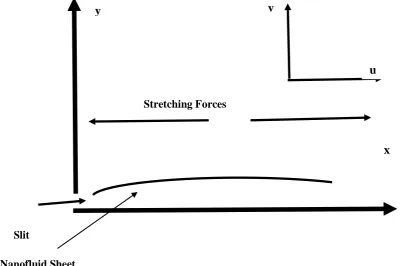
Here a steady, incompressible and 2D boundary layer laminar flow of a nanofluid past a flat sheet which coincides with the plane y 0 and the flow of the fluid being confined toy 0has been considered. The flow is
produced, due to non- linear stretching of the sheet, caused by the synchronous use of two equivalent and inverse powers
along the
x
axis. Keeping the origin fixed, the sheet is then stretched with a velocityu
w
ax
n, varying nonlinearly with the distance from the slit. A schematic representation of the physical model and coordinates system is depicted in Fig. 1.Stretching Forces
Slit
Nanofluid Sheet
Fig. 1 Physical Model
y
v
u
The pressure gradient and external forces are neglected. The stretching surface is maintained at constant temperature and concentrationTwandCw, respectively, and these values are assumed to be greater than the ambient
temperature and concentration,Tand”C, respectively. The governing equation of the flow is considered as:
0
u
v
x
y
(1)2
2
u
u
u
u
v
x
y
y
(2)2 2 2 T m B D
T T T C T T
u v D
x y y y y T y
(3)
2 2
2 2
T B
D
C C C T
u v D
x y y T y
(4)
where , ( )
( ) p p p f c c
(5)
The respective boundary conditions of the flow are:
,
0,
,
at
0
0,
0,
,
as
n
w w
u
ax
v
T
T
C
C
y
u
v
T
T
C
C
y
(6)The similarity variable and dimensionless functions are considered as:
1 2
1 2
( 1) 1
( ), 2 1 ( 1) , , 2 n n n w w
a n n
u ax f v y x f f
n
T T C C a n
y x
T T C C
(7)So the above equations (2-4) now reduced to,
2
2
0
1
n
f
ff
f
n
(8)
21
0
b t
r
f
N
N
P
(9)0
t e bN
L f
N
(10)where Pr , m, T( w ), B( w )
e t b
B
D T T D C C
L N N
D T
(11)
So the boundary conditions are reduced as:
0,
1,
1,
1 as
0
0,
0,
0 as
f
f
f
(12)Eq. (8) with the boundary condition (12) with n 0, are the classical Blasius flat plate flow problem. For the linearly
stretching boundary problem (i.e.,
n
1
) the exact solution for 'f ' is f( )
1 efirst obtained by Crane [2] and this exact solution is unique, while for the nonlinearly stretching boundary problem (i.e.,n
1
) there is no exact solution.3. PHYSICAL QUANTITIES:
The physical quantities which are studied in this paper are as follows:
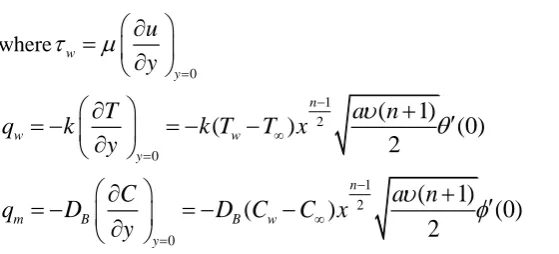
2 , x ( ), x ( )
xq xq
w w m
f uw k Tw T DB Cw C
C Nu Sh
where 0 w y
u
y
1 2 0(
1)
(
)
(0)
2
n
w w
y
T
a
n
q
k
k T
T x
y
1 2 0(
1)
(
)
(0)
2
n
m B B w
y
C
a n
q
D
D C
C x
y
4. RESULTS AND DISCUSSION:
To give a physical understanding into the flow issue, numerical calculations are conducted for different estimations of the parameters that portray the flow qualities and the results are outlined graphically. Fig. 2 checks the validation of all the profiles of stream function( )f , temperature( )
and nanoparticle concentration ( )
for the pertinent parameters. An excellent agreement with previous study gave confidence to proceed with our extension. Fig. 3(a-d) shows the variation of velocity profile( ')f for different values of Brownian motion parameter(Nb), thermophoretic parameter(Nt), stretching parameter( )n and Lewis number(Le).Since in velocity equation, temperature( )
and nanoparticle concentration( )
were absent so the parameters like Brownian motion parameter(Nb), thermophoretic parameter(Nt)and Lewis numbers(Le)have no effect which can be observed in Fig.3(a, b & c) but in case of stretching parameter( )n ,velocity profile gets decelerated when nonlinearity increases (Fig. 3(c)). Fig. 4(a-d) shows the variationof temperature profile( )
for different values of Brownian motion parameter(Nb), thermophoretic parameter(Nt), stretching parameter( )n and Lewis number(Le).The boundary layer profiles for the temperature are of the same form as in the case of regular heat transfer fluids. The temperature in the boundary layer increases with the increase in the Brownian motion parameter(Nb). It is also observed that an increase in the thermophoretic parameter(Nt)leads to increase in fluid temperature. An increase in non-linear stretching parameter( )n leads to increase the temperature profile. It is obvious that the temperature in the boundary layer region is low for(n0) (moving plate with constant velocity) as compared to higher value of stretching parameter( )n . Lewis number(Le) defines the ratio of thermal diffusivity to mass diffusivity. It is used to characterize fluid flows where there is simultaneous heat and mass transfer by convection. As a result, Temperature profile decreases with an increase in Lewis number. Fig. 5(a-d) shows the variation of Concentration profile( )
for different values of Brownian motion parameter(Nb), thermophoretic parameter(Nt), stretching parameter( )n and Lewis number(Le). The nanoparticle volume fraction profile( )
decreases with the increase in the Brownian motion parameter(Nb). Brownian motion serves to heat the boundary layer and simultaneously exacerbates particle deposition away from the fluid regime (onto the surface), thereby accounting for the reduced concentration magnitudes. It is observed that an increase in the thermophoretic parameter(Nt)leads to increase in nanoparticle concentration profile. An increase in non-linear stretching parameter( )n leads to increase in the concentration profile. However, the thickness of the boundary layer concentration function ( )
is found to be smaller than the thermal boundary layer thickness for Lewis number(Le 1). Concentration profile decreases with an increase in Lewis number. But the concentration profile is affected more even for small value of Lewis number as compared to temperature profile. Fig. 6(a-d) shows the variation of Skin friction coefficient(Cf)for different values of Brownian motion parameter(Nb), thermophoretic parameter(Nt), stretching parameter( )n and Lewis number(Le). As expected there is no deflection in Skin friction coefficient(Cf)for different values of Brownian motion parameter(Nb), thermophoretic parameter(Nt)and Lewis number(Le). But for increasing values of stretching parameter( )n , it increases. Fig. 7(a-d) shows the variation of Nusselt number(Nux)for different values of Brownian motion parametersheet (n). Fig. 8(a-d) shows the variation of Nusselt number(Shx)for different values of Brownian motion parameter
(Nb), thermophoretic parameter(Nt), stretching parameter( )n and Lewis number(Le).It has been observed that rate of mass transfer increases for increasing values of Brownian motion parameter(Nb) and Lewis number(Le)but reverse trend is noticed for increasing values of thermophoretic parameter(Nt)and stretchingparameter( )n .
5. CONCLUSION:
An analysis have been made with the study of MHD boundary layer flow. A non-linear stretching surface in a nanofluid with Brownian motion and thermophoresis effects incorporated. The governing partial differential equations are made simple ordinary differential equations by using similarity transformation which includes equations for mass, momentum, energy and nanoparticles conservation. These equations are solved numerically by using 4th order
Runge-Kutta method with shooting technique. Effects of various governing parameters on velocity, temperature and concentration profiles are shown graphically. Variations of Skin friction, local Nusselt number (wall heat transfer rate) and local Sherwood number (wall mass transfer rate) are presented in graph.
Theresults in summary have shown that:
1. An increase in Brownian motion parameter(Nb) and thermophoresis parameter(Nt) upgrade temperature in the boundary layer region. Also increasing thermophoresis parameter(Nt) increases concentration while
increasing values of Brownian motion parameter(Nb) shows reverse effect.
2. Increasing Brownian motion parameter(Nb) and thermophoresis parameter(Nt) lessens the local heat transfer rate (Nusselt number). We can concluded from this result that the different types of nanoparticles i.e. Al, Cu, Al2O3 and CuO, have diverse qualities for these parameter and have distinctive heat transfer rate. Therefore,
they can be utilized viably to control/mimicking the heat transfer rates in such types of problems.
3. For increasing values of stretching parameter( )n , Skin friction coefficient(Cf) increases but shows no fluctuation for different values of Brownian motion parameter(Nb), thermophoretic parameter(Nt).
4. The dimensionless mass transfer rates increases with increasing values of Brownian motion parameter(Nb)
and thermophoresis parameter(Nt).
5. The impact of the stretching parameter( )n is to increase the mass transfer rate with its expansion aside from Lower value of both Prandtl number( )Pr and Lewis number(Le) whereas it is to decrease the heat transfer rate with the exception of higher value of Prandtl number( )Pr and Lower value of Lewis number(Le).
REFERENCES:
1. Sakiadis BC. Boundary layer behaviour on continuous moving solid surfaces, I. Boundary layer equations for two-dimensional and axis-symmetric flow, II. Boundary layer on a continuous flat surface, III. Boundary layer on a continuous cylindrical surface. Am Inst Chem Eng J 1961; 7:26–8. 221–225, 467–472.
2. Crane LJ. Flow past a stretching plate. Z Angrew Math Phys 1970; 21:645–7.
3. Dutta BK, Roy P, Gupta AS. Temperature field in the flow over a stretching sheet with uniform heat flux. Int Commun Heat Mass Trans 1985; 12:89–94.
4. Chen CK, Char MI. Heat transfer of a continuous stretching surface with suction or blowing. J Math Anal Appl 1988; 135:568–80.
5. Kelson NA, Desseaux A. Effect of surface condition on flow of micropolar fluid driven by a porous stretching sheet. Int J Eng Sci 2001; 39:1881–97.
6. Mohammadein AA, Gorla RSR. Heat transfer in a micropolar fluid over a stretching sheet with viscous dissipation and internal heat generation. Int J Numer Methods Heat Fluid Flow 2001; 11:50–8.
7. Bhargava R, Kumar L, Takhar HS. Finite element solution of mixed convection micropolar fluid driven by a porous stretching sheet. Int J Eng Sci 2003; 41:2161–78.
8. Desseaux A, Kelson NA. Flow of a micropolar fluid bounded by a stretching sheet. ANZIAM J 2003; 42:C536– 60.
9. Bhargava R, Sharma S, Takhar HS, Beg OA, Bhargava P. Numerical solutions for micropolar transport phenomena over a nonlinear stretching sheet. Nonlinear Anal: Model Cont 2007; 12:45–63.
10. Nadeem S, Hussain A, Khan M. HAM solutions for boundary layer flow in the region of the stagnation point towards a stretching sheet. Commun Nonlinear Sci Numer Simul 2010; 15:475–81.
11. Magyari E, Keller B. Exact solutions for self-similar boundary-layer flows induced by permeable stretching walls. Eur J Mech B Fluids 2000; 10:109–22.
12. Cortell R. Similarity solutions for flow and heat transfer of a viscoelastic fluid over a stretching sheet. Int J Non-Linear Mech 1994; 29:155–61.
13. Cortell R. Numerical solutions for the flow of a fluid of grade three past an infinite porous plate. Int J Non-Linear Mech 1993; 28:623–6.
14. Gupta PS, Gupta AS. Heat and mass transfer on a stretching sheet with suction or blowing. Can J Chem Eng 1977; 55:744–6.
15. Vajravelu K. Viscous flow over a nonlinearly stretching sheet. Appl Math Comput 2001; 124:281–8.
16. Cortell R. Viscous flow and heat transfer over a nonlinearly stretching sheet. App Maths Comput 2007; 184:864–73.
17. Nadeem S, Hussain A, Vajravelu K. Effects of heat transfer on the stagnation flow of a third-order fluid over a shrinking sheet. Zeitschrift für Naturforschung A 2010; 65a:969–94.
18. Prasad KV, Vajravelu K, Datti PS. Mixed convection heat transfer over a non-linear stretching surface with variable fluid properties. Int J of Non-Linear Mech 2010; 45:320–30.
19. Choi S. Enhancing thermal conductivity of fluids with nanoparticles in developments and applications of non-newtonian flows. In: Siginer DA, Wang HP, editors. ASME; 1995. vol. 66, pp. 99–105.
20. Masuda H, Ebata A, Teramae K, Hishinuma N. Alteration of thermal conductivity and viscosity of liquid by dispersing ultra-fine particles. Netsu Bussei 1993;7: 227–233.
21. Buongiorno J. Convective transport in nanofluids. ASME J Heat Trans 2006; 128: 240–50.
22. Das SK, Choi S, Yu W, Pradeep T. Nanofluids: science and technology. New Jersey: Wiley Interscience; 2007. 23. Eastman J, Choi SUS, Lib S, Yu W, Thompson LJ. Anomalously increased effective thermal conductivities of
ethylene-glycol-based nanofluids containing copper nanoparticles. Appl Phys Lett 2001; 78: 718–20.
24. Buongiorno J, Hu W. Nanofluid coolants for advanced nuclear power plants. Proc ICAPP ’05, Seoul 2005; 705:15–9.
25. Kuznetsov AV, Nield DA. Natural convection boundary-layer of a nanofluid past a vertical plate. Int J Them Sci 2010; 49:243–7.
27. Cheng P, Minkowycz WJ. Free convection about a vertical flat plate embedded in a porous medium with application to heat transfer from a dike. J Geophys Res 1977; 82:2040–4.
28. Tzou DY. Thermal instability of nanofluids in natural convection. Int J Heat Mass Trans 2008; 51:2967–79. 29. Tzou DY. Instability of nanofluids in natural convection. ASME J Heat Trans 2008; 130:1–9.
30. Bachok N, Ishak A, Pop I. Boundary layer flow of nanofluid over a moving surface in a flowing fluid. Int J Therm Sci 2010; 49:1663–8.
31. Khan WA, Pop I. Boundary-layer flow of a nanofluid past a stretching sheet. Int J Heat Mass Trans 2010; 53:2477–83.
32. Pattnaik, P. K. and Biswal, T., (2015). MHD free convective boundary layer flow of a viscous fluid at a vertical surface through porous media with non-uniform heat source, IJISET, 2(3).
33. Pattnaik, P. K. and Biswal, T., (2015). Analytical Solution of MHD Free Convective Flow through Porous Media with Time Dependent Temperature and Concentration, Walailak J Sci & Tech, 12 (9) 749-762.
34. Pattnaik, P. K., Mishra, S. R., Bhatti, M. M., Abbas, T., (2017). Analysis of heat and mass transfer with MHD and chemical reaction effects on viscoelastic fluid over a stretching sheet, Indian J Phys, DOI 10.1007/s12648-017-1022-2.
35. Pattnaik, P. K., Mishra, S. R., Dash, G. C., (2015). Effect of heat source and double stratification on MHD free convection in a micropolar fluid, Alexandria Engineering Journal, 54 681–689.
36. Pattnaik, P. K., Mishra, N., Muduly, M. M., Mohapatra, N. B., (2018). Effect of Chemical Reaction on Nanofluid Flow Over an Unsteady Stretching Sheet in Presence of Heat Source, Pramana Research Journal, 8 (8) 142-166.
37. Pattnaik, P. K., Mishra, N., Muduly, M. M., Effect of slip boundary conditions on MHD nanofluid flow, Epra International Journal of Research and Development (IJRD), 3 (10),( 2018)124-141.
38. Pattnaik, P. K., Mishra, N., Muduly, M. M., Thermophoretic effect on MHD flow of maxwell fluid towards a permeable surface, Epra International Journal of Multidisciplinary Research (IJMR), 4(10)(2018)127-139. 39. Pattnaik, P. K., Mishra, N., Thermal radiation effect on MHD slip flow past a stretching sheet with variable