THE IMPACT OF PROJECT BASED LEARNING AS AN EFFECTIVE
PROCESS OF TEACHING STRATEGY IN HIGHER EDUCATION
Dr. Deepa Roy
Guest Lecturer,
Department of Education,
Kishore Bharati Bhagini Nivedita College, University Of Calcutta, Kolkata, West Bengal, India Email – [email protected]
1. INTRODUCTION:
Teaching is a complex field of study, which is theoretical as well as practical. The classroom teaching activity confined to memory level & rote learning. But it does not effective in higher education. Higher education that focus on students understanding level & able them to content & mastery of subject matter. The purpose of higher learning is to
develop the abilities of critical analysis, problem solving, discover the new facts, creative thinking, etc. ‘Project Method’
is also a good technique for developing the students own view. A teacher able to know that Project is the effective
method to enrich the student’s independent thinking.
Prof. G.S Krishnayya –“The project briefly described, is that method of teaching which encourage a maximum
amount of purposeful activity on the part of the pupil.” A Project is defined as a purposeful problematic specific case to solve the student’s participation. In such method, the schools, the curriculum, the subject matter, depend on the
learner’s point of view. According to Kalpatrick (founder of project method) –“A whole- hearted purposeful activity
proceeding in a social environment.”
1.1 Characteristics of Project Based Learning
The Project must be completed in its natural setting.
The Project undertaken are complete itself.
Definite attainable goal.
Purposeful learning based activity
Correlation system
Emphasis as ‘Learning by Doing’1.2 Steps of Project Method
Teacher provides a real
situation
Students chooses the project
Planning Execut the
plan Evaluation & Judgement of its utility & Recording
Abstract: In 21st Century teachers prepared for their teaching skills, knowledge, & use in various effective strategies to improve the students’ career. The outcome of this adopted method is ‘Project’. The most important contribution of educational practices is the Project Method, which is ‘a problematic act carried to completion in its natural setting.’ Project is a method of the educational enterprise to solve the problem & develop to the students’ efficacy, skills build up their & gain to experience of knowledge. In this method focus on students activeness. Project combined in two words- Project, Activity
Psychologically also, this method is sound because of the students are always interested in doing things with their own hands. In this study focus on the impact of Project Based learning as a teaching pedagogy, this is an effected in higher education.
Project method is based on the principle of ‘Learning by Doing’ strategy. It’s a self study that has increased
the interest level of subjects.
1.3 Design of Project
The project design is an organic process, not a mechanic. The teacher’s focused on the whole project at fast & therefore he/she highlighted the part which is generated the idea of the student’s, how to reach their goal. Design of
Project structures is following below-
1. Selecting a goal 2. Introduce the project 3. Build up the skills
Key of content & understanding
Key of success skills 4. Develop the project 5. Presenting the project
1.4 Project Based Learning in Higher Education
Project Based Learning, is generally associated with higher education. It’s an activity based learning, that is
motivated the student’s & developed their higher thinking capacity. In higher education mainly focus on students Increase the content knowledge
Develop the understanding level
Problem solving ability
Attitude toward content & interest the subject
PBL concerned about the changes of higher education, these are given bellow
In higher education ‘lecture’ is a stereotype method, but such an opportunity can be included in PBL it’s a
really effective in the classroom. During a Project is the best way of students ‘to learn something & to do
something.’
PBL in higher education students must be concerned about their content & use of knowledge in real world applications, to analysis the problem & to communicate, finding to an audience. PBL helps to develop thestudent’s confidence, communication, power, individual thinking skills etc.
Fig.1 Project Based Learning in Higher Education
Creation ( arrange whole ideas nd making or innovate the new facts)
Evaluation( judgmental guidelinens)
Synthesis (combind new ideas from whole parts)
Analysis (part by part understand the concept & relate to others parts)
Application ( gained new thing & use in new way)
Comprehension( making sense for what he/she learnt)
21st Century higher thinking capacity developed by the Project based Learning & its helps to develop the student’s creative & analytical thinking skills. Higher thinking is associated with high levels of Bloom Taxonomy.
1.5 Project Based Teaching Strategy
Teaching is a process of sharing the knowledge, experience that is changing the behavior of students. Teaching
has helped to develop the student’s individual abilities. Now a day, education is ‘child centric’ that means main focus
on students. In the area of effective teaching strategy ‘Project’ is the most important technique. This is used for higher
education for enriching the power of student’s capacities. In classroom teaching the teachers played a supporting
character. Teachers as
a- Facilitator
Communicator &
Mediator
PBL also a powerful teaching method-
Motivates the students,
PBL prepares the students for higher education & enlarged their capabilities
PBL helps to know the content in deeply & increased the student’s thinking skills
PBL as an effective way of classroom teaching strategy & closely related to teachers attitude.
Fig.2 Project Based Teaching Strategy 1.6 Project as a Process of Learning
Project method is an effective process of classroom learning. PBL is focused on the learner activity that is involved in vigorous classroom performance that is knowing the deeper knowledge of students to face a challenging situation and active them to solve it. PBL focused on classroom
teaching- Problem solver
Responsible
Works well with others
Work independently
Critical thinker
Confident
Manages the time to work effectively
Good communicator with the people
PBL provides the opportunities for students to grow up these qualities, as well as more deeper knowledge on the content & understand & also applies the concept in their real world. PBL active those learners who are passive in the classroom teaching. PBL restores the enjoy & motivate the teaching & build up them as a good communicator.
knowlegde, understanding, success & skills
Assign the associative group work
Connect to the pupils of real world
Set up the arameters of project Teachers
feedback Complete
2. LITERATURE REVIEW:
Jean Piaget & John Dewey was one of the first developers who developed the idea of constructivism. They were concerned about the learn performance. They wanted to know that learner as an important agent of the learning process.
According to Dewey, he believed in ‘learner centered’ education. Dewey said, “Method means that arrangement of subject matter which makes it more effective in use. Never is method something outside of the material.” In this method Dewey said “Project Method”. Dewey was advocated the ‘experimental learning’ or ‘hands on learning’. Dewey
advocated those learners who are emphasized them by their own capacities. In between the role of teachers who are friend, philosopher & guide.
Ruikar & Demain (2013) made links with industry engagement through multimedia podcasting in the UK. In Australia (2007) Project Based Learning investigated the link between self directed learning readinesses such as having high self management skills was a key enabler for achieving learning an outcome from PBL. Students through PBL learn to be self reliant through goal setting, planning & organization; they develop collaboration skills through social learning & become motivated by being encouraged to exercise an element of choices, while learning at their own level (Bell, 2010). Gibbes &Carson (2014) investigated PBL using Activity Theory in university language programmers in Ireland. The outcome of the results was mixed because of contradictions found in the activity system. According to Thomas (2000) identified the five characteristics of Project Based Learning.
Centrality
Driving Question
Constructive Investigation
Autonomy
Realism
3. OBJECTIVE OF THE STUDY:
The study focus on student’s activeness. Like their individual thinking, abilities of self study, critical thinking,
problem solving ability etc.
The role of the teacher’s attitude of this strategy & applies this relevant teaching strategy in the way of
teaching.
This study examines the positively correlated with higher education.
4. HYPOTHESIS OF THE STUDY:
There is no significant relationship between student’s performance with PBL in classroom obtain.
There is no significant difference between the teacher’s attitude with applying the teaching strategy in the way
of PBL.
There is no positive correlation between PBL with teaching & learning in the classroom.
There is no significant relation between project as an effective method in higher education.
5. VARIABLE OF THE STUDY: Independent Variable - Teacher
Dependent Variable - Student
Intervening Variable - Teaching Strategy, (Project Method)
6. DILIMITATION OF THE STUDY
This study is limited to the project based learning
This study is limited on project based teaching strategy
This study is limited to higher education
7. METHODOLOGY OF THE STUDY:
7.1 Research Design & Methods
Re + Search= ‘Research’ means search in again & again & discover many new facts. ‘Project’ is also a
process of research technique. Researcher concern about the impact of study and explore that Project Based Learning as an effective process of teaching strategies in higher education. The researcher chose the certain area of higher education sector. This study is based on quantitative survey research.
Sampling Methods: Random Sampling
Sample Size:150 sample divided from three parts 50 of teachers & 100 (50 boys & 50 girls) of students in higher education sectors.Age ranged teachers are 35 to 50 & students are 18 to 21 male female both
Sampling Location: West Bengal, Kolkata in higher education sectors
Research Instrument: Structure Questionnaire
8. DATA ANALYSIS:
The data are computed here in the Graphically & also use of statistical methods of Mean, Sd Significance levels of Mean & Sd, T- test, Chi- square & Correlation.
8.1 INTERPRETATION OF DATA
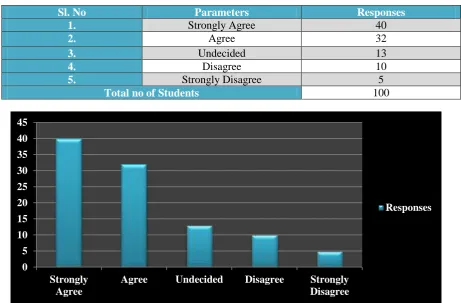
The Researcher asked the students that PBL is mostly effected in their class performance & developed their capacities, abilities & individual thinking. Regarding the response describe the table & represent in graphically. Responses are described in 5 points of Likert Scale.
Table 1: Response to the Question No 1
Sl. No Parameters Responses
1. Strongly Agree 40
2. Agree 32
3. Undecided 13
4. Disagree 10
5. Strongly Disagree 5
Total no of Students 100
Out of 100 respondents S A (Strongly Agree) 40 (40%) A (Agree) with 32 respondents (32%) U (Undecided) with 13 (13%) D (Disagree) 10 (10%) & S D (Strongly Disagree) only 5 (5%). The graph is showing that most of the students are accepted that PBL helps them to increase their capacities, abilities power & also active them in the class performance.
The Researcher asked to teacher’s that PBL is highly motivated the teaching strategy in classroom teaching.
Regarding the view of teachers under the survey & put their responses in graphically
.
Table 2: Response to the Question No 2
Sl. No Parameters Responses
1. Strongly Agree 22
2 Agree 16
3 Undecided 3
4 Disagree 7
5. Strongly Disagree 2 Total no of Teachers 50 0
5 10 15 20 25 30 35 40 45
Strongly Agree
Agree Undecided Disagree Strongly
Disagree
Out of 50 respondents S A (Strongly Agree) 22 (44%) A (Agree) with 16 respondents (32%) U (Undecided) with 3 (6%) D (Disagree) 7 (14%) & S D (Strongly Disagree) only 2 (4%). This graph is following that most of the teachers are agreeing with PBL is highly motivated the students in the classroom.
The Researcher asked for the teachers that PBL as an effective teaching technique which is highly related to higher education. Regrading the responses described in the table.
Table 3: Response to the Question No 3
Sl. No Parameters Responses
1. S A 17
2. A 15
3. U 5
4. D 10
5. S D 3
Total no of Teachers 50
0 2 4 6 8 10 12 14 16 18
Strongly Agree
Agree Undecided Disagree Strongly
Disagree
Responses 0
5 10 15 20 25 30 35 40 45
Strongly Agree
Agree Undecided Disagree Strongly
Disagree
Out of 50 respondents S A (Strongly Agree) 17 (34%) A (Agree) with 15 respondents (30%) U (Undecided) with 5 (10%) D (Disagree) 10 (20%) & S D (Strongly Disagree) only 3 (6%). The graph is described that most of the teachers are agreeing that PBL is highly related to higher education. But 20% teachers are not followed that PBL use in higher education. Because lack of infrastructure.
The Researcher asked the student’s that they are preferred in PBL as an interesting method of higher education rather than other methods. Responses are given bellow
Table 4: Response to the Question No 4
Sl. No
Parameters
Responses
1.
S A
19
2.
A
14
3.
U
7
4.
D
3
5.
S D
7
Total no of Students
50
Out of 50 respondents S A (Strongly Agree) 19 (38%) A (Agree) with 14 respondents (28%) U (Undecided) with 7 (14%) D (Disagree) 3 (6%) & S D (Strongly Disagree) only 7 (14%). Most of the students are preferred in PBL as a higher technique in higher education. But 10% are confused & 10% are referred in a lecture or class note in higher education.
9. RESULTS, DISCUSSION & ANALYSIS :
The data will be analyzed with the help testing of hypothesis, i.e. chi-square test and t-test. Different tables will be produced for establishing the result. The results are represented by the table.
RESULTS
Variable Group Sample Mean SD Chi- square T- test
Levels of significance 0.05 & 0.01
Teachers 50 56.02 11.9 30.2
Both levels of significance
Students
Boys 100 50 65.5 12.6 3.97 Both levels of
significance
Girls
5057.19
7.8
0 2 4 6 8 10 12 14 16 18 20
Strongly Agree
Agree Undecided Disagree Strongly
Disagree
Hypothesis – 1
Table for testing 1 Hypothesis 1
There is no significant relationship between student’s performance with PBL in classroom obtain
Variable Group Sample Mean SD T – test DF (degree
of freedom)
Levels of significance 0.05 & 0.01
Students
Boys 50 65.5 12.6 3.97 98 Both levels
of significance
Girls 50 57.19 7.8
Here, t –value = 3.97 & DF = (degree of freedom) 98, table value 0.05 level =1.98 & 0.01 levels = 2.63 both values less than t- value. Therefore, the researcher can be interpreted that null hypothesis is rejected. So, a student’s
performance in classroom teaching is highly significant with PBl & PBL as a productive process that can be motivated
& developed the student’s career.
Hypothesis – 2
Table for testing 2 Hypothesis 2
There is no significant difference between the teacher’s attitude with applying the teaching strategy in the way of PBL
Variable Category of
responses
Chi - square DF (degree of freedom)
Levels of significance 0.05 & 0.01
Teachers
S A
30.2
4
Both levels of
significance
A U D S D
Here, x2 = 30.2 & DF = 4, table value, 0.05 = 9.488 & 0.01 = 13.277 both levels are less than the observed value.
Therefore, the null hypothesis can be rejected & significance the both levels. The researcher can be interpreted that the
teacher’s attitude highly related to PBL as an effective teaching strategy in classroom teaching.
Hypothesis – 3
Table for testing 3 Hypothesis 3
There is no positive correlation between PBL with teaching & learning in the classroom
Sl. No Correlation of Coefficient between
PBL with teaching & learning High or Positive Correlation
1. r = 0.79
r = 0.79, denoted that ‘High or Positive correlation’. Which is shown that PBL as highly correlated to teaching &
learning field. Therefore, the null hypothesis is rejected.
Hypothesis – 4
Table for testing 4 Hypothesis 4
There is no significant relation between project as an effective method in higher education
Variable Sample (N)
Mean SD T - test DF
Levels of significance 0.05 & 0.01
Students 100 67.72 19.4
6.1 148
Both levels of significance
Here, t –value = 6.1 & DF = (degree of freedom) 148, table value 0.05 level =1.98 & 0.01 levels = 2.61. Hence, less than t- value. So that null hypothesis is rejected. Therefore researcher can be interpreted that Project as an effective method in higher education. Most of the teachers & students both are preferred that PBL as a powerful method which is a good impact on higher education.
10. FINDING OF THE STUDY:
The conclusion can be drawn by the testing of hypothesis
1. Hypothesis – 1, Represented that the student’s performance in classroom teaching is highly
significant with PBl & PBL as a valuable process that can be motivated & developed the student’s
career.
2.
Hypothesis –2, Clarified that the teacher’s attitude highly related to PBL & an effective impact on teaching strategy in the classroom teaching.3.
Hypothesis – 3, Shown that PBL as highly correlated to teaching & learning field.
4. Hypothesis – 4, Verified that Project as an effective method in higher education. & PBL also a powerful method of higher education.
11. CONCLUSION:
The present study must be concluded that Project Based Learning as a beneficial method which is enriched the
student’s capacities, developed their abilities, individual thinking & able them to face a problematic situation as well as
grow up their own capability to solve the problem. Teacher’s who as an active agent of society, who played a vital role
in the classroom teaching. So, this study focused on their attitude & their viewpoint with applying the teaching strategy in the way of PBL. The study also focused on the higher education & applying a method which is creating a good impact
on teaching & learning aspect. At last the researcher concluded that ‘Project’ as a worthwhile method of teaching,
learning as well as in higher education.
REFERENCES:
1. Mangal, S.K. (2010). Statistics in Psychology and Education (2ndED.) ISBN -978-81-203-2088-8.
New Delhi: Published by Asoke K. Ghosh.
2. Best, J.W & Kahn, J.V. (2005). Research in Education (10th ED.). United Stated: A Person education
company.
3. Koul, L. (2009). Methodology Of Educational Research (4th ED.). New Delhi: Vikas Publishing
House PVT LTD.
4. Sharma, R.C. ( 2014). Modern Science Teaching ISBN-13: 9788187433972. New Delhi: Dhanpat Rai Publishing Co (P) Ltd.
5. Larmer, J, Mergendoller. J & Boss, S. ( 2015). Setting the Standard for Project Based Learning ISBN-1416620916, 9781416620914. ASCD Publisher.