Available Online At www.ijpret.com
INTERNATIONAL JOURNAL OF PURE AND
APPLIED RESEARCH IN ENGINEERING AND
TECHNOLOGY
A PATH FOR HORIZING YOUR INNOVATIVE WORKCOMPARATIVE PERFORMANCE EVALUATION OF XYZ PLANE BASED
SEGMENTATION AND ENTROPY BASED SEGMENTATION FOR PEST DETECTION
TRUPTI S. BODHE, Dr. PRACHI MUKHERJI
1. Dept. of E&TC, Smt. Kashibai Navale College of Engineering, Pune, India.
2. Head of Department, Dept. of E&TC Smt. Kashibai Navale College of Engineering Pune,
India
Accepted Date:
27/02/2013
Publish Date:
01/04/2013
Keywords
Greenhouse,
Image Segmentation,
Pest Detection,
Color Plane
Corresponding Author Ms. Trupti S. Bodhe
Abstract
Image segmentation is the process of partitioning an image into multiple segments. The purpose of segmentation is to decompose the
image into parts that are meaningful with respect to a particular application. In modern crop status management in greenhouse, instead
of doing manually, crop status is monitored using cameras with some
automation. One of the major problems in the greenhouse crop production is the presence of pests. An accurate and timely monitoring
of pests population is the basic requirement. In the pest detection, image segmentation is one of the desirable steps to distinguish the pest
from rest of part of an image. This work suggests two methods, namely ‘Segmentation using XYZ plane’ and‘Entropy based histogram
thresholding’. In the first method, XYZ color plane followed by
thresholding is used instead of RGB space to overcome with some major problems in segmentation. The second method is given in which
the maximum information content is used to decide the segmentation
rule. Results are dependent upon a color space selection. The suggested segmentation algorithm is applied for images of pest infected leaves.
Available Online At www.ijpret.com I. INTRODUCTION
The purpose of image segmentation is to decompose the image into parts that are meaningful with respect to a particular application. Image segmentation is typically
used to locate objects and boundaries (lines, curves, etc.) in images. More precisely, image segmentation is the process of assigning a label to every pixel in an image such that pixels with the same label share certain visual characteristics.
Pest detection is a major challenge in horticulture. Traditionally, counting is done manually and this is very time-consuming and expensive process. Results may not be accurate most of the times as human gets fatigue. Thus, machine vision is the best way to get accurate results. Image segmentation is one of the desirable steps in image analysis which is required for pest detection.
The greenhouse whiteflies (TrialeurodesvaporariorumWestwood) are
significant pests in greenhouse crops worldwide. Whitefly population levels can be monitored by trapping winged adults on sticky cards and inspecting leaves.
Main goal of this project is the detection of bioagressors. The adult whiteflies can usually be found towards the top of the plant on younger leaves. It is very beneficial
to take photographs of these adult whiteflies. Whitefly management is a rapidly changing scene. For crop protection, it is necessary to obtain the accurate information about the status of the plants. Thus, pest detection is very much necessary to take decision about the treatments.
One of the most important problems in color image analysis for pest detection is the segmentation. In this paper, we consider color uniformity as a relevant criterion to partition an image into significant regions. For this purpose, the color of each pixel is initially represented in the RGB color space where the color component levels of the corresponding pixel are namely red (R), green (G) and blue
Available Online At www.ijpret.com The review [1] related to color image
segmentation helps to understand various techniques, methods, themes, approaches and controversies that are to be applied for
color image segmentation. Different image segmentation techniques have been surveyed through [2], [3] and [4]. The basic idea of pest detection in greenhouse crop is taken from [5] and [6]. In [7] and [8], XYZ color space is studied well. These papers include the advantages and use of XYZ color space. Basic theory for segmentation is taken from [9], [10], [11] and [12]. Different types of segmentation methods have been surveyed. In [13], Entropy Based Histogram
Thresholding Algorithm is explained for color image segmentation for aerial images. The aim is to detect the whiteflies on the infected leaves. In [14], color space and its relation with image segmentation is described.
II. SEGMENTATION USING XYZ COLOR
PLANE
1. Basic Idea
‘Color’ is a property that distinguishes among different kinds of light. It is defined wholly in terms of human perception. A
‘color space’ is a method by which we can specify, create and visualize color. Generally, a color space is a geometrical representation of colors in a space. The
characteristics generally used to distinguish one color from another are brightness, hue and saturation. The hue and saturation are together called as Chromaticity. The amount of red, green and blue needed to form any particular color are called the Tristimulus values.
The RGB color space is a primary additive color space. It is possible to match any color by mixing appropriate amounts of three primary colors. The RGB color space has a major drawback that, the tristimulus values and chromaticity coordinates can be negative, because it is not possible to match all the colors by additive mixture with a real primary space. The XYZ color space was developed by CIE as an alternative to RGB.
One of the characteristics of this system is that the tristimulus values X, Y, and Z, are always positive for all real color stimuli.
Available Online At www.ijpret.com 1. It was necessary to devise X, Y, and Z
such that they would be positive for all possible real stimuli.
2. The coefficients were chosen such that the Y tristimulus value was directly proportional to the luminance of the additive mixture.
In this space, X, Y and Z primaries are not physically realizable but they have been defined so that all the color stimuli are expressed by positive tristimulus values.
2. Segmentation
As specified earlier, the XYZ color space is very useful for segmentation using simple
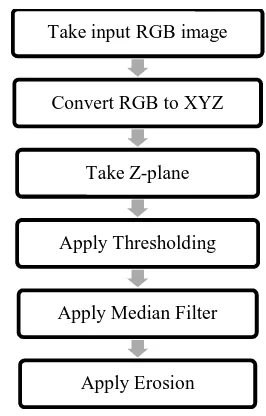
thresholding. The algorithm for the method ‘segmentation using XYZ plane’ is shown in Fig. 1. The algorithm steps are described as follows:-
Step 1: Take input RGB image.
Primary image is generally is in RGB format. Thus, camera captured image is considered.
Step 2: Convert RGB color space to XYZ color Space.
As specified earlier, due to some drawbacks of RGB color space, the RGB image is
converted to XYZ color space image. The basic transformation is given as follows-
X = 0.607R + 0.174 G + 0.200B
Y = 0.299R + 0.587G + 0.114B
Z = 0.000R + 0.066G + 1.116B (1)
Step 3: Take Z-plane.
It was observed that the Z-plane is more suitable for segmentation than the other two planes. Thus, Z-plane is considered separately for further processing.
Fig. 1 Algorithm for Segmentation Using XYZ Plane
Step 4: Apply Thresholding. Take input RGB image
Convert RGB to XYZ
Take Z-plane
Apply Thresholding
Apply Median Filter
Available Online At www.ijpret.com The Simple thresholding is applied on the
Z-plane image which, in turn give a segmented image which is in binary form.
Step 5: Apply Median filter. (If necessary)
The segmented image may contain some noise which is similar to salt and pepper noise. Thus, if necessary, the median filtering is done.
Step 6: Apply erosion. (If necessary)
If the segmented image is used for further use, such as counting, erosion is very useful to separate out the pests from each other.
Thus, if necessary, the erosion is applied.
In this way, the segmentation is done using transformation from RGB to XYZ color space.
III. ENTROPY BASED HISTOGRAM THRESHOLDINGALGORITHM
1. Basic Idea
Color image segmentation using entropy based thresholding is dependent on the ‘information content’ measured by entropy which is used to select the color space domain such that it is the largest among other color spaces under test. The aim is to allocate an individual pixel into its
corresponding segment by maximizing the total information and minimizing the difference between the information contained in foreground or background
surface. [7] Primary image is taken from the camera which is generally, in RGB format. Other color spaces like YUV, YIQ, HSI, I1I2I3, HSV are obtained through appropriate transform operations.
Different color spaces are used because each space indicate different amount of information in an image. Thus, best suitable color space component is selected for segmentation.
2. Entropy Based Thresholding
Image segmentation is done depending on entropy calculation of each color space component. The image is segmented as foreground and background based on segmenting criteria.
2.1 Entropy Calculation
Entropy or information content of each color space component is obtained from probability distribution. Let the color image in RGB format be given by
Available Online At www.ijpret.com Where,I = {R , G B }, for i = 1, … . . , v,
j = 1, … , u, denotes the color magnitude of
a pixel located in image’s ij location. Subscripts u, v are the width and the height of the image.
For each color component, histogram is obtained as
H$= {h$&} (3)
Where, r is subscript for R component
and k = 1, … , k) is bin index. Here the
number of bins is chosen for sufficient resolution and ease of computation.
The histogram is firstly normalized to give a probability distribution. The entropy or information content is then calculated for normalized histogram of each color space component. The entropy is given by,
E$= − ∑ h-$&log01h-$&2 (4)
Where, E$ is entropy related to given color
space and h-$& is the normalized histogram or the probability distribution of a given color space is given in equation (5).
h-$& =∑ 3∀5345 45(5)
The color space component with maximum entropy is selected among all. It given as:
E = max8{E8} (6)
Where, c is the index for each color space component. The histogram related to this maximum entropy color component is used for segmentation.
2.2 Segmentation
The original histogram with maximum entropy is considered for thresholding to separate the image into foreground and background objects. Let the distribution
H:be selected. The condition to obtain candidate threshold is that the some of the entropies of the foreground and background objects is maximized and their difference is minimized. That is, balance
between total maximum information content and individual maximum information is attempted to find as a segmentation design principle.
Let the candidate threshold be τ. The foreground and background objects are
determined as a function of the variables
Available Online At www.ijpret.com Where, k; and k= are the indices of
foreground and background objects such that their pixel values in the selected color space fall within the range of the
distribution that is to be segmented.
The threshold τ is further adjusted across
the distribution, such that, 0 < A < k) . Two entropies corresponding to foreground and background objects are calculated using Equation (8) and (9)-
H;B= − ∑ h
: ;log
01h:;2
;∈&D (8)
H=B= − ∑ h
:
=log
01h:=2
=∈&E (9)
The segmenting threshold, τ∗ is selected using (10),
τ∗ = max
B{GH;B+ H=BH − |H;B− H=B|} (10)
This segmenting threshold is then applied on the color space component having maximum entropy. Each pixel is compared with the segmenting threshold and final the segmenting pattern is obtained.
The received segmenting pattern is then applied to original RGB image to obtain foreground and background objects which are segmented as
F = KI&D
L , B = KI&E
L (11)
Where, KI&DL are pixels such that their
transformed space pixels fall within the foreground range of bins in the selected distribution of a color space. The background object B is selected as all other
pixels indexed by k=.
IV. EXPERIMENTALSTUDY
Three test images of pest infected leaves are used in the experiment to verify the segmentation results of the methods, namely ‘Segmentation Using XYZ Plane’ and ‘Entropy Based Thresholding’. Discussion on the results is done as follows:-
1. Segmentation Using XYZ Plane
Available Online At www.ijpret.com Test image 1 is clearly segmented. Test
image 2 is segmented well with little bit noise. Test image 3 is also segmented very well.
2. Entropy Based Thresholding Algorithm
2.1 Information Content
The entropies calculated are different for different color spaces as each space contain different information. In Test Image 1, the maximum entropy obtained is 2.7105 found in S space of HSV color space. In Test Image 2, the maximum entropy obtained is 2.7880 found in S space of HSV color space. Maximum entropies are selected for remaining images similarly.
2.2 Segmentation
Results of segmentation are shown in Fig.3. In Test Image 1, single pest is segmented as foreground object and rest of the part is considered as a background. In Test Image 2, pests are segmented along with veins of a leaf. Leaf veins are counted as white pixels, thus, adding some noise in the segmentation result. The segmentation
result is not satisfactory for Test Image 3.
V. CONCLUSION
The goal is detection of pests in the greenhouse crops. The paper focuses on two methods, namely ‘Segmentation using XYZ plane’ and ‘Entropy based Segmentation’ for detecting the pests. As lot of color spaces exist for different applications and several definitions for a same color space, it is difficult to select one for a color image analysis application. The CIE XYZ color space is the most common way to describe the color of light. The CIE XYZ color space is selected in order to
overcome the problems of the RGB primary space. The second suggested method is used for segmentation of color images. The study of selection of the color space for deciding a segmentation threshold has been presented. Different color space component carry different amount of information. This information is obtained by calculating entropy of individual color space component. The segmentation result has been obtained by applying threshold on single color space. Both the methods give well results for segmentation. But the
Available Online At www.ijpret.com segmentation using XYZ plane gives binary
segmented image. But in Segmentation using XYZ plane method, the total noise gets removed. Thus, as per the
requirement, both the methods can be well executed. The suggested method is verified for pest infected leaves.
(a) (b) (c)
(d) (e) (f)
(g) (h) (i)
Fig.2 Segmentation Results of Method Using XYZ Plane:
(a), (d) and (g) - Test Image 1, Test Image 2 and Test Image 3
(b), (e) and (h) – Z-plane Image
(c), (f) and (i) – Final Segmented Image
(a) (b) (c)
(d) (e) (f)
... ….
(g) (h (i)
Fig.3 Segmentation Results of Entropy Based Histogram Thresholding
(a), (d) and (g) - Test Image 1, Test Image 2 and Test Image 3
(b), (e) and (h) - Foreground Objects
Available Online At www.ijpret.com
REFERENCES
1. S. Pradeesh Hosea, S. Ranichandra,
T.K.P. Rajagopal, “Color Image Segmentation – An Approach”, International Journal of Scientific & Engineering Research, Volume 2, Issue 3, March-2011.
2. Rajeshwar Dass, Priyanka, Swapna Devi,
“Image Segmentation Techniques”, IJECT, Vol. 3, Issue 1, Jan. - March 2012.
3. Amanpreet Kaur, Bhogal Neeru, Singla Maninder Kaur, “Comparison of Algorithms for Segmentation of Complex Scene
Images”, (IJAEST) Vol No. 8, Issue No. 2, 306 – 310
4. Krishna Kant Singh, Akansha Singh, “A Study Of Image Segmentation Algorithms For Different Types Of Images”, IJCSI
International Journal of Computer Science Issues, Vol. 7, Issue 5,S eptember 2010.
5. Paul Boissarda, Vincent Martinb, Sabine Moisanb, “A cognitive vision approach to early pest detection in greenhouse crops”,
computers and electronics in agriculture, 2008.
6. Vincent Martin and Sabine Moisan, “Early Pest Detection in Greenhouses”, 2004 route des Lucioles.
7. Douglas A. Kerr, “The CIE XYZ and xyY Color Spaces”, Issue 1, March 2010.
8. Slawomir Bogumil Wesolkowski, “Color
Image Edge Detection and Segmentation: A Comparison of the Vector Angle and the Euclidean Distance Color Similarity Measures”, A thesis presented to the University of Waterloo, Ontario, Canada, 1999.
9. TranosZuva, Oludayo O. Olugbara,
Sunday O. Ojo and Seleman M. Ngwira, “Image Segmentation, AvailableTechniques, Developments and OpenIssues”, Canadian Journal on Image Processing and Computer Vision, Vol. 2, No. 3, March 2011.
10. Lilly Spirkovska, Ames Research Center,
Moffett Field, California, “A Summary of Image Segmentation Techniques”, NASA Technical Memorandum, June 1993.
11. Yu-Jin Zhang, T singhua University,
Available Online At www.ijpret.com 12. Hugo Hedberg, “A Survey of Various
Image Segmentation Techniques”, Dept. of Electroscience, Box 118, Lund University, SE-221 00 Lund, Sweden.
13. N. M. Kwok, Q. P. Ha, G. Fang, “Effect of color space on color image segmentation”, IEEE 2009.
14. Laurent Busin, Nicolas Vandenbroucke
and Ludovic Macaire, “Color spaces and image segmentation”, Université des Sciences et Technologies de Lille 59655 Villeneuve d’ Ascq – France, July 2007.
15. Rafael C. Gonzalez and Richard E.