Management and Research
Available online at: www.ijstmr.comIJSTMR
©
2016 |
All Rights Reserved
13
A Review on Secured Data Storage and Retrieval
in Multicloud Computing
Ashvini Deore1 Jyoti Vadje2 Department of Computer Department of Computer
Gangamai College of Engineering,Nagaon, Gangamai College of Engineering,Nagaon,
Maharashtra, India Maharashtra, India
Umesh Shimpi3 G.M.Poddar4 Department of Computer Prof. Department of Computer
Gangamai College of Engineering, Nagaon, Gangamai College of Engineering,Nagaon,
Maharashtra, India Maharashtra, India
_____________________________________________________________________________________________________________________________
Abstract: Now days, the Cloud Computing is a very popular technology for storing and retrieving of data. Cloud computing delivers the on demand services to its customers (users). As a result, many organizations makes use of cloud computing for processing their data. Cloud computing is also known as pay per service business model. In cloud computing, cloud stores sensitive and important information for its users. So, this information must be secure, but security is a big challenge in cloud computing environment. Privacy and security are the main issues in cloud computing. Therefore, cloud providers has to give high as well as urgent priority for solving these issues. This paper reviews some of the related work which will be useful for developing the multiclouds system in proposed work. For this, proposed system uses a multi-cloud secret sharp model which aims to provide good economical distribution as well as retrieval of data among the cloud service providers. This model will provide customers with the data availability and secure data storage.
Keywords: - Cloud Computing, Cloud Security, Data Integrity, Service Availability, Multi Cloud.
____________________________________________________________________________________
I. INTRODUCTION
IJSTMR
©
2016 |
All Rights Reserved
14
important for users [1]. The security problem is very significant, still there is scope for security research in cloud computing. Let us introduce the data security risks. Those are
1) Data Integrity
Data integrity is one of the most important issue in cloud security risks. The cloud data may suffer from damage during transition operation from or to the cloud storage provider. Data integrity ensures that the data in the cloud is supposed to be there, and is protected against accidental alteration without authorization.
2) Data Intrusion
Another security risk with the cloud service provider is a hacked password or data intrusion [7]. 3) Service Availability
The most problematic issue is service availability. The cloud service should be access anytime and anywhere without any problem. The availability of cloud can be increase through widespread internet-enabled access. But some of the client is dependent on the timely and robust provision of resources. Availability is dependent on the capacity building and good architecture provided by the service provider, as well as the defined contract between user and the service provider.
To solve the issue of data security we are providing a framework that will guarantee to prevent security risks in cloud computing. The framework contains multi-clouds and secret sharing algorithm to secure cloud database. This will lessen the risk of data intrusion and the loss of service availability in the cloud as well as ensures data integrity.
The rest of the paper is as follows: Section II presents the literature survey over the related work. In section III, proposed system is presented. Finally, the section IV concludes the survey paper.
II. LITERATURE REVIEW
In this section, we have studied some data as well as previous research papers related to securing the cloud data storage in cloud computing.
Data security is a major challenge in cloud computing. To solve this, there are various methods and algorithms for data encryption and data security. The encryption algorithms for security implementation are RSA, DES and Blowfish algorithm etc. These algorithms have some drawbacks if used in cloud computing. Hence, we will be using AES algorithm. Storage outsourcing is an increasing trend which suggests a number of security problems, among them many are largely searched in the past. Provable Data Possession (PDP) is one of the recent topic in the research literature. The cloud storage server is assumed to be untrusted entity when considering the security and reliability aspects of data storage. It is important to frequent, effective and secure verification of clients outsourced data by the storage server. Let us see some of the papers view related to cloud security as well as multicloud concept.
IJSTMR
©
2016 |
All Rights Reserved
15
A. Bessani [3] develops a DepSky system, which does not have limitations like HAIL. H. Weatherspoon [4] proposed a RACS system which differs from the DepSky system. RACS system deals with “economic failures” and vendor lock-in. But it does not address the cloud storage security issues. Also, it does not ensures data confidentiality and updates of the stored data. To address the data retrievability issue, Bessani uses a Byzantine fault-tolerant replication for storing the data on cloud servers. Because of this, the data is able to retrieve correctly even if the cloud provider is damaged. Also, to address the loss of data privacy issue, Bessani uses data encryption as a solution [3]. They suggest that the data should be encrypted before it is stored on the cloud, so that the stored data can get protected from the malicious insider. To achieve this, DepSky system uses secret sharing algorithm and to hide the key value from malicious insider, the system stores the cryptographic security keys in the cloud.
The limitation of DepSky is, it is only a storage service like Amazon S3 and does not offer a IaaS cloud model [5]. Further, this system provides a safe storage cloud, but does not provide security of data in the IaaS cloud model. Because it uses data encryption and stores the encrypted key in the clouds using a secret sharing technique, it is unsuitable for the IaaS cloud model [5].
Cachin et al. [6] presents two layers in the multicloud environment 1)Bottom layer (inner cloud) 2)Inter cloud layer one is the bottom layer is the inner-cloud. Intercloud layer has the Byzantine fault tolerance method. Author primarily outline the previous Byzantine protocols across the last three decades. Cachin et al. [6] proposed a framework for intercloud storage (ICStore), the framework is finer than RACS and HAIL as a dependable service in multiple clouds. He also develop theories as well as protocols to address the attributes like confidentiality, integrity, reliability and consistency of the data stored in clouds in cloud environment.
III. PROPOSED SYSTEM
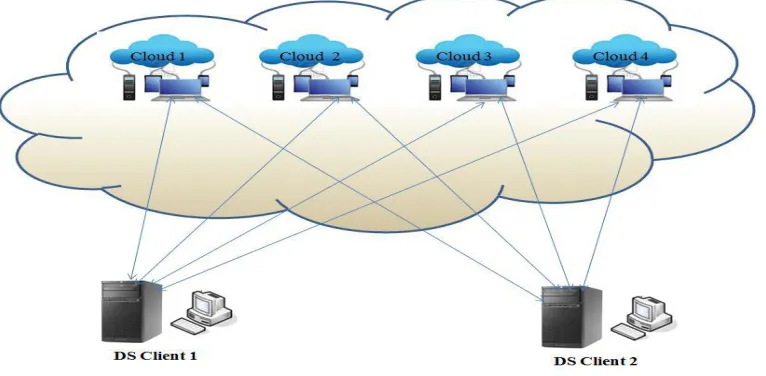
Proposed system uses multi cloud architecture as shown in Fig. 1. Multicloud concept will be implement using Shamir’s Secret Sharing algorithm. It will reduce the risk of data intrusion and loss of service availability for ensuring data.
V. PROPOSED ALGORITHM VI. COMPARATIVE ANALYSIS
Figure 3 Comparison using no of dependencies
CONCLUSION AND FUTURE WORKS
IJSTMR
©
2016 |
All Rights Reserved
16
Using multicloud concept, a multi-cloud secret sharp model will be proposed in cloud computing. It holds an economical distribution and retrieval of data key among the available CSPs in the market and provide customers with data availability and secure data storage.
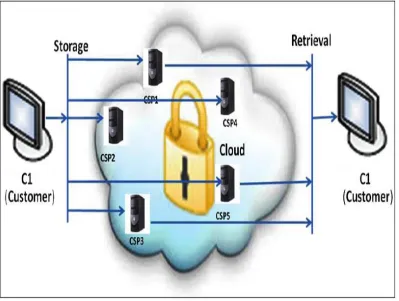
Proposed model is illustrated with an example in Fig. 2. In this, we assume that there are five Cloud Service Providers (CSP’s) i.e. CSP1, CSP2, CSP3, CSP4 and CSP5. Customer (C1) encrypts his own data, after this the available encoded key is split and wishes to store on some servers into five pieces of encoded data key.
Let us assume that a customer (C1) has encrypt his own data then the available encoded key is split and store on some CSP’s servers into five pieces of encoded data key. To reconstruct and get the full information a customer requires at least three pieces of encoded data key from different service providers. In our example, the CSP’s that will participate in the encoded data key retrieval are CSP1, CSP3 and CSP5.
Figure 2: Data Storage and Retrieval in proposed system
The proposed system has two phases 1) Data Storage and 2) Data Retrieval.
Secured data storage in proposed system involves data distribution from the data source to different cloud providers. This is done after executing the polynomial functions on the data.
IJSTMR
©
2016 |
All Rights Reserved
17
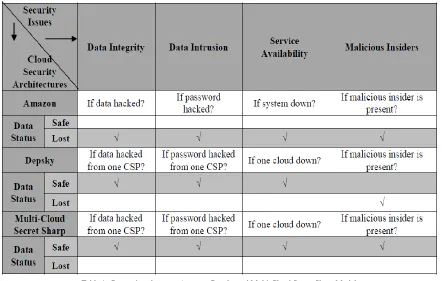
We have compare the three cloud security models (Amazon, DepSky, Multicoud Secret Sharp (proposed model)) as shown in following Table .
Table 1: Comparison between Amezon, Depsky and Multi-Cloud Secret Sharp Models
In the table, the models are compared considering the three characteristics i.e. data integrity, data intrusion, and service availability. It reveals that, our newly proposed Multi-Coud Secret Sharp model is superior in achieving the three security factors than in Amazon and Depsky cloud service model. Also, the proposed model is more secure to protect users data from untrusted CSP’s and malicious threats whereas the Amazon cloud service ask the users to encrypt their data before storing it in their instances. In this way, multi cloud secret sharp model supports data integrity, data intrusion, service availability in a well manner than other cloud service model and also protects the cloud data from malicious insiders.
CONCLUSION
IJSTMR
©
2016 |
All Rights Reserved
18
framework for not only proofs but also applications. We provide a secure computation platform based on a simple secret sharing scheme than Shamir's scheme. The migration facility to multicloud decrease the security risks and thus, relax the cloud computing users.
ACKNOWLEDGMENT
We would like express our sentiments of gratitude to all who rendered their valuable guidance to us. We would like to express our appreciation and thanks to the Principal of our college. We are also thankful to the Head of Department. We are thankful to the anonymous reviewers for their valuable comments.
REFERENCES
1. Mohammed A. AlZain , Eric Pardede , Ben Soh , James A. Thom, “Cloud Computing Security: From Single to Multi-Clouds”, 2012 45th Hawaii International Conference on System Sciences, 2012, pp. 5490-5499.
2. K.D. Bowers, A. Juels and A. Oprea, "HAIL: A high-availability and integrity layer for cloud storage", CCS'09: Proc. 16th ACM Conf. on Computer and communications security, 2009, pp. 187-198.
3. A. Bessani, M. Correia, B. Quaresma, F. André and P. Sousa, "DepSky: dependable and secure storage in a cloudof- clouds", EuroSys'11:Proc. 6thConf. On Computer systems, 2011, pp. 31-46.
4. H. Abu-Libdeh, L. Princehouse and H. Weatherspoon, "RACS: a case for cloud storage diversity", SoCC'10:Proc. 1st ACM symposium on Cloud computing, 2010, pp. 229-240.
5. F. Rocha and M. Correia, "Lucy in the Sky without Diamonds: Stealing Confidential Data in the Cloud", Proc.1stIntl. Workshop of Dependability of Clouds, Data Centers and Virtual Computing Environments, 2011, pp. 1-6.
6. C. Cachin, R. Haas and M. Vukolic, "Dependable storage in the Intercloud", Research Report RZ, 3783, 2010.
7. S. L. Garfinkel, An evaluation of amazon’s grid computing services: EC2, S3, and SQS, Citeseer, 2007, pp. 1-15