
2Department of Chemistry, College of Education for Women, University of Anbar, Ramadi, Anbar – F.R. Iraq
Abstract–The (E)-3-(3-acetylphenylimino) indolin-2-one (Bidentate) ligand type [HL], has been prepared from Isatin and
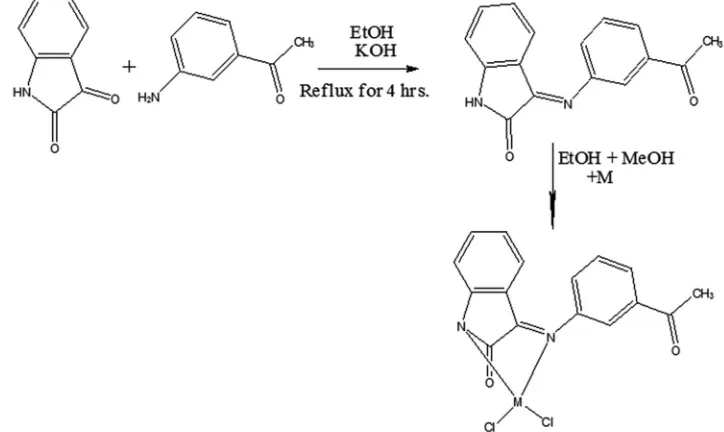
3-aminoacetophenone in the presence of KOH. In general, the ligand contains oxygen (O) and nitrogen (N) donor atoms. The reaction of Isatin and 3-aminoacetophenon was carried out in ethanol by
condensation reaction at 80°C with reflux for 4 h, to form [HL] ligand
type. This ligand has been used to prepare NiII and CoII complexes in
the ratio of 1:1 metal-ligand. All compounds have been characterized by spectroscopic methods (Fourier transform infrared and ultraviolet-visible), C.H.N, thin-layer chromatography, mass spectrum, X-ray diffraction, magnetic moment, conductivity measurements and milting point, the synthesized ligand and its metal complexes have been tested for their antibacterial activity against Staphylococcus aureus and
Bacillus subtilis using agar disc diffusion method. The ligand and
its complexes showed significant activities against S. aureus and B. subtilis. Our study revealed the formation of four coordinate square planar complexes around NiII and CoII metal ions.
Index Terms—3-aminoacetophenone, Bidentate ligand and (N) donor atoms, Isatin, Schiff base.
I. Introduction
Schiff bases have played an important role in the development of coordination chemistry as they readily form stable complexes with most of the transition metals. The chemistry of Schiff base ligands species has been gaining considerable interest primarily because of their fascinating structural diversities (Asadi, et al., 2011; Monfared, et al., 2011; Chamayou, et al., 2011). The electrophilic carbon atoms of aldehydes and ketones can be targets of nucleophilic attack by amines. The end result of this reaction is a compound in which the C=O double bond is replaced by a C=N double bond. This type of compound is known as an imines, or Schiff base with the general formula R1R2C=NR3,
where R is an organic side chain. In this definition, Schiff base is synonymous with azomethine. Many Schiff base complexes show excellent catalytic activity in various reactions and in the presence of moisture (Abu-Dief Ahmed and Mohamed Ibrahim, 2015). The Schiff bases are widely used for industrial purposes and also exhibit a broad range of biological activities. This short review compiles examples of the most promising antimalarial, antibacterial, antifungal, and antiviral Schiff bases. An overview of synthetic methodologies used for the preparation of Schiff bases is also described (Da Silva Cleiton, et al., 2011). Isatin is a yellowish red crystalline compound soluble in hot water, used for the preparation of vat dyes. Formula: C8H5NO2. Is found in many plants and Schiff bases of Isatin are investigated for their pharmaceutical properties (Jarrahpour and Khalili, 2005). This was prepared according to the literature method, Isatins can be made from the corresponding indole in good yield by a mixing of InCl3 and IBX in an acetonitrile-water solution at 80°C (Yadav, et al., 2007). The electrophilic carbon atoms of Isatin carbonyl group can be targets of nucleophilic attack by amines (Jarrahpour and Khalili, 2005). 3-Aminoacetophenone is one of the most typical aromatic carbonyls which show photochemical properties3-aminoacetophenone with molecular formula C8H9NO, having melting point 96–98°C. Another additional interest that 3-aminoacetophenone derivatives possess some degree of local anesthetic activities(Nomenclature of Organic Chemistry, 2014). Acetophenone is used for the synthesis of many pharmaceuticals (Braish and Gadamasetti, 2007). Acetophenone is recovered as a by-product of the oxidation of ethylbenzene to ethylbenzene hydroperoxide (Siegel H., Eggersdorfer M., 2005). In this work, we report the synthesis characterization of Isatin compound with 3-aminoacetophenone and its complexes with selected transition elements such as Ni11 and Co11, the antibacterial activity of the prepared complexes has been tested against Gram-positive
Staphylococcus aureus and Bacillus subtilis (Shaker, et al., 2013) (Fig. 1).
II. Experimental
Reagents were purchased from Fluka and Redial - Dehenge Chemical Co. and used without further putrefaction. Fourier transform infrared (FT-I.R) spectra were recorded in the range 4000–400/cm. Electronic spectra of the prepared compounds
ARO-The Scientific Journal of Koya University
Volume VI, No 1(2018), Article ID: ARO.10245, 8 pages DOI: 10.14500/aro.10245
Received 11 May 2017; Accepted 03 May 2018 Regular research paper: Published 25 May 2018
were measured in the region 200–900 nm for 10−3 M solutions
in methanol for the ligand and in distilled water for the complexes at 25°C using a Shimadzu 160 spectrophotometer with 1.000–0.001 cm matched quartz cell. Elemental microanalyses were performed on a (C.H.N) analyzer.
A. Syntheses of the ligand (E)-3-(3-acetylphenylimino) indolin-2-one [HL]
The ligand (E)-3-(3-acetylphenylimino)indolin-2-one type [HL] has been prepared from dissolving (0.3 g and 2.039 mmole) of Isatin in 25 ml ethanol, and mixed with a solution of 3-aminoacetophenone (0.275 g and 2.034 mmole) under refluxed for 4 h to gain (0.2 g) of a pale brown precipitate after filtration and drying at room temperature, to yield 66.6%, mp (63°C).
B. Syntheses of [Ni(L)Cl2] complex
[Ni(L)Cl2] complex has been prepared from 0.15 g, 0.567 mmole of [HL] dissolved in 25 mL methanol with a solution of 0.134 g, 0.663 mmole of NiCl2.6H2O. Moreover, refluxed for 2 h to obtain (0.11 g) pale yellow precipitate. Yield 73%, mp 134°C.
C. Syntheses of [Co(L)Cl2] complex
The same method used to prepare [Ni(L)Cl2] complex was used to prepare [Co(L)Cl2] complex but with a solution of 0.13 g, 0.546 mmole of CoCl2.6H2O to form (0.13 g) deep brown precipitate. Yield 86.6%, 118°C. Table I shows the microanalysis results and some physical properties for the ligand and its complexes.
III. Results and Discussion
A. Synthesis of the ligand [HL]
The (FT-I.R) spectra for the starting materials of the ligand [HL], the essential infrared data are summarized in Table II.
In the spectrum of 3-aminoacetophenone, there are two sharp absorption bands at 3470 and 3450/cm that assigned to the stretching vibration of υsy(N-H) and υasy(N-H) of the primary amine (R-NH2) group (Nakamoto, 1997) (Fig. 2). These bands have been disappeared in the spectrum of the ligand [HL], because of its condensation reaction with Istian.
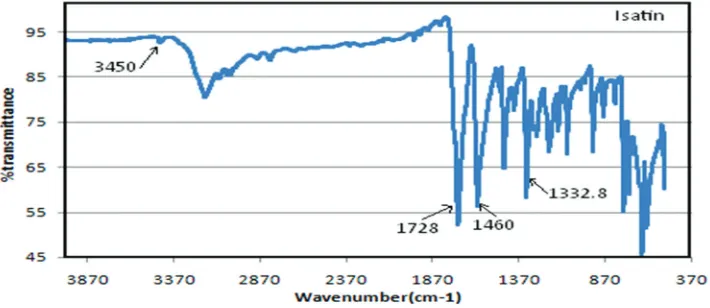
In the spectrum of Isatin Fig. 3., there is a band at 3450.6/cm due to the υ(N-H) of the secondary amine (R2-NH) group (Rostkowska, et al., 1993), is shifted to lower frequency about (50/cm) as shown in the spectrum of the ligand [HL] as a consequence of the coordination between both of Isatin and 3-aminoacetophenone.
The appearance of a new band at 1550/cm range in the spectrum of [HL] ligand was assigned to the υ(C=N) stretching, indicating formation a new compound and Schiff base reactions (Ali, et al., 1981; Ivanov and Nikolova, 2008) 3-aminoacetophenone and Istian. Figs. 2 and 3 displayed strong bands at 1728/cm and 1695/cm range, assigned to the stretching vibration of υ(C=O) group, respectively, which are shifted to lower frequency at 1650/cm compared with the spectra of the ligand [HL] (Anuradha and Rajarel, 2011; Colchoubian, et al., 1999) (Fig. 4).
U.V-Vis spectrum for [HL], Fig.5. exhibits a high intense absorption peak at 240 nm (41666/cm) (∈max = 450/molar/cm), assigned for n→π*. A shoulder peaks at 290 nm (34482/cm) (∈max = 366/molar/cm) and (339 nm) (29498/cm) (∈max = 120/ molar/cm) were assigned to π→π* transitions (Colchoubian, et al., 1999; Kindeel, et al., 2013) (Table III).
B. Synthesis of the complexes
The band at 1650/cm-1 of the υ(C=O) stretching vibration (Ali,
et al., 1981; Ivanov and Nikolova, 2008) of the ligand is shifted to higher frequencies at 1670–1665 range for Ni
II and CoII, complexes because of the coordination with the metal ions. Compound υ(N-H)
Primary-R-NH2 υ(N-H) Secondary R2-NH υ(C=O) υ(C=N)-Imine M-OM-N 3-aminoacetophenone 3470
3450 - 1695 - -
-Istian
-- 3450.6(sh) 1728(sh) - -
-[HL]
-- 3400 1650 1550 -
-[Ni (L) CL2]
-- - 1670 1592 530590
[Co (L) Cl2]
-- 1665 1595 526
580
Table III
Electronic spectral data and conductance measurements of the ligand and its complexes
Compound λ nm cm−1υ wave number ∈
Max/molar/cm Assignments conductance B.M
[HL] 240 290 339
41666 34482 29498
450 366 120
n→π*
π→π*
π→π* [Ni (L) CL2] 240
285 410 425
41666 35087 24390 23529
1141 440 200 180
Ligand field
C.T
1A 1→1E’ 1A
1→1E
20 2.9
[Co (L) Cl2] 255 291 394 447
39215 34364 25380 22371
904 1122
309 103
Ligand field
C.T
4A
2g→4T1g (F 4A
2g→4T2g
16 1.6
Moreover, the band at 1550/cm1 of υ(C=N) imine (Anuradha and Rajarel, 2011; Colchoubian, et al., 1999) is shifted to higher frequencies about (40/cm) range for the complexes due to the forming ring system with the metal ions. Metal oxygen and metal nitrogen band further confirmed by the presence of
peaks at 530–590/cm and 526–580/cm range were assigned to υ(M-O) and υ(M-N) (Halli, et al., 2012; Jakels, et al., 1983) stretches for the NiII and CoII complexes, respectively.
UV-Vis spectra of NiII and CoII complexes Figs. 8 and 9, respectively, showed two intense peaks in the range 240 nm, Fig. 3. The Fourier transform infrared spectrum of Isatin
Fig.4. The Fourier transform infrared spectrum of [HL] ligand
(41666/cm), (∈max = 1141/molar/cm) and 255 nm, (39215/cm-1), (∈max = 904/molar/cm) range assigned to the ligand field for NiII and CoII, respectively (Lever, 1984). Another two peaks at 285 nm, (35087/cm), (∈max = 440/molar/cm) and (291 nm), (34364/cm), (∈max = 1122/molar/cm) range assigned to the charge transfer transition for NiII and CoII, respectively (Al-Shihri, 2004). Another two peaks are detected in the visible region for NiII complex at 410 nm, (24390/cm), (∈
max = 200/
molar/cm) and (425 nm), (23529/cm), (∈max = 180/molar/cm) are due to (1A
1→1E’) and (1A1→1E (“ transitions, indicating a tetrahedral structure (Lever, 1984) around NiII. So that for the two peaks of CoII complex at 394 nm, (25380/cm), (∈
max = 309/molar/cm) and (447 nm), (22371/cm), (∈max = 103/molar/ cm) are assigned to (4A
2g→4T1g(F) and (4A2g→4T2g) transitions (AL-Shihri, 2004), suggesting a tetrahedral structure around CoΙΙ ion. is assigned to d-d transitions (AL-Shihri, 2004).
Fig.6. The Fourier transform infrared spectrum of [Ni(L)Cl2] complex
Fig. 7. The Fourier transform infrared spectrum of [Co(L)Cl2] complex
the complexes show more activity than the ligand under similar experimental conditions with the same kinds of bacteria.
Molar conductance in DMSO solutions lie in the (16 and 20/cm/mole) range indicating its electrolytic nature with (1:1) Fig. 10. The thin-layer chromatography for the ligand and its NiII, CoII
complexes
Fig. 11. The biological activity of [HL] and its NiII, CoII complexes
Fig. 12. The X-ray powder diffraction of [Co(L)Cl2] complex Fig. 9. The ultraviolet-visible spectrum of [Co(L)Cl2] complex
Thin-layer chromatography (TLC) measurement for the derivative ligands [HL], and its complexes were performed with CoII and NiII is showed in Fig. 10. and Table IV. The appearance of new spots with different Rf compared with the Rf of the ligands, for CoII and NiII indicated the formation of the complexes. The spots positions belong to CoII, and NiII ion complexes are differ from the positions of the ligands spot.
of the Coп and Niп, metal ion complexes (Kai, et al., 2009;
Refat and Struct, 2007) (Table I).
Magnetic moment (1.6 and 2.9 B.M) value of the Coп
and Niп ion complexes, respectively, as well as the other
analytical data Table III is in agreement with the suggested structure of square planar geometry for the two complexes in the solid state (Uppadin, et al., 2001; Al-Jeboori, et al., 2010).
X-ray powder diffraction (XRD) pattern of Coп complex
shows well-defined crystalline peaks indicating that the sample is 37% crystalline in nature (Dokken, et al., 2009). An XRD powder diffraction pattern of the copper complex has been given in Fig. 12 of different scale particles are well coincident with each other, and it means that different forms of complexes have the same structure (Guillemet-Fritsch, et al., 2006). The sample has been dried and then scanned in the 2θ range of 10–80° confirming square planar geometry around Coп ion complex (Kavitha and Lakshm, 2017; Zheng,
et al., 2017).
Mass spectrum shows the base peak at 264 related to the molecular weight of the ligand. Moreover, all the other fragmentations are compatible with the value of the fragments of the ligand as shown in Fig. 13.
References
Abu-Dief Ahmed, A.M. and Mohamed, I.M.A., 2015. A review on versatile applications of transition metal complexes incorporating Schiff bases. Beni-Suef University Journal of Basic and Applied Sciences, 4, pp.119-133.
Ali, H., Al-Azawi, S., Silverschtien, R.M., Bassler, G.C. and Morril, T.C., 1981.
Spectrophotometers Indentification of Organic Compounds. John Wiley and Sons, New York.
Al-Jeboori, M.J., Al-Tawel, H.H. and Mahmood, R., 2010. New metal complexes of N2S2 tetradentate ligands: Synthesis and spectral studies. Inorganica Chimica Acta, 363, pp.1301-1305.
AL-Shihri, A.S., 2004. Spectrochimica acte. Part A, 60, pp.1189-1192. Anacona, J.R. 2006. Synthesis and antibacterial activity of some metal complexes
of β-. Lactams antibiotics. Journal of Coordination Chemistry, 54, pp.355-365.
Anuradha, K. and Rajarel, R., 2011. Synthesis, spectral characterization and biological activity of new symmetrical macrocyclic binuclear Schiff base complexes. Internatiol Journal of Pharmacy and Technology, 2, pp.2217. Asadi M., Sepehrpour, H. and Mohammadi, K.H., 2011. “Tetradentate schiff base ligands of 3,4-diaminobenzophenone: Synthesis, characterization and thermodynamics of complex formation with Ni(II), Cu(II) and Zn(II) metal ions. Journal of the Serbian Chemical Society, 76, pp.63-74.
Siegel, H., Eggersdorfer, M., 2005. Ketones, Ullmann's encyclopedia of industrial chemistry, weinheim: wiley VCH. doi:10.1002/14356007.a15_077. (https://en.wikipedia.org/wiki/Acetophenone).
Braish, T. and Gadamasetti, K., 2007. Process Chemistry in the Pharmaceutical Industry, Vol. 2. CRC Press, Boca Raton, pp.142-145.
Chamayou, A.C., Lüdeke, S., Brecht, V., Freedman, T.B., Nafie, L.A. and Janiak, C., 2011. Chirality and diastereoselection of Δ/∇-configured tetrahedral zinc complexes through enantiopure Schiff base complexes: Combined vibrational circular dichroism, density functional theory, 1H NMR, and X-ray structural
studies. Inorganic Chemistry,50, pp.11363-11374.
Colchoubian, H., Waltz, W.L. and Quail, J.W., 1999. Synthesis and characterization of Schiff base folic acid based ligand and its complexes. Canadian Journal of Chemistry, pp.37-77.
Fig. 13. The mass spectrum of [HL]
Table IV
The TLC measurements for the [HL] ligand and its CoII and NiII complexes
Compound Range of Rf (mm) [HL]
[Co (L) Cl2]
[Ni (L) CL2]
0.7 3.3 2.2
Da Silva Cleiton, M., da Silva Daniel, L., Modolo, L.V., Alves, R.B., de Resende, M.A., Martins, C.V.B. and Ângelode, F., 2011. Schiff bases: A short review of their antimicrobial activities. Journal of Advanced Research, 2, pp.1-8. Dokken, K.M., Parsons, J.G., McClure, J. and Gardea-Torresdey, J.L., 2009. Synthesis and structural analysis of copper(II) cysteine complexes. Inorganica Chimica Acta, 362, pp.395-401.
Guillemet-Fritsch, S., Lebey, T., Boulos, M. and Durand, B. 2006. Dielectric properties of CaCu3Ti4O12 based multiphased ceramics. Journal of the European Ceramic Society, 26, pp.1245-1257.
Halli, M.B., Patil, V.B., Sumathi, R.B. and Mallikarjun, K., 2012. Synthesis, characterization and biological activity of mixed ligand metal (II) complexes derived from benzofuran-2-carbohydrazide schiff base and malonyldihydrazide. Der Pharma Chemica, 4, pp.2360-2323.
Ivanov, I. and Nikolova, S., 2008. Synthesis of New β-enaminones of
Isoquinolines with 5, 5-Dimethyl-cyclohexanedione. Molbank, Plovdiv. pp.565. Jakels, S.C., Ciavola, J., Carter, R.C., Cheek, P.L. and Pascarlli, T.D., 1983. Inorganic Chemistry, 22, pp.3956.
Jarrahpour, A.A. and Khalili, D., 2005. Synthesis of some new bis-Schiff Bases of
Isatin and 5-fluoroisatin in a water suspension medium. Molecules, 11, pp.59-63.
Kai, Y., Gu, Z., Ji, R. and Lou, L.S., 2009. Heterogeneous chiral Mn(111)
salen catalysts for the epoxidation of unfunvtionalized olefins immobilized on
mesoporous materials with different pore sizes. Tetrahedron, 65, pp.305-311. Kavitha, N. and Lakshm, P.V.A., 2017. Synthesis, characterization and thermogravimetric analysis of Co(II), Ni(II), Cu(II) and Zn(II) complexes supported by ONNO tetradentdate Schiff base ligand derived from hydrazine benzoxazine. Journal of Saudi Chemical Society, 21 Suppl 1, pp.S457-S466. Kindeel, A.S., Dawood, I.J. and Aziz, M.R., 2013. Synthesis and characterization of some mixed ligand complexes containing (8-hydroxyquinoline) and (2-picoline) with some metal ions. Baghdad Science Journal, 10, pp.396. Lever, A.B.P., 1984. Inorganic Electronic Spectroscopy. 2nd ed., Elsevier,
New York.
Monfared, H.H., Vahedpour, M., Yeganeh, M.M., Ghorbanloo, M., Mayer, P. and Janiak, C. 2011. Concentration dependent tautomerism in green
[Cu(HL1)(L2)] and brown [Cu(L1)(HL2)] with
H2L1=(E)-N′-(2-hydroxy-3-methoxybenzylidene) benzoylhydrazone and HL2=pyridine-4-carboxylic (isonicotinic) acid. Dalton Transactions, 40, pp.1286-1294.
Nakamoto, K., 1997. Infrared and Raman Spectra of Inorganic and Coordination Compounds, Parts A and B. 5th ed. John Wiley Sons, New York.
Nomenclature of Organic Chemistry: IUPAC Recommendations and Preferred Names. 2013. Blue Book. The Royal Society of Chemistry, Cambridge. pp.723. Refat, M.S., and Struct, J.M., 2007. Complexes of uranyl (II), vanadyl (II) and zirconyl (II) with orotic acid “vitamin B13”: Synthesis, spectroscopic, thermal studies and antibacterial activity. Article in Journal of Molecular Structure, 842, pp.24.
Rostkowska, N.M.J., Lapinski, L., Bertner, M., Kulikowski, T., Les, A. and Adamowicz, L., 1993. Spectrochim. Acta A. 49, pp.551.
Shaker, A.M., Nassr, L.A.E. and Adam, M.M.S.S., 2013. Synthesis, characterization and spectrophotometric studies of seven novel antibacterial hydrophilic iron (II) Schiff base amino acid complexes. Journal of the Korean Chemical Society, 5, pp.560.
Sultana, N. and Arayne, M.S., 2007. In vitro activity of cefadroxil, cephalexin, cefatrizine and cefpirome in presence of essential and trace elements. Pakistan Journal of Pharmaceutical Sciences, 20, pp.305-10.
Uppadin, L.H., Weeks, J.M. and Beer, P.D., 2001. Metal-directed self-assembly of terphenyl based dithiocarbamate ligands. Journal of the Chemical Society Dalton Transactions, 22, pp.3367-3372.
Yadav, J.S., Reddy, B.V.S., Reddy, C.S. and Krishna, A., 2007. Indium(III) chloride/2-iodoxybenzoic acid: A novel reagent system for the conversion of indoles to isatins. Synthesis. 5, pp.693-696.
![Table IThe microanalysis results and some physical properties of [HL] and its complexes](https://thumb-us.123doks.com/thumbv2/123dok_us/457700.2044091/3.612.101.493.383.690/table-ithe-microanalysis-results-physical-properties-hl-complexes.webp)
![Fig. 7. The Fourier transform infrared spectrum of [Co(L)Cl2] complex](https://thumb-us.123doks.com/thumbv2/123dok_us/457700.2044091/5.612.121.477.407.607/fig-fourier-transform-infrared-spectrum-l-cl-complex.webp)
![Fig. 9. The ultraviolet-visible spectrum of [Co(L)Cl2] complex](https://thumb-us.123doks.com/thumbv2/123dok_us/457700.2044091/6.612.51.295.261.512/fig-the-ultraviolet-visible-spectrum-co-cl-complex.webp)
![Table IVThe TLC measurements for the [HL] ligand and its Co](https://thumb-us.123doks.com/thumbv2/123dok_us/457700.2044091/7.612.121.478.53.309/table-ivthe-tlc-measurements-hl-ligand.webp)
