SMS Based Alerting System for Train Passengers
B. N. JAGADALE1 and KUSUMA HEGDE2
1
Department of Electronics
Kuvempu University, Shankaragatta, INDIA
2
J.M.J.First Grade College Sirsi, North Kanara, INDIA
(Received on: October 30, 2012)
ABSTRACT
Now a days journey, travelling from one place to another has become part of our day-to-day life. The people who depend on the public transports for their travel have a bundle of bad experience of missing there transport, waited in the bad weather or in unsafe place for long time, or without prior knowledge of arrival of stop in long journey; often we see this as the prevalent excuse given by students, employees, applicants for interview. It may be by passenger in long distant journey will be destined in odd timing (at mid-night) who will come to know that his station has been past. We can’t control the late arrival or the early arrival of the transport but we can have an option of planning our daily work if we were intimated the arrival of the transport to particular route or station. For long distance travel usually we are using Train. But in train we are going to face lot of problems during night journey because in night it is difficult to identify the station name. So we came up with a novel idea of intimating such people by method called “SMS Based Alerting System for Train Passengers”.
Keywords: Flash magic, Public transport system, Embeded Apllications, Alerting System, Indian Railways.
1. INTRODUCTION
1.1 PROBLEM STATEMENT
Possessing own transportation has become more common nowadays. The number of vehicles on the road keep on increasing and most of us are eager to own
reduced road traffic. Besides, it provides a low-cost transportation, which is a means to the low-income family for traveling to another destination. Most often, it is desired to travel in train for long distance & reach the destiny in odd timings especially at mid nights. Most often, we will be busy in our own daily work. So we need someone to remind about destination.
1.2 OBJECTIVES
The objectives of this workt are:
To create an application that is able to estimate destination station and alert the passengers through short message service.
To offer a convenient mobile information service, this ensures the passengers to get the alert of destination station in the previous station.
Main objective is to alert the passengers. As the “mobile” is portable thing & is now the best way of communication.
So we have chosen the “SMS” as the best service to intimate the people as even the basic sets will support this
facility. Hence better way to alert all class people and is cost effective.
1.3 WHY IT IS NEEDED?
As we have seen any country of the matter more than 70% of people relay on public transport it may be a big metropolitan city or small village with a small community of people. Most of the people in this metropolitan city or village are the middle class and low class people they are very much relayed on this public transport to go to the various destination, as it offer one of the most cheapest mode so all middle and low lass people relay on this to their daily activity.
There is a possibility that train passengers travelling over long distance can miss their destination station and reach unknown city or village especially at mid nights. It can lead to frustration and disappointment.
So for those people this project could brings a solution to overcome the above problem. The figure 1.1 shows the condition of passenger travelling over long distance.
Block Diagram
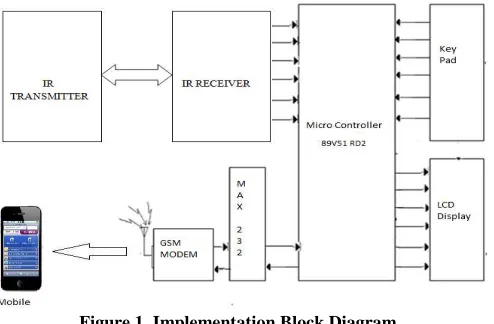
Below figure shows the implementation block diagram of “SMS Based Alerting System for Train Passengers”.
The following steps briefly demonstrate the work.
STEP1:-Passenger enters the destination
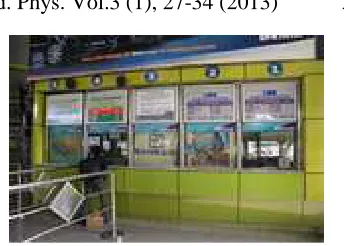
station number and phone number using a keypad while taking ticket and LCD is used for displaying the user information. (Ref. figure 1.3)
Figure 2 Passenger Taking Ticket in Station
STEP2:-Once the passenger enters the train
and starts his journey, the IR sensors situated before each station senses the arrival of train, and sends the control signal or IR status signal to Microcontroller Unit (MCU).
Figure 3 IR Transmitter & Receiver
STEP3:-The IR status signal is sent to the
microcontroller (particular destination station number which is predefined) enables the GSM modem to send SMS to the passenger’s mobile by using serial communication (RS-232 port & MAX-232 IC). Figure 1.5 shows the SMS sent to passenger’s mobile from GSM modem.
LITERATURE SURVEY
The Government has released an amount of Rs.22.70 crores for project to be implemented in Mysore for city buses named “Intelligent Transport System (ITS)”. This project is mainly based on GPS technology. This project information extracted from “ Prajavani news paper” and official website “ www.cirtindia.com”. By keeping above projects in mind
we thought of an idea to alert the passengers through SMS (which is more preferable for communication now a days), and designed this project which is cost effective.
Extensions: This project is restricted to alert
the passengers only through SMS, but can also be extended to flash SMS and voice mail services.
Software Used
• Keil µ-Vision 3 IDE
• Flash Magic
Keil µ-Vision
The Keil µ-vision 3 IDE is a Windows based software development platform that combines a robust editor and project manager. µ-vision integrates all tools including the C-compiler, macro assembler, linker/locator, and HEX file generator. µ-vision 3 helps expedite the development process of your embedded applications.
The µ-vision IDE & Debugger is the central part of the Keil development tool chain. µ-vision offers a Build Mode and a Debug Mode. In the µ-vision Build Mode you maintain the project files and generate the application. In the µ-vision Debug Mode you verify your program either with a powerful CPU and peripheral simulator.
Flash Magic:
Flash Programming software is used for downloading the application program into Microcontroller.
ADVANTAGES & DISADVANTAGES:
Advantages
The passengers can get arrival time of train.
It is helpful to identify the destination station very easily.
This can also be used for buses also.
Even a basic mobile set can get information & SMS service is economic.
Disadvantages
Velocity of the train will not be same throughout the distance.
Network congestion.
Reader fails to read the tag from great distance if there is a rain or fog.
FUTURE SCOPE
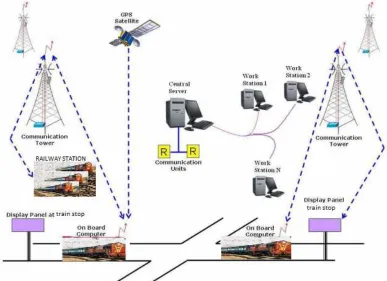
Real Time Train Information System (RTIS) could soon be a reality for Indian Railways. Traditionally, Indian Railway has been the early adopter of computing & technology advancements and Railways administration is investing quite a big amount of money in implementing RTIS. Indian Government is planning to invest Rs. 110 Crore to offer real-time updates on the train status, exact location, speed, expected delays and other vital information to the passengers.
Figure 5 RTIS in Indian Railway
with digital tracking equipped with GPS information. The GPS modules will be installed on the trains and their positions will be tracked via a GPS satellite to provide accurate & adequate information about the train’s current status. A pilot project is under progress with Shatabdi and Rajdhani
express. The results obtained so far are encouraging and if all the tests are passed, the system will gradually be expanded to cover all the trains across all regions in India. The system has been jointly developed by IIT-Kanpur and RSDO (Research Designs & Standards Organization).
Figure 8.2 Design overview of RTIS in Indian Railways
Benefits of this Project can include 1. Vehicle Tracking System 2. Central Control Station
3. Passenger Information Management System
4. Communication Sub System 5. Travel Demand Management
6. Incident and Emergency Management System
7. Operational and Maintenance Specification Fleet Management System.
RESULTS AND CONCLUSION
sim-card in GSM modem for sending SMS. The table below illustrates tests and results in practical. From below table it can be clearly seen that SMS received mainly depends on network reliability of service provider.
Tests & Results
Sl. No. Entered Station No. Service Providers
Time taken for receiving SMS
1 Station 2 Reliance 8.2 seconds 2 Station 4 Aircel 6.1 seconds
3 Station 3 BSNL 10.2 seconds
4 Station 1 Airtel 5.3 seconds 5 Station 2 Vodafone 6.4 seconds
CONCLUSION
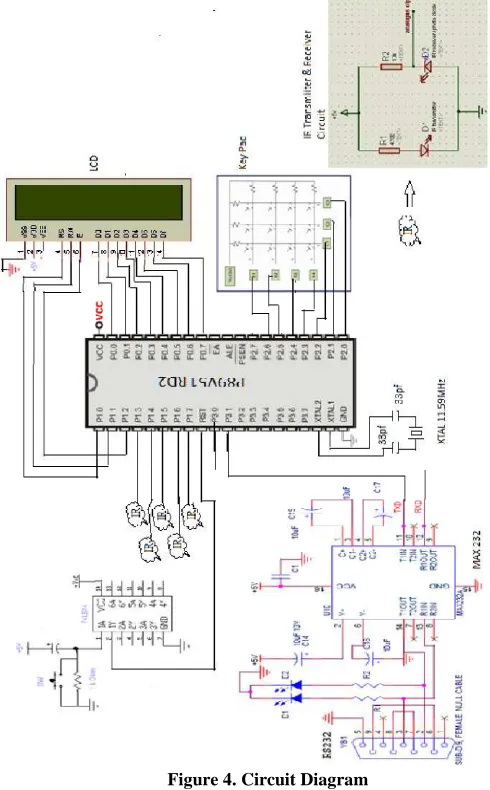
Avoidance of missing the destination can now be overcome by implementation of SMS based station alerting system within the train and station. It uses the combined technology of sensors (sensing for train arrival), GSM technology (for SMS alerting), programming skills for interface of various circuits to a chip so called microcontroller. Related circuits of various components and its interfacing circuit diagrams, related issues, soft-wares used and related programs as a pictorial representation have been documented in this book. To overcome issues related to sensors and other areas theoretical models have been given in appendices. So by implementation of such system information services remain fundamental to passenger satisfaction; slight adjustments can be made for real time application using GPS (Global Positioning System) tracking system.
After studying this report one can able to build such a model for practical
applications with some slight changes. In this project we have implemented circuit for one-way communication i.e. alerting the passenger from station site by collecting his/her cellphone number at the ticket counter. It can also be extended for two-way communication i.e. by sending the SMS from customer site to the application in the specified standard format one can get the information related to train such as location of train, arrival time. So if such application is implemented in real time then it will be greatly helpful to the public.
One can even extend this application with inclusion of other functionalities such as automatic announcement (within the compartments in different languages inside the train), these services over internet, etc., with expansion of memory and/or using database router for storage of large customer data. Ideas and implementation of application are still an open issue so that one can work on it. Different implementation will come up with blend of different drawbacks, but proper standardization and depth they cover in efficient and effective manner can lead to best successful implementation; one such approach has been done in this report.
REFERENCES
1. Microcontrollers By Mazidi and Mazidi (2006).
2. Microcontrollers by Kenneth Ayala. Cengage Learning, 412 pages 01, Jul. (2004).
10-Sep. (2004).
4. Mazidi, The 8051 Microcontroller And Embedded Systems Using Assembly And C, 2/E, Pearson Education India, - 560 pages, 01-Sep. (2007).