R E S E A R C H
Open Access
A BDDC algorithm for the mortar-type
rotated
Q
FEM for elliptic problems with
discontinuous coefficients
Yaqin Jiang
1*and Jinru Chen
2**Correspondence:
[email protected]; [email protected] 1School of Sciences, Nanjing University of Posts and Telecommunications, Nanjing, 210046, P.R. China
2Jiangsu Key Laboratory for NSLSCS,
School of Mathematical Sciences, Nanjing Normal University, Nanjing, 210046, P.R. China
Abstract
In this paper, we propose a BDDC preconditioner for the mortar-type rotatedQ1finite
element method for second order elliptic partial differential equations with piecewise but discontinuous coefficients. We construct an auxiliary discrete space and build our algorithm on an equivalent auxiliary problem, and we present the BDDC
preconditioner based on this constructed discrete space. Meanwhile, in the
framework of the standard additive Schwarz methods, we describe this method by a complete variational form. We show that our method has a quasi-optimal
convergence behavior,i.e., the condition number of the preconditioned problem is
independent of the jumps of the coefficients, and depends only logarithmically on the ratio between the subdomain size and the mesh size. Numerical experiments are presented to confirm our theoretical analysis.
MSC: 65N55; 65N30
Keywords: domain decomposition; BDDC algorithm; mortar; rotatedQ1element;
preconditioner
1 Introduction
The method of balancing domain decomposition by constraints (BDDC) was first intro-duced by Dohrmann in []. Mandel and Dohrmann restated the method in an abstract manner, and provided its convergence theory in []. The BDDC method is closely related to the dual-primal FETI (FETI-DP) method [], which is one of dual iterative substructur-ing methods. Each BDDC and FETI-DP method is defined in terms of a set of primal conti-nuity. The primal continuity is enforced across the interface between the subdomains and provides a coarse space component of the preconditioner. In [], Mandel, Dohrmann, and Tezaur analyzed the relation between the two methods and established the corresponding theory.
In the last decades, the two methods have been widely analyzed and successfully been extended to many different types of partial differential equations. In [], the two algo-rithms for elliptic problems were rederived and a brief proof of the main result was given. A BDDC algorithm for mortar finite element was developed in [], meanwhile, the author also extended the FETI-DP algorithm to elasticity problems and Stokes problems in [, ], respectively. These algorithms are based on locally conforming finite element methods, and the coarse space components of the algorithms are related to the cross-points (i.e., corners), which are often noteworthy points in domain decomposition methods (DDMs).
Since the cross-points are related to more than two subregions, thus it is not convenient to design the domain decomposition algorithm.
The BDDC method derives from the Neumann-Neumann domain decomposition method (see []). The difference is that the BDDC method applies an additive rather than a multiplicative coarse grid correction, and substructure spaces have some constraints which result in non-singular subproblems. Thus we need not modify the bilinear forms on subdomains, and we can solve each subproblem and coarse problem in parallel.
The rotatedQelement is an important nonconforming element. It was introduced by Rannacher and Turek in [] for stokes equations originally, and it is the simplest example of a divergence-stable nonconforming element on quadrilaterals. Since its degree of freedom is integral average on element edge which is not related to the corners, and each degree of freedom on subdomain interfaces is only included in two neighboring subdomains, so it is easy to design the BDDC algorithm.
The mortar technique was introduced in []. This method is nonconforming domain decomposition methods with nonoverlapping subdomains. The meshes on different sub-domains need not align across subdomain interfaces, and the matching of discretiza-tions on adjacent subdomains is only enforced weakly. This offers the advantages of freely choosing highly varying mesh sizes on different subdomains and is very promising to ap-proximate the problems with abruptly changing diffusion coefficients or local anisotropic. In this paper, we study the BDDC algorithm for the mortar-type rotatedQelement for the second order elliptic problem with discontinuous coefficients, where the discontinu-ities lie only along the subdomain interfaces. Following the technique in [], we construct an auxiliary discrete space and build our BDDC algorithm on an equivalent auxiliary prob-lem. This approach overcomes the difficulty caused by the mortar condition and simpli-fies the implementation of the BDDC preconditioning iteration. Furthermore, since the rotatedQelement is not related to the subdomain’s vertices, we can complete our theo-retical analysis conveniently. It is proved that the condition number of the preconditioned operator is independent of the jumps of the coefficients and only depends logarithmically on the ratio between the subdomain size and mesh size. Numerical experiments are pre-sented to confirm our theoretical analysis.
The rest of this paper is organized as follows: in Section , we introduce the model prob-lem and the auxiliary probprob-lem. Section gives the BDDC algorithm and proposes the BDDC preconditioner. Several technical tools are presented and analyzed in Section . In Section , we give the proof of the main result. Last section provides numerical experi-ments. For convenience, the symbols,andare used, andxy,xy, andxy mean thatx≤Cy,x≥Cy, andcx≤y≤Cyfor some constantsC,C,C, and cthat are independent of discontinuous coefficients and mesh size.
2 Preliminaries
Let⊂R be a bounded, simply connect rectangular orL-shaped domain, we divide into several nonoverlapping regular rectangular subdomainsi(i= , . . . ,N),i.e.,¯ = N
i=¯i. Consider the following model problem: Findu∈H() such that
where
a(u,v) =
N
i=
i
ρi(x)∇u· ∇v dx, f(v) = N
i=
i
fv dx,
f∈L(), the coefficientsρ
i(x) (i= , . . . ,N) are piecewise positive constants overi(i=
, . . . ,N).
For simplicity, we only consider the geometrically conforming case,i.e., the intersection between the closure of two different subdomains is empty, or a vertex, or an edge. The subdomains{i}Ni= together form a coarse partitionTH(), we denote the diameter of
eachibyHi. LetTh(i) be a quasi-uniform partition with the mesh sizeO(hi), made
up of shape regular rectangles in i. The resulted partition can be nonmatched across
adjacent subdomain interfaces. We denote the sets of edges of the triangulationTh(i)
iniand∂ibyei,h,∂ei,hrespectively, and leti,h,∂i,h be the sets of vertices of the
triangulationTh(i) that are in¯i,∂¯irespectively.
For each triangulationTh(i), the rotatedQelement space is defined by
Xh(i) =
v∈L(i) :v|E=aE+aEx+aEy+aE
x–y,aiE∈R;
e
v ds= ,∀e∈∂E∩∂,E∈Th(i), forE,E∈Th(i),
if∂E∩∂E=e, then
e
v|∂Eds=
e
v|∂Eds
.
Let the global discrete space Xh() = Ni=Xh(i). We equip the spaceXh(i) with the
following seminorm:
|v|
Hh(i)=
E∈Th(i) |v|H(E).
We denoteij the common open edge ofi andj, and let=
ijij. Eachijcan
be regarded as two sides corresponding to the two subdomainsiandj. We define one
of the sides ofijas mortar denoted byγm,iand the other one as nonmortar denoted by
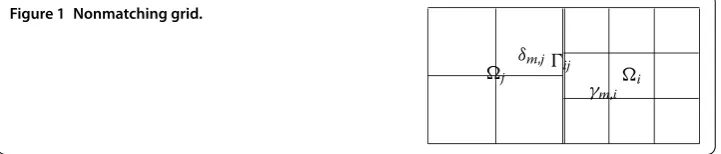
δm,j, heremrepresents the indexing ofij(see Figure ). We assume that: () the mortar for
γm,i=δm,j=ijis chosen by the conditionρjρi; () there is at least one subdomain which
has two mortar sides associated with each cross point; ()hihj,i.e.,hi/hjis bounded. The
first condition used in choosing mortar sides is essential (see the numerical tests in []). The last condition is technical but not essential for the convergence analysis. Along each ij, there are two independent and different -D meshes which are denoted byThi(γm,i) and Tj
h(δm,j). For each nonmortar sideδm,j=ij, we denote byMhj(δm,j)⊂L(ij) an auxiliary
Figure 1 Nonmatching grid.
j i
δm,jij
test space whose functions are piecewise constant onThj(δm,j). We denote byQm theL
-orthogonal projection from theL(
ij) space to theMhj(δm,j) space.
Now we define the mortar-type rotatedQspace as follows:
Vh=
v=
N
i=
vi∈Xh() :Qm(vi|γm,i) =Qm(vj|δm,j),∀γm,i=δm,j⊂
, (.)
herevi|γm,iis the restriction ofvi∈Xh(i) to the mortar sideγm,i, andvj|δm,j is the
restric-tion ofvj∈Xh(j) to the nonmortar sideδm,j. The condition in (.) for each interface is
calledmortar condition. The mortar-type rotatedQelement approximation of problem (.) is: finduh∈Vhsuch that
ah(uh,vh) = (f,vh), ∀vh∈Vh, (.)
where
ah(uh,vh) = N
i=
ah,i(uh,vh), ah,i(uh,vh) =
E∈Th(i)
E
ρi∇uh∇vhdx.
It can easily be shown thatah(·,·) is positive definite onVh, which yields the existence
and uniqueness of the discrete solution. The error estimate between the discrete and the continuous solution is discussed in [].
Since the mortar condition depends on both the degrees of freedom on the interfaces and the ones near the interfaces, it is difficult to construct a preconditioner directly for (.). To overcome this difficulty, we introduce a new discrete space and an auxiliary prob-lem which is equivalent to probprob-lem (.).
For each v∈Vh, we define an elementv˜= iN=v˜i∈Xh() that satisfies the following
conditions:
• for anye∈(Ni=ie,h)∪(mTi h(γm,i)),
|e|
e ˜
v ds=
|e|
e
v ds; (.)
• for anyψ∈Mhj(δ m,j),
δm,j ˜
vψds=
δm,j ¯
vψds, (.)
wherev¯∈L(γ
m,i)is a piecewise constant function on elements ofThi(γm,i)such that ¯
v|e=|e|evi|γm,idsfor anye∈T i
h(γm,i). Note that the average value ofv˜one∈Thj(δm,j)
can be calculated by(.).
By the above definition, allv˜associated withvform a spaceV˜h⊂Xh() as
˜
Vh=
˜
v=
N
i=
˜
vi∈Xh() :v∈Vh
.
Lemma .([]) For any pair of v∈Vh,v˜∈ ˜Vhdefined above,the following is true:
ah(v,v)ah(˜v,˜v). (.)
Now we introduce the auxiliary problem, that is, to findu˜∈ ˜Vhwhich satisfies
ah(u˜,˜v) =f(v˜), ∀˜v∈ ˜Vh. (.)
Define an operatorA˜h:V˜h→ ˜Vhby
(A˜hv˜,w˜) =ah(v˜,w˜), ∀˜v,w˜∈ ˜Vh.
From the above lemma, we only need to construct a preconditioner for the operatorA˜h.
3 BDDC algorithm
In this section, we introduce our BDDC preconditioner for problem (.) and describe the BDDC algorithm.
We first define a discrete harmonic operatorHiassociated with the rotatedQelement: for anyv∈Xh(i), letHiv∈Xh(i) such that
ah,i(Hiv,w) = , ∀w∈Xh(i),
|e|
eHiv ds=
|e|
ev ds, ∀e∈∂ e i,h,
hereX
h(i) ={v∈Xh(i) :
ev ds= ,∀e∈∂ei,h}. LetXh(∂i) =Hi(Xh(i)). We defineH
as a corresponding piecewise harmonic operator on the auxiliary spaceV˜hbyH|i=Hi.
In order to introduce our domain decomposition method, we decompose the auxiliary discrete spaceV˜has follows:
˜
Vh=XhP()⊕ ˜Vh() and XhP() = N
i=
Xh(i), (.)
where the spaceV˜h() is a piecewise harmonic function space defined as
˜
Vh() =H(V˜h) =
v∈ ˜Vh:v|i=Hi(v|i),i= , , . . . ,N
.
We define a spaceX˜h() ={v∈ Ni=Xh(∂i) :
γm,iv|ids=
δm,jv|jds,∀γm,i=δm,j⊂}.
The spaceX˜h() is betweenV˜h() and Ni=Xh(∂i), and our BDDC preconditioner is
mainly constructed on this space.
As we know, the technical aspect in DDMs is that the preconditioner includes a coarse problem which can enhance the convergence. In view of the characteristic of the space
˜
Xh(), we select the standard coarse spaceVH() which is the rotatedQfinite element space associated with the coarse partition TH(), and it satisfies primal constraints on
subdomain interfaces.
The substructure spaceV˜ (i) with constraints is defined by
˜ V (i) =
v∈Xh(∂i) :
ij
v ds= ,∀ij⊂∂i
DenoteV˜ () = Ni=V˜ (i). The coarse space and the product spaceV˜ () play an
im-portant role in the description and analysis of our iterative method.
To present our BDDC preconditioner, we introduce several space transfer operators. Define an interpolation operatorIH:V˜h→VH() by
ijIHv ds |ij| =
ijv ds
|ij| , ∀ij⊂.
The intergrid transfer operatorIh:VH()→ ˜Xh() is defined by
eIhv ds |e| =
ev ds
|e| , ∀e∈∂
e
i,h(i= , . . . ,N).
Define an extension operatorRT
i :Xh(∂i)→ ˜Vh() as
• for anye∈γm,i⊂∂iT i
h(γm,i), |e|
eR T
iv|γm,ids=
|e|
ev|γm,ids;
• for anye∈γr,j⊂∂iThj(γr,j), |e|
eRTiv|γr,jds= ;
• for anye∈nThj(δn,j), |e|
eR T
iv|δn,jdssatisfies(.).
Its transposeRi:V˜h()→Xh(∂i) is defined by
(Riw,v) =
w,RTiv, ∀w∈ ˜Vh(),v∈Xh(∂i).
DenoteRTi|V˜ (i):V˜ (i)→ ˜Vh() byR T
,i, the corresponding transposeR ,i:V˜h()→ ˜
V (i) is defined by
(R ,iw,v) =
w,RT ,iv, ∀w∈ ˜Vh(),v∈ ˜V (i).
We also need to define another prolongation operatorEi:Xh(i)→ ˜Vhas follows:
• ife∈ei,h, then|e|eEiv ds=|e|
ev ds;
• ife∈Thi(γm,i),γm,i⊂∂i, then|e|
eEiv ds=
|e|
ev ds;
• ife∈Thk(γs,k),∀γs,k,k=i, then|e|
eEiv ds= ;
• ife∈sThj(δs,j), it follows from(.)that|e|
eEiv dscan be obtained by the edge
average values on associated mortar sides; • else,|e|eEiv ds= .
In what follows, we describe our BDDC preconditioning algorithm, we apply the ba-sic framework of additive Schwarz method (or parallel subspace correction method []). From the decomposition (.), we only need to choose appropriate subspace solvers.
First of all, the coarse subspace solverBH:VH()→VH() is defined by
(BHuH,vH) =ah(uH,vH), ∀uH,vH∈VH().
On each subdomain, similar operatorsBi:V˜ (i)→ ˜V (i) andBP,i:Xh(i)→Xh(i)
are defined, respectively, by
(Biu,v) =ah,i(u,v), ∀u,v∈ ˜V (i),
Remark . The bilinear form on the coarse space can be different from that on substruc-ture space, here we only use the exact solvers. On each subdomain, we avoid the possible singularity of local subproblem and we need not modify the bilinear forms.
Now we define our BDDC preconditioner as
Bbddc=RTB–HR+
N
i=
RT ,iB–i R ,i+ N
i= B–p,i,
whereRT
=
N
i=RTi Ih,Ris the corresponding transpose defined by
(Rw,v) =
w,RTv, ∀w∈ ˜Vh(),v∈VH().
LetPbe an operator fromV˜h() toVH() defined by
ah(Pu,v) =ah
u,RTv, ∀u∈ ˜Vh(),v∈VH(),
PiandPp,ibe the operators fromV˜h() toV˜ (i) andXh(i) defined, respectively, by
ah,i(Piu,v) =ah
u,RT ,iv, ∀u∈ ˜Vh,v∈ ˜V (i),
ah(Pp,iu,v) =ah(u,v), ∀u∈ ˜Vh,v∈Xh(i).
Then the BDDC preconditioned operatorPbddc=BbddcA˜hcan be written as
Pbddc=RTP+
N
i=
RT ,iPi+ N
i= Pp,i.
We have the following main result.
Theorem . The BDDC preconditioned operator Pbddcsatisfies
ah(u,u)ah(Pbddcu,u)
+logH
h
ah(u,u), ∀u∈ ˜Vh,
where H/h=maxi(Hi/hi).
4 Technical tools
In this section we state and prove a few technical lemmas necessary for the proof of The-orem .. Our theoretical analysis is based on the substructuring theory of conforming elements.
We assumeVh(
i) be the bilinear conforming element space associated with the
par-titionTh(i). We split the interface∂iinto four open edgesE, and define a restriction
operatorIE:Vh(∂
i)→Vh(∂i) (Vh(∂i) =Vh(i)|∂i) as: for anyv∈Vh(∂i)
IEv=
v, onE, , on∂i\E.
Lemma .([]) For an edgeEof∂i,then for any v∈Vh(∂i),we have
IEvH/(∂
i)
+logHi
hi
vH/(∂
i).
Remark . The above lemma is related to vertex-edge-face arguments in substructuring methods, in view of the characteristic for the rotatedQ element, here the results only concern the inequalities for faces.
LetVh/(
i) be the conforming element space of bilinear continuous functions on the
partitionTh/(i) which is constructed by joining the midpoints of the edges of elements
ofTh(i). We now introduce a local equivalence mapMi:Xh(i)→Vh/(i) as follows
(cf.[]).
Definition . Givenv∈Xh(i), we defineMiv∈Vh/(i) by the values ofMivat the
vertices of the partitionTh/(i).
• IfPis a central point ofE,E∈Th(i), then
(Miv)(P) =
ei∈∂E
|ei|
ei
v ds.
• IfPis a midpoint of one edgee∈∂E,E∈Th(i), then
(Miv)(P) =
|e|
e
v ds.
• IfP∈i,h\∂i,h, then
(Miv)(P) =
ei
|ei|
ei
v ds,
where the sum is taken over all edgeseiwith the common vertexP,ei∈∂Ei,
Ei∈Th(i).
• IfP∈∂i,h, then
(Miv)(P) = |
el|
|el|+|er|
|el|
el
v ds
+ |er|
|el|+|er|
|er|
er
v ds
,
whereel∈∂E∩∂iander∈∂E∩∂iare the left and right neighbor edges ofP,
E,E∈Th(i). IfPis a vertex ofi, thenE=E.
Define the pseudo-inverse mapM+
i :Vh/(i)→Xh(i) by
|e|
e
M+
iv ds=v(P), ∀v∈Vh/(i),
wheree∈∂E,E∈Th(i),Pis the midpoint ofe. Obviously, we have
M+
For the operatorsMiandM+i, we have the following results (see []):
|Miv|H(
i) |v|Hh(i), ∀v∈Xh(i); M+
ivHh(i) |v|Hh(i), ∀v∈V h/(
i).
(.)
Lemma . For any ui∈ ˜V (i),we can split uiinto ui=
ij⊂∂iuij,and we have
|uij|H
h(i)
+log(Hi/hi)
|ui|H
h(i), (.)
where uij∈ ˜V (i), and for any e∈eij,
euijds/|e|=
euids/|e|; for any e∈∂ei,h \ij,
euijds/|e|= .
Proof By (.), Lemma ., the inverse trace theorem, the trace theorem, and the Poincaré inequality, we obtain
|uij|H
h(i)≤M
+
iHiIE(Miuij)∂ iHh(i) HiIE(Miuij)∂
iHh(i) IE(Miuij)∂
iH/(∂i) +log(Hi/hi)
MiuiH/(∂
i) ≤ +log(Hi/hi)
MiuiH(
i) +log(Hi/hi)
|Miui|H(
i) +log(Hi/hi)
|ui|H
h(i),
whereHiis a piecewise bilinear conforming element harmonic operator, and we have used
the minimal energy property of discrete harmonic functions.
5 Proof of Theorem 3.1
In the proof of Theorem . we use the abstract framework of ASM methods (see []), we need to prove three assumptions. Assumption II follows from the standard coloring argument, we only need to prove Assumption I and Assumption III.
First we show the following stability of the decomposition.
Lemma .(Assumption I) For any u∈ ˜Vh,we have the following decomposition:
u=RTuH+ N
i=
RT ,iui+ N
i=
up,i, uH∈VH(),ui∈ ˜V (i),up,i∈Xh(i), (.)
which satisfies
ah(uH,uH) + N
i=
ah,i(ui,ui) + N
i=
ah,i(up,i,up,i)ah(u,u). (.)
Proof First we show the decomposition (.). For any functionu∈ ˜Vh, letup,i=Pp,iuand
uH=IHu, obviouslyu–
N
denoteu =u–Ni=up,i–IhuH,ui=u |i. From the definition ofIHandIh, we have
ij
uids=
ij
u ds=
ij
(u–IhuH)ds=
ij
(u–uH)ds= ,
and by the definition ofRT
,i, we get
RTuH+ N
i=
RT ,iui+ N
i= up,i=
N
i=
RTiIhuH+ N
i= RTi
u–
N
i=
up,i–IhuH
+
N
i= up,i
=
N
i= RTi
u–
N
i= up,i
+
N
i= up,i
=u–
N
i= up,i+
N
i= up,i
=u,
where we have used the factNi=RTiu=u,∀u∈ ˜Vh(). Henceui∈ ˜V (i) and the equality
(.) holds.
Now we prove the stability of decomposition (.). Let u¯ij =
iju ds/|ij|. Using
Lemma . in [], Poincaré-Friedrichs’ inequality and scaling argument, we derive
ij,ik⊂∂i
|¯uij–u¯ik|
=
ij,ik⊂∂i
|ij|
ij
(u–u¯ik)
ik⊂∂i
Hiu–u¯ik
L(
i)+|u|
H
h(i)
|u|H
h(i). (.)
From (.) and the discrete equivalent norm, we have
ah(uH,uH) = N
i=
ah,i(uH,uH) N
i= ρi
ij,ik⊂∂i
|¯uij–u¯ik|
a
h(u,u). (.)
SincePp,iis an orthogonal projection with respect toah,i(·,·), we obtain
N
i=
ah,i(up,i,up,i) = N
i=
ah,i(Pp,iu,Pp,iu)≤ah(u,u). (.)
Meanwhile, from the fact that the harmonic function has minimal energy norm and (.)-(.), we deduce
N
i=
ah,i(ui,ui) =ah(u ,u )
=ah
u–
N
i=
up,i–IhuH,u– N
i=
ah(u,u) + N
i=
ah,i(up,i,up,i) +ah(IhuH,IhuH) (.)
ah(u,u). (.)
So (.)-(.) lead to (.).
Next we state the local stability as follows.
Lemma .(Assumption III) For any u∈ ˜V (i),we have
ah
RT ,iu,RT ,iu
+logH
h
ah,i(u,u). (.)
For any uH∈VH(),we have
ah
RTuH,RTuH
+logH
h
ah(uH,uH). (.)
Proof To prove (.) we first introduce a functionθm= Ni=θm,i∈ ˜Vh associated with a
mortar sideγm,i⊂, which satisfies the following:
• for anye∈Ti h(γm,i),
|e|
eθm,i|γm,ids= ;
• for anye∈r=mTi h(γr,i),
|e|
eθm,i|γr,ids= ;
• for anye∈nThj(δn,j), |e|
eθm,j|δn,jdssatisfies(.).
Then we can decomposeRT ,iu∈ ˜Vh() as follows:
RT ,iu=RTiu=H
γm,i⊂∂i
Ih
θm,i(Eiu)
= γm,i⊂∂i
HIh
θm,i(Eiu)
, (.)
here we have used the fact that the degrees of freedom on the interfaceof the functionu are as same as that ofγ
m,i⊂∂iIh(θm,i(Eiu)), and the operatorIhis defined by the average
values on the edge elements,i.e.,
|e|
e
Ih
θm,i(Eiu)
=
|e|
e
θm,ids·
|e|
e
Eiu ds, ∀e∈∂eh,i.
Note that the support ofH(Ih(θm,i(Eiu))) is on¯i∪ ¯j, and using Lemma . in [] we
have
ah
HIh
θm,i(Eiu)
,HIh
θm,i(Eiu)
ρiHIh
θm,i(Eiu)
H
h(i). (.)
Since the degrees of freedom on the interface∂iofHi(Ih(θm,i(Eiu))) are only nonzero on
the edgeγm,i, using Lemma ., we deduce HIh
θm,i(Eiu)H
h(i) =Hi
Ih
θm,i(Eiu)H
h(i)
+log(Hi/hi)
|Hiu|H
h(i)
+log(Hi/hi)
|u|H
h(i). (.)
Using similar techniques to those in (.), and summing over all subdomains, we can complete the proof of (.).
6 Numerical results
In this section, we show numerical results of our method using the model problem
–div(ρ∇u) =f, in, u= , on∂,
where= [, ]. The domain is composed ofM×Msub-squares, their mesh sizes are H, and the sub-squares are divided into smaller ones with mesh sizeshmin mortar
subdo-mains; andhnin nonmortar subdomains. The coefficientρis either or k(k= , , ).
We use the preconditioned conjugate gradient (PCG) method with zero initial guess for the discrete system of equations. The stopping criterion for the PCG method is when the -norm of the residual is reduced by the factor of – of the initial guess. An estimate for the condition number of the corresponding system is computed by using the Lanczos algorithm.
In Table , we show the number of iterations and the condition numbers with different ratioH/hn. In Figure , we plot the condition number as the function ( +log(H/h))for
Table 1 The number of iterations and condition numbers forhm/hn= 2/3
M×M H/hn= 4 H/hn= 16
k= 2 k= 4 k= 6 k= 2 k= 4 k= 6
4×4 10 (3.30) 10 (3.30) 10 (3.30) 12 (5.15) 12 (5.15) 12 (5.15) 8×8 11 (3.30) 11 (3.34) 11 (3.32) 12 (5.30) 13 (5.34) 13 (5.34) 16×16 11 (3.24) 12 (3.21) 13 (3.21) 13 (5.32) 13 (5.39) 14 (5.39) 32×32 11 (3.24) 12 (3.24) 12 (3.24) 15 (5.37) 15 (5.41) 15 (5.41)
domains. From the results in Table and Figure , we see that the convergence of our method is quasi-optimal since the number of iterations is independent of the jumps of the coefficients, and almost independent of the mesh size.
Competing interests
The authors declare that they have no competing interests.
Authors’ contributions
All results belong to YJ and JC. All authors read and approved the final manuscript.
Acknowledgements
The work was supported by the National Natural Science Foundation of China (Grant Nos. 11371199 and 11301275), Jiangsu Provincial 2011 Program (Collaborative Innovation Center of Climate Change), the Program of Natural Science Research of Jiangsu Higher Education Institutions of China (Grant No. 12KJB110013), the Doctoral fund of Ministry of Education of China (Grant No. 20123207120001), and Jiangsu Key Lab for NSLSCS (Grant No. 201306). Moreover the authors are grateful to anonymous referees for their constructive comments and suggestions.
Received: 14 January 2014 Accepted: 17 March 2014 Published:03 Apr 2014
References
1. Dohrmann, C: A preconditioner for substructuring based on constrained energy minimization. SIAM J. Sci. Comput.
25, 246-258 (2003)
2. Mandel, J, Dohrmann, C: Convergence of a balancing domain decomposition by constraints and energy minimization. Numer. Linear Algebra Appl.10, 639-659 (2003)
3. Li, J, Widlund, O: FETI-DP, BDDC, and block Cholesky methods. Int. J. Numer. Methods Eng.66, 250-271 (2006) 4. Mandel, J, Dohrmann, C, Tezaur, R: An algebraic theory for primal and dual substructuring methods by constraints.
Appl. Numer. Math.54, 167-193 (2005)
5. Kim, H: A BDDC algorithm for mortar discretization of elasticity problems. SIAM J. Numer. Anal.46, 2090-2111 (2008) 6. Kim, H: A FETI-DP formulation of three dimensional elasticity problems with mortar discretization. SIAM J. Numer.
Anal.46, 2090-2111 (2008)
7. Kim, H, Lee, C, Park, E: A FETI-DP formulation for the Stokes problem without primal pressure component. SIAM J. Numer. Anal.47, 4142-4162 (2010)
8. Le Tallec, P, Mandel, J, Vidrascu, M: A Neumann-Neumann domain decomposition algorithm for solving plate and shell problems. SIAM J. Numer. Anal.35, 836-867 (1998)
9. Rannacher, R, Turek, S: Simple nonconforming quadrilateral Stokes element. Numer. Methods Partial Differ. Equ.8, 97-111 (1992)
10. Bernardi, C, Maday, Y, Patera, A: Domain decomposition by the mortar element method. In: Kaper, HG, Garbey, M, Pieper, GW (eds.) Asymptotic and Numerical Methods for Partial Differential Equations with Critical Parameters, pp. 269-286. Kluwer Academic, Dordrecht (1993)
11. Marcinkowski, L: Additive Schwarz method for mortar discretization of elliptic problems withP1nonconforming elements. BIT Numer. Math.45, 375-394 (2005)
12. Wang, F, Chen, J, Xu, W, Li, Z: An additive Schwarz preconditioner for the mortar-type rotatedQ1FEM for elliptic problems with discontinuous coefficients. Appl. Numer. Math.59, 1657-1667 (2009)
13. Chen, J, Xu, X: The mortar element methods for rotatedQ1element. J. Comput. Math.20, 313-324 (2002) 14. Xu, J: Iterative methods by space decomposition and subspace correction. SIAM Rev.34, 581-613 (1992) 15. Xu, J, Zou, J: Some nonoverlapping domain decomposition method. SIAM Rev.40, 857-914 (1998) 16. Toselli, A, Widlund, O: Domain Decomposition Methods: Algorithms and Theory. Springer, Berlin (2005)
10.1186/1687-2770-2014-79
Cite this article as:Jiang and Chen:A BDDC algorithm for the mortar-type rotatedQ1FEM for elliptic problems with