Completely Informed Artificial Bee Colony for Multimodal
Optimization Problems
Zakir Hussain
Research ScholarJJT University , Rajasthan
Syed Raziuddin
Professor,Deccan College of Engineering & Technology Telengana
I.
Introduction
Real world optimization problems are complex, nonlinear and multimodal and dynamic in nature. Robust optimization algorithms are needed to solve the growth of real time problems. In the past few years, Swarm Intelligence(SI) has gained the positive result of scholars providing optimized problems. Artificial Bee Colony (ABC) is newly presented method that is stochastic in nature, dependent on population for optimized technique forintelligence and foraging behavior of bee swarm .
Many numerical optimization problems2-4 and real-time optimization problems can be solved by this technique due to its simplicity and ease of implementation2-8, 14, 15. In ABC algorithm, an answer for the difficult boggling issue to be enhanced is spoken to by the position of the food source and the quality (wellness) of the related problem is spoken to by nectar amount. A exceptionally essential research zone for the ABC community is to enhance the ABC algorithm for the nature of solution.Optimization problems whichare of higher dimension and dynamic are complex and multimodal in nature. Most of the SI algorithmswhich have fewer control parameters namely ABC algorithm are simple to implement with fewer control parameter does not perform well on these kind of optimization problems.Bees information sharing strategy has become the major hurdle towards ABC method. In the present flow cycle, the best solution is held by the ABC algorithms amid the hunt procedure. Up gradation for the coordinates by employees & onlooker beesbased on their neighborhood.The ability to keep a record of the potential solutions that are produced during search process is lacking in the basic ABC algorithm.
This paper proposes a new strategy named Completely informed Artificial Bee Colony (CABC) which is based on completelyinformed strategy and the external archive. According to theweighted difference of the bee and the neighbor bee are added to the elite bee in the completely informed strategy.Again an external archive is kept up to hold the quantity of good solutions created and the individuals from the file are randomly chosen for differential redesign. The archive redesign technique is additionally proposed in this paper. Theproposed algorithm is comparedto the present state-of-the-art9-13for performance on standard multi-modal scalable benchmark problems that are characterized by different difficulties in local optimality, non-uniformity, discontinuity, non-convexity and high-dimensionality. The extensive test examination demonstrates the viability
Abstract:
Complex multimodal optimization problem have been studied for proposing a novel alternative Artificial Bee Colony Algorithm. The alternate is known to be Completely Informed Artificial Bee Colony (CABC) enhances the method of sharing the information to improve the quality of service. In order to maintain the consistent solution generated by the iterations, external archive is incorporated with CABC. Complete analysis of our method is executed on standard benchmark problems with higher dimensions (10, 30, 50 & 100) optimization problems. Performance of suitability, convergence rate and robustness of the proposed technique is evaluated. We obtain better and competitive results compared with the existing algorithms.of the proposed calculation regarding convergence, quality of solution and robustness. The aggressiveness of the proposed calculation is likewise shown on dynamic optimization issues.
The remaining part of paper is presentedas follows: Section 2 describes the basic artificial bee colony (ABC) mechanism. Section 3 illustratesCABC algorithm and external archive. The practical framework for performance analysis is given in section 4. The outcomes are discussed in section 5 and conclusion in section 6.
II.
Artificial Bee Colony (ABC) Algorithm
In 2005 Karaboga proposed an artificial bee colony(ABC) mechanism1. The ABC method was produced to imitate the practices of genuine bees on discovering food source (the nectar) and sharing nectars data to other bees in hive. Onlooker, Employed and Scout bees are the names of bees colony. Every method has their our assumption in the search process. The first phase deals with employed bees and second phase deals with onlooker bees. Every employed bee has only one single source food and the hive has equal number of food source and employed bees. The employed bee stays on the food source and records in its memory and the onlooker bees collects the information of food source from the employed bees. in order to assemble the nectar, it selects one food source among all. The scout is formed by the employed bee whose food source has been drained. The scout is accountable for finding new food sourceson its own.The data exchange among bees is through an exceptional waggle dance. Since information about all the current quality food sources is open to onlookers on the dance floorand consequently they collect the food source with full fitness. Employed foragers grant their information to a probability, which is relating to the health of the food source,and henceforth, the enrollment is relative to gainfulness of a food source1, 4. The bees look for the food sources to amplify of the objective functionF (Ɵ), Ɵ ∈R (for maximization problem). The Ɵiis the location of the i
th
food source and F(Ɵi)
the wellness of the nectar amount located at Ɵi. The employed bee’s waggle dance selects about where the
onlooker bees go for rummaging. The onlooker bee moves to area of food source located at Ɵi by probability4
andfinds food sources around. The ithdimension ofjthbee is updated as
Ɵ𝑖𝑗(c+1) = Ɵ𝑖𝑗(c) + rand*(Ɵ𝑖𝑗(c )-Ɵ𝑘𝑛(c))--- (1)
Where c corresponds to the current iteration, Ɵ𝑘𝑛(c) is selected randomly kthdimension of randomly selected nth
neighbor. and is the random number in [0,1]. The Ɵ𝑖(c) is modified to Ɵ𝑖(c + 1) if the nectar amount F(Ɵ𝑖(c +
1)) at Ɵ𝑖(c+1) is higher than that atƟ𝑖(c), else Ɵ𝑖(c) is unchanged. In the event that the position Ɵ𝑖 of the food
source 'i'cannot be enhancedfor foreordained number of endeavors; say "limit", then it is surrendered by its employed bee and turns into a scout. The scout begins to scan for anotherfood source arbitrarily.
III.
Completely Informed Artificial Bee Colony (CABC)
The significant upgrade information can be done to ABC mechanism is the bees sharing methodology. In established ABC mechanism onlooker bees and employed bees redesign their directions in light of the data of their adjacent bees (equation 1). The best arrangement that is being created in each cycle amid search process is just remembered and utilized as maintenance applicant. The ABC mechanism doesn’tuse the data of potential arrangement being created for better looking. The established ABC mechanism even does not have the capacity to hold a decent number of potential arrangements created through the eras. This paper proposes a novel methodology in view of complete information sharing and the external archive. The significant upgrades that are being fused are talked about under the accompanying headings.
A. Complete information sharing under elite bee
In this technique the first class bee is chosen in each cycle. The first class bee has the most ideal answer for the issue under thought ever. As per the full data sharing methodology, the weighted contrast of the bee and data of its adjacent are included under the direction of the first class bee. The ith dimension ofjth bee is updated as
Ɵ𝑖𝑗(c+1) = Ɵ𝑚𝑒(c) + β*(Ɵ𝑖 𝑗
(c )-Ɵ𝑘𝑛(c)) ---(2)
Where c is the current iteration, Ɵ𝑚𝑒 (c) corresponds to the randomly selected mth dimension of the elite bee, and,
Ɵ𝑘𝑛(𝑐)the haphazardly chose kthmeasurement of arbitrarily chose nth neighbor. The βis the weight, in our practice
we have utilizedβ = 0:5.
An external archive is created to store the results. At first, the archive is vacant. We have utilized limited archive to protect great arrangements; the span of the document is similar as the quantity of colony size. As the era advances, great arrangements enter the archive and are redesigned in each era. The great arrangements got in every era are contrasted one by one and the present archive. The archive is upgraded by considering
The new arrangement is not accepted if the updated arrangement is much more exceedingly terrible than the individuals from archive.
If the new arrangement is superior to the individuals of the archive, then new arrangement enters the archive
If archive surpasses most extreme predefined measure then rejects the individuals from the file with low quality arrangement.
C. full information sharing under exemplars of archive
Since an external archive is kept up to hold the quantity of better arrangements delivered, hypothetically the models from the archive are the best ever. Again here, as indicated by the complete data sharing methodology, the weighted contrast of the bee and its adjacent are included under the direction of arbitrarily chose models of archive. The ith measurement of jth bee is redesigned as takes after. The
ithinstrument of jth bee is redesigned as takes after
Ɵ𝑖𝑗(c+1) = Ɵ𝑚𝑎(c) + β*(Ɵ𝑖 𝑗
(c )-Ɵ𝑘𝑛(c)) (3)
Where Ɵ𝑚𝑎(c) is the haphazardly chosen mthmeasurement of the haphazardly choseathmodel of the archive.
The importance of c, Ɵ𝑘𝑛and βaresimilar as above inequation 2
Algorithm 1 Completely informed Artificial Bee Colony (CABC)
Initiate
Initiate and Evaluate the wellness of complete bees. Initiate the archive to the colony size.
Optimized
Assess the nectar measures of employed bees
Locate the excellent bee among the bee swarm: first class.
Move the bees under direction of elite
Ascertain the likelihood of selecting a food4
Move the onlookers under the direction of elite eq. 2.
Move the scout
Locate the depleted employed bee: the scout Move the scouts arbitrarily in the pursuit extend.
Move the bees under direction of models from archive
Move the bees under the direction of models from archive eq. 3.
Upgrade the archive
Keep upgrading until halting criteria or surpassing most extreme emphasis.
TABLE I Function Name Function Definition Ackley
𝑓1(͞𝑥) 20 + 𝑒 −
1 5 1
𝐷 𝑥𝑖
2 𝑖
− 𝑒−𝐷1 𝐶𝑂𝑆(2𝜋𝐷 𝑖
𝑥𝑖)
𝑓2(͞𝑥)
Griewank 𝑥𝑖2
4000
𝐷
𝑖=1
− 𝑐𝑜𝑠(𝑥𝑖
𝑖 ) + 1
𝐷
𝑖=1
𝑓3(͞𝑥) Rastrigin
(𝑥𝑖2− 10𝑐𝑜𝑠(2𝜋𝑥𝑖) + 10) 𝐷
𝑖=1
𝑓4(͞𝑥) Rosenbrock
[100(𝑥𝑖2− 𝑥𝑖+1)2+(𝑥𝑖− 1)2] 𝐷−1
𝑖=1
𝑓5(͞𝑥) Sphere
𝑥𝑖2 𝐷
BENCHMARK FUNCTIONS DEFINITION
IV. Simulation
The simulation is performed in the environment consisting of PIV, 2GHz with minimum of 1GB RAM. The technology utilized for the proposed mechanism isMatlab 7.2 in Windows platform. Everyalgorithm is set with the population size of 25, the quantity of cycle is 1000. The outcomes recorded are the normal of 15 trials.The halting criteria for every one of the algorithms are set to 1x10-250. The measurements of 10, 30, 50 and 100 were utilizedfor testing nature of outcomes. For CABC external archive size is set equivalent to the populace, the weight β = 0:5 & alternate arguments are similar as that of ABC2. All the selected functionalities are complex, multimodal and scalable in measurements. The meaning of the selected issues are given in Table I, they are numbered as f1 to f6 respectively for Ackley, Griewank, Rastrigin, Rosenbrock, Sphere and Zakharov.
V.
Results
10, 30, 50 and 100 dimensions with asymmetric initialization were taken for conducting experiments on a set of six complex scalable multimodal benchmark problems Convergence, Mean results and Robustness were considered for performance comparisons
A. Mean results and Robustness
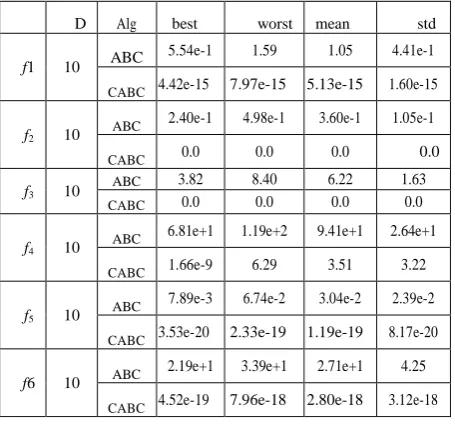
Table II to Table V presents the average results.Thefunction name, dimension and the algorithmsare shown in the first three columns of these tables. The sixth and seventh columns give complete information about the mean result and standard deviations achieved.The best results for mean and standard deviation achieved are shown in bold. On 10D problems CABC performs better than all the algorithms on functions f1 to f6. On 30D
problems the mean results of CABC performs well on all the problems. The lowest outcomes gained by CABC are better than the best outcomes gained by ABC. Performance of CABC has analyzed with 50D and 100D problems has good improvements compared to ABC. Robustness of the algorithm is shown by standard deviationalgorithms. They are calculated over 15 trials and 1000 iterations. The best results of standard deviation are shown with bold. CABC is well stable on all most all of the problems irrespective of dimension as it can be seen from Table II .
TABLE II
AVERAGE RESULTS ACHIEVED OVER 20 RUNS FOR 10 DIMENSIONS
𝑓6(͞𝑥)
Zakharov 𝐷𝑖=1𝑥𝑖2+( 𝑖=1𝐷 0.5𝑖𝑥𝑖)2+ ( 𝐷𝑖=10.5𝑖𝑥𝑖)4
D Alg best worst mean std
f1 30
ABC 6.13 6.93 6.39 3.42e-1
CABC 1.52e-14 3.98e-14 2.66e-14 9.85e-15
f2 30 ABC 1.06 1.42 1.23 1.65e-1
CABC 0.0 0.0 0.0 0.0
f3 30
TABLE III
AVERAGE RESULTS ACHIEVED OVER 20 RUNS FOR 30 DIMENSIONS
TABLE IV
AVERAGE RESULTS ACHIEVED OVER 20 RUNS FOR 50 DIMENSIONS
CABC 0.0 0.0 0.0 0.0
f4 30 ABC 4.54e+3 6.44e+3 5.40e+3 9.73e+2
CABC 4.47e-15 3.87e-8 1.39e-8 1.89e-8
f5 30
ABC 4.72e+1 1.15e+2 8.88e+1 2.72e+1
CABC 5.10e-18 2.20e-17 1.59e-17 6.45e-18
f6 30 ABC 2.65e+2 3.20e+2 2.99e+2 2.39e+1 CABC 4.38e-5 4.81e-4 1.48e-4 1.87e-4
D Alg best worst mean std
f1 10 ABC
5.54e-1 1.59 1.05 4.41e-1
CABC 4.42e-15 7.97e-15 5.13e-15 1.60e-15
f2 10
ABC 2.40e-1 4.98e-1 3.60e-1 1.05e-1
CABC 0.0 0.0 0.0 0.0
f3 10
ABC 3.82 8.40 6.22 1.63
CABC 0.0 0.0 0.0 0.0
f4 10
ABC 6.81e+1 1.19e+2 9.41e+1 2.64e+1
CABC 1.66e-9 6.29 3.51 3.22
f5 10
ABC 7.89e-3 6.74e-2 3.04e-2 2.39e-2
CABC 3.53e-20 2.33e-19 1.19e-19 8.17e-20
f6 10 ABC
2.19e+1 3.39e+1 2.71e+1 4.25
CABC 4.52e-19 7.96e-18 2.80e-18 3.12e-18
D Alg best worst mean Std
f1 50 ABC 9.14 1.19e+1 1.07e+1 1.03
TABLE V
AVERAGE RESULTS ACHIEVED OVER 20 RUNS FOR 100 DIMENSIONS
f2 50
ABC 5.28 1.17e+1 8.87 2.39
CABC 1.12e-16 1.90e-15 8.89e-16 9.23e-16
f3 50 ABC 1.52e+2 2.03e+2 1.85e+2 2.20e+1
CABC 0.0 1.72e-13 5.69e-14 8.05e-14
f4 50 ABC 2.32e+4 3.82e+5 1.20e+5 1.49e+5
CABC 3.35e-4 4.79e+1 1.39e+1 2.63e+1
f5 50
ABC 2.94e+2 1.03e+3 4.80e+2 3.05e+2
CABC 9.14e-17 2.26e-16 1.69e-16 4.82e-17
f6 50 ABC 5.60e+2 6.42e+2 6.15e+2 3.21e+1 CABC 2.43e-2 1.17e-1 6.21e-2 4.15e-2
D Alg best worst mean std
f1 100 ABC 1.39e+1 1.65e+1 1.5e+1 1.15 CABC 1.06e-8 1.41e-7 4.45e-8 5.45e-8
f2 100
ABC 5.15e+1 1.20e+2 8.11e+1 3.23e+1
CABC 1.28e-9 2.91e-8 1.06e-8 1.10e-8
f3 100 ABC 5.10e+2 5.88e+2 5.49e+2 2.74e+1
CABC 5.812-6 7.79e+1 3.69e+1 3.58e+1
f4 100 ABC 4.65e+5 6.53e+6 2.67e+6 2.28e+6
CABC 9.74e+1 9.79e+1 9.76e+1 1.70e-1
f5 100 ABC 8.48e+3 1.54e+4 1.13e+4 2.88e+3
CABC 4.33e-14 2.19e-12 5.38e-13 9.40e-13
B. Convergence
Stochastic algorithms are tested for the speed of Convergence based on quality of solution achieved in number of iterations. The graphs that are drawn again the average of 15 trails over 1000 iterations. Since the pattern of the convergence does not vary considerably for higher dimension problems, hence only 10D problem graphs are shown here. Fig. 1 records the convergence characteristics on problems from f1 to f6. From Fig. 1 it is
Fig. 1. Convergence graphs: 1) f1, 2) f2, 3) f3, 4) f4, 5) f5, 6) f6,
VI.
Conclusion
The information sharing method of ABC is presented. ABC algorithm has given a clear method where information sharing and maintaining of records of possible good solution in an external archive is done. Quality of solution and convergence speed are enhanced by these novel changes. This paper also shows the complete analysis of the newly designed variant of ABC algorithm with well known techniques. Standard multimodal bench mark methods are used to analyze the performance of our algorithm which is better compared to existing approaches. The variation in the dimension of theproblem does not affect themean values of the proposed solution.
References
[1]. Karaboga D. An idea based on honey bee swarm for numerical optimization. Technical report-tr06, Erciyesuniversity, engineering faculty, computer engineering department; 2005 Oct.
[2]. Karaboga D, Basturk B. A powerful and efficient algorithm for numerical function optimization: artificial bee colony (ABC) algorithm. Journal of global optimization. 2007 Nov 1;39(3):459-71.. [3]. Basturk B, Karaboga D. An artificial bee colony (ABC) algorithm for numeric function optimization,
IEEE Swarm Intelligence Symposium 2006, May 12–14, 2006. Indianapolis, Indiana, USA. 2006.. [4]. Karaboga D, Basturk B.On the performance of artificial bee colony (ABC) algorithm.Applied soft
computing. 2008 Jan 31;8(1):687-97.
[6]. Karaboga D, Akay B. Artificial bee colony (ABC) algorithm on training artificial neural networks. InSignal Processing and Communications Applications, 2007.SIU 2007. IEEE 15th 2007 Jun 11 (pp. 1-4). IEEE.
[7]. Karaboga N. A new design method based on artificial bee colony algorithm for digital IIR filters. Journal of the Franklin Institute. 2009 May 31;346(4):328-48.
[8]. Singh A. An artificial bee colony algorithm for the leaf-constrained minimum spanning tree problem.Applied Soft Computing. 2009 Mar 31;9(2):625-31.
[9]. Kennedy J. Particle swarm optimization. InEncyclopedia of machine learning 2011 (pp. 760-766).Springer US.
[10]. Eberhart R, Kennedy J. A new optimizer using particle swarm theory. InMicro Machine and Human Science, 1995.MHS'95., Proceedings of the Sixth International Symposium on 1995 Oct 4 (pp. 39-43). IEEE.
[11]. Robinson J, Rahmat-Samii Y. Particle swarm optimization in electromagnetics. IEEE transactions on antennas and propagation. 2004 Feb;52(2):397-407.
[12]. Gao XZ, Wang X, Ovaska SJ. Fusion of clonal selection algorithm and differential evolution method in training cascade–correlation neural network.Neurocomputing. 2009 Jun 30;72(10):2483-90.
[13]. Hashmi SA. Vectorial updates in Artificial Bee Colony.
[14]. ]Raziuddin S, Sattar SA, Lakshmi R, Parvez M. Differential artificial bee colony for dynamic environment. InInternational Conference on Computer Science and Information Technology 2011 Jan 2 (pp. 59-69). Springer Berlin Heidelberg.