Volume 2, Issue 6, December 2014
Abstract—Inter-cell interference (ICI) is a capacity-limiting factor in any wireless cellular system. Recently, base stations coordination (i.e., network MIMO) is considered as a promising way to improve system performance whereby adjacent cells strategize their transmissions such that interference generated to other cells is reduced. One of the major challenges encountered by network MIMO is resource allocation because resource allocation strategy one cell affects the other cells’ performance. This paper proposes a resource allocation algorithm that performs optimal allocation of subcarrier and power allocation in multi-user network MIMO with multi-antenna base stations subject to individual user minimum rate requirement and base station power constraints. The optimization problem is formulated using Lagrange theorem and solved using Particle Swarm Optimization (PSO). Our simulation study shows that the proposed resource allocation algorithm achieves a substantial network throughput gain while ensuring fairness.
Index Terms—ICI, network MIMO, resource allocation, optimization, Lagrange theorem, PSO.
I. INTRODUCTION
With the ever increasing demands on wireless applications such as web browsing, voice over internet protocol (VoIP) and multimedia downloading, wireless spectrum efficiency is becoming increasingly important. However, the cell-edge performance degrades due to inter-cell interference (ICI) which creates a large quality of service (QoS) discrepancy in relative to the cell center users. Network MIMO consists of several base stations with multiple antennas, forming a large antenna array and coordination among the base stations has been considered as a promising way to mitigate ICI in future cellular networks [1]-[4]. The coordination requires inter-base station signaling over the backhaul network which allows information and data sharing across the cells [5].On the other hand, it is known that resources in wireless networks such as bandwidth and power are limited and expensive. In network MIMO, resource allocation strategy of one cell affects the performance of other cells in the network. Therefore, in order to achieve high QoS in network MIMO, efficient resource allocation algorithms should be carried out by exploiting various diversities offered by the time-varying wireless channels.
II. NETWORKMODEL
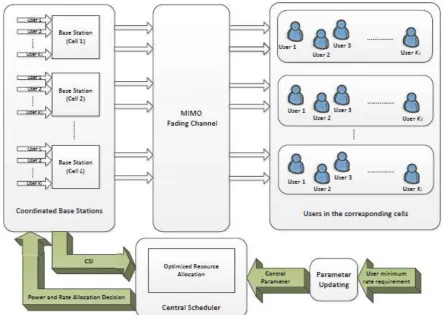
A network MIMO system consists of L cooperative base stations as shown in Figure 1 is assumed. Each base station has transmit antennas. is the number of users in each cell in the network and each user device is equipped with receive antennas. Hence, the base stations and users form a virtual network MIMO system. Suppose that there are N subcarriers available across the system bandwidth and is the base station maximum transmit power. is the power transmitted by user over subcarrier i in cell l, and is the corresponding channel matrix with dimensions . Assuming the eigenvalues of
are , where . For certain values of and , there is a group of eigen-channels denoted
by the above eigenvalues. Usually, there is a dominant Eigen value which is much larger than the others within one group according to singular value decomposition (SVD) technique. In this paper, we utilize these Eigen-channels to feedback channel state information (CSI) and make subcarrier and power allocation decision. The achievable data rate, of user over subcarrier and stream in cell is given by equation (1):
(1)
where the total bandwidth is represented by . Consequently, is the bandwidth per subcarrier? The parameter is the SNR gap and denotes the BER. In addition, if subcarrier is allocated to
Resource Allocation in Network MIMO using
Particle Swarm Optimization
Volume 2, Issue 6, December 2014
user in cell . Otherwise, .The instantaneous signal to noise ratio (SINR) seen at user in cell over subcarrier and stream is expressed in equation (2):
(2
)
where is the interference caused by user in cell over subcarrier and
stream in cell and is the noise power over subcarrier in cell .
Fig.1. Network MIMO system model
In this paper, the following assumptions are considered:
1) Each subcarrier for each user experiences independent downlink MIMO fading 2) Within a cell, the carrier cannot be shared by different users.
3) The system suffers a slowly time-varying frequency selective fading channel. 4) CSIs of all users are available across base stations
III. LITERATUREREVIEW
This section reviews the seminal and recent work in the field of resource allocation for network MIMO with emphasis on ensuring high QoS. The problem of assigning the subcarriers, rates, time slots and power to the different users, specifically in a network MIMO has been an area of active research over the past several years. The research in this area can be broadly categorized into two; suboptimal solutions and optimal solutions. The implementation of suboptimal solutions relaxes the burden or requirements on computational complexity, however at the expense of network performance gain. Optimal solutions on the other hand, put heavy burden on computation procedure, but they results in significant performance enhancement.
Volume 2, Issue 6, December 2014
power constraints. By an analytical derivation, binary power control is proved to be the optimal solution for any given selected user group.
In order to provide a notion of fairness, [9] formulated weighted sum-rate maximization under both per-base station and per-antenna power constraints. The algorithm finds the optimum power distribution to all users based on water-filling (WF) rule. The weight for user , are chosen such that , with is the total number of user. A higher weight for a user would imply a higher priority of getting resources. However, subcarrier allocation problem was neglected in the study. On the other hand, the work in [10] presented an optimal subcarrier assignment algorithm by maximizing the average throughput of users in the entire network.
While optimized resource allocation approaches in network MIMO presented in [6]-[8] achieved data rate due to sum-rate maximization policy, the issue of fairness remains unsolved. From user end perspective, the fairness among users is an important measure because it determines how smooth end-user applications are run on the systems. Although the algorithm in [9] introduced a weight factor that represents rate proportion of each user to enforce a notion of fairness, the weights are assigned explicitly in the formulation. Consequently, at any scheduling instant, fairness in frequency could not be attained. Moreover, the work in [10], [11] neglected the minimum rate requirement of each participating user. In view of that, there is a need to carry out an optimized resource allocation algorithm that provides high throughput while ensuring fairness under some practical constraints.
IV. PROBLEMFORMULATION
The maximization of the proportional fairness utility in the network can be formulated as
(3)
subject to:
(4)
(5)
The constraint in equation (4) incorporated in the optimization problem in equation (3) restricts the total power allocated to the users should not exceed the maximum transmission power of a base station. On the other hand, to provide high QoS satisfaction among users, the second constraint in equation (5) is imposed to ensure that each user will get at least the minimum data rate that they need. The approach of equation (3) is referred to as proportional fairness since it maximizes the logarithmic utility [11]-[13]. Using the achievable rate at each scheduling instant in equation (3) achieves proportional fairness in frequency. This results is widely used in the literature including [14]-[17].
V. APPLICATIONOFLAGRANGEANDKARUSH-KUHN-TUCKER(KKT)THEOREMIN
PROPORTIONALFAIRNESSUTILITYMAXIMIZATION
In order to reach the solution of the problem defined in equation (3), the Lagrangian which entails two vectors of Lagrange multipliers and corresponding to the power and individual minimum rate requirement, respectively
is defined as:
(6)
Volume 2, Issue 6, December 2014
(7)
To solve the problem formulated in equation (3), the bio-inspired optimization technique based on particle swarm optimization (PSO) will be used.
VI. RESOURCEALLOCATIONUSINGPARTICLESWARMOPTIMIZATION(PSO)
Optimization methods are extensively applied in many areas such as engineering, economics, management, physical sciences, etc. The ultimate role of optimization methods is to select the best or a satisfactory one from amongst the possible solutions to an optimization problem [19]. The process of using optimization methods principally involves the formulation of the optimization problem and the selection of appropriate numerical method.
The particle swarm optimization (PSO) algorithm is a population-based optimization technique motivated by social behavior of bird flocking or fish schooling. PSO has been an extremely important and promising optimization tool due to its simplicity, fast convergence and high searching ability. The optimization process of a PSO system begins with an initial population of random solutions and finds for optima by updating various properties of the individuals in each generation. The potential solutions known as particles, fly through the solution space by following own experiences and the current best particles. The velocity and position of a particle are updated according to equation (8) and (9) during iteration process. Given that and are the velocity and position of particle at iteration respectively. The updated velocity and position at particle at the
iteration is represented by and .
(8) (9)
where is the inertia weight. The parameters and are acceleration coefficients, and are random
numbers uniformly distributed on , is the personal best position of the th particle and
is the global best position at the -th iteration. Pseudo code for proposed optimized resource
allocation algorithm is provided in Figure 2.
Fig.2. Pseudo code for the proposed resource allocation algorithm using PSO
INITIALIZATION
= number of swarm particles; initial weight; = final weight;
; = maximum number of iteration; , = acceleration coefficient; = current position of particle ; = velocity of particle ;
= personal best position of particle ; = global best position; ) = fitness value; WHILE (termination condition = )
DO
% Inertia weight
FOR ( = 1 to )
FOR = 1 to
END FOR
Update and END FOR
Volume 2, Issue 6, December 2014
VII. DESIGNAPPROACH
The resource allocation strategies of cells in a network MIMO affect each other’s performance. Through efficient resource allocation, ICI coordination (ICIC) technology manages radio resources such that ICI is kept under control. Consequently, SINR as well as system throughput and spectrum efficiency for users can be improved significantly. Central scheduler of the network has the task to allocate the radio resources most efficiently to the users of the network. It stores the CSI of all users over the network for ICIC purpose. Based on the proposed resource allocation algorithm, the central scheduler will decide the subcarriers and power that will be allocated to the users in the network. The algorithm takes into account the minimum rate requirements from users. The minimum rate constraint specifies that all users must be provided with a minimum rate for their traffic class. Finally, the resource allocation decision will be forwarded to the base stations and each corresponding base station will serve the selected users. Figure 3 shows the block diagram of the implementation of the proposed resource allocation algorithm in the downlink transmission of network MIMO.
Fig.3. Optimized resource allocation implementation in downlink network MIMO
VIII. SIMULATIONRESULTSANDDISCUSSION
The PSO algorithm has been used to allocate subcarriers and power to the multi-user network MIMO system. The PSO parameters used are given in Table 1 and the network model parameters are presented in Table 2
TABLE 1. PSO parameter setting
Parameters Values
No. of particles No. of iteration Acceleration coefficients, and
Inertia weights, and
Volume 2, Issue 6, December 2014
TABLE 2.Parameters of network MIMO system
Parameter Assumption
Distance-dependent path-loss System bandwidth,
Carrier frequency Subcarrier spacing
Total number of subcarriers,
Shadow fading standard deviation Inter-site distance
Base station maximum power,
No. of base station transmit antenna,
No. of user device receive antenna,
dB
5 MHz 2 GHz 15 kHz 300 8 dB 500 m 43 dBm
4 2
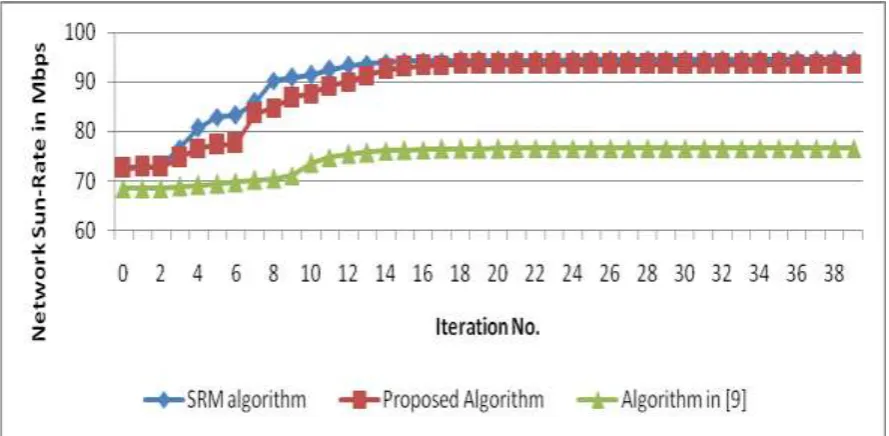
The network sum-rate results for the different algorithms with respect to number of iteration are shown in Figure 4. The convergence of sum-rate maximization (SRM) algorithm, the proposed algorithm and algorithm in [9] for the case occur after 37-38 iterations by using PSO. Clearly, SRM has the best performance, followed by the proposed algorithm, finally the algorithm in [9].
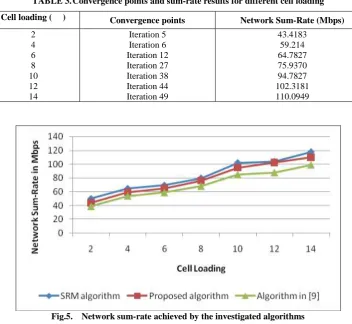
By varying the cell loading, multiuser diversity is exploited to obtain additional gain. It should be noted that the convergence points for different are not similar. For instance, faster convergence could be achieved when small is considered, and slow convergence may occur for large. This is due to the larger search space involved wherein the swarm particles move around to find the global optimum. The convergence points and the output results for different is provided in Table 3 and the sum-rate results for the investigated algorithms with various cell loading is shown in Figure 5. It can be observed that a significant gain in network sum-rate is achieved by the proposed algorithm compared to the algorithm in [9], with range of enhancement between 10% and 16%. This is due to the proportional fairness utility function used in the resource allocation optimization problem. Thus, based on the results in Figure 5, the proposed algorithm is more efficient than the algorithm in [9] in allocating network resources to the users. SRM algorithm is used as the upper baseline and it is shown in Figure 5 that SRM algorithm outperforms our proposed algorithm. This is because, in order to maximize the network sum-rate in SRM algorithm, each subcarrier should be allocated to the user with the best gain on it. However, it should be noted that the approach suffers from the unfairness problem.
Volume 2, Issue 6, December 2014
TABLE 3. Convergence points and sum-rate results for different cell loading
Cell loading ( ) Convergence points Network Sum-Rate (Mbps)
2 4 6 8 10 12 14
Iteration 5 Iteration 6 Iteration 12 Iteration 27 Iteration 38 Iteration 44 Iteration 49
43.4183 59.214 64.7827 75.9370 94.7827 102.3181 110.0949
Fig.5. Network sum-rate achieved by the investigated algorithms
Next, the fairness performance, expressed in Jain’s Fairness Index metric of the investigated algorithms is evaluated. The results are provided in Figure 6. By adopting proportional fairness utility as the objective function, the proposed resource allocation algorithm achieves the best user fairness index by contrast to SRM algorithm and the algorithm proposed in [9]. The range of fairness enhancements between 8.82% and 19.3% is achieved by the proposed algorithm compared to the one in [9]. For instance, an enhancement of 19.3 % is achieved for equals 14. Although the algorithm in [9] provides a notion of fairness by assigning different weights to different users, the utility adopted in our proposed algorithm has better impact on improving user fairness.
Volume 2, Issue 6, December 2014
IX. CONCLUSIONS
In this paper, the optimized resource allocation algorithm for multi-user network MIMO system is proposed. The algorithm optimally allocates network subcarriers and power to the participating users with the aim to achieve high network throughput while ensuring fairness. The optimization problem is formulated using Lagrange theorem and it was shown that KKT conditions is satisfied. In order to reach the optimal solutions, PSO algorithm is applied. Simulation study shows that the proposed algorithm enhances network sum-rate and fairness index compared to the algorithm in [9]. The performance gain is accomplished by exploiting frequency and spatial diversities in the time-varying wireless channels. Further research direction includes the cross-layer design which exploits more diversities offered by wireless environment to further improve network performance.
ACKNOWLEDGMENT
The authors would like to thank to UniversitiTun Hussein Onn Malaysia (UTHM), UniversitiTeknologi Malaysia (UTM) and Ministry of Higher Education, Malaysia (MOHE) for their supports.
REFERENCES
[1] A. S. Md Zain, A. Yahya, M. F. A. Malek, and N. Omar, “Improving Performance-limited Interference System with Coordinated Multipoint Transmission,” Procedia Eng., vol. 53, pp. 428–434, Jan. 2013.
[2] L. Sun, Shaohui and Gao, Qiubin and Peng, Ying and Wang, Yingmin and Song, “Interference management through CoMP in 3GPP LTE-advanced networks,” Wirel. Commun. IEEE, vol. 20, no. 1, pp. 59–66, 2013.
[3] D. Gesbert, S. Hanly, H. Huang, S. Shamai Shitz, O. Simeone, and W. Yu, “Multi-cell MIMO cooperative networks: A new look at interference,” Sel. Areas Commun. IEEE J., vol. 28, no. 9, pp. 1380–1408, 2010.
[4] Coordinated Multi-Point in Mobile Communications: from theory to practice. Cambridge University Press, 2011.
[5] “3GPP TS 36.420 V.10.0.1 (2011-03); 3GPP Technical Specification Group Radio Access Network; EUTRAN; X2 General Aspects and Principles (Release 10).”
[6] R. Zhang, “Cooperative Multi-cell Block Diagonalization with per-BS Power Constraints,” IEEE J. Sel. Areas Commun., vol. 28, no. 9, 2010.
[7] D. Choi, D. Lee, and J. H. Lee, “Resource Allocation for CoMP with Multiuser MIMO-OFDMA,” IEEE Trans. Veh. Technol., vol. 6, no. 9, 2011.
[8] C. Jingya, L., Tommy, S., Carmen, B., Thomas, E., Xiaodong, X. and Xin, “Joint Scheduling and Power Control in Coordinated Multipoint Clusters,” in IEEE Vehicular Technology Conference (VTC), 2011.
[9] G. A. Ana, S. F. Matilde, and R. C., “Constrained Power Allocation Schemes for Coordinated Base Station Transmission using Block Diagonalization,” EURASIP J. Wirel. Commun. Netw., 2011.
[10]C. Li, C. Lei, Z. Xin, and Y. Dacheng, “A Coordinated Scheduling Strategy in Multicell OFDM Systems,” in IEEE Global Communications Conference, Exhibition and Industry Forum (GLOBECOM), 2010.
[11]H. Ekram, B. L. Long, and N. Dusit, Radio Resource Management in Multi-Tier Cellular Wireless Networks. John Wiley & Sons, Inc., 2014.
[12]S. Slawomir, W. Marcin, and B. Holger, Fundamentals of Resource Allocation in Wireless Networks: Theory and Algorithms. Springer, 2009.
[13]E. E. Y., Efficient Resource Allocation in Uplink OFDMA Systems. American University of Beirut, 2010.
[14]G. Song and Y. Li, “Cross-Layer Optimization for OFDM Wireless Networks-Part I: Theoretical Framework,” IEEE Trans. Wirel. Commun., vol. 4, no. 2, pp. 614–624, 2005.
[15]C. Y. Ng and C. W. Sung, “Low Complexity Subcarrier and Power Allocation for Utility Maximization in Uplink of OFDMA Systems,” IEEE Trans. Wirel. Commun., vol. 7, no. 5, pp. 1667–1775, 2008.
[16]J. Lim, H. G. Myung, K. Oh, and D. J. Goodman, “Proportional Fair Scheduling of Uplink Single-Carrier FDMA Systems,” in IEEE Personal Indoor, Mobile and Radio Communications, 2006.
[17]Balamurali, “A Low Complexity Resource Scheduler for Cooperative Cellular Networks,” in IEEE International Conference on Internet Multimedia Services and Architecture Applications, 2009.
Volume 2, Issue 6, December 2014