R E S E A R C H A R T I C L E
Open Access
Simultaneous determination of five active
compounds in
chimonanthus nitens
by
double-development HPTLC and
scanning densitometry
Bin Zhou
1,2, Miao Tan
2, Jing-feng Lu
2, Jing Zhao
2*, Ai-feng Xie
3and Shao-ping Li
2*Abstract
Background:Chimonanthus nitens(family Calycanthaceae), Shanlamei in Chinese, is an unique species in China. The extract of dried leaves ofChimonanthus nitenshas anti-inflammatory, antipyretic and antitussive effects. Terpenes, coumarins, and flavonoids are usually regarded as the main active components. Therefore, simultaneous determination of these compounds is very important to control the quality ofChimonanthus nitens.
Results:A double-development TLC method was developed for simultaneous analysis of five compounds in
Chimonanthus nitens. The chromatography was performed on silica gel 60 plate with chloroform-methanol (9:1, v/v) and petroleum ether-ethyl acetate (10:1, v/v) as mobile phase for twice development. Their characteristic TLC profiles were observed under UV light at 365 nm and the bands were then revealed by reaction with 1% vanillin-H2SO4
solution. Quantification of three monoterpenes was achieved by densitometry at 545 nm (β-caryophyllene) or 606 nm (cineole and linalool). Two coumarins (scopoletin and scoparone) were determined by densitometry at 340 nm with filter wavelength of 370 nm. The investigated compounds had good linearity (R2>0.99) within test ranges.
Conclusions:The developed double-development TLC method is helpful to control the quality ofChimonanthus nitens, which is simple and accurate.
Background
The dry leaves of Chimonanthus nitens Oliv., an unique species in China, have been extensively used for treating colds and influenza. Pharmacological studies have shown that it has antitussive, anti-inflammatory, antipyretic, antimicrobial, and antihypertensive activities [1,2]. The chemical components in leaves of Chimonanthus nitens include volatile oil, coumarins, flavonoids, and alkaloids [3-5]. Especially, the volatile oil, accounting for 1.82-2.46%, is one of kinds of active compounds in leaves of Chimonanthus nitens [1], and the coumarins also have definite biological activities [6]. Therefore, simultaneous analysis of these active compounds is very important to ensure the safety and efficacy of Chimonanthus nitens.
GC-MS analysis showed that terpenes, such as cineole, linalool and β-caryophyllene, were the main ingredients of volatile oil fromChimonanthus nitens[7-10].
This study was to establish a method for simultaneous separation of three monoterpenes (linalool, cineole and
β-caryophyllene) and two coumarins (scopoletin and scoparone) on a single TLC plate by using double devel-opment because of their obvious difference of polarity [11,12], and quantification by scanning densitometry. This method could be used for quality control of Chimo-nanthus nitens.
Experimental
Chemicals and materials
Ethyl acetate, petroleum ether and methanol were from Uni-Chem (Belgrade, Serbia and Montenegro). Formic acid was obtained from Guangdong Guanghua Chemical Factory Co., Ltd (Shantou, Guangdong). Deionized water was prepared by Millipore Milli Q-Plus system (Millipore,
* Correspondence:[email protected];[email protected]
2
State Key Laboratory of Quality Research in Chinese Medicine, and Institute of Chinese Medical Sciences, University of Macau, Macao, SAR, China Full list of author information is available at the end of the article
Billerica, MA, USA). Chloroform was purchased from Unichem (Belgrade, Serbia and Montenegro).
Reference standards of scopoletin and scoparone were purchased from the National Institute for Food and Drug control (Beijing, China), and cineole, β-caryophyllene and linalool were obtained from International Laboratory (Lexington, USA). Chimonanthus nitens, obtained from Jiangxi Youmei Pharmaceutical Company Ltd. (Wuyuan, China), was identified, and voucher specimens were deposited at the Institute of Chinese Medical Sciences, University of Macau, Macao, China.
Standard and sample preparation
The reference compounds were accurately weighed and dissolved in methanol, the mixed standards solution was
obtained by mixing the stock solutions. The concentra-tion of five compounds was 0.755 mgml-1 (cineole), 0.725 mgml-1 (β-caryophyllene), 1.800 mgml-1 (lina-lool), 3.720 μgml-1 (scoparone) and 5.360 μgml-1 (sco-poletin), respectively.
Dried leaves powder (500 mg) of Chimonanthus nitens was mixed with 5 mL methanol in a sealed tube. The solution was treated in an ultrasonic clean bath (881w, 43 kHz, Bransonic, Danbury, CT) for 60 min, at room temperature (25 ± 2°C). Then methanol was added to compensate for the lost weight during the ex-traction. After centrifugation in an Allegra X-15R refri-gerated centrifuge (Beckman Coulter, Fullerton, CA) for 10 min (at 3500 rpm), the supernatant was collected for analysis.
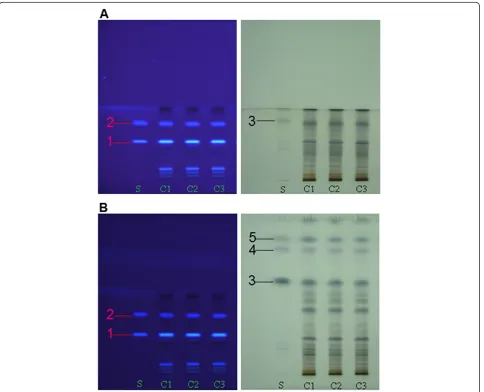
Figure 1TLC chromatograms of mixed standards and methanol extracts ofChimonanthus nitensfor (A) one and (B) twice
development on silica gel 60 TLC plate viewed (left) atλ= 365 nm and (right) after coloration with 1% vanillin-H2SO4solution.Mobile
TLC
Chromatography was performed on Silica gel 60 TLC plates (Merk, Darmstadt, Germany), and a HPTLC sys-tem (Desaga GmbH, Germany) including AS30 HPTLC Applicator, CD60 HPTLC densitometer with Pro Quant Windows software. Mixed standards (10μL) and samples (5μL) ofChimonanthuswere spotted in duplicate on the plate as bands 7 mm wide, 8 mm apart and 10 mm from the bottom edge, respectively. First, the plate was devel-oped to a distance of 40 mm with chloroform-methanol (9:1, v/v) in a Desaga 20 cm × 10 cm glass flat-bottom chamber after equilibration with mobile phase vapor for 10 min. The developed plate was dried in a stream of cool air, and then further developed to the distance of 90 mm with petroleum ether-ethyl acetate (10:1, v/v) in another chamber after equilibration with the same solution vapor. The developed plate was viewed under UV 365 nm and scanned at 340 nm with filter wavelength of 370 nm for quantitative determination of two coumarins (scopoletin and scoparone). and then colorized with vanillin-H2SO4 solution (1 g vanillin dissolved in 100 mL 1% H2SO4) and heated at 85°C on a YOKO-XR plate heater (Wuhan
YOKO technology Ltd., China) to make spots colorized clearly. The treated plate covered with a transparent glass and scanned at 545 nm (β-caryophyllene) or 606 nm (cineole and linalool) in reflectance-extinction mode by use of the densitometer. The slit dimensions were 0.02 mm × 4 mm.
Method validation
For calibration and assessment of linearity, the mixed standard solutions were applied in eight amounts (1, 2, 4, 6, 8, 10, 12 and 15 μL). Linearity was determined by constructing calibration plots of peak area against amounts of each analyte.
To assess stability, the peak area was measured by ap-plying the mixed standards solution, developing the plate, and scanning each band every 5 min for 30 min.
Instrumental precision was checked by scanning the same spot of the investigated compound in mixed stan-dards solution (10μL) six times. Identical plate precision was determined by analyzing six spots of the mixed stan-dards solution (10μL) on one plate, while different plate precision was tested by determining one spot of the mixed standards solution (10 μL) on six TLC plates, respectively.
The limits of detection (LOD) and quantification (LOQ) were determined as the amounts for which the signal-to-noise ratios (S/N) were 3:1 and 10:1, respect-ively. Noise was defined as the peak area corresponding to the blank solution.
Method accuracy was evaluated by measurement of de-tection recovery and extraction recovery. Dede-tection re-covery was tested at three concentrations of mixed standard solution, namely 80% (low), 100% (medium), and 120% (high) of the medium amount of the linear range of the relevant tested compound. Recovery (%) was calculated asAm/As× 100%, whereAmwas the measured amount andAswas the sampling amount of the analyte. To determine extraction recovery, three successive extractions of one sample were carried out to indentify the relevant tested compounds by TLC-densitometry.
The repeatability was evaluated by preparing and ana-lyzing six solutions of the same sample (500 mg each). One spot of each solution was analyzed on the same
Table 1 Summary for the tested samples ofChimonanthus nitens
Analyte Regression Precision (RSD%,n = 6) Stability
(RSD, %) Linear regression equation Linear range [μg] R2 Instrument Identical plate Different plate
Linalool Y = 125.1 x + 368.8 1.80-18.00 0.990 0.6 3.5 9.7 2.0
β-caryophyllene Y = 356.7 x + 195.7 0.72-10.87 0.992 1.5 8.0 9.0 3.0 cineole Y = 206.2 x + 199.9 0.76-11.40 0.991 4.8 4.0 4.3 3.3 scopoletin Y = 45.2 x + 45.5 0.011-0.064 0.996 1.2 2.6 5.4 4.2 scoparone Y = 48.7 x + 236.4 0.015-0.045 0.993 1.8 3.7 8.3 2.5
plate, and RSD of the investigated compounds were calculated.
Result and discussion Optimization of the method
TLC analysis was performed under carefully optimized chromatographic condition. Chloroform-methanol (9:1, 8:2, v/v), ethyl acetate-formic acid-water (8:1:1, 7:1.5:1.5, v/v), and petroleum ether-ethyl acetate (9:1, 10:1, v/v) were not available for simultaneous separation of low-and high-polarity compounds in Chimonanthus with good resolution in one run. Thus, twice development was employed. The optimum development reagents are: chloroform-methanol (9:1, v/v) for the first development
and petroleum ether-ethyl acetate (10:1, v/v) for the sec-ond development. As the results, the high-polarity com-pounds such as scopoletin (1) and scoparone (2) were separated, while the low-polarity compounds were devel-oped as one main band in the first run because of the high polarity of mobile phase. Then the low-polarity components, including linalool (3), β-caryophyllene (4) and cineole (5), were further resolved using low-polarity mobile phase in the second run, while the high-polarity compounds could not be driven. Finally, five compounds inChimonanthus nitenswere well separated in twice de-velopment (Figure 1).
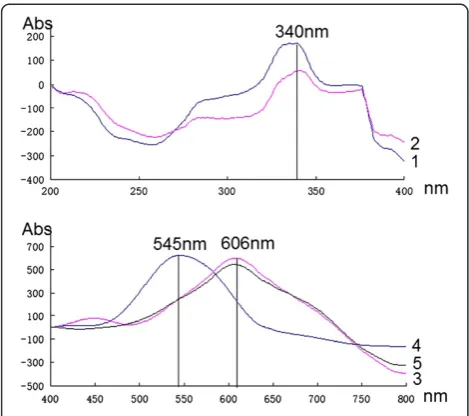
The detection wavelengths for quantification of the tested compounds were selected based on their spectra
Table 2 LOD, LOQ, repeatability, and accuracy for the compounds investigated
Analyte LOD
[ng]
LOQ [ng]
Repeatability (RSD,%,n = 6)
Accuracy (%)
Extraction recovery (RSD,%, n = 3)
Detection recovery (RSD%, n = 3)
Low Medium High
Linalool 35 87 3.2 96.3 (2.5) 109.8 (1.9) 95.8 (2.9) 97.5 (2.0)
β-caryophyllene 28 54 4.4 89.7 (3.8) 96.7 (3.6) 90.7 (2.2) 86.1 (3.3) cineole 9 43 2.7 92.8 (1.6) 82.3 (2.7) 93.4 (4.0) 87.6 (4.1) scopoletin 2 6 2.9 95.1 (2.4) 88.7(2.2) 106.0(4.0) 92.3(3.5) scoparone 1 3 4.8 94.6 (1.9) 102.0(3.7) 90.4(2.9) 97.8(3.7)
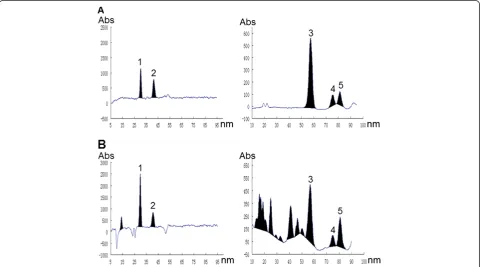
Figure 3Typical twice development TLC densitograms of (A) mixed standards and (B) methanol extracts ofchimonanthus nitens detected at (left) 340 nm using filter of 370 nm and (right) 606 nm after coloration of 1% vanillin-H2SO4solution. 1, scopoletin;2,
(Figure 2). The detection wavelength for determination of two coumarins, scopoletin (1) and scoparone (2), was set as UV 340 nm with filter wavelength of 370 nm before colouration, while the quantification of β-caryophyllene (4) was chosen at 545 nm, as well as linalool (3) and cineole (5) were at 606 nm after colouration.
Method validation
Regression, precision and stability for the analyes were determined and summarized in Table 1. All plots were linear (R2>0.99) within the ranges examined. The sta-bility results shows that although peak area of each investigated compound decreased as time passed, it was stable within 30 min. Instrumental precision (RSD, %) was less than 5% (n = 6). For identical plates, precision as overall RSD was below 4% (n = 6), and the different plates precision was also determined (Table 1). LOD and LOQ for the tested compounds were listed in Table 2. Good accuracy, detection recovery and extrac-tion recovery, were achieved for the analytes (Table 2). The repeatability for all the analytes was also shown in Table 2.
Analysis of the compounds in chimonanthus nitens Quantitative analysis of Chimonanthus nitens samples collected from Wuyuan (Jiangxi, China) was performed by densitometric TLC. The typical TLC scanning pro-files based on Figure 1 were shown in Figure 3. The amounts of five investigated compounds in Chimonan-thus nitens were (n = 3): 0.11 ± 0.01 mgg-1, 0.05 ± 0.01 mgg-1, 3.47 ± 0.24 mgg-1, 0.53 ± 0.03 mgg-1 and 0.61 ± 0.01 mgg-1 for scopoletin, scoparone, linalool, β -caryophyllene and cineole, respectively.
Conclusion
A double-development TLC method was developed for simultaneous analysis of five compounds, including three monoterpenes (linalool,β-caryophyllene and cineole), two coumarins (scopoletin and scoparone), in Chimonanthus nitens, which was helpful to control its quality.
Abbreviations
TLC, Thin layer chromatography; GC-MS, Gas chromatography–mass spectrometry; HPLC, High performance liquid chromatography.
Acknowledgements
This study was partially supported by grants from the Natural Science Foundation of Jiangxi Province (2010GZY0058 to B.Zhou), Macao Science and Technology Development Fund (028/2007/A2 to S.P.Li) and University of Macau (UL015A to S.P.Li).
Author details
1School of Pharmacy, Jiangxi Science and Technology Normal University,
Nanchang, China.2State Key Laboratory of Quality Research in Chinese Medicine, and Institute of Chinese Medical Sciences, University of Macau, Macao, SAR, China.3Jiangxi Youmei Pharmaceutical Company Ltd, Wuyuan, China.
Authors’contributions
SPL initiated and designed the study. The extraction and method developments were conducted by BZ who drafted the manuscript, and all other authors. All authors contributed to data analysis and manuscript finalization.
Received: 17 March 2012 Accepted: 22 May 2012 Published: 22 May 2012
References
1. Li SS, Shu RG:Advances on chemical components and pharmacological activities ofChimonanthus nitens.West Chin J Pharm Sci2009,2:198–200. 2. Diao JC, Wu XZ, Ding G:Study on disinfection and antibacterical of
Chimonanthus nitens.Jiangxi J Trad Chin Med2002,33:35. 3. Xiao BK, Liu YM, Feng SX, Huang RQ, Luo CH, Dong JX:Study on the
chemical components ofChimonanthus nitens.Chin Tradit Herb Drugs
2005,36:187–189.
4. Shu RG, Li SS, Hu HW, Zhang PZ:Studies on Chemical Constituents of
Chimonanthus nitensOliv.Chin Pharm J2010,45:1134–1135.
5. Sun LR, He MZ, Feng YL, Chen KP, Jian H, Wang YS, Yang SL:Study on the chemical components ofChimonanthus nitens Oliv.Chin Tradit Herb Drugs
2009,40:1214–1216.
6. Zhang SY, Meng L, Gao WY, Song NN, Jia W, Duan HQ:Advances on biological activities of coumarins.Chin J Chin Mater Med2005,6:410–414. 7. Shu RG, Li SS, Zhang PZ:Influence of collection time and extraction
method on constituents of volatile oil fromchimonanthus nitens.Chin Hosp Pharm J2010,30:761–765.
8. Cao L, Liu ZY, Liu DW:GC-MS Study on the Essential Oil ofChinonanthus
nitensOliv. Leaves.Lishizhen Med Mater Med Res2008,19:41–42. 9. Zhan ZG, Xu C:GC/MS studies on chemical constituents of the essential
oil ofChimonanthus nitensOliv.Chin J Pharm Anal2006,26:1168–1170. 10. Xu NJ, Bai HB, Yan XJ, Xu JL:Analysis of Volatile Components in Essential
Oil ofChimonanthus nitensby Capillary Gas Chromatography–Mass Spectrometry.J Instru Anal2006,25:90–93.
11. Yang J, Chol LL, Yang FQ, Zeng LJ, Zhao J, Li SP:Simultaneous Analysis of Hydrophilic and Lipophilic Compounds in Salvia miltiorrhiza by Double-Development HPTLC and Scanning Densitometry.J Planar Chromatogr
2011,3:1–7.
12. Zhang JS, Guan J, Yang FQ, Liu HG, Cheng XJ, Li SP:Qualitative and quantitative analysis of four species of Curcuma rhizomes using twice development thin layer chromatography.J Pharm Biomed Anal2008, 48:1024–1028.
doi:10.1186/1752-153X-6-46
Cite this article as:Zhouet al.:Simultaneous determination of five active compounds inchimonanthus nitensby double-development HPTLC and scanning densitometry.Chemistry Central Journal20126:46.
Open access provides opportunities to our colleagues in other parts of the globe, by allowing
anyone to view the content free of charge.
Publish with
Chemistry
Central and every
scientist can read your work free of charge
W. Jeffery Hurst, The Hershey Company.
available free of charge to the entire scientific community peer reviewed and published immediately upon acceptance cited in PubMed and archived on PubMed Central yours you keep the copyright
Submit your manuscript here: