Forms of social interactions in section 2, wangsa maju
base on the integration platform concept
Marzudi Md Yunus
Lecturer Malay Socio-Culture,
University of Malaya, Kuala Lumpur, Malaysia
Abstract: Ethnic diversity in Malaysia is a challenge in creating a harmonious society. Social interactions reveal the social condition of the society whether they have social integration or vice versa. Ethnic relations form discriminatory, competitive, conflicting relationships that affect the relationship of the community. A study on 300 respondents is conducted through questionnaires and observation method examined the relationship between ethnic communities in the Section 2, Wangsa Maju, Kuala Lumpur community. The forms of social interaction within the community will certainly determine the level of social integration between them. This research shows that the majority of social interactions in the community are still influenced by ethnicities that lead to prejudice, stereotyping and ethnocentrism. These factors then form a variety of patterns and forms of interaction in the community whether conflicted, competing, discriminating, cooperating or uncooperative. Integrated platform concept has been used to describe the situation in the community. The findings have shown that social interactions at the individual level show more negative influences than positive aspects. However, the analysis of the findings illustrated in terms of the concept of integration platform shows that individual incidents and attitudes towards different ethnic groups are a journey to the existence of adaptation in establishing mutual understanding within the framework of social interaction.
Index Terms: interaction; social; ethnic; integrity; integration
INTRODUCTION
The multinational social interaction in Malaysia is an interesting aspect to be studied. The prevailing social interaction of multiethnic is influenced by certain elements till it creates the forms of social interaction in society. The phenomenon of social interaction in the community further demonstrates the social condition of the community whether it has social integration or vice versa. The relationship between ethnicity in Malaysia is in a good condition and sometimes it can turn negative if there are issues involving ethnic sensitivities (Ahmad Fawzi Basri et al., 1987).
The appearance and shape of Malaysian society today is a result of the country's long history covering the early days of the Malacca Malay government, the collapse of the Melaka Malay kingdom, pre-independence, post-independence,and the modern era of the country. The current development of the society has slightly affected the forms of social interaction between ethnic groups in this country (Marzudi, 2015). Current events that occur in the society will influence the relations between ethnicities in this country known as society with high social composition (Abdul Rahman, 2006).
In discussing ethnic interaction, the clashes of two or more ethnics in a situation certainly manifests several changes to the way and cultural elements in the society. This clash will result in new patterns in the forms of social interaction between ethnics (Mansor et al., 2006). It is definitive that in the early stages, each ethnic group will distance themselves from different ethnic groups in order to maintain the bond between their own ethnic groups and to safeguard their own interests in different ethnic clashes in their environment.
To understand the forms of multinational social interaction in the country, ethnic relations changes need to be clearly understood. The level of multiethnic relationship that exists today is not a case without a cause, but instead it is derived from the experience of social interactions that occur in the society. The experience encountered in social interaction has shaped formal social and informal social interaction norms. Norms in this context are what can or should not be done in the aspect of social interaction among ethnicities in this country. One of the examples in the formal aspect, it is stipulated in the constitution that all citizens are entitled to equal rights in the religion, language and cultural aspects. The determination in this aspect of the law is later translated into every unofficial relationship among multiethnic societies in this country without them being aware of it (Shamsul, 2012).
based on economic and political interests. Social interaction occurred on the market to sell merchandise brought to Malacca which became a significant trading centre at the time. Strengthening of subsequent social interactions was also made to preserve Malacca's stability and peace through royal marriage between Sultan Mansor Shah and Hang Li Po's princess. The marriage indirectly reduces the risk of threats from foreign powers such as attacks from the Siamese government.
The second phase of social interaction in the country was planned by the British power through the formation of plural society. Communities have been separated in violation of policies and orders to facilitate the UK to implement their agenda in administration and economy. The UK has brought immigrants from India and China to advance the colonial economy. Physical placement of Chinese and Indian is separated from child settlement. Multiethnic interaction at the people's rank is reported very low. The involvement of children in economic activity has been limited by British colonizers which resulted in social interaction in daily activities occurring in certain places only such as in the market and government offices (Hasnah, 2009).
This British colonial policy had a profound effect on the demographic changes of the Malayan population at that era. Physical separation of religious, cultural, and social system differences has created significant interferences of interaction. This has caused each ethnic group to have a prejudice attitude and negative stereotypes between one another. Differences in every corner of life have led to the process of knowing the personal and cultural life of other ethnic minorities less proactively. As a result, each individual makes a wrong interpretation of different ethnicities in their lives (Marzudi, 2015).
The era of ethnic conflict took place between 1945 and 1960 following living conditions that required physical and social development. The most significant problem of social interaction between ethnicity is between Malay and Chinese ethnics that were influenced by communist elements. The 14-days of communist control after the end of the Japanese conquest in Malaya have been placing negative episodes of multiethnic social interactions. The Three Stars actions which hunted and condemned the Malay ethnic who served the Japanese Army became the trigger of a tense relationship between the Malay and Chinese in the country. The dissatisfaction of the Malay ethnic with the Chinese ethnicity has grown due to the British proposal to establish the Malayan Union. Most Malays see the establishment of the Malayan Union as a form of colonial punishment against those who support the Japanese occupation in Malaya. The consequence of this conflict has created the feeling of distant and distrust between the two ethnic groups and is believed to be one of the causes of the May 13, 1969 Tragedy (Shamsul, 2012).
In the next era, which is the stable but tensed era has witnessed some of the challenges of ethnicity in this country. In this era, the Malay-Chinese ethnic riot took place in Singapore on July 21 and September 3, 1964 which have involved and caused many innocent lives. The tragedy of ethnic clashes was further erupted on May 13, 1969 which resulted in many lives being killed. The result of the Malay-Chinese ethnic clash has given considerable depth to these two ethnic groups (Shamsul, 2012). This event illustrates that the form and pattern of multiethnic society should be structured in various aspects including economics and social involving education, governance and political approach (Fatan Hamamah, 2011).
The May 13, 1973 incident gave awareness to all parties that ethnic conflicts do not benefit all. The New Economic Policy which structures a separate, isolated and conflicting plural society towards social integration in the concept of a dynamic platform based on toleration. The sense of commonality and common values through the ideology of Rukun Negara has successfully created social integration in the diversity of elements and values held by every ethnic in the country (Shamsul, 2012). The act of celebrating other ethnic cultures in the society is a symbol of the existence of ethnic differences in the country. Hence, it shows that the structure of Malaysian society is no longer a plural characterized as separate, isolated and conflicting society.
The latest phenomenon in the history of the development of multi-ethnic society in Malaysia suggests the growing awareness of common ideals and aspirations across ethnic boundaries. The multinational community begins to foster the values of humanity, the principle of justice, democracy and integrity. They began to talk about governance malfunctions, poverty issues, cronyism and issues of consumerism across ethnic boundaries more openly. If it was back then, before and decades after independence, the orientation of multi-ethnic political parties was lacking in support, but today's political party (multi-ethnic) emerged as a new rival against a single ethnic-based party (Siddiq, 2016). The phenomenon in this political aspect actually means that the social dimension of a plural society has changed to form social integration.
RESEARCH PROBLEMS
community are not static. The state of social interaction is as if at times pointed to a solid unity as expressed by the government. While at the same time, there is an opinion stating that social interaction in society suggests no solid unity. Hence, the question arises on what are the forms of social interaction that exist in the multi-ethnic society after the social change in the country.
LITERATURE REVIEW
Social interactions occur when there is a relationship between two individuals and parties. Positive interaction will show a positive social interaction, and vice versa. In discussing the interactions, the theory of relations by Gordon Allport (1954) was o ne of the relinquished theories in explaining the concept of 'interaction' as a way of forming an effective relationship between groups facing conflicts. This theory emphasizes the aspect of relationships as an appropriate way to reduce prejudice between the majority and minority groups.
In general, social interaction is a very important aspect in the formation of social activities in the society. Social interactions between human groups are conducted involving interactions with internal group well as with external groups. The interaction occurred is due to the importance and purpose of the individual’s interaction in general, involving the purpose of the occurred interaction. As a result of these processes, social interactions between individuals or groups can be categorized into various forms such as discrimination, cooperation, competition, hostility and conflict (Elly Setiadi et al., 2006; Abdul Rahman Putra, 2007; Soerjono, 2012; Wan Norhasniah, 2012).
Allport (1954) explains that if a relationship is built in a proper manner, it will effectively reduce the existing problems between the involved groups. Positive relationships are able to publish effective interactions between them. According to Allport (1954), there are four main aspects that influence the existence of positive interactions between different ethnic groups. These aspects include the status equality in interactions, goals or shared equality, collaboration between groups, as well as the provision of the authority in the community. These four aspects are seen as capable of reducing prejudice, stereotyping and discrimination in social interactions.
Social interactions will form a cohesion that is a social phenomenon driven by the deep curiosity of unity which in turn affects the members of the community to unravel the various endeavors and activities that are considered prerequisites to unity. Integration in the context of Malaysian society is a combination of all the unified diversity elements forming a different society but having the same nationality bond (Shamsul Amri Baharuddin, 2012).
METHODOLOGY AND CONCEPT
This study was conducted in Section 2, Wangsa Maju is one of the sections in the Wangsa Maju township. This study uses a combination of quantitative and qualitative approaches, through the method of survey and observation in obtaining data and solving research problems. Data collection was done through questionnaires and observation methods to get the pattern of interaction within the community studied. The sampling method used to get the respondent is the probability sampling, Random Stratified Sampling. This means that the selected samples are based on ethnic-based homogeneous groups namely Malay, Chinese and Indian. This sampling was chosen because the community characteristics of the population in this study area involved a homogeneous population classification, each group having similar characteristics according to ethnicity in urban areas. The sample size for this study was 300 respondents from Chinese respondents, 30.7% from Malay and 15% from Indian. Percentage of respondents by ethnicity is based on the percentage of ethnic gross percentage in the community.
Integration Platform is a concept designed to explain the social integration process of multiethnic society in Malaysia. This concept was spearheaded by Prof. Dr. Shamsul Amri (2018) in explaining the social integration and ethnic relations in Malaysia. This concept explains that social integration in the integration framework involves the adaptation process of various cultures and social characteristics that exist in society (2012; 2018) that society can accept as common values. The elements embodied in this integration platform include aspects of acceptance, celebrating diversity, sole interaction, value modification and tradition in a physical space that serves as a platform for integration in society. Acceptances or clashes that apply within the social environment take place in the process of socio-socialization in which the opposing elements are adapted according to the suitability of cultural characteristics, values, local traditions through social interaction processes with the aim of all parties acquiring common well-being (Shamsul, 2018). Implementation of this concept of integration platform can occur at the level of individual relationships with individuals, individuals with the community, community with community and also being institutionalized at the state administrative level.
FINDINGS
Discrimination
The analysis of the data shows that there are social interactions that take place in the form of discrimination. The interaction in the form of discrimination in the community takes place in the aspect of providing different services, conducting barriers and denial of rights to different ethnicities. The results of the analysis of the discrimination constructs found that racial discrimination actions differed in the form of providing different services, and acting as barriers and denial of rights. Discrimination action in the form of separation does not apply within the community. Referring to Table 1, discrimination in the form of different services is performed by 43.3% of respondents. Discrimination in the form of barriers and denial rights was conducted by 52.7% of respondents. Hence, it can be concluded that the discrimination in the multi-ethnic community involves the differentiating of ethnicities by providing different services, conducting barriers and denial of rights to other ethnicities.
Table 1 Feedback from discrimination constructs (%)
Discrimination construct No inclination of
action Neutral
Tendency of action
Unable to identify
Providing different services 24.7 32.0 43.3 -
Obstruction and denial of
rights 29.7 17.0 52.7 0.6
Separation action
95.3 4.3 0.0 -
N=300
Competition
Table 2 contains three statements that can be attributed to social interaction in the form of competition. There are two types of competition that occur in the community namely competition position and role, and ethnic competition. Competition in terms of position and role refers to leadership in the community, which is more than half that is 69.7% of respondents assuming that community leadership is more suitable to be held by its own ethnic group. Each ethnicity assumes that their ethnicity is only qualified to become leaders. Every individual in ethnic groups within the community, position themselves and their ethnicities in high positions and feels that they fit to play an important role in the organizational structure of the community.
Table 2 Social interaction in the form of competition (%)
Statement Do not
agree Uncertain Agree
Does not answer Community leadership is more suitable to be
held by own ethnic group 7.7 22.3 69.7 0.3
Each individual has the right based on the total
number of ethnic numbers. 49.3 11.0 39.7 -
More inclined to choose an individual from the
same ethnic group when voting for leaders. 3.0 9.0 87.7 0.3
N= 300
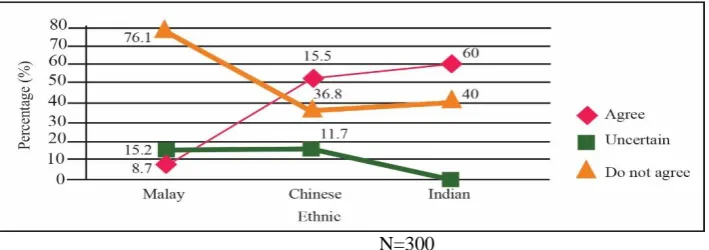
For the majority, they are more likely to defend their rights as a majority by supporting the opinion stating that individual rights must be based on the total number of ethnic members in the community. Based on Figure 1, it is found that many Chinese respondents, 51.5%, support the views that determine the individual's right to be a leader are according to the number of ethnic population. This view means that the growing number of members of an ethnic group will give more rights to individuals than that ethnic group to become community leaders. Meanwhile, 76.1% of Malay respondents disagreed with the opinion. This situation shows that there is competition in terms of obtaining position and role.
N=300
The second type of competition is in the aspect of ethnic competition. Ethnic competition refers to the tendency to choose the same ethnical individual during the process of leadership selection within the community. This ethnic competition is actually a competition in the field of culture. But in the context of the communities studied, ethnic competition has been mixed in terms of position and role competition. Potentially, ethnocentrism and racism factors influence social interaction resulting in feelings and emotions that only one’s individual ethnics have the advantage and are worthy of all the advantages over other ethnics. Table 3 shows the mean and competition mode in the community for the entire respondent and according to ethnic breakdown. The competition mean in the community for the entire respondent was 3.72 rated as having a low level of competition. The mean of the Malay respondents' competition was at a low level, while the mean competition between Indian and Chinese respondents was moderate.
Table 3 Competition mean and mode
Overall/According to ethnic Mean Mode Level of Justification
Overall 3.72 3.67 Low
Malay 3.28 3.67 Low
Chinese 4.03 4.67 Moderate
Indian 3.51 4.00 Moderate
N=300
Conflict
In Table 4, conflict-related values, involve negative views on other ethnicities, and suspect other ethnicities also have negative views on their ethnicity and self. Negative views on other ethnicities are based on their own cultural values or point of view (Shamsul Amri Baharuddin, 2008). While the second conflict involved is differences in interests and politics. Conflicts involving differences of interest refer to the tendency of choosing one’s own ethnic to be a leader, and will not cooperate if the leadership is not of its own ethnic. But in the context of the community studied, the act of not cooperating with the leader or the other ethnic leadership is minor with only 14.4%. Although the total number of such groups is small, this situation indicates that social interactions in the form of conflict exist in the community.
Table 4 Social interaction in the form of conflict (%)
Statement Do not
agree Uncertain Agree
Does not answer
Have negative view of other ethnic groups 6.7 28.3 68.7 -
Suspect other ethnicities to have negative views on
their ethnicity and self 4.0 37.0 59.0 -
More inclined to choose the same ethnic group only
when voting for a leader. 3.0 9.0 87.7 0.3
Will not cooperate if the community leader is not
from the same ethnic. 44.7 40.3 14.4 0.6
N=300
Meanwhile, Table 5 shows the mean and mode value of respondents' level of conflict. Overall, the mean level of conflict is 3.50, which is justified as a conflict at a low level. Mean conflict rates by ethnic groups showed that Malay respondents at 3.57 and Chinese values at 3.38 were at low levels. Meanwhile, the conflict level of Indian respondents is justified as moderate at a mean value of 3.77.
Table 5 Mean and mode value on level of conflict
Overall/According to ethnic Mean Mode Level of Justification
Overall 3.50 3.75 Low
Malay 3.57 3.75 Low
Chinese 3.38 3.25 Low
Indian 3.77 4.00 Moderate
N=300
liquor towards the surau. According to informants who are also retired teachers, the surau's provocative action was made by certain individuals who were disturbed by the call to prayer at dawn. Figure 1 shows a surau with a barrier fence built on the roof to avoid objects thrown by the provocateur into the surau area.
Figure 1 The fence on the roof of the surau was built due to provocation
Cooperation and non-cooperation
Table 6 is a response to statements that can be linked to social interactions in the form of cooperation. In Table 6, there is a feedback that needs to be justified, which is "uncertain" feedback. Respondents who answer "uncertain" are those who do not know their tendency in the aspect of cooperating or not. In this context, respondents who provide "uncertain" feedback are respondents who do not contribute to positive (collaborative) efforts in the community. Therefore, researchers argue that respondents who give "uncertain" responses have a greater tendency towards cooperation. This means social interaction in the form of non-cooperation exists in the community as well.
Table 6 Social interaction in the form of cooperation (%)
Statement Do not
agree Uncertain Agree Does not answer
Will not cooperate if the community leader
is not from the same ethnic group. 44.7 40.3 14.4 0.6
Other neighbouring ethnics do not cooperate
in neighbourhood activities. 35.0 51.7 13.3 -
N=300
Table 7 above can be seen to assess the level of cooperation of respondents in the community. Overall, the mean value of cooperation level between ethnics is at the value of 2.57 which is below the neutral level and can be justified as non-cooperation. Mean level of cooperation according to ethnic fraction also indicates the mean value is below the value of 3.00. Based on the mean value, it can be concluded that there is no cooperation between different ethnic groups in the community.
Table 7 Mean and mode of cooperation level
Overall/According to ethnic Mean Mode Level of Justification
Overall 2.57 3.00 Uncooperative
Malay 2.80 2.50 Uncooperative
Chinese 2.32 2.00 Uncooperative
Indian 2.98 3.00 Uncooperative
N=300
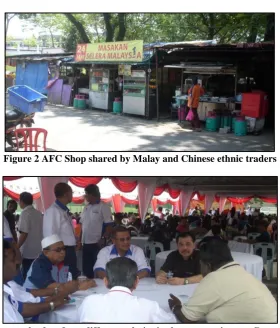
Cooperation in political aspects also occurs in the community. Different political parties consists of different ethnics have collaborated to help improve the quality of life and provide services regardless of ethnic differences. Figure 3 shows some political leaders from different ethnic groups are discussing in a program of a political party in the community. Despite the ethnic and cultural differences, cooperation in the aspects of common interests such as politics and economics can still be carried out. Hence, based on the data obtained, it indicates that social interactions in the community also take place in the form of cooperation and in the form of non-cooperation. This shows that when there is a matter involving common interest, positive outcomes can occur in different ethnic relations.
Figure 2 AFC Shop shared by Malay and Chinese ethnic traders
Figure 3 Several party leaders from different ethnics in the community at a Communities program
DISCUSSION
The journey of ethnic relations in this country has basically gone through several major stages. The ratings are; the conflict era began from 1948 to 1960; Stable but tense era that started from 1961 to 1970; and the era of social integration that began in 1971 till present (Shamsul, 2012). During this period, there are several changes that took place in terms of ethnic relations in Malaysia. Positive changes in the direction of the conflict towards social integration have blessed the relationship between ethnicity. However, the research conducted by the researcher shows mixed conditions, but does not deny the results of other studies.
The findings obtained through research indicate that the average member of an ethnic group living in this community has a relationship in the form of discriminatory, competitive, conflicting and unwilling to cooperate. However, the findings also show that there are a few who have no discriminatory, non-conflicted relations and cooperate with other ethnic groups. Based on these conditions, the social integration of ethnic communities in the community studied has yet to achieve the comprehensive level of integration. Social integration according to the concept of Integration Platform has not been fully implemented entirely. There are a number of ethnic social values that ethnic members still hold on to, to the extent that have thickened the ethnic boundaries within the community.
The competition for political leadership of the community has become an element that increases the ethnic boundary within the community. To gain political rights at the community level, an ethnic member will return to his ethnicity for support. At this stage the ties to their own ethnicity will become strong and directly diminishing the ethnic boundaries within the community. It also naturally creates discrimination against individuals within different ethnic groups who are eligible to be elected leaders but not elected in the voting of community leadership.
Negative views on other ethnicities that exist among the majority of ethnicities against other ethnicities have led to conflict in the community. At the same time, the majority of members of the community also assume that other ethnics also have negative feelings about themselves and their ethnicities. Negative views on others are one of the prejudice constructs, which is a false assumption without fundamental and justification. Based on the findings in the negative aspects of the suspicion (Table 4), it can be defined that the relationship in the community studied has a high prejudice effect. A high prejudice attitude towards other ethnics is a challenge in building understanding in the concept of an integrated platform.
Conflict is an element that threatens social integration between ethnic groups. Based on the findings of this study, conflicts involving the practice of ethnic religion in the community have taken place. In this context, the act of throwing liquor bottles is a fact that can be expressed as evidence of conflict. This phenomenon also proves that the tolerance towards the aspect of religious practice by another party does not exist entirely in the community studied. It should be noted in this discussion that tolerance to other ethnic cultures is an important element in the creation of integration between different ethnic groups. Acceptance and respect for other people's religious practices are the basis of integration platform concepts. However, the conflicts that exist in the community do not turn violent on ethnic members in the community. This is due to the particular ethical tolerance of handling conflicts. Actions of a handful of ethnic members who throw liquor bottles towards the surau are not aggressively attended by the Malays. The Malay community who became the ward of the surau had made precautionary measures by installing nets on the roof of the surau to avoid liquor bottles entering the mosque. It is an action taken to avoid serious conflicts between ethnic groups in the community. The situation proved that religious elements contributed to the harmony among ethnics in the community. Here, religious values held by an ethnic group are a barrier to constant conflict.
In terms of the form of cooperation, Table 6 has shown that majority of the community members are less likely to cooperate. However, based on the observation of the researchers, there is a significant cooperative relationship. Collaborative relationships in the economy are actively involved. Integration of Chinese and Malay business culture takes place in one premise. The second example is the collaboration between ethnic-based political parties in the community joining together to serve the community members together. It is clear that the practice of accepting differences, diversity and tolerance to culture differ in certain circumstances.
The existence of the cooperation element in the economic and political field is a crucial matter in the relationship between ethnicity in the community at the macro level. The explanation of how relationships at the individual level are seen as negative can turn out to be positive at the institutional level and in the economic sector, making it interesting to take note on. The picture is in fact conforming to the explanation of the formation of Malaysian society in the reference platform of the integration carried by Prof Dr. Shamsul Amri, who explained that mutual interest will build a relationship that is accepting and celebrating the cultural value of society. People who are related to each other do not see an issue within the framework of ethnicity. This means that the separation caused by ethnic boundaries itself will be unraveled when the joint attachment goes beyond ethnic boundaries.
Based on the findings and analysis obtained, it is evident that the role of institutions and relationships bound in ethnic boundaries is of paramount importance to a society of ethnicity. The ingenuity at the individual level is not allowed to be enlarged till it damages the entire community. Interrelated relationships such as in economic aspects, for instance witnessing conflict will reduce returns on business results. Business interests in enhancing the social well-being of the parties involved are a barrier to ethnic conflicts.
The roles of an institution in the community are as the control for members of an ethnic group rather than continuing to build and stop conflicts. In the case of this community, conflicts were initiated by some members of the community who were not happy with the call to prayer, ‘azan’ from the surau by throwing liquor bottles. The action taken by the surau institution is not done in responding directly to the provocation. They built a fence on the roof of the surau (as shown in Figure 1). This action is one of the actions taken without involving conflict. Tolerance towards provocation from others is one way to avoid conflict directly. This picture implies that in building an integration platform, the tolerance to the other party's negative acceptance is also necessary in creating a harmonious atmosphere in a composite society in various aspects of life. The principle of acceptance and appreciation of differences in the concept of an integrated platform in building social integration in ethnicity should be guided by a solid foundation.
Next, we see the role of political institutions in the community. Despite political orientation in ethnic-based communities, binders to their differences are aspirations for the well-being of everyday life. The majority of members of the community belong to the working class who are squeezed by poverty. The dependence on building material well-being and physical facilities in the community to the government is still high. Politics is indirectly used as a tool for gathering the resources by community members. Hence, the role of political parties is very important in controlling the behavior of their party members in the community. The bond of cooperation that becomes the integration platform has established mutual value creation so that everyone in the community gets what they want, despite the fact that the way each ethnic world's perspective is essentially different.
REFERENCES:
[1] Abdul Rahman. (2006). Nation-Process and Debate. Bangi: Publisher of National University of Malaysia.
[2] Ahmad Fawzi Basri, Abdul Halim Ahmad, Abdul Rahman Aziz. (1987). Issues of National Unity- Challenges, Achievements
& Future. Jitra: Universiti Utara Malaysia.
[3] Allport, G.W. (1954). Properties of Prejudice. New York: Doubleday & Company, Inc.
[4] Fatan Hamamah. (2011). Discourse of Ethnic Relations: Sociology Perspective. at Abdul Razaq Ahmad and Anuar Ahmad. (2011). Education and Ethnic Relations. Bangi: Faculty of Education, Universiti Kebangsaan Malaysia.
[5] Hasnah Hussiin. (2009). State Articles and Ethnic Relations. Kuantan: The publisher of Universiti Malaysia Pahang.
[6] Mansor Mohd Noor, Abdul Rahman Abdul Aziz, Mohamad Ainuddin Iskandar Lee. (2006). Ethnic Relations in Malaysia. Petaling Jaya: Dewan Prentice.
[7] Mansor Mohd Noor. (2012). Social Composer and Ethnic Limit Thinning. Bangi: Publisher of National University of Malaysia. [8] Marzudi. (2015). The Effect of Prejudice, Stereotypes and Discrimination Against Social Interaction Multi-ethnic In Wangsa Maju, Kuala Lumpur. Bangi: Faculty of Social Science, Humanities and the Environment of the National University of Malaysia. [9] Shamsul Amri Baharuddin. (2012). Ethnic Relations Module. Bangi: Institute of Ethnic Studies.
[10] Siddiq Fadzil, (2016). Race-Diversification in Union Frame. Kuala Lumpur: Institute of Darul Ehsan.
[11] Suresh Kumar N Vellymalay. (2014). Ethnicity And Social Interaction Among Different Ethnicities in Classroom. Human