86
ANALYSIS OF VARIOUS INTRUSION DETECTION TECHNIQUES
Abstract
In recent years, the utilization of mobile ad hoc networks (MANETs) has been extensive in many applications that include some task critical applications, and as such safety has become one of the major anxiety in MANETs. Because of some unique features ofMANETs, deterrence methods alone are not enough to make them secure; thus, detection should be added as another guard before an aggressor can violate the system. However, the intrusion detection techniques for conventional wirelessnetworks are not well enough for MANETs. Here in this paper, we categorize the architectures for intrusion detection systems (IDS) that have been proposedfor MANETs
I.
Introduction
From some past years, mobile computing devices
for example mobile phones, palmtops, laptops etc
are very popular and brought a great and drastic
change in medium of communication and this
change in computing will not simply depend on the
ability provided by the personal computers, and the
concept of ever-present computing appears and
becomes one of the research area in the computer
field. The Mobile Ad-hoc network is wireless
communication medium is a mobile network,
which has also become a very fascinated area of
research where there are no wired connections and
there is no centralized coordinator.
IN MANETlocation the security of each entity network node is very
important because of the enveloping nature of
MANETs. The node will not always be below the power
of their holders and as a result the security of the node
will turn into a very important issue .The links between
wireless nodes are highly vulnerable to link attacks that
include passive snooping, lively interfering, and seepage
of secured information, data fiddling, imitation, message
reply, and rejection of service. All these features and
susceptibilities of MANETs, pretenses many confronts
to build a secure MANET. [1]
II.
Mobile Ad-Hoc Network
A Mobile Ad hoc Network (MANET) can be defined as
the construction of wireless mobile nodes that can
organize it and change dynamically in random and its
network topologies. People and transportation can work
and make use of internet without a defined
communication infrastructure or in other words it can be
said that when utilization of such infrastructure need
wireless extension. Nodes in MANET converse with
each other directly within their range of wireless
Sana Sheikh
Department of Information Technology.
NRI Institute of Science and Technology,
RGPV, Bhopal
[email protected]
Angad Singh
Department of Information Technology.
NRI Institute of Science and Technology,
RGPV, Bhopal
87
network and those nodes that are bit faraway, conversewith the help of intermediate nodes. [2]
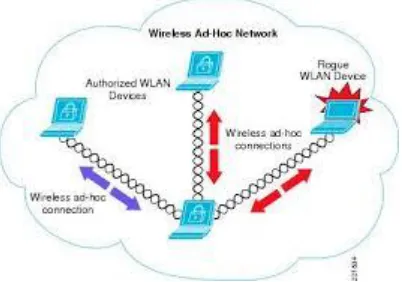
Figure 1 Mobile Ad-Hoc Network
The main point which needs attention is the security of
Mobile Ad-Hoc network because it is more likely to
have vulnerable attacks as compared to wired networks
as the mobile networks does not have trusted central
coordinator and the number of valuable resources. For
maintaining security, few important objectives of
security that needs to be addressed for maintaining a
secure and trustworthy environment. They are:
Authentication
Reliability
Confidentiality
Non-Repudiation
Integrity
Confidentiality consists in making data inarticulate to individuals other than those concerned in the operation.
Integrity means proving data integrity consists in deceiving if the data were distorted during transmission.
Availability aims to assurance access to a service or resources.
Non-Repudiation means data is the assurance that none of the parties concerned can reject an operation at a later date.
Authentication consists in confirming a user's identity, i.e. assuring for each party that their associates are truly who they think they are. An access control donating access to sources only to approved individuals [3].
III.
Intrusion Detection System
Intrusion detection (ID) is a type of security supervision
system related to computers and networks. An ID
system collects and examines datafrom various places
within a computer or a network to recognize possible
security breaches that comprises both intrusions (attacks
from outside the organization) and exploitation. ID uses
susceptibility assessment that sometimes can be called
as scanning that is a developed by technology to charge
the security of a computer system or network. [4].
Many past situations have shown that intrusion
prevention methods alone, for e.g. encryption and
authentication, that normally be considered as a first
method of defense, that are not enough. As the system
become more intricate, there are also more flaws, which
lead to more problems related to security. Another
method to protect the network is the intrusion detection,
from such problems. If the imposition is detected, a
reply can be initiated to avert or minimize damage to the
88
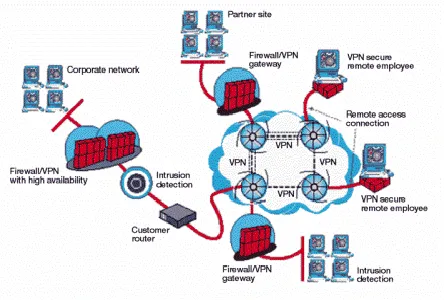
Figure 2 Intrusion Detection System
IV.
Different types of Architecture of
Intrusion Detection System
MANET can be organized in different type of
infrastructure as in flat infrastructure or in multi-layer
architecture. Depend on the infrastructure of MANET;
Intrusion Detection System can be organized. Following
are the different types of intrusion detection System: [5]
1.
Simple Intrusion Detection System
In this simple architecture, the nodes in the network does
not communicate to each other and to identify the
intrusions, the detection system run individually on every
node for recognizing the impositions. The conclusion will
also be decided which is based on the data collected on
every node after detecting intrusions. Thus in this way no
information is exchanged among nodes. As this
architecture is not so effective because of having so many
shortcomings.
2.
Dispersed and Supportive Intrusion
Detection System
As it knows that the nature of Mobile Ad-Hoc network is
based on cooperation among nodes, then the intrusion
detection system that can also be organized on this
principle. In this system each node can have an agent of
IDS that will recognize intrusions and collect information
related to it and start operation autonomously. Though the
co-nodes also contributes in detecting the vulnerable
attacks with the help of universal Intrusion Detection
System when the proof is uncertain. This method is
proposed by Zhang and Lee [6].
3. Multi -Layered Intrusion Detection System
For the networks that are divided into clusters, this
hierarchal IDS is proposed. Unlike Distributed Intrusion
Detection System which is developed for flat networks,
Multi-layered Intrusion Detection System is proposed for
Multi-layer architecture. In the cluster-based architecture,
head cluster is responsible for routing and forwarding
data packets. The same idea is applied in Multi -Layered
Intrusion Detection where each node locally in its cluster
will be liable for noticing intrusions and the head-cluster
will detect intrusions first at its node point and also
globally responsible for its group(cluster).Each node will
be treated as IDS agent for all the participating members
of a clusters. The head-cluster will monitor and instigate
the reaction. [5]
V. Methodologies For Detecting Intrusion Detection
Different methods are used for detecting the intrusions
based new technologies. Some methods are based on
rule-based learning, artificial intelligence and other
computational methods. Below are some methods for
detecting intrusion detection.
Bayesian Network-This network comprises of nodes
and edges that stand for variables in the network,
where some variables are chosen for observing the
89
network, the evaluation of relationship between thevariables is done. The third step is to define support for
the variables that will define the present state of
variables where support factor is defined as the
possibility of happening of the states observed. If this
value is less than threshold value then a signal is
generated.
Neural Networks
This network contains of Nodes and Edges. The cost of
the weight on arcs describes how a node influences on
adjoining node. A group of the nodes in the model is
defined which is known as incoming nodes. The other
group contains the outgoing nodes from which there is no
association themselves, their outcome is the result of the
analysis.
Expert System
The Expert Systems working procedure is based on a
formerly defined set of rules that defines an attack. All
security connected occurrences included in an audit track
are translated with the help of if - else rules.
Fuzzy Logic
Fuzzy Logic denotes to the model of indecision of natural
language. Here the logic depends on language which
takes the smallest amount of set of happenings or highest
instead of defining OR, AND or NOT condition in the
if-then-else condition. Essentially, intrusion detection
systems differentiate between two different types of
actions, normal and irregular. Fuzzy logic could generate
sets that have in-between values where the distinctions
between the two sets are not defined well
Immune Based
Intrusion Detection System based on the Immune is
related to human immune system and can execute duties
similar to native and adaptive immunity. The outline of
normal behavior is produced by collecting suitable
behavior of services corresponded to audit data. One
confront is faced to distinguish between self and
non-self data which tries to control reasons scaling problems
and the continuation of errors in detector sets. [7]
VI.
Related Work
Anand and Patel [8] have discussed about Intrusion and
Detection and its various protocols. They discussed
about the importance of intrusion detection and the
number of attacks that can occur on various different
type of protocols like UDP,TCP,ICMP and ARP. They
have also proposed a method for fast detecting the
intrusion based time detection. They further added that
the proposed method will recognize anomalies on the
basis of connections made in single second and for
validation the method is applied on real traffic.
Ning and Jijodia [9] discussed about intrusion detection
and types of detection as anomaly, misuse and detection
in distributed systems. In their work they have put some
light on all the existing techniques for intrusion
detection they address that the detection of intrusion is
still a problem .Finally they conclude that if the attack
scenarios are reconstructed from alert of intrusions then
the integration and performance of Intrusion detection
will improve.
Anantvalee et.al [5] in their work have surveyed on
techniques of intrusion detection in MANET. They have
discussed about in brief about intrusion and the various
architectures of it. Finally they have compared the
previous and current intrusion detection architectures
90
should be structured distributed and cooperated andprefer anomaly detection over misuse detection.
Wenjia Li and Anupam Joshi,in the paper,”Security
Issues in Mobile Ad Hoc Networks - A Survey “ [5]
tried to discover the issues of security in Mobile Ad hoc
network. They state that due to increased use of mobility
and open nature of media, Mobile Ad hoc network are
likely to experience all kind of security risks. Thus more
attention related to security must be given to wireless
MANET on contrast to wired networks. In their work
they first discussed about the features of Mobile Ad hoc
network and its importance in today’s network users.
Secondly they elaborated some deceitful fears in Mobile
Ad hoc network which can be originated by some own
features like dynamically changing topology, mobility
etc. Lastly they discussed about security solutions and
criteria for security in Mobile Ad hoc network. It also
convoluted about techniques that can help to defend the
Mobile Ad hoc network.
VII. Conclusion
Mobile Ad-Hoc network is a always been an interesting
issue for research .It is observed that MANET has been
widely used in today’s scenario and thus its security in
MANET has also become a significant factor. Thus to
improve the security, the concept of Intrusion Detection
has been evolved for detecting and monitoring the
network. Here in this paper we have presented a brief
introduction of MANET and its security. We have also
described about intrusion detection and about its
different architectures and explained the different types
of Intrusion detections .There are still more methods
that can be elaborated in the intrusion detection system.
References
[1]. Eratul.L & Ibrahim. D,” Evaluation of Secure
Routing Protocols in Mobile Ad Hoc Networks
(MANETs)”. [2]. http://www.slideshare.net/piyushmittalin/securi ty-in-mobile-ad-hoc-networks [3]. http://en.kioskea.net/contents/635-introduction-to-it-security [4]. http://searchmidmarketsecurity.techtarget.com/ definition/intrusion-detection
[5]. Anantwalee,” A Survey on Intrusion Detection
in Mobile Ad Hoc Networks” Springer pp. 170 – 196, 2006.
[6]. Y. Zhang, W. Lee, and Y. Huang, \Intrusion
Detection Techniques for Mobile Wireless
Networks," ACM/Kluwer Wireless Networks
Journal (ACM WINET), Vol. 9, No. 5,
September 2003.
[7]. Akbar et.al,” Intrusion Detection System
Methodologies Based on Data Analysis”,
International Journal of Computer Applications
(0975 – 8887)Volume 5– No.2, August 2010
[8]. Anand and Patel,“ An Overview on Intrusion
Detection System and Types of Attacks It Can
Detect Considering Different Protocols”
International Journal of Advanced Research in
Computer Science and Software Engineering,
Volume 2, Issue 8, August 2012
[9]. Ning and Jijodia,”Intrusion Detection
Techniques”.
[10]. Li. W & Joshi. A.”Security Issues in Mobile