5 (1), Spring 2013, Ser. 70/4 ISSN: 2008-8191. pp. 111-136
The Effect of Lexical Collocational Density on the Iranian EFL Learners’ Reading Comprehension
S. Sadighi Ph.D. Student, TEFL Zand Institute of Higher Education
email: [email protected]
R. Sahragard Associate Professor, TEFL
Shiraz University
email: [email protected]
Abstract
The present study aims at investigating the effect of different levels of lexical collocational density on EFL learners’ reading comprehension. Eighty sophomore students with different levels of proficiency studying at Zand Institute of Higher Education in Shiraz, Iran were chosen from among eighty five learners based on their score distribution on a reduced TOEFL test constructed by Educational Testing Service (ETS, 1998). Forty participants were randomly assigned to the control group, while the other forty made the experimental group. Another instrument used in this study was a lexical collocation test containing two texts (as pre- and post-tests): A high and a low lexical collocational density tests designed by the researchers. A few paired/independent sample t-tests, and a two-way repeated measure were used to answer the five research questions. Results indicated that texts with high lexical collocational density influenced learners’ comprehension positively. Although the instruction of lexical collocation did not have any effects on answering the vocabulary items significantly, teaching lexical collocations affected learners’ reading skills positively. Finally, different proficiency levels of the participants did not affect their performance on lexical collocation test with different lexical collocational density significantly.
Keywords: lexical collocation, lexical collocational density, reading comprehension
–––––––––––––––––––––––––––––––––––––––– Received: 9/1/2012 Accepted: 3/10/2013
1. Introduction
The significance of learning a language through words and word combinations was attended to by some researchers during the 1990s, and since then many researchers have considered teaching and learning lexicon and word combinations as a proper way to learn a second or foreign language. These researchers include Natinger and DeCarrico (1992) who talked about lexical phrases and language teaching, and Lewis (1993) who proposed the lexical approach.
Likewise, collocation as a dimension of textual structure giving cohesion to the body of a text has been regarded as an integral part of language learning. Lewis (1993) defines collocation as a subcategory of multi-word items, which is made up of individual words that habitually co-occur. He believes collocations are different from “institutionalized expressions” which indicate what a language user does rather than what a language user expresses. In recent years, many applied linguists have emphasized the importance of drawing language learners’ attention to standardized multi-word expressions, such as collocations and idiomatic expressions (Celce-Murcia, 2001; Huang, 2001; Zhang; 1993, Pouralvar, 2007; Lewis, 1993). Halliday and Hasan (1985) elaborated on “cohesion” and “coherence” as having a great role in hanging the elements of a text together. In addition, he stated that in lexical cohesion the relations between vocabulary items in texts are of two kinds: collocation, the one which is the focus of this study and is defined as co-occurrence of words, and reiteration.
According to Lauder (n.d., p.6), “In corpus linguistics, to improve clarity of description when talking about collocation, the word in a concordance line which is the subject of interest is referred to as the node and the co-occurring word is the collocate. Gorjani (1996) classified nodes into two categories: pairs of words and lexical chains. “Ill, doctor”, and “sky, cloud, rain” are instances of different categories of nodes, respectively.
Lexical collocational density is the extent to which collocation of words have been used in a text. Gorjani (1996) stated that lexical collocational density is calculated by dividing the total number of nodes by the total number of words of the text multiplied by 100.
1.1 Statement of the problem
Despite the problems identified, very few studies have been done on the degree of lexical collocational density of a text and its interplay with the comprehension of texts. Moreover, little attention has been paid to explore the significant difference between different groups of students with different proficiency levels in terms of the effect of collocational density on reading comprehension. A few studies have investigated the topic of interest in an EFL context. Rahimi (2005) stated that a systematic teaching of lexical collocations effects vocabulary learning by Iranian EFL learners positively. Haung (2001) indicated that free combinations created the least amount of difficulty for his participants, whereas pure idioms were the most difficult. Zhang (1993) found a correlation between the quality of college freshmen’s writing and the knowledge and use of collocations. Having reviewed the previous studies on collocations and their impact on ESL/EFL learners' reading comprehension, what seems necessary is an attempt to fill these gaps by studying the effects of collocative items and their corresponding types on understanding the reading texts and guessing the unknown vocabularies.
This study, in general, aims at investigating the effect of the collocative items on Iranian EFL learners’ reading comprehension of texts. In other words, this study is to find out whether instruction of lexical collocation helps EFL learners develop their reading skills. Finally, this study aims at finding out whether or not there is a difference between different groups of students with different proficiency levels in terms of the effect of collocational density on their reading comprehension. In line with the above objectives, answers to the following research questions are sought:
1. Do different levels of lexical collocational density affect EFL learners’ comprehension of English texts?
2. How can different levels of lexical collocations affect guessing the unknown vocabulary items?
3. Does instruction of lexical collocation help EFL learners to answer the vocabulary items correctly?
4. Does instruction of lexical collocation help EFL learners develop their reading skills?
5. Is there any significant difference between different groups of students with different proficiency levels in terms of the effect of collocational density on their reading comprehension?
1.2 Theoretical framework
The lexical approach to second language teaching has become an alternative to grammar-based approaches. The lexical approach develops learners' proficiency with lexis, or words, and word combinations. It is based on the fact that an important issue in language acquisition is the ability to comprehend and produce lexical phrases as unanalyzed wholes, or "chunks," and that these chunks were perceived traditionally as grammar (Lewis, 1993, p. 95). In the lexical approach, instruction emphasizes fixed expressions that occur frequently in spoken language, such as, "I'm sorry," "I didn't mean to make you jump," or "That will never happen to me," rather than creating novel sentences (Lewis, 1997, p. 212).
In the present study, the framework for lexical collocational analysis is taken from Gorjani’s (1996), originally proposed by Aitchison (1987). According to them, there are three kinds of lexical collocations: coordination, superordination and marked nodes. For instance, “air” and “Hydrogen, Neon, Krypton, Helium, Ozone, Xenon, and Carbon Dioxide” are instances of superordination in the lexical collocation text with high lexical collocational density which were used in this study. “Salt and pepper”, “light and heavy” are examples of coordination. Marked nodes as exemplified above are of two types: pair of words and lexical chains. This framework was used to calculate the lexical density of texts by counting the nodes which exist in the text. The degree of lexical collocational density has been claimed to have an effect on reading comprehension of the students (Gorjani, 1996).
2. Literature Review
There is first a discussion on the definition and types of collocation and then some studies on the issue is reviewed.
2.1. Definition and Types of Collocation
Celce-Murcia (2001) defines collocation as go togetherness of lexical items in combinations, which differs in frequency or acceptability. Items which collocate frequently with each other are called ‘habitual’, e.g. tell a
story, whereas those which cannot go together are called ‘unacceptable’, e.g.
*powerful tea instead of strong tea.
Collocation is the combination of words that co-occur more often which is not based on chance in a text and that are more restricted than free combinations (e.g. very cold) and less restricted than idioms (e.g. get the
cold shoulder). They are common in technical genres in English, and their
According to Lewis (2000), some kinds of combinations are part of the native speaker’s mother tongue who can use them easily and unconsciously. Schmitt (2000) advocates the Lexical Approach by saying that lexical chunks are stored and processed as individual wholes in the mind rather than combinations of single words. He believes that because the mind has limited short-term capacity, it is better for the brain to store ‘chunks’ of language as one piece of information than single words. Among different types of ‘chunks’, collocation is the "single most important kind of chunk", as Lewis (2000, p. 8) suggests.
Two kinds of collocations are lexical and grammatical collocations. However, the present study focuses only on lexical collocations. One main reason is that grammatical collocations can be found easily in dictionaries whereas lexical collocations are more difficult for second language learners to find in dictionaries (Ieh, 2005).
Hammer (1991) has stated that word meaning can be affected by the meaning of other words which come in its environment. In fact, in order to use a word receptively and productively, one should know what words can accompany it (Hammer, 1991).
It has been claimed that collocations are important for learners who want high competence in a language (Nesselhauf, 2003) and also for those who even have “less ambitious aspirations” (Nesselhauf, 2003, p. 223). The reason is that knowing how to use collocations improves both accuracy and fluency. McCarthy (1990) believes that an important factor that distinguishes a native speaker from a non-native speaker is the knowledge of collocations. An immediate pedagogical implication is that collocation should be given “the same kind of status in our methodology as other aspects of language such as pronunciation, intonation, stress, and grammar” (Hill, 2000, p. 59).
Lewis (1997) proposes the following categories for collocations:
1. Strong: A large number of collocations are strong. For example, we
say rancid butter, but that does not mean that other things cannot be rancid.
2. Weak: There are words which go together with random frequency; for example, white wine or red wine.
3. Medium strength: There are words that go together with a greater frequency than weak collocations. Some examples are: hold a meeting, carry out a study.
There exists a correlation between the degree of cohesiveness of a text and the extent to which lexical collocations are related to the textual background information (i.e. not too many and not too few collocative nodes) used by the writer. This would help the writer and the reader to negotiate meaning (Van Dijk & Kintsch, 1983; Lotfipour, 1997). In this case, the writer and the reader interact through the text as a dynamic process (Lotfipour, 1997). Both interlocutors use different kinds of strategies such as "elaborative" and "reductive" strategies. The writer's elaborative strategies and the reader's reductive ones are activated mostly through lexical collocations (Aitchison, 1987).
The role of lexical collocation gets clearer when we consider that collocations hang the elements of the text together and create cohesion among the sentences of a text which help the reader comprehend the meaning of the text more easily (Halliday, 1975; Halliday & Hasan, 1976; Van Dijk, 1977; Van Dijk & Kintsch, 1983).
2.2 Studies done on collocation
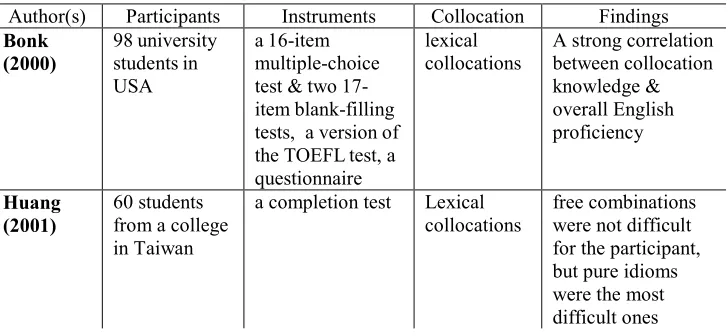
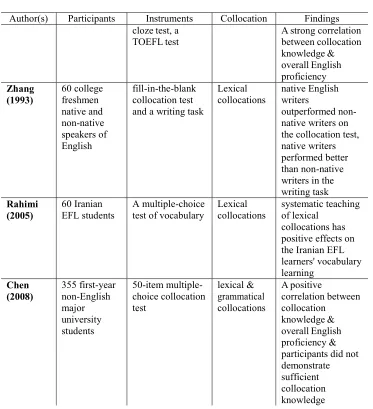
The available relevant literature on collocation and English language learning and teaching is displayed in Table 1 below:
Table 1. Studies done on collocation
Author(s) Participants Instruments Collocation Findings Bonk
(2000)
98 university students in USA
a 16-item multiple-choice test & two 17-item blank-filling tests, a version of the TOEFL test, a questionnaire
lexical
collocations A strong correlation between collocation knowledge & overall English proficiency
Huang (2001)
60 students from a college in Taiwan
a completion test Lexical collocations
Author(s) Participants Instruments Collocation Findings Lin (2001) 89 senior high
school students in Taiwan
a 15-item blank-filling test & a 15-item multiple-choice test, a 40-item self-developed English proficiency test, a questionnaire lexical collocations (V + N)
A strong correlation between collocation knowledge & overall English proficiency Zughoul & Hussein (2001) 70 university students in Jordan a 20-item multiple-choice a translation task
lexical collocations (V + N)
EFL learners have insufficient knowledge of English collocations Tseng
(2002) 94 senior high school students in Taiwan two 50-item blank-filling tests & two compositions a questionnaire lexical collocations (V + N)
The positive effects of collocation instruction on collocation knowledge MartyDsk
a (2004)
53 high school students in Poland word matching, collocation completing, correct option selecting, error identifying and correcting lexical collocations
The importance of learning chunks Tang (2004) 96 first-year university students in Taiwan
a revised speaking and writing tests (General English Proficiency Test) lexical collocations & grammatical collocations No direct relationship between collocation competence & overall English proficiency Mahmoud (2005) 42 university students in Sultanate of Oman
42 essays lexical collocations &
grammatical collocations
The importance of collocation instruction Wang (2005) 75 university students in Taiwan (senior English majors)
a modified, in-depth vocabulary knowledge measure & 3 oral
elicitation tasks, a questionnaire
lexical
collocations No direct relationship between collocation competence & depth of vocabulary knowledge Keshavarz & Salimi (2007) 100 university students in Iran a 36-item multiple-choice cloze test & a 36-item open-ended
lexical & grammatical collocations
Author(s) Participants Instruments Collocation Findings cloze test, a
TOEFL test A strong correlation between collocation knowledge & overall English proficiency Zhang (1993) 60 college freshmen native and non-native speakers of English fill-in-the-blank collocation test and a writing task
Lexical
collocations native English writers outperformed non-native writers on the collocation test, native writers performed better than non-native writers in the writing task Rahimi
(2005)
60 Iranian
EFL students A multiple-choice test of vocabulary Lexical collocations systematic teaching of lexical collocations has positive effects on the Iranian EFL learners' vocabulary learning
Chen
(2008) 355 first-year non-English major university students 50-item multiple-choice collocation test lexical & grammatical collocations A positive correlation between collocation knowledge & overall English proficiency & participants did not demonstrate sufficient collocation knowledge
Table 1 shows that different methodologies and different participants (high school students’ and university students) were used examining collocational competence and their types (cf. Bonk, 2000; Tang, 2004; Mahmoud, 2005; Keshavarz and Salimi, 2007; Lin, 2001; and Zughoul and Hussein, 2001; Chen, 2008), in various studies. All researchers focused on students at one high school or university, except Lin’s (2001) study which was done on two high schools.
knowledge is quite insufficient (e.g. Zughoul and Hussein (2001), Tseng (2002), Keshavarz and Salimi (2007)).
Some researchers explored the relationship between collocation competence and overall English proficiency. Other researchers, such as Bonk (2000), Lin (2001), Tseng (2002), and Keshavarz and Salimi (2007) stated that there is a significantly positive relationship between collocation competence and overall English proficiency except for Tang (2004), who did not find any significant correlation between collocation competence and overall English proficiency. With regard to collocation teaching, researchers such as Lin (2001), Tseng (2002), and Tang (2004) found a close correlation between instruction of collocations and the learners’ collocation knowledge increase. Our study’s departure from the above studies is that we mainly focused in the collocational density of reading comprehension texts.
The above literature review shows that most of the studies focused on the type of collocations that posed difficulty for the learners. Furthermore, it was found out that systematic teaching of lexical collocations affects vocabulary learning by Iranian EFL learners positively (cf. Rahimi, 2005). No other study could be found that has investigated the issues dealt with here in this study, however. Therefore, the issue is further investigated to provide more insights to the picture of lexical collocational studies in relation to understanding the meaning of unknown vocabularies and its effects on the learners’ reading comprehension. Lexical collocational analysis is used as a tool in this research in order to identify the effectiveness of lexical collocations in activating the adult readers’ cognitive processes in comprehending texts with different lexical collocational density.
3. Method 3.1 Participants
among the learners as the selected participants whose test results would be analyzed.
3.2 Instruments
In order to gather the data, two instruments were employed in this study. The first one was a reduced TOEFL test constructed by the Educational Testing Service (ETS, 1998) which was administered to all the participants to screen subjects for the study so that their results on the tests with high and low lexical collocational density could be analyzed. The reduced TOEFL test included 15 structure items, 15 items on written expressions, and 30 reading comprehension items. The rationale behind administering a reduced form of the TOEFL test was to lessen the possibility of the participants’ losing their patience as a result of staying too long in the test session, and hence, the probability of obtaining unreliable results is reduced.
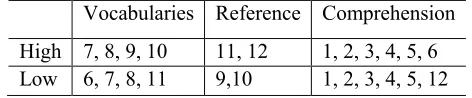
The second instrument was a lexical collocational test containing two texts, with high and low lexical collocational density each followed by twelve multiple choice items constructed by the researcher. The two texts were similar in all aspects except the lexical collocational density. The length of the two texts, the topic, and their level of the difficulty was similar. Four items dealt with guessing the unknown vocabularies, two items with understanding the references, and six items required comprehension of the text using cohesive ties in the text. The distribution of the test items is represented in Table 2.
Table 2. Distribution of test items in lexical collocational test with high and low lexical collocational density
Vocabularies Reference Comprehension High 7, 8, 9, 10 11, 12 1, 2, 3, 4, 5, 6 Low 6, 7, 8, 11 9,10 1, 2, 3, 4, 5, 12
by asking the views of 3 experts in the field. They unanimously reiterated that the content taps the issue under investigation. The construct validity of the test was sought through exploratory factor analysis where the results of principal component analysis returned higher loadings on one factor, suggesting collocation knowledge. Moreover, to further investigate item characteristics of the two collocation tests, the results of the same test were used to examine item facility, item discrimination and choice distribution of the items. The item facility for both tests fell within an appropriate range (0.37 and 0.63, respectively).
3.3 Data collection
Data collection took place during the Fall of 2010 in the participants’ reading comprehension course. The reason for choosing this course was to give the treatment during the course. To make the subjects familiar with the test-taking procedure, the instructions were orally given both in English and Persian by the instructor of the course. She was aware of how to employ the method of giving treatments to the students. Then, the reduced TOEFL test was administered having 60 minutes to perform the task. After that, the two texts with high and low lexical collocational density were administered at the same time as a pre-test. The time allocated for the administration of the tests was 30 minutes. The same tests were administered in interval of one month as a post-test. The learners in the experimental group were given 6 sessions of 2 hour treatment during which the learners’ attention was directed to collocations. The course instructor used four passages of their text book, English through Reading” by W.W.S Bhasker and N.S. Prabhu (1975), attempting to increase the students’ awareness of lexical collocation and how they can be useful for reading comprehension. .
The lexical collocational density of the two lexical collocation tests was calculated by dividing the total number of nodes by the total number of words multiplied by 100 following Gorjani (1996). The students were given 30 minutes to do the test. This pre-test was used to assess the students’ reading comprehension ability before the treatment. The same test was used as a post-test with an interval of 1 month to see the effect of treatment on the students’ reading comprehension.
3.4 Data analysis
experiment in order to measure the significance of the growth in the performance of the experimental group on the lexical collocational test with high and low lexical collocational density from the pre- to the post-test. In other words, this was used to see whether different levels of lexical collocational density affect EFL learners' comprehension of English texts or not. A t-test aimed at comparing the performance of the control and the experimental groups on the lexical collocational test with high and low lexical collocational density. Four paired sample t-tests aimed at responding to the third research question of this experiment to find out if instruction of lexical collocation had any significant effect on guessing the meaning of the unknown vocabularies. Another t-test was run to see if instruction of lexical collocation had any significant effect on developing reading skills.
In order to answer the fifth research question, the participants were divided into three groups of highly, moderately, and poorly proficient, according to their TOEFL grades. 27% of the scores from the beginning were considered as high, 27% of the scores from the end as poor, and the scores between these two groups as moderate. Then, a two-way repeated measure was run to investigate the difference, if any, between different groups of the participants with different proficiency levels in terms of the effect of lexical collocational density on their reading comprehension.
4. Results and Discussions 4.1 Results of descriptive statistics
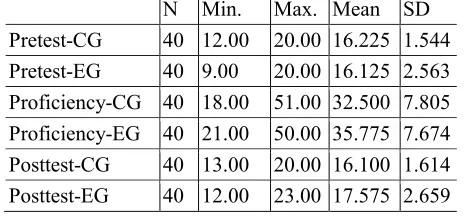
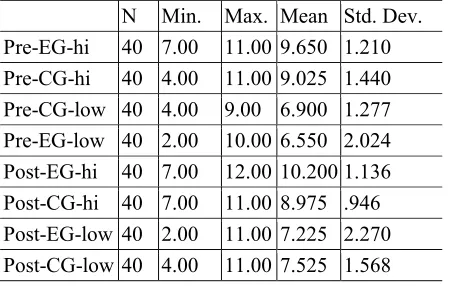
Table 3 presents the descriptive statistics of the different tests used in this study. The mean, standard deviations (SD), maximum and minimum of the scores are tabulated.
Table 3. Basic descriptive statistics for the tests used in the study N Min. Max. Mean SD
Pretest-CG 40 12.00 20.00 16.225 1.544 Pretest-EG 40 9.00 20.00 16.125 2.563 Proficiency-CG 40 18.00 51.00 32.500 7.805 Proficiency-EG 40 21.00 50.00 35.775 7.674 Posttest-CG 40 13.00 20.00 16.100 1.614 Posttest-EG 40 12.00 23.00 17.575 2.659
closeness of the means of the two groups is an indicator of homogeneity of the two with respect to their collocational knowledge. However, the dispersion of the scores is wider for the experimental group. Based on the third and fourth rows of the table, the resulting SDs show that the two sets of scores are fairly similarly scattered along the horizontal axis.
The fifth and sixth rows of the above table on the post-test demonstrate that the difference between the means of the two groups can be an indicator of the effectiveness of the treatment of instruction of lexical collocations in reading comprehension of the texts. However, further research is needed to examine the effectiveness of this treatment in the long run. A marked difference can be seen in the two SDs. This suggests that the scores of the experimental group are more widely scattered along the horizontal axis.
As the first and the second rows in Table 3 show that the participants did not demonstrate a very high knowledge of lexical collocation which is in line with Ceh (2005), Zughoul & Hussein (2001), Keshavarz & Salimi (2007), and Chen (2008) who proposed that lexical collocations are problematic for learners and difficult to find in dictionaries. The reason is that there is no explicit rule for lexical collocations. They are recurrent patterns of one’s language which is in line with Zhang (1993) indicating that native writers performed better on lexical collocational test than non-native writers.
Table 4 below shows basic descriptive statistics for the high and low lexical collocational tests.
Table 4.Basic descriptive statistics for the high and low lexical collocational tests
N Min. Max. Mean Std. Dev. Pre-EG-hi 40 7.00 11.00 9.650 1.210 Pre-CG-hi 40 4.00 11.00 9.025 1.440 Pre-CG-low 40 4.00 9.00 6.900 1.277 Pre-EG-low 40 2.00 10.00 6.550 2.024 Post-EG-hi 40 7.00 12.00 10.200 1.136 Post-CG-hi 40 7.00 11.00 8.975 .946 Post-EG-low 40 2.00 11.00 7.225 2.270 Post-CG-low 40 4.00 11.00 7.525 1.568
The third and the fourth rows of the above table represent that the two groups have fairly similar means with slightly different SDs. Likewise, the fifth and sixth rows reveal that the mean gain in the experimental group can be contrasted with the mean loss in the control group when compared with the scores in the pretest. The SDs are not much affected but the control group is a bit more homogenous.
The seventh and eighth rows in the table convey that the mean scores for both groups have dropped similarly and the dispersion of the scores is quite different. Results of both groups are in harmony with the expectation to have scores being more widely scattered compared with the scores for the high lexical collocation test.
As is evident from Table 4, the means of the two groups on high lexical collocational test as a pre-test (9.65 and 9.02, respectively) were higher than the means of the two groups on low lexical collocational test (6.55 and 6.90). This shows that participants performed better on the test with high lexical collocational density. The result is in line with (Halliday & Hasan, 1976; and MartyRska, 2004) contending that collocational knowledge is effective in overcoming the problems of understanding the text and guessing the unknown vocabularies due to the degree of lexical collocational density. Comparing the mean scores of the two groups on high lexical collocational test, we can say that the treatment had an effect on the comprehension of the text and consequently on the performance of the participants on the post-test.
Table 5 presents the descriptive statistics of the number of the students who answered the four items (7, 8, 9, and 10 in the collocation test with high lexical collocational density) and four items (6, 7, 8, and 11 in the collocation test with low lexical collocational density) of guessing the unknown vocabulary items correctly.
Table 5. Basic descriptive statistics for vocabulary items in the high and low lexical collocational test
N Maximum Mean Std. Deviation High 80 4.00 2.212 .923
Low 80 4.00 1.587 .806 Valid N (listwise) 80
High= the number of students who answered four questions of vocabularies correctly on collocation test with high lexical collocational density
As shown in the table, the mean score of the participants who answered the four vocabulary questions correctly in the collocation test with high lexical collocational density is 2.21 with a standard deviation of .92. Similarly, the mean score of the same participants who answered the four vocabulary questions correctly, in the collocation test with low lexical collocational density, is 1.58 with a standard deviation of .80.
As Table 5 indicates the mean score of the participants who answered four vocabulary questions correctly is higher (2.21) on the lexical collocation test with high lexical collocational density than the mean scores of the participants who answered the four vocabulary questions correctly on the lexical collocation test with low lexical collocational density (1.58). This shows that the participants had less difficulty answering the unknown vocabularies on the collocation test with high lexical collocational density. In other words, lexical collocational density helps the participants to answer the unknown vocabularies better.
4.2 Results of inferential statistics
In order to answer the research questions, ten t-tests of Independent-Sample and Paired ones as well as one repeated measures test were run on the data. The first statistical procedure presented here is that of a paired-sample test which looks at the significant growth in the performance of participants in the experimental group on the high lexical collocational test from pre- to post test. The results of this test are shown in Table 6.
Table 6. Paired-sample test for the experimental group (high lexical collocational density)
Table 6 has yielded results which could be used to answer the first research question of this study. In other words, its outcomes are important to make inferences about the effectiveness of the treatment on the performance of the participants in the experimental group on high lexical collocational test from the pre- to post test. There was a statistically significant increase in the scores of the participants in the experimental group on the high lexical collocational test from the pre- test (m= 9.65, SD= 1.21) to the post test (m= 10.20, SD= 1.13) (t (39) = -3.73, df= 39, p< .05). Thus, one can infer that there is a significant growth in the scores of the experimental group on the lexical collocational test with high lexical collocational density. In other
Test Sig
(two-tailed)
t Df Mean Mean of Scores SD
Pair 1
Pre-EG-hi –
Post-EG-hi .001 -3.731 39 -.550
Pre-EG-hi =9.650 1.210 post-EG-hi
words, one can say that texts with high lexical collocational density affect the comprehension of the texts positively. A few studies have been done on the effect of cohesion on reading comprehension. Halliday and Hasan (1976) stated that cohesion relates different elements of a text together which enables the reader or the listener to use those elements to comprehend a text better. Similarly, (McClure & Steffensen, 1985; and Ehrlich, Remond, and Tardieu, 1999) found a positive relation between cohesion and comprehension of the texts. However, no experimental studies, to the knowledge of the researcher, have been done on the effect of lexical collocational density on EFL learners’ comprehension of English texts. Therefore, the results of the present study cannot be compared with any studies done up to the present time. The next analysis undergoes the same procedure as for the low lexical collocation test. The result of this is presented in Table 7.
Table 7. Paired-sample test for the experimental group (low lexical collocational density)
Test Sig (two-tailed) t Df Mean Mean SD
Pair 1 Pre-EG-low-Post-EG-lo
.010 -2.710 39 -.675 Pre-EG-low
=6.550 2.024 Post-EG-low
=7.225
2.270
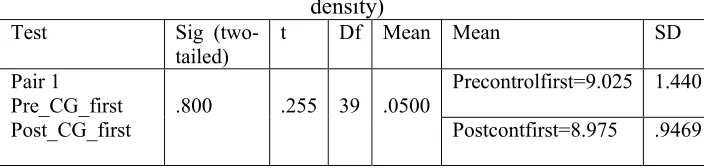
Table 8. Paired-sample test for the control group (high lexical collocational density)
Test Sig
(two-tailed) t Df Mean Mean SD
Pair 1 Pre_CG_first
Post_CG_first .800 .255 39 .0500
Precontrolfirst=9.025 1.440
Postcontfirst=8.975 .9469
In the above table, a decrease in the scores of the participants in the control group on high lexical collocational test from the pre- test (m= 9.02, SD= 1.44) to the post test (m= 8.97, SD=.94), t (39) = -.25, p> .05(two-tailed) was observed which is not statistically significant. This can be evidence for the effectiveness of the treatment which was absent in the control group. The following table observes the growth in the performance of the participants in the control group on low lexical collocational test from the pre- to the post- test.
Table 9. Paired-sample test for the control group (low lexical collocational density)
Test Sig
(two-tailed)
T Df Mean Mean SD
Pair 1
Pre_CG_Second
Post_CG_Second .520 -.650 39 -.1500
precontsecond =7.000 1.281 postcontsecond=7.150 1.075
Table 10. Independent-sample test for the four vocabulary items of the collocation test with high and low lexical collocational density Test sig t Df Sig (two-tailed) Mean of Scores Density
EVA* EVNA^
.172 4.559
4.559 158 155.184 .000 .000 High= 2.212 Low= 1.587
*EVA= Equal Variances Assumed, ^EVNA= Equal Variances Not Assumed The answer to the second research question of this study can be sought in the above table. This question investigates the effect of different levels of lexical collocations on participants’ answering the vocabulary items. Table 4.8 shows us that the P-value or level of significance is .17 (Sig= .17). As (.172> 0.05), (0.05 is the significance level of the test), the first assumption of equal variances is accepted, and the results of the t-test are given based on the fact that the variances are equal. The results of the test show that the t-value is 4.559 which is more than the level of significance which is .000 (4.559 > .000). This means that the difference is significant. In other words, the test being highly densed or lowly densed collocationally will have an impact on the participants’ correct responses. In other words, the participants could answer the vocabulary items better in the collocation test with high lexical collocational density. As Halliday and Hasan (1976) contend, in collocations, cohesion is achieved through the close co-occurrence of words in a text that relates one part of a text to another which leads to its better understanding. In the collocation test with high lexical collocational density, there are more cohesive ties which can be the reason that participants answered the vocabulary items better than in the test with low lexical density. The next statistical procedure is a paired sample test, observing any significant growth in the performance of participants in the experimental group on vocabulary items in high lexical collocational test from the pre- to post-test.
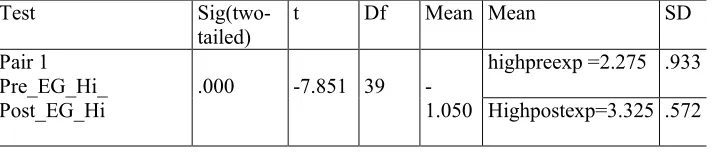
Table 11. Paired-sample test for the growth in the experimental group on vocabulary items (high lexical collocational density)
Test
Sig(two-tailed) t Df Mean Mean SD
Pair 1 Pre_EG_Hi_
Post_EG_Hi .000 -7.851 39 -1.050
highpreexp =2.275 .933
Highpostexp=3.325 .572
lexical collocational test from the pre-test (m=2.27, SD=.93) to the post test (m= 3.32, SD= .57), t (39) = -7.85, p<.05(two-tailed). Table 11 indicates that the significance level for the experimental group on high lexical collocational density from the pre-test to the post-test is .000 which is statistically significant. The results indicate the significance of the treatment in the experimental group which is in line with Rahimi (2005) proposing the effectiveness of the systematic teaching of lexical collocations on vocabulary learning. In the following table, another paired sample test was run to investigate any significant growth in the performance of the participants in the control group on vocabulary items in high lexical collocational test from the pre- to post- test.
Table 12. Paired-sample test for vocabulary items of the control group (high lexical collocational density)
Test Sig (two-tailed) t Df Mean Mean SD
Pair 1 Pre_CG_Hi
Post_CG_Hi .000 -5.731 39 -.800
highprecont =2.150 .921 highpostcont
=2.950 .597
Obviously, further research is needed on collocations with different levels of lexical collocational density with more vocabulary items specifically to (dis) confirm the results of this study. The next analysis undergoes the same procedure for the low lexical collocation test. The result of this is presented in Table 13.
Table 13. Paired-sample test for the vocabulary items of the control group (low lexical collocational density)
Test Sig (two-tailed) t Df Mean Mean SD
Pair 1 Pre_CG_Lo
Post_CG_Lo .017 -2.490 39 -.375
lowprecont
=1.550 .814
lowpostcont
=1.925 .655
There was a statistically significant increase in the scores of the participants in the control group in the vocabulary items on lexical collocation test with low lexical collocational density from the pre-test (m= 1.55, SD= .81) to the post test (m= 1.92, SD= .65), t (39) = -2.49, p< .05(two-tailed). Similarly, the above table does not support the effectiveness of the treatment for there was an increase in the scores of the participants in both the control and the experimental group which is in contrast with Rahimi (2005). The next table investigates any significant growth in the performance of participants in the experimental group in the vocabulary items in low lexical collocational test from the pre- to the post- test.
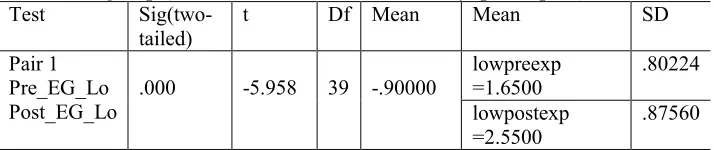
Table 14. Paired-sample test for the vocabulary items of the experimental group (low lexical collocational density, pre & post)
Test
Sig(two-tailed) t Df Mean Mean SD
Pair 1 Pre_EG_Lo
Post_EG_Lo .000 -5.958 39 -.90000
lowpreexp
=1.6500 .80224 lowpostexp
=2.5500 .87560
which are smaller than .05. This could be another piece of evidence for the ineffectiveness of the treatment.
The results shown in Tables 11 to 14 can help to answer the third research question of this study. Thus, in responding to this research question of the experiment, one can say that there is no significant relationship between instruction of lexical collocation and answering the vocabulary items correctly. The next table compares the performance of the control and the experimental groups on lexical collocational test as the pre/post-tests.
Table15. Results of t-test 10: Descriptive statistics and Independent Samples Test for the pre/post tests
Test sig t Df Sig (two-tailed) Mean of Scores Pretest EVA*
EVNA^ .001 .211 .211 78 63.999 .833 .833 Control= 16.225 Experi.= 16.125 Posttest EVA
EVNA .009 2.999 2.999 78 64.302 .04 .04 Control=16.100 Experi.=17.575 *EVA= Equal Variances Assumed, ^EVNA= Equal Variances Not Assumed
the difference between different groups of students with different proficiency levels in terms of the effect of collocational density on their reading comprehension.
Table 16. A two-way repeated measure for different proficiency levels of the students and different levels of collocational density on reading
comprehension
Effect Value F Hypothesis df Error df Sig. factor1 Pillai's Trace .586 1.088E2a1.000 77.000 .000
Wilks' Lambda .414 1.088E2a1.000 77.000 .000 Hotelling's Trace 1.413 1.088E2a1.000 77.000 .000 Roy's Largest Root 1.413 1.088E2a1.000 77.000 .000 factor1 * level Pillai's Trace .021 .817a 2.000 77.000 .446 Wilks' Lambda .979 .817a 2.000 77.000 .446 Hotelling's Trace .021 .817a 2.000 77.000 .446 Roy's Largest Root .021 .817a 2.000 77.000 .446 a. Exact statistic
b. Design: Intercept + level Within Subjects Design: factor1
In response to the fifth research question of this study, Table 16 shows that the value for Wilk's Lambda (the most commonly reported statistics) is .414 for factor 1 (high and low lexical collocational density), with a probability value of.00. The p value is less than .05; therefore, it can be concluded that there is a statistically significant difference between high and low lexical density of the collocation test and its effect on the performance of the participants.
The value for Wilk's Lambda of the relationship of factor 1(high and low lexical collocational density) and level (proficiency level of the participants) is .97, with a probability value of .44. The p value is more than .05; therefore, it can be claimed that different proficiency levels of the participants does not affect their performance on different levels of lexical collocational test significantly.
5. Concluding Remarks
The results show that different proficiency levels of the participants did not affect their performance on lexical collocational tests with different lexical collocational density significantly. The result of this experiment is in contrast with Zhang’s (1993) contentions that native and non-native good writers performed significantly better than poor writers on the writing test. This distinction between the results of the two studies can be because of the insufficient number of the participants taking part in our experiment.
As it was mentioned previously, the results of the collocation test show discouraging facts about EFL learners’ knowledge of lexical collocations. Although the scores of the participants improved in the post-test due to the effectiveness of the treatment, their collocational knowledge was not high enough. This explains the fact that learners should spend more time and exert more effort to improve their knowledge of collocations. The results of the study confirm the fact that lexical collocations can be effective in learners’ comprehension of the texts especially when there is a high level of lexical collocational density. Therefore, teachers should increase the students’ awareness to use their knowledge of lexical collocation in reading. The results would also be helpful for materials developers in including more collocations in their textbooks. These issues are crucial, especially in Iran, where the concept of collocation is unknown for many students. Likewise, test developers can benefit from the results of such studies showing the difficulty EFL/ESL learners face while they are engaged in reading texts with English collocations. They can design their tests so that they incorporate collocational items and make the learners aware of the existence and importance of these elements in the language.
6. Limitations and Suggestions for Further Research
practicality issues. Thus, one can increase the number of the vocabulary items to evaluate the results of the present experiment.
To recapitulate, the experiment presented here should be seen as a starting point whose results need to be replicated to further explore the effect of lexical collocational density on the Iranian EFL learners’ reading comprehension and even their writing ability.
References
Akbari, R. & Mirhassani, A. (2000). Study skills. Tehran.: SAMT.
Aitchison, J. (1987) Words in the mind: An introduction to the mental
lexicon. Oxford: Blackwell Publishers.
Bonk, W. J. (2000). Testing ESL learners’ knowledge of collocations. (ERIC Document Reproduction Service No. ED 442309)
Ieh, Z. (2005). Crucial combinations. English Teaching Professional, 37, 29-31.
Celce-Murcia, M. (2001). Teaching English as a second or foreign
language. (3rd ed.). Boston: Heinle & Heinle.
Chen, M. (2008). A Study of the English Collocation Competence of College
Students in Taiwan. Unpublished MA Thesis, National Taiwan
University of Science and Technology.
Ehrlich, M., Remond, M. and Tardieu, H. (1999). Processing of anaphoric devices in young skilled and less skilled comprehenders: Differences in metacognitive monitoring. Reading and Writing: An
Interdisciplinary Journal 11 (1), 29-63.
Gorjani, B. (1996). The role of lexical collocations as a textual structure and its effect on cognitive processing in reading comprehension.
Unpublished MA Thesis.Tabriz: The University of Tabriz.
Halliday, M. A. (1975). Explorations in the functions of language. London: Edward Arnold.
Halliday, M. A. K. and Hasan. R. (1985). Language, context and text: A
social semiotic perspective. London: Deakin University Press.
Halliday, M.A. and Hasan, R. (1976). Cohesion in English. London: Longman.
Hammer, J. (1991). The practice of English language teaching (2nd ed.). London: Longman.
Hill, J. (2000). Revising priorities: From grammatical failure to collocational success. In
Lewis, M. (Ed.). Teaching Collocation Further developments in the lexical
approach, pp.47-69. Croatia: Heinle.
Huang, L. (2001). Knowledge of English collocations: An analysis of
Taiwanese EFL Learners. In Luke, C.& Rubrecht, B. (Eds.). Texas
papers in foreign language education:
Selected proceedings from the Texas Foreign Language Education
Conference, 2001.
Volume 6. (ERIC Document Reproduction Service No. ED465288)
Keshavarz, M. H. & Salimi, H. (2007). Collocational competence and cloze test performance: a study of Iranian EFL learners. International
Journal of Applied Linguistics, 17(1),81-92.
Lauder, A. (n.d.). Collocation, Semantic Preference and Translation:
Semantic Preference as a Reference Source for Translation. Retrieved 12 January 2013 from
english.um.edu.my/anuvaada/PAPERS/LAUDER.pdf
Lewis, M. (1993). The lexical approach: The state of ELT and the way
forward. Hove: Language Teaching Publications.
Lewis, M. (1997). Implementing the lexical approach: Putting theory into
practice. Hove: Language Teaching Publications.
Lewis, M. (2000). Language in the lexical approach. In Lewis, M. (Ed.).
Teaching collocation:
Further developments in the lexical approach, pp.126–154. Hove: Language
Teaching Publications.
Lin, Y. P. (2001). The Effects of collocation instruction on English
vocabulary development of senior high students in Taiwan.
Unpublished master’s thesis, National Kaohsiung Normal University, Taiwan, R.O.C.
Lotfipour, K. (1997). Lexical cohesion and translation equivalence. META,
45, 185-192.
Mahmoud, A. (2005). Collocation errors made by Arab learners of English.
Asian EFL Journal. August 2005, Article2.
MartyRska, M. (2004). Do English language learners know collocations? Investigationes Linguisticae, XI.
McCarthy, M. (1990). Vocabulary. Oxford: Oxford University Press.
McClure, M. and Steffensen, M. (1985). A study in the use of conjunctions
across grades and ethnic groups.Research in the Teaching of English
19 (3), 217-36.
Nattinger, J.R. & DeCarrico, J.S. (1992). Lexical phrases and language teaching.Oxford University Press.
Nesselhauf, N. (2003). The use of collocations by advanced learners of
English and some implications for teaching. Applied Linguistics, 24
Pouralvar, K. (2007). The effect of lexical collocational density of texts on readability. ILI Language Teaching Journal, 3(2), 159-164.
Rahimi, A. (2005). The Role of systematic exposure to lexical collocations
in learning English vocabulary by Iranian students. Unpublished
M.A. Thesis. Shiraz Islamic Azad University.
Schmitt, N. (2000). Key concepts in ELT: Lexical chunks. ELT Journal,
54(4), 400–401.
Sinclair, J. (1991). Corpus, concordance, and collocation. Oxford: Oxford University Press.
Smadja, F. (1993). Retrieving collocations from text.
ComputationalLinguistics,19(1), 143–177.
Tang, Y. T. (2004). A Study of the collocation errors in the oral and written
production of the college students in Taiwan. Unpublished master’s
thesis, National Taiwan Normal University, Taiwan, R.O.C.
Tseng, F. P. (2002). A Study of the effects of collocation instruction on the
collocational competence of senior high school students in Taiwan.
Unpublished master’s thesis, National Taiwan Normal University, Taiwan, R.O.C.
Van Dijk, T. A. (1977). Semantic macro-structures and knowledge frames in discourse comprehension. In Just, M.A. and Carpenter, P.A.:
Cognitive processes in comprehension. New York: Lawrence
Erlbaum.
Van Dijk, T.A. and Kintsch, W. (1983). Strategies of discourse
comprehension. New York: Academic Press.
Wang, C. J. (2001). A study of the English collocational competence of
English majors in Taiwan. Unpublished master’s thesis, Fu-Jen
Catholic University, Taiwan, R.O.C.
Zhang, X. (1993). English collocations and their effect on the writing of
native and non-native college freshmen. Unpublished doctoral
dissertation. Pennsylvania, USA: Indiana University of Pennsylvania. Zughoul R. & Hussein, A. (2001). Collocational competence of Arabic