http://www.sciencepublishinggroup.com/j/fm doi: 10.11648/j.fm.20170306.11
ISSN: 2575-1808 (Print); ISSN: 2575-1816 (Online)
Squeezing Flow Analysis of Nanofluid Under the Effects of
Magnetic Field and Slip Boundary Conditions Using
Chebychev Spectral Collocation Method
Gbeminiyi M. Sobamowo
1, *, Lawrence O. Jayesimi
21
Department of Mechanical Engineering, University of Lagos, Akoka, Lagos, Nigeria
2
Works and Physical Planning Department, University of Lagos, Akoka, Lagos, Nigeria
Email address:
[email protected] (G. M. Sobamowo), [email protected] (G. M. Sobamowo)
*Corresponding author
To cite this article:
Gbeminiyi M. Sobamowo, Lawrence. O. Jayesimi. Squeezing Flow Analysis of Nanofluid Under the Effects of Magnetic Field and Slip Boundary Conditions Using Chebychev Spectral Collocation Method. Fluid Mechanics. Vol. 3, No. 6, 2017, pp. 54-60.
doi: 10.11648/j.fm.20170306.11
Received: October 16, 2017; Accepted: November 20, 2017; Published: December 27, 2017
Abstract:
In this work, analysis of two-dimensional squeezing flow of a nanofluid under the influences of a uniform transverse magnetic field and slip boundary conditions is carried out using Chebychev spectral collocation method. The analytical solutions are used to investigate the effects of fluid properties, magnetic field and slip parameters on the squeezing flow. It is revealed from the results that the velocity of the fluid increases with increase in the magnetic parameter under the influence of slip condition while an opposite trend is recorded during no-slip condition. Also, the velocity of the fluid increases as the slip parameter increases but it decreases with increase in the magnetic field parameter and Reynold number under the no-slip condition. The results of the Chebychev spectral collocation method are in excellent agreement with the results of the convectional numerical method using Runge-Kutta coupled with shooting method. The findings in this work can be used to further study the squeezing flow in applications such as power transmission, polymer processing and hydraulic lifts.Keywords:
Nanofluid,S
queezing Flow, Slip Boundary, Magnetic Field, Chebychev Collocation Method1. Introduction
In recent times, the research interests of squeezing flow of fluid between two parallel plates have increased tremendously. This is because of the various industrial and biological applications of squeezing flow such as in moving pistons, chocolate fillers, hydraulic lifts, electric motors, flow inside syringes and nasogastric tubes, compression, injection modeling, power transmission squeezed film and polymers show the important of the area. Although, the pioneer work and the basic formulations of the squeezing flows under lubrication assumptions are given by Stefan [1], there have been improved works on the flow phenomena. However, the earlier studies on squeezing flow were based on Reynolds equation [1-3] in whichthe insufficiencies for some cases have been shown by Jackson [4] and Usha and Sridharan [5]. Consequently, in recent times, there have been several attempts and renewed research interests by
[44]. Ebaid [45] studied the effects of magnetic field and wall slip conditions on the peristaltic transport in an asymmetric channel. The influence of slip on the peristaltic motion of third-order fluid in asymmetric channel is studied by Hayat et al. [46]. The effects of slip condition on the rotating flow of a third grade fluid in a non-porous medium are investigated by Hayat and Abelman [47]. Abelman et al. [48] extended their work to a porous medium and obtained the numerical solutions for the steady magnetohydrodynamics flow of a third grade fluid in a rotating frame. The past efforts in analyzing the squeezing flow problems have been largely based on the applications of various approximate analytical methods such as differential transformation method (DTM), Adomian Decomposition Method (ADM), homotopy analysis method (HAM), homotopy perturbation method (HPM), variational iteration method (VIM). Numerical methods such as Euler and Runge–Kutta methods are limited to solving initialvalue problems. With the aid of shooting method, the methods could be carried out iteratively to solve boundary value problems. However, these numerical methods are only useful for solving ordinary differential equations. On the other hand, numerical methods such as finite difference method (FDM), finite element methods (FEM) and finite volume method (FVM) can be adopted to analyze nonlinear equations with single and multiple independent variables as they have been used to solve different linear and non-linear differential equations in literatures. On the other hand, the fast rate of convergence and a very large converging speed of spectral methods over most of the commonly used numerical methods have been established in the field of numerical simulations. The converging speed of the approximated numerical solution to the primitive problem is faster than any one expressed by any power-index of N−1. Numerical methods such as finite element method (FEM) and the finite volume method (FVM) provide linear convergence, while, the spectral methods provide exponential convergence [49, 50]. Spectral methods have been widely applied in computational fluid dynamics [51, 52], electrodynamics [53] and magnetohydrodynamics [54, 55]. From the view of approximation to the original equation, the spectral method can be classified as the collocation method which presents discretization in physical space, the Galerkin method which seeks solution in spectral space, and the pseudo-spectral method which provides discrete integration in physical space at first and then presents transformation into spectral space for seeking the solution. Among the three methods, the collocation method is much more suitable for treating with non-linear problems. Recent numerical work concerned with the solution of non-linear differential equations has also provided more and more evidence of the applicability and accuracy of the Chebyshev collocation method [56-61]. The main advantage of spectral methods lies in their accuracy for a given number of unknowns. For smooth problems in simple geometries, they offer exponential rates of convergence/spectral accuracy [62-64]. Despite the high
accuracy and efficiency of the method, it has not been significantly applied to nonlinear heat transfer problems.
Therefore, in the paper, axisymmetric
magnetohydrodynamic squeezing flow of nanofluid in porous media under the influence of slip boundary condition is analyzed using Chebychev spectral collocation method. Also, the effects of the various flow parameters on the squeezing flow are investigated.
2. Problem Formulation
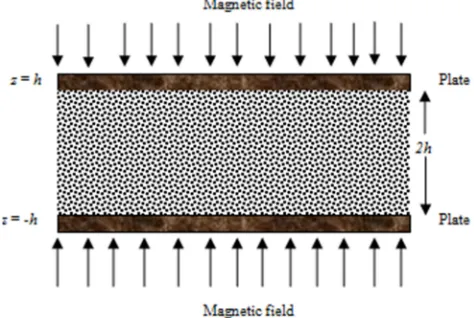
Consider a squeezing flow of an incompressible Newtonian fluid with constant density ρ and viscosity µ, squeezed between two large planar parallel plates separated by a small distance 2h approaching each other with a low constant velocity v in the presence of a magnetic field, as shown in Figure 1.
Figure 1. Model of the squeezing flow of nanofluid under transverse uniform magnetic field.
Assume that the flow is quasi steady, and the Navier-Stokes equations governing such flow when inertial terms are retained, the equations of motion governing the flow are:
.v 0
∇ = (1)
( )
2 20
. . ɶ B
ɶ
ɶ ɶ ɶ nf ɶ
nf nf nf
v v
v v f p v v
t k
µ
ρ ∂ + ∇ =ρ − ∇ +µ ∇ − −σ
∂
(2)
where
(
1)
nf f s
ρ =ρ −φ +ρ φ
(
)
2.51
f nf
µ
µ
φ
= −
0
r r z
v v v
r r z
∂ ∂ ∂
+ + =
∂ ∂ (3)
(
)
20
B 2
ɶ ɶ ɶ
ɶ ɶ nf ɶ nf ɶ
nf v w p nf w v
k
ρ µ
ρ µ ν σ
− × + ∇ + = ∇× − −
(4)
where
( )
1 2,
r z E
r ψ
Ω = − (5)
Introducing the stream function
ψ
( )
r z, , gives1 1
vr , vz .
r z r r
ψ
ψ
∂ ∂
= = −
∂ ∂ (6)
Eliminating the pressure term from Eqs. (3) and (4), one arrives at
(
)
( )
2 2 2
4 2
0 2
, / 1
B , nf nf nf E r E
r z r r k z
ψ ψ µ µ ψ
ρ ψ σ
∂ ∂ = − + + ∂ ∂ (7) where 2 2 2 2 2 1 E r r r z ∂ ∂ ∂ = − + ∂
∂ ∂ (8) The compatibility Eq. (7) reduces to Eq. (9) after defining the stream function as
(
2 2)
2
nf
r z
p=
ρ
ν
+ν
( )iv
( )
1 B20 ''( )
2 nf( ) ( )
''' 0nf nf
f z f z f z f z
k ρ σ µ µ − + + = , (9)
And the slip boundary conditions are
( )
( )
( )
( )
( )
''
' ''
0 0, 0 0, ,
2
f f
v
f h f h βf h
= =
= = (10)
Using the following dimensionless parameters in Eq. (11)
(
)
* *
2
2 0
, , Re ,
/ 2 B 1 = f f nf Hv f z F z v h
G h Da m
k
ρ
µ
σ
µ
= = = + = + (11)and omitting the * for the sake of conveniences, Eq. (9) and Eq. (10) becomes
( )
( )
(
)
(
)
2.5( ) ( )
''' 2 ''( )
1 1 0
iv s
f
F z Re φ φ ρ φ F z F z G F z
ρ
+ − + − − =
(12)
And the boundary conditions are
( )
( )
( )
( )
( )
''
' ''
0 0, F 0 0,
1 1, F 1 1
F
F γF
= =
= = (13)
With γ β= /h and R, m are Reynolds and Hartmann numbers respectively.
3. The Procedure of Chebychev
Collocation Spectral Method
The nonlinearity in governing equation Eqs. (12) makes it very difficult to develop a closed-form solution to the non-linear equation. Therefore, in this work, a spectral collocation method of the Chebyshev type is employed to solve the heat transfer equation. The Chebyshev collocation spectral method is based on the expansion by virtue of the Chebyshev polynomials. At first, it expands the variable at collocation points and seeks the variable derivatives at these points, then substitutes the expansions into the differential equations and finally seeks the approximated solution in physical space. This means that Chebyshev collocation spectral method is accomplished through, starting with Chebyshev approximation for the approximate solution and generating approximations for the higher-order derivatives through successive differentiation of the approximate solution.
Looking for an approximate solution, which is a global Chebyshev polynomial of degree N defined on the interval [-1, 1], the interval is dicretized by using collocation points to define the Chebyshev nodes in [-1, 1], namely
, 0,1, 2,...
j
j
x cos j N
N
π
= =
(14)
The derivatives of the functions at the collocation points are given by:
( )
( )
0
, 1, 2.
N
n n
j kj j
j
f x d f x n
=
=
∑
= (15)where dkjn represents the differential matrix of order n and are given by
( )
( )
1 1 0, 0 4 ,, 0,1,... ,
N n
j n n
kj l k n j
l
n l n l odd
n
d T x T x
N c
k j N
γ
−γ
= = + = =
=
∑ ∑
(16a)
(
2 2)
( )
( )
1 2
0, 0
2
,
, 0,1,... ,
N n
n
j n
kj l k n j
l
n l n l even
n n l
d T x T x
N c
k j N
γ
γ
− = = + = − = =∑ ∑
(16b)1
0, 2
1 1, 2,... 1
j
j or N
j N
γ
=
=
= −
(17a)
2 0,
1 1, 2,... 1
l
l or N c
l N
=
=
= −
(17b)
As described above, the Chebyshev polynomials are defined on the finite interval [-1, 1]. Therefore, to apply Chebyshev spectral method to Eq. (12), we make a suitable linear transformation and transform the physical domain [-1, 1] to Chebyshev computational domain [-1,1]. We sample the unknown function w at the Chebyshev points to obtain the data vectorw=w x
( )
o ,w x( ) ( )
1 ,w x2 ,...w x( )
N T. The next stepis to find a Chebyshev polynomial P of degree N that interpolates the data
(
i e. ., P x( )
j =wj, j=0,1,...N)
and obtains the spectral derivative vector w by differentiating Pand evaluating at the grid points
( )
(
')
. ., j ' j j, 0,1,...
i e w =P x =w j= N . This transforms the nonlinear
differential equation into system nonlinear algebraic
equations, which are solved by Newton’s iterative method starting with a initial guess.
Making a suitable transformation to map the physical domain [0, 1] to a computational domain
[-1,1] to facilitate our computations.
Eqs. (14) are transformed to the following equations
( )
( )
(
)
(
)
2.5( ) ( )
''' 2 ''( )
1 1 0
ɶiv s ɶ ɶ ɶ
f
F z Re φ φρ φ F z F z G F z
ρ
+ − + − − =
(18)
And the slip boundary conditions are
( )
( )
( )
( )
( )
''
' ''
0 0, F 0 0,
1 1, F 1 1
ɶ ɶ
ɶ ɶ ɶ
F
F γF
= =
= = (19) After applying CSCM to Eq. (15) and the boundary conditions in Eq. (16), the governing equation and boundary conditions are transformed into a system of nonlinear algebraic equations:
( )4
( )
(
)
(
)
2.5 (1)( )
(3)( )
(2)( )
, , , ,
0 0 0 0
1 1 0
ɶ ɶ ɶ ɶ
N N N N
s
j j j j
k j k j k j k j
f
j j j j
d F η Re φ φ ρ φ d F η d F η G d F η
ρ
= = = =
+ − + − − =
∑
∑
∑
∑
(20)For k = 2, 3,...N-1
And the boundary conditions in Eq. (13) become
( )
( )2( )
0 0
0 0, 0
ɶ ɶ
N
j j
F d F η
=
=
∑
=( )
( )1( )
( )2( )
, ,
0 0
1 1, 0
= =
=
∑
=∑
=ɶ ɶ ɶ
N N
j j
N j N j
j j
F d F η γ d F η (21)
The developed nonlinear algebraic equation form the analysis above for the unknown fɶ
( )
ηj ,i=1, 2,3,...,N is solved by Newton’s method.4. Results and Discussion
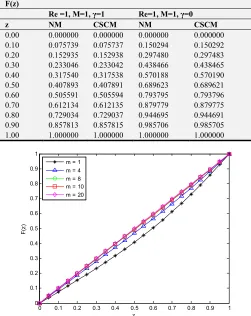
The above procedures show the analysis of a steady two-dimensional axisymmetric flow of a nanofluid fluid under the influence of a uniform transverse magnetic field with slip boundary condition. Using CSCM, a closed form series solution was obtained as it provides excellent approximations to the solution of the non-linear equation with excellent accuracy as shown in Table 1. Also, the Table depicts the prediction of the fluid velocity by including the slip parameter in the model. From the results in the Table, there is an over-prediction of the flow velocity when the slip parameter, is assumed zero or neglected i.e. when there is an assumption of no slip in the flow process.
Table 1. Comparison of results.
F(z)
Re =1, M=1, γ=1 Re=1, M=1, γ=0
z NM CSCM NM CSCM
0.00 0.000000 0.000000 0.000000 0.000000 0.10 0.075739 0.075737 0.150294 0.150292 0.20 0.152935 0.152938 0.297480 0.297483 0.30 0.233046 0.233042 0.438466 0.438465 0.40 0.317540 0.317538 0.570188 0.570190 0.50 0.407893 0.407891 0.689623 0.689621 0.60 0.505591 0.505594 0.793795 0.793796 0.70 0.612134 0.612135 0.879779 0.879775 0.80 0.729034 0.729037 0.944695 0.944691 0.90 0.857813 0.857815 0.985706 0.985705 1.00 1.000000 1.000000 1.000000 1.000000
Figure 2. Effects of magnetic parameter on the flow behavior of the fluid under the influence of slip condition.
0 0.1 0.2 0.3 0.4 0.5 0.6 0.7 0.8 0.9 1
0 0.1 0.2 0.3 0.4 0.5 0.6 0.7 0.8 0.9 1
F
(z
)
z m = 1
Figure 3. Effects of magnetic field parameter on the flow behavior of the fluid for no-slip condition.
Figure 4. Effects of slip parameter on the flow behavior of the fluid.
In order to get an insight into the problem, the effects of pertinent flow, magnetic field and slip parameters on the velocity profile of the fluid are investigated. Figure 2 shows the effects of magnetic field parameter, Hartmann number on the velocity of the fluid under the influence of slip condition, while Figure 3 depicts the influence of the magnetic field parameter on the velocity of the fluid under no-slip condition. It could be inferred from the figures that the velocity of the fluid increases with increase in the magnetic parameter under slip condition while an opposite trend was recorded during no-slip condition as the velocity of the fluid decreases with increase in the magnetic field parameter under the no slip condition.
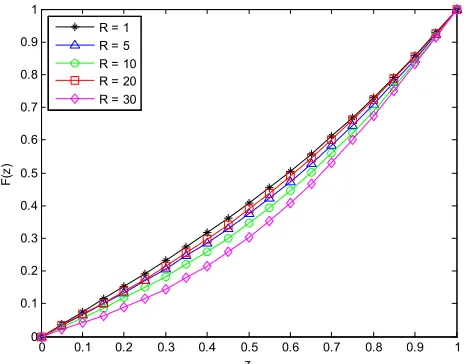
Figure 4 shows the influence of the slip parameter on the fluid velocity. By increasing , it is observed that the velocity of the fluid increases. Figure 5 presents the effects of Reynold’s number on the velocity of the fluid. It is observed from the figure that by increasing the value R, the velocity of the fluid decreases.
Figure 5. Effects of Reynolds number on the flow behavior of the fluid under the influence of slip condition.
5. Conclusion
In this work, Chebychev spectral collocation method has been applied to analyze two-dimensional squeezing flow of a nanofluid under the influence of a uniform transverse magnetic field and slip boundary condition. The approximate analytical solutions have been used to investigate the influence of pertinent model parameters on the squeezing flow. The results that the velocity of the fluid increases with increase in the magnetic parameter under the influence of slip condition while an opposite trend is recorded during no-slip condition. Also, the velocity of the fluid increases as the slip parameter increases but it decreases with increase in the magnetic field parameter and Reynold number under the no-slip condition. The verification of the Chebychev spectral collocation method revealed excellent agreement and accuracy between the results of approximate analytical method and numerical method. The results in this work can be used to further study the squeezing flow in applications such as power transmission, polymer processing and hydraulic lifts
Nomenclature
b induced magnetic fields B total magnetic field Bo imposed magnetic field E electric field
h half of the gap distance between the plates J electric current density
M Hartmann number p pressure
r radius of the pipe Re Reynolds number t time
T Cauchy stress tensor
u velocity component in r-direction v velocity component in z-direction
0 0.1 0.2 0.3 0.4 0.5 0.6 0.7 0.8 0.9 1
0 0.1 0.2 0.3 0.4 0.5 0.6 0.7 0.8 0.9 1
F
(z
)
z m = 1
m = 4 m = 8 m = 10 m = 20
0 0.1 0.2 0.3 0.4 0.5 0.6 0.7 0.8 0.9 1
0 0.1 0.2 0.3 0.4 0.5 0.6 0.7 0.8 0.9 1
F
(z
)
z
γ = 0.0
γ = 0.5
γ = 0.6
γ = 0.7
γ = 1.0
0 0.1 0.2 0.3 0.4 0.5 0.6 0.7 0.8 0.9 1
0 0.1 0.2 0.3 0.4 0.5 0.6 0.7 0.8 0.9 1
F
(z
)
z R = 1
z axis perpendicular to plates
ρ density of the fluid
σ electrical conductivity
γ slip papramter
m
µ magnetic permeability ∇ material time derivatives,
µ dynamic viscosity
References
[1] M. J. Stefan. Versuch Uber die scheinbare adhesion’’, Sitzungsberichte der Akademie der Wissenschaften in Wien. Mathematik-Naturwissen 69, 713–721, 1874.
[2] O. Reynolds. On the theory of lubrication and its application to Mr Beauchamp Tower’s experiments, including an experimental determination of the viscosity of olive oil. Philos. Trans. Royal Soc. London 177, 157–234, 1886. [3] F. R. Archibald, F. R., 1956. Load capacity and time relations
for squeeze films. J. Lubr. Technol. 78, A231–A245.
[4] J. D. Jackson. A study of squeezing flow. Appl. Sci. Res. A 11, 148–152, 1962.
[5] R. Usha and R. Sridharan, R. Arbitrary squeezing of a viscous fluid between elliptic plates. Fluid Dyn. Res. 18, 35–51, 1996. [6] Wolfe, W. A., 1965. Squeeze film pressures. Appl. Sci. Res.
14, 77–90. Yang, K. T., 1958. Unsteady laminar boundary layers in an incom- pressible stagnation flow. J. Appl. Math. Trans. ASME 80, 421– 427.
[7] D. C. Kuzma. Fluid inertia effects in squeeze films. Appl. Sci. Res. 18, 15–20, 1968.
[8] J. A. Tichy, W. O. Winer. Inertial considerations in parallel circular squeeze film bearings. J. Lubr. Technol. 92, 588–592, 1970.
[9] R. J. Grimm. Squeezing flows of Newtonian liquid films: an analysis include the fluid inertia. Appl. Sci. Res. 32 (2), 149– 166, 1976.
[10] G. Birkhoff. Hydrodynamics, a Study in Logic, Fact and Similitude, Revised ed. Princeton University Press, 137, 1960. [11] C. Y. Wang. The squeezing of fluid between two plates. J.
Appl. Mech. 43 (4), 579–583, 1976.
[12] C. Y. Wang, L. T. Watson. Squeezing of a viscous fluid between elliptic plates. Appl. Sci. Res. 35, 195–207, 1979. [13] M. H. Hamdan and R. M. Baron. Analysis of the squeezing
flow of dusty fluids. Appl. Sci. Res. 49, 345–354, 1992. [14] P. T. Nhan. Squeeze flow of a viscoelastic solid. J.
Non-Newtonian Fluid Mech. 95, 343–362, 2000.
[15] U. Khan, N. Ahmed, S. I. U. Khan, B. Saima, S. T. Mohyud-din. Unsteady Squeezing flow of Casson fluid between parallel plates. World J. Model. Simul. 10 (4), 308–319, 2014. [16] M. M. Rashidi, H. Shahmohamadi and S. Dinarvand,
“Analytic approximate solutions for unsteady two dimensional and axisymmetric squeezing flows between parallel plates,”
Mathematical Problems in Engineering, Vol. (2008), pp. 1-13, 2008.
[17] H. M. Duwairi, B. Tashtoush and R. A. Domesh, “On heat transfer effects of a viscous fluid squeezed and extruded between parallel plates,”Heat Mass Transfer, vol. (14), pp. 112-117, 2004.
[18] A. Qayyum, M. Awais, A. Alsaedi and T. Hayat, “Squeezing flow of non-Newtonian second grade fluids and micro polar models, “Chinese Physics Letters, vol. (29), 034701, 2012 [19] M. H Hamdam and R. M. Baron, “Analysis of squeezing flow
of dusty fluids,” Applied Science Research, vol. (49), pp. 345-354, 1992.
[20] M. Mahmood, S. Assghar and M. A. Hossain, “Squeezed flow and heat transfer over a porous surface for viscous fluid,”
Heat and mass Transfer, vol. (44), 165-173.
[21] M. Hatami and D. Jing, “Differential Transformation Method for Newtonian and non-Newtonian nanofluids flow analysis: Compared to numerical solution, “Alexandria Engineering Journal, vol. (55), 731-729.
[22] S. T. Mohyud-Din, Z. A. Zaidi, U. Khan, N. Ahmed. On heat and mass transfer analysis for the flow of a nanofluid between rotating parallel plates, Aerospace Science and Technology, 46, 514-522, 2014.
[23] S. T. Mohyud-Din, S. I. Khan. Nonlinear radiation effects on squeezing flow of a Casson fluid between parallel disks, Aerospace Science & Technology, Elsevier 48, 186-192, 2016 [24] M. Qayyum, H. Khan, M. T. Rahim, I. Ullah. Modeling and
Analysis of Unsteady Axisymmetric Squeezing Fluid Flow through Porous Medium Channel with Slip Boundary. PLoS ONE 10(3), 2015
[25] M. Qayyum and H. Khan. Behavioral Study of Unsteady Squeezing Flow through Porous Medium, Journal of Porous Media, pp: 83-94, 2016.
[26] M. Mustafa, Hayat and S. Obaidat “On heat and mass transfer in the unsteady squeezing flow between parallel plates,”
Mechanica, vol. (47), pp. 1581-1589, 2012.
[27] A. M. Siddiqui, S. Irum, and A. R. Ansari, “Unsteady squeezing flow of viscous MHD fluid between parallel plates,” Mathematical Modeling Analysis, vol. (2008), 565-576, 2008.
[28] G. Domairry and A. Aziz, “Approximate analysis of MHD squeeze flow between two parallel disk with suction or injection by homotopy perturbation method,” Mathematical Problem in Engineering, vol. (2009), pp. 603-616, 2009. [29] N. Acharya, K. Das and P. K. Kundu, “The squeezing flow of
Cu-water and Cu-kerosene nanofluid between two parallel plates,” Alexandria Engineering Journal, vol. (55), 1177-1186. [30] N. Ahmed, U. Khan, X. J. Yang, S. I. U. Khan, Z. A. Zaidi, S.
T. Mohyud-Din. Magneto hydrodynamic (MHD) squeezing flow of a Casson fluid between parallel disks. Int. J. Phys. Sci. 8 (36), 1788–1799, 2013.
[31] N. Ahmed, U. Khan, Z. A. Zaidi, S. U. Jan, A. Waheed, S. T. Mohyud-Din. MHD Flow of a Dusty Incompressible Fluid between Dilating and Squeezing Porous Walls, Journal of Porous Media, Begal House, 17 (10), 861-867, 2014.
[33] U. Khan, N. Ahmed, Z. A. Zaidi, M. Asadullah, S. T. Mohyud-Din. MHD squeezing flow between two infinite plates. Ain Shams Eng. J. 5, 187–192, 2014b.
[34] T. Hayat, A. Yousaf, M. Mustafa and S. Obadiat, “MHD squeezing flow of second grade fluid between parallel disks,”
International Journal of Numerical Methods, vol. (69), pp. 399-410, 2011.
[35] H. Khan, M. Qayyum, O. Khan, and M. Ali. Unsteady Squeezing Flow of Casson Fluid with Magnetohydrodynamic Effect and Passing through Porous Medium," Mathematical Problems in Engineering, vol. 2016, Article ID 4293721, 14 pages, 2016.
[36] I. Ullah, M. T. Rahim, H. Khan, M. Qayyum. Analytical Analysis of Squeezing Flow in Porous Medium with MHD Effect, U. P. B. Sci. Bull., Series A, Vol. 78, Iss. 2, 2016. [37] R. J. Grimm, “Squeezing flows of Newtonian liquid films an
analysis including fluid inertia,” Applied Scientific Research, vol. 32, no. 2, pp. 149–166, 1976.
[38] W. F. Hughes and R. A. Elco, “Magnetohydrodynamic lubrication flow between parallel rotating disks,” Journal of Fluid Mechanics, vol. 13, pp. 21–32, 1962.
[39] S. Kamiyama, “Inertia Effects in MHD hydrostatic thrust bearing,” Transacti ons ASME, vol. 91, pp. 589–596,1969. [40] E. A. Hamza, “Magnetohydrodynamic squeeze film,” Journal
of Tribol ogy, vol. 110, no. 2, pp. 375–377, 1988.
[41] S. Bhattacharyya and A. Pal, “Unsteady MHD squeezing flow between two parallel rotating discs,” Mechanics Research Communications, vol. 24, no. 6, pp. 615–623,1997.
[42] S. Islam, H. Khan, I. A. Shah, and G. Zaman, “Anaxisymmetric squeezing fluid flow between the two infinite parallel plates in a porous medium channel,” Mathematical Problems in Engineer- ing, vol. 2011, Article ID 349803, 10 pages, 2011.
[43] C.-L.-M.-H. Navier, “Sur les lois de l’ equilibre et du movement des corps solides elastiques,” Bulletin des Sciences par la SocietePhilomatique de Paris, pp. 177–181, 1823. [44] C. le Roux, “Existence and uniqueness of the flow of second
grade fluids with slip boundary conditions,” Archive for Rational Mechanics and Analysis, vol. 148, no. 4, pp. 309– 356,1999.
[45] A. Ebaid, “Effects of magnetic field and wall slip conditions on the peristaltic transport of a Newtonian fluid in an asymmetric channel,” Physics Letters A, vol. 372, no. 24, pp. 4493–4499, 2008.
[46] T. Hayat, M. U. Qureshi, and N. Ali, “The influence of slip on the peristaltic motion of third order fluid in an asymmetric channel,” Physics Letters A, vol. 372, pp. 2653–2664, 2008. [47] T. Hayat and S. Abelman, “A numerical study of the influence
of slip boundary condition on rotating flow,” International Journal of Computational Fluid Dynamics, vol. 21, no. 1, pp. 21–27, 2007.
[48] S. Abelman, E. Momoniat, and T. Hayat, “Steady MHD flow of a third grade fluid in a rotating frame and porous space,” Nonlinear Analysis: Real World Applications, vol. 10, no. 6, pp. 3322–3328, 2009.
[49] E. H. Doha, A. H. Bhrawy, S. S. Ezzeldeen, Efficient Chebyshev spectral methods for solving multi-term fractional orders differential equations, Appl. Math. Model. (2011) doi:10.1016/j.apm.2011.05.011.
[50] D. Gottlieb, S. A. Orszag, Numerical analysis of spectral methods: Theory and applications, in: Regional Conference Series in Applied Mathematics, vol. 28, SIAM, Philadelphia, 1977, pp. 1–168.
[51] C. Canuto, M. Y. Hussaini, A. Quarteroni, T. A. Zang, Spectral Methods inFluid Dynamics, Springer-Verlag, New York, 1988. [52] R. Peyret, Spectral Methods for Incompressible Viscous Flow,
SpringerVerlag, New York, 2002.
[53] F. B. Belgacem, M. Grundmann, Approximation of the wave and electromagneticdiffusion equations by spectral methods, SIAM Journal onScientific Computing 20 (1), (1998), 13–32. [54] X. W. Shan, D. Montgomery, H. D. Chen, Nonlinear
magnetohydrodynamicsby Galerkin-method computation, Physical Review A 44 (10) (1991)6800–6818.
[55] X. W. Shan, Magnetohydrodynamic stabilization through rotation, Physical Review Letters 73 (12) (1994) 1624–1627. [56] J. P. Wang, Fundamental problems in spectral methods and
finite spectral method, Sinica Acta Aerodynamica 19 (2) (2001) 161–171.
[57] E. M. E. Elbarbary, M. El-kady, Chebyshev finite difference approximation for theboundary value problems, Applied Mathematics and Computation 139 (2003)513–523.
[58] Z. J. Huang, and Z. J. Zhu, Chebyshev spectral collocation method for solution ofBurgers’ equation and laminar natural convection in two-dimensional cavities, Bachelor Thesis, University of Science and Technology of China, Hefei, 2009. [59] N. T. Eldabe, M. E. M. Ouaf, Chebyshev finite difference
method for heat and masstransfer in a hydromagnetic flow of a micropolar fluid past a stretching surfacewith Ohmic heating and viscous dissipation, Applied Mathematics and Computation 177 (2006) 561–571.
[60] A. H. Khater, R. S. Temsah, M. M. Hassan, A Chebyshev spectral collocation methodfor solving Burgers'-type equations, Journal of Computational and Applied Mathematics 222 (2008) 333–350.
[61] C. Canuto, M. Y. Hussaini, A. Quarteroni, T. A. Zang, Spectral Methods in Fluid Dynamics, Springer, New York, 1988. [62] E. H. Doha, A. H. Bhrawy, Efficient spectral-Galerkin
algorithms for direct solution of fourth-order differential equations using Jacobi polynomials, Appl. Numer. Math. 58 (2008) 1224–1244.
[63] E. H. Doha, A. H. Bhrawy, Jacobi spectral Galerkin method for the integrated forms of fourth-order elliptic differential equations, Numer. Methods Partial Differential Equations 25 (2009) 712–739.