ISSN 2373-7662 (Print) 2373-7670 (Online) Copyright © The Author(s). 2015. All Rights Reserved. Published by American Research Institute for Policy Development DOI: 10.15640/ijn.v3n1a4 URL: https://doi.org/DOI: 10.15640/ijn.v3n1a4
The Value Nurse Workforce
Tatiane Araújo dos Santos
1, Cristina Maria Meira de Melo
2, Juliana Alves Leite Leal
3, Valdira
Gonzaga Rodrigues
4& Handerson Silva Santos
5Abstract
The aim was to understand how the value of the labor force in Brazil is formed, having the workforce of nurses as a case in the context of contemporary work in a theoretical analysis based in the Marx’s theory of value. The methodological steps used were: understanding the concepts of workforce and value from the field of sociology of work, researching data in secondary bases about labor market and correlation of concepts, and data for the nurse workforce. For the analysis, we used the dialectical method. The conformation of the value of the nurse workforce in the Brazilian context dominates the elements that reduce this value, such as: precariousness of job, the competition among nurses, and others nursing professions and occupations such as Community Health Workers (CHW) and caregivers; the insipient organization of nurses as working class. Consequently, if the price of this workforce is below its actual value, this benefits capitalist production mode, and biomedical care model, because they cannot prescient this workforce, since it is essential to coordinate the nursing work process and to articulate the health work processes.
Keywords: Nurse, Workforce, Economic Value. Social value.
1. Introduction
In capitalist society, the sale of workforce as a commodity allows the employee to participate in social relations of production. The workforce is the willingness to work, i.e., the physical and mental vigor, and currently more and more the intellectual vigor that the worker sells in the labor market. As a commodity in capitalism, workforce has, like all other commodities, use-value, and value (Marx, 2013).
1 Nurse. Master in Nursing. PhD Student in Nursing from the Graduate Program in Nursing - UFBA. Assistant Professor at the
Department of Community Nursing, School of Nursing of the Federal University of Bahia. Address: Escola de Enfermagem Campus Universitário do Canela. Rua Basilio da Gama S/N. 3º Pavimento – Grupo Gerir. Bairro: Canela. Salvador Bahia. CEP 40110-907. E-mail: [email protected]. Phone: +55 71 991240639.
2 Nurse. PhD in Public Health. Associate Professor at the Department of Community Nursing, School of Nursing of the Federal
University of Bahia. Addres: Escola de Enfermagem Campus Universitário do Canela. Rua Basilio da Gama S/N. 3º Pavimento – Grupo Gerir. Bairro: Canela. Salvador Bahia. CEP 40110-907. E-mail: [email protected]. Phone: +55 71 981294588.
3 Nurse. Master in Public Health. PhD Student in Nursing from the Graduate Program in Nursing - UFBA. Assistant Professor at the
State University of Feira de Santana - BA. Addres: Escola de Enfermagem Campus Universitário do Canela. Rua Basilio da Gama S/N. 3º Pavimento – Grupo Gerir. Bairro: Canela. Salvador Bahia. CEP 40110-907. E-mail: [email protected]. Phone: +55 71 992161545.
4 Nurse. Master Student in Nursing from the Graduate Program in Nursing - UFBA. Coordinator of the Internal Audit Service of the
University Hospital Professor Edgar Santos/UFBA. Addres: Escola de Enfermagem Campus Universitário do Canela. Rua Basilio da Gama S/N. 3º Pavimento – Grupo Gerir. Bairro: Canela. Salvador Bahia. CEP 40110-907. E-mail: [email protected]. Phone: +55 71 991236723.
5 Nurse. Master in Nursing. PhD Student in Nursing from the Graduate Program in Nursing - UFBA. Assistant Professor at the
Value can be understood as "the social form acquired by the work products in the context of certain relations of production between people" (Rubin, 1980, p.83). This means that the value cannot be determined either before or outside of the exchange process and of the relations of production. It is in the production process that connections between various producers are established, allowing production to become a social phenomenon. It is also in the production process that the value of the workforce comprises the exchange relationship between the worker and the owners of the means of production. The value assigned to the workforce in this process is configured from the appearance of this particular job, regarded as socially necessary for the production of a given commodity (Marx, 2013; Rubin, 1980).
The value of the workforce is composed by the value of the livelihoods of a worker. These livelihoods are: access to goods, services and commodities related to consumer habits; spending habits with the qualification of the worker, as the more qualified the workforce, the greater its value. This value is limited by the extension of the working day, the intensity of work and by the productive power of labor. These variables influence each other so that the value of the workforce only changes as a result of the concomitant change in the journey composition, in the intensity of labor and in its productive force (Marx, 2013).
The price paid for the workforce commodity can also derogate from its value, showing no relation between them (Marx, 2013; Rubin, 1980). The minimum limit for the value of the workforce is calculated by the sum of goods necessary for the maintenance of the worker. If the price of the workforce approaches this minimum limit, the value assigned to the workforce by the mode of production will not allow the worker's development.
The work of the nurse, in the context of Brazilian capitalism, has the characteristics to be classified as having an economic rationality: it has use-value; it has an exchange value; it is produced in the public sphere, in a time that can be measured. This makes the nurse a socially useful good, with use-value and exchange value (Gorz, 2007).
Nurses, as any worker who own the workforce commodity, need to sell it in order to accomplish their use-value, and as a result of this sale, they will be able to acquire the goods necessary for them to survive daily and return to the labor market, renewing the sale of their workforce.
The nurse workforce is characterized by elements that add value to them, such as their training experience, the nature of the work they perform and because this profession is, in the field of nursing, the one that appropriated intellectual work, which is considered more complex. Other elements, characteristic of this workforce, such as the technical and social division of labor, female labor, the intensity, and the duration of the working day and the formation of the reserve army, contribute to decrease the value of nurse workforce and approach it to the minimum limit.
Although nurses perform a qualified work, characterized as intellectual work in their professional field, the price of the nurse workforce has been decreasing in the last ten years (Brasil, 2011a, 2011b). In the context of work in contemporary society, when flexibility is enhanced and new forms of insecurity are introduced, the value of the workforce often is reduced. This context subjects the employee to working days that leads them to physical and mental wear, and to maintain working links that do not guarantee their minimum social rights (Druck, 2011).
We started from the hypothesis that the elements that contribute to the assignment of a lower value of the nurse workforce –excessive insecurity and flexibility of labor, technical and social division of labor, increased working hours and intensity of work and female labor - are preponderant in relation to those that contribute to assign greater value to this workforce. Given the characteristics of work in the contemporary world, this difference tends to increase unfavorably for nurses.
Moreover, the nurse’s work is relevant to the recovery of sick individuals and for the maintenance of life in contemporary society, since it ensures the conditions for the actions and health services are provided in the public sphere (Hernandez et al, 2011). Therefore, the predominance of the factors that assign a lower value to the nurse workforce is convenient for the capitalist mode of production. The owners of the capitalist means of production, by supporting the production of surplus value through the exploitation of the workforce, can keep in their staff a workforce that, while being qualified to meet the demands of the system, such as nurse workforce, can be purchased for a low price.
2. Method
This is a theoretical and empirical analysis that is grounded on studies on sociology of work, value, and value of workforce (Marx, 2013; Rubin, 1980) to understand how these elements are conformed regarding the nurse workforce in Brazil.
In order to identify the variables to understand the value of the nurse workforce, we performed the reading of Marxist works (Marx, 2013; Rubin, 1980) and the works of the nursing field, which were chosen by the proximity to the object of this study (Melo, 1986; Silva, 1986; Alves, 1987, Pires, 1989, Germano, 1993, Collière, 1999).
The analysis variables were female labor; training time needed to production of skilled labor; the partial division of labor and the restructuration ofnurse work in contemporary society; working experience, analyzing the working hours and the intensity of the nurse work and how these factors influence the conformation of the value of their workforce.
There has been continuous and systematic review of the literature on the variables. We used the research bases SciELO and Lilacs, with the descriptors: work, value, value of the workforce, nurse work, nursing work, nursing labor market, nurse labor market. The inclusion criteria were: full text articles that addressed the research theme and that were published in the last 20 years, given the scarcity of publications on this topic. Exclusion criteria were: articles with incomplete text or that did not address the same research theme, although presenting the descriptors in their abstracts. A total of 77 articles were used in the fields of Sociology, Health, and Nursing. This search for the dissertation was held in the archive of university libraries.
Secondary data on nurse labor market and health (salary, working hours, type of labor contract, number of professionals) were found by searching in the websites of Observatório de Recursos Humanos em Saúde/Estação de Pesquisa
Sinais de Mercado/Núcleo de Educação em Saúde Coletiva/Faculdade de Medicina da Universidade Federal de Minas Gerais
(Observatório de Recursos Humanos em Saúde, 2011) and of theConselho Federal de Enfermagem(Cofen, 2010).
Other data on the nurse labor market were accessed through the Cadastro Geral de Empregados e Desempregados - General Register of databases of Employment - and Unemployment (Brazil, 2011b) and the Relação Anual de
Informações Sociais - Annual Social Information - (Brazil, 2011a), which refer only to formal employment relationship.
Thus, the information used is limited as it does not include the informal labor market for nurses.
The dialectical method involves critical and totalizing reflection on the topic, as it submits the previously existing interpretation of the object of studyto analysis (Ianni, 1988). Therefore, we made a critical review of existing concepts, in order to be incorporate or overcome them. The use of dialectics allowed decomposing reality or the knowledge produced to obtain an overview, which was reworked in a constant search not for an absolute truth, but for the historical truths about the value of the nurse workforce. Its basic elements are the thesis-statement, the antithesis-denial or opposition and the synthesis-result that contradicts other elements (Oliveira, 1990; Ianni, 1988).
To understand the value of the nurse workforce we analyzed not the value itself, which is composed of complex categories, but the simple categories that make up this concept. So, we started with the understanding of the work, the simplest category, and by identifying the attributions of nurse's work, we reached to the understanding of its value. By doing the opposite route, it was possible to understand that the value of workforce is the result of a set of relationships about and in nurse’s work.
3. Results And Discussion
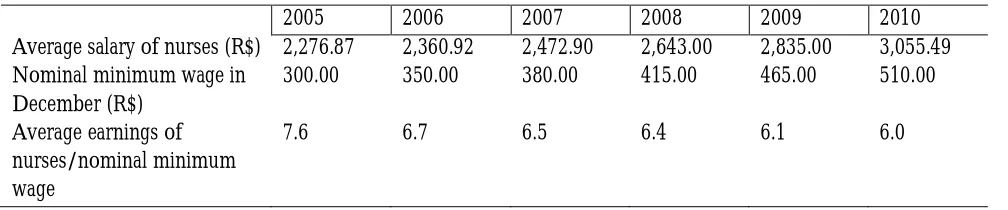
To analyze the value of the nurse workforce, we started from the immediate phenomenon - its price, the salary. When comparing the average salary of nurses and a nominal minimum wage (Table 01), taking as reference six years, it is observed that the corresponding quantitative relationship between the minimum wage and nurse’s salary has been decreasing, especially in 2010, where there was wage loss for nurses.
Table 1: Average salary of nurses, nominal minimum wage, Brazil, 2005-2010
2005 2006 2007 2008 2009 2010
Average salary of nurses (R$) 2,276.87 2,360.92 2,472.90 2,643.00 2,835.00 3,055.49 Nominal minimum wage in
December (R$)
300.00 350.00 380.00 415.00 465.00 510.00
Average earnings of nurses/nominal minimum wage
7.6 6.7 6.5 6.4 6.1 6.0
Source: DIEESE, 2006; Observatório de Recursos Humanos em Saúde, 2011
Since the minimum wage is rectified taking into account the losses for the period, and the average pay of nurses has been equal to less and less minimum wages, it appears that there is no real gain to the salary of the nurse or the gain is extremely low. Therefore, nurses’ salary approaches the threshold to supply their basic needs, because it has been representing a smaller proportion of minimum wages each year.
The increased number of graduates, added to economic factors, has contributed to increase the formation of nurses reserve army. In this case, the formation of the reserve army has its negative impact increased by the fragile political organization of these professionals, which forces them to yield individually to capital pressures always accepting, more and more, lower salaries and increased working hours. A category with an incipient political organization, like the nurses, is more likely to disrupt in the search for jobs in the labor market, because each worker seeks for a position, and when the achieve it, they negotiate salary and journey individually.
In addition to the formation of the reserve army, competition among workers lowers the wage and among nurses, this is enhanced through competition with complementary workforce. The technical division of nursing labor in in Brazil establishes that, in the hospital, patient care is mainly provided by technical and nursing assistants. In this scenario, the nurses’ work is primarily the management of nursing care, the articulation between the various work processes in health, and also the articulation of materials and supplies necessary for the provision of care and production of other services by the nursing team and by health professionals. Continuing education for the nursing staff, keeping them up to date as to technological advances and scientific knowledge, is also nurses’ attribution.
Studies (Lima and Magalhães, 2006; Rossetti and Gaidzinski, 2011) indicate that there is in hospital organizations deficit of nurses in relation to the number of technicians and assistants. This suggests that in the daily production of hospital services technicians and assistants perform procedures that are attributed only for nurses, especially in service-producing units that require less qualification and/or expertise. Persistence of the deficit of nurses in health services can be partly explained by the fact that the nurse is the most expensive workforce in the field of nursing. For the employer, it is cheaper to use technicians and assistants workforce for the execution of care procedures, using the nurse workforce in managerial activities, and occasionally, in care.
Piecemeal division of nursing labor in Brazil still produces a peculiar situation. In the last 20 years, there have been the occupations that in practice perform actions of nursing field, acting as additional workforce in this field, namely community health workers (CHW) and caregivers of children and elderly. Although CHWs are not formally included as one of the professions of nursing, they represent another piecemeal division of labor in this field by covering actions that are historically developed by nurses in primary health care in Brazil, such as the educational actions in health and monitoring of groups and individuals in different territories, such as the home. Therefore, the CHW workforce is used to expand the coverage of basic care programs formulated by the Ministry of Health, for a cheaper price than the other nursing workers do.
The caregiver's role can be paid or not, and the Ministry of Health points out that this worker cannot perform routinely techniques or procedures regulated by the Federal Nursing Council. However, in the technical handbook developed by this very Ministry (Brazil, 2009) to direct the caregivers’ actions there are similar guidelines to the activities performed by nursing technicians and assistants. However, for the caregiver to perform these activities, no qualification is required.
Thus, it can be stated that the existence of caregiver category is another way to lower the cost of workforce in health, and given the similarity between the actions taken by the caregivers and the nursing technicians/assistants, the former also represent a reserve army in the nursing field. It is noteworthy that the caregiver activity is very similar to the former category of nursing attendant, who assisted the patient regarding hygiene and other less complex procedures and that, however, assumed in everyday services, including the hospitals, responsibilities legally defined for nursing professionals.
In everyday services and in the competition in the labor market, the field of nursing is divided in five categories, two of which are regarded as complementary: the CHW and the caregiver. The new occupations disputing for performance of care with nursing workers contribute to the cheaper purchase of this workforce, given that they demand less qualification. This complementary workforce favors the reduction of the price paid by the nurse workforce (and nursing technicians and assistants) and takes some of the work that nurses could perform.
Regarding the valorization of the workforce, the piecemeal division of labor between nurses, technicians, assistants, CHWs and caregivers (the latter two in a complementary basis) contributes to the loss of the uniqueness of the nursing work. This new technical division of labor that incorporates low-skilled occupations also affects the value of the nurse workforce. In this division of labor, the market starts to depose nurses, to some extent, of the realization of relevant and complex activities.
As for the journey and the intensity of the nurse work, these factors converge to the reduction in the value of the workforce, because if the price does not compensate for wear suffered by the worker due to intensity of work and working hours, its value decreases, even though the price is momentarily high (Marx, 2013).
Nurses, nursing technicians and assistants have a weekly workload of 30 to 44 hours; since the workday can range from 6, 8, 12 or 24 hours, or workload of six hours a day during four days and twelve hours in one day, according to the employment contract. Nursing professionals who work in public services are usually included in a 30 hours/week basis (Fiocruz, 2012). However, employees in private services have workload defined in accordance with the interests of the employing organization. However, in both cases, there is no legislation establishing the specific work hours in nursing.
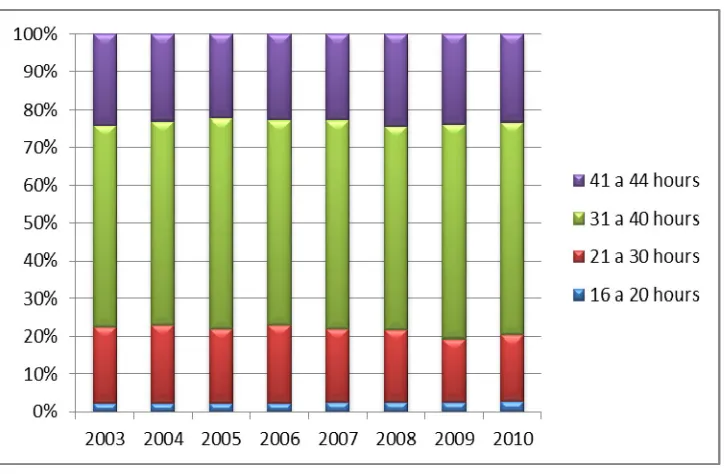
Analyzing the weekly working hours of nurses from 2003 to 2010, it is observed that there is growth in the formal labor relationships, whose journey is from 31 to 44 hours (Figure 1).
Figure 1: Weekly working hours, Nurses, Brazil, 2003-2010
The increase in working hours is also perceived by the accumulation of employment bonds by nurses in order to compensate for the low wages received (Freitas, Fugulin and, Fernandes, 2006). As Figure 1 refers to the journey of a single bond, it can be inferred that nurses are working much more than 40 hours per week due to the accumulation of bonds. In addition to the absolute increase in workload, which is represented both by the number of hours worked as by the accumulation of bonds; we highlight the issue of overtime (Duffield, Gardner and, Catling-Paull, 2008). In the context of Toyotism, that organizes work based on a small number of workers, working overtime is one of the practices to increase the use of the workforce. Thus, it is a mechanism employed by the Health Departments as a way to remedy the shortage of nurses (Veras, 2003).
Another practice in nursing responsible for the increase in working hours is the work "sublease" (Veras, 2003, p. 76) known as sale of shifts. This situation occurs when a nurse passes on her work schedule (sells the shift) to another nurse, who takes it in exchange for a payment (purchase the shift). The sale of shifts is a kind of outsourcing work schedule among nurses. The alleged reasons for this practice are: the coincidence between shifts of different jobs; the physical and mental fatigue, also because of the multiple bonds; personal reasons. The nurse who buys the shift of her colleague claims low payment as a reason for this, with the extra shifts serving as a complement to the salary. The sale of shifts and the maintenance of many bonds to compensate the low wages evidence that nurses contribute to reduce the value of their workforce. Thus, the value of their workforce decreases further because there is not even the momentary financial compensation for the wear of their ability to work.
Another factor worth mentioning is the intensity of the working day. For the nurse, the increased intensity of work is evident when they have to answer, in a single shift, for more than one healthcare production unit; when by managing nursing teams with number of workers less than the recommended, they are required to perform procedures that would be under the responsibility of nursing technicians/assistants; when they provide consulting services to the health service to which they are linked, for example regarding equipment purchase, inputs, implementation of some service, evaluation or technology, without receiving salary and/or recognition for such activity; and finally, the increased intensity is also revealed in the overcrowding of patients in the wards and other facilities at the hospital, which leads the nurse and other workers to provide assistance to a number of patients above the recommended, or to keep in the shift (double workload) due to the lack of workers to replace them.
In primary health care network, this intensity is configured when, due to lack of professionals, the nurse is in charge of supporting other team members’ work or takes responsibility for a number of families larger than recommended by the Ministry health, or has to answer partially or totally by the managerial duties in basic health unit. This entire situation is aggravated by poor conditions and work overload, submitting the worker to physical, biological, and psychological hazards. The fragile political organization of nurses also contributes to the maintenance of this situation, since they act individually to circumvent this situation and not invest in collective action.
4. Final Considerations
Through the analysis of the variables that comprise the value of the nurse workforce and using the elements of the dialectical method, it can be considered:
Thesis: The value of the nurse workforce is high because of their qualifications, by the increasing training
time and by the expansion of the scope of knowledge required for the production of this workforce; by the care and managerial nature of the work, allowing to work in various health services; and by the nurse’s role as intermediary manager in the capitalist mode of production, to articulate the workforce and inputs to the realization of care.
Antithesis: The value of the nurse workforce is reduced because of structural conditions, which in the
Synthesis: In the formation of value of the nurse workforce in the Brazilian context, the elements that
reduce this value are predominant. Consequently, the price of this workforce has been reduced below its value, which benefits the capitalist mode of production and the biomedical care model, as these cannot dispense with nurse workforce, which is essential to coordinate the nursing work process and to articulate the health work processes.
The understanding of the value of the nurse workforce is based not only in economic aspects but also in the social relations of production. Overcoming these relationships, which also support the biomedical care model, cannot be achieved in technical-professional level. This confrontation requires the collective organization of the category and the explanation of the political dispute between the nurses and between nurses and other workers in nursing and health fields. In this dispute, nurses need to collectively develop strategies that lead to changes within the profession as well as in the social context in order to overcome or mitigate the obstacles that interfere in social recognition and the economic value of their work.
References
Marx, K(2013) O capital: crítica da economia política. Livro 1: O processo de produção do capital. Boitempo, São Paulo.
Rubin,II(1980) A teoria marxista do valor. Tradução de José Bonifácio de S. Amaral Filho. Brasiliense, São Paulo. Gorz, A(2007) Metamorfoses do trabalho: crítica da razão econômica. Tradução de Ana Montoia. 2nd edn.
Annablume, São Paulo.
Brasil (2011a) Ministério do Trabalho e Emprego. Relação Anual de Informações Sociais. Base online. www.mte.gov.br/rais/default.asp (accessed2 july 2011).
Brasil (2011b) Ministério do Trabalho e Emprego. Cadastro Geral de Empregados e Desempregados (Caged). www.portal.mte.gov.br/caged/ (accessed 2 july 2011).
DruckG(2011) Trabalho, precarização e resistência: novos e velhos desafios? Cad CRH 24 (1): 37-57.
Daune-Richard AM (2003) Qualificações e representações sociais. In: Maruani M,Hirata H, org. As novas fronteiras da desigualdade: homens e mulheres no mercado de trabalho. Tradução de Clevi Rapkieviez. Editora Senac, São Paulo: 65-76.
Hernandez MLG et al (2011) Construcción emergente del concepto:cuidado profesional de enfermería.Texto contexto - enferm.20(spe): 74-80.
Melo C (1986) Divisão social do trabalho e enfermagem. Cortez, São Paulo. SilvaGB (1986) Enfermagem profissional: análise crítica. Cortez, São Paulo.
Alves DB (1987)Mercado e condições de trabalho na enfermagem. Gráfica Central, Salvador. PiresD (1989) Hegemonia médica na saúde e a enfermagem. Cortez, São Paulo.
Germano RM (1993) Educação e ideologia da enfermagem no Brasil. Cortez, São Paulo.
Collière MF (1999)Promover a vida. Da prática das mulheres de virtude aos cuidados de enfermagem. 2nd edn.LIDEL, Porto.
Observatório de Recursos Humanos em Saúde (2010) Estação de Pesquisa de Sinais de Mercado. Sinais de Mercado– dados sobre salário, média salarial por hora trabalhada e índice salarial.Núcleo de Educação em Saúde Coletiva. Faculdade de Medicina da Universidade Federal de Minas Gerais.
www.epsm.nescon.medicina.ufmg.br/epsm (accessed 10 march 2010).
Conselho Federal de Enfermagem (2011)Análise de dados dos profissionais de enfermagem existentes nos Conselhos Regionais.www.novo.portalcofen.gov.br (accessed15 august2011).
Oliveira MA (1990) Dialética e Hermenêutica em Jurgen Habermas. In: Haguette TMF, org.Dialética hoje. Vozes, Petropólis: 81-115.
Ianni O (1988)Dialética e capitalismo:ensaio sobre o pensamento de Marx. Vozes, Petrópolis.
Dieese (2006)Departamento Intersindical de Estatística e Estudos Socioeconômicos. Nota técnica número 33. O trabalhador da saúde em seis regiões metropolitanas brasileira. Setembro de 2006.
http://www.dieese.org.br(accessed 31 august2011).
Inep (2011)Instituto Nacional de Estudos e Pesquisas Educacionais Anísio Teixeira. Censo da Educação Superior. www.portal.inep.gov.br/web/censo-da-educacao-superior(accessed 24 may 2011).
LimaLB,Magalhães AMM (2006) Dimensionamento de pessoal de enfermagem em centro cirúrgico. Rev Gaúcha Enferm27(3): 426-433.
Rossetti AC, GaidzinskiRR (2011)Estimativa do quadro de pessoal de enfermagem em um novo hospital. Rev Latino-Americana de Enferm19(4): 1011-1017.
Brasil (2009) Ministério da Saúde. Secretaria de Atenção à Saúde, Secretaria de Gestão do Trabalho e da Educação na Saúde. Guia prático do cuidador. 2nd edn. Ministério da Saúde, Brasília.
PierantoniCR,VarellaTC (2002) Classificação Brasileira de Ocupações (CBO)-2002 - perspectivas para análise do mercado de trabalho em saúde com o foco na Enfermagem. Rev Formação2(6):55-68.
Fiocruz (2012)Fundação Oswaldo Cruz. A saúde no Brasil em 2030: diretrizes para a prospecção estratégica do sistema brasileiro. Fiocruz/Ipea/Ministério da Saúde/Secretária de Assuntos Estratégicos da Presidência da república, Rio de Janeiro.
Freitas GF, Fugulin FMT,Fernandes MFP (2006) A regulação das relações de trabalho e o gerenciamento de recursos humanos em enfermagem. Rev Esc de Enferm – USP40 (3): 434-438.
Duffield C, Gardner G, Catling-Paull C (2008) Nursing work and the use of nursing time. J of Clin Nurs 17(24): 3269–3274