International Journal of Current Research in
Biosciences and Plant Biology
Volume 4 ●Number 10 (October-2017) ● ISSN: 2349-8080 (Online)
Journal homepage: www.ijcrbp.com
Original Research Article doi: https://doi.org/10.20546/ijcrbp.2017.410.007
Bioecological and Agrocultural Properties of
Ranunculus
L. in the Flora of
Azerbaijan
T.M. Akbari*
PhD Student, Institute of Botany of the Azerbaijan National Academy of Sciences (Baku), Azerbaijan
*Corresponding author.
A b s t r a c t A r t i c l e I n f o
In this article, the results of agricultural and bioecological analysis of Ranunculus genus species are described. Our researches were conducted on different ecological conditions on plants having different areas. We proposed the taxonomy of Ranunculus in Azerbaijan on the basis of division by Ranunkier who firstly proposed life forms of plants in 1884. According to this division, 6 species R. cornutus, R. muricatus, R. ophioglossofolius, R. scleratus, R. arvensis, R. chius are terophytes, the rest are hemicripthophytes.12.5% of researched species are found in steppes, 41.67% in lower and middle mountainous layers, 8.33% in middle and high layers, 25% in subalpine and alpine, 12.5% in high layers. The agricultural applications of Ranunculus species related with their medical importance, feed plant and application as decorative plants.
Accepted: 30 September 2017 Available Online: 06 October 2017
K e y w o r d s
Azerbaijan
Bioecological traits Medical herbs
Ranunculus
Introduction
Ranunculus types have a great agricultural importance. Nowadays herbal medicines are greatly demanded. In old times people treated illnesses with herbals. These herbals are widely used in pancreatic, diuretic, painful, anti- fever, cardiovascular and diabetes. Ranunculaceae
was included 146 species in the former Soviet Union (1937) (15 in Arctic, 43 in the USSR, 58 in the Caucasus, 32 in West Siberia, 22 in East Siberia, 17 in Far East, 55 in Central Asia).
Bioecological researches are considered important for identification of the ways to solve arguments on most aspects including species formation. Our researches were conducted on different ecological conditions on plants having different areas. Ecology of Ranunculus
was researched by many scientists. However, in the present research, it was done in the flora of Azerbaijan.
Materials and methods
The research of Ranunculus species was conducted through all regions of Azerbaijan. These researches were conducted in different ecological conditions and in different periods following standard methods and procedures.
Results and discussion
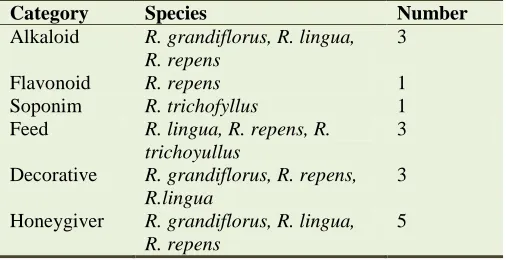
Below listed Tables reflects the results of our research on the importance and bioecological study of
Ranunculus. The phytochemical category of Ranunculus
have high level of chemicals which are used in different areas of economy. Therefore, species can be divided into the following major groups. Medical herbs.Ranunculus
species are toxic plants (Vereshagina, 1959). As a result of research, scientists have found that small doses of aquatic anemia affect the nervous system, increases the member of erythrocytes in hemoglobin, also has antimicrobial and fungal effects that are used in many intestinal diseases. Also, medicals used in skin tuberclulosis are from its leaves.
Table 1. Phytochemical category of Ranunculus.
Category Species Number
Alkaloid R. grandiflorus, R. lingua, R. repens
3
Flavonoid R. repens 1 Soponim R. trichofyllus 1 Feed R. lingua, R. repens, R.
trichoyullus
3
Decorative R. grandiflorus, R. repens, R.lingua
3
Honeygiver R. grandiflorus, R. lingua, R. repens
5
Most Ranunculusesare toxic plants. However, there are some less poisonous species. Animals may be poisoned by eating some species. Poisonous- R. sceleratus, R. arvensis, R. lingua, R. repens, R. bulbosus.
Freshly packed Ranunculus is used in homeopathy, padagra, neuralgia, and many other skin diseases. People use it as medicine in wounds, headaches, burns, as well as tonusator (Bogatkina, 1984) as it contains flavooid and alcohols. These substances affect the nervous system and the amount of erythrocytes in the blood. It also has antimicrobial features (affect staphylococcus and intestinal trash). Ranunculus is used in skin diseases (podagra, neuralgia, headache, furuncle).
According to the researches of different scientists this species contain saponin, alcohol, carotene, vitamin C, flavonoids, vaccine and anemone. It is usually used in the treatment of dirty wounds, dermatology, and bacterial anti-gum negative. R. sceleratus toxic Ranunculus contains essential oil, saponin alcohol, choline, vaccine coumarin, lactone, and anemone; there are coal steroids, saponins, alcohols, vaccines, flavonoids, fat oil. It can be used in tuberculosis, headache, heart attack, skin cancer. Drugs made of roots are useful in skin diseases.
R. repens—areptile Ranunculus is rich with saponin,
alkaloid, and kumarine. It can be used during injuries, as well as in the treatment of fever. Its fruit is bird’s nutrition, and is used in soups.
R .bulbosus is used in homeopathy, neuralgia, flu, skin
diseases, padagra and lipomas. It’s also important as feed.
R.chius- is used as anti-fungal.
R. illiricus contains vaccines, alcoholics, coumarins,
umbelelliferon, scopoletti, and flavonoid. It can be used as herbal bath in some diseases as it has an anti-bacterial effect.
R. lingua- used in fever. Ranunculus contains sinxic
acid, it is visible only in new harvested plants. The type
of R. arvensis is richer with this acid. Generally, they
have high protein content. Although it contains toxic substances, green leaves and flowers are eaten by small horned animals. It also have decorative feature except medicine. Medicine, feed, honey, etc. features are also widely spread.
And it depends on the degree of flavonoids and alkaloids in their content. Most species have high concentrations of alkaloids in the roots and it depends on the development of the plant and their ending conditions. The concentration is low in the trunks and leaves according to their development condition.
All types of Ranunculus are toxic plants. They contain a large amount of alkaloids. When these plants are dry, the percentage of toxic substances in them is reduced.
The second main feature is its use as feed plant. Some species of Ranunculus are used. It’s the feed of cattle,
birds and gazelles. It’s a decorative plant. So, the beauty of outer appearance allows the use of these plants as decorative herbs. The larger flower of some species (Ivanova, 1970) considers the beautiful images and shimmering petals should be planted as decorative plants. Some species are spread in high mountain ranges as it attracts more people. For ex: R. lingua, R. grandiflorus.
flowering. This is also useful for both land and economics.
As we know, the purification of these plants is carried out by insects. Insects take powder and honey from the nectar. The quantity of honey in different species is various. During mass flowering, the amount of biologically active substances increases and varies according to species. Many of the honey plants are also medical herbs (Ivanovka, 1970, Kartasheva).
Most Ranunculuses are considered as honey giver, while nectar and pollen are pollinated with insects and these species are included in the spring. Most of the 24 species and 7 subspecies of Ranunculus in Azerbaijan flora are considered useful plants. Among the species of economic importance are the main herbs. Taking into account this feature of many decorative species, cultivation is important. Almost all of the 24 species spread in Azerbaijan have economic significance.
Ranunculus species are found in all botanical geographical regions of Azerbaijan. They are spread from steps to mountainous regions, both in water and ground conditions. Ranunculus species creates step and pratenzaphytosenosises and associations in some locations. They are most often found in middle and high mountainousareas.
Ranunculus species formed different plant groups in the flora of Azerbaijan.
Effects of some environmental factors must be considered on researching environmental traits of
Ranunculusspecies. Ranunculusspecies are divided in 2 groups for their relationship to light:
Heliophytes (L.max.) –these species like sunshine, mostly
grow in lighter places where sun shines – R.lingua, R.strigillosus, R.scleratus.
Heliocitsiophytes(L.opt.)– shadow tolerant species, they
grow at shiny places but they develop better at shadowy places – R.repens, R.buhsei, R.elegans. Most species of the genus are heliophytes.
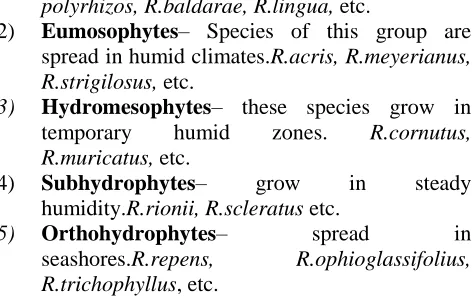
On relationship with humidity, the genus is divided into 5 groups:
1) Pseudoxerophytes– these species grow in dry
climates. They have a short vegetation period during relatively humid times of year. R.
polyrhizos, R.baldarae, R.lingua, etc.
2) Eumosophytes– Species of this group are
spread in humid climates.R.acris, R.meyerianus, R.strigilosus, etc.
3) Hydromesophytes– these species grow in
temporary humid zones. R.cornutus,
R.muricatus, etc.
4) Subhydrophytes– grow in steady
humidity.R.rionii, R.scleratus etc.
5) Orthohydrophytes– spread in
seashores.R.repens, R.ophioglassifolius, R.trichophyllus, etc.
Ranunculus in Azerbaijan can be divided into 5 groups for their physical specifications:
1. Petrophytes–9 of ranunculus species in
Azerbaijan are spread in sandy and stony conditions.R.illiricus, R.chius, R.grandiflorus, R.oreophilius, R.arachoides, R.crassifolius, R.buhsei, R.merovensis, R.strigillosus
2. Agrillophytes– grow in muddy soils. R.aucheri
3. Species growing in forest grey soils.R.elegans
4. Species, which are regardless to soil type. All
the rest species are in this group.
There are many similar plant-covering zones because physical-geographical condition of territory of Azerbaijan is very different.
We propose the taxonomy of Ranunculus in Azerbaijan on the basis of division by Ranunkier who firstly proposed life forms of plants in 1884. According to this division, 6 species R.cornutus, R.muricatus, R.ophioglossofolius, R.scleratus, R.arvensis, R.chiusare
terophytes, the rest are hemicripthophytes (Table 2).
Hemicripthophytes are dominant through the
Ranunculusspecies. For Serebryakova perennial and annual are found within these species. The other species researched are perennial. Life forms of the Ranunculus
species are annual and perennial (Table 3).
Table 2. Life forms of Ranunculus.
Life forms Hemicripthophytes Terophytes Numbers of
species
18 6
Percentage 75% 25 %
Lots of other genus species grow along with Ranunculus
Rumex L., Senecio L., Silene L., Allium L., Gladiolus L.,
Ophrys L., Tulipa L., Linum L., Bellevalia Lapeyr,
Muscari Mill., Lotus L., Lathyrus L., Lamium L,
Filipendula Mill., Dianthus L. Brassicaceae Roth,
Polygonaceae Juss., Asteraceae Dumort., Liliaceae L.,
Hyacintaceae Batch., Campanulaceae Adans.,
Euphorbiaceae Juss., Caryophyllaceae Juss., Apiaceae
Lindl., Fabaceae Lindl.
R.oxyspermus is found in all areas regardless of soil type. R.illiricus, R.grandiflorus are found in stony soils. They grow together with Hyacinthaceae, Brassicaceae
species.
R.illiricus is found in Minor Caucasus central-southern, mountainous and step zones of Nachichevan. R.illiricus
phytosenosis found in Shahbuz region, around Batabat lake, near Zorsping, in the village of Bichenek. These formations are Ranunculus covers. Neighbourhood of them Hyacinthaceae species are often found.
R.repensis found in though all Azerbaijan. Especially in forest regions, along with rivers, springs, humid locations. It is spread in most areas of the world, it is considered cosmopolite. Grows beside Dianthus, Muscari, Allium, Lamium, it was described from Europe. It is found even in Crimea, Western and Eastern Siberia, Far East, Northern Persia and America.
R.linguawas collected from Khizi by Grossgeym. In the flora of Caucasus, it was also indicated that it was collected from Khizi in Azerbaijan. Recently it is found in Guba region as well. It is found from steps to high mountainous locations. In the literature data, it is an area indicated to be Siberia, Stavropol and Southern-west of Turkey. Firstly, it was described from Europe.
R.cicitariusis found up to middle mountainous layers, Kobustan, Major Caucasus, Shabran, Caspian shore, also Central Minor Caucasus, Diabar, Lenkoran regions. In Caucasus, it is widespread in Dagestan, Western Caucasus and Persia.
Depending on altitude, genesis and environmental factors affect in areal of the species. The object of our research–Ranunculus grows in lower, middle and high mountain layers, subalpine and alpine and nival with one species. The annual species are found in steppes and lower layers, perennial species are found in other higher layers. That is why the division by Prilipco was considered to be proper for clarification of spread
principles of Ranunculus depending on altitude (Table 3).
Table 3. Percentage of the species depending on altitude.
Layers Number
of species
Percentage (%) Steppe (70-400 m) 3 12.5 Lower and middle mountaneous
layer 500-1000 m
10 41.67
Middle and high mountaneous layer 800-1800 m
2 8.33
Subalpine and alpine layer 1900-2350 (2400 m)
6 25.0
High mountainous layer 2350-2400 (2500 m)
3 12.5
I. Steppe zone– 70-400 m altitude. 3
ranunculus species found–R. chius, R. cornetus, R. ophioglosiflius.
II. Lower and middle mountaineous layer 10
species found – R. lingua, R. scleratus, R. repens, R. meyerianus, R. muricatus, R. arvensis, R. oxyspermus, R. cicutarius, R. illiricus, R.trichophyllus.
III. Middle and high mountaineous layer 2 species found – R.glandiflorus, R.polyrhizos.
IV. Subalpine and alpine layers– 6 species R.
strigillosus, R. oleophyllus, R. baldarae, R. crassifolius, R. arachnoideus, R.elegans.
V. High mountaineous layer–3 species R.
buhsei, R. aucheri, R.rioni.
Azerbaijani species of Ranunculus are found from steppe to nival. It was identified that, they are mostly found in lower, middle mountainous layers, subalpine and alpine layers. 12.5% of researched species are found in steppes, 41.67% in lower and middle mountainous layers, 8.33% in middle and high layers, 25% in subalpine and alpine, 12.5% in high layers. They are found almost in all regions of Azerbaijan including agricultural areas, forests, roadsides, stony soils etc.
Conflict of interest statement
Author declares that there is no conflict of interest.
References
Гроссгейм, А. А. Флора Кавказа / А. А. Гроссгейм. – Изд-во Аз.ФАН, Баку, 1930. – Т. II. –C. 115–119. Карягин, И.И. Флора Азербайджана. Род Ranunculus
Т.ХIII, Т.IV, 1953. – C. 72–99.
Кемулярия-Натадзе, Л.М. Раналиевые на Кавказе и их таксономия / Л. М. Кемулярия-Натадзе. – Изд-во Мецниерева. Тбилиси, 1966. – C. 178– 255.
Конспект Флоры Кавказа: В 3-х томах. Т. 3, ч. 2 / Отв. ред. А.Л.Тахтаджан.Ред. Г.Л.Кудряшова, И.В. Татанов. – СПб.; М.: Товарищество научных изданий КМК, 2012. – 613 с.
How to cite this article: