Smaranika Mohapatra et al, International Journal of Computer Science and Mobile Applications, National Conference on “The Things Services and Applications of Internet of Things”, Gandhi Institute for Education and Technology (GIET) Baniatangi, 23-24 March 2018, pg. 72-78
ISSN: 2321-8363 Impact Factor: 5.515
REVIEW ON INTERNET OF THINGS:
CHALLENGES, SMART APPLICATIONS
AND UPCOMING TECHNOLOGIES
Smaranika Mohapatra
1, Dr. Kusumlata Jain
2, Neelamani Samal
31Department of Computer Science & Engineering, MAIET, Mansarovar, Jaipur, [email protected]
2
Department of Computer Science & Engineering, MAIET, Mansarovar, Jaipur, [email protected]
3
Department of Computer Science & Engineering, GIET, Baniatangi, BBSR, [email protected]
Abstract
Internet is in a continuous transformation of some new kind of technology which includes software and hardware becoming necessary for anyone. Internet of Things ( IoT ) gained a great attention from the researchers, as promises a smart human being life, by allowing a communications between objects, machines and every things together with peoples The IoT is an intelligent connection between the systems and devices which includes the smart machines, real-world objects, the Radio Frequency Identification(RFID) Devices ,sensor network technologies, etc. We have seen the communication between human to human (H-H) , human to machines ( H-M ) but IoT helps to build a communication between machine to machine(M-M), which results in huge amount of data to generate, process and store and can be used to make our day to day life easier and safer. This paper aims to discuss the various challenges incurred, smart applications and its future technologies.
Keywords: Internet of Things, RFID, IoT Applications, Future Technologies, Smart Cities, Smart Environment, Smart Energy and Grid, Smart Manufacturing, Smart Healthcare.
1. Introduction
The term Internet of Things (IoT) represents a very general concept which realizes the capability of network devices to find, store and collect data from all over the world, and then it shares that collected data throughout the Internet where it is processed and used for various purposes and applications. Objects distinguish themselves and gains intelligence behavior by composing or enabling the related decisions to understand the basis that they can easily share the information about themselves [3]. The concept of IoT dates back to 1982 when a modified coke machine was connected to the Internet which was able to report the drinks contained and that whether the drinks were cold [1]. The Internet of Things (IoT) is frequently referred to as the Internet of Objects, which will boost and change this entire world. Now-a-days Internet plays a very important role in education, business, government, healthcare[2].
Smaranika Mohapatra et al, International Journal of Computer Science and Mobile Applications, National Conference on “The Things Services and Applications of Internet of Things”, Gandhi Institute for Education and Technology (GIET) Baniatangi, 23-24 March 2018, pg. 72-78
ISSN: 2321-8363 Impact Factor: 5.515
Figure 1.Concept of Internet of Things
In future, the services for communication and storage will be pervasive and distributed: people, machines, smart objects, surrounding environment and platforms connected with sensors, M-M devices, RFID tags will help to create a highly decentralized resources interconnected by a dynamic network [6].
The language will be based on interoperable protocols, which will be helpful in heterogeneous environments and platforms [7].
This paper is organized in following sections:
Section 2 discusses the concept of IoT-Architecture, Standardizations and Protocols. Section 3 includes the application of internet of things. Section 4 will provide the Challenges and Future technologies will be reviewed in section 5.
Section II
2.1 ARCHITECTURAL, PROTOCOLS & STANDARDIZATIONS:
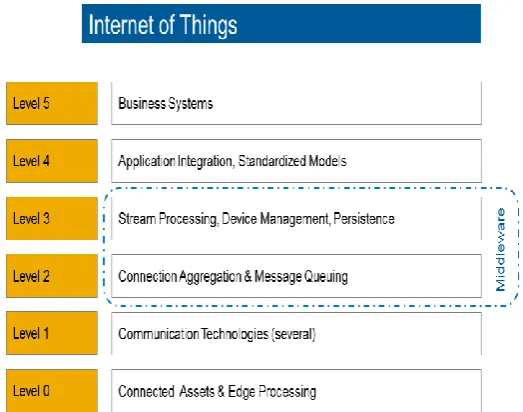
Chen[8],initially proposed a three key-level architecture of IoT, a four key level architecture was proposed by Suo, et all [9] which was extended by Liu et all[10] in five layered architecture using the features based on TCP/IP and TMN models. A more generalized and accepted six-layered architecture was also proposed based on the network hierarchical structure [11] as shown in the Fig. 2.
2.1.1 Coding Layer:
Coding layer is the basic layer of IoT which gives identification to the objects of interest. In this layer, a unique ID is assigned to each object which helps to distinguish the objects [11].
2.1.2 Perception Layer
Smaranika Mohapatra et al, International Journal of Computer Science and Mobile Applications, National Conference on “The Things Services and Applications of Internet of Things”, Gandhi Institute for Education and Technology (GIET) Baniatangi, 23-24 March 2018, pg. 72-78
ISSN: 2321-8363 Impact Factor: 5.515
Figure 2. Layered Architecture-IoT
2.1.3 Network Layer
This layer gets the required information in the form of digital signals from the previous Layer and sends it for processing in the Middleware Layer through the transmission mediums like Wi-Fi , Bluetooth, WiMaX , Zigbee , GSM, 3G etc with protocols like IPv4, IPv6, MQTT, DDS etc [13].
2.1.4 Middleware Layer
This layer utilizes the information received from the sensors [14]. It includes the technologies like Cloud computing, Ubiquitous computing which confirms a direct access to the database to store all the required information. An automated action is taken based upon the processed info.
2.1.5 Application Layer
This layer visualizes the applications of IoT for all kinds of industries, based on the processed data and information received from previous layers. The IoT related applications could be smart homes, smart transportation, etc.
2.1.6 Business Layer
This layer is useful in managing the applications and services of IoT. It generates different business models for effective business strategies [15].
2.2 Standardization and Protocols
Smaranika Mohapatra et al, International Journal of Computer Science and Mobile Applications, National Conference on “The Things Services and Applications of Internet of Things”, Gandhi Institute for Education and Technology (GIET) Baniatangi, 23-24 March 2018, pg. 72-78
ISSN: 2321-8363 Impact Factor: 5.515
Section III
3. APPLICATIONS
Internet of Things has many applications in human life. It makes the daily life easier and faster. These emerging applications with automation will definitely increase the quality of our life. Some of the applications are discussed below:
3.1 Smart Environment
Predicting the natural disasters such as flood, fire, earthquakes etc will be possible due to emerging technologies of IoT. There will be a proper monitoring of air pollution in the environment which will help to curb Global Warming which is nowadays a major concern.
3.2 Smart Cities
Big cities like New York, Shanghai, Singapore, and Dubai do support smart projects. To realize the fact that cities can be made hi-tech with the smart technologies, IoT can be a smart choice to automate the various functionalities in the cities making life easier and faster to live.
3.3 Smart Hospitals
The Hospitals will be furnished with smart wearable embedded with RFID tags which will be given to the patients, which will help the doctors and nurses to have an eye on the patient inside or outside the hospitals [20]. In medical emergencies Drone can be a big help to monitors patients condition till the medical help reaches the patient.
3.4 Smart Agriculture
Many countries still have Agriculture as a major livelihood. Internet of Things will help to monitor the soil nutrition, humidity, etc. This maintenance and monitoring will help to increase the production with better quality crops [21].
3.5 Smart Energy and the Smart Grid
Using the information and communication technologies(ICTs) for the electrical network at real time will enable a two way clink between the suppliers and users, which will increase the sustainability of electricity efficiently with increased efficiency and performance[22]. Many applications can be such solar power, nuclear power, vehicles, hospitals and cities power control which can take advantage of Internet of Things.
Section IV
4. CHALLENGES
The major challenges faced by IoT are:
4.1 Scalability
Smaranika Mohapatra et al, International Journal of Computer Science and Mobile Applications, National Conference on “The Things Services and Applications of Internet of Things”, Gandhi Institute for Education and Technology (GIET) Baniatangi, 23-24 March 2018, pg. 72-78
ISSN: 2321-8363 Impact Factor: 5.515
4.2Self-Organizing
Mobile things, which are generally or sporadically used, is required to establish connections dynamically and spontaneously, and must be capable to organize and configure themselves for a particular environment.
4.3Data volumes
When a huge amount of data is collected through sensor networks or from some large-scale networks and this term is referred to as big data which will require additional mechanisms to perform and operate efficiently.
4.4Data interpretation
It also requires that the data collected by sensors is properly.
4.5 Interoperability
Different objects of IoT have different informations, communication, processing, conditions and requirements to operate, so to facilitate these various concerns some generalized standards are put to use
4.6 Software complexity
In order to manage the smart objects of IoT, extensive and smart softwares are required as infrastructure to support the services.
4.7 Wireless communications:
The technologies like Wi-Fi, Bluetooth, etc are the wireless communication technologies which are less suitable from energy point of view whereas recent WPAN standards like ZigBee and other technologies having narrower bandwidth but can be significantly of less power.
Section V
5. FUTURE TECHNOLOGIES
New technologies have evolved in order to use the concept of IoT.
5.1 Cloud Computing
When huge data is collected an efficient method for those data is Cloud. It’s an efficient and intelligent technology which computes the various servers stored in cloud to access each other’s resources at anytime and anyplace. Cloud computing not only stresses the data it also computes the data stored and processes it for other resources.
5.2Big Data
Smaranika Mohapatra et al, International Journal of Computer Science and Mobile Applications, National Conference on “The Things Services and Applications of Internet of Things”, Gandhi Institute for Education and Technology (GIET) Baniatangi, 23-24 March 2018, pg. 72-78
ISSN: 2321-8363 Impact Factor: 5.515
5.3. Optical Technologies
Developments in the form of technologies like Li-Fi and Cisco’s BiDi optical technology could be very important in the evolution of IoT. Li-Fi, an epoch-making Visible Light Communication (VLC) technology, which helps to give better connectivity on higher bandwidths similar is the case with Bi-Directional (BiDi) which supports a 40G Ethernet from different devices of IoT [40].
5.4 Distributed Computing
When networked computers are used for computing it is known as Distributed Computing. It has several common issues with concurrent and parallel computing. Nowadays the above technique is coupled with hardware virtualization, service oriented architecture, and autonomic and utility computing which leads to Cloud Computing. Internet of Things helps to remotely control the physical access of Internet [25].
6. CONCLUSION
Communication between the machines in organizations and industries has become difficult. To overcome the situation, scientists and researchers have supported IoT as a breakthrough in the path of success. It assures to make a tremendous change in every step of the livelihood of humans. Its an intelligent system which has its marks in healthcare, automation, manufacturing, security education, etc. In this paper we have discussed the various technologies, challenges and applications of Internet of Things to make a better living.
References
[1] “The ”Only” Coke Machine on the Internet,” Carnegie Mellon University, School of Computer Science. [2] M. A. Ezechina, K. K. Okwara, C. A. U. Ugboaja. The Internet of Things (Iot): A Scalable Approach to
Connecting Everything. The International Journal of Engineering and Science 4(1) (2015) 09-12. [3] http://www.nxp.com/assets/documents/data/en/white-papers/INTOTHNGSWP.pdf
[4] Saranya C. M., Nitha K. P., Analysis of Security methods in Internet of Things. International Journal on Recent and Innovation Trends in Computing and Communication, Volume 3, Issue 4; April 2015.
[5] Sapandeep Kaur, Ikvinderpal Singh. A Survey Report on Internet of Things Applications. International Journal of Computer Science Trends and Technology Volume 4, Issue 2, Mar - Apr 2016.
[6] Suwimon Vongsingthong and Sucha Smanchat. A Review of Data Management in Internet of Things. KKU Res. J. 2015
[7] http://cdn2.hubspot.net/hubfs/552232/Downloads/Partner_program/Smart_Environments_Flyer.pdf?t=1458917278396
[8] Wang Chen, ”AN IBE BASED SECURITY SCHEME OF INTERNET OF THINGS,” in Cloud Computing and Intelligent Systems (CCIS), 2012, pp. 1046, 1049
[9] Hui Suo, Jiafu Wan, Caifeng Zou, Jianqi Liu, ”Security in the Internet of Things: A Review,” in Computer Science and Electronics Engineering (ICCSEE), 2012, pp. 648-651
[10] MiaoWu, Ting-lie Lu, Fei-Yang Ling, ling Sun, Hui-Ying Du, ”Research on the architecture of Internet of things,” in Advanced Computer Theory and Engineering (ICACTE), 2010, pp. 484-487
[11] Xu Cheng, Minghui Zhang, Fuquan Sun, ”Architecture of internet of things and its key technology integration based-on RFID,” in Fifth International Symposium on Computational Intelligence and Design, pp. 294-297, 2012
Smaranika Mohapatra et al, International Journal of Computer Science and Mobile Applications, National Conference on “The Things Services and Applications of Internet of Things”, Gandhi Institute for Education and Technology (GIET) Baniatangi, 23-24 March 2018, pg. 72-78
ISSN: 2321-8363 Impact Factor: 5.515
[13] Ying Zhang, ”Technology Framework of the Internet of THings and Its Application,” in Electrical and Control Engineering (ICECE), 2011, pp. 4109-4112
[14] Guicheng Shen and Bingwu Liu, ”The visions, technologies, applications and security issues of Internet of Things,” in E -Business and E -Government (ICEE), 2011, pp. 1-4
[15] Rafiullah Khan, Sarmad Ullah Khan, Rifaqat Zaheer and Shahid Khan, ”Future Internet: The Internet of Things Architecture, Possible Applications and Key Challenges,” in Proceedings of Frontiers of Information Technology (FIT), 2012, pp. 257-260
[16] http://standardsinsight.com/iot/iotworkshp
[17] http://www.ipv6forum.com/iot/index.php/homepage [18] http://iot6.eu/iot6_main_achievements
[19] Isam Ishaq et al., IETF Standardization in the Field of the Internet of Things (IoT): A Survey. J. Sens. Actuator Netw. 2 (2013) 235-287, doi: 10.3390/jsan2020235
[20] P.Fuhrer, D.Guinard, ”Building a Smart Hospital using RFID technologies,”
[21] F.TongKe, ”Smart Agriculture Based on Cloud Computing and IoT,” in Journal of Convergence Information Technology (JCIT), Jan’13
[22]Smart Grid enabling energy efficiency and low carbon transition,
https://www.gov.uk/government/uploads/system/uploads/attachment_data/file/321852/Policy_Factsheet__ Smart_Grid_Final__BCG_.pdf
[23] https://5gppp.eu/wpcontent/uploads/2014/02/Advanced-5GNetworkInfrastructure-PPP inH2020_Final_November-2013.pdf
[24] Hele-Mai Haav. linked data connections with emerging information technologies: A survey. International Journal of Computer Science and Applications Vol. 11, No. 3, (2014) 21-44.
[25] Virendra Dilip Thoke. Theory of distributed computing and parallel processing with applications, advantages and disadvantages. International Journal of Innovation in Engineering, ResearchandTechnology.