doi: 10.11648/j.ijiis.20130203.11
System design of a computer-based clinical decision
support system management by using radial basis
function approach
Neda Darvish
1, *, Khikmat Kh. Kuminov
1, Hoda Darvish
2, Marjan Fakhar
31Physical-Technical Institute Named after S. U. Umarov of the Academy Sciences of the Republic of Tajikistan 2Islamic Azad University, Tehran Medical Branch, Tehran, Iran
3Islamic Azad University, Parand Branch, Tehran, Iran
Email address:
[email protected](N. Darvish), [email protected](K. K. Kuminov)
To cite this article:
Neda Darvish, Khikmat Kh. Kuminov, Hoda Darvish, Marjan Fakhar. System Design of a Computer-Based Clinical Decision Support System Management by Using Radial Basis Function Approach. International Journal of Intelligent Information Systems.
Vol. 2, No. 3, 2013, pp. 46-54. doi: 10.11648/j.ijiis.20130203.11
Abstract:
Effective corporate governance mechanisms and strategies are commonly referred to as the area of management that deals with getting the best performance from employees within the organization at hand. Whilst the activities involved in the management of people for their optimal performance have been carried out for generations, it is only relatively recently that attempts have been made to identify, describe and refine the practices of effective corporate governance mechanisms and strategies. The present paper introduces and outlines the framework of modern Optimal Human Resource Management of hospital with using Neural Network (NN) and its crucial connectivity to Optimal Performance of people within the organization at hand and what the organization needs to do in order to achieve such well sought after connectivity. The NN is described in the present paper identifying its basic structures, unique characteristics, advantages and. Hospital as the most well known organization provides this type of service that plays an important role in maintaining the health of patients. Improving the quality of health care and reducing medical errors seems to be essential that available strategies should be used to achieve this goal. One of the strategies is to design System that in the present study, the modeling of this system is based on decision support systems using RBF.Keywords:
Radial Basis Function, Neural Network, System Design, Decision Support System, Modeling1. Introduction
A systematic training procedure for developing neural network models is proposed in the present paper. The procedure is based on back-propagation or feed-forward control as applied to goals assessment and goals management of Optimal Human Resource Management. Also, the present paper introduces an efficient training strategy for problem solving of Optimal Human Resource Management. The strategy involves a carefully selected and trained neural network as a combination of the following three approaches: (a) algorithmic procedures, (b) reasoning by deduction and (c) reasoning by analogy.
The paper presents the attributes of Optimal Human Resource Management such as the productivity and people, organization’s goal and people, job satisfaction and people and job incentives and people. The paper introduces the
Neural Network for Optimal Human Resource Management of effective people management for optimal performance such as the relationship between Optimal Human Resource Management and management and the importance of linking business strategy and Optimal Human Resource Management connectivity activities.
using Matlab software is done in order to improve quality and to consider the clinical performance, professional development programs and error management [1].
This descriptive- analytical- observational study is based on inputs, patient information and human resources of Bu Ali Hospital of Islamic Azad University and sampling has been done in a form of gradual – descriptive sampling. The input criteria in this study come from HIS (Hospital Information system) during the years 2010-2011. Analysis of data done by SPSS statistical software and in modeling by using RBF neural network method, the System Design is presented [2, 5].
2. Background
Because the pattern of the relationships between the independent (input) factors and the dependent (output) factor in our model will be learned from the data by the
Artificial Neural Network (ANN) algorithm, the selection of input to the neural networks is an important decision. It is crucial to select factors that fully capture the domain of interest-success factors in the product innovation process.
In this session we focuses on a literature review of the factors to provide an understanding of how they affect the successful product innovation development. Also, as our goal is different from that of previous study; therefore, our selection process differs. Instead of adopting a micro approach to understand the specific effects of a few factors, we use a macro approach that examines a broad variety of factors in an effort to capture the complexities of the product innovation development. This macro approach is warranted because we are trying to subsume the intricacies of the process into our model to improve the accuracy of its predictions (Calantone, di Benedetto, and Bojanic 1988) [6]. Furthermore, all the measures were well-validated and accepted measures in the new product literature (see Song and Parry 1997 [7]). In choosing the input for our models, we rely on the resource-based theory of the firm (Wernerfelt 1984, Barney 1991; Conner 1991) [8, 10]. Resource-based theory provides a unique insight
In to the situation that faces managers who make project Selection and resource allocation decisions.
The Central tenant of resource-based theory is that this offering is the mechanism for creating a sustainable competitive Advantage for the firm. A review of literature in the study of factors influence the Successful product innovation has shown numerous factors which can be grouped into three main factors: (1) the Firm’s innovation capability, (2) the firm’s new product Development capability, (3) the external competitive Environment.
3. Clinical Decision System
Management – System Design
Clinical Decision Support System (CDSS) that is designed by using computer software helps to the hospital management system for making decision and better diagnosis to improve patient condition and expert system based on CDSS is according to the conventional rules by using human professional knowledge in order to solve problems in the real world and providing professional knowledge [5].
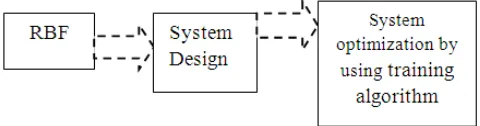
Figure 1. Medical system design modeling based on neural network
4. The Firm’s Innovation Capability
A review of the new product success literature suggests. That the firm’s innovation capability is the necessity Required to create product innovation. Absorptive capability is the firm ability to recognize the Value of new information, assimilate it and apply it to Commercial end [11].Cooper [12] has found that adopting a transnational new product process is a critical success factor to the product innovation. Organizational learning capability that regarded as the characteristic of absorptive capability of firm also has a significant and positive impact on process innovation [13]. The successful project execution methods are positively associated with development project execution [15], while New product success rates show a strong correlation with Project portfolio management performance and project Portfolio management methods used [16]. In addition, Study has shown that creative capability and creative Problem solving processes have significant impact on Product innovation [13,17]. Prajogo and McDermott [17] and Valencia, Valle and Jimenez [18] studied culture Of innovation of firm and found that adhocratic cultures Could enhance the development of new products or Services. In addition, firm culture shows a positive Relationship with product innovation. Ragatz, Handfield and Scannel [19] concluded that commitment from top Management of companies in supporting new product Development is a strategically critical issue impact a Successful product innovation.
similarly in certain respects to the interconnections of individual neurons in the brain. Mathematical neural networks function by constantly adjusting the interconnections between individual neural units. The process by which the mathematical network "learns" to change the interconnections, improve performance, recognize patterns, and develop generalizations is called the training rule. One of the popular algorithms that have been used successfully in many applications is the "radial basis function learning algorithm”, described below. This study uses this algorithm for assessing successful propensity of developing product innovation. Essentially, the feed forward designation indicates that the flow of the network intelligence or information is from input toward output as, for example, occurs in path models and structural equation or maximum likelihood factor analysis causal models.
5. Analysis
5.1. Definition of Neural Network
The computer model of human brain or biological neural network is called, “Artificial Neural network”. Each neuron in neural network processes input data and stimulations and will send them as the output that these outputs may be connected to the inputs of other neurons. The performance and output of a neural network will work by processing of input data in a way that it already has learned. Thus this neural network uses the predetermined learning algorithms. One of the neural network methods is RBF model (Radial Basis Function) that compared to the other methods has a higher performance speed and also has the classification technique compared to the traditional statistical model [6,9].
5.2. In the Initial Design, RBF Includes Three Layers as Shown in the Below
The first layer or input layer that is simple layer and does not perform any processing and the second layer or hidden layer normally receive non-linear equation from the input space and in a large scale separates the linear model. The output layer is the set of weights with a linear combination. If the neural network of RBF is used for estimating of function with input of real numbers so its output is correct. Therefore, in classification of patterns, a function in the form of sigmoid or hard-limit or will be placed in the way of an output neuron and the output value will be determined as zero or clustering. Thus the distance from the cluster center is calculated, which is the same as non-linear distance.
We are working within the standard framework of function approximation. We have a set of N data points in a
multi-dimensional space such that every D dimensional
input vector :i=1,…,D} has a corresponding K
dimensional target output : 1, … , The target outputs will generally be generated by some underlying functions gk (x) plus random noise. The goal is to
approximate the gk(x) with functions yk(x) of the form
∑ (1) We shall concentrate on the case of Gaussian basis functions
!
"#$! % (2)
In which we have basis centers {m } j and widths {s } j .
Naturally, the way to proceed is to Develop a process for finding the appropriate values for M, {wkj}, {m } ij and {s } j . We can cast the RBF Mapping into a form that resembles
a neural network. With the sum of the weighted hidden unit activations giving the output unit activations. The Hidden unit activations are given by the basic functions φ j
(x,µj ,σj ), which depend on the “weights” {µ ,σ } ij j and
input activations {xi} in a non-standard manner. The proofs
about computational power tell us what an RBF Network can do, but nothing about how to find all its parameters/weights { , } , wkj ij j µ σ .
In RBF networks the hidden and output layers play very different roles, and the corresponding “weights” have very different meanings and properties. It is therefore appropriate to use different learning algorithms for them. The input to hidden “weights” (i.e. basis function parameters {µ ,σ } ij j ) can be trained (or set) using any of
a number of unsupervised learning techniques. Then, after the inputs to hidden “weights” are found, they are kept fixed while the hidden to output weights are learned. Since this second stage of training involves just a single layer of weights {wjk} and linear output activation functions, the
weights can easily be found analytically by solving a set of linear equations. This can be done very quickly, without the need for a set of iterative weight updates as in gradient descent learning. The simplest and quickest approach to setting the RBF parameters is to have their centers fixed at
M points selected at randomfrom the N data points, and to
set all their widths to be equal and fixed at an appropriate size for the distribution of data points. Specifically, we can use normalized RBFs centered at {µ } j defined by
!
"#$! % ' ( ) * (3)
and the σjare all related in the same way to the maximum or average distance between the chosen centers µj.
Common choices are which ensure that the individual RBFs are neither too wide, nor too narrow, for the Given training data. For large training sets, this approach gives reasonable results.
+ ,-.√" (4)
with linear output. If the RBF network is used for function in accordance with the actual number so this output is optimal.
Y=Rad base (││w-x││b) (5) Y=Rad base (n) = e-n2 (6)
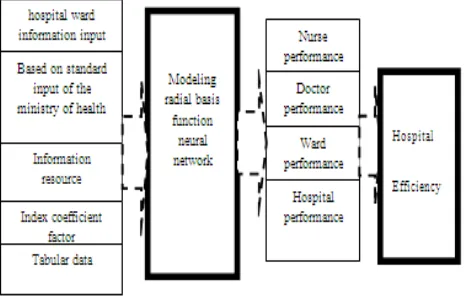
The algorithm of medical expert system design is done based on the block diagram of below figure
Figure 2. Simulations by using RBF neural network model
6. Network Generalize Ability
6.1. Selection of the Model and Presentation of Algorithm
To select a model, we should study affordable and compatible methods with the limited resources of the hospital. Also we should maintain the quality and healthcare services that it needs to make a balance between health care costs and quality of service. If the sense of responsibility and authority of nurses towards patients, increase the efficiency and quality of services will also increase. As a result the duration of stay of patient in hospital will decrease and also the hospital efficiency increase and all costs reduce. In fact increasing the number of human resources will result to increase the efficiency and quality of healthcare services, but should be studied in terms of hospital costs and income. The aim of expert system design is to decide appropriately in a sample space that its data is randomly distributed and construction of the above system is based on knowledge [12]. Average time of service /1 =time unit/1= time unit/output = the amount of service. When we use the probability of distribution, is better to use the expected amount of service that we show it with µ (mu).In this step for reminding, we introduce the formula of negative exponential distribution and we’ll use them as examples to clarify our discussion. y= µ*e ^ (-µt)(7), Y is the frequency of occurrence in the time of provided service. µ is the amount of service and t is time. If any individual is not in the system, the equipments have nothing to do. Therefore the probability of presence of individuals in system is equal with the probability of idle. P0 = (1-λ/µ)* (λ/µ) ^0 = (1-λ/µ)(8), Other statistics: We can calculate two other important statistics about queue: The waiting time for standing in queue = λ/µ (µ-λ)(9), The average number of individuals who are waiting in queue =
(λ^2)/µ (µ-λ)(10),The elements of queuing issues: We’ll discuss some factors in order to review this issue with queuing theory. Most of queuing issues have similar elements. Nine factors can be determined on any issue: There is equipment for offering an issue.“Equipment” can be the emergency room or hospital obstetric department and even a fund. This equipment is different but their issues are similar. There are some customers that use the available equipment. Customers can be those patients who seeking treatment, employees who waiting for vacations, and those who go to the bank for receiving salary and etc
6.2. The Use of Systems and Intelligent Algorithms in other Systems
This part can be an important part of intelligent systems, because this part connects with that information that other system collected them, so it does the following responsibilities about other systems:
1. Data analysis
2. Increase the efficiency
One of the goals of expert systems is facilitating decision system. In general, expert systems are designed to make available the skill of qualified personnel for non specialist. This program simulates the pattern of thinking and style of human performance and it makes closer the expert system performance to the human performance or expert person.
25
18 1 59
51 1
_
( 0
(( ((
1)) /
( 0 1)) / ( ((
)) 100
nstep j i
j i
nstep
j i
P
j i
Doctor Performance
n if t s nstep
n nstep
n if t s nstep
nstep W
= =
= =
=
= → −
=
= →=
+ −
×
∑
∑
∑
∑
(11)
42
10 1
58
51 1
_
(( (( ( 0 1)) /
( (( ( 0 1)) / )) 100
nstep j i
j i
nstep
j i B
j i
Bed Performance
nstep n if t s n nstep
nstep n if t s nstep W
= =
= =
=
− = → =
+ − = →= ×
∑
∑
∑
∑
(12)
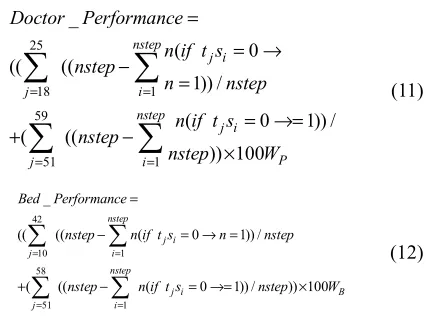
P,T:The total number of steps, The time of one step.TTotal:
nstep*5 minutes,PjSj: the number of token in the place of j
and in (i) step Clinical fuzzy expert systems are done by using Matlab software and figure 6 shows graphical model of window program.
In this study, we do the optimization process by using table 1 and considering the index Factor (f) which is related to efficiency and work experience and education of human resources in the hospital system.
(01(2345 67 89 :;<=> @;<B< ? @; A (13)
F: efficiency index for education, work experience and bed.
ST: the total number of stages.
NT: the number of discussed variable such as the number of bed.
Table 1. The efficiency index for number of bed /education/work experience
The Title of section / bed / experience / education
Nurse 44h
General physician
Specialist
physician Obstetrician
Ccu 1.11 0.99 1.80 1.11
Icu 2.08 1.50 2.20 2.08
Nicu 2.08 1.50 2.1 2.08
Post ccu 0.58 0.60 0.80 0.58
Emergency 1.6 1.2 2 1.6
Surgery 1.2 1.3 1.99 1.2
Conversion of the model is possible by using neural networks with various programming and understand the layering and statistical inference. Figure 3 shows the simulation of medical expert systems by using RBF neural network.
Figure 3.General Graph of medical expert system design by using RBF neural network
6.3. All Types of Factor Index
Based on accurate and scientific standards and indexes, all organizational and technical aspects of performance should be considered. The study of indexes includes:
1 – To increase indexes. 2 – To increase efficiency.
3 – To increase health care services. 4 – To increase Responsibility. 5 – To study all types of index.
6.4. General Structure of the Nursing System
According to the scenario of nurses working for 36 hours or 44 hours per week, the optimal number of teamwork is as following:
1 - Scenario of work for 36 hours per week, 9 to 12 nurses.
2 - Scenario of work for 44 hours per week, 8 to 10 nurses.
3 - The optimal combination of skills in the hospital sector includes:
To train due to the progress of science.
To increase the general capabilities and potentials. After determining the optimal combination of skills based on specialization of human Resources and technical analysis and by using scientific methods we can achieve the number of resources to devote to the teamwork.
There are 8 main methods for analyzing and identifying the exact location of the hospital personnel that include:
1 - Task analysis
2 - Activity analysis / sampling of activities 3 - Record of daily experiences
4- A combination of specializations 5 - Re-engineering
6 - Professional judgment
7 - To evaluate the role individuals 8 - Innovation and Possibility
On this basis, determining the various skills such as nursing system in different parts of hospital is based on table 2, 3, and 4 which are according to the standard rules of WHO.
Table 2. Determining the percentage of skills of nurses in different hospital wards
ICU Coefficient w
ICU
Coefficient w
ICU CCU Title bed
organizational structure of hospital
1 m Head of section
1 h Head nurse
N= Round
( B × W) 2.08 1.1
N= Round
(B × W) n Nurse 44h
N= Round
( B ×W) 1.33 1.3
N= Round
( B × W) n Nurse 36h
Table 3. ID of beds / wards – information of human resources coefficients
Hospital ward
Ratio of skill combination
Total %
Nurse% Nurse
Assistant%
CCU 90 10 100
ICU 95 5 100
POST CCU 75 25 100
NICU 80 20 100
Table 4. A comprehensive table of coefficients human resources of nursing personnel
Title of ward/bed
coefficients human resources for each bed nurse
44hours 36hours
ICU 2.08 2.49
NICU 2.08 2.49
Pediatric Surgery 0.66 0.79
NICU 0.94 1.12
Internal Surgery 0.58 0.70
Table 5. the average of patient entry in 8 time period
The number of patients Time period (hour)
71 8-11
50 11-14
56 14-17
Table 6. The need of healthcare services according to the type of patients
Total Healthcare
services of nurse per minute Physical type of
Healthcare services (minute) Patient type
15 10
5 Low care
30 20
10 Inter mediate care
65 45
20 High care
Table 7. Hospital shift work
hour shift
7.13-14 First shift
14-19 Second shift
19-17 Third shift
We study the expert system design based on the decision support system of human resource management or content and technical indexes such as those indexes which are associated with the hospital organization like reduce the length the of stay and also administrative and operational indexes such as increasing concentration and then we will apply the optimal skill combination in hospital wards[3].
To determine the percentage of skills, a major approach has been studied such as analysis of activities and professional judgment.
7. Use of Radial Basis Function
Environment Model for the Design of
System
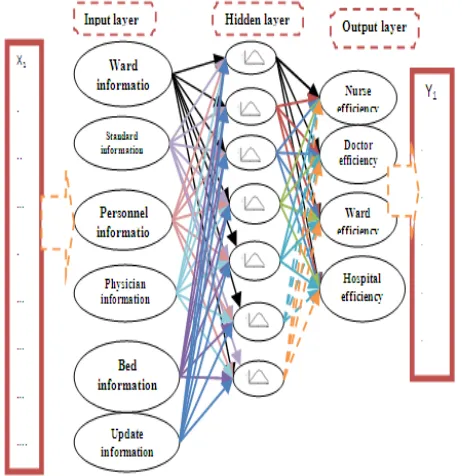
Our focus in evaluating our system's performance will be Generalization. Generalization refers to the ability of a Trained artificial neural network to respond correctly to Input not used during the training process. Therefore we Train our model with one partition of the data set and test With another partition not used during the training. Network generalize ability is related to the concepts of under fitting For modeling, firstly it shows network architecture design, includes determining the number of layers in the network and the number of neurons in each layer and then determining the type of conversion function, network training the number of neurons in each layer that includes learning algorithms, such as processes by which the network weights are adjusted and finally offers the appropriate output for each input. Medical expert system modeling is simulated in the form of below graphical model and based on the block diagram in Figure4.
Figure 4. Graphical model of neural network based on architecture of layers
weighted and combined and not to reach a particular threshold, a very small amount of output is produced th neural network all nodes have two forms: 1) active form or one 2) inactive form or zero
According to Fig. 4, edges between nodes have weight Edges with positive weight stimulate or activate the next active groups and edges with negative weight, disa inhibit the next connected node [6, 9, and 11
Figure 5. The process of patient Movement
With the analysis attitude and according to the actual observations and this Figure, based on layering there are three layers which include: 1) input layer
includes hospital ward information such as info about the hospital beds, human resources, time healthcare services, coefficient factor index
information based on defined standards and information about work experience and education level of human resources. 2) Output layer includes the evaluation of nurse and physician and hospital performance. 3)
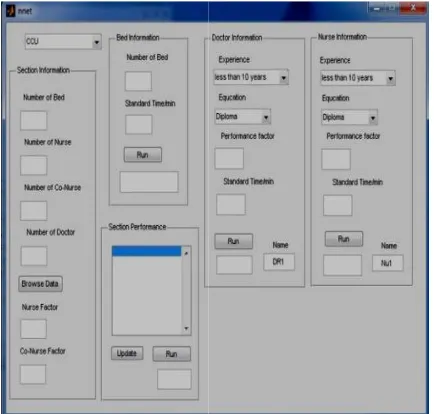
by using mathematical calculations, the design of expert system will be done based on RBF neural networks, and according to Tables 5,6,7 and also Table 8 which is related to cycle movement of patients (Fig 6) in hospital
time process and by using Matlab programming software. By running this program, window will run as figure 6. completing information and the getting data from Data option of table 8 and by running
obtained results of running this program is in accordance with Table 9.
Table 9. Showing the results of medical expert system based on RBF neural network
Registration of patient Time of patient entry to the ward
11.38 11.51
9.02 9.22
22.05 23.14
13.54 14.2
11.15 11.37
16.37 17
weighted and combined and not to reach a particular ll amount of output is produced that in neural network all nodes have two forms: 1) active form or
4, edges between nodes have weight. Edges with positive weight stimulate or activate the next active groups and edges with negative weight, disable or
, 9, and 11].
The process of patient Movement
and according to the actual Figure, based on layering there are input layer: this layer information such as information resources, time to provide , coefficient factor index , input information based on defined standards and information and education level of human layer includes the evaluation of nurse and physician and hospital performance. 3) hidden layer
by using mathematical calculations, the design of expert system will be done based on RBF neural networks, and according to Tables 5,6,7 and also Table 8 which is related to cycle movement of patients (Fig 6) in hospital-based on sing Matlab programming software. By running this program, window will run as figure 6. By completing information and the getting data from Browse running the program, the obtained results of running this program is in accordance
Table 8. Information about hospital ward and human resources and time of patient care services
Nursing Service time
Service Time for patient 3
Waiting Time for hospitaliza tion
15 20 5
20 27 6
25 30 7
20 20 4
20 10 5
27 20 8
Teaching and learning and the final major goals of this expert system.
this network we can generally find the answer of this question that "what if...?".
We can do the proper processing of the data which are obtained from the implementation of expert system and input data relating to human
fault management and eventually
Decision Support System by studying and analysis of defined input criteria in Table 9 and the results of running the program and accelerating in decision process will be done properly.
Figure 6. Run of programming Window
Showing the results of medical expert system based on RBF neural network
Time of patient entry to the
Visiting time of doctor Service
Time for patient 1
20 10
10 7
15 10
20 10
25 12
25 15
Information about hospital ward and human resources and time
Waiting Time for hospitaliza
Number of bed
Number of nurses
8 3
8 5
8 5
8 4
8 5
8 5
Teaching and learning and the final decision are the major goals of this expert system. In fact, by modeling of this network we can generally find the answer of this
roper processing of the data which are obtained from the implementation of expert system and input data relating to human resource, time management, eventually optimization of Medical by studying and analysis of defined input criteria in Table 9 and the results of running the program and accelerating in decision process will be
Run of programming Window
Showing the results of medical expert system based on RBF neural network
Time for patient 1
Service
Time for patient 2
10
10
11
12
13
Standard time/doctor/min Nurse information
experience Education of nurse
Performance of doctor factor
Doctor Time/min
Doctor information experience
15 <10 B .11 25 <10
10 >10 B .5 40 >10
Doctor Performance %
Nurse performance
% Hospital performance % Bed performance %
80 30 50 44
40 55 35 30
Num of bed Num of nurse Num of co-nurse Num of doctor Num of standard bed Nurse factor Co-nurse factor
8 5 1 3 8 .33 .33
12 4 1 5 16 .44 .44
Standard time/doctor/min Nurse information experience Education of nurse Performance of doctor factor Doctor Time/min Doctor information experience
15 <10 B .11 25 <10
10 >10 B .5 40 >10
Standard time/min
nurse Education of doctor Performance factor
7 GP .11
7 B .5
8. Conclusion
This objective of this study is to develop the model concerning factors influencing the successful product Innovation and the utilizing of artificial intelligent Methodologies and applications. We conclude that firm’s Innovation capabilities, firm’s new product development Capability and external competitive environment are three Groups of factors that influence the successful product Innovation. In searching for the alternative and more Effective tools to the statistic analysis method traditionally Used, we selected the Artificial Neural Network (ANN) Model, which is particularly useful for modeling Underlying patterns in data through a learning process. Knowledge management technology in an organization will be used in order to optimize and improve patient care services based on RBF. learning algorithm in neural network is very effective for detecting errors. In near future, we can improve the engineering of hospital structure in mathematical atmosphere by using other methods of artificial intelligence and combination of these methods in this modeling and also with the analysis attitude and the actual observations.
References
[1] Andreassen, S., Riekehr C., Kristensen, B, Schønheyder, H.and Leibovici, L. (2000),” Using probabilistic and decision-theoretic methods in treatment and prognosis modeling”. Artificial Intelligence in Medicine, 15, pp.121-134.
[2] Institute of Medicine. Crossing the Quality Chasm: “A New Health System for the 21st Century”, National Academy Press; 2001.
[3] Wilson MC, Hayward RS, Tunis SR, Bass EB, Guyatt G, “Users' guides to the Medical Literature”. VIII. How to use
clinical practice guidelines. B. what are the recommendations and will they help you in caring for your patients? The Evidence-Based Medicine Working Group.JAMA. 1995 Nov 22-29; 274(20):1630-2.
[4] Aickelin, U. and White, P. (2004),” Building Better Nurse Scheduling Algorithms”. Annals of Operations Research 128, 159-177.
[5] E. Mourtou, “The role of Rules and Regulations in the management of technological change in hospitals”. The journal on Information Technology in Healthcare, 4(3), 147-154, 2006
[6] R. Calantone, A. Benedetto, and D. Bojanic,” Multi method Forecasts for Tourism Analysis. Annals of Tourism Research, vol. 15, 1988, pp. 387-406.
[7] X. M. Song, and M. E. Parry, “A Cross-National Comparative Study of New Product Development Processes: Japan and the United States,” Journal of Marketing, vol. 61, 1997, pp. 1-18.
[8] B. Wernerfelt, “A Resource-Based View of the Firm,”Strategic Management Journal, vol. 5, 1984, pp. 171-180.
[9] R. J. Barney, “Firm Resources and Sustained CompetitiveAdvantage,” Journal of Management, vol. 17, 1991, pp. 99-120.
[10] K.R. Conner, “A Historical Comparison of Resource-Based Theory and Five Schools of Thought Within Industrial Organization Economics: Do We Have a New Theory of the Firm?” Journal of Management, vol. 17, 1991, pp. 121-154.
[11] W. M. Cohen and D. A. Levinthal, “Absorptive Capacity: A New Perspective on Learning and Innovation,” Administrative Science Quarterly, vol. 35, 1990, pp. 128- 152.
[12] R. G. Cooper, “From Experience: The Invisible Success Factors in Product Innovation,” Journal of ProductInnovation Management, vol. 16, 1999, pp. 115-133.
Evidence from SMEs Located in Turkish Science and Technology Parks,” European Journal of Innovation Management, vol. 14, 2011, pp. 172-206.
[14] M. A. Maidique and B. J. Zirger, “A Study of Success and Failure in Product Innovation: The Case of the U.S. Electronics Industry,” IEEE Transactions in Engineering Management, vol. 4, 1984, pp. 192-203.
[15] M. V. Tatikonda and S. R. Rosenthal, “Successful Execution of Product Development Projects: Balancing Firmness and Flexibility in Innovation Process,” Journal of Operations Management, vol. 18, 2000, pp. 401-425.
[16] C. P. Killen, R.A. Hunt, and E.J. Kleinschmidt, “Project Portfolio Management for Product Innovation,” International Journal of Quality & Reliability Management, vol. 25, 2008, pp. 24-38.
[17] D. I. Prajogo and C. M. McDermott, “The Relationship Between Multidimensional Organizational Culture and Performance,” International Journal of Operations & Production Management, vol. 31, 2011, pp.712-735.
[18] J. C. N. Valencia, R.S. Valle, and D.J. Jimenez, “Organizational Culture as Determinant of Product Innovation,” European Journal of Innovation Management, vol. 13, 2010, pp.466 – 480.
[19] J. Valach, F. Lehocki. Clinical Decision Support Systems. Med ITECH - Proceedings of the ESF project conference, Bratislava, Slovakia;26 May 2008.
[20] L. Smith, ed. (1996, 2001), “An Introduction to Neural
Networks”, URL:
http://www.cs.stir.ac.uk/~lss/NNIntro/InvSlides.html
[21] Sarle, W.S., ed. (1997), Neural Network FAQ, URL: ftp://ftp.sas.com/pub/neural/FAQ.html
[22] StatSoft, "Neural Networks", URL: http://www.statsoftinc.com/textbook/stneunet.html
[23] S. Cho, T. Chow, and C. Leung, “A Neural-Based Crowd Estimation by Hybrid Global Learning Algorithm”, IEEE Transactions on
[24] Sweetser, Penny. “Strategic Decision-Making with Neural Networks and Influence Maps”, AI Game Programming Wisdom 2, Section 7.7 (439 – 46)
[25] Russell, Stuart and Norvig, Peter. Artificial Intelligence: A Modern Approach, Section 20.5 (736 – 48)
[26] Artificial Intelligence and Expert Systems for Engineers, C.S. Krishnamoorthy, S. Rajeev, 1996
[27] Baxt, W. G. (1995). Application of Artificial Neural Networks to Clinical Medicine. Lancet, 346, 1135-1138