Application of Serious Game Model on Simulation Training for Decision
Makings of Project Management
Hung-Ming Chen
*, Kai-Wei Wei
Department of Civil & Construction Engineering, National Taiwan University of Science & Technology, Taipei, Taiwan, ROC.
Received 23 July 2017; received in revised form 07 August 2017; accepted 10 August 2017
Abstract
This study develops a novel serious game foster decision making skills in project management based on role
playing. It provides features such as accident event handling, resource allocation, selections of subcontractors,
procurement and stock management, adjustment of project scheduling, and performance evaluations to be exercised
by user online. In doing so, users can strengthen their project skills by managing a virtual project. Importantly, the
proposed game provides users with virtual experiences to implement management and control tasks of a construction
project, which is often difficult to offer in conventional training. The proposed system is an online game deve loped by
using advanced web development tools with integrations of MySQL for project data management and MS project for
project schedule update on the server side. Users are presented with a virtual project in dynamic scene image depicting
a construction s ite, which changes as the game progresses. There are also images present various construction events.
During game play, users can function as a project manager whom is responsible for making various decisions
involving accident handling and resource allocation as the virtual construction project progresses. Results of the
decisions made are obtained by real-time simulation based on project data, then are visually and interactively replied
to the users to understand the subsequent effects of their actions. In this training mode, decision-based simulation can
provide realistic and reliable consequences of their decisions. The virtual reality feature of this computer game offers
an economic and viable alternative to actual project management experiences.
Keywords: serious game, decision simulation, virtual training, project management
1.
Introduction
An increasing number of computer game modes that integrate a diverse array of knowledge skills have been adopted to
facilitate professional staff training. In terms of training professional staff in construction engineering, related projects are
characterized by customization, large scale nature, long construction time, high cost, unforeseeable circumstances, and poten tial
risk involving construction safety. In contrast with other industries, a construction project must draw from the accumulated
experiences of its professional staff. However, accumulating relevant experiences is rather difficult owing to the unique
characteristics of construction projects, such as their large scale nature and high cost. Therefore, providing virtual work
experiences through computer games that simulate a construction project setting is a viable alternative. Virtual operations can
mitigate the risks incurred by direct physical exercise and are not subject to external weather factors. Moreover, users can be
*Corresponding author. E-m ail address: hungm ing@m ail.ntust.edu.tw
oriented on unfamiliar situations repetitively. In contrast with training in a conventional setting, computer games can save a
substantial amount in project costs and waiting time by switching game scenes frequently and simulating different conditions,
ultimately allowing trainees to accumulate relevant knowledge skills and experiences cost effectively.
Computer game applications in training can be divided into operational and role -playing modes. Trainees use the
operational mode to simulate various workplace operations, e.g., driving an excavator or operating large -scale machinery, with a
particular emphasis on fostering the adaptability of trainees to certain tasks [1-6]. Alternatively, trainees use the role-playing
mode to manage a virtual company or shop from a managerial perspective and to devise responsive strategies based on
information that the computer provides, ultimately allowing trainees to accumulate managerial experience [7-11]. Conversely,
conventional modes for training construction engineering managers include classroom instruction, orientation on business
practices, and site visits; of classroom instruction is the most prevalent. As is generally assumed, students acquire p ractical
experience in construction management courses, when they actually lack praxis -based opportunities for exercise. Although some
training curriculums provide students with opportunities to practice in an enterprise setting, student learning of constr uction
work is insufficient owing to the short training period. Conventional learning is limited in its ability to only assign stude nts a
low-level task without actually participating in management tasks. This explains why students often struggle upon ente ring the
industrial workplace, eventually learning only after a trial and error approach towards correct industrial practices and expe rience
acquired over time. The training mode of a computer game allows the trainee to act as managerial staff involved in engineering
projects. In addition to enhancing the simulation, security, and playfulness of training, integrating a computer game with
construction engineering supplements training in addition to normal class instruction. At present, this computer game mod e can
offer a simulative scene to trainees, allowing them to feel by themselves and to visualize site situation using pictures and words,
which will no longer be subject to individual imagination. During simulation, the game can incorporate the proposed so lution
derived from classroom case studies for analogous calculation and comparison with original estimates. As for security, the
computer game can eliminate potential risks in an actual workplace training site and simulate accidents through a video clip,
offering trainees with the emotions of an on-site incident without fear of injury.
Therefore, this work presents a novel computer simulation game to train construction project managers. The computer game
contributes to the development of assistant training software based on decision-making management principles that combine
simulation with engineering managerial knowledge. In this game, users serve as a construction site project manager responsible
for a series of decisions, as presented in 3D and game formats. Related tasks include arranging labor, material quantity and
equipment for each project, controlling the cash flow and construction period, selecting a contractor, ensuring safety in
construction site management, performing field inspection and qualit y control, as well as forecasting weather-related factors to
achieve construction project goals.
The virtual construction management practices taught in this computer game are an economical, safe, and interesting means
of filling the gap between teacher-student interaction and simulation of actual construction management training in the field. By
making decisions in a gaming environment, trainees can understand life -like situations found in actual cases through repeated
feedback and practice according to performance evaluation. As is expected, this virtual construction game provides trainees with
the unique opportunity to manage a virtual construction site. By applying concepts taught in virtual construction, trainees c an
learn from experiences involving ins pection and verification, thus clarifying case studies presented in the classroom and
strengthening their perceptiveness. Additionally, via this virtual medium, trainees can understand the implications of damage
caused by improper management practices, without concern over actually losing money and compromising security. Trainees
2.
Content and Scope of Virtual Construction
The proposed game allows users to thoroughly understa nd decision making concepts in construction engineering.
Although the main training objects are the on -site managerial staff, game contents encompass tasks of the project manager,
construction site owner, and contractor, they are not limited to specific ro les. Moreover, contents are delivered by assuming that
users can comprehend situations based on clear instruction from the 3D animations, although it is not expected to simulate th e
actual situation completely and accurately.
As the proposed game simulates all work tasks involved in making construction project management -related decisions and
schedules, this work selects the contents for a course called Project Planning and Control as the primary source for simulation.
Initially, virtual construction scripts are sorted out from course-related contents involving construction management and
administrative operations. Simulated construction contents are divided into four parts, as listed in the following. Based on the
contents of each section, several parts are selected as the simulation script. Those contents are described briefly as follows:
(1) Construction contracts and management: specifications based on construction contracts, bid package format, constriction claims and disputes resulting from contracts, as well as provisions of changing orders following commencement of the project. The contract content format is added to the game script in order to describe the task of virtual construction in the proposed game;
(2) Subcontract: construction bidding and the selection methods for a construction site owner to choose which company to cooperate with, including quality control methods to manage the subcontract after the project is initiated. The proposed game attempts to incorporate methods of selecting contractors and their effects into operating costs, quality, and time, as well as other effects into the game script;
(3) Construction procedures: confirmation of the contract before starting the construction, daily management after the project is initiated, and accepting provisions after construction is completed. The proposed game attempts to incorporate management tasks conducted by the site manager into the game script in order to provide trainees with management training-related experience; and
(4) Cost estimation and control: quantity takeoffs in the training of construction operation, measures to control costs and scheduling, and measures to allocate resources efficiently. The proposed game attempts to incorporate factors aimed at balancing resource allocation and r controlling costs and scheduling into the game script to provide trainees with resource allocation-related skills.
The simulated contents originate from course instruction. Additionally, the game elements are embedded in the virtual
construction of the script with reference to current operating modes and elements of a simulated business game in the current
market. Finally, the estimated game script is prepared as the design basis of the simulated training contents for the game af ter
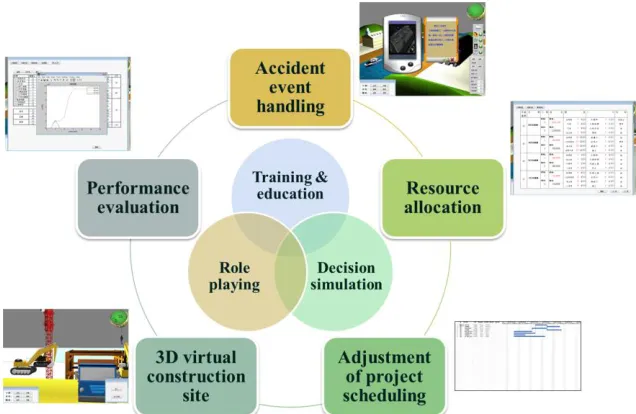
discussing details with experienced staff. Fig. 1 shows the main contents of the game script of the proposed virtual construction.
Tasks in this work include drawing up a construction contract initially, selecting collaborating companies, allocating resour ces
efficiently after the project is initiated, controlling costs and schedules, handling unforeseen emergencies such as those
involving construction safety, and evaluating the performance of construction quality after completion. Cumulatively, the abo ve
tasks form the basis for establishing a game-based training mode for decision making in construction management.
3.
Analysis of System Requirements
Once the game script for virtual training and presentation of the game contents and interactive modes are established, this
work further analyzes operating conditions based on the above considerations to prepare the details of system development.
Fig. 1 Contents of the proposed training mode
3.1. Decision mak ing
One of the key responsibilities of a construction manager is to make decisions in construction management. Whether
making the appropriate management decision or not is one of the determinant factors for the success or failure of project
management, and it is one of the key competencies that needs to be acquired first. Based on the script in this study, the
management decision making given to trainees in the game includes two parts: decision making for emergencies and decision
making for selecting the contractor. Emergencies are generally divided into two parts: those caused by climate and those caused
by human factors. The disaster triggered randomly by the climate system of the game causes delays or a shut -down, and thus
users must make a decision immediately. With regard to accidents caused by human factors, many accidents questioning
construction safety caused by the incompetence of the cooperating company or by the improper habits of the construction
workers are triggered in order for users to prepare solutions and select contractors carefully.
3.2. Resource allocation and management
During construction, the manager must arrange the resources including labor, money, and machinery, for reacting to
various uncertain factors. These are very important as they can affect the schedule of the whole construction. Therefore, the
virtual construction management presented in this study provides trainees with the function of adjusting resources used in
construction.
The number and type of resources initially planned for each work item are the reference basis. After the scheduling is
completed, the actual resource number is divided by the reference number. The ratio is divided into several blocks for differ ent
days, and the stepwise method is applied to reduce the days. The number of resources after adjustment is multiplied by unit price
and days after changing. The obtained number will be the cost of the operation.
3.3. Schedule and progress control
Due to uncertainties in the simulation, the system allows users to adjust the operating resources according to the
encountered situation. The original schedule and progress control are then changed with the occurrence of events and related
arrangement. Moreover, based on the schedule and progress control, it is necessary to update the schedule and th e cost.
To attain the requirement of schedule and progress control, which is achieved by integrating MS Project, each game data in
the main program is saved in a database, and then it is converted to the specified format set by the MS Project. All the kinds of
operations in virtual construction can be arranged using this software. After finishing the operation arrangement, the updated
scheduling information is stored back to the database and the main program for updating game status through reading the
database.
3.4. Evaluation of management performance
In current project management practice, the evaluation of management performance as a management tool has been
introduced. According to the resources to invest and the schedule, the performance index is calculated theoretically to help the
manager control and determine in real time the effectiveness of the management strategy in use. Using the evaluation index ca n
analyze the reasons why the results are not effective. This is to discuss further the occurrence point of the reason and to c onsider
and acquire the improved method and make adjustments .
The game should provide the function of evaluating management perfo rmance in a virtual construction. Based on
performance evaluation function offered by the system, users can check, during the game training period or after, their
management strategy for resource allocation, cost and time control, and decision making. The proper evaluation theories,
including the score index and S Curve, are selected to calculate real-time indexes and control curves based on all kinds of status
data in the process of game such as loss amount caused by construction safety, types of accidents , and expenses.
4.
System Implementation
The training system for the proposed game is developed based on the above functions. Five functional bars allow users to
control and summon all functions. The functions of each function menu are listed as follows:
(1) Main function toolbar: Users can access the contract contents and select the collaborating company from a list of many contractors, adjust the number of resources in each construction, shorten or extend the duration, rearrange the operating time to control construction operations, and make verifications and adjustments by accessing the performance scores;
(2) Time status bar: This menu indicates the date in the game world; the operation is run based on it. Users can accelerate or decelerate the game speed, as well as stop the game;
(3) Project status bar: Game climate can affect operation efficiency and the construction period. An icon denotes the current weather situation. Conditions of the worker, owner, finances, and duration are denoted by three lights, i.e. red, y ellow, and green lights, to remind users to control them in real time;
(4) Sub function toolbar for daily management: Users can give management instructions, such as orient the trainees, using various management functions offered in this functional toolbar;
(5) Display area of virtual scene: The animations of construction operations and animations of triggered events are displayed here. Users can switch for a closer view of scenes on-site by clicking the building under construction .
5.
Effectiveness Evaluation
Fifty students enrolled in a course on project planning and control at National Taiwan University of Science and
Technology tested the effectiveness of the proposed game. User survey statistics reveal an agreement level of 4.32 out of 5 t hat
this game benefits learning and that course contents are clearly understood. This game -based training is regarded to perform
better in simulation, interest, interactivity, learning efficiency, and immersion than other training modes do. The leading f ive
features selected are management decision making, 3D display of virtual construction site, tutorial hints, project scheduling, as
6.
Conclusions
By applying role-playing functions and simulation games, the proposed game orients students on decision making in
project management. For instance, in a virtual work site, users can act as site directors to conduct a series of daily duties . Based
on the understanding and analysis of managerial experience and construction processes accumulated from managing virtual
projects, a virtual training system design is planned to fulfill the function demand. Also, users do not need to be concerned with
poor decisions that can incur property damage or budgetary loss. Additionally, the proposed virtual game can make
modifications according to the feedback from the performance evaluation index after training. This feature helps users to
determine and compensate for management limitations and other details to prevent time and financial loss result ing from a lack of
experience or wrong judgment in their future work. The proposed game provides a virtual presence that allows users to observe
the incident on site, as well as interact with each other in the decision -making process, which is in contrast with conventional
classroom teaching methods. Moreover, the proposed game also ensures a better performance in terms of calculating costs and
safety in practical training, which represents an advantage over practical training in enterprises, construction s ite visits, and
other training modes.
References
[1] I. Javier and D. Abraham, “Application of virtual reality technology for the improvement of safety in the steel erection
process,” International Conf. Computing in Civil Engineering, June 2005, pp. 1-11.
[2] H. Dib, M. F. Shiratuddin, and D. Fletcher, “Learning construction surveying in a virtual environment: a proposed
approach,” Proc. of 12th International Conference in Civil and Building Engineering & 2008 International Conference on information Technology in Construction, October 2008.
[3] C. M. Li, I. C. Yeh, S. F. Chen, T. Y. Chiang, and L. C. Lien, “Virtual reality learning system for digital terrain model surveying
practice,” ASCE Journal of Professional Issues in Engineering Education and Practice, vol. 134, no. 4, pp. 335-345, October 2008.
[4] C. C. Lu, S. C. Kang, S. H. Hsieh, and R. S. Shiu, “Improvement of a computer-based surveyor-training tool using a user-centered approach,” Advanced Engineering Informatics, vol. 23, no. 1, pp. 81-92, January 2009.
[5] H. Dib and N. Adamo-Villani, “A virtual steel sculpture for structural engineering education: development and initial
findings,” Journal of Educational Technology Systems , vol. 44, no. 4, pp. 430-449, June 2016.
[6] N. Adamo-Villani and H. Dib, “A study of the effects of teaching avatars on students' learning of surveying mathematics,”
International Journal of Information and Communication Technology Education , vol. 12, no. 2, pp. 1-13, April 2016. [7] I. D. Tommelein, D. R. Riley, and G. A. Howell, “Parade game: impact of work flow variability on trade performance,” ASCE
Journal of Construction Engineering and Management, vol. 125, no. 5, pp. 304-310, September 1999.
[8] K. Nassar, “Simulation gaming in construction: ER, the equipment replacement game,” Journal of Construction Education, vol. 7, no. 1, pp. 16-30, September 2002.
[9] W. C. Wang, R. J. Dzeng, and Y. H. Lu, “Integration of simulation-based cost model and multi-criteria evaluation model for bid price decisions,” Journal of Computer-Aided Civil and Infrastructure Engineering, vol. 22, no. 3, pp. 223-235, February 2007.
[10] A. Sherif and H. Mekkawi, “A computer-aided-learning tool for teaching construction engineering decision making: an excavation stage educational game,” Proc. of 12th International Conference in Civil and Building Engineering & 2008
International Conference on information Technology in Construction, October 2008.
[11] H. Dib, N. Adamo-Villani, and J. Yu, “Computer animation for learning building construction management: a comparative study of first person versus third person view,” Proc. of the 1st International Conference on E-Learning, E-Education, and