Techniques
& Principles
in Language
Teaching
Great Clarendon Street, Oxford 0X2 6DP
Oxford University Press is a department of the University of Oxford. It furthers the University’s objective of excellence in research, scholarship, and education by publishing worldwide in Oxford New York
Auckland Cape Town Dar es Salaam Hong Kong Karachi Kuala Lumpur Madrid Melbourne Mexico City Nairobi New Delhi Shanghai Taipei Toronto
With offices in
Argentina Austria Brazil Chile Czech Republic France Greece Guatemala Hungary Italy Japan Poland Portugal Singapore South Korea Switzerland Thailand Turkey Ukraine Vietnam OXFORD and OXFORD ENGLISH are registered trade marks of Oxford University Press in the UK and in certain other countries © Oxford University Press 2011
The moral rights of the author have been asserted Database right Oxford University Press (maker) First published 2011
2016 2015 2014 2013 2012 10 9 8 7 6 5 4 3
No unauthorized photocopying
All rights reserved. No part of this publication may be reproduced, stored in a retrieval system, or transmitted, in any form or by any means, without the prior permission in writing of Oxford University Press, or as expressly permitted by law, or under terms agreed with the appropriate reprographics rights organization. Enquiries concerning reproduction outside the scope of the above should be sent to the ELT Rights Department, Oxford University Press, at the address above You must not circulate this book in any other binding or cover and you must impose this same condition on any acquirer
Any websites referred to in this publication are in the public domain and their addresses are provided by Oxford University Press for information only. Oxford University Press disclaims any responsibility for the content ISBN: 978 0 19 442360 1
Printed in China
This book is printed on paper from certified and well-managed sources. ACKNOWLEDGEMENTS
The authors and publisher are grateful to those who have given permission to reproduce the following extract of copyright material: p.214 Screenshot from Facebook (http://www.facebook.com). Reproduced by kind permission of Facebook.
Sources: p.215 www.wikipedia.com; p.205 The British National Corpus
Illustrations by: Chris Pavely pp. 26, 38, 53, 56, 72, 87, 89, 106, 118, 135, 153, 172, 183, 188, 193.
In memory of my parents, Elaine and Randolph Larsen, with heartfelt gratitude for their love and encouragement
DIANE LARSEN-FREEMAN
In memory of my mother, Mavis Anderson, and in honor of my father, Elmer Anderson, who both inspired me to be curious and compassionate
Contents
Acknowledgments List of Acronyms
To the Teacher Educator
1 Introduction
2 The Grammar-Translation Method 3 The Direct Method
4 The Audio-Lingual Method 5 The Silent Way
6 Desuggestopedia
7 Community Language Learning 8 Total Physical Response
9 Communicative Language Teaching 10 Content-based Instruction
11 Task-based Language Teaching
12 The Political Dimensions of Language Teaching and the Participatory Approach 13 Learning Strategy Training, Cooperative Learning, and Multiple Intelligences 14 Emerging Uses of Technology in Language Teaching and Learning
15 Conclusion
Acknowledgments
We thank the readers of the first and second editions of this book. Your invaluable feedback and input have helped to shape this third edition.
The approach we have used in this book, as in the previous two editions, is based on our experience in teaching the methods/approaches course at the Master of Arts in Teaching Program at the School for International Training. This book would not have been written in the first place if it had not been for the influence of colleagues and students there. We are indeed grateful for the time we spent in this wonderful community.
Marti would like to thank Diane for being an inspiring teacher and mentor as well as beloved colleague and friend. Working with her on this project has been a great privilege.
Diane would like to thank Marti for her willingness to join her in this project and her ‘can-do’ attitude throughout. Diane is counting on Marti to make this project her own and carry it into the future.
We wish to thank our life partners for their encouragement and support.
For the initial faith they showed and for their continued encouragement and helpful suggestions, Diane acknowledges with gratitude the editors of this series, Russell Campbell and William Rutherford.
It has also been a pleasure working with the professionals at Oxford University Press. For this edition, we want to acknowledge Julia Bell’s helpfulness especially, and Ann Hunter’s and Keith Layfield’s skillful copy-editing.
List of Acronyms
ALM Audio-Lingual Method
BNC British National Corpus
CBI Content-based Instruction
CLL Community Language Learning
CLT Communicative Language Teaching
CALL Computer-assisted Language Learning
CLIL Content and Language Integrated Learning
ELF English as a Lingua Franca
LCD Liquid Crystal Display
SLA Second Language Acquisition
SAARRD Security, Aggression, Attention, Reflection, Retention, and Discrimination
SIOP Sheltered Instruction Observation Protocol
TL Target Language
TBLT Task-based Language Teaching
WL Whole Language
To the Teacher Educator
The Work of Language Teaching
The work of teaching is simultaneously mental and social. It is also physical, emotional, practical, behavioral, political, experiential, historical, cultural, spiritual, and personal. In short, teaching is very complex, influenced not only by these 12 dimensions and perhaps others, but also requiring their contingent orchestration in support of students’ learning. When language teaching in particular is in focus, the complexity is even greater, shaped by teachers’ views of the nature of language, of language teaching and learning in general, and by their knowledge of the particular sociocultural setting in which the teaching and learning take place (Adamson 2004). Indeed, research has shown that there is a degree of shared pedagogical knowledge among language teachers that is different from that of teachers of other subjects (Gatbonton 2000; Mullock 2006). Nonetheless, each teacher’s own language learning history is also unique. The way that teachers have been taught during their own ‘apprenticeship of observation’ (Lortie 1975) is bound to be formative. There is also the level of complexity at the immediate local level, due to the specific and unique needs of the students themselves in a particular class at a particular time, and the fact that these needs change from moment to moment. Finally, the reality of educational contexts being what they are, teachers must not only attempt to meet their students’ learning needs, but they must also juggle other competing demands on their time and attention.
Because of this complexity, although this is a book about the methods and methodological innovations of recent years, we do not seek to convince readers that one method is superior to another, or that there is or ever will be a perfect method (Prabhu 1990). The work of teaching suggests otherwise. As Brumfit observes:
A claim that we can predict closely what will happen in a situation as complex as [the classroom] can only be based on either the view that human beings are more mechanical in their learning responses than any recent discussion would allow, or the notion that we can measure and predict the quantities and qualities of all … factors. Neither of these seems to be a sensible point of view to take.
(Brumfit 1984: 18–19)
language teaching’ (Tudor 2003: 3), with adjustments being made for the age of the learners, specific goals, or class numbers, etc. However, the truth is that
Learners are not ‘simply’ learners any more than teachers are ‘simply’ teachers; teaching contexts, too, differ from one another in a significant number of ways. In other words, language teaching is far more complex than producing cars: we cannot therefore assume that the technology of language teaching will lead in a neat, deterministic manner to a predictable set of learning outcomes.
(Tudor 2003: 3).
Tudor goes on to observe that this is true even within a given culture. It cannot be assumed that all teachers will share the same conceptions of language, of learning, and of teaching.
Rather than the elegant realisation of one rationality, then, language teaching is likely to involve the meeting and interaction of different rationalities. Murray (1996) is therefore right in drawing attention to the ‘tapestry of diversity’ which makes our classrooms what they are.
(ibid. 2003: 7)
Language Teacher Learning
Recognizing the complex and diverse nature of the work of teaching has stimulated much discussion during the last 15 years around the question of how it is that language teachers learn to teach (Bailey and Nunan 1996; Bartels 2005; Burns and Richards 2009; Freeman and Richards 1996; Hawkins 2004; Johnson 2009; Tedick 2005). In addition, during this same time period, the journal Language Teaching Research began publication with Rod Ellis as its editor. Much of the research reported on in these sources can be summed up in what Johnson describes as her current understanding of language teacher learning:
L2 teacher learning [is] … socially negotiated and contingent on knowledge of self, subject matter, curricula, and setting … L2 teachers [are] … users and creators of legitimate forms of knowledge who make decisions about how best to teach their L2 students within complex socially, culturally, and historically situated contexts.
(Johnson 2006: 239)
must teach the skills of reflectivity and it must provide the discourse and vocabulary that can serve participants in renaming their experience’ (Freeman 2002: 11).
It is these two functions that we believe our study of methods is well-positioned to address. First of all, by observing classes in action and then analyzing the observations, we intend to help readers cultivate skills in reflectivity, important for their sense of self-efficacy (Akbari 2007). The point is to illustrate the thinking that goes on beneath the surface behavior enacted in the classroom in order to understand the rationale for some of the decisions that teachers make (Woods 1996; Borg 2006). A study of methods is also a means of socialization into professional thinking and discourse that language teachers require in order to ‘rename their experience,’ to participate in their profession, and to learn throughout their professional lives.
A Study of Methods
Thus, a study of methods is invaluable in teacher education in at least five ways: 1 Methods serve as a foil for reflection that can aid teachers in bringing to conscious
awareness the thinking that underlies their actions. We know that teachers come to teacher training with ideas about the teaching/learning process formed from the years they themselves spent as students (Lortie 1975). A major purpose of teacher education is to help teachers make the tacit explicit (Shulman 1987). By exposing teachers to methods and asking them to reflect on the principles of those methods and actively engage with the techniques, teacher educators can help teachers become clearer about why they do what they do. They become aware of their own fundamental assumptions, values, and beliefs. In turn, reflective teachers can take positions on issues that result in the improvement of the society in which they live (Clarke 2007; Akbari 2007).
2 By becoming clear on where they stand (Clarke 2003), teachers can choose to teach differently from the way they were taught. They are able to see why they are
attracted to certain methods and repelled by others. They are able to make choices that are informed, not conditioned. They may be able to resist, or at least argue against, the imposition of a particular method by authorities. In situations where a method is not being imposed, different methods offer teachers alternatives to what they currently think and do. It does not necessarily follow that they will choose to modify their current practice. The point is that they will have the understanding and the tools to do so, if they are able to and want to.
3 A knowledge of methods is part of the knowledge base of teaching. With it, teachers join a community of practice (Lave and Wenger 1991). Being a community
less isolated in their practice.
4 Conversely, by being members of a professional discourse community, teachers may find their own conceptions of how teaching leads to learning challenged.
Interacting with others’ conceptions of practice helps to keep teachers’ teaching alive and to prevent it from becoming stale and overly routinized (Prabhu 1990). 5 A knowledge of methods helps to expand a teacher’s repertoire of techniques. This
in itself provides a further avenue for professional growth, since some teachers find their way to new pedagogical positions by first trying out new techniques rather than by entertaining new principles. Moreover, effective teachers who are more experienced and expert have a large, diverse repertoire of best practices (Arends 2004), which presumably helps them deal more effectively with the unique qualities and idiosyncrasies of their students.
Criticisms of Methods
Despite these potential gains from a study of methods, it is important to acknowledge that a number of writers in our field have criticized the concept of language teaching methods. Some say that methods are prescriptions for classroom behavior, and that teachers are encouraged by textbook publishers and academics to implement them whether or not the methods are appropriate for a particular context (Pennycook 1989). Others have noted that the search for the best method is ill-advised (Prabhu 1990; Bartolome 1994); that teachers do not think about methods when planning their lessons (Long 1991); that methodological labels tell us little about what really goes on in classrooms (Katz 1996); and that teachers experience a certain fatigue concerning the constant coming and going of fashions in methods (Rajagopalan 2007). Hinkel (2006) also notes that the need for situationally relevant language pedagogy has brought about the decline of methods.
These criticisms deserve consideration. It is possible that a particular method may be imposed on teachers by others. However, these others are likely to be disappointed if they hope that mandating a particular method will lead to standardization. For we know that teaching is more than following a recipe. Any method is going to be shaped by a teacher’s own understanding, beliefs, style, and level of experience. Teachers are not mere conveyor belts delivering language through inflexible prescribed and proscribed behaviors (Larsen-Freeman 1991); they are professionals who can, in the best of all worlds, make their own decisions—informed by their own experience, the findings from research, and the wisdom of practice accumulated by the profession (see, for example, Kumaravadivelu 1994).
institutional constraints and demands, and factors connected to the wider sociocultural context in which the instruction takes place. Even the ‘right’ method will not compensate for inadequate conditions of learning, or overcome sociopolitical inequities. Further, decisions that teachers make are often affected by exigencies in the classroom rather than by methodological considerations. Thus, saying that a particular method is practiced certainly does not give us the whole picture of what is happening in the classroom. Since a method is more abstract than a teaching activity, it is not surprising that teachers think in terms of activities rather than methodological choices when they plan their lessons.
What critics of language teaching methods have to offer us is important. Admittedly, at this point in the evolution of our field, there is little empirical support for a particular method, although there may be some empirical support in second language acquisition research for methodological principles (Long 2009). Further, what some of the methods critics have done is to raise our awareness about the importance of critical pedagogy. As Akbari puts it:
By viewing education as an intrinsically political, power-related activity, supporters of critical pedagogy seek to expose its discriminatory foundations and take steps toward reforming it so that groups who are left out because of their gender, race, or social class are included and represented … Critical pedagogy puts the classroom context into the wider social context with the belief that ‘what happens in the classroom should end up making a difference outside of the classroom’ (Baynham 2006).
(Akbari 2008: 644)
Larsen-Freeman and Freeman concur:
It is clear that universal solutions that are transposed acritically, and often accompanied by calls for increased standardization, and which ignore indigenous conditions, the diversity of learners, and the agency of teachers are immanent in a modernism that no longer applies, if it ever did. (Larsen-Freeman and Freeman 2008: 168)
suggest that one measure of a method should be its adaptability—the degree to which it can be adapted to satisfy different conditions.
In the end, then, which method is practiced is, or at least should be, a local decision. In this regard, teachers’ voices must be heeded. And what teachers have to say about the value of methods is unequivocal:
Few teachers define methods in the narrow pejorative sense used by post-methodologists. Most teachers think of methods in terms of techniques which realize a set of principles or goals and they are open to any method that offers practical solutions to problems in their particular teaching context.
(Bell 2007: 141)
Continuing, Bell writes:
A knowledge of methods is equated with a set of options, which empowers teachers to respond meaningfully to particular classroom contexts. In this way, knowledge of methods is seen as crucial to teacher growth.
(ibid. 2007: 141–2)
As one teacher in a study conducted by Bell remarked:
‘I think that teachers should be exposed to all methods and they themselves would ‘build’ their own methods or decide what principles they would use in their teaching. We cannot ignore methods and all the facts that were considered by those who ‘created’ or use them in their teaching. We need a basis for building our own teaching.’
(ibid. 2007: 143)
New to this Third Edition
Some modest revision has been made throughout the book, including a new discussion in Chapter 13 of Howard Gardner’s habits of mind, which he claims students need to develop in order to participate effectively in current and emerging cultural and work environments. Other chapters have remained relatively untouched. This is because these chapters describe methods that are more historical than contemporary, although they are all still being practiced somewhere in the world today. In any case, we believe that educators should have a sense of the history of the field, not only of contemporary practices. As we have already indicated, our goal in this book is to expose readers to the ‘tapestry of diversity’ that exists in human teaching and learning, not to convince readers of the value of any one method over the others.
There are also several major changes that have been made for this edition. First, three methodological innovations—Content-based, Task-based, and Participatory Approaches—which were dealt with in a single chapter in the previous edition, are each addressed in separate chapters in this edition. These three chapters allow for the more in-depth treatment that these enduring practices warrant. Content-based Instruction, or Content and Language Integrated Learning (CLIL), has seen widespread adoption, both in the education of English language learners in the USA and in language education in other countries, particularly in Europe, where it is increasingly common for governments to encourage the teaching of language and other subjects in tandem in state schools. It was also important to expand the discussion of Task-based Language Teaching, which a new chapter has allowed us to do, as it is the method that has received the most support from second language acquisition research. The third new chapter, the Participatory Approach, has enabled us to elaborate on the political dimensions of language teaching, including how language study can influence a language learner’s sociopolitical identity.
In addition, we have added a new chapter on technology. Technological aids to language teaching have been around for some time, of course, but in our opinion, technology has reached a point where it should be considered not only as a supplement to teaching or a resource for teachers, but also as an opportunity for autonomous learning. A technological approach to language teaching rests on its own unique set of principles, including a new understanding of the nature of language.
Terminology
Two notes about terminology are also in order:
techniques carry out a method which is consistent with an approach’. Following Anthony, in certain of the chapters we will introduce a particular method by showing how it is an example of a more general approach to language teaching. However, not all methods discussed in this book conveniently follow from a general approach. They all do, though, have both a conceptual and an operational component, fitting the definition in the Dictionary of Language Teaching and Applied Linguistics (a method is ‘a way of teaching a language which is based on systematic principles and procedures’), and thus justifying our use of the term. Admittedly, we have sometimes found it difficult to use the term ‘method’ with more recent innovations, such as learning strategies, cooperative learning, and technology. At such times, we have resorted to the term ‘methodological innovations.’
2 We have used the term ‘target language’ to mean ‘the language being taught’ for three reasons. First, we intend for this book to be useful to teachers of all
languages, not only English teachers. Second, we acknowledge that many teachers and students are multilingual or plurilingual (to use the Council of Europe’s term) and so the use of the term ‘second’ language does not really apply. Third, we have avoided using the term ‘foreign’ language because this designation is relative to the speaker and mutable in the context. For instance, in the USA, Spanish has a
heterogeneous identity: it could be considered as a ‘foreign’ language to those with little or no knowledge of it; as a ‘second’ language to those who use it in addition to their first language; or as a ‘native’ language to those for whom it is a home or heritage language (Larsen-Freeman and Freeman 2008). Although the term ‘target language’ is not without its problems, using this term seemed a reasonable
compromise.
Finally, although we have made every effort toward a faithful rendering of each method and methodological innovation, there will undoubtedly be those who would not totally accept our rendition. This is understandable and probably inevitable. Our description is, as it must be, a product of our own experience.
It is our sincere hope that this book will both inform and stimulate its readers and that it will encourage them to reflect, inquire, and experiment. If it meets these goals, then it may help to restore faith in the appropriate use of teaching methods in language teacher education.
Brattleboro, Vermont and Ann Arbor, Michigan Diane Larsen-Freeman
References/Additional Resources
Akbari, R. 2007. ‘Reflections on reflection: A critical appraisal of reflective practices in L2 teacher education.’ System 35: 192–207.
____. 2008. ‘Postmethod discourse and practice.’ TESOL Quarterly 42/4: 641–52.
Adamson, B. 2004. ‘Fashions in language teaching methodology’ in A. Davies and C. Elder (eds.). The Handbook of Applied Linguistics: 604–22. Malden, MA:
Blackwell.
Anthony, E. 1963. ‘Approach, method, and technique.’ English Language Teaching 17: 63–7. Reprinted in H. Allen and R. Campbell (eds.). Teaching English as a Second Language (2nd. edn.). 1972. New York: McGraw-Hill.
Arends, R. 2004. Learning to Teach. (6th edn.) New York: McGraw-Hill.
Bailey, K. and D. Nunan (eds.). 1996. Voices from the Language Classroom. Cambridge: Cambridge University Press.
Bartels, N. (ed.). 2005. Applied Linguistics and Language Teacher Education. New York: Springer.
Bartolome, L. 1994. ‘Beyond the methods fetish: Toward a humanizing pedagogy.’ Harvard Educational Review 64/2: 173–94.
Bax, S. 2003. ‘The end of CLT: A context approach to language teaching.’ ELT Journal 57/3: 278–87.
Baynham, M. 2006. ‘Agency and contingency in the language learning of refugees and asylum seekers.’ Linguistics and Education 17: 24–39.
Bell, D. 2007. ‘Do teachers think that methods are dead?’ ELT Journal 61/2: 135–43.
Borg, S. 2006. Teacher Cognition and Language Education. London: Continuum.
Brumfit, C. 1984. Communicative Methodology in Language Teaching. Cambridge: Cambridge University Press.
Burns, A. and J. Richards (eds.). 2009. The Cambridge Guide to Second Language Teacher Education. New York: Cambridge University Press.
Canagarajah, A. (ed.). 2005. Reclaiming the Local in Language Policy and Practice. Mahwah, NJ: Lawrence Erlbaum.
Clarke, M. 2003. A Place to Stand: Essays for Educators in Troubled Times. Ann Arbor, MI: University of Michigan Press.
____. 2007. Common Ground, Contested Territory. Examining the Roles of English Language Teachers in Troubled Times. Ann Arbor, MI: University of Michigan Press.
____ and J. Richards (eds.). 1996. Teacher Learning in Language Teaching. New York: Cambridge University Press.
Gatbonton, E. 2000. ‘Investigating experienced ESL teachers’ pedagogical knowledge.’ Canadian Modern Language Review 56: 585–616.
Hawkins, M. (ed.). 2004. Language Learning and Teacher Education: A Sociocultural Approach. Clevedon: Multilingual Matters.
Hinkel, E. 2006. ‘Current perspectives on teaching the four skills.’ TESOL Quarterly 40/1: 109–31.
Johnson, K. 2006. ‘The sociocultural turn and its challenges for second language teacher education.’ TESOL Quarterly 40/1: 235–57.
____. 2009. Second Language Teacher Education: A Sociocultural Perspective. New York: Routledge.
Katz, A. 1996. ‘Teaching style: A way to understand instruction in language classrooms’ in K. Bailey and D. Nunan (eds.). Voices from the Language Classroom, 57–87. Cambridge: Cambridge University Press.
Kumaravadivelu, B. 1994. ‘The postmethod condition: (E)merging strategies for second/foreign language teaching.’ TESOL Quarterly 28/1: 27–48.
____. 2006. ‘TESOL methods: Changing tracks, challenging trends.’ TESOL Quarterly 40/1: 59–81.
Larsen-Freeman, D. 1991. ‘Research on language teaching methodologies: A review of the past and an agenda for the future’ in K. de Bot, R. Ginsberg, and C. Kramsch (eds.). Foreign Language Research in Cross-Cultural Perspective, 119–32.
Amsterdam/Philadelphia: John Benjamins Publishing Co.
____. 1998. ‘Learning teaching is a lifelong process.’ Perspectives XXIV/2: 5–11. ____. 2000. ‘On the appropriateness of language teaching methods in language and
development’ in J. Shaw, D. Lubelske, and M. Noullet (eds.). Partnership and Interaction: Proceedings of the Fourth International Conference on Language and Development. Hanoi, Vietnam, 65–71. Bangkok: Asian Institute of Technology. ____ and L. Cameron. 2008. Complex Systems and Applied Linguistics. Oxford:
Oxford University Press.
____ and D. Freeman. 2008. ‘Language moves: The place of “foreign” languages in classroom teaching and learning.’ Review of Research in Education 32: 147–86.
Lave, J. and E. Wenger. 1991. Situated Learning: Legitimate Peripheral Participation. New York: Cambridge University Press.
Publishing Co.
____. 2009. ‘Methodological principles for language teaching’ in M. Long and C. Doughty (eds.). The Handbook of Language Teaching, 373–94. Malden, MA: Wiley-Blackwell.
Lortie, D. 1975. Schoolteacher: A Sociological Study. Chicago: University of Chicago Press.
Mullock, B. 2006. ‘The pedagogical knowledge base of four TESOL teachers.’ Modern Language Journal 90/1: 48–66.
Murray, D. 1996. ‘The tapestry of diversity in our classrooms’ in K. Bailey and D. Nunan (eds.). Voices from the Language Classroom, 434–48. Cambridge:
Cambridge University Press.
Pennycook, A. 1989. ‘The concept of method, interested knowledge, and the politics of language teaching.’ TESOL Quarterly 23/4: 591–615.
____. 2001. Critical Applied Linguistics: A Critical Introduction. Mahwah, NJ: Erlbaum.
Prabhu, N. S. 1990. ‘There is no best method—Why?’ TESOL Quarterly 24/2: 161– 76.
____. 1992. ‘The dynamics of the language lesson.’ TESOL Quarterly 26/2: 225–41.
Rajagopalan. K. 2007. ‘From madness in method to method in madness.’ ELT Journal 62/1: 84–5.
Richards, J. 2008. ‘Second language teacher education today.’ RELC Journal 39/2: 158–77.
Savignon, S. 2007. ‘Beyond communicative language teaching: What’s ahead?’ Journal of Pragmatics 39: 207–20.
Shulman, L. 1987. ‘Knowledge-base and teaching: Foundations of the new reform.’ Harvard Educational Review 57/1: 1–22.
Tedick, D. (ed.). 2005. Language Teacher Education: International Perspectives on Research and Practice. Mahwah, NJ: Lawrence Erlbaum Associates.
Tudor, I. 2003. ‘Learning to live with complexity: Towards an ecological perspective on language teaching.’ System 31: 1–12.
Widdowson, H. G. 2004. ‘A perspective on recent trends’ in A. P. R. Howatt with H. G. Widdowson. A History of English Language Teaching (2nd edn.), 353–72. Oxford: Oxford University Press.
1
Introduction
Goals of this Book
One of the goals of this book is for you to learn about many different language teaching methods. We will use the term ‘method’ to mean a coherent set of links between the actions of a teacher in a classroom and the thoughts that underlie the actions. The actions are the techniques, and the thoughts are the principles in the title of this book: Techniques and Principles in Language Teaching.
A second goal is to help you uncover the thoughts that guide your own actions as a teacher. They may not be ones of which you are aware. Seeking to determine which principles of the methods you read about here are most [dis]harmonious with your own thinking will help you to uncover some of your implicit thoughts and beliefs about teaching.
Thought-in-Action Links
It is important to recognize that methods link thoughts and actions, because teaching is not entirely about one or the other. Of course this is as true about your own teaching as it is about any method you will read about in this book. As a teacher of language, you have thoughts1 about your subject matter—what language is, what culture is—
and about your students—who they are as learners and how it is they learn. You also have thoughts about yourself as a teacher and what you can do to help your students to learn. Many of your thoughts have been formed by your own experience as a language learner. It is very important for you to become aware of the thoughts that guide your actions in the classroom. With this awareness, you are able to examine why you do what you do and perhaps choose to think about or do things differently.
As an example, let us relate an anecdote about a teacher with whom Diane Larsen-Freeman was working some time ago. We will call her Heather, although that is not her real name. From her study of methods in Stevick (1980), Heather became interested in how to work with teacher control and student initiative in her teaching. Heather determined that during her student teaching internship, she would exercise less control of the lesson in order to encourage her students to take more initiative. She decided to narrow the goal down to having the students take the initiative in posing the questions in the classroom, recognizing that so often it is the teacher who asks all the questions, not the students.
Diane was Heather’s teaching supervisor. When Diane came to observe her, Heather was very discouraged. She felt that the students were not taking the initiative that she was trying to get them to take, but she could not see what was wrong.
When Diane visited her class, she observed the following:
HEATHER: Juan, ask Anna what she is wearing.
JÜAN: What are you wearing?
ANNA: I am wearing a dress.
HEATHER: Anna, ask Muriel what she is writing.
ANNA: What are you writing?
MÜRIEL: I am writing a letter.
This pattern continued for some time. It was clear to see that Heather had successfully avoided the common problem of the teacher asking all the questions in the class. The teacher was not asking the questions—the students were. However, Heather had not achieved her goal of encouraging student initiative, since it was she who took the initiative by prompting the students to ask the questions. Heather and Diane discussed the matter in the postobservation conference.
activity was not essential. Diane talked about several ways Heather might do this. During this discussion, Heather came to another important awareness. She realized that since she was a fairly inexperienced teacher, she felt insecure about having the students make the decisions about who says what to whom, and when. What if the students were to ask her questions that she was unable to answer? Having students take the initiative in the classroom was consonant with her values; however, Heather realized that she needed to think further about what level of student initiative would be comfortable for her at this stage in her career as a teacher. The point was that it was not necessarily simply a matter of Heather improving her technique; she could see that that was one possibility. Another was to rethink the way in which she thought about her teaching (Larsen-Freeman 1993).
A Coherent Set
Returning to the methods in this book, we will see that it is the link between thoughts and actions that is common to them all. But there is another way in which links are made in methods, and that is the connection between one thought-in-action link and another. A method is a coherent set of such links. Methods are coherent in the sense that there should be some theoretical or philosophical compatibility among the links. It would make little sense, for example, for a methodologist who believes that language is made up of a set of fixed patterns to characterize language acquisition as a creative process, and to employ discovery learning techniques to help learners discover the abstract rules underlying a language in order to enable them to create novel sentences.
To say there is coherence among the links does not mean, however, that the techniques of one method can not be used with another. The techniques may look very different in practice, though, if the thoughts behind them differ. For example, Stevick (1993) has shown that the simple technique of using a picture to provide a context for a dialogue that the students are supposed to learn can lead to very different conclusions about teaching and learning depending on how the technique is managed. If the students first look at the picture, close their eyes while the teacher reads the dialogue, and then repeat the dialogue bit by bit after the teacher, repeating until they have learned it fluently and flawlessly, the students could infer that it is the teacher who is the provider of all language and its meaning in the classroom. They could further infer that they should use that ‘part of their brains that copies but not the part that creates’ (1993: 432).
Which Method is Best?
It is not our purpose in this book to promote one method over another. Thus, from our perspective, it is not a question of choosing between intact methods; nor should the presence of any method in this book be construed as an endorsement by us. Our agnostic stance will no doubt irritate some of our readers. However, like Prahbu (1990), we do not believe that there is a single best method. Further, it is not our purpose to have you sift through the methods presented here in order to choose the one with which you feel the most philosophically in tune. Instead, it is intended that you will use what is here as a way to make explicit your own beliefs about the teaching–learning process, beliefs based upon your experience and your professional training, including the research you know about. Unless you become clear about your beliefs, you will continue to make decisions that are conditioned rather than conscious. Engaging with the professional beliefs of others in an ongoing manner is also important for keeping your teaching practice alive. Furthermore, ‘if the teacher engages in classroom activity with a sense of intellectual excitement, there is at least a fair probability that learners will begin to participate in the excitement and to perceive classroom lessons mainly as learning events—as experiences of growth for themselves’ (Prabhu 1992: 239).
be clear, then, that some of the methods featured in this book are incompatible with others.
Of course, it is not only the dynamics internal to the field that contribute to changing practices. There are factors external to the field that affect language teaching as well. For instance, population flows among countries of the world have increased multilingualism (Todeva and Cenoz 2009). Then, too, the development and promotion of the Common European Framework (CEFR: Council of Europe 2001) has influenced thinking about language education. Among other things, the Council of Europe has encouraged plurilingualism (an individual’s language proficiency in several languages). Use of the CEFR promotes the view that most learners are not complete tabulae rasae. They already have some degree of competence in another language or languages, and teachers should take advantage of this (Paradowski 2007). The ongoing development of technology is another of those external influences that has had a major impact in the field, and this is likely to increase in the future. Speaking of external influences, we should also acknowledge that standardized examinations and textbooks, which require adherence to even the smallest details through their teacher guides, mean that, in reality, teachers are not always able to exercise the methodological choices they would wish (Akbari 2007).
Finally, it was not our intent to be comprehensive and to deal with all language teaching methods that have ever been practiced. While we consider the various methods in a rough chronological order, it is also the case that there were methods practiced before the first one discussed in this book, and that many of them are practiced concurrently. To be clear, we are not claiming that newer methods are better in all respects than older methods. What we did choose to do was to include methods2
Doubting Game and Believing Game
Some of what you encounter here will no doubt affirm what you do or believe already; other things you read about may challenge your notions. When our fundamental beliefs are challenged, we are often quick to dismiss the idea. It is too threatening to our well-established beliefs. Diane Larsen-Freeman will never forget one of the first times she heard Caleb Gattegno discuss the Silent Way, a method presented in this book (see Chapter 5). Diane reports that it was at a language teaching convention in New York City in 1976:
Several things Gattegno talked about that day were contrary to my own beliefs at the time. I found myself listening to him and at the same time hearing this doubtful voice in my head saying ‘Wait a minute… .’
Gattegno said that day that a teacher should never praise a student, not even say ‘Good,’ or smile. ‘Wait a minute,’ I heard the voice in my head echoing, ‘Everyone knows that being a good teacher means giving positive feedback to students and being concerned about their affective side or their feelings. Besides, how will the students know when they are right if the teacher doesn’t tell them so?’
Later, though, I found myself thinking, ‘On the other hand, I can see why you are reluctant to give feedback. You have made me think about the power of silence. Without having the teacher to rely on, students have to assume responsibility for the work—just as you so often say, ‘only the learner can do the learning.’ I can see how this silence (behavior) is in keeping with your belief that the students must do without the overt approval of the teacher. They must concentrate on developing and then satisfying their own inner criteria. Learning to listen to themselves is part of lessening their reliance on the teacher. The teacher will not always be there. Also, they will be encouraged to form criteria for correcting their own mistakes—for monitoring their own progress. I also see how you think that if the teacher makes a big deal out of students’ success, this implies that what the student is doing is out of the ordinary—and that the job of learning a language must be difficult. Also, I see that in your view, students’ security is provided for by their just being accepted without regard for any linguistic successes or difficulties they might be having.
doubting and believing games are games because they are rule-governed, ritualized processes, which are not real life. The doubting game, Elbow says, requires logic and evidence. ‘It emphasizes a model of knowing as an act of discrimination: putting something on trial to see whether it is wanting or not’ (Larsen-Freeman 1983a: 15). We think its practice is something far more common to the academic world than its counterpart—the believing game. As the famous Tibetan Buddhist master, Sogyal Rinpoche, puts it:
Our contemporary education, then, that indoctrinates us in the glorification of doubt, has created in fact what could almost be called a religion or theology of doubt, in which to be seen to be intelligent we have to be seen to doubt everything, to always point to what’s wrong and rarely to ask what is right or good …
(Sogyal Rinpoche 1993: 123–4).
Many of us are very good at playing the doubting game, but we do so at a cost. We may find fault with a new idea before giving it a proper chance.
What does playing the believing game require, then? The believing game ‘emphasizes a model of knowing as an act of constructing, an act of investment, an act of involvement’ (Elbow 1973: 163). It is not just the withholding of doubt. Rather, it asks us to put on the eyeglasses of another person—to adopt his or her perspective —to see the method as the originator sees it. Further, it requires a willingness to explore what is new.
Layout of Chapters
You will learn about the methods by entering a classroom where each method is being practiced. In most chapters in this book, one language teaching method is presented. However, in a few chapters, a more general approach to language teaching is presented, and what are described in the chapter are one or more methods that are examples of the approach3. We have assumed that observing a class will give you a
greater understanding of a particular method and will give you more of an opportunity to reflect on your own practice than if you were simply to read a description of it. It should be acknowledged, however, that these classroom encounters are idealized. Anyone who is or has been a language teacher or student will immediately recognize that lessons seldom go as smoothly as the ones you will see here. In the real world students do not always catch on as quickly, and teachers have to contend with many other social and classroom management matters than those presented here. As we have already acknowledged, a method does not reflect everything that is happening in the classroom.
We will observe the techniques the teacher is using as well as his or her behavior. (In the even-numbered chapters, the teacher is female; in the odd-numbered chapters, the teacher is male.) After observing a lesson, we will try to infer the principles on which the teacher’s behavior and techniques are based. Although in most cases, we will observe only the one beginning or intermediate-level class for each method, once the principles are clear, they can be applied to other situations. To illustrate the application of the principles at more than one level of proficiency, in two instances, with the Silent Way and Desuggestopedia, we will first visit a beginning-level class and then later briefly visit a class at a high-intermediate level. It should be noted that when learners are at the advanced level, methods are often less distinct because advanced learners may have special, well-defined needs, such as learning how to read and write academic texts. However, as we have seen from Stevick’s example of using a picture to teach a dialogue, the way the teacher thinks about language teaching and learning will still affect how the teacher works at all levels.
After we have identified the principles, we will consider the answers to 10 questions. The questions are:
1 What are the goals of teachers who use this method?
2 What is the role of the teacher? What is the role of the students? 3 What are some characteristics of the teaching/learning process?
4 What is the nature of student–teacher interaction? What is the nature of student– student interaction?
7 What areas of language are emphasized? What language skills are emphasized? 8 What is the role of the students’ native language?
9 How is evaluation accomplished?
10 How does the teacher respond to student errors?
The answers to these questions will add to our understanding of each method and allow us to see some salient differences among the methods presented here. Before reading the answers to these questions in the book, you might first try to answer them yourself. This might increase your understanding of a method and give you practice with reflecting on an experience.
Following these questions, the techniques we observed in the lesson will be reviewed and in some cases expanded, so that you can try to put them into practice if you wish. Indeed, as we mentioned earlier, another purpose of this book is to present a variety of techniques, some of which may be new to you, and to encourage you to experiment with them. We know that the more experienced a teacher is, the broader is his or her repertoire of techniques (Arends 2004). Presumably, such versatility allows a teacher to deal more effectively with the unique constellation of students with whom she or he is working at any one time.
In the conclusion to each chapter, you will be asked to think about how all of this information can be of use to you in your teaching. It is you who have to view these methods through the filter of your own beliefs, needs, knowledge, and experience. By playing the believing game, it is our hope that no matter what your assessment of a particular method, you will not have reached it without first ‘getting inside the method and looking out’. We should note, though, that this book is not a substitute for actual training in a particular method, and specific training is advised for some of them.
References/Additional Resources
Akbari, R. 2007. ‘Reflections on reflection: A critical appraisal of reflective practices in L2 teacher education.’ System 35: 192–207.
Anthony, E. 1963. ‘Approach, method and technique.’ English Language Teaching 17: 63–7. Reprinted in H. Allen and R. Campbell (eds.). Teaching English as a Second Language (2nd edn.). 1972. New York: McGraw-Hill.
Arends, R. 2004. Learning to Teach (6th edn.). New York: McGraw-Hill.
Bailey, K., M. Long, and S. Peck (eds.). 1983. Second Language Acquisition Studies. Rowley, MA: Newbury House.
Cook, G. 2010. Translation in Language Teaching–An Argument for Reassessment. Oxford: Oxford University Press.
Council of Europe. 2001. Common European Framework of Reference for
Languages: Learning, Teaching, Assessment. Cambridge: Cambridge University Press.
Elbow, P. 1973. Writing without Teachers. New York: Oxford University Press.
Larsen-Freeman, D. 1983a. ‘Second language acquisition: Getting the whole picture’ in K. Bailey, M. Long and S. Peck (eds.). Second Language Acquisition Studies. Rowley, MA: Newbury House Publishers, Inc.
____. 1983b. ‘Language teaching methods: Getting the whole picture.’ Keynote address delivered at the First Annual Summer Conference for Language Teachers, June 24–5, School for International Training, Brattleboro, Vermont.
____. 1993. Foreign language teaching methodology and language teacher education. Plenary address delivered at AILA 1993, Amsterdam.
Paradowski, M. 2007. ‘Comparative linguistics and language pedagogy: concise history’ in F. Boers, J. Darquennes, and R. Temmerman (eds.). Multilingualism and Applied Comparative Linguistics, 1–20. Newcastle: Cambridge Scholars
Publishing.
Prabhu, N. S. 1990. ‘There is no best method—Why?’ TESOL Quarterly 24/2: 161– 76.
____. 1992. ‘The dynamics of the language lesson.’ TESOL Quarterly 26/2: 225–41.
Rajagopalan, K. 2007. ‘From madness in method to method in madness.’ ELT Journal 62/1: 84–5.
Rinpoche, S. 1993. The Tibetan Book of Living and Dying. New York: Harper Collins.
____. 1993. ‘Social meanings for how we teach’ in J. Alatis (ed.). Georgetown University Round Table on Languages and Linguistics. Washington, DC: Georgetown University Press.
Todeva, E. and J. Cenoz (eds.). 2009. The Multiple Realities of Multilingualism. Berlin: Mouton de Gruyter.
1 We will use the term ‘thoughts’ for the sake of simplicity; however, we mean for thoughts to include beliefs,
attitudes, values, and awarenesses as well.
2 It should be acknowledged that not all of the originators of the methods presented in this book would call their
contribution a ‘method’ because they note that the term is sometimes associated with formulaic practice. We hope that we have made it clear that for us a method is a way of connecting particular principles with particular techniques into a coherent package, not a ‘recipe’ to be prescribed to teachers.
2
The Grammar-Translation Method
Introduction
The Grammar-Translation Method is not new. It has had different names, but it has been used by language teachers for many years. At one time it was called the Classical Method since it was first used in the teaching of the classical languages, Latin and Greek. Earlier in the 20th century, this method was used for the purpose of helping students to read and appreciate foreign language literature. It was also hoped that through the study of the grammar of the target language1 students would become
more familiar with the grammar of their native language and that this familiarity would help them speak and write their native language better. Finally, it was thought that foreign language learning would help students grow intellectually; it was recognized that students would probably never use the target language, but the mental exercise of learning it would be beneficial anyway.
Experience
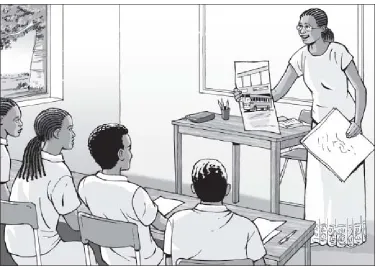
As we enter the classroom, the class is in the middle of reading a passage in their textbook. The passage is an excerpt entitled ‘The Boys’ Ambition’ from Mark Twain’s Life on the Mississippi. Each student is called on to read a few lines from the passage. After he has finished reading, he is asked to translate the few lines he has just read into Spanish. The teacher helps him with new vocabulary items. When the students have finished reading and translating the passage, the teacher asks them in Spanish if they have any questions. One girl raises her hand and says, ‘What is paddle wheel?’ The teacher replies, ‘Es una rueda de paletas.’ Then she continues in Spanish to explain how it looked and worked on the steamboats which moved up and down the Mississippi River during Mark Twain’s childhood. Another student says, ‘No understand “gorgeous”.’ The teacher translates, ‘primoroso.’
Since the students have no more questions, the teacher asks them to write the answers to the comprehension questions which appear at the end of the excerpt. The questions are in English, and the students are instructed to write the answers to them in English as well. They do the first one together as an example. A student reads out loud, ‘When did Mark Twain live?’ Another student replies, ‘Mark Twain lived from 1835 to 1910.’ ‘Bueno,’ says the teacher, and the students begin working quietly by themselves.
In addition to questions that ask for information contained within the reading passage, the students answer two other types of questions. For the first type, they have to make inferences based on their understanding of the passage. For example, one question is: ‘Do you think the boy was ambitious? Why or why not?’ The other type of question requires the students to relate the passage to their own experience. For example, one of the questions based on this excerpt asks them, ‘Have you ever thought about running away from home?’
After one-half hour, the teacher, speaking in Spanish, asks the students to stop and check their work. One by one, each student reads a question and then reads his or her response. If the answer is correct, the teacher calls on another student to read the next question. If the student is incorrect, the teacher selects a different student to supply the correct answer, or the teacher herself gives the right answer.
‘noisy,’ ‘ugly,’ and ‘proudly,’ and are directed to find the opposites of these words in the passage. When they have finished this exercise, the teacher reminds them that English words that look like Spanish words are called cognates. The English ‘-ty,’ she says, for example, often corresponds to the Spanish endings -dad and -tad. She calls the students’ attention to the word ‘possibility’ in the passage and tells them that this word is the same as the Spanish posibilidad. The teacher asks the students to find other examples in the excerpt. Hands go up; a boy answers, ‘Obscurity.’ ‘Bien,’ says the teacher. When all of these cognates from the passage have been identified, the students are told to turn to the next exercise in the chapter and to answer the question, ‘What do these cognates mean?’ There is a long list of English words (‘curiosity,’ ‘opportunity,’ ‘liberty,’ etc.), which the students translate into Spanish.
Figure 2.1 An example of a Grammar-Translation exercise
The next section of the chapter deals with grammar. The students follow in their books as the teacher reads a description of two-word (phrasal) verbs. This is a review for them as they have encountered phrasal verbs before. Nevertheless, there are some new two-word verbs in the passage the students haven’t learned yet. These are listed following the description, and the students are asked to translate them into Spanish. Then they are given the rule for use of a direct object with two-word verbs:
and its particle. However, separation is necessary when the direct object is a pronoun. If the verb is inseparable, then there is no separation of the verb and particle by the object. For example:
John put away his book.
or
John put his book away/John put it away.
but not
*John put away it.
(because ‘put away’ is a separable two-word verb)
The teacher went over the homework.
but not
*The teacher went the homework over.
(because ‘go over’ is an inseparable two-word verb).
After reading over the rule and the examples, the students are asked to tell which of the following two-word verbs, taken from the passage, are separable and which inseparable. They refer to the passage for clues. If they cannot tell from the passage, they use their dictionaries or ask their teacher.
Finally, they are asked to put one of these phrasal verbs in the blank of each of the 10 sentences they are given. They do the first two together.
1 Mark Twain decided to ____ because his parents wouldn’t let him get a job on the river.
2 The steamboatmen ____ and discharge freight at each port on the Mississippi River.
When the students are finished with this exercise, they read their answers aloud.
At the end of the chapter there is a list of vocabulary items that appeared in the passage. The list is divided into two parts: the first contains words, and the second, idioms like ‘to give someone the cold shoulder.’ Next to each is a Spanish word or phrase. For homework, the teacher asks the students to memorize the Spanish translation for the first 20 words and to write a sentence in English using each word.
2 State the rule for the use of a direct object with two-word verbs, and apply it to other phrasal verbs.
3 Do the remaining exercises in the chapter that include practice with one set of irregular past participle forms. The students will be asked to memorize the present tense, past tense, and past participle forms of this irregular paradigm:
drink drank drunk
sing sang sung
swim swam swum
ring rang rung
begin began begun
4 Write a composition in the target language about an ambition they have. 5 Memorize the remaining vocabulary items and write sentences for each.
Thinking about the Experience
This has been just a brief introduction to the Grammar-Translation Method, but it is probably true that this method is not new to many of you. You may have studied a language in this way, or you may be teaching with this method right now. Whether this is true or not, let us see what we have learned about the Grammar-Translation Method. We are able to make a number of observations about the class we attended. Our observations will be listed in the left column; from them we will try to identify the principles of the Grammar-Translation Method. The principles will be listed in the right column. We will make our observations in order, following the lesson plan of the class we observed.
Observations Principles
1 The class is reading an excerpt from Mark Twain’s Life on the Mississippi.
A fundamental purpose of learning a language is to be able to read literature written in it. Literary language is superior to spoken language. Students’ study of the target culture is limited to its
literature and fine arts.
2 Students translate the passage from English into Spanish.
An important goal is for students to be able to translate each language into the other. If students can translate from one language into another, they are
considered successful language learners.
3 The teacher asks students in their native language if they have any questions. A student asks one and is answered in her native language.
The ability to communicate in the target language is not a goal of language
instruction.
4 Students write out the answers to reading comprehension questions.
The primary skills to be developed are reading and writing. Little attention is given to speaking and listening, and almost none to pronunciation.
5 The teacher decides whether an answer is correct or not. If the answer is
incorrect, the teacher selects a different student to supply the correct answer or the teacher herself gives the right answer.
6 Students translate new words from English into Spanish.
It is possible to find native language equivalents for all target language words.
7 Students learn that English ‘-ty’ corresponds to -dad and -tad in Spanish.
Learning is facilitated through attention to similarities between the target
language and the native language.
8 Students are given a grammar rule for the use of a direct object with two-word verbs.
It is important for students to learn about the grammar or form of the target
language.
9 Students apply a rule to examples they are given.
Deductive application of an explicit grammar rule is a useful pedagogical technique.
10 Students memorize vocabulary. Language learning provides good mental exercise.
11 The teacher asks students to state the grammar rule.
Students should be conscious of the grammatical rules of the target language.
12 Students memorize present tense, past tense, and past participle forms of one set of irregular verbs.
Wherever possible, verb conjugations and other grammatical paradigms should be committed to memory.
Reviewing the Principles
The principles of the Grammar-Translation Method are organized below by answering the 10 questions posed in Chapter 1. Not all the questions are addressed by the Grammar-Translation Method; we will list all the questions, however, so that a comparison among the methods we study will be easier for you to make.
1 What are the goals of teachers who use the Grammar-Translation
Method?
According to the teachers who use the Grammar-Translation Method, a
fundamental purpose of learning a language is to be able to read literature written in the target language. To do this, students need to learn about the grammar rules and vocabulary of the target language. In addition, it is believed that studying another language provides students with good mental exercise, which helps develop their minds.
2 What is the role of the teacher? What is the role of the students?
The roles are very traditional. The teacher is the authority in the classroom. The students do as she says so they can learn what she knows.
3 What are some characteristics of the teaching/learning process?
Students are taught to translate from one language into another. Often what they translate are readings in the target language about some aspect of the culture of the target language community. Students study grammar deductively; that is, they are given the grammar rules and examples, are told to memorize them, and then are asked to apply the rules to other examples. They also learn grammatical paradigms such as verb conjugations. They memorize native language equivalents for target language vocabulary words.
4 What is the nature of student–teacher interaction? What is the
nature of student–student interaction?
Most of the interaction in the classroom is from the teacher to the students. There is little student initiation and little student–student interaction.
5 How are the feelings of the students dealt with?
There are no principles of the method which relate to this area.
Literary language is considered superior to spoken language and is therefore the language the students study. Culture is viewed as consisting of literature and the fine arts.
7 What areas of language are emphasized? What language skills are
emphasized?
Vocabulary and grammar are emphasized. Reading and writing are the primary skills that the students work on. There is much less attention given to speaking and listening. Pronunciation receives little, if any, attention.
8 What is the role of the students’ native language?
The meaning of the target language is made clear by translating it into the students’ native language. The language that is used in class is mostly the students’ native language.
9 How is evaluation accomplished?
Written tests in which students are asked to translate from their native language into the target language or vice versa are often used. Questions about the target culture or questions that ask students to apply grammar rules are also common.
10 How does the teacher respond to student errors?
Reviewing the Techniques
Ask yourself if any of the answers to the above questions make sense to you. If so, you may choose to try some of the techniques of the Grammar-Translation Method from the review that follows. On the other hand, you may find that you agree very little with the answers to these questions, but that there are still some techniques from the Grammar-Translation Method that you can usefully adapt. Below is an expanded description of some of these techniques.
• Translation of a Literary Passage
Students translate a reading passage from the target language into their native language. The reading passage then provides the focus for several classes: vocabulary and grammatical structures in the passage are studied in subsequent lessons. The passage may be excerpted from some work from the target language literature, or a teacher may write a passage carefully designed to include particular grammar rules and vocabulary. The translation may be written or spoken or both. Students should not translate idioms and the like literally, but rather in a way that shows that they understand their meaning.
• Reading Comprehension Questions
Students answer questions in the target language based on their understanding of the reading passage. Often the questions are sequenced so that the first group of questions asks for information contained within the reading passage. In order to answer the second group of questions, students will have to make inferences based on their understanding of the passage. This means they will have to answer
questions about the passage even though the answers are not contained in the
passage itself. The third group of questions requires students to relate the passage to their own experience.
• Antonyms/Synonyms
Students are given one set of words and are asked to find antonyms in the reading passage. A similar exercise could be done by asking students to find synonyms for a particular set of words. Or students might be asked to define a set of words based on their understanding of them as they occur in the reading passage. Other
exercises that ask students to work with the vocabulary of the passage are also possible.
• Cognates
that correspond between the languages. Students are also asked to memorize words that look like cognates but have meanings in the target language that are different from those in the native language. This technique, of course, would only be useful in languages that share cognates.
• Deductive Application of Rules
Grammar rules are presented with examples. Exceptions to each rule are also noted. Once students understand a rule, they are asked to apply it to some different
examples.
• Fill-in-the-blanks Exercise
Students are given a series of sentences with words missing. They fill in the blanks with new vocabulary items or with items of a particular grammar type, such as prepositions or verbs with different tenses.
• Memorization
Students are given lists of target language vocabulary words and their native
language equivalents and are asked to memorize them. Students are also required to memorize grammatical rules and grammatical paradigms such as verb conjugations.
• Use Words in Sentences
In order to show that students understand the meaning and use of a new vocabulary item, they make up sentences in which they use the new words.
• Composition
Conclusion
You have now had an opportunity to examine the principles and some of the techniques of the Grammar-Translation Method. Try to make a connection between what you have understood and your own teaching situation and beliefs.
Do you believe that a fundamental reason for learning another language is to be able to read the literature written in the target language? Do you think it is important to learn about the target language? Should culture be viewed as consisting of literature and the fine arts? Do you agree with any of the other principles underlying the Grammar-Translation Method? Which ones?