Annales
Geophysicae
The storm time central plasma sheet
R. Sch¨odel1, K. Dierschke1, W. Baumjohann2, R. Nakamura2, and T. Mukai3
1Max-Planck-Institut f¨ur extraterrestrische Physik, Garching, Germany
2Institut f¨ur Weltraumforschung der ¨Osterreichischen Akademie der Wissenschaften, Graz, Austria 3Institute of Space and Astronautical Science, Sagamihara, Japan
Received: 28 January 2002 – Revised: 17 May 2002 – Accepted: 20 June 2002
Abstract. The plasma sheet plays a key role during mag-netic storms because it is the bottleneck through which large amounts of magnetic flux that have been eroded from the dayside magnetopause have to be returned to the dayside magnetosphere. Using about five years of Geotail data we studied the average properties of the near- and midtail central plasma sheet (CPS) in the 10–30RE range during magnetic storms. The earthward flux transport rate is greatly enhanced during the storm main phase, but shows a significant earth-ward decrease. Hence, since the magnetic flux cannot be circulated at a sufficient rate, this leads to an average dipo-larization of the central plasma sheet. An increase of the spe-cific entropy of the CPS ion population by a factor of about two during the storm main phase provides evidence for non-adiabatic heating processes. The direction of flux transport during the main phase is consistent with the possible forma-tion of a near-Earth neutral line beyond∼20RE.
Key words. Magnetospheric physics (plasma convection; plasma sheet; storms and substorms)
1 Introduction
Magnetic storms are basically caused by prolonged periods of southward IMF that lead to greatly enhanced reconnec-tion at the Earth’s dayside magnetosphere and to a massive accumulation of magnetic flux in the tail lobes. This flux has to be returned to the dayside magnetosphere through the plasma sheet. It is the dynamical processes in the plasma sheet during the storm main phase, like substorm activity and convection, that are most likely responsible for the injection of energetic ions into the ring current and the depression of theDst index. The question whether the frequent occurrence of magnetospheric substorms or whether enhanced magne-tospheric convection alone is responsible for the accumula-tion of energetic particles in the near-Earth magnetosphere is still subject of considerable debate (Kamide et al., 1998). Correspondence to: R. Sch¨odel ([email protected])
Recently, Lui et al. (2001) presented evidence that both pro-cesses are involved in causing theDst depression observed during magnetic storms.
Baumjohann et al. (1996) compared the behavior of the near-Earth tail during storm-time and non-storm substorms, deriving the following picture. Substorms that occur during magnetic storms are accompanied by a much stronger dipo-larization of the magnetic field in the central plasma sheet (CPS) than non-storm substorms. Parallel to the strong CPS dipolarization the lobe magnetic field pressure decreases dur-ing storm-time substorms, while it stays approximately con-stant during non-storm substorms. While both types of sub-storms heat the CPS ion population by about equal amounts, the ions in the storm time CPS have already a tempera-ture about twice as high as the non-storm CPS ions before substorm onset. Baumjohann et al. (1996) concluded that during storm-time susbtorms lobe magnetic flux might be reconnected at a near-Earth neutral line (NENL), and that the stronger dipolarization and the higher temperature of the plasma sheet during storm-time substorms lead to an effec-tive injection of energetic particles into the ring current.
In the last decade the Geotail satellite has provided exten-sive measurements of the magnetotail, especially from the near- and midtail regions. We examined∼5 years of Geotail data in order to address the question of the average behavior of the CPS in the 10–30RE region during magnetic storms usingDst values for selecting the data according to magne-tospheric activity.
2 Data
Activity 10-20RE 20-30RE
[image:2.595.87.247.99.155.2]main phase 5,200 3,800 recovery phase 23,100 32,000 quiet times 288,000 471,000
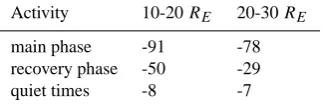
Table 2. AverageDst values for the data in each distance bin
Activity 10-20RE 20-30RE
main phase -91 -78 recovery phase -50 -29 quiet times -8 -7
(LEP) experiment (Mukai et al., 1994) and the magnetic field data were obtained by the magnetic field (MGF) instrument (Kokubun et al., 1994).
Hourly finalDst indices for the corresponding period are provided by the World Data Center for Geomagnetism, Ky-oto. From theseDst data we selected 81 storms that showed clear signatures of main and recovery phase. We defined the beginning of the main phase by the time when theDst in-dex started to drop toward the main phase minimum. Storm sudden comencement is not a useful marker because this fea-ture cannot be clearly distinguished for many storms. We defined the end of the main phase and the beginning of the recovery phase by the time whenDst reached its peak (i.e., minimum) value. The end of the recovery phase was chosen as the time whenDsthad decayed to∼20% of its peak value. Quiet times were defined byDst values>−25. In order to have sufficient samples for a statistical analysis, we chose to bin the data into only two radial distance ranges from 10– 20REand from 20–30RE. Table 1 gives the number of CPS samples (12-s averages) for the main and recovery phases of magnetic storms, and for quiet times. The averageDstvalues per bin are indicated in Table 2.
The criterion for selecting samples from the CPS was β >0.5 (Angelopoulos et al., 1994). In order to assess the influence of this selection criterion on the data, we repeated our analysis forβ >0.1 as well as forβ >1. All of the ex-amined parameters change by less than 20% whenβis varied over an order of magnitude. The advantage of our selection criterion is that it allows for an unbiased examination of the field elevation in the CPS.
3 Properties of the storm-time CPS
Based on our data selection as described above, we calcu-lated average values of the magnetic field and of the plasma parameters in the CPS for the storm time main and recovery
displayed in Fig. 1. Values for the recovery phase lie gen-erally between those for the main phase and those for quiet times, being usually not significantly different from the lat-ter. Hence the CPS recovers within a fairly short time from the effects of a magnetic storm, with the exception of ion temperature, which remains significantly higher during the recovery phase than during quiet times.
During the main phase the magnetic field strength is raised by a factor of about two over the values at quiet times. The magnetic field elevation angle is about 30◦ and approxi-mately constant out to distances of 20–30RE, and is thus considerably increased compared to quiet times. Conse-quently, on average, the CPS seems to be inflated in the re-gion 10–30RE during the storm main phase. Baumjohann et al. (1996) found that the magnetic field elevation in the 10–20RE CPS is considerably increased by substorms that occur during storm times, while the lobe magnetic pressure decreases. These findings correspond well to the interpreta-tion of an average dipolarizainterpreta-tion of the 10–30RECPS during the storm main phase caused by a successive occurrence of substorms.
Like Baumjohann et al. (1996) we find that the average temperature of ions in the CPS is strongly increased during magnetic storms. Since the ion temperature remains sig-nificantly above quiet time levels even during the recovery phase, we conclude that the energetic ions remain trapped in the CPS and loose their energy only gradually, comparable to the slow, exponential decay of the ring current during the recovery phase.
Our definition of specific entropy, kT /n2/3, is based on using a polytropic law of the formP =αNγ, withγ =5/3 (adiabatic case). αis a constant that depends on the specific entropy of the plasma (see Siscoe, 1983; Baumjohann, 1993). Thereby we assume that the majority of the density-pressure changes in the CPS follow an adiabatic path and that different plasma regimes such as high-speed flows and quiet plasma are characterised by different levels of their specific entropy. For an ample discussion on the issue see Baumjohann (1993). The increase of the specific entropy of the ions by a factor of two during the main phase indicates that they are heated by non-adiabatic processes. Liu and Rostoker (1995) have sug-gested such a non-adiabatic mechanism: They showed that the tail plasma will gain energy through non-adiabatic pitch angle scattering combined with Fermi and betatron acceler-ations if it is circulated recurrently between the tail and the inner magnetosphere by repeated substorm activity.
4 Transport processes
[image:2.595.87.250.213.267.2]Fig. 1. Average values of the magnetic
[image:3.595.46.410.62.545.2]field strength, of the magnetic field el-evation, of the total (i.e. thermal and magnetic) pressure, and of the ion spe-cific entropy in the central plasma sheet. Solid lines: main phase, dashed: recov-ery phase, dotted: quiet times(Dst > −25). Error bars are 0.2σ of the data distribution functions.
Fig. 2. Average values of the ion bulk
velocity, of the rate of earthward trans-port of magnetic flux, VXBZ, of the
overall level of east-westward transport of magnetic flux,|VYBZ|, and of the
to-tal pressure in the central plasma sheet. Solid lines: main phase, dashed: recov-ery phase, dotted: quiet times(Dst > −25). Error bars are 0.2σ of the data distribution functions.
(Fig. 2). However, a strong earthward decrease of the trans-port rates during the storm main phase is evident from the data. An explanation for this behavior may be the steep gra-dient of the total (i.e., thermal and magnetic) pressure during the main phase (Fig. 2). In order to check on the question whether the flux transport might be significantly diverted to eastward or westward directions during the main phase closer to Earth, we examined the average of|VYBZ|as well. One can see in Fig. 2 that the earthward decrease ofVXBZ can-not be explained by a diversion of the flux transport. Hence, assuming that the CPS does not expand in the earthward di-rection, we can conclude that during the storm main phase magnetic flux cannot be returned at a sufficient rate toward
the dayside magnetosphere in order to maintain a steady av-erage transport rate. Since the magnetic field elevation is increased during the main phase as mentioned in the pre-vious section, we favour the assumption that the hindered transport processes in the plasma sheet lead to a dipolariza-tion which is rapidly progressing in the tailward direcdipolariza-tion. The boundary between the dipolarized/stretched regions of the CPS thereby acts as a barrier for transport processes (Sh-iokawa et al., 1997). However, since we are dealing with time averaged data we cannot observe a “snapshot” of this bound-ary, just the resulting average dipolarization of the CPS and the decrease of the transport rates.
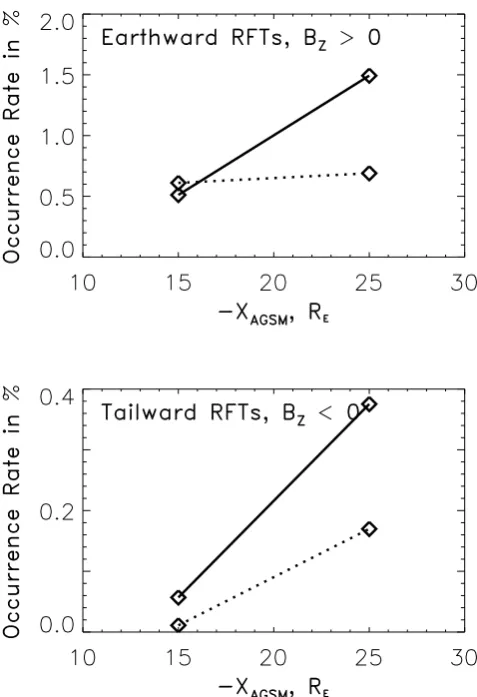
trans-Fig. 3. Occurrence rates of earthward (BZ>0) and tailward (BZ<
0) directed rapid flux transport events in the CPS. Solid lines: storm time (Dst <−25), dotted lines: quiet times.
port events (RFTs) during the different phases of magnetic storms. RFTs, defined by Sch¨odel et al. (2001), are short bursts of strong flux transport in the CPS, with EH = [(VXBZ)2+(VYBZ)2]1/2 >2mV/m, that are directed per-pendicularly to the magnetic field direction, and have very similar properties to the short bursts of fast plasma flow that are observed in the CPS (Baumjohann et al., 1990; An-gelopoulos et al., 1994). Since RFTs have occurrence rates of just a few percent, we used a broader (and somewhat coarser) data base for the analysis by selecting as storm time CPS data all samples obtained at times withDst <−25. The resulting occurrence rates (Fig. 3) for earthward directed RFTs with a northward magnetic field show that tailward of∼20RE they occur much more frequently during storm times than during quiet times, in agreement with the overall enhanced convec-tion during storm times. The earthward decrease of their oc-currence rate may be related to the strong pressure gradient during the magnetic storm main phase (Fig. 2), which may cause the RFTs to be braked rapidly (Shiokawa et al., 1997), such that in the 10–20REregion their occurrence rate is not higher than during quiet times. Quiet time occurrence rates
significant frequency only tailward of ∼20RE consistent with the findings of Sch¨odel et al. (2001). In fact, the oc-currence rate of the tailward RFTs earthward of∼25RE is <0.1%, which cannot be seen in Fig. 3 because of the bin-ning. Since this type of RFT could be expected tailward of a putative near-Earth neutral line, this indicates that during the storm main phase the most earthward location of a possi-ble NENL would be tailward of 20RE. In this case the tail-ward increase of the occurrence rate of (tailtail-ward and earth-ward) RFTs would mean that either the NENL forms on av-erage more frequently farther tailward than 20REor that the NENL retreats tailwards during individual storm time sub-storms.
5 Conclusion
A statistical analysis of about five years of Geotail data al-lowed us to derive the average properties of the CPS dur-ing magnetic storms. Durdur-ing the recovery phase, the aver-age state of the CPS is very similar to its state during quiet (Dst > −25) times, except for the ion temperature, which is still considerably increased (by ∼50%). The transport of plasma and of magnetic flux is strongly increased during the storm main phase, but a steep pressure gradient appar-ently leads to a considerable reduction of the transport rates closer to Earth and consequently to a dipolarization of the CPS. This is reflected in the significantly increased magnetic field elevation angle in the regions 10–30REduring the main phase. Hence, on average, the CPS seems to inflate during the storm main phase. Increased specific ion entropy points to non-adiabatic heating processes, like a recurrent circula-tion of ions between the tail and the inner magnetosphere by repeated substorm activity (Liu and Rostoker, 1995). The oc-currence rates of tailward rapid flux transport events point to the earthward most location of a possible near-Earth neutral line during the main phase at∼20RE.
Acknowledgements. We are grateful to S. Kokubun for generously
providing the Geotail MGF data.
Topical Editor G. Chanteur thanks two referees for their help in evaluating this paper.
References
Angelopoulos, V., Kennel, C. F., Coroniti, F. V., Pellat, R., Kivel-son, M. G., Walker, R. J., Russell, C. T., Baumjohann, W., Feld-mann, C. W., and Gosling, J. T.: Statistical characteristics of bursty bulk flow events, J. Geophys. Res., 99, 21 257–21 280, 1994.
Baumjohann, W., Paschmann, G., and L¨uhr, H.: Characteristics of high-speed ion flow in the plasma sheet, J. Geophys. Res., 94, 3801–3809, 1990.
[image:4.595.47.286.60.409.2]Baumjohann, W., Kamide, Y., and Nakamura, R.: Substorms, storms, and the near-Earth tail, J. Geomagn. Geoelectr., 48, 177, 1996.
Kamide, Y., Baumjohann, W., Daglis, I. A., Gonzalez, W. D., Grande, M., Joselyn, J. A., McPherron, R. L., Phillips, J. L., Reeves, E. G. D., Rostoker, G., Shama, A. S., Singer, H. J., Tsurutani, B. T., and Vasyliunas, V. M.: Current understanding of magnetic storms: Storm-substorm relationships, J. Geophys. Res., 103, 17 705-17 728, 1998.
Kokubun, S., Yamamoto, T., Acu˜na, M. H., Hayashi, K., Shiokawa, K., and Kawano, H.: The Geotail magnetic field experiment, J. Geomagn. Geoelectr., 46, 7–21, 1994.
Liu, W. W. and Rostoker, G.: Energetic ring current particles gen-erated by recurring substorm cycles, J. Geophys. Res., 100, 21 897–21 910, 1995.
Lui, A. T. Y., McEntire, R. W., and Baker, K. B.: A new insight
on the cause of magnetic storms, Geophys. Res. Lett., 28, 3413– 3416, 2001.
Mukai, T., Machida, S., Saito, Y., Hirahara, M., Terasawa, T., Kaya, N., Obara, T., Ejiri, M., and Nachida, A.: The low energy parti-cle (LEP) experiment onboard the Geotail satellite, J. Geomagn. Geoelectr., 46, 669–692, 1994.
Sch¨odel, R., Baumjohann, W., Nakamura, R., Sergeev, V. A., and Mukai, T.: Rapid flux tranport in the central plasma sheet, J. Geophys. Res., 106, 301–313, 2001.
Shiokawa, K., Baumjohann, W., and Haerendel, G.: Braking of high-speed flows in the near-Earth tail, Geophys. Res. Lett., 24, 1179–1182, 1997.