ORIGINAL PAPER
Frugal cannibals: how consuming conspecific tissues can provide
conditional benefits to wood frog tadpoles (
Lithobates sylvaticus
)
Dale M. Jefferson&Keith A. Hobson&Brandon S. Demuth& Maud C. O. Ferrari&Douglas P. Chivers
Received: 13 November 2013 / Revised: 22 January 2014 / Accepted: 28 January 2014 / Published online: 18 February 2014
#Springer-Verlag Berlin Heidelberg 2014
Abstract Tadpoles show considerable behavioral plasticity. When population densities become high, tadpoles often be-come cannibalistic, likely in response to intense competition. Conspecific tissues are potentially an ideal diet by composi-tion and should greatly improve growth and development. However, the potential release of alarm cues from the tissues of injured conspecifics may act to deter potential cannibals from feeding. We conducted multiple feeding experiments to test the relative effects that a diet of conspecifics has on tadpole growth and development. Results indicate that while conspecific tissues represent a better alternative to starvation and provide some benefits over low-protein diets, such a diet can have detrimental effects to tadpole growth and/or devel-opment relative to diets of similar protein content. Additionally, tadpoles raised individually appear to avoid consuming conspecific tissues and may continue to do so until they suffer from the effects of starvation. However, tadpoles readily fed upon conspecific tissues immediately when raised with competitors. These results suggest that cannibalism may occur as a result of competition rather than the specific quality of available diets, unless such diets lead to starvation.
Keywords Cannibalism . Competition . Density . Diet . Tadpole .Lithobates sylvaticus
Introduction
Many species of biphasic amphibians rely on ephemeral wet-lands for larval development (Wellborn et al. 1996). The unpredictable conditions and duration of such habitats require inherent plasticity in behavior, growth, and development that are necessary for rapid adaptive responses to local conditions (Relyea 2004; Richter-Boix et al. 2007). Pond drying in-creases the risk of desiccation for developing tadpoles and can simultaneously increase population densities while reduc-ing dietary resource availability, thus increasreduc-ing competition (Babbitt and Meshaka2000; Newman1987). Larval amphib-ians experiencing such conditions should increase their rate of development to rapidly achieve metamorphosis and escape the drying habitat (Wellborn et al.1996).
Deteriorating conditions associated with drying ephemeral wetlands can lead to reductions in quality and/or quantity of dietary resources (Babbitt and Meshaka 2000). Under such conditions, altering diet selection may improve growth and development. In particular, cannibalism can improve the sur-vivorship of individuals within the population (Fox 1975). Cannibalism is both an intraspecific predator–prey interaction and a form of interference competition,“limiting population size before the resource itself becomes limiting”(Fox1975). Conspecific tissues represent a potentially ideal diet satisfying all nutritional requirements for growth, development, and reproduction because all nutrients should be available in ap-propriate proportions (Meffe and Crump1987). Cannibalism may sustain individuals to metamorphosis under conditions of dietary stress (Bleakney1958). Even in the absence of severe dietary stress, cannibalism may be highly advantageous from a growth perspective so long as the costs of cannibalism do
Communicated by: Sven Thatje
Electronic supplementary materialThe online version of this article (doi:10.1007/s00114-014-1156-4) contains supplementary material, which is available to authorized users.
D. M. Jefferson (*)
:
B. S. Demuth:
D. P. ChiversDepartment of Biology, University of Saskatchewan, Saskatoon, Saskatchewan S7N 5E2, Canada
e-mail: [email protected]
K. A. Hobson
Environment Canada, Saskatoon, Saskatchewan S7N 3H5, Canada
M. C. O. Ferrari
not exceed the benefits. Cannibalism may reduce fitness of individuals through increased risk of injury from retaliation (Wildy et al.2001), increased exposure to pathogens (Bolker et al. 2008), and reduced survivorship of kin (Fox 1975). Additionally, species ofCeratophrysandGephyromantis tad-poles appear to have evolved acoustic signals that may also reduce the occurrence of cannibalism among conspecifics (Costa et al.2014; Reeve et al.2011).
Petranka and Thomas (1995) suggest that the evolution of explosive concurrent breeding among wood frogs (Lithobates sylvaticus) was influenced by the efficiency of tadpole canni-balization of vulnerable conspecifics. Indeed synchronized explosive breeding can reduce the risk of cannibalism by limiting the differences in size and development among indi-viduals (Crossland et al.2011; Petranka and Thomas1995). Additionally, food availability and conspecific density influ-ence the expression of intraspecific aggression and cannibal-istic behavior (e.g., Collins and Cheek1983; Wildy et al.
2001). Conversely, Babbitt and Meshaka (2000) suggest that cannibalism among free-feeding tadpoles is an adaptation to low quality and/or abundance of food rather than to pond drying, due to the observation of prolonged larval develop-ment among tadpoles fed a high-quality diet and conspecific tissues.
Individuals engaged in cannibalism are often older tadpoles that attack eggs and newly hatched larvae (Petranka and Thomas 1995). It is unclear why cannibalism is not more common and pervasive throughout tadpole populations. The objective of our study was to further explore the efficacy of cannibalism as a diet and characterize mechanisms that may mediate its emergence within populations.
An initial experiment was developed to compare the rela-tive efficacy of conspecific tissues as a diet to that of a high-profit diet on individual tadpoles. Previous studies suggest that tadpole growth and development is protein limited ( M c C a l l u m a n d Tr a u t h 2 0 0 2; K u p f e r b e rg 1 9 9 7; Steinwascher and Travis1983). Therefore, we used protein as a simple measure of quality among diets. We expected, based on the assumption that cannibalism represents an ideal diet by composition that a diet of conspecific tissues should facilitate equal or greater tadpole growth and development relative to that of tadpoles fed a diet of similar protein content (Meffe and Crump1987).
Subsequently, a second experiment was conducted to fur-ther explore cannibalism as a diet for larval wood frogs. In this experiment, tadpoles were raised in groups, subjecting them to relatively high intraspecific competition. High-quality, low-quality, mixed (high and low), and starved dietary treatments were included to further examine the relative efficacy of conspecific tissues as a diet. Cannibalism is often observed in situations of high conspecific density; therefore, we expect-ed that tadpoles raisexpect-ed in a competitive environment would readily consume conspecific tissues (Jefferson et al.2014).
Richter-Boix et al. (2007) observed that tadpoles may prefer-entially consume dietary resources that are ideal to facilitate growth or development in response to predation or pond drying, respectively. Additionally, numerous studies have ob-served the importance of animal tissues in the diet of wood frog tadpoles. Therefore, we expect that tadpoles fed the mixed diet would preferentially consume the high-quality dietary component over the low-quality component. Starvation and/or low-protein dietary treatments may induce cannibalistic behavior in tadpoles due to the nutritional stress that may result from these treatments (i.e., Venesky et al.
2012). Crespi and Denver (2005) observed that starvation stimulated increased whole-body corticosterone content in pre-metamorphic Western spadefoot toad (Spea hammondii) tadpoles. They indicated that secretion of corticosterone in-duces foraging through appetite stimulation, facilitating the restoration of energy reserves during stress-induced anorexia. Similarly, Venesky et al. (2012) suggest that tadpoles experiencing nutritional deficits from consumption of a pri-marily low-protein-content diet can lead to elevated cortico-sterone levels. Therefore, we expected tadpoles suffering nu-tritional deficiencies to exhibit elevated corticosterone levels. Under such conditions, elevated corticosterone levels could encourage cannibalistic behavior.
A third experiment was conducted to test whether the effects of a cannibalistic diet would persist if tadpoles were tested at later stages of development after being fed a control diet composed of low- and high-protein diets for approximate-ly a month prior to testing. We also included two treatments where conspecific tissues were combined equally by mass with the high- and low-protein diets to test how tadpole growth and development were affected. It was predicted that due to the protein content of conspecific tissues, tadpoles fed a mixture of cornmeal and conspecific tissues would exhibit improved growth and development relative to those fed corn-meal alone, while those fed conspecific tissues and brine shrimp would do poorly relative to individuals fed brine shrimp alone.
Materials and methods
Collection and maintenance
Collection sites were open canopy and contained semi-aquatic or biphasic species of predatory invertebrates (e.g., odonates and dytiscids). Vertebrate predators (e.g., garter snakes, adult frogs, and predatory birds and mammals) are common and represent a potential threat to tadpoles.
Experiments were performed under a controlled 14:10-h light/dark photoperiod. All tadpoles received 100 % water changes 3 days a week (M, W, F), were fed immediately after all water changes were completed and were fedad libitum. Water quality (i.e., pH, NH3, NO2−, NO3−) of experimental containers was assessed a minimum of once a week within 24 h of feeding using commercially available aquarium test strips. Mean (± SE) water temperatures for experimental con-tainers were 17.1 ° C (± 0.6) throughout the course of the experiments. Tadpoles were stocked at a density of one tad-pole per liter in each experiment to reduce differences in potential informative cue (i.e., alarm cues or competitive cues) concentrations that could influence tadpole behavior (Relyea
2002).
Experimental procedures
Experiment 1
When tadpoles had achieved approximately stage 25, 90 tadpoles were randomly selected for testing, divided into two groups of 45, and randomly assigned one of two exper-imental treatments. Initial masses and Gosner stages were recorded for every individual. Five tadpoles were randomly selected and euthanized immediately using a buffered tricaine methansulfonate (TMS) solution. The masses and develop-mental stages of these euthanized tadpoles were recorded and prepared for stable isotope (δ13C,δ15N) analysis. The stable isotope values of these individuals were also used as the initial values of tadpoles in experiment 2.
Tadpoles were individually housed in 1-L plastic con-tainers filled with de-chlorinated water. Tadpoles were indi-vidually housed to remove any potential competitive and predatory interactions between individuals. Tadpoles were fed either a commercial frozen brine shrimp (BS) diet or a cannibalistic diet of homogenized whole-body conspecific tissues (CAN). Frozen BS was chosen because of its relatively high protein content. Dry protein of diets was calculated by multiplying the %N values of dietary samples by 6.25 as described by Sterner and Elser (2002).
To assess relative dietary quality, an independent two-samplet-test was used to compare values of estimated final % dry protein compositions between diets. Bonferroni-corrected one-samplet-tests were used to compare estimated protein composition of experimental diets to mean observed protein values of diets in prior studies. No significant differ-ences were observed in protein composition between BS and CAN (t[5.6]=0.004;P=0.99). Mean (± SE) dry protein % of
frozen BS was estimated to be 48.7 % (± 1.4) and that of CAN was 48.7 % (± 5.9). Protein compositions for both diets were significantly greater than 33 % protein of ingested diets of wood frog tadpoles from natural populations reported by Schiesari et al. (2009) (BS:t[5]=10.9; P<0.001; CAN: t[5]=
2.6;P=0.04). Mean % protein values of BS were significantly higher than the 44 % protein composition of the most profitable diet (100 % soybean) as tested by McCallum and Trauth (2002) (t[5]=3.3;P=0.02). However, CAN was not significantly
dif-ferent from the 100 % soybean diet (t[5]=0.8;P=0.5).
The CAN diets were produced by collecting wild tadpoles from the same ponds as the tadpoles used in the experiment. Initial tadpoles used to produce the CAN diet were gut loaded by briefly feeding frozen BS prior to being homogenizedwith an ultrasonic homogenizer. Additional tadpoles were collected for feeding at days 21, 28, and 42 but were not fed in the lab. Randomly selected tadpoles from these additional collections were used to provide mass and developmental values of wild tadpoles throughout the study. No tadpoles could be collected after day 42 due to flooding of the sampling site from the adjacent Saskatchewan River.
Frozen foods were weighed and thawed in 200 mL of de-chlorinated water and distributed among tadpoles in respec-tive treatments. Although tadpoles were fed ad libitum, food rations were adjusted, reflecting observed feeding behavior to allow individuals to feed to satiation over the 48-h feeding period and minimize water fouling.
Groups of up to five tadpoles were randomly selected at the end of each week, for 9 weeks, and were euthanized. Wet masses and developmental stages of euthanized tadpoles were recorded. Results from mortalities were excluded from this study because tissue degradation of deceased specimens could have led to erroneous measurements. Snout–vent length (SVL), mass, and developmental stages of randomly selected wild tadpoles were recorded when additional specimens were collected for cannibal diet preparation. Experimental tadpoles and their diets were also analyzed forδ13C andδ15N values.
Experiment 2
At stage 25, tadpoles were randomly distributed among 40 10-L experimental aquaria; at five treatments with eight replicates per treatment and a stocking density of ten tadpoles per aquarium (one tadpole per liter). Tadpoles were randomly assigned to one of five experimental dietary treatments: (1) frozen brine shrimp (BS), (2) cornmeal (CM), (3) mixed 50 % brine shrimp and 50 % cornmeal (BS/CM), (4) homogenized conspecifics (CAN), and (5) starvation (ST).
SE) dry protein content of BS was 54.9 % (± 1.6), and protein content of CAN was 53.6 % (± 1.6). A diet of CM was selected because of its relatively low protein content (mean± SE 6.6 %±0.2) and was identified by McCallum and Trauth (2002) as a low-quality diet for wood frog tadpoles. An ANOVA used to compare protein content among BS, CM, and CAN found that there was a significant difference in estimated protein content among diets (F[2,30]= 109.7; P<0.001). Post hoc Tukey pairwise comparisons indicated that there was no significant difference between BS and CAN (P=0.9), and both BS and CAN exhibited significantly higher estimated dry protein content relative to CM (both
P<0.001). An ANOVA test of estimated dry protein content among BS and CAN between experiments 1 and 2 identified no significant differences (F[3,33]=1.02;P=0.4).
Tadpoles used to produce the cannibal diet were coarsely homogenized with an ultrasonic homogenizer. All tadpoles used to produce the mcannibal diet were raised on a mixed diet of frozen BS and CM. These tadpoles were never fed within 48 h of being euthanized to produce the conspecific diet to reduce the effects that chemical cues from these fresh diets may have had on test specimens.
The experiment was concluded after 14 days (to accom-modate starved tadpoles) and all surviving tadpoles were euthanized using a buffered TMS solution. SVL, mass, and developmental stages of tadpoles were recorded immediately after being euthanized.
Two tadpoles in each replicate of each treatment (where tadpole survival allowed) were randomly selected and ana-lyzed for total body corticosterone concentration (for detailed methods, see Online Resource1a). Analysis of whole-body corticosterone was used in the second experiment to determine if the low quality and cannibalistic diets could illicit hormonal responses that may alter corticosterone levels.
Subsequently, up to three tadpoles were randomly selected from all treatment replicates (where survival allowed) and a minimum of eight replicates of each diet (BS, CM, and CAN) were analyzed for C and N stable isotope composition. Tissue values ofδ13C andδ15N were used as a tool to assess dietary composition (i.e., protein and lipid content) as well as to track tadpole foraging (for detailed methods, see Online Resource
1b). The stable isotope values allowed us to assess the assim-ilation of dietary resources in each of the experiments.
Experiment 3
Tadpoles were maintained in four 38-L glass aquaria filled with room temperature de-chlorinated water. Tadpoles in all stock aquaria were maintained at approximately the same densities, and all were within the range of natural population densities observed by Biesterfield et al. (1993). When the majority of tadpoles in these tanks had achieved stage 29 of development, individuals were haphazardly removed from
stock aquaria and randomly distributed among 48 10-L ex-perimental aquaria at an initial stocking density of ten tadpoles per aquarium (one tadpole per liter). Each aquarium was filled with de-chlorinated water in advance and had been assigned to one of six dietary treatments, with eight replicates per treat-ment. The six experimental dietary treatments were: (1) frozen brine shrimp, (2) cornmeal, (3) mixed 50 % brine shrimp and 50 % cornmeal by mass, (4) homogenized conspecifics, (5) mixed 50 % brine shrimp and 50 % conspecific tissues by mass, and (6) mixed 50 % cornmeal and 50 % conspecific tissues by mass. Tadpoles were fed BS/CM in the 10-L ex-perimental aquaria for 2 weeks until the tadpoles in each tank reached a minimum developmental stage of 29. The experi-ment was run for 14 days to be consistent and comparable with experiment 2.
Due to tadpole mortalities prior to the initiation of testing, the number of individuals in each tank at the start of testing was reduced to eight tadpoles per aquarium across all treat-ments. SVL, developmental stage, and mortalities were re-corded at the end of the 14-day testing period; due to difficul-ties with a balance, masses could not be obtained for tadpoles in this experiment.
Statistical analyses
Experiment 1
A one-way multivariate analysis of variance (MANOVA) was used to compare final values of SVL, mass, and developmen-tal stages between tadpoles fed the BS diet and those fed the CAN diet. To adjust for differences in developmental stages, the same procedure was used to compare the masses of tadpoles at comparable stages of development (between stages 27 and 32).
Overall values of SVL, mass, and developmental progres-sion were compared among wild, BS-fed, and CAN-fed tad-poles at days 21, 28, and 42 (days where data existed for all three groups) using a one-way MANOVA; all paired compar-isons were made using Hotelling’s T-square test. Overall differences in discrimination factors of tadpoles were com-pared using an ANOVA. Pairwise comparisons were per-formed using Tukey’s honestly significant difference (HSD) test for differences in discrimination factors of tadpoles be-tween days 0 and 14 fed each of the experimental diets and with tadpoles fed CAN between days 28 and 63. Similarly, one samplet-tests were used to assess the difference of these discrimination factors from the expected mean discrimination factor of 1.0‰over the same time period.
Experiment 2
ANOVAs were used to compare mortalities, final SVL, mass, development (final Gosner stage), and whole-body corticoste-rone levels of tadpoles among treatments. Additionally, dif-ferences in intra-population growth were analyzed by performing a one-way ANOVA on the coefficient of variance (CV) of tadpole mass among all treatments except ST. Tukey HSD tests were subsequently used to conduct pairwise com-parisons among treatments where ANOVA tests indicated overall significant differences.
δ13
C values of consumers are typically similar to those of their diet; conversely,δ15N values of consumers are typically greater than those of their diet. Therefore, the relative trophic positioning of starved individuals, based on isotopic values relative to those of initial tadpole values, was analyzed using two two-sample t-tests with Bonferroni correction. Proportional contributions of BS and CM were estimated usingδ13C andδ15N values and the stable isotope mixing model SIAR (R Development Core Team2010).
Experiment 3
Tadpole SVL, developmental stage, and mortalities were test-ed using three one-way ANOVA tests. Post hoc Tukey HSD tests were used to make pairwise comparisons among tadpoles in each feeding treatment.
Analyses in all experiments, other than those using SIAR, were performed using Systat (Wilkinson1998). Outliers were removed where identified through the statistical software. A conservative testing procedure was adopted independently for each experiment by adjusting significance levels using the Holm–Bonferroni correction (Marcus et al. 1976) to reduce the risk of committing a type 1 error (Sokal and Rohlf1995). All figures were produced using SigmaPlot (Systat Software, San Jose, CA, USA).
Results
Experiment 1
Tadpoles fed CAN and BS diets had mean (± SE) initial SVL of 4.3 mm (±0.1) and 4.7 mm (±0.1), respectively; tadpoles in both dietary treatments had initial masses of 0.02 g (± 0.00) and initial developmental stages of 25.3 (± 0.1) and 25.7 (± 0.1), respectively (Fig.1a, b). Wild tadpoles euthanized at day 0 had mean (± SE) initial SVL of 4.1 mm (±0.2), initial mass of 0.02 g (± 0.00), and initial developmental stage of 25.0 (± 0.0) (Fig.1c). A total of 12 mortalities occurred throughout the experiment: ten occurred among tadpoles fed the CAN diet and two in the group fed BS.
During the initial 14 days of the experiment, tadpoles fed BS rapidly consumed dietary rations and correspondingly exhibited a mean increase in mass (± SE) of 0.23 g (± 0.03).
Conversely, over the same 14-day period, tadpoles fed CAN did not consume their dietary rations and exhibited a mean (± SE) increase in mass of only 0.02 g (± 0.01). Multivariate analysis identified significant overall differences in growth and development between tadpoles fed BS and those fed CAN over the duration of the experiment (day 1–63) (Hotelling–Lawley trace:F[3,75]=30.2,P<0.001). Univariate F-tests indicate that tadpoles fed the BS diet had significantly larger SVL (F[1,77]=35.5,P<0.001; Fig.1a), had larger mass
(F[1,77]=33.9,P<0.001; Fig.1b), and obtained significantly
greater developmental stages (F[1,77]=38.1,P<0.001; Fig.1c)
relative to tadpoles fed the CAN diet. However, tadpoles fed CAN appear to have exhibited“catch-up growth”as described by Audo et al. (1995), whereby tadpoles achieve similar mass at metamorphosis as controls but do so at the cost of prolonging their developmental period. When differences in tadpole development were accounted for between experimen-tal treatments by testing tadpoles of overlapping developmen-tal stages (27–32), multivariate analysis still identified overall significant differences in growth (Hotelling–Lawley trace:
F[2,39]=18.7,P<0.001); univariateF-tests identified that
tad-poles fed CAN were still significantly smaller in SVL (F[1,40]=35.8,P<0.001) relative to tadpoles fed BS; however,
the two groups were not significantly different in mass (F[1,40]=0.4,P=0.5) (Fig.S1in Online Resource2).
Tadpoles fed BS exhibited similar growth and development to tadpoles from natural communities, while those fed the CAN diet exhibited inferior growth and developmental progress relative to both groups. Overall differences in SVL, mass, and development were observed between wild tadpoles and experimental (BS-fed and CAN fed) tadpoles across days 21–42 (developmental; SVL:
F[2,55] =7.8, P=0.001; mass: F[2,57] =8.7, P=0.001; stages: F[2,57]=8.6,P=0.001). Wild tadpoles had achieved significantly
greater SVL (P<0.005), greater mass (P<0.005), and advanced developmental stages (P=0.01) relative to tadpoles fed CAN. There was no significant difference observed in SVL (P=0.6), mass (P=0.3), or developmental progress (P=0.1) between wild tadpoles and tadpoles fed BS (Fig.1a–c).
Tadpole stable isotopic values corresponded with differ-ences in tadpole growth between treatments. Significant dif-ferences in overall isotopic values of tadpole tissues relative to those of the diet were observed (F[1,34]=131.8; P<0.001).
Tadpoles fed conspecifics between days 0 and 14 were signif-icantly enriched compared to tadpoles fed BS over the same time period (P=0.001) and those of tadpoles fed CAN be-tween days 28 and 63 (P<0.05). Differences in isotopic values between tadpoles fed BS between days 0 and 14 and tadpoles fed conspecifics between days 28 and 63 were not significant-ly different (P=0.6). Differences in mean (± SE)δ13C be-tween tadpole tissues and the CAN diet at days 0 and 14 (1.9± 0.3‰) were significantly greater than the expected value of 1.0‰(t[8]=2.9;P<0.01). The difference inδ13C values of
0.2‰) and conspecific fed tadpoles between days 28 and 63 (0.8±0.1‰) was similar to the expected 1.0‰(allP>0.05).δ
15
N values of tadpoles fed CAN did not increase between days 0 and 14, while tadpoles fed BS exhibited a rapid increase inδ15N over the same time period.
Initial (day zero) meanδ13C andδ15N values of tadpoles were −27.3 and 7.3‰, respectively. Homogenized tadpole tissues, used to feed the CAN diet group, shifted from initial meanδ13C andδ15N values from−27.1 and 7.5‰to final mean values of−30.4 and 4.2‰, respectively (Fig.1d, e). This shift was due to natural ontogenetic shifts in isotopic values of tadpoles resulting from the transition to free feeding (Jefferson and Russell2008; Trakimas et al.2011). Tadpoles fed CAN
exhibit meanδ13C andδ15N values of−25.2 and 7.8‰at day 7 and final values of−29.1 and 7.1‰at day 63. Mean trophic discrimination values ofδ13C andδ15N between days 21 and 63 were calculated to be approximately 1.2 and 2.6‰, respec-tively (Fig. 1d, e). Commercial BS offered at day 0 was slightly depleted in 13C and was greatly enriched in 15N relative to the initial values of the tadpoles (mean δ 13C
−28.3‰; mean δ15N 16.2‰).δ 13C and δ 15N values of tadpoles fed BS rapidly increased towards equilibration with the experimental diet, achieving values of−27.2 and 17.2‰ (respectively) within 21 days (Fig.1f, g). A change to a new batch of commercial BS prior to day 28 resulted in an unex-pected shift inδ13C values. The new batch of BS exhibited aδ
13
C value of−21.0‰and resulted in a rapid shift in tadpoles to a meanδ13C value of−22.0‰by day 63 (Fig.1f).δ15N values of BS also increased to 17.0‰prior to day 28, which resulted in15N enrichment of tadpoles to a final meanδ15N value of 18.9‰at day 63 (Fig.1g).
Experiment 2
Tadpoles in both the starved and BS dietary treatments exhib-ited the relatively high mean (± SE) mortality of 42.5 % (± 13.7); those in the BS/CM dietary treatment had a slightly lower mean (± SE) mortality of 35.0 % (± 8.9). Tadpoles in the CAN treatment exhibited mean (± SE) mortality of 18.8 % (± 6.2) and those fed the CM diet had a mean (± SE) mortality of 11.2 % (± 2.9). Despite the relatively large difference in mean mortality among treatments, no statistically significant differ-ences were observed (F[4,35]=2.2,P=0.08).
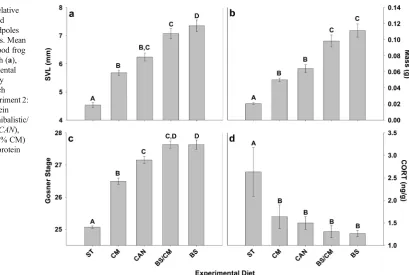
Tadpoles in all dietary treatments were observed foraging on the first day of feeding. However, we observed significant differences in final snout–vent length (SVL) (F[4,29]=36.6, P<0.001), development (F[4,27]=88.4,P<0.001), and whole
body corticosterone (F[4,20]= 15.2, P< 0.001) among
treatments.
No significant differences were observed in SVL between tadpoles fed the BS and the BS/CM diets (P=0.3). Tadpoles fed the BS/CM diet were not significantly larger than those fed the CAN diet (P=0.08) but were significantly larger than those fed the CM diet (P<0.001) and those in the ST treatment group (P<0.001). Tadpoles fed the BS diet exhibited signifi-cantly larger SVL relative to tadpoles in all other treatments (allP<0.001). BS-fed tadpoles exhibited a mean (± SE) SVL of 7.4 (± 0.2)mm, while the mean (± SE) mass of BS/CM-fed tadpoles was 7.1 mm (± 0.2). No significant difference was observed in mean (± SE) SVL of tadpoles between the CAN (6.2±0.1 mm) and CM (5.7±0.1 mm) dietary treatments (P= 0.9); however, tadpoles in both treatments were significantly larger than ST tadpoles (bothP=0.01). Starved tadpoles were significantly smaller than tadpoles in all other treatments (all
P< 0.01), exhibiting a mean (± SE) SVL of 4.5 (± 0.1) (Fig.2a).
No significant differences were observed in mass between tadpoles fed the BS and the BS/CM diets (P=0.6); however, tadpoles in both treatments exhibited significantly higher masses relative to tadpoles in all other treatments (all
P<0.001). HP-fed tadpoles exhibited a mean (± SE) mass of 0.11 g (± 0.01), while the mean (± SE) mass of BS/CM-fed tadpoles was 0.10 g (± 0.01). No significant difference was observed in mean (± SE) masses of tadpoles between the CAN (0.06±0.01 g) and CM (0.05 g±0.00) dietary treatments (P= 0.9); however, tadpoles in both treatments were significantly larger than ST tadpoles (CAN–ST: P<0.001; LP–ST: P= 0.01). Starved tadpoles were significantly smaller than
tadpoles in all other treatments (all P<0.01), exhibiting a mean (± SE) mass of 0.02 g (± 0.00) (Fig.2b).
Starved tadpoles exhibited a significantly lower mean (± SE) final developmental stage (25.1±0.0) than tadpoles in all other treatments (all P<0.001). Tadpoles fed the CM diet exhibited a mean (± SE) final developmental stage of 26.5 (± 0.1), which was significantly lower than tadpoles fed the BS diet (P<0.001), fed the BS/CM diet (P<0.001), and fed the CAN diet (P<0.005). Tadpoles fed the BS/CM diet had a mean (± SE) final developmental stage of 27.7 (± 0.1), which was not significantly different from those fed the CAN diet (27.2±0.1;P=0.18) or those fed the BS diet (27.7±0.2;P= 0.62). However, tadpoles fed the BS diet had a significantly higher final developmental stage than tadpoles fed the CAN diet (P=0.01) (Fig.2c).
Starved tadpoles exhibited a significantly higher mean (± SE) corticosterone level (2.63 ng g−1±0.54) than tadpoles in all other treatments (allP<0.001). However, no other signif-icant differences were observed in mean (± SE) corticosterone levels (BS 1.26 ng g−1±0.07; CM: 1.64 ng g−1±0.26; BS/CM 1.30 ng g−1±0.13; CAN 1.49 ng g−1±0.14) among treatments (allP>0.10) (Fig.2d).
Analysis of intraspecific variation in SVL of tadpoles indi-cated overall differences among treatments (F[3,22]=10.9, P<0.001). Interestingly, tadpoles in the CAN treatment ex-hibited the highest %CV at 53.2±5.7 % (mean ± SE), relative to all other treatments (allP<0.005). Pairwise comparisons among all other treatments were not significantly different (all
P>0.5), whereby tadpoles exhibited a mean (± SE) %CV of 33.7±4.9 % in the BS treatment, 37.7±2.6 % in the CM treatment, and 35.6±1.5 % in the BS/CM treatment. This indicates a relatively greater discrepancy in size among indi-vidual tadpoles fed the CAN diet than tadpoles fed any other diet (Fig.S2in Online Resource2).
Starved tadpoles exhibited a similar shift from initial stable isotopic values as observed in cannibalistic tadpoles at day 14 in experiment 1. Mean (± SE)δ13C values of starved tadpoles (−24.3±0.1‰) were significantly higher than those of initial tadpole values (−27.3 ± 0.0‰; t[1.6]= 15.3, P= 0.01).
Conversely,δ15N values were not different between starved tadpoles (7.4±0.2‰) and initial values (7.2±0.1‰;t[5.7]=5.7, P=1.0; Fig. S3 in Online Resource 2). This result appears consistent with that of tadpoles fed CAN within the initial 14 days of experiment 1, confirming that these tadpoles ex-perienced a period of starvation during this time period.
process of feeding on BS. In the absence of BS, tadpoles exhibited relatively passive foraging behaviors, lacking the same attraction to food as they exhibit towards BS. In all experimental aquaria (including stock aquaria used to raise tadpoles to produce the cannibal diet) where tadpoles compet-ed for BS, aggressive behavior (i.e., biting) was observcompet-ed among tadpoles as they vigorously competed for this resource. Occasionally, large tadpoles were observed cannibalizing smaller live conspecifics as a result of such encounters. This may then partially account for the relatively high mortality in the BS and BS/CM treatments.
Experiment 3
Tadpoles in stock aquaria were casually observed to form large feeding aggregations around patches of food resources, often within 30 s of either diet being offered. Aggression was commonly observed among competing individuals, which was on multiple occasions observed leading further on to cannibalistic behavior. Cannibalism was initially observed in stock aquaria within 8 days of hatching and within 2 days of initiating free-feeding at stage 25 of development. The initial observation of cannibalistic behavior involved a relatively larger individual attacking a smaller individual from above and behind. The victim was attacked, while feeding, from an aggressor using an attack similar to that described by Petranka and Thomas (1995). The attacker assumed a head-down po-sition aimed at the victim and repeatedly bit near the dorsal posterior end of the victim’s body, propelling itself at the
victim with thrusts from its tail (Petranka and Thomas
1995). Similar observations were described by Caldwell and Araújo (1998) in interspecific predation betweenDendrobates auratus(prey) andRana warschewitschii(predator) and be-tween Den droba te s casta neotic us (predator) and
Epipdeobates femoralis (prey). Additional tadpoles rapidly began joining the original aggressor in frenzied feeding upon the dead or dying victim, similar to the situations described by Petranka and Thomas (1995) and Crump (1986). In the feed-ing melee, up to five or six individuals were observed swarming the victim until the body was consumed. Similar situations were observed at multiple times throughout the study.
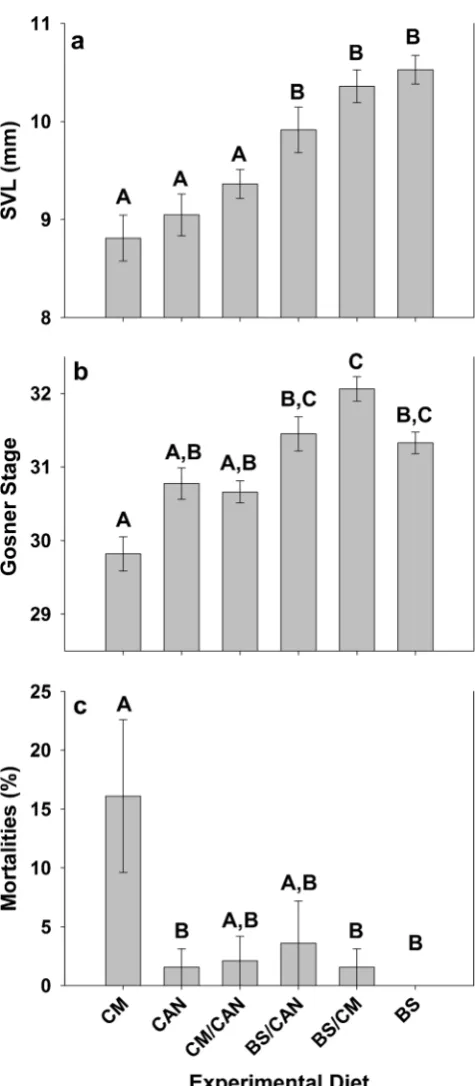
Tadpoles in all dietary treatments were observed foraging on experimental diets from the initial day of experimentation. However, tadpoles exhibited overall significant differences in final snout–vent lengths among dietary treatments (F[5,41]=
13.3,P<0.001). A clear divide was observed in SVL btween those tadpoles fed a diet containing BS and those fed diets that lacked BS. Mean (± SE) SVL of tadpoles fed a diet with BS exhibited no significant difference among each other (BS 10.6 ±0.1 mm; BS/CAN 9.9±0.2 mm; BS/CM 10.4±0.2 mm; all
P>0.2) but all significantly larger than those fed diets without BS (allP≤0.02). Similarly, all tadpoles fed diets lacking BS exhibited no significant differences in mean (± SE) SVL (CM 8.8±0.2 mm; CAN 9.0±0.2 mm; CM/CAN 9.4±0.1 mm) (all
P>0.3; Fig.3a).
Overall significant differences were observed in the devel-opmental progress of tadpoles among dietary treatments
(F[5,41]=10.9,P<0.001). Differences in final developmental
stages in tadpoles among dietary treatments were less straight-forward than those observed for SVL values. Tadpoles fed
CM exhibited the lowest mean (± SE) final developmental stage (29.8±0.3), which was significantly lower than tadpoles fed BS/CAN (31.4 ± 0.2; P< 0.001), BS/CM (32.1 ± 0.2;
P<0.001), and BS (31.3±0.2;P=0.001) but were not signif-icantly different from tadpoles fed CAN (30.8±0.2;P=0.07) or CM/CAN (30.7±0.2; P=0.1). Similarly, no significant differences were observed in final developmental stages among tadpoles fed CAN, CM/CAN, BS/CAN, and BS (all
P>0.1), and no significant differences were observed among tadpoles fed BS/CAN, BS/CM, and BS (allP>0.1); however, tadpoles fed BS/CM exhibited a significantly higher final developmental stage than tadpoles fed CAN (P<0.005) and CM/CAN (P=0.001; Fig.3b).
Unlike observations from experiment 2, tadpoles fed at later stages differed in overall percent mortality among dietary treatments (F[5,38]=3.5;P=0.01). Tadpoles fed CM had the
highest mean (±SE) percent mortality among all treatment groups (16.1±6.5 %), which was significantly greater than the mortality observed for tadpoles fed diets of CAN (1.6± 1.6 %;P<0.05), BS/CM (1.6±1.6 %;P<0.05), and BS (0± 0 %;P<0.01). No significant difference in mean (±SE) per-cent mortality was observed between BS/CAN (3.6±3.6 %) and CM/CAN (2.1±2.1 %; P=1.0) nor were tadpoles from these treatments observed to differ from those of any other treatment (allP>0.05; Fig.3c).
Discussion
Cannibalism can be a highly profitable strategy, yielding a theoretically ideal diet by composition while diminishing intraspecific competition (Fox 1975; Meffe and Crump
1987). Wood frog tadpoles are capable predators and efficient cannibals upon embryonic and newly hatched larval amphib-ians (Petranka and Thomas 1995; Petranka et al. 1998; Holbrook et al.2004). Therefore, a diet consisting of conspe-cific tissues should be highly beneficial to tadpole growth and development. However, the results of our experiments here indicate that tadpoles experience sub-optimal growth and development when provided an exclusively cannibalistic diet. Individually housed tadpoles provided the CAN diet starved for the initial 14 days of feeding period. This is supported by the results of stable isotope analyses and com-parison of results from the starvation treatment in experiment 2. Lack of15N enrichment suggests that cannibal tadpoles did not metabolize protein during this period (Gannes et al.1997; McCue 2007). Therefore, the increase in whole-body δ13C values of cannibalistic tadpoles suggests that they metabolized only stored lipids. Lipid metabolism resulting from starvation would result in rapid loss of13C depleted lipids, leading to an increase in total bodyδ13C values while leavingδ15N values relatively unchanged. The subsequent shift in isotopic values between tadpole tissues and the CAN diet that appears from
day 28 to day 60 corresponds with the expected values of free-feeding tadpoles (~1.0‰).
Tadpoles raised in groups fed immediately and successfully upon CAN; therefore, it does not appear that the individually housed tadpoles starved as a result of an inability to locate, consume, or assimilate CAN. Individually housed tadpoles appear to have preferentially avoided consuming CAN during the initial 14-day period, suggesting that tadpoles responded to a risk cue emanating from the homogenized tissues. Kinship cues are unlikely to initiate this response because they were composed of individuals from multiple egg clutches and from multiple ponds. Similarly, prior experiments suggest that tadpoles maintain feeding under risk of predation and that hunger results in increased feeding regardless of apparent risk (Bridges 2002; Horat and Semlitsch 1994). Similarly, in a prior experiment, we observed that chemical cues of homog-enized conspecifics alone did not dissuade tadpoles from feeding but may have instead been interpreted as competitive cues resulting in larger tadpole bodies (Jefferson et al.2013). However, Jefferson et al. (2013) combined cues from macer-ated conspecifics with a profitable diet; this may have initimacer-ated a conflict in information between putative alarm cues and profitable dietary cues. In our current study, the source of the putative alarm cues was also the diet itself, providing no conflicting cue to potentially lure the tadpoles in to feed. Jefferson et al. (2014) seem to support this, showing that tadpoles responded to conspecific tissues more rapidly when combined with the chemical cues of an alternative diet.
Tadpoles may have also avoided feeding on CAN due to potential for acquisition of pathogens (Pfennig et al.1998). Kiesecker et al. (1999) observed that bullfrog tadpoles prefer-entially avoid conspecifics infected with pathogenic yeast (Candida humicola) as identified by chemical cues. We ini-tially attempted to limit such risk by collecting pre-free-feeding tadpoles. Additionally, tadpoles raised in groupsbegan feeding immediately. This may have been the result of differ-ences in pathogen exposure of tadpoles between experiments. Conversely, the difference in feeding response may simply have been a result of tadpole exposure to actual competition. Relyea (2002) observed that wood frog tadpoles exhibit in-creasi ng acti v ity w ith i n traspecific c ompeti tion. Therefore,competitive effects may have precededthose ofputative risk cues. This is also supported by Jefferson et al. (2014) who observed that tadpoles provided a diet of conspecific tissues would initiate feeding more rapidly in the presence of a competitor than when fed individually.
Audo et al. (1995) found that tadpoles starved in early development experienced prolonged developmental periods. The duration of the nutritional stress experienced by individ-ual cannibalistic tadpoles and their developmental stage at which they experienced nutritional stress were similar to thoseof tadpoles in the early starvation treatmentprocedure in Audo et al. (1995). These cannibalistic tadpoles, having
experienced approximately 14d of starvationsimilarly exhibitedthe prolonged larval developmental and apparent
“catch-up growth”(Fig.S1in Online Resource2) observed by Audo et al. (1995).
McCallum and Trauth (2002) observed that tadpoles fed a 100 % CM diet were smaller, required longer time to meta-morphosis, and had lower survival than tadpoles fed diets with a greater proportion of protein (100 % soybean). Babbitt and Meshaka (2000) suggest that cannibalism among free-feeding tadpoles is an adaptation to low food quality and/or food abundance rather than one of pond drying, due to the obser-vation of prolonged larval development among tadpoles fed a high-quality diet and conspecifics tissues. Interestingly, results of Experiment 2 suggest that a cannibalistic diet facilitated a developmental rate that was greater than that of tadpoles fed the low quality CM diet and similar to that of tadpoles fed the mixed diet. However, despite the deficits of CM as a diet our results indicate that short-termobligatory feeding upon this low quality diet failed to elicit the elevated corticosterone levels suggested by Venesky et al. (2012). Therefore, these conditions may be insufficient to elicit the same feeding response upon CAN exhibited by starved tadpoles. It may be that long-term obligatory feeding on such a diet may eventu-ally stimulate elevated corticosterone levels and elicit such a response; however this appears to require longer than the 14d feeding period tested. Since our results also indicate no differ-ence in growth of cannibalistic tadpoles to those fed CM, but significantly lower than tadpoles fed the mixed or high quality BS diets, it does not appear that cannibalism is simply an adaptive response to low dietary resource quality.
had become conditioned to their initial control diet of BS/CM and required a transition period to the experimental diets. This may be supported by the relatively high mortality of tadpoles fed CM alone; having been previously provided a diet with both CM and BS, tadpoles may have been unable to cope with the rapid decline in dietary quality. The relatively low protein content or possibly the indigestibility of CM may have been a major factor since mortalities in all other dietary treatments were relatively low. It is also possible that the observational period for this experiment was too short and that differences between groups would have become increasingly apparent over time.
Tadpoles have traditionally been considered as indiscrimi-nate foragers (Dickman 1968), suspension feeders, herbi-vores, and detrivores (Duellman and Trueb1986; Altig et al.
2007). However, when we presented tadpoles with the 50:50 mix of high and low protein diets, they assimilated a dispro-portionately high amount of BS relative to CM (Fig.S3in Online Resource 2). Secco et al. (2005) suggest that CM represents a relatively digestible diet for bullfrog tadpoles (Lithobates catesbeianus); however, our results suggest that it may be less so for wood frog tadpoles. Additionally, CM was always present, even after BS was depleted, and tadpoles were rarely observed actively consuming CM. It is possible that tadpoles selectively consumed BS over CM to ideally facilitate growth and/or development as suggested by Richter-Boix et al. (2007). Tadpoles were observed excreting corn-meal that appeared undigested in both experiments 2 and 3. This further suggests that wood frog tadpoles were unable to properly digest CM and may have required coprophagy to extract sufficient energy and nutrient from this diet.
Alternatively, tadpoles may also have responded to attrac-tive chemical cues released from BS while ignoring CM or CAN diets due to a lack of any preferential cues. Therefore, the efficacy of diets lacking attractive cues may be hindered by the inability of tadpoles to identify them as profitable resources. Heinen and Abdella (2005) observed that American toads would not cannibalize injured live conspe-cifics but may consume dead conspeconspe-cifics. The authors sug-gest that the feeding response is stimulated by chemical cues that are only released as a result of bacterial decomposition. While this is certainly possible, it does not explain why tadpoles in experiment 1 tolerated nearly 2 weeks of starvation before consuming it, while tadpoles housed in groups began feeding immediately.
An alternative proximal trigger of cannibalistic behavior may be the presence of a high-quality diet (i.e., BS). Our observations of aggressive feeding behavior are consistent with those of Waldman (1985), who noted that when food resources are limited, tadpoles will “displace conspecifics feeding on an attractive food source”. While the resources themselves were not limited (we provided the tank with suf-ficient food to last the 48-h feeding periods), these resources
were often unevenly distributed within aquaria, allowing cer-tain individuals to monopolize profitable feeding areas. Individual tadpoles exhibiting relatively greater competitive success may then have grown larger, and this pattern of aggressive behavior could lead to encounters resulting in cannibalism.
Peacor and Pfister (2006) stated that differences in intra-population growth rates and thus size variation can arise from differences in individual growth rates (“size dependent”) and through phenotypic differences in foraging among individuals (“size independent”). Peacor and Pfister (2006) also observed that “size-dependent” factors appear to be responsible for differences in sizes at lower competition, while“ size-indepen-dent”factors appear primarily responsible for intra-population size variation at greater competition levels. Acquisition of limited resources can be improved in individuals with advan-tageous traits and thus worsened in those without (Peacor and Pfister2006). The effects of these traits then become increas-ingly pronounced with increasing competition, and thus an increased size disparity develops among individuals within the population (Peacor and Pfister2006).We therefore expect-ed that the greatest size discrepancy would have been ob-served among tadpoles in dietary treatments including BS due to its high profitability and attractiveness. However, the observation that the greatest size variation was among tad-poles fed CAN may still be congruent with the findings of Peacor and Pfister (2006). Our initial results from experiment 1 indicate that individual tadpoles may have an aversion to consuming CAN. However, if some individuals exhibit a phenotypic foraging trait that may encourage consumption of these tissues (e.g., boldness), then this would similarly explain the discrepancy among individuals despite the lack of apparent competition among individuals for this food re-source. Additionally, the aggression observed among tadpoles provided BS in their diets may act to reduce size disparity within populations by increasing the mortality of smaller individuals. Although we did not observe any such evidence for this in our study, our observations of size-dependent ag-gression and cannibalism among BS-fed individuals suggest that this is a possibility. Similarly, McCallum and Trauth (2002) observed that the Illinois chorus frog (Pseudacris streckeri) exhibited cannibalistic behavior and may have con-tributed to mortality within their experiment.
that tadpoles will not resort to cannibalistic behavior at a later period. Under more dire circumstances (e.g., pond drying, increased competition, increased predation, etc.) requiring increased protein in the tadpoles’diet to improve growth or development, cannibalism may fulfill such necessary protein requirements.
Acknowledgments DMJ was supported by a Dean’s Scholarship from the University of Saskatchewan. Research funding was provided by a Natural Sciences and Engineering Research Council Discovery Grant to DPC and Environment Canada operating funds to KAH. Shelly Fisher and Harrison Moore assisted in field collections, Chantel Showers and Geoff Kohler assisted with stable isotope analyses, David Janz aided in corticosterone analysis and interpretation, and Jill Johnstone and Ronald Russell provided statistical advice. All work was approved by the Uni-versity of Saskatchewan Animal Ethics Committee under protocols #20100019, #20120026, and #20130040.
References
Altig R, Whiles MR, Taylor CL (2007) What do tadpoles really eat? Assessing the trophic status of an understudied and imperilled group of consumers in freshwater habitats. Freshw Biol 52:386–395 Audo MC, Mann TM, Polk TL, Loudenslager CM, Diehl WJ, Altig R
(1995) Food deprivation during different periods of tadpole (Hyla chysoscelis) ontogeny affects metamorphic performance differently. Oecologia 103:518–522
Babbitt KJ, Meshaka WE Jr (2000) Benefits of eating conspecifics: effects of background diet on survival and metamorphosis in the Cuban treefrog (Osteopilus septentrionalis). Copeia 2000:469–474 Biesterfield JM, Petranka JW, Sherbondy S (1993) Prevalence of chem-ical interference competition in natural populations of wood frogs,
Rana sylvatica. Copeia 1993:688–695
Bleakney S (1958) Cannibalism inRana sylvaticatadpoles: a well-known phenomenon. Herpetologica 14:34
Bolker BM, de Castro F, Storfer A, Mech S, Harvey E, Collins JP (2008) Disease as a selective force precluding widespread cannibalism: a case study of an iridovirus of tiger salamanders,Ambystoma tigrinum. Evol Ecol Res 10:105–128
Bridges CM (2002) Tadpoles balance foraging and predator avoidance: effects of predation, pond drying, and hunger. J Herpetol 36:627–634 Caldwell JP, Araújo MC (1998) Cannibalistic interactions resulting from indiscriminate predatory behavior in tadpoles of poison frogs (Anura: Dendrobatidae). Biotropica 30:92–103
Collins JP, Cheek JE (1983) Effect of food and density on development of typical and cannibalistic salamander larvae inAmbystoma tigrinum nebulosum. Am Zool 23:77–84
Costa CS, Pereyra MC, Alcalde L, Herrera R, Trudeau VL, Natale GS (2014) Underwater sound emission as part of an antipredator mech-anism in Ceratophrys cranwelli tadpoles. Acta Zool–Stockholm Crespi EJ, Denver RJ (2005) Roles of stress hormones in food intake
regulation in anuran amphibians throughout the life cycle. Comp Biochem Physiol A 141:381–390
Crossland MR, Hearnden MN, Pizzatto L, Alford RA, Shine R (2011) Why be a cannibal? The benefits of cane toad,Rhinella marina
[=Bufo marinus] tadpoles of consuming conspecific eggs. Anim Behav 82:775–782
Crump ML (1986) Cannibalism by younger tadpoles: another hazard of metamorphosis. Copeia 1986:1007–1009
Dickman M (1968) The effect of grazing by tadpoles on the structure of a periphyton community. Ecology 49:1188–1190
Duellman WE, Trueb L (1986) Biology of amphibians. McGraw-Hill, New York
Fox LR (1975) Cannibalism in natural populations. Ann Rev Ecol Syst 6: 87–106
Gannes LZ, O’Brien DM, del Rio CM (1997) Stable isotopes in animal ecology: assumptions, caveats, and a call for more laboratory exper-iments. Ecology 78:1271–1276
Gosner ML (1960) A simplified table for staging anuran embryos and larvae with notes on identification. Herpetologica 1960:183–190 Heinen JT, Abdella JA (2005) On the advantages of putative cannibalism
in American toad tadpoles (Bufo a. americanus): is it active or passive and why? Am Midl Nat 153:338–347
Holbrook CT, Petranka JW, Douglas ME (2004) Ecological interactions betweenRana sylvatica andAmbystoma maculatum: evidence of interspecific competition and facultative intraguild predation. Copeia 2004:932–939
Horat P, Semlitsch RD (1994) Effects of predation risk and hunger on the behaviour of two species of tadpoles. Behav Ecol Sociobiol 34:393–401 Jefferson DM, Russell RW (2008) Ontogenetic and fertilizer effects on stable isotopes in the green frog (Rana clamitans). Appl Herpetol 5: 189–196
Jefferson DM, Hobson KA, Chivers DP (2013) Understanding the infor-mation value of repeated exposure to chemical alarm cues: what can growth patterns tell us? Ann Zool Fenn 50:237–246
Jefferson DM, Hobson KA, Chivers DP (2014) Time to feed: how diet, competition, and experience may influence the feeding behaviour and cannibalism of wood frog tadpoles (Lithobates sylvaticus). Curr Zool Kiesecker JM, Skelly DK, Beard KH, Preisser E (1999) Behavioral reduction of infection risk. Proc Natl Acad Sci U S A 96:9165–9168 Kupferberg SJ (1997) The role of larval diet in anuran metamorphosis.
Amer Zool 37:146–159
Marcus R, Peritz E, Gabriel KR (1976) On closed testing procedures with special reference to ordered analysis of variance. Biometrika 63: 655–660
McCallum ML, Trauth SE (2002) Performance of wood frog (Rana sylvatica) tadpoles on three soybean meal–cornmeal rations. Podarcis 3:78–85
McCue MD (2007) Western diamondback rattlesnakes demonstrate phys-iological and biochemical strategies for tolerating prolonged starva-tion. Physiol Biochem Zool 80:25–34
Meffe GK, Crump ML (1987) Possible growth and reproductive benefits of cannibalism in the mosquito fish. Am Nat 129:203–212 Newman RA (1987) Density and predation onScaphiopus couchii
tad-poles in desert ponds. Oecologia 71:301–307
Peacor SD, Pfister CA (2006) Experimental and model analyses of the effects of competition on individual size variation in wood frog (Rana sylvatica) tadpoles. J Anim Ecol 75:990–999
Petranka JW, Thomas DG (1995) Explosive breeding reduces egg and tadpole cannibalism in the wood frog,Rana sylvatica. Anim Behav 50:731–739
Petranka JW, Rushlow AW, Hopey ME (1998) Predation by tadpoles of
Rana sylvaticaonAmbystoma maculatum: implication of ecological role reversals by Rana (predator) and Ambystoma (prey). Herpetologica 54:1–13
Pfennig DW, Ho SG, Hoffman EA (1998) Pathogen transmission as a selective force against cannibalism. Anim Behav 55:1255–1261 R Development Core Team (2010) R: a language and environment for
statistical computing. R foundation for statistical computing, Vienna.—cran.r-project.org/doc/manuals/refman.pdf
Reeve E, Ndriantsoa SH, Strauβ A, Randrianiaina R-D, Hiobiarilanto TR, Glaw F, Glos J, Vences M (2011) Acoustic underwater signals with a probable function during competitive feeding in a tadpole. Naturwissenschaften 98:135–143
Relyea RA (2004) Fine-tuned phenotypes: tadpole plasticity under 16 combinations of predators and competitors. Ecology 82:172–179 Richter-Boix A, Llorente GA, Montori A, Garcia J (2007) Tadpole diet
selection varies with the ecological context in predictable ways. Basic Appl Ecol 8:464–474
Schiesari L, Werner EE, Kling GW (2009) Carnivory and resource-based niche differentiation in anuran larvae: implications for food web and experimental ecology. Freshw Biol 54:572–586
Secco EM, De Stéfani MV, Vidotti RM (2005) Apparent digestibility of different ingredients in diets for bullfrogRana catesbeianatadpoles. J World Aquacult Soc 36:135–140
Sokal RR, Rohlf FJ (1995) Biometry: the principles and practice of statistics in biological research, 3rd edn. Freeman, New York Steinwascher K, Travis J (1983) Influence of food quality and quantity on
early larval growth of two anurans. Copeia 1983:238–242 Sterner RW, Elser JJ (2002) Ecology of stoichiometry: the biology of
elements from molecules to the biosphere. Princeton University Press, Princeton
Trakimas G, Jardine TD, BarisevičiūtėR, Garbaras A, SkipitytėR, Remeikis V (2011) Ontogenetic dietary shifts in European common frog (Rana temporaria) revealed by stable isotopes. Hydrobiologia 675:87–95
Venesky MD, Wilcoxen TE, Rensel MA, Rollins-Smith L, Kerby JL, Parris MJ (2012) Dietary protein restriction impairs growth, immu-nity, and disease resistance in southern leopard frog tadpoles. Oecologia 169:23–31
Waldman B (1985) Olfactory basis of kin recognition in toad tadpoles. J Comp Physiol A 156:564–577
Wellborn GA, Skelly DK, Werner EE (1996) Mechanisms creating community structure across a freshwater habitat gradient. Annu Rev Ecol Syst 27:337–363
Wildy EL, Chivers DP, Kiesecker JM, Blaustein AR (2001) The effects of food level and conspecific density on biting and cannibalism in larval long-toed salamanders, Ambystoma macrodactylum. Oecologia 128:202–209