IJBCP
International Journal of Basic & Clinical Pharmacology
Research Article
Identifying learning techniques among high achievers
Shanmukananda P
a*, L Padma
aINTRODUCTION
Studying medicine is very stressful and challenging because of the sheer volume of learning, in addition to dealing with human lives. Because of these, students have very less opportunity to relax and involve in recreational activities.1 All this can result in anxiety and depression, impaired concentration and judgment, and loss of self-esteem.2
In addition to the academic pressure, medical students also have to deal with the uncertainty of the future and the pressure to excel in their careers.3 In addition, for students who have been reasonably good in academics in
school, getting mediocre scores as a medical
undergraduate is often unfathomable. This further has a bearing on their quality of life.3
So, the learning techniques of these students are an important aspect towards their achieving academic success in medical school, as well as professional success, later as physicians.
It is well-known that in spite of being exposed to the same teaching modalities in the class rooms and in spite of adopting seemingly similar learning strategies, some students perform much better than their peers. This can be evaluated in the form of better academic performance in the formative assessments they undertake.
Information on the learning techniques of medical students are lacking in medical colleges in India. These techniques may be associated with student understanding and may predict success in examination. The present study was carried out to identify high achievers in ABSTRACT
Background: In every college, it is noticed that in spite of being exposed to the same teaching modalities and adopting seemingly similar strategies, some students perform much better than their peers. This can be evaluated in the form of better academic performance in the internal assessments they undertake. This project is an endeavor to identify the learning techniques among high achievers which they employ to outperform others. We can also suggest the same to the medium and low achievers so that they can improve their academic performance. This study was conducted to identify different learning techniques adopted by high achievers and suggesting the same to medium and low achievers.
Methods: After obtaining clearance from the institutional ethics committee, the high achievers were identified by selecting the upper third of the students in the ascending order of marks obtained in the consecutive three internal assessments in three consecutive batches. The identity of the students was not revealed. They were then administered an open ended questionnaire which addressed relevant issues. The most common and feasible techniques will be suggested to the medium and low achievers.
Results: The respondents’ (n=101) replies were analyzed by calculating the percentages of responses, and assessing based on that, which were the most frequently adapted techniques by these high achievers
Conclusions: High-achievers have a diligent study pattern; they not only study regularly, but also involve in group discussions and approach their teachers when in doubt. Additionally, they refer to other sources of information like the internet, demonstrating a proactive attitude towards studies.
Keywords: Learning techniques, High achievers, Second year MBBS, Pharmacology
doi: 10.5455/2319-2003.ijbcp20130316
aDepartment of Pharmacology, Dr.
B. R. Ambedkar Medical College, Bangalore-560045, India
Received: 24 February 2013
Accepted: 28 February 2013
*Correspondence to:
Dr. Shanmukananda P, Email:
© 2013 Shanmukananda P et al. This is an open-access article distributed under the terms of the Creative Commons Attribution License, which permits
medical college, learn the techniques they employ to outperform their peers and make recommendations on the most effective techniques based on our study findings to the medium and low achievers.
METHODS
After obtaining clearance from the institutional ethics committee, the current study was conducted on the second phase MBBS students at Dr. B. R. Ambedkar Medical College, Bangalore between December 2010 and June 2012. Second phase comprises of three terms and internal assessments are conducted at the end of each term. The high achievers were identified by selecting the upper third of the students in the ascending order of average marks obtained in the consecutive three internal assessments. The total marks for each internal assessment
was 60. The identities of the students were not revealed. An open ended questionnaire with 19 questions was then administered to these students addressing relevant issues (see Box 1). The questions were categorized into three groups for the purpose of understanding the learning techniques adapted by these students: (i) study pattern, (ii) study techniques and (iii) techniques during exams.
The primary objective of the study was to identify different learning techniques adopted by the high achievers. The secondary objective was to suggest the same to medium and low achievers.
The respondents’ replies were analysed by calculating the percentages of responses, and assessing based on that, which were the most frequently adapted techniques by these high achievers.
RESULTS
A total of 101 students met the criteria of were included in this study. The average maximum mark obtained was 29, and the upper third of students had an average of 39 marks across three internals.
Study pattern
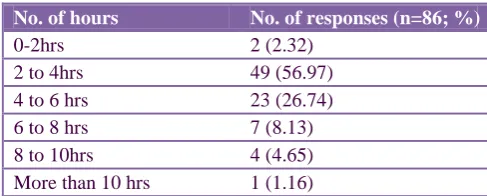
[image:2.595.305.549.623.721.2]A total of 86 students answered the question on duration of studying per day. Majority of the students (n=49; 48.51%) studied for 2-4 h every day, followed by 23 (22.77%) studying for 4-6 h/day. Two of them studied for <2 h/day and only one studied for >10 h (see Table 1).
Table 1: Total number of study hours/day.
No. of hours No. of responses (n=86; %)
0-2hrs 2 (2.32)
2 to 4hrs 49 (56.97)
4 to 6 hrs 23 (26.74)
6 to 8 hrs 7 (8.13)
8 to 10hrs 4 (4.65)
More than 10 hrs 1 (1.16)
Of the 74 students who answered the question on the preferred time of study, 33 (32.97%) studied at night (8 pm- 3 am) followed by 18 (17.82%), 15 (14.85%) and 8
Box 1: Questionnaire I Study pattern
1. How many hours do you study in a day?
2. What time of the day do you prefer to study?
3. Why do you prefer that time to study?
4. Do you prefer to study at home, room or at the library?
II Study techniques
5. Which method do you follow to study?
i. Read only
ii. Read and Write
iii. Read loudly
iv. Any other method
6. What do you feel is the advantage of this method?
7. Do you make notes in the class?
8. Do you refer to your notes when you study?
9. Do you refer any other media for extra information?
10. What do you feel are the advantages of that media?
11. Do you indulge in Group discussions with your classmates or seniors?
12. What do you feel are the advantages of Group discussions?
13. Do you feel that difficult topics need discussion?
14. Do you approach your teachers in case of difficult topics to clarify your doubts?
15. How do you relax after studying?
16. How much does relaxation help you as far as studies are concerned?
III Techniques during exams
17. Do you sleep more/less/equal amount of time during your exams?
18. Does the amount of sleep affect your performance in the examination?
(7.92%) who studied in the evening (5 pm- 8 pm), morning (3 am- 9 am) and day (9 am- 5 pm) respectively. When asked why they preferred this time, there were 135 responses, of which the most frequent was ‘lack of disturbance’ (n=54; 40%), followed by ‘can concentrate’ and ‘feel fresh’ in 29 and 23 students, respectively.
Most of the students preferred to study either at home (n=44; 43.56%) or room (n=30; 29.7%). Few others studied in the library (n=14; 13.86%); one student studied in all the above places, while 12 did not answer this question.
Study Techniques
[image:3.595.312.566.165.326.2]With regard to the method of study adopted, there were totally 119 responses. Of these, 63 (62.37%) preferred to read and write; 29 (24.36%) and 26 (21.84%) to read loudly and read only, respectively. One student adopted a different method, but did not specify what. The advantages of the method adopted are enumerated in table 2.
Table 2: Advantages of the different study methods, according to the students.
Advantage
Number of responses (%)
Increases speed 4 (4.04)
Acts as Revision 11 (11.11)
Time Saving 12 (12.12)
No reply 4 (4.04)
Stimulates both audio and visual
pathways 9 (9.09)
Improves Remembrance 53 (53.53)
Helps in Concentration 6 (6.06)
When asked if they make notes in class, 85 of them answered in the affirmative, while 16 did not. Of these 85 who made notes, 76 referred to the notes.
In addition to standard text books, 78 of the students referred to other media for extra information, while 23 did not. The most common was the internet (n=55; 51.88%). Few referred to library book and books from other authors (n=14; 13.2%). Fourteen of them did not specify what media they referred to. The advantages of referring these additional media are shown in Figure 1.
Eighty-three students indulged in group discussions with classmates and seniors. There were 123 responses with regard to advantages of group discussions (see Table 3).
Additionally, 93 students felt that difficult topics need discussion, while 5 felt that they did not and 3 others did not answer this question. A total of 68 students (67.32%) approached teachers to clarify their doubts in case of
doubts; 30 of them did not and again, 3 did not answer this question.
[image:3.595.47.290.370.515.2]When asked about how they relaxed after studying, there were 210 responses. Sleeping (n=48; 22.85%) and listening to music (n=45; 21.42%) were the most common relaxation techniques (see Table 4).
Figure 1: Advantages of referring to other media for extra information.
Table 3: Advantages of group discussion with classmates and seniors.
Advantages Number of responses (%)
Better Recall 41 (33.33)
Better Understanding 19 (15.45)
Topic is made easy 4 (3.25)
Can clarify doubts 10 (8.13)
Extra information 20 (16.26)
No advantages 9 (7.32)
Better analysis of subject 20 (16.26)
Table 4: Various relaxation techniques.
Relaxation techniques Number of responses (%)
Snacks and beverages 9 (4.28)
Listening to music 45 (21.42)
Watching television 40 (19.5)
Light reading (newspaper, novels
and internet) 16 (7.61)
Playing games and exercising 34 (16.19)
Sleeping 48 (22.85)
Talking to people 18 (8.57)
[image:3.595.307.549.431.553.2] [image:3.595.308.550.586.719.2]Techniques during exams
When the sleeping patterns of these students was probed, it was found that 63 (62.38%) of them slept less, while 15 (14.85%) slept more. There was no change in the duration of sleep in 21 students (20.79%). Two students did not answer this question. When asked if the change in the duration of sleep affected their performance, 35 (34.31%) answered in the affirmative, while 43 (42.16%) refuted it. Ten of them answered that adequate sleep is proportional to better performance, and nine that less sleep is proportional to reduced performance. Four of them did not answer this question.
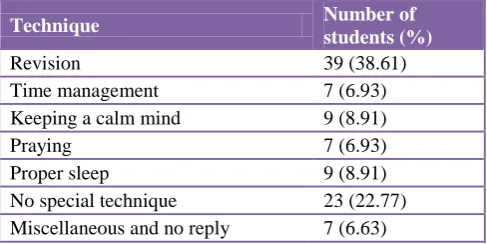
[image:4.595.46.289.313.421.2]Students were asked if they followed any special technique on the day of the exam. Their responses are tabulated in table 6.
Table 5: Advantages of the adapted relaxation techniques.
Advantage Number of responses (%)
Helps to concentrate 23 (22.77)
Feels fresh 23 (22.77)
Helps to remember 6 (5.94)
Helps a lot 29 (28.71)
No answer 9 (8.91)
Miscellaneous 11 (10.89)
Table 6: Special techniques followed on the day of the exam.
Technique Number of students (%)
Revision 39 (38.61)
Time management 7 (6.93)
Keeping a calm mind 9 (8.91)
Praying 7 (6.93)
Proper sleep 9 (8.91)
No special technique 23 (22.77)
Miscellaneous and no reply 7 (6.63)
DISCUSSION
The current study enabled us to identify the various methods medical students adopt in order to achieve success in their exams.
All these students studied regularly, with 81.28% of them studying between 2-6 h every day. About a third of them studied at night, between 8 PM and 3 AM. They preferred studying either at their home or in their rooms (74.26%). These high achievers seemed to follow a set study pattern, because of which they would cover the portions taught in class and also complete other course work regularly.
According to a study by Sarwar et al.,4 high achievers have better study habits and attitude as compared to low achievers; the former group revised daily what was taught in the class on that particular day. They also studied according to a timetable. However, in our study we did not question the students on this aspect.
About two-thirds of the high achievers in our survey used to both read and write, while studying. Most of them made notes in class (84.15%), and 75.24% referred to these notes later on. Additionally, 77.23% of these students referred to additional media, especially the internet. This shows that these students were highly motivated to ensure that they used the correct study technique, in order to improve retention and also gather extra information. These techniques also probably helped them understand what they were studying, rather than mere memorising. This aspect was however not directly questioned in our survey. Sarwar et al.4 also demonstrated in their study that high achievers reported putting in more vigorous efforts; additionally, they said that they tried to understand things and not memorize them.
Most of these students (n=83) appreciated the importance of group discussions with their peers and seniors. They felt that these discussions helped in better recall, analysis of the subject, understanding and also gives them extra information. Additionally, 67.32% of these students approached their teachers in case of any doubts. All these demonstrate a proactive behaviour on the part of the students, trying to put in as much extra effort as possible to ensure they understand and retain what they study. A previous study has also shown that high achievers approach the teacher to explain parts of the lessons they do not understand.4 In a study by Engels and de Gara,5 it was observed that medical students followed the assimilatory learning style of the Kolb learning style inventory. Essentially, people following this learning style
enjoyed creating theoretical models and placed
importance in theory and logic, and are less interested in people and more concerned with abstract concepts.
[image:4.595.46.290.466.588.2]like regular debating club, movie club, sports club, music and art gallery. Lee and Graham1 opine that stress management and time management techniques should be included in the first and second year curriculum of medical education in order to assist students in dealing with stress.
Apart from these aspects the perspective and attitude of the student seems to be important aspects deciding his/her
academic performance. Mc Coach et al.8 demonstrated in
their study that high-achieving students showed more
positive academic self-perceptions,
motivation/self-regulation, goal valuation, attitudes towards school, attitudes toward teachers than low achieving students. However, academic self-perceptions and motivation/self-regulation appeared to be stronger predictors of academic achievement status than attitude toward school and teachers. According to Sarwar et al.,4 high-achievers reported being more calm and efficient compared to low achievers. These students also found their school subjects relevant and interesting. In addition, they report that the high achievers have a positive attitude towards teachers and believed that their studies were practically relevant for their lives. This group of students also generally reported that they obtained marks that they deserved and not due to some other reasons. In another study, Sarwar et al.9 state that attitudes and achievement are directly proportional. A positive attitude towards studies translates to a greater achievement.
Undoubtedly, exam times are the most stressful times faced by students. When we probed about any special technique these students used during exams, the most frequent response was that they revised what they had studied before (38.61%). A few others followed other techniques like keeping calm, praying, sleeping well, etc. but about 22.77% stated that they did not follow any special technique.
Some of the limitations of our study are that (i) we did not have a comparator group, (ii) the students were categorised as high-achievers based on the marks of only one subject (Pharmacology), while there are three other subjects as part of the second year curriculum, (iii) we used an open-ended questionnaire, because of which we received varied responses.
In conclusion, high-achievers have a diligent study pattern, they not only study regularly, but also involve in
group discussions and approach their teachers when in doubt. Additionally, they refer to other sources of information like the internet for additional information, demonstrating a proactive attitude towards studies. They also involve in relaxation in order to beat the stress of medical education. However, we need large trials including students from different medical colleges to confirm these findings.
Funding: No funding sources Competing interests: None declared
Ethical approval: The study was approved by the Institutional Ethics Committee
REFERENCES
1. Lee J, Graham AV. Students’ perception of medical
school stress and their evaluation of wellness elective. Medical Education 2001;35:652-9.
2. Gisele M. Stress in graduate medical degree. Med J
Aust 2002;17:10-1.
3. Kate MS, Kulkarni UJ, Shetty YC, Deshmukh YA,
Moghe VV. Acknowledging stress in undergraduate medical education and methods of overcoming it. Curr Res J Soc Sci 2010;2:282-7.
4. Sarwar M, Bashir M, Khan MN, Khan MS.
Study-orientation of high and low academic achievers at secondary level in Pakistan. Educ Res Rev 2009;4:204-7.
5. Engels PT, de Gara C. Learning styles of medical students, general surgery residents, and general surgeons: implications for surgical education. BMC Med Educ 2010;10:51.
6. Jain A, Bansal R. Stress among medical and dental students: A global issue. IOSR J Dent Med Sci 2012;1:5-7.
7. Dyrbye LN, Thomas MR, Massie FS, Power DV,
Eacker A, Harper W, et al. Burnout and suicidal ideation among U.S. medical students. Ann Intern Med 2008;149:334-41.
8. McCoach DB, Siegle D. A comparison of high
achievers’ and low achievers’ attitudes, perceptions, and motivations. Academic Exchange Quarterly. 2001;5(2):71-6.
9. Sarwar M, Bashir M, Alam M. Study attitude and academic achievement at secondary level in Pakistan. Journal of College Teaching and Learning. 2010;7:55-60.
doi:10.5455/2319-2003.ijbcp20130316