Print ISSN: 2383-451X Online ISSN: 2383-4501 Web Page: https://jpoll.ut.ac.ir, Email: [email protected]
Stabilization of Filter Cake and its Leaching Behaviour: A Case
Study with Cementitious and Soluble Phosphate Additives
Shirdam, R.*, Nourigohar, A. and Mohamadi, S.
Faculty of Environment, P.O.Box 31746-118, Karaj, Iran
Received: 07.01.2019 Accepted: 10.04.2019
ABSTRACT: Filter cake is one of the main waste products of zinc processing industries and it contains a high amount of toxic heavy metals. In this research in order to reduce heavy metals leachability in filter cake, Portland cement, natural pozzolan, diammonium phosphate (DAP), triple superphosphate (TSP), lime, zinc oxide and ground granulated blast furnace slag (GGBFS) have been used. This research’s results suggest that even though leachability of lead in the filter cake is quite low, it should be noted that limestone doubles the solubility level of Pb due to the mineralogical nature of the waste, by converting its sulphate form (PbSO4) to its carbonate form (PbCO3), which is more
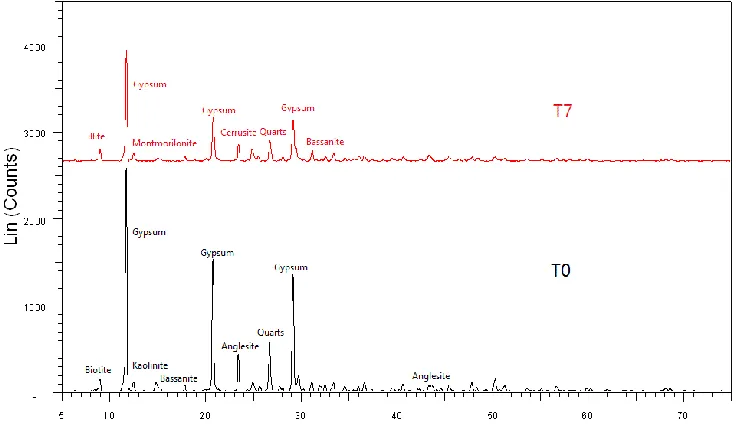
soluble. TSP was the only additive capable of reducing the leachability of metal elements in the filter cake as well as stabilizing the amounts of Pb and Cd in TCLP extracts within the limit. Although all additives were able to reduce Cd leachability, TSP and ZnO had the most remarkable efficiency. According to XRD results, the main factor in lead stabilization using TSP was a reduction in the amount of PbSO4 (with high Ksp) and an
increase in PbS (with low Ksp), which ultimately reduced lead leachability. The Pozzolan which was used for the first time as a stabilizer demonstrated a good performance in reducing the leachability of Cd, Ni and Cu. In addition, due to the pseudo-cementitious properties of Pozzolan, it can reduce leachability of metal elements, along with other additives such as cement, by increasing the solidification efficiency.
Keywords: Waste products, immobilization, zinc processing, TSP, Iran.
INTRODUCTION
Unfortunately, heavy metals in the soil last for a long time despite organic pollutants, since they cannot be destroyed and are merely relocated from one point to another
(Kumpiene et al., 2008). The
bioavailability and mobility of substantial fractions of metals in the soil may cause biotoxicity, accumulation, and transport in long-term metal deposition (Adriano et al., 2004). Nevertheless, remediating soils which are polluted by heavy metals is a necessity, considering their human and
* Corresponding Author, Email: [email protected] /[email protected]
eco-toxicity (Yu et al., 2017). Zinc leaching industries produce three types of solid wastes during their process, namely leaching filter cake (leach cake), hot Filter cake (cobalt cake) and cold filter cake (nickel cake). Each of these wastes has high amounts of heavy metals. During the waste disposal’s process of heavy metals containing solids, the released contaminants
burial of contaminated soils at specific locations), soil washing, immobilization (chemical stabilization or fixation) and solidification/solidification of contaminated soil or heavy metal polluted waste (Yao et al., 2012). In order to reduce the mobility of heavy metals, contaminated soils or polluted waste must be chemically stabilized. The less mobile contents formed through stabilization demonstrate a low bioavailability and are less accessible to plants. The relatively high efficiency as well as the economic cost of the stabilization agents makes them a better option in comparison with other methods (Uzinger & Anton, 2008). In order to reduce heavy metal mobility and ensure chemical stabilization, many different additives such as lime (Modarres & Nosoudy, 2015), phosphate based materials like DAP (Basta & McGaven, 2004), TSP (Chen et al. 2008; Cao et al. 2008) metal oxides (Derghazarian, 2010), Portland cement (Volgar and Lestan, 2010), lime and GGBFS (Shirdam et al., 2017) and egg shells as a source of calcium carbonate (Ashrafi et al., 2015) have been used. Cement additives have also been used as a stabilizing agent in many different studies (Tang et al., 2016; Song et al., 2013; Patel & Pandey, 2012). The results of these researches indicate that cement is effective in two processes, one as a stabilizing agent and the other as a solidifying agent (physical stabilizer). Because of cement’s high potential to increase the mechanical strength of the wastes, it has been used as a physical stabilizing agent in many cases. In this regard, Volgar and Lestan used Portland cement (7, 10, 15 and 20% w/w) with the objective to stabilize lead, cadmium, zinc, and copper in contaminated soils. As their results demonstrated, the increase in the cement/soil weight ratio enhanced the mechanical strength of the waste and caused a decrease in the TCLP extractable heavy metals (Volgar & Lesten, 2010). In other cases, cement was
used as a chemical stabilizing agent and in low quantities (less than 10% by weight). As an example, Abdel-Kader et al. 2013, used 1 and 2 percent by weight of cement. They realized that this additive in such low quantities can reduce the solubility of lead and cadmium through the surface adsorption process (Abdel-Kader et al, 2013). Basta and McGowan also tested the effects of phosphate additives, including DAP. They believed the reason for reduction of lead solubility is the formation of a very stable
chemical substance called
Hydroxylpyromorphite (Basta & McGaven, 2004). This study identify and evaluate efficient and cost effective additives (such as cementitious additives), with a fast and durable effect in order to stabilize heavy metals in the produced filtered cakes in zinc industries.
MATERIALS& METHODS
separately. After 28 days of curation, the samples were ready for TCLP extraction
procedure. TCLP or ―Toxicity
Characteristic Leaching Procedure‖ is a test to determine the mobility of contaminants in solid wastes or soils. This test method which is represented by USEPA has been used to evaluate the stabilization efficiency in many studies (Ganjidost et al., 2009; Basta & McGowen, 2004). The equipment used in this extraction method consisted of a rotary agitation device, capable of rotating at 30 ± 2 rpm for 18 ± 2 hours, extraction
bottles made of high density
polyethylene, a pH meter with an accuracy of 0.05 1 and a magnetic stirrer. The chemicals used to prepare the extraction fluids were deionized water, hydrochloric acid (N1), nitric acid (N1), sodium hydroxide (N1), and glacial acetic acid (USEPA Method 1311).
After 28 days of curing, the samples were reduced in diameter to 9.5mm per particle. Then, the extraction fluid assigned to each sample in the previous step (extraction fluid #1 and #2) was mixed with the sample by a weight ratio of 20:1 (solution: waste sample) and the samples were rotated for 18 hours on a rotary agitation device at a speed of 31 rpm. The extracts were then filtered through a 0.45-micron fiberglass filter in order to remove the suspended particles (EPA Method 1311). In the next step, the concentrations of Cd, Co, Mn, Fe, Ni, Cu, Pb and Zn in the filtered extracts were determined using an atomic absorption apparatus (FAAS, Varian AA240) according to the USEPA 7000B method. Each extraction was performed three times and the average values were reported to ensure data repeatability (USEPA, 2007). In order to measure the heavy metal contents of the filter cake, first, the sample was acid digested (according to USEPA 3050B) and then analysed using
an atomic absorption spectrophotometer (USEPA 7000B). In order to determine chemical properties of different additives and the filter cake, XRF analysis was used (SIEMENS SRS3000). Also, XRD analysis was used to identify the various minerals present in the filter cake and the sample treated with TSP. XRF and AAS analysis had been performed in laboratory of Research and Engineering Company for Non Ferrous Metals (RECo.). Also, XRD analysis had been carried out at the XRD laboratory of School of Mining Engineering, College of Engineering, University of Tehran.
RESULTS AND DISCUSSION
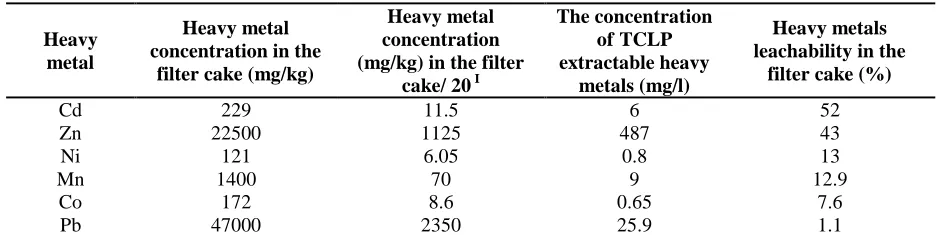
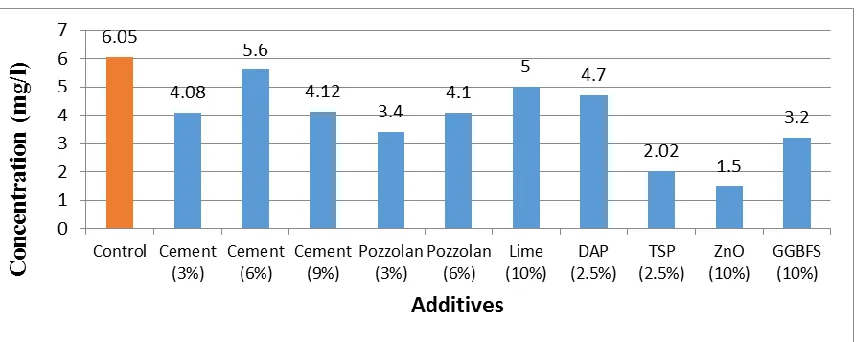
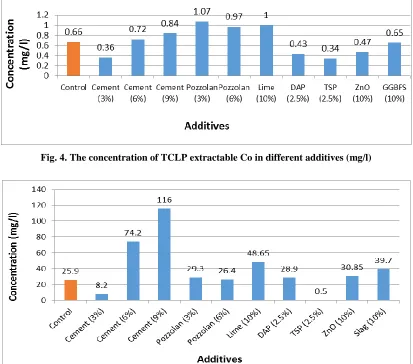
The concentrations of Cd, Co, Mn, Fe, Ni, Cu and Zn in the TCLP extracts are represented in Table 3. The leachability of metals in the waste was obtained by comparing the total amount of each metal in the filter cake with its concentration in the TCLP extract. TCLP extractable ratios are presented in Table 4. Although the concentration of Cd and Pb in the TCLP extract exceeded the TCLP regularity limits (USEPA, 2005), as demonstrated in Table 4, the leachability of Pb in the filter cake is very low. The effects of each additive on the leachability of Cd, Zn, Ni, Co, Pb, and Cu are presented in Figures 1 to 6. Among all additives, TSP and ZnO treatments caused the greatest reduction in TCLP extractable Pb and Cd and were able to reduce the concentration of Cd and Pb to below the TCLP regularity limits. A detailed interpretation of the effects of each additive on the leachability of metals in the filter cake is presented in the following sections.
Table 1. The physicochemical properties of the examined filter cake
Other parameters Oxides (%)
Heavy metal (total)
5.86 pH 27.99 SO3 134 Cu (ppm) 35 w (%) 19.7 SiO2 0.14 Mn (%) 0 LL & PL (%)
17.14 CaO
3.87 Fe (%)
0 (%) 2µm
6.86 ZnO
4.7 Pb (%)
88 (%) 75µm
4.87 Al2O3
229 Cd (ppm)
12 75µm-4.75mm (%)
4.66 Na2O
172 Co (ppm)
17.4
(KN/m3) 1.71 MgO 121 Ni (ppm) ML 1USCS 0.91 K2O
2.25 Zn (%) SILT 2 USDA 0.46 TiO2 1
Unified Soil Classification System
2
United States Department of Agriculture
Table 2. The chemical composition of different additives based on XRF (X-Ray Fluorescence) analysis.
SO3 K2O
Na2O MgO
TiO2 ZnO
CaO Fe2O3
SiO2 Al2O3
Materials - <0.1 <0.1 0.53 <0.1 - 71.24 0.12 1.2 0.69 Lime 2.3 0.69 0.2 1.72 - - 63.77 4.05 21.52 4.97 Portland Cement - 0.6 0.45 10.8 3.5 - 37 0.6 36 9.5 GGBFS - 2.31 3.90 2.50 0.49 -3.50 3.40 60.8 17 Pozzolan 1.197 0.83 2.58 0.098 0.006 93.22 0.001 0.12 0.6 0.008 ZnO
Table 3. The concentration of TCLP extractable heavy metals in the filter cake (mg/l)
Above the TCLP regularity
limit TCLP extractable heavy metals
Zn Pb Cu Ni Fe Mn Co Cd Mix Design -5 -1 TCLP Threshold (USEPA 2005)
Cd-Pb 487 25.9 0.22 0.82 ND 9 0.66 6.05 FC (Filter Cake :Control)
Cd-Pb 279 8.2 ND 0.6 ND 2.9 0.36 4.08 FC + Cement (3%)
Cd-Pb 472 74.2 0.9 1.2 ND 8.4 0.72 5.6
FC + Cement (6%)
Cd-Pb 392 116 ND 0.74 ND 8.05 0.84 4.25 FC + Cement (9%)
Cd-Pb 878 29.3 ND 0.7 ND 13.6 1.07 3.4
FC + Pozzolan (3%)
Cd-Pb 539 26.4 ND 0.8 ND 11.4 0.97 4.1
FC + Pozzolan (6%)
Cd-Pb 501 48.6 0.26 0.94 ND 9.65 1 5 FC + Lime (10%)
Cd-Pb 434 28.9 0.3 0.77 ND 5.5 0.43 4.7
FC + DAP (2.5%)
176 0.5 0.15 0.88 ND 4.2 0.34 2.02* FC + TSP (2.5%)
Pb 2494 30.8 ND 0.43 ND 7.5 0.47 1.5* FC + ZnO (10%)
Cd-Pb 319 39.7 ND 0.54 ND 12.0 0.65 3.2
FC + GGBFS (10%)
* TSP and ZnO was able to reduce the concentration of TCLP extractable Cd to its TCLP regularity limit.
Table 4. Heavy metals leachability in the filter cake (%)
Heavy metal
Heavy metal concentration in the
filter cake (mg/kg)
Heavy metal concentration (mg/kg) in the filter
cake/ 20 I
The concentration TCLP of extractable heavy metals (mg/l) Heavy metals leachability in the
filter cake (%)
Cd 229 11.5 6 52
Zn 22500 1125 487 43
Ni 121 6.05 0.8 13
Mn 1400 70 9 12.9
Co 172 8.6 0.65 7.6
Pb 47000 2350 25.9 1.1
I
Fig. 1. The concentration of TCLP extractable Cd in different additives (mg/l) TCLP regularity limit for Cadmium: (1 mg/l)
Fig. 2. The concentration of TCLP extractable Zn in different additives (mg/l)
Fig. 4. The concentration of TCLP extractable Co in different additives (mg/l)
Fige. 5. The concentration of TCLP extractable Pb in different additives (mg/l) (TCLP ragularity limit for lead: 5 mg/l)
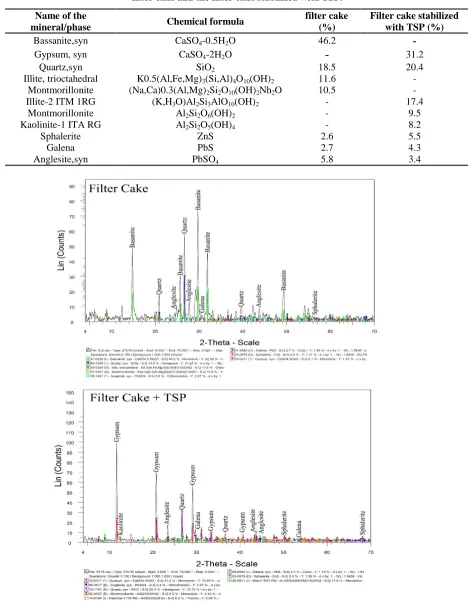
Table 5. The list of different compounds, identified by X-ray Diffraction Analysis in the control sample filter cake and the filter cake stabilized with TSP.
Filter cake stabilized with TSP (%) filter cake
(%) Chemical formula
Name of the mineral/phase
-46.2
CaSO4-0.5H2O
Bassanite,syn
31.2
-CaSO4-2H2O
Gypsum, syn
20.4 18.5
SiO2
Quartz,syn
-11.6
K0.5(Al,Fe,Mg)3(Si,Al)4O10(OH)2
Illite, trioctahedral
-10.5
(Na,Ca)0.3(Al,Mg)2Si2O10(OH)2Nh2O
Montmorillonite
17.4
-(K,H3O)Al2Si3AlO10(OH)2
Illite-2 ITM 1RG
9.5
-Al2Si2O6(OH)2
Montmorillonite
8.2
-Al2Si2O5(OH)4
Kaolinite-1 ITA RG
5.5 2.6
ZnS Sphalerite
4.3 2.7
PbS Galena
3.4 5.8
PbSO4
Anglesite,syn
The role of lime in the immobilization of heavy metals is that by increasing the pH level, the leachability of metal cations decreases (Gray et al. 2006). In this study, lime in 10 wt% increased the leachability of most of the heavy metals in the filter cake, especially lead. Therefore, lime in this particular dosage is not an appropriate immobilization agent for the filter cake. Lime increased Co, Ni, Cu, and Pb concentrations in the TCLP extract by 51, 14, 18 and 87 percent respectively but it could also reduce Cd leachability by 18% compared to the control sample. A similar stabilizing effect of lime on the EDTA extractable heavy metals in filter cake was previously observed by Shirdam et al. in 2016. It was concluded that using lime as an immobilization agent in 10 wt. % (with 3% Red mud) can reduce the leachability of most metals in the filter cake. However, it had a negative effect on the leachability of lead and increased its leachability by 90% compared to the control sample (Shirdam et al., 2016). On the other hand, the results of the XRD analysis of control and lime-stabilized
samples (figure 8) indicate that in the presence of lime, the relatively stable sulphate form of lead (PbSO4) converts
to carbonaceous form, which has a higher solubility. Also, Brown et al. in 2005 demonstrated that the use of lime does not cause a significant decrease in the amount of lead compared with the control sample (Brown et al. in 2005. It needs to be pointed out that the stabilization performance of lead via lime depends on the type of minerals and the acidity of the waste (Brown et al. 2005).
Heavy metals immobilization could take place through three different
mechanisms, namely, chemical
incorporation (precipitation, co-precipitation, and surface complexation), sorption, and micro-encapsulation (Chen et al. 2008). Generally, increasing the cement/waste dosage will in turn boost the immobilization efficiency of cement. This could take place because the cement-based material can enhance the compressive strength of the waste and turn the process of immobilization into that of solidification (Voglar & Leštan.
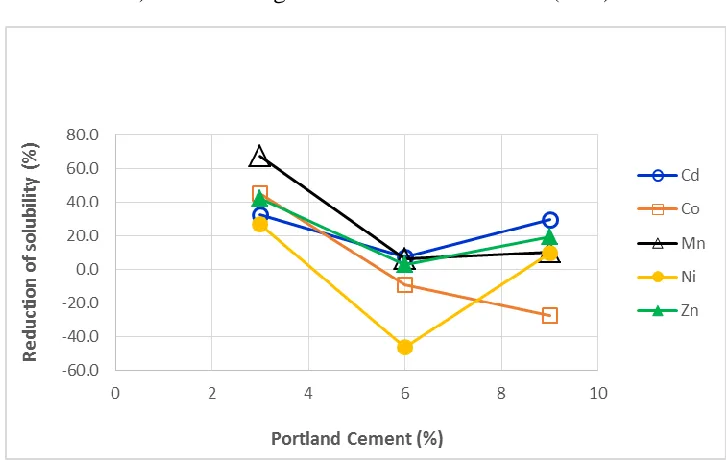
2010). In the present study, cement efficiency was evaluated merely as a chemical stabilization agent which was applied to the filter cake at 3, 6 and 9 wt. %. The results presented in Figures 1 to 6 demonstrate that there is a reverse correlation between cement dosage and heavy metals immobilization efficiency, in a way that increasing cement from 3 to 9 wt. % caused an increase in the heavy metals released in the extract, with the most effective treatment being at 3 % wt. (Figure 9). It is worth noting that Abdel-Kader concluded that cement in low weight percentages (1 and 2 wt. %) has a good effect on reducing the leachability of lead, cadmium, and cobalt (Abdel-Kader et al. 2013). According to
Ganjidoust et al. hydrating cement products enhance the heavy metals precipitation on the surfaces of their particles. Lead and Cadmium were found in stabilized forms of Ca2Pb2O5(OH)2,
and CaCd(OH)4, respectively (Ganjidoust
et al, 2009).
Lead solubility was enhanced as the percentage of cement was increased from 3% to 6 and then to 9%. This behavior is similar to the effect of lime on the increase of lead solubility in the filter cake, and might be due to the increase of CaO caused by the higher cement percentage in the filter cake. It must be stated that according to Table 2, the amount of CaO in the cement (64%) is approximately close to that in the lime (71%).
Fig. 9. Effects of Portland cement on heavy metals solubility in filter cake
Before this study, Natural pozzolan
has never been used as an
immobilization agent. According to the results of this investigation, Pozzolan demonstrated a dual behaviour in its transaction with the heavy metals in the filter cake. The use of Pozzolan reduced the leachability of cadmium, nickel, and copper in other hand, it increased the leachability of cobalt, manganese, lead and zinc metals. According to the information provided in Table 4,
Ma et al., 1993). Metal phosphate minerals adjust metal solubility in soil suspensions in the presence of soluble phosphorus (Santillian-Medrano & Jurinak, 1975). Also, they cause the development of heavy metal phosphate precipitates.
(McGowen et al. 2001; Khan & Jones, 2009; Triple Superphosphate (TSP) is one of the phosphate fertilizers used in agriculture. In the present study, TSP (at 2.5 wt. %) was the only additive which could reduce the leachability of all metal elements in the filter cake. The leachability of Cd, Co, Mn, Cu, Pb, and Zn decreased by about 66, 48, 53, 32, 98 and 64%, respectively. Also, TSP was the only additive that was able to reduce Pb and Cd concentrations in the TCLP extracts of the filter cake blow to their TCLP regularity limits. The results of the XRD analysis indicate that TSP could reduce lead mobility by converting PbSO4 (Ksp = 1.6 ×10⁻⁸) into PbS (Ksp = 4.4×10⁻²⁶), which has a very low solubility. In a similar study conducted by Brown et al (2005), the TSP additive (at 2 wt. %) caused a reduction in lead, cadmium and zinc solubility by 99, 95% and 96%, respectively. The high efficiency of TSP in the immobilization of heavy metals in the waste could be due to the low acidity of the Filter Cake (pH= 5.86) considering that phosphate additives have better performance at lower pH levels (Chen et al. 2008; Cao et al. 2008).
Using DAP in the filter cake caused a reduction in the leachability of cadmium, cobalt, manganese and zinc by about 22, 35, 39 and 11%, respectively. On the other hand, it increased the solubility of lead and copper in the waste by 12 and 36%, respectively. The results of a similar study by Basta and McGaven in 2004 on using DAP as an immobilization agent (in 1 and 9 wt. %) indicate that DAP can also reduce Cd leachability by 56 and 99%, respectively (Basta & McGaven, 2004).
This additive demonstrated a relatively good performance in reducing the leachability of cobalt, nickel, manganese and especially cadmium in the filter cake, by 28, 47, 16 and 75% respectively. It is noteworthy that zinc oxide had the best performance among all additives in reducing cadmium leachability in the filter cake. Due to the high solubility of cadmium, the combined utilization of ZnO (as a Cd immobilizer) with other additives (for reducing the leachability of other heavy metals) could be highly efficient for heavy metal immobilization. Obviously, the use of lower percentages of this additive (2 to 3%) in cadmium stabilization prevents zinc increase in the filter cake extract.
The furnace slag in the amount of 10 wt% in the filter cake reduced the leachability of Cd, Ni, Zn and Cu by 47, 34, 35 and 99%, respectively; however, it increased the leachability of Pb by 54% compared with the control sample.
CONCLUSION
The important results of this research are as follows:
Although the results indicate that the concentration of Pb in the
extract exceeded the TCLP
regularity limits as presented in Table 3, the leachability of Pb in the filter cake was low and presented a low risk (Table 4). Cd had the highest leachability in
In the current study, TSP (2.5 wt. %) was the only additive that could reduce the leachability of all the metal elements within the filter cake. Moreover, it was the only additive that could reduce the leachability of two of the toxic heavy metals (Pb and Cd) in the filter cake to below their TCLP regularity limits. The results of XRD analysis indicate that TSP could reduce lead mobility by converting PbSO4 (Ksp
= 1.6 ×10⁻⁸) into PbS (4.4×10⁻²⁶), which has a very low solubility. Lime as a stabilization agent for
the filter cake doubled the concentration of Pb in the lime-treated TCLP extract. The reason could be that in the presence of lime, the lead sulphate form (PbSO4), which has a relatively
low solubility, turned into the carbonate form (PbCO3), which is
more soluble.
The Pozzolan which was used for the first time as a stabilizer had a high efficiency in the stabilization of Cd, Ni, and Cu. Since Pozzolan exhibits cementitious properties in combination with CaO, it can play the role of cement in the stabilization and solidification processes. Obviously, the use of
Pozzolan (for cement
replacement) can reduce the cost of stabilization’s implementation. Present study suggests that
Portland cement in low amounts demonstrated a better stabilization efficiency.
REFERENCES
Abdel-Kader, N. H., Reda, S. R. and Hasan, K. A. (2013). Assessment of heavy metals immobilization in artificially contaminated soils using some local amendments. Open J. Met., 3; 68-76.
Adriano, D., Wenzel, W., Vangronsveld, J. and Bolan, N. (2004). Role of assisted natural
remediation in environmental cleanup. Geoderma, 122; 121-142.
Ashrafi, M., Sharifah, M., Yusoff, I., Shahul Hamid, F. (2015). Immobilization of Pb, Cd, and Zn in a contaminated soil using eggshell and banana stem amendments: metal Leachability and a sequential extraction study. Environ. Sci. Pollut. Res., 22; 223-230.
Basta, N. T. and McGowen, L. S. (2004). Evaluation of chemical immobilization treatments for reducing heavy metal transport in a smelter-contaminated soil. Environ. Pollut., 127; 73-82. Berti, W. R. and Cunningham, S. D. (1997). In-place inactivation of Pb in Pb-contaminated soils. Environ. Sci. Technol. 31; 1359-1364.
Brown, S., Christensen, B., Lombi, E. (2005). An inter-laboratory study to test the ability of amendments to reduce the availability of Cd, Pb, and Zn in situ. Environ. Pollut., 138; 34–45. Chen, Q. Y., Tyrer, M., Hills, C., Yang, X. M. and Carey, P. (2008). Immobilization of heavy metal in cement-based solidification/stabilisation: a review. Waste Manage., 29; 390-403.
Cao, X., Ma, L. Q., Singh, S. P. and Zhou, Q. (2008). Phosphate-induced lead immobilization from different lead minerals in soils under varying pH conditions. Environ. Pollut., 152; 184-192. Karbassi, A., Nasrabadi, T., Rezai, M., & Modabberi, S. (2014). Pollution with metals (As, Sb, Hg, Zn) in agricultural soil located close to Zarshuran gold mine, Iran. Environ. Eng. Manage. J., 13(1); 115-122.
Cotter, H. J. and Caporn, S. (1996). Remediation of contaminated land by formation of heavy metal phosphates. Appl. Geochem., 11; 335-342.
Derghazarian, S. S. (2010) Immobilization of arsenic in mine tailings using standard and nanoscale metal oxides. Dissertation, Concordia University.
Ganjidoust, H. A., Hassani, A. and Rajabpour Ashkiki, A. (2009). Cement-based solicitation/stabilization of heavy metal contaminated soils with the objective of achieving high compressive strength for the final matrix. Sci. Iran, 16; 107-115.
Pollution is licensed under a "Creative Commons Attribution 4.0 International (CC-BY 4.0)" gold mine, Iran. Environmental Engineering &
Management Journal, 13(1); 115-122.
Kumpiene, J., Lagerkvist, A. and Maurice C. (2008). Stabilization of As, Cr, Cu, Pb and Zn in soil using amendments–a review. Waste Manage., 1; 215-225.
Khan, L. M. and Jones, L. D. (2009). Effect of composts, lime and diammonium phosphate on the phytoavailability of heavy metals in a copper mine tailing soil. Pedosphere. 19; 631-641.
Ma, Y. Q., Traina, S. j., Logan, T. j. and Ryan J. A. (1993). In situ lead immobilization by apatite. Environ. Sci. Technol. 27; 1803-1810.
McGowen, L. S., Basta, N. and Brown, G. (2001). Use of diammonium phosphate to reduce heavy metal solubility and transport in smelter-contaminated soil. J. Environ. Qual., 30; 493-500. Modarres, A. and Nosoudy, Y. M. (2015). Clay stabilization using coal waste and lime—Technical and environmental impacts. Appl. Clay Sci., 116; 281-288.
Nasrabadi, T., Bidhendi, G. N., Karbassi, A., & Mehrdadi, N. (2010a). Evaluating the efficiency of sediment metal pollution indices in interpreting the pollution of Haraz River sediments, southern Caspian Sea basin. Environ. Monit. Assess., 171(1-4); 395-410.
Nasrabadi, T., Bidhendi, G. N., Karbassi, A., & Mehrdadi, N. (2010b). Partitioning of metals in sediments of the Haraz River (Southern Caspian Sea basin). Environ Earth Sci., 59(5); 1111-1117. Patel, H. and Pandey, S. (2012). Evaluation of physical stability and leachability of Portland Pozzolona Cement (PPC) solidified chemical sludge generated from textile wastewater treatment plants. J. Hazard. Mater., 208; 56-64.
Rahimi, G., Dodangeh, H., Marofi, S. and Gholami, M. (2015). The effects of chemical and organic manures on stabilization of lead and cadmium in polluted soils. J. Soil Water Conserv., 21; 71-92. Santillan-Medrano, J. and Jurinak, J. J. (1975). The chemistry of lead and cadmium in soil: Solid phase formation. Soil Sci Soc Am J., 39; 851-856.
Shirdam, R., Emami, S. and Mohammadi, S. (2016, December) Chemical stabilization of heavy metals in soil and the zinc and lead industry's waste, using lime, red mud, cement and iron melting slag as additives (Paper presented at the International Conference on Civil Engineering, Architecture and Urban Development, Tehran)
Song, F., Gu, L., Zhu, N. and Yuan, H. (2013). Leaching behavior of heavy metals from sewage sludge solidified by cement-based binders. Chemosphere. 92; 344-350.
Tang, Q., Liu, Y., Gu, F. and Zhou, T. (2016). Solidification/Stabilization of fly ash from a municipal solid waste incineration facility using Portland cement. Adv. Mater. Sci. Eng., 1-10. U. S. Environmental Protection Agency (USEPA), Introduction of hazardous waste identification (40 CFR parts 261), 2005.
U. S. Environmental Protection Agency (USEPA), Method 7000B, Test method for Flame Atomic Absorption Spectrophotometry, 2007.
U. S. Environmental Protection Agency (USEPA), Method 1311, Toxicity Characteristics Leaching Procedure, SW-846: Test methods for evaluating solid waste, physical/chemical methods, 1998. U. S. Environmental Protection Agency (USEPA), Method 3050B, Test methods for Acid Digestion of Sediments, Sludges and soils, USEPA. 1996. Uzinger, N. and Anton, A. (2008). Chemical stabilization of heavy metals on contaminated soils by lignite. Cereal Res. Commun., 36; 1911-1914. Voglar, G. E. and Leštan, D. (2010). Solidification/stabilisation of metals contaminated industrial soil from former Zn smelter in Celje, Slovenia, using cement as a hydraulic binder. J. Hazard. Mater., 178; 926-933.
Yu, K., Xu, J., Jiang, X., Liu, C., McCall, W. and Lu, J. (2017). Stabilization of heavy metals in soil using two organo-bentonites. Chemosphere, 184; 884-891.