1. INTRODUCTION
Reducing fuel consumption of an engine has different solutions but only economic solutions and those that need fewer changes in production line can be accepted. One of fuel consumption reduction methods is the application of variable valve timing, that in addition to fuel consumption and pollution reduction, it can solve low end torque problem.
The first variable valve timing systems came into existence in the nineteenth century on early steam locomotives, supported variable cutoff. In early 1920s variable valve timing was developed on some airplane radial engines with high compression ratios to enhance their performance [1].
In automotive applications, the variable valve timing was first developed by Fiat in late 1960 [2]. Considering the ability of the system it was soon used by other companies like Honda [3] General motors, Ford [4] and other automobile manufacturers [5].
Different control methods for inlet and exhaust valves have been presented to date, among them Pierik et al. [6] studied the continuing development progress of a mechanical VVA system. The application of this VVA mechanism demonstrated BSFC improvements of approximately 12% at idle, 7-10% at low to middle load, and 0-3% at middle to high load, over the low to
mid rpm (1200–3200 rpm) range, and the peak torque improved by an average of 3%.
Bohac et al. [7] studied the effect of variable exhaust valve opening (EVO) and exhaust valve closing (EVC) on hydrocarbon emissions reduction. They studied the effect of different EVO and EVC timings under steady-state and start-up conditions, and concluded that the early EVO could be helpful for engine hydrocarbon emission reduction in steady-state conditions but not in start-up condition.
Robert et al. [8] proposed a simulation base approach and optimization framework to optimize the set points of multiple independent control variables. To demonstrate the proposed methodology, the cam phasing strategy at Wide Open Throttle (WOT) was optimized for a dual-independent VVT engine. The optimality of the cam-phasing strategy was validated with engine dynamometer tests. With dual-independent cam phasers, the dual-independent variables were: intake cam-phasing, exhaust phasing, spark timing and fuel-air equivalence ratio. The magnitudes of predicted relative engine torque improvements in the low- to medium-speed range were also confirmed. The main effect was concluded to come from optimized intake valve closing time.
Sellnau et al. [9] developed a 2-step VVA system using an early-intake-valve-closing strategy. A 2-step
Determination of optimal valve timing for internal
combustion engines using parameter estimation method
A. H. Kakaee1,*and M. Pishgooie2
1Assistant Professor, 2MSc student, Department of Automotive Engineering, Iran University of Science and Technology, Tehran,
Iran
Abstract
In this article determination of appropriate valve timing using sensitivity analysis problem is investigated for a gasoline four stroke engine. In the first part of this study a 4-storke Spark Ignition engine (XU7JP4/L3) including its different systems such as inlet and exhaust manifold, exhaust pipe and engine geometry are modeled using GT-Power software and the model is coupled with MATLAB/Simulink to be able to control input and output parameters. Then in order to find the best model that fits experimental data, sensitivity analysis is performed and the best unknown parameters that can best model the engine are obtained. The input parameters are considered to be the inlet port temperature and pressure, and manifold friction coefficient. The target was achieving the least square error in engine power, torque and fuel consumption. In the second part of the study the optimized model is used for the sensitivity analysis and minimizing the engine specific fuel consumption up to 10 percent reduction in specific fuel consumption as a target. Sensitivity analysis is used for finding the best valve timing in different engine speeds to achieve the target.
Keywords: Variable Valve Timing system, GT-Power, MATLAB Simulink, Valve Timing, sensitivity analysis
Downloaded from www.iust.ac.ir at 21:17 IRST on Friday March 3rd 2017
* CorrespondingAuthor
valve train and the engine management system were also developed. Extensive engine dynamometer and vehicle tests were completed to evaluate fuel economy and emissions potential of the system and finally they reported their conclusions as below: For application of 2-step on the production engine, dynamometer tests indicated a fuel economy benefit of 4.5 and 4.8 percent. An enhanced combustion system was developed for 2-step EIVC using a chamber mask for increased in-cylinder tumble. Valve lift profiles were modified to maximize fuel economy potential. Dynamometer tests showed substantial improvement of burn characteristics and extension of dilute combustion limits. Fuel economy was improved 6.9 percent relative to the production engine with exhaust cam phasing only. Vehicle tests were performed for the EPA City cycle and 5.5 percent improvement was measured with a 46 percent reduction in NOx.
Leroy et al. [10] studied air path control of a spark ignition engine without an EGR loop. VVT devices were used to produce internal exhaust gas recirculation. A closed-loop control law based on measurement of the intake manifold pressure was presented. The strategy was tested on a test bench and results were compared with experiments. The results revealed, VVT devices provide good effects in terms of fuel consumption and pollutant emissions reduction. However, VVT actuators affect the fresh air charge in the cylinders. This has an impact on the torque output (leading to drive ability problems) and on the fuel/air ratio (FAR) (leading to pollution peaks).
Fontana et al. [11], investigated the potential of a simple VVT system. The system was designed to update a small displacement engine pursuing the objective of optimizing both engine performance and fuel consumption at part load operation. A continuously variable cam phaser (CVCP), able to produce a reverse Miller cycle effect during the intake phase and a significant internal EGR generation at the end of the exhaust stroke, were introduced. It was concluded that the VVT system was effective in reducing the pumping losses and specific fuel consumption, at partial loads..
In single camshaft engines, independent control of inlet and exhaust valves is not possible because all valves are opened by one camshaft and any changes in timing of inlet valve will affect exhaust valve and vice versa. In such engines in order to use the befit of
variable valve system either coupled cam phasing or variable valve lift can be used [12]. In this study a coupled cam phasing is selected to be used in the SOHC engine. This system uses an ECU controlled mechanism to optimize both inlet and exhaust valve timings. Although the system is not as effective as independent valve control system, it is an economical solution. In this study GT-POWER is linked with MATLAB Simulink to validate an engine model and simulate for the optimization of engine valve timing.
2. SOLUTION METHODS
The exact measurement of some parameters is not practically possible. For instance in this study such parameters were inlet port temperature, inlet port pressure, inlet manifold friction coefficient, cylinder temperature, inlet and exhaust manifold temperature gradient, cylinder head parts temperature gradient, piston temperature, inlet and exhaust valve lash, exhaust pipe temperature gradient. Proper estimations for these parameters, therefore, are needed for minimizing the error between the model power and torque outputs and those obtained from experiments. Trial and error may look as a simple solution but in addition to being time-consuming it faces problem with choosing optimum parameters.
Diversity and large number of initial conditions and functions makes it difficult to find a suitable model for the engine that indicates all engine specifications. As a result of the complexity and the lack of direct calculation methods, inverse problems may be most appropriate methods for modeling and optimization of internal combustion engines. Inverse methods are methods by which the unknown parameters are calculated by means of measured data. Usually due to an error in the measured values and ill conditions, the problem could not directly and accurately be solved for unknown parameters.
Various methods, including sensitivity analysis [13] or variation methods, genetic algorithm [14] Neural Networks [15] and the cascade model [16] have been applied to such problems. For the present problem the work will be followed in two stages:
Stage 1: calibration of the model and determination of unknown parameters to achieve a reliable model
Stage 2: engine valve timing optimization to achieve minimum brake specific fuel consumption (BSFC)
Downloaded from www.iust.ac.ir at 21:17 IRST on Friday March 3rd 2017
In the first stage, optimization is equivalent to reducing the error between the model output and experimental results. In the second stage, optimization means achieving a timing by which the engine output reaches the minimum deviation from the target.
2. 1. Sensitivity analysis method
The target is minimization of mean square error:
(1)
In which Oc
i,j is jthmodel output in each ithengine
speed and Om
i,j is the measured value of the same
output in the same engine speed. In this study engine power and torque (j=1, 2) in calibration process and brake specific fuel consumption (j=1) in valve timing optimization process were considered as the outputs at various engine speeds.
Weighting matrix Wis a matrix by which different
parameters are weighted due to their effects on model output values in each engine speed compared to other engine speeds. For minimization of sum of squares
errors, it is necessary to note that Oc
i,jis a function of
unknown parameters of Pi,k. And i is an index that
shows the amount of the unknown parameters in the
same engine speed. Index k shows the kth variable
(there is no k in the equation). The parameters Pi,kare
inlet port temperature, engine port pressure and inlet manifold friction coefficient in model optimization stage and inlet and exhaust valve open timing in valve timing process, thus one can write:
(2)
In other words, the sum of squares which is a
function of output function is a mapping of
unknown parameters [13] so minimization of S, is
equivalent to solution of following equation which is minimum finding equation:
(3)
Substituting equation (1) in equation (3) the following equation will be obtained:
(4)
In which X is the sensitivity matrix:
(5)
The simplest solution for numerical solution of
equation (4) is to guess an initial value for ,
naturally this guess has differentiation with
optimum value of . Using Taylor series
expansion the following equation will be found [17]:
(6)
In other words, solving equation (6) leads to correction of the initial guess followed by getting
closer to the answer. However, since the function is
nonlinear and also experimental data and the parameters should be corrected over and over to reach to the optimum answer, the following algorithm is used:
1. is guessed
2. Equation (2) is solved
3. S is determined. If S< 1, the calculation
stops otherwise next step is followed.
4. Sensitivity matrix X is determined
5. Equation (6) is solved to find
6. is corrected and equation (2) is solved
again
7. Quantities of are determined
8. Sis determined
It should be noted that due to the ill condition nature of the inverse problem, convergence criteria provided in step (3) can not solely be enough, and in many conditions even reaching the criteria may not be possible. Therefore, two other criteria for convergence are proposed as:
(7)
(8)
And the calculation stops when any of the three
proposed criteria is satisfied. The sign in norm sign
and it is better to be used in second order. And 1, 2
and 3are small quantities. [18].
This algorithm is one of the simplest methods available. But, despite the low errors in calculations, because of nonlinearity of the problems, this method is faced with a slow convergence rate problem [19]. One
H
H H .
3 1
H
k k k
S S S
2
H
'P&c
O&
P&
P& '
H
P&
f &
T
W
X
O
&
mO
&
cP
&
!
"
X
TX
X
'
P
&
P&
P&
'
P&
# $ %
w w "
X
T T c
P O
& ( ) w&
&
m c"0T
O O& &
W X
0
" w w
P S &
n
P&
c O&
P f
O&c & &
"
Om Oc T Om OcS " & & W & &
Downloaded from www.iust.ac.ir at 21:17 IRST on Friday March 3rd 2017
of the solutions to the problem is to improve
convergence rate using Levenberg-Marquardt
nonlinear iterative least square method [20] which is an efficient method compared with other methods [21]. In this method, S is defined as follows:
(9)
In which k is a counter of iteration, is weighting
matrix, and is regulation oefficient so equation (6)
will change to equation (10) below:
(10)
Note that regulation coefficient decreases as the algorithm reaches the final answer [22]. Another important point in these calculations, is calculation of the sensitivity matrix [19]:
(11)
This type of investment-related index is in cases that parameters are optimized in each engine speed. In cases that the parameters must be optimized in all engine speeds simultaneously; the matrix combination should be used. Calculation of the matrix values for a linear problem is quite simple. But due to the nonlinear nature of equations governing an internal combustion engine model, in this study the matrix should be calculated numerically, and for numerical
derivation presented here small number of
differentiation should be used.
(12)
In equation (12) is a small number whose value
depends on sensitivity of the problem to the unknown parameter. On the other hand the parameter should not be such small that leads to large amount of calculation error in modeling optimization process. [22]
3. BASE MODEL AND COUPLING GT-POWER AND MATLB/SIMULINK
The function , in equation (2), is the combination
of experimental differential and algebraic equations, which are solved simultaneously. This function models all parts of an internal combustion engine from inlet port of air cleaner to end of exhaust pipe [23]. In other words in this study the function is a nonlinear mapping which is defined in GT-POWER software.
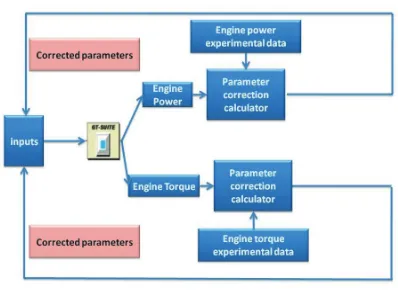
GT-Power is engine simulation software which can model all parts of an internal combustion engine, and can solve all engine equations simultaneously. The software needs hundreds of parameters affecting the performance of the engine as inputs of the functions, using the functions and the parameters the software is able to calculate output of the engine like power, torque, fuel consumption and etc. Some of input parameters are measured or are available in engine catalogue but there are parameters that cannot be measured or exact measurement of the parameters is not practically possible. So a solution should be presented to manage and control unknown parameters to apply the optimization method to the model
In order to couple GT-POWER and Simulink-MATLAB three kinds of objects should be added to GT-POWER namely are: 1. Sensors: These objects send the output parameters from GT-POWER to Simulink, 2. Actuators: these objects send input parameters from Simulink to GT-POWER, 3. Wiring harness: this object controls the data exchange between the two software
In the first step sensors should be linked to engine crank train block of GT-power model to get the measured data of engine torque and power and also connect to injector block of GT-power model in order to get the data of fuel consumption rate. On the other hand actuators should be linked to engine crank train block of GT-power model to be able to give the model the data send by Simulink. Then all sensors and actuators are linked to
f
& H
k i
k i c
j i k
i c
j i k j
P P O P
O X
, , , ,
, ,
1
H
H
"
k i
c j i k j
P O X
, , ,
w w "
Om T &
W
X m O&c P&
!
"XTWXQk:k
''P&Q
:
O O O OP P
S &m &cT &m &c k &T k &
' '
" W Q ȍ
Fig. 1. GT-Power and SIMULINK coupled for model optimization
Downloaded from www.iust.ac.ir at 21:17 IRST on Friday March 3rd 2017
wiring harness, if wiring harness option changes to Simulink mode, the object will be able to contact Simulink and exchange data with it. In the next step GT-POWER block in Simulink library should be brought to Simulink environment, now the two software are coupled and ready to use. Using calculative blocks of Simulink linked to GT-POWER block makes it possible to solve the
engine equation Oc
i,j using GT-POWER and to apply
optimization process to the model using Simulink.
4. FIRST STAGE-PROVIDING BASE MODEL As noted, it is necessary to initially provide a reliable base model based on the experimental data which can model the behavior of the engine. For this purpose, as was mentioned before GT-Power software was used. Software inputs come from various sources. Geometry of the engine cylinder, inlet and exhaust manifold, combustion chamber and engine piston were obtained from maps XU7/L3 engine. Also information of experimental data are based on dynamometer test result of the engine in IPCO laboratory. GT-POWER software only has the ability to solve the problem directly and cannot implement inverse analysis. Thus the direct solution of the model is done by GT-POWER and calculations of the inverse analysis are done by Simulink.
The optimization is based on the output model sensitivity to changes in input parameters. The model output tries to get to the closest values to experimental data. In this study the sensitivity of outputs (power, torque and fuel consumption) with the input and initial conditions was studied and then proper initial values were estimated.
Optimizing all 10 unknown parameters
simultaneously is very time-consuming and its convergence using available facilities is not possible. For this reason sensitivity analysis method was used and an initial screening was performed using studies on changes of the parameters in the neighborhood of the base values. Ultimately among these parameters, the model showed most sensitivity to the first three parameters, inlet port temperature, inlet port pressure and inlet manifold friction. So these three parameters were optimized.
In optimization program for a minimum iteration was defined 10 thousand times. At first single-parameter optimization was performed, and the results were used as first estimation in optimizing the three parameters simultaneously. Minimum accessible mean square error achieved in the optimization was 11.81%. On the other hand minimum accessible mean square error achieved in three parameter optimization was 8.47 %.
1500 2000 2500 3000 3500 4000 4500 5000 5500 6000 80
90 100 110 120 130 140 150
RPM
T
o
rq
u
e
(N
.m
)
Model torque experimental Torque
Fig. 2. camparison of model output torque with experimental torque
1500 2000 2500 3000 3500 4000 4500 5000 5500 6000 20
30 40 50 60 70 80 90 100
RPM
P
o
w
e
r
(h
p
)
experimental power model Power
Fig. 3. camparison of model output power with experimental power
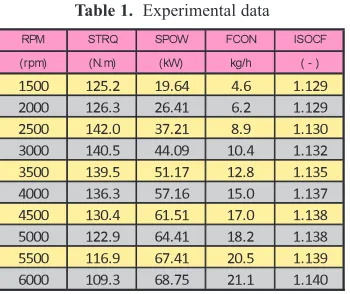
RPM STRQ SPOW FCON ISOCF (rpm) (N.m) (kW) kg/h ( - ) 1500 125.2 19.64 4.6 1.129 2000 126.3 26.41 6.2 1.129 2500 142.0 37.21 8.9 1.130 3000 140.5 44.09 10.4 1.132 3500 139.5 51.17 12.8 1.135 4000 136.3 57.16 15.0 1.137 4500 130.4 61.51 17.0 1.138 5000 122.9 64.41 18.2 1.138 5500 116.9 67.41 20.5 1.139 6000 109.3 68.75 21.1 1.140
Table 1. Experimental data
Downloaded from www.iust.ac.ir at 21:17 IRST on Friday March 3rd 2017
Available experimental data are summarizing in Table (1) [17]. In the table, RPM is engine speed, STRQ is ISO corrected torque factor, SPOW is ISO corrected power, FCON is fuel consumption and ISOCF is ISO correction factor based on ISO1585.
The result of optimization of three input parameters simultaneously is presented in Figures 2-5. In Figure 2 the best achieved result for the optimization of model’s torque with experimental torque is presented. As shown, similar behavior in model output torque and experimental torque is observed. In Figure 3 model and experimental power comparison is presented, as shown, in the lower engine speed the model can provide very good approximations of experimental power but in high engine speeds the model faces with higher error. In Figure 4 fuel consumption calculated by model in comparison with fuel consumption measured in the laboratory is presented, the result shows a very good approximation
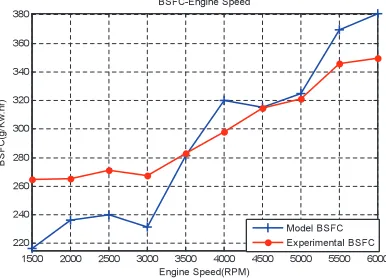
of experimental fuel consumption. In Figure 5 the model BSFC output compared with measured BSFC in experimental data is shown. BSFC is less than experimental data in low engine speeds and more in high engine speeds.
In high engine speed larger errors are observed due to two reasons: optimization is applied in three parameters and other seven unknown parameters are estimated, the estimated parameters impose an error to the model that affect the final error. The other reason is ignoring ram effect and backflow in GT model.
5. VALVE TIMING DETERMINATION
In this part of the study the optimization target is reducing brake specific fuel consumption of the engine by optimizing inlet and exhaust valve timing by using the same coupled GT-POWER and Simulink software.
As presented in Figure 6 input parameters to be optimized are inlet and exhaust valve timing and the target is reducing brake specific fuel consumption. Applying the sensitivity analysis in MATLAB -Simulink the software uses the algorithm mentioned in previous section to find the best valve timing to reaching the target BSFC and uses GT-POWER to solve the direct equation. Before going through complete solution a logical target should be selected. According to previous studies, BSFC reduction using coupled cam phasing is reported to be between 5-10 percent [24]. Thus in this research two targets for the reduction of BSFC will be selected at 5 and 10% respectively.
15004 2000 2500 3000 3500 4000 4500 5000 5500 6000 6
8 10 12 14 16 18 20 22
RPM
F
u
e
l
c
o
n
s
u
m
p
ti
o
n
(
k
g
/h
r)
Model Fuel Consumption Experimental Fuel consumption
Fig. 4. camparison of model output fuel consumption with experimental fuel consumption
1500 2000 2500 3000 3500 4000 4500 5000 5500 6000 220
240 260 280 300 320 340 360 380
Engine Speed(RPM)
B
S
F
C
(g
/K
w
.h
r)
BSFC-Engine Speed
Model BSFC Experimental BSFC
Fig. 5. camparison of model output fuel consumption with experimental fuel consumption
Fig. 6. GT-Power and SIMULINK coupled model for valve timing optimization
Downloaded from www.iust.ac.ir at 21:17 IRST on Friday March 3rd 2017
6. RESULTS
In this part, first a 5% reduction of BSFC will be examined and if the optimization reaches the target, in next stage a 10% reduction will also be considered otherwise the optimization process will be ended.
6.1. A 5% target reduction in BFSC
The results of sensitivity analysis with a 5% reduction target in BSFC are presented in Figures 7-9. In Figure 7 targeted BSFC, BSFC of optimized model with VVT (VVT BSFC) and BSFC of base model (Output BSFC) are compared. BSFC is reduced in most engine speeds but in few engine speeds increment in BSFC can be observed using coupled cam phasing system. The average reduction is about 4.5%. Figure 8 presents torque variations when coupled cam phasing is applied. The results show torque increment in all engine speeds. The average value of increment in engine torque is about 3.5%. The torque diagram in VVT mode is smoother and torque increments in low engine speeds are considerable. In Figure 9, power increments are observed in all engine
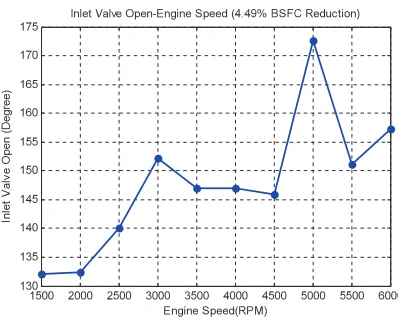
speeds and the average amount of increment is about 3%. The results of determination of valve timing using sensitivity analysis with 5% reduction target in BSFC are presented in Figures 10 and 11.
The inlet valve open advance is useful in all engine
B
S
F
C
(g
/K
w
.h
r)
1500 2000 2500 3000 3500 4000 4500 5000 5500 6000 200
220 240 260 280 300 320 340 360 380
VVT BSFC Output BSFC BSFC Target
Fig. 7. BSFC vs engine speed
Engine Speed BSFC Reduction(%)
1500 0.45%
2000 3.58%
2500 7.39%
3000 3.12%
3500 2.31%
4000 6.24%
4500 3.71%
5000 5.36%
5500 6.69%
6000 6.06%
Average Reduction 4.49%
Table 2. Percent of reduction in BSFC in different engine speeds
1500 2000 2500 3000 3500 4000 4500 5000 5500 6000
80 90 100 110 120 130 140 150
Engine Speed(RPM)
T
o
rq
u
e
(N
.m
)
Torque-Engine Speed
Output Torque vvt Torque
Fig. 8. Torque vs Engine speed Diagram
1500 2000 2500 3000 3500 4000 4500 5000 5500 6000 30
35 40 45 50 55 60 65 70 75 80
Engine Speed(RPM)
P
o
w
e
r(
h
p
)
Power-Engine Speed
Output Power VVT Power
Fig. 9. Power vs Engine speed Diagram
1500 2000 2500 3000 3500 4000 4500 5000 5500 6000 130
135 140 145 150 155 160 165 170 175
Engine Speed(RPM)
In
le
t
V
a
lv
e
O
p
e
n
(
D
e
g
re
e
)
Inlet Valve Open-Engine Speed (4.49% BSFC Reduction)
Fig. 10. Inlet valve timing vs Engine speed Diagram
Downloaded from www.iust.ac.ir at 21:17 IRST on Friday March 3rd 2017
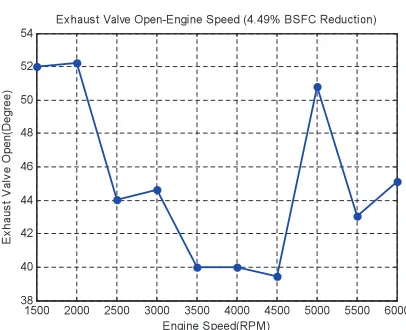
speed but exhaust valve open advance is useful only in high engine speeds. This result is in agreement with theoretical and experimental data [25]. The achieved fuel consumption reduction values in every engine speed using coupled cam phasing is summarized in Table 2.
6. 2. A 10% target reduction in BSFC
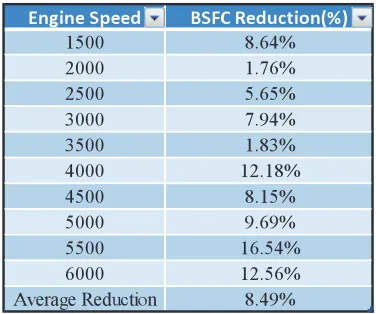
All results presented for the 5% target reduction in BSFC are again obtained for a 10% target and are presented in Figures 12-14 for BSFC, torque and power respectively. This time the average reductions are about 8.49%, 3% and 2.44% for the BSFC, torque and power. The unprecedented result is having less increment in torque comparing to the 5% target reduction in BSFC. The reason is losing engine performance in expense of a better fuel efficiency.
Valve timing diagrams presented in Figures 15 and 16 shows that the inlet valve timing advance leads to enhancement in engine performance approximately in all engine speeds, but exhaust valve timing advance 1500 2000 2500 3000 3500 4000 4500 5000 5500 6000
38 40 42 44 46 48 50 52 54
Exhaust Valve Open-Engine Speed (4.49% BSFC Reduction)
Engine Speed(RPM)
E
x
h
a
u
s
t
V
a
lv
e
O
p
e
n
(D
e
g
re
e
)
Fig. 11. Exhaust valve timing vs Engine speed Diagram
1500 2000 2500 3000 3500 4000 4500 5000 5500 6000 150
200 250 300 350 400
Engine Speed(RPM)
B
S
F
C
(g
/K
w
.h
r)
BSFC-Engine Speed
VVT BSFC Model BSFC Target BSFC
Fig. 12. BSFC-Engine speed Diagram
1500 2000 2500 3000 3500 4000 4500 5000 5500 6000 30
35 40 45 50 55 60 65 70 75
Engine Speed(RPM)
P
o
w
e
r(
h
p
)
Power-Engine Speed
Model Power VVT Power
Fig. 14. Power vs Engine speed Diagram
1500 2000 2500 3000 3500 4000 4500 5000 5500 6000
80 90 100 110 120 130 140 150
Engine Speed (RPM)
T
o
rq
u
e
(N
.m
)
Torque-Engine Speed
model Torque VVT Torque
Fig. 13. Torque vs Engine speed Diagram
1500 2000 2500 3000 3500 4000 4500 5000 5500 6000 150
200 250 300 350 400
Engine Speed(RPM)
B
S
F
C
(g
/K
w
.h
r)
BSFC-Engine Speed
VVT BSFC Model BSFC Target BSFC
Fig. 15. Inlet valve timing vs Engine speed Diagram
Downloaded from www.iust.ac.ir at 21:17 IRST on Friday March 3rd 2017
enhancement will be considerable in mid to rather high engine speeds, as again in agreement with theoretical and experimental data [25]. The achieved fuel consumption reductions are summarized in Table 3. The average value is 8.5% that is almost twice that of the 5% target.
7. CONCLUSION
In this research the main aim was to find a way to estimate the unknown and immeasurable parameters of an internal combustion engine in order to find the optimum model, and also to find control parameters like valve timing and spark timing to enhance the performance measures (e.g. power, torque and fuel consumption). Results of this study establish a framework for calibration and determining the optimal
input parameters for an engine modeling and optimization.
The solution presented in this study uses a sensitivity analysis that varies the input parameters according to amount of output sensitivity to input parameters in order to find the best values for the input parameters.
The XU7/L3 engine was modeled in GT-Power software and known boundary and initial conditions were used and the model was optimized by using a sensitivity analysis to have least errors with experimental data by changing unknown parameters and finding the best unknown parameters that estimates the engine.
Then the GT-Power model was coupled with MATLAB/Simulink which results in a two part model. The first part was Simulink and managed the input/output parameters and the second part was GT-Power that calculated engine output according to the inputs.
Then sensitivity analysis was programmed in Simulink and optimization was implemented to find the inlet port temperature, pressure and inlet manifold friction coefficient to minimize the error between models calculated and experimental measured power and torque.
In the next stage the same coupled software was used to optimize the exhaust valve timing in order to achieve a 5 and a 10% BSFC reduction. For a 5% target an average of 4.5% reduction was accompanied simultaneously with a 3.4% increment in torque and a 2.9% increment in power. For a 10% reduction in BSFC the results are 8.49% reduction for BSFC together with a 3% increment in torque and a 2.44% increment in power.
In addition to above mentioned enhancement in engine performance the torque diagram in VVT mode became smoother and torque increments in low engine speeds was considerable.
One of the most important achievements of this study is determination of the effect of using variable valve timing in XU7/L3 engine fuel consumption reduction.
The fact that implementation of coupled cam phasing on the engine doesn’t need any change in cylinder and cylinder head production line and only needs little change in camshaft machining lines to add cam phaser, reveals the importance of this study.
1500 2000 2500 3000 3500 4000 4500 5000 5500 6000
38 40 42 44 46 48 50 52
Engine Speed(RPm
E
x
h
a
u
s
t
V
a
lv
e
O
p
e
n
(D
e
g
re
e
)
Exhaust Valve Open-Engine Speed (8.49% BSFC Reduction)
Fig. 16. Exhaust valve timing vs Engine speed Diagram
Engine Speed BSFC Reduction(%)
1500 8.64%
2000 1.76%
2500 5.65%
3000 7.94%
3500 1.83%
4000 12.18%
4500 8.15%
5000 9.69%
5500 16.54%
6000 12.56%
Average Reduction 8.49%
Table 3.Percent of reduction in BSFC in different engine speeds
Downloaded from www.iust.ac.ir at 21:17 IRST on Friday March 3rd 2017
REFERENCES
[1] Snell, J B., "Mechanical Engineering:
Railways", Longman & Co, London, 1971
[2] VALVE-ACTUATING MECHANISM FOR
AN INTERNAL COMBUSTION ENGINE, United States Patent 3641988 ,1960
[3] http://world.honda.com/automobile-technology
/ VTEC/
[4] http://media.ford.com/article_display.cfm
article_id=31280
[5] http://www.freepatentsonline.com/
3641988.html
[6] Ronald J Pierik and James F Burkhard "Design
and Development of a Mechanical Variable Valve System”, Variable valve actuation, SAE Technical paper 2000-01-1221
[7] Stanislav V.Bohac and Denis N. Assanis "Effect
of Exhaust valve Timing on Gasoline engine Performance and Hydrocarbon Emissions" , SI engine Performance and Additives, Gasoline engine cold start, SAE international Conference Tampa Florida USA,2004
[8] Bin Wu, Prucka R. G., Filipi Z. S., Kramer D.
M., Ohl G. L., "Cam-Phasing Optimization Using Artificial Neural Network Surrogate Model- Maximizing output Torque "Variable Valve Timing, SAE Paper 2005-01-3757, 2005
[9] Sellnau M., Kunz T., Sinnamon J. and Burkhard
J. "2-step Variable Valve Actuation: System Optimization and Integration on an SI Engine" SAE World Congress Detroit Michigan April 3-6 2003-6 ,2003-6-01-0040
[10] Leroy T., Chauvin J. and Petit N., "Motion planning for experimental air path control of a variable-valve-timing spark ignition engine " Control Enginering Practice , , Elsevier journal, 2008
[11] Fontana G. and Galloni E., "Variable valve
timing for fuel economy improvement in a small spark-ignition engine" ,Applied Energy, Elsevier journal, 2009
[12] Flierl, R. (2000). The third generation of valve trains-new fully variable valve trains for throttle-free load control. SAE Paper, 2000-01-1227
[13] Kleuter, B., Menzel, A., Steinmann, P., Generalized parameter identification for finite
viscoelasticity, International Journal of
Plasticity 20 (2004) 1403–1440
[14] Alonge, F., D'Ippolito, F ., Raimondi, F.M., , Least squares and genetic algorithms for parameter identification of induction motors, Control Engineering Practice 9 (2001) 647}657 [15] Nyarko, E.K., Scitovski, R., Solving the
parameter identification problem of
mathematical models using genetic algorithms, Applied Mathematics and Computation 153 (2004) 651–658.
[16] Ponthot, J.-P., Kleinermann, J.-P., A cascade
optimization methodology for automatic
parameter identification and shape/process optimization in metal forming simulation, Comput. Methods Appl. Mech. Engrg. 195 (2006) 5472–5508
[17] Beck, J.V., Nonlinear Estimation Applied to the Nonlinear Heat Conduction Problem, Int. J. Heat & Mass Transfer, Vol. 13, pp.703-716, 1970
[18] Iran standard and industrial research
administration “national fuel consumption standard and fuel label for gasoline engine” national standard no 4241-2 first edition, 2007 [19] Beck, J.V., Blackwell, B., St. Clair, C.R., Jr.,
Inverse Heat Conduction: Ill-posed Problems, John Wiley Pub.1985
[20] Levenberg, K.A., A Method for the Solution of Certain Non-Linear Problems in Least Squares, Q. Appl. Math., Vol. 2, pp. 164-168, 1944 [21] Bledsoe, K.C., Favorite, J.A., Aldemir, T., A
comparison of the Covariance Matrix
Adaptation Evolution Strategy and the
Levenberg–Marquardt method for solving multidimensional inverse transport problems, Annals of Nuclear Energy 38 (2011) 897–904 [22] Kakaee, A.H Moving Surface Temperature
Identification With Inverse Analysis, PHD thesis, Sharif University of Technology, May 2003 (In Farsi).
[23] Mohamad Ebrahim a. “Samand XU7/L3 engine manifold modeling and optimization”, MSc thesis Iran University of Science and Technology, November 2007
[24] United States Environmental And Pollution Agency "Draft Regulatory Impact Analysis Proposed Rulemaking to Establish Light-Duty Vehicle Greenhouse Gas Emission Standards
and Corporate Average Fuel Economy
Downloaded from www.iust.ac.ir at 21:17 IRST on Friday March 3rd 2017
Standar`ds" , EPA-420-D-09-003,September 2009
[25] Pierik R. J. and Burkhard J. F. "Design and Development of a Mechanical Variable Valve System" , Variable valve actuation, SAE Technical paper 2000-01-1221
NOMENCLATURE
Oc
i,j jthmodel output in each ith engine speed
Om
i,j The measured value of the same output in ith
engine speed
W : Weighting matrix
Oc
i,j :i function of un known parameters
Pi,k : Unknown parameters
: Mapping of unknown parameters :weighting matrix,
: regulation coefficient so equation
Q
:
c
O&
Downloaded from www.iust.ac.ir at 21:17 IRST on Friday March 3rd 2017